
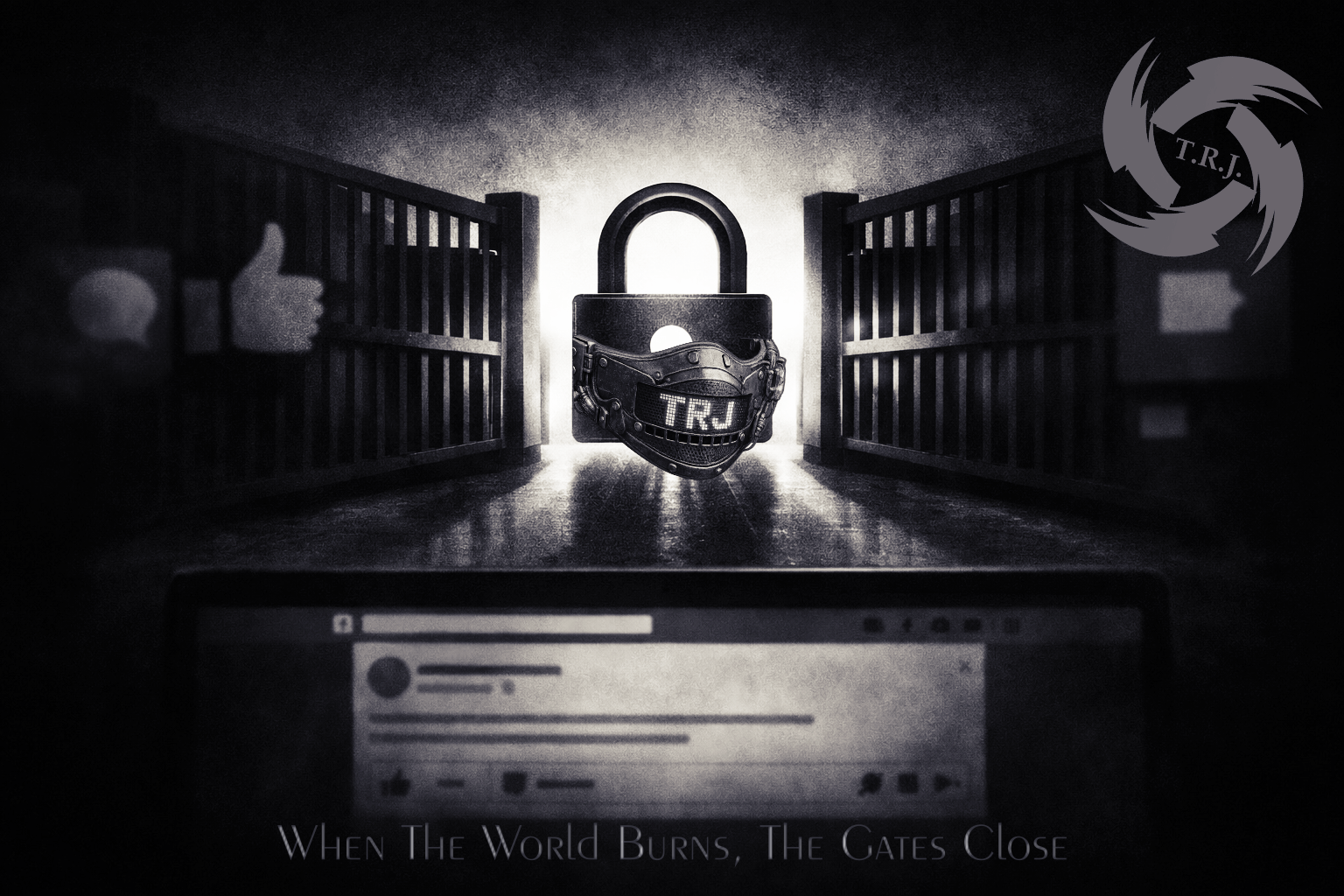
How silent throttling and platform gatekeeping are quietly choking independent journalism
There is a pattern that has become impossible to ignore, and at this stage pretending it is accidental no longer survives even minimal scrutiny. When this pattern is pointed out, the response from some observers is predictable: that raising these concerns amounts to complaining, that attention should be focused elsewhere, or that increased visibility on the open web should be considered sufficient.
That argument misunderstands how the modern information economy actually functions.
Being visible on the open web does not translate into sustainability. It does not generate sales on its own. It does not secure sponsorships, fund investigations, or keep independent operations alive. It merely means the work exists in a vast digital landscape where discoverability is largely dictated by forces outside the publisher’s control. Presence is not viability.
The reality is that the dominant marketplace for attention, engagement, and revenue no longer resides on the open web alone. It resides on social platforms. These platforms are where audiences congregate, where discovery happens at scale, where conversations form, and where independent publishers either reach critical mass or disappear into obscurity. Being “seen” without access to those distribution channels is functionally equivalent to being invisible when it comes to economic survival.
So the question is not why these issues are raised so persistently. The question is why they should not be. When the primary pathways to audience reach and financial sustainability are controlled by a handful of private platforms, and when access to those pathways is quietly restricted during moments that matter most, remaining silent is not prudence. It is surrender.
Raising these concerns is not about entitlement or grievance. It is about confronting the structural reality that independent work now operates under. A system that allows content to exist but prevents it from circulating is not neutral. It is selective. And when that selectivity determines whether work can sustain itself financially, speaking about it is not excessive—it is necessary.
Silence does not fix structural suppression. Visibility without viability is not success. And acknowledging that reality is not complaining. It is refusing to pretend that exposure alone keeps independent journalism alive.
Some have asked whether there is fear of retaliation—whether publishing articles that scrutinize major platforms, their practices, or the conduct of their owners invites lawsuits meant to intimidate or silence. The answer is no.
You do not sue someone for telling the truth. And you do not successfully sue someone for documenting facts that are already on the public record.
Litigation is not a magic eraser. It does not make documented actions disappear. It does not rewrite filings, statements, policies, financial disclosures, or platform behavior that can be independently verified. Courts are not instruments for burying truth; they are forums where claims must withstand evidence, record, and scrutiny. When reporting is factual, sourced, and grounded in observable reality, the threat of legal action loses its power.
The assumption behind that question—that truth should be feared when it challenges powerful entities—reveals how distorted the environment has become. Fear only applies when deception is involved, when facts are fabricated, or when claims cannot survive examination. None of that applies here. The material published is based on documented conduct, visible outcomes, and verifiable patterns. Much of it originates from the companies themselves, through their own policies, systems, and actions.
There is also a fundamental misunderstanding about who lawsuits are meant to protect. Defamation law exists to address false statements that cause harm, not to shield corporations from accountability or criticism. Reporting on behavior, structure, and consequence—especially when supported by evidence—is not defamation. It is journalism.
If the act of telling the truth becomes grounds for punishment, then the legal system itself has failed its purpose. But that is not the standard, and it has never been the standard. The record matters. Facts matter. And when the truth is already documented, attempting to suppress it through legal intimidation only reinforces the very concerns being raised.
Fear thrives in silence. Transparency thrives in daylight. This work operates in the open, on the record, and grounded in verifiable reality. That is not recklessness. It is credibility.
We don’t fear them. They fear us. That is why they try to silence us — The Realist Juggernaut.
When serious events unfold in the world—geopolitical escalation, national security failures, large-scale cyber incidents, institutional corruption, regulatory collapse, or moments that demand sustained, uncomfortable analysis—the distribution gate for The Realist Juggernaut does not merely narrow. It constricts. It hardens. It closes. And it tightens further the moment that censorship is exposed.
What surfaces in those moments is not a single malfunction or a scattered collection of technical hiccups. It presents as a recurring sequence of breakdowns that align too closely with relevance to be dismissed. Articles stall during submission. Posts that should publish cleanly instead fail without warning. Links that function normally elsewhere return errors when shared. Previews either render incorrectly or disappear altogether. Reach declines sharply and without notice. Visibility collapses so thoroughly that content effectively ceases to exist beyond the originating site.
And when this happens, the burden does not fall on the platforms creating the disruption. It falls on us. We are left to diagnose, troubleshoot, and repair problems we did not cause. We maintain a dedicated team solely to deal with these failures—time, labor, and resources spent fixing damage imposed from the outside, at significant and ongoing cost.
These failures do not appear in isolation, and they do not occur at random intervals. They surface together, cluster around moments of consequence, and resolve only after the window of impact has passed. The timing is too consistent to dismiss. The repetition is too precise to ignore. This does not happen once or twice. It happens repeatedly, predictably, and across platforms that publicly insist they operate independently of one another.
This has not been occurring for weeks or months. It has been unfolding for years. Long enough to establish pattern. Long enough to eliminate coincidence. Long enough that any claim of randomness collapses under the accumulated record. When the same disruptions reappear under the same conditions year after year, chance is no longer a credible explanation.
This is not speculation. It is not theoretical modeling. It is lived operational reality.
That reality carries direct financial consequence. Each disruption compounds. Each moment of throttled visibility erodes revenue, interrupts momentum, and undermines sustainability. The cost is not abstract. It is measurable. It shows up in stalled projects, lost sales, sponsorship conversations that never reach negotiation, and work that never reaches the audience it was built to serve. The impact has reached a point where the survival of the company itself is no longer a distant concern, but an active and ongoing risk.
Nothing on our end explains this pattern. Publishing behavior has remained consistent. Cadence has not shifted. Infrastructure functions as designed. Servers remain stable. The site remains live. The archive remains intact. The reporting remains original, factual, and publicly accessible across the open internet.
The work exists. The site is live.
The material is available.
What changes—again and again—is not the content, but the willingness of platforms to allow it to move.
This is not moderation in any honest sense of the word. Moderation implies standards, enforcement, explanation, and appeal. What occurs instead is suppression by friction. Delay replaces denial. Silence replaces justification. Access is throttled quietly, invisibly, and without traceable decision points. There is no notice, no warning, no policy citation, and no accountable human contact.
It leaves no paper trail. It produces no record.
It offers no recourse.
Functionally, the outcome is identical to censorship—just easier to deny and far harder to challenge. We have tried to find legal representation willing to confront these companies, and the response has been consistent. Because our company is small, most are unwilling to take the risk. More than one has been blunt about it: we do not have the money to keep up.
And they are right. We are not billionaires. We do not have endless legal budgets or teams of corporate attorneys on retainer. That imbalance is not incidental—it is part of how this system protects itself. When the cost of accountability is pushed deliberately out of reach, silence becomes the default outcome, not because the case lacks merit, but because power has priced resistance out of existence.
We have downloaded our data multiple times. We have proof that we are being suppressed—shadow banning, whatever term is applied. The bottom line is simple: the proof exists.
Our company can barely keep $1,000 in its account. Let that sink in—because we already have.
Individual failures are dismissed as temporary outages. Broken links are blamed on bugs. Collapsing reach is attributed to opaque algorithmic shifts. Each incident, taken alone, is framed as inconsequential. But when those incidents cluster precisely around moments that matter—when they occur across multiple platforms at the same time and repeat year after year—the explanation collapses under its own weight.
This is not sustainable.
We have contacted these companies repeatedly. Directly. Through formal channels. Through support systems, reporting tools, appeals, and escalation paths. We have documented incidents. We have submitted evidence. We have followed every process made available. We have waited weeks, months, and in some cases indefinitely.
The outcome is always the same. No response. No explanation. No resolution.
In one recent case, an article submitted to Tumblr remains indefinitely “under review.” Not rejected. Not approved. Frozen in administrative limbo without timeline or communication. Delay replaces accountability. Silence replaces decision. The effect is functionally identical to suppression, just sanitized enough to be defensible.
This is how control works now. Not through force, but through neglect.
Platforms like Meta (Facebook), X, Medium, Reddit, Bluesky, Tumblr, Gettr, and Amazon are not neutral infrastructure. They are commercial entities that control the primary distribution channels of modern communication. Without them, independent publishers do not merely lose convenience. We lose viability.
The work is live. The reporting exists. The archive is accessible. But in the modern media environment, discoverability without social distribution is insufficient. Social platforms determine whether work is seen, shared, discussed, monetized, or ignored. They determine whether audiences are reached, whether sponsors engage, whether books move, whether music surfaces, and whether independent operations can sustain themselves at all.
When those gates narrow—even subtly—the damage is immediate and compounding.
Revenue drops.
Projects stall.
Books and Music stop moving.
Books and Music disappears from visibility.
Sponsors disengage before conversations begin.
Staff time is consumed by damage control rather than creation.
Not because the work lacks value.
Not because it is false.
Because the work does not align with mass social-media behavior, those companies—already wealthy and insulated—restrict our reach. They do not want us seen. Period.
This is not about ego, vanity metrics, or chasing reach for its own sake. It is about survival. The work produced here is built around care—for people, for accuracy, for consequence. It exists to inform, to warn, and to confront realities that others prefer to smooth over or ignore entirely.
But care does not pay hosting bills.
Care does not fund investigations.
Care does not sustain a company when distribution is quietly strangled.
Without income, there is no platform.
Without a platform, the work ends.
The irony is impossible to miss. The same corporations exerting this control are among the wealthiest institutions on the planet. They were built on the labor, content, and engagement of independent creators—including us. When that work challenges narratives, exposes structural failures, reveals what is not being told, or refuses to flatten reality into algorithm-friendly shapes, access narrows.
Not through bans. Not through warnings.
But through invisibility.
This is not a free marketplace of ideas. It is a managed ecosystem where economic pressure replaces overt censorship and silence becomes policy. Voices are not removed. They are starved.
There are larger projects ahead. Deeper investigations. Work that could genuinely help people on a scale that matters. But at the current rate, those projects may never exist. Not because of lack of vision or capability, but because the economic foundation required to sustain them is being eroded before growth is even possible.
By the time these platforms finish delaying, throttling, and ignoring independent publishers, there may be nothing left to scale. That is not a flaw in the system. That is the system functioning as designed.
Free speech does not vanish overnight. It erodes quietly, economically, and selectively. It dies when independent voices can no longer afford to continue. It dies when distribution is controlled by entities that answer to no one and explain nothing.
In a world already saturated with deception, suppressing independent analysis is not neutral. It is dangerous. When platforms quietly decide who may speak during moments that matter most, what remains is not truth. It is convenience. It is alignment. It is safety for power.
This is not a plea. It is not a campaign. It is definitely not a performance.
It is a record.
We have attempted resolution. We have reached out. We have waited. We have adapted. We have absorbed the cost—financially and professionally. But silence is not resolution. Delay is not fairness. And suppression by neglect is still suppression.
If independent work cannot survive in the modern public square, then the square itself is already compromised.
And when that happens, free speech is not under threat.
It is already gone.
The censorship needs to stop. Our livelihood depends on it. Views and page visits matter. We are deeply grateful to those who are here every day—reading, sharing, and supporting this work, both above ground and in the underground worlds. We see you, and we sincerely thank you.
We do not engage in complaint for its own sake. But this is frustrating. Time and again, we have demonstrated that this platform operates with transparency, neutrality, and a commitment to factual accuracy. That standard is not performative—it is structural. And it is precisely why pressure is applied. Platforms that refuse alignment, refuse simplification, and refuse narrative compliance become inconvenient.
If independent, unbiased work like this disappears, what replaces it will not be better—it will be acceptable. Not truthful, not rigorous, not challenging. Just good enough to pass, good enough to scroll past, good enough to get by. That is the direction everything moves when accountability is filtered out and friction is rewarded.
We are still here because we refuse that outcome. But the pattern is clear: once platforms that value truth over conformity are gone, the public is left negotiating with “good enough” as a permanent standard.
We will continue doing our best to keep this going. For how long, we do not know. The reality is disgusting.


🔥 NOW AVAILABLE! 🔥
🔥 NOW AVAILABLE! 🔥
📖 INK & FIRE: BOOK 1 📖
A bold and unapologetic collection of poetry that ignites the soul. Ink & Fire dives deep into raw emotions, truth, and the human experience—unfiltered and untamed
🔥 Kindle Edition 👉 https://a.co/d/9EoGKzh
🔥 Paperback 👉 https://a.co/d/9EoGKzh
🔥 Hardcover Edition 👉 https://a.co/d/0ITmDIB
🔥 NOW AVAILABLE! 🔥
📖 INK & FIRE: BOOK 2 📖
A bold and unapologetic collection of poetry that ignites the soul. Ink & Fire dives deep into raw emotions, truth, and the human experience—unfiltered and untamed just like the first one.
🔥 Kindle Edition 👉 https://a.co/d/1xlx7J2
🔥 Paperback 👉 https://a.co/d/a7vFHN6
🔥 Hardcover Edition 👉 https://a.co/d/efhu1ON
Get your copy today and experience poetry like never before. #InkAndFire #PoetryUnleashed #FuelTheFire
🚨 NOW AVAILABLE! 🚨
📖 THE INEVITABLE: THE DAWN OF A NEW ERA 📖
A powerful, eye-opening read that challenges the status quo and explores the future unfolding before us. Dive into a journey of truth, change, and the forces shaping our world.
🔥 Kindle Edition 👉 https://a.co/d/0FzX6MH
🔥 Paperback 👉 https://a.co/d/2IsxLof
🔥 Hardcover Edition 👉 https://a.co/d/bz01raP
Get your copy today and be part of the new era. #TheInevitable #TruthUnveiled #NewEra
🚀 NOW AVAILABLE! 🚀
📖 THE FORGOTTEN OUTPOST 📖
The Cold War Moon Base They Swore Never Existed
What if the moon landing was just the cover story?
Dive into the boldest investigation The Realist Juggernaut has ever published—featuring declassified files, ghost missions, whistleblower testimony, and black-budget secrets buried in lunar dust.
🔥 Kindle Edition 👉 https://a.co/d/2Mu03Iu
🛸 Paperback Coming Soon
Discover the base they never wanted you to find. TheForgottenOutpost #RealistJuggernaut #MoonBaseTruth #ColdWarSecrets #Declassified


Sponsored • TRJ Ads
Inquiries: contact@therealistjuggernaut.com





