
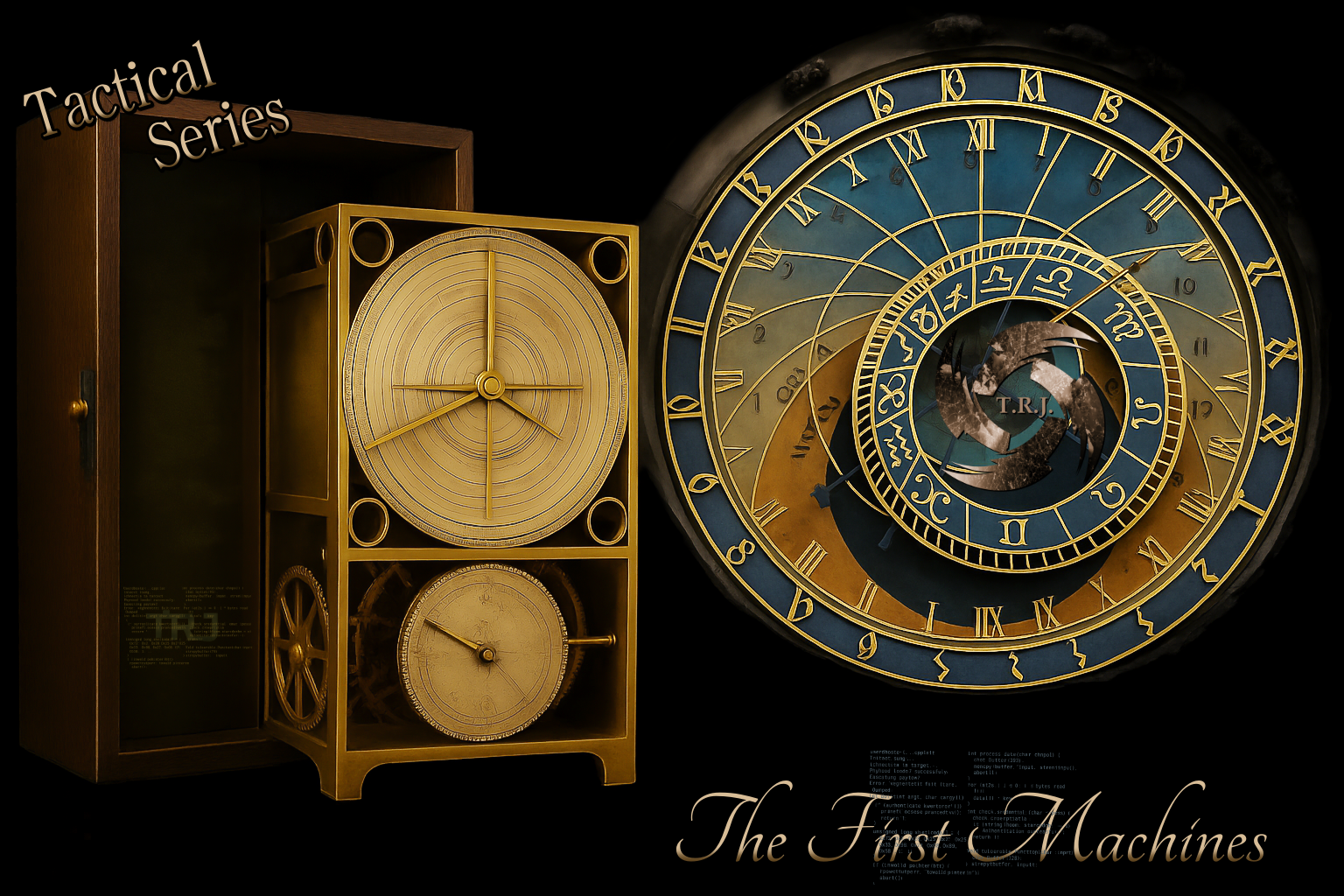
THE MACHINE AGE THAT CAME BEFORE
Long before the term “computer” entered our language — centuries before modern processors hummed beneath glass and copper — human civilizations were already reaching for the code of the cosmos. Not with transistors or electricity, but with bronze gears, celestial charts, and obsessive precision.
Two artifacts remain as eerie echoes of that era. One, discovered in the depths of the Aegean Sea. The other, perched on a medieval tower in the heart of Prague. Both are machines. Both are time-keepers. And both, in their own way, are computers. Not theoretical. Not symbolic. Mechanical computers — built before the world even understood what a computer was.
The first, the Antikythera Mechanism, was engineered in ancient Greece around 100 BCE. What looks like a corroded fragment of metal was once a multi-geared device capable of predicting eclipses, planetary positions, and lunar phases with staggering accuracy. It modeled astronomical cycles down to the minute, compressing centuries of knowledge into a single, handheld system of dials and teeth. Nothing like it would appear again for over a thousand years.
The second, the Prague Astronomical Clock, was installed in 1410 — a towering machine that doesn’t just keep time, but layers it. Solar time, sidereal time, lunar motion, zodiac phases, and religious feast days all rotate in sync on a façade of gilded precision. It doesn’t just tell you the hour. It tells you where you are — cosmically.
Together, these artifacts shatter the illusion that advanced computation is a modern achievement. They remind us that before silicon, there was brass. Before programming languages, there was mechanism. Before digital logic, there was design. They weren’t prototypes. They were mastery — just in a different form. And they raise a question history still can’t answer: What else was built… and never found?
THE ANTIKYTHERA MECHANISM: THE COMPUTER THAT SUNK WITH EMPIRES
It wasn’t pulled from a vault or preserved in a museum. It was dredged from a shipwreck — rusted, silent, and almost erased.
In 1901, sponge divers near the Greek island of Antikythera were searching for statues. Instead, they found a corroded mass of bronze and decayed wood — unremarkable at first glance, but hiding one of the most advanced machines of the ancient world.
Once examined, its components revealed a startling level of precision. This wasn’t debris. It was a mechanism — calculated, deliberate, and mechanically intelligent. Not a clock. Not a compass.
A computer — the first of its kind.
Dating to around 150–100 BCE, the Antikythera Mechanism is now considered the world’s oldest known analog computing device. Inside were more than 30 interlocking gears, finely machined and organized to model the movement of celestial bodies with stunning accuracy. It predicted eclipses with precision.
It tracked the positions of the Moon and Sun. It accounted for the Metonic cycle, the Saros cycle, and even the irregular orbit of the Moon using a mechanical differential gear — a concept that wouldn’t appear again for over a thousand years.
Key Functions:
- Solar and lunar alignment tracking
- Eclipse prediction down to the hour
- Modeling of astronomical cycles including Metonic and Saros
- Olympiad tracking — hinting at use for ancient Greek games
- Inscriptions detailing astronomical and calendrical data — over 2,000 characters
But what makes it more than an ancient artifact is what’s missing.
No records of how it was built. No writings explaining its design. No other machines like it from the same era. It appeared fully formed, then vanished. And for two millennia, the world forgot it ever existed.
That silence speaks louder than its gears. It suggests a depth of knowledge that either collapsed with its civilization — or was intentionally buried. The Antikythera Mechanism isn’t a myth. It isn’t a theory. It’s technology. And it ran not on power, but on an understanding of the universe we’re only beginning to rediscover.
THE PRAGUE ASTRONOMICAL CLOCK: THE MIDNIGHT CALCULATOR OF EMPIRES
While the Antikythera Mechanism vanished beneath the salt and pressure of the Aegean depths, another machine emerged into the open air of empire — not hidden, but exalted. Not buried, but mounted high on a tower where time itself could be watched unfold.
In 1410, within the walled cities of Bohemia, a mechanism known as the Prague Orloj was installed into the southern face of the Old Town Hall. What the crowds saw was a clock. What they didn’t realize was that it was far more — a celestial data processor disguised as medieval art.
Built at the convergence of Gothic architecture, Ptolemaic astronomy, and European religious timekeeping, the Orloj doesn’t just tell you when you are — it tells you what you are in relation to the cosmos.
Its face is a map of layered realities. Three types of time — Old Bohemian, Babylonian, and the modern 24-hour system — rotate simultaneously across the dial, each calibrated to solar angles and seasonal shifts. The zodiacal ring glides in tandem with the ecliptic, calculating constellational positions with the same elegance that once guided kings, popes, and navigators.
What It Calculates:
- Civil and canonical time (across multiple overlapping calendar systems)
- Phases and orbital location of the Moon
- Apparent movement of the Sun along the ecliptic
- Zodiac constellations and sidereal alignment
- Solar zenith points — including solstices and equinoxes
- Astrological “golden hours” and feast day alignments
But its function goes beyond mathematics. The Orloj was designed to capture belief — to link time to meaning. Skeletons ringing bells, apostles passing in stately motion, the rising and setting of heavenly bodies rendered in gearwork too precise for the age.
It is a cosmograph — a medieval universe condensed into brass, wood, and stone. It encodes a worldview in motion. Not just a map of time, but a theological mechanism, syncing human ritual with celestial rhythm. The very structure of faith, monarchy, and mortality was etched into its programming.
The Orloj remains one of the oldest continuously operating astronomical clocks in the world. More than six centuries after its creation, it still calculates the heavens with chilling accuracy — a machine older than most nations, surviving revolutions, occupations, and wars. And it still ticks. Not because someone programmed it to. Because someone believed it had to.
TWO MACHINES. ONE THREAD OF INTELLIGENCE.
They were born in different centuries, built by different cultures, and shaped by different philosophies. One was hidden in a shipwreck, the other mounted on a civic cathedral. But when you strip away time and geography, something extraordinary becomes clear: These machines are not distant cousins. They are siblings — born of the same ambition.
To translate the universe.
One mechanical, one monumental. One submerged in silence, the other ringing out from a tower. And yet, both of them reach for the same goal — to impose order on the chaos, to track what cannot be held, and to simulate reality in brass and bronze before humanity even had the words for such a thing. These aren’t just clocks. They’re frameworks.
A Single Thread: The Will to Calculate
What binds them is not just ingenuity, but intention. These devices were never meant to be mere decorations or marvels of craftsmanship. They were machines of knowing — designed to compute the divine, to simulate planetary alignment, to predict phases and cycles that determined the rhythms of kings and peasants alike.
In a sense, they are primitive analogs of what we now call artificial intelligence — not in the modern, sentient sense, but in the purest form of the phrase: a machine built to simulate intelligent awareness of time, space, and causality. They didn’t think, but they calculated. They didn’t speak, but they encoded the stars. They didn’t respond, but they revealed things.
They were humanity’s first efforts to embed cognition into matter. Not silicon and code — but wheel and ratio. A gear rotated, and with it turned a piece of the heavens, scaled down to human terms. These were not just technologies. They were statements. They declared, across millennia: We are not passive beneath the sky. We are its interpreters.
Even now, in our digital age of predictive algorithms and quantum computation, these machines remain relevant. Because they remind us of something easily forgotten: intelligence doesn’t begin with consciousness — it begins with comprehension. And these ancient devices? They comprehended deeply. They took the infinite — and made it visible. They took the divine — and made it mechanical.
They took time itself — and dared to model it.
So let that settle in: Our ancestors weren’t waiting for the information age.
They were forging it, gear by gear, sky by sky.
THE THIRD RELIC: THE CLOCK THAT DREAMED IN GEARS
This machine isn’t as ancient as the Antikythera Mechanism, nor as globally recognized as the Prague Orloj. But in the hierarchy of human computation — it deserves a pedestal just as high. Crafted in the 14th century by Italian physician and scholar Giovanni de Dondi, this astronomical clock — known as the Astrarium — was not conceived for decoration, ceremony, or spectacle. It was born from an obsession: to master time not through myth, but through motion.
Standing like a cathedral in miniature, its geometry speaks a lost dialect — one etched not in ink, but in ratios, torque, and celestial reference points. Each gear was a question. Each rotation, an answer. This was not an ornament of empire — it was a planetary reckoner, hand-forged to track the divine machinery of the cosmos.
Its core purpose: to simulate the heavens with mechanical purity. The phases of the Moon. The transit of stars. The motion of the Sun through its annual path. This was no mere clock. It was a gravitational dialogue machine — a mechanical priest that kept vigil over cycles humans could barely name. At a time when most of Europe still feared eclipses and comets as omens, this relic knew better. It didn’t just tell the hour — it whispered the architecture of eternity.
De Dondi’s Astrarium, completed between 1348 and 1364, is often considered the first fully documented planetarium clock. Though the original was lost, detailed manuscripts allowed modern horologists to reconstruct it — revealing a machine with 107 gears, simulating the movements of the seven known celestial bodies of the time: the Moon, Mercury, Venus, the Sun, Mars, Jupiter, and Saturn.
And yet, like so many marvels, it was nearly lost to history. For centuries it sat uncelebrated, misunderstood, mistaken as an old curiosity. But now, fully restored, its design is seen for what it truly is: a mechanical manuscript, authored by hands that understood the cosmos through metallurgy and motion. This is not digital. It is analog transcendence. The intelligence of a world before electricity, captured in brass and gear teeth. Now photographed in sharp clarity, this third relic is no longer silent.
It joins the continuum of intelligence — not artificial, not synthetic, but unmistakably real. A mind made of metal. A question made clockwork. And a reminder that before we coded in bits and bytes, we dreamed in gears.
WHY THIS STILL MATTERS
In an era ruled by invisible algorithms, serverless networks, and predictive logic masked as artificial intelligence, we’re trained to believe that computation began with silicon. That before electricity, there was nothing but myth and mechanism. That the digital age marked the birth of intelligence. But that’s a lie dressed as progress.
The Antikythera Mechanism and the Prague Orloj dismantle that illusion. They remind us that computation doesn’t begin with code — it begins with intent. With geometry, metallurgy, and an understanding of time so precise it had to be carved by hand, not written in binary. These are not just machines. They are messages. And we were never meant to forget them.
They show us that intelligence has always been possible — not just in circuits, but in gears. That human beings once built devices to interpret the sky without ever needing to escape the Earth. That ancient minds reached for the same truths we still chase: pattern, order, meaning. These artifacts weren’t designed for speed. They were designed for alignment — of time, space, and spirit. And in that lies the warning. That we’ve confused advancement with acceleration. That we’ve traded precision for convenience. And that the deeper we digitize our lives, the further we drift from the ancient clarity of why we started building machines in the first place. The Antikythera Mechanism wasn’t trying to dominate nature. The Orloj wasn’t trying to sell time.
They were made to witness it, to record it and to reflect it back at us. Maybe the singularity isn’t coming.
Maybe we already passed it — sometime before we ever called it “technology.” And maybe what we call progress now… is really just forgetting.
TRJ BLACK FILE — EARLY COMPUTATION DOSSIER
Artifacts:
- Antikythera Mechanism (c. 100 BCE – 200 BCE)
- Prague Astronomical Clock / Orloj (installed 1410 CE)
- Giovanni de Dondi’s Astrarium (constructed c. 1348–1364 CE)
Key Similarities:
- Gear-driven analog computation
- Celestial modeling with astronomical precision
- Integrated cultural symbolism (Zodiac, calendar, planetary motion, death/rebirth cycles)
Real Intelligence:
Not silicon. Not algorithm.
Purpose. That’s what powered them..


TRJ BLACK FILE — THE FIRST MACHINES
These are not myths. These are blueprints from an age we no longer remember — but never escaped.
FILE #001 — The Antikythera Mechanism (150–100 BCE)
Unearthed from a Roman shipwreck. A gear-driven device that forecasted solar and lunar eclipses, tracked planetary motion, and modeled celestial harmonics. No electricity. Just logic, forged in bronze. The world’s first analog computer — 2,000 years ahead of its time.
FILE #002 — The Prague Astronomical Clock (1410 CE)
Built into a medieval tower. This cosmic chronograph tracked Bohemian time, zodiac constellations, moon phases, and sacred cycles of death and rebirth. Its gears moved apostles, skeletons, and the heavens — all in public ritual, powered by ancient cosmology.
Shared Function:
These were not just timekeepers. They were planetary engines — encoding astronomy, spirituality, and human fate in mechanical form. Long before code, before silicon, before cloud computing — intelligence was measured in gears.
FILE #003 — THE DREAM THAT TURNED TO BRASS
Artifact: Giovanni de Dondi’s Astrarium (c. 1348–1364)
Function: Planetary Calculator — A pre-digital machine designed to simulate the heavens
This machine wasn’t built to tick hours — it was built to model eternity. Crafted by hand in the 14th century, the Astrarium translated celestial logic into gearwork. Over 100 components moved in precise symphony to predict the positions of the Moon, Sun, and planets known at the time — each orbit represented, each revolution calculated.
It was the universe, clocked into metal.
Unlike its siblings in sunken hulls or Gothic towers, this one was born in a physician’s study — not for kings, but for knowledge. Its gears spoke not of dominion, but of alignment. It wasn’t a clock. It was a reckoner of divinity.
This is not primitive engineering. This is ancient intelligence running on mechanics instead of code.
And it didn’t crash — it was buried.
🔥 NOW AVAILABLE! 🔥
📖 INK & FIRE: BOOK 1 📖
A bold and unapologetic collection of poetry that ignites the soul. Ink & Fire dives deep into raw emotions, truth, and the human experience—unfiltered and untamed.
🔥 Kindle Edition 👉 https://a.co/d/9EoGKzh
🔥 Paperback 👉 https://a.co/d/9EoGKzh
🔥 Hardcover Edition 👉 https://a.co/d/0ITmDIB
Get your copy today and experience poetry like never before. #InkAndFire #PoetryUnleashed #FuelTheFire
🚨 NOW AVAILABLE! 🚨
📖 THE INEVITABLE: THE DAWN OF A NEW ERA 📖
A powerful, eye-opening read that challenges the status quo and explores the future unfolding before us. Dive into a journey of truth, change, and the forces shaping our world.
🔥 Kindle Edition 👉 https://a.co/d/0FzX6MH
🔥 Paperback 👉 https://a.co/d/2IsxLof
🔥 Hardcover Edition 👉 https://a.co/d/bz01raP
Get your copy today and be part of the new era. #TheInevitable #TruthUnveiled #NewEra
🚀 NOW AVAILABLE! 🚀
📖 THE FORGOTTEN OUTPOST 📖
The Cold War Moon Base They Swore Never Existed
What if the moon landing was just the cover story?
Dive into the boldest investigation The Realist Juggernaut has ever published—featuring declassified files, ghost missions, whistleblower testimony, and black-budget secrets buried in lunar dust.
🔥 Kindle Edition 👉 https://a.co/d/2Mu03Iu
🛸 Paperback Coming Soon
Discover the base they never wanted you to find. TheForgottenOutpost #RealistJuggernaut #MoonBaseTruth #ColdWarSecrets #Declassified
Support truth, health, and preparedness by shopping the Alex Jones Store through our link. Every purchase helps sustain independent voices and earns us a 10% share to fuel our mission. Shop now and make a difference!
https://thealexjonesstore.com?sca_ref=7730615.EU54Mw6oyLATer7a

Sponsored • TRJ Ads
Inquiries: contact@therealistjuggernaut.com






Thanks for sharing, John. I hadn’t heard of any of these three but I looked each one up and they are, indeed, amazing. It always blows my mind when I see a complex watch that was made hundreds of years ago. It is one thing to create the tiny parts to make the thing and quite another to know what to make. For a man to have the concept and understanding to create such a fine tuned machine shows me what some were capable of even in those times.
You’re welcome. Appreciate you reading it, Chris. That’s exactly the point — these machines weren’t just technical marvels; they were acts of intellectual defiance. The men who built them weren’t stumbling in the dark. They understood the mechanics of the cosmos well enough to simulate it — not digitally, but physically.
It’s easy today to assume complexity is modern — but the truth is, those builders had no instruction manuals, no automation, no processors. Just mind, metal, and meaning. And somehow, they still built devices that echo through time — not just to measure it, but to reveal it. 😎
Your comment about builders of these machines having no instruction manuals, etc., makes this subject so much more fascinating to me, John. Thank you for your reply. I hope you are having a good weekend!
Thanks again, Chris — I really appreciate that.
That’s what makes these ancient machines so powerful to me — they weren’t built with instructions, templates, or software. They were built from comprehension, patience, and an unshakable understanding of how the universe moves. That’s not just craftsmanship — it’s legacy.
Hope you’re having a great weekend too. 😎