
Thank you for reading or listening to The Realist Juggernaut. Independent journalism should be accessible to everyone.
Very Important!
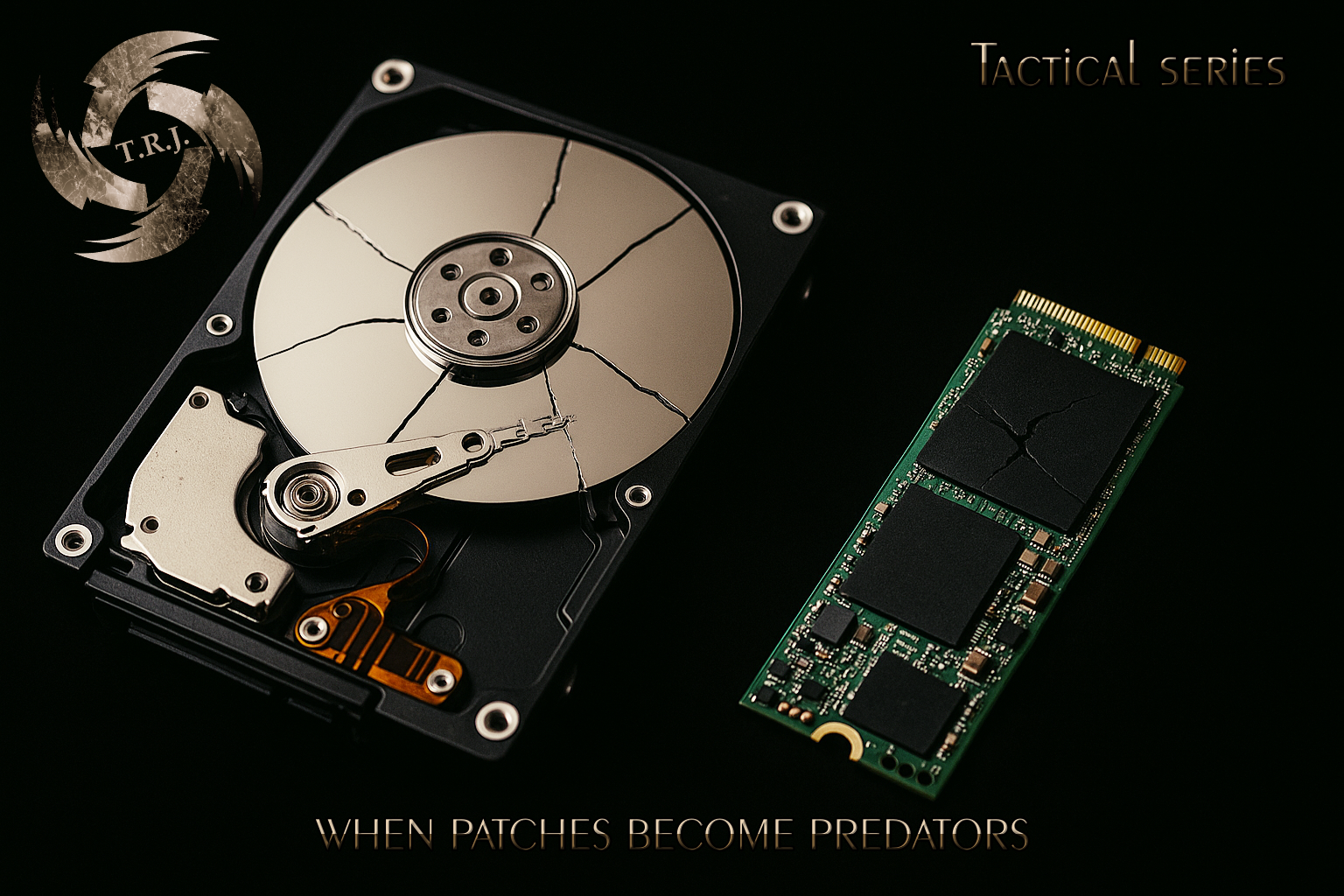
It started quietly, like these things always do. A patch released on August 12th — just another line in Microsoft’s long list of security rollouts. KB5063878, the cumulative update for Windows 11 version 24H2, was supposed to harden defenses and keep systems safe. Instead, it did the opposite: it broke the one thing no machine can live without — the drive that holds everything.
Computers failed to boot. SSDs disappeared mid-transfer. Data turned into raw, unreadable partitions. People who had built their workflows on Windows found themselves trapped in a loop of restarts, corrupted drives, and unrecoverable files. And while forums filled with panicked reports, Microsoft’s official channels remained quiet until the press forced their hand. This wasn’t a minor inconvenience. This was a catastrophic failure. And it’s absolutely ridiculous that one company can wield this much power over the very foundation of modern computing. I don’t know about you, but I’m tired of it. Not to mention the laziness when it comes to fixing any of these issues that these companies create because of their own negligence.
The Problem With Lock-In
This is what happens when these giants — Microsoft and Apple mainly — hold near-total control over operating system infrastructure. The illusion of choice is thin: hardware, drivers, and creative software ecosystems are built to run on Windows or macOS. If either breaks, the fallout is global. Small businesses go down. Creators lose projects. Enterprises lose uptime. Hospitals, schools, and governments — all forced to wait while a vendor that treats its user base as unpaid QA engineers scrambles to fix what should never have been pushed out and downloaded by millions.
This is lock-in at its most dangerous. You don’t get to decide when updates roll out. You don’t get to decide whether a patch is safe before it installs. You don’t even get the courtesy of transparency when things go wrong. The patch machine just keeps moving, and you — no matter how critical your work is — are expected to deal with the consequences. And trust me, this will only get worse down the road. You’re left doing the work to figure out what the issue was, scrambling for answers, and hoping you backed up your machine in time. Oh — and just like that, all of these giants now expect you to find the answers. They want you to troubleshoot, to document every glitch, and to send them videos that ultimately mean nothing — because half the time you can’t even recreate the problem, let alone explain what caused it in the first place. Which means, in the end, you called them for nothing, and your problem is never theirs to own. And let me tell you, the so-called specialist you spoke to wasn’t even a specialist in the first place. Most of the time they can’t figure out your problem, and the lifetime you spent on the phone got you nowhere — time you’ll never get back.
The Linux Contrast
Linux isn’t perfect. No system is. But it offers something Windows and macOS can’t: choice and transparency.
- You choose when to update.
- You choose what kernel, what desktop, what package system you trust.
- You’re not locked into a corporate feedback loop where the same company writes the OS, controls the drivers, and dictates the pace of updates.
The stability of Linux distributions, especially those built with long-term support models, shows that you don’t need monopolistic choke points to run a modern computing environment. You don’t need to gamble with your entire data store every Patch Tuesday. And you don’t need to accept an ecosystem where “security” updates arrive with a side of catastrophic failure.
Why Microsoft and Apple Keep Getting Away With It
Because the ecosystem is chained to them. Printers, audio interfaces, graphics drivers, productivity software, games — all of it built with the assumption that you’re running Windows or macOS. This is what makes the lock-in so powerful: switching isn’t a matter of preference, it’s a matter of compatibility. If you want to run what your business or industry depends on, you’re stuck in their system.
And that’s exactly why the stakes are so high when updates like KB5063878 ship broken. This wasn’t just a patch that caused some instability. It was a patch that struck the foundation of the system — storage. That’s right — no startup. And once that goes, nothing else matters. The system is dead before it even breathes. Good thing I’m experienced enough to know what to do when that happens. Why is that? Oh right — because it has happened so many times throughout my lifetime. Microsoft is notorious for these kinds of failures. They’ll build something that works flawlessly, and the moment it does, they find a way to destroy it. Why? Because a stable, working system doesn’t make them more money. That’s the bottom line. People really need to start speaking up, because this will only get worse — I promise you that. It’s a damn good thing that I know how to operate a Linux machine, and it’s a damn good thing that we use our own OS to run our servers. Because if we didn’t, our business would have been shut down for days. And you know how Microsoft works — they’re still ‘investigating the issue,’ and we both know that means it will take weeks, maybe even months, just to roll back a problem they created in the first place.
The Cost of Complacency
Every time we accept this cycle — patch, break, panic, fix, repeat — we give these companies a free pass to treat the world as their testing ground. Every time we shrug it off as “just another Windows issue,” we allow the lock-in to deepen. And every time we rebuild our systems after failures like KB5063878, we silently reinforce the idea that it’s acceptable for billion-dollar corporations to gamble with the tools we depend on to live, work, and create.
But it doesn’t stop there. Complacency comes with its own interest rate, and it compounds. Each time we stay quiet, we lower the bar of accountability. Each time we absorb the losses, we train these corporations to believe downtime is a minor inconvenience, not a breach of trust. Each time we let them get away with it, we teach them that user suffering is an acceptable cost of doing business.
The truth is simple: the more silence they receive, the more chaos they will deliver. If the market never punishes them, if the users never push back, then the next KB5063878 won’t just kill startup or corrupt a drive — it will bleed into every corner of our digital lives. And make no mistake, it will come.
The Truth We Don’t Want to Admit
We should be able to choose freely what operating system we use. We should be able to expect that choice to run everything we need, smoothly, without artificial walls built by corporations. Our hardware should not be tethered to one vendor’s patch cycle. Our creativity, our businesses, our archives of memory and knowledge should not be subject to the whims of monopolies.
Yet here we are — held hostage by these giant companies who control the operating systems that drive the majority of the world’s hardware. And when they fail, we all pay the biggest price ever. Oh, and by the way — you sign off on that shit too. They are never held responsible unless it hurts other big corporations, or better yet, the government. For you, it doesn’t matter. I mean — haha! You don’t matter.
Users began reporting that their SSDs, especially those running Phison NAND controllers, were vanishing mid-operation. Not corrupted in the old-fashioned way, not the slow crawl of a dying disk, but simply gone. A transfer of 50GB here, a drive 60% full there — suddenly, the system couldn’t see its own storage. Reboots didn’t fix it. File systems flipped to RAW. For some, the only answer was data loss and reinstall.
This isn’t a small corner case. This is the kind of bug that nukes workstations in photography studios, editorial rooms, design labs, and small businesses where uptime isn’t optional. And yet — Microsoft let that ship sail.
The Lazy Cycle
This is the cycle we’ve been forced into:
- Microsoft pushes updates fast, without rigorous regression testing.
- Edge cases — or what they call edge cases — slip through.
- Users discover catastrophic failures in the wild.
- Only after the press piles on does Microsoft acknowledge the issue.
- The “fix” drags behind, leaving businesses in limbo.
In this case, Microsoft didn’t acknowledge the SSD-breaking bug until August 20th, eight days after KB5063878 went live. By then, forums were burning, Event Viewers were clogged with disk errors, and professionals were juggling backups, reinstalls, and lost productivity.
It’s not “quality assurance” anymore. It’s a shell game where the user base doubles as the QA department, except the stakes aren’t abstract bug reports — they’re the drives storing livelihoods.
The Business Risk
Downtime is a nuisance for casual users. But for anyone running creative or technical work — photo libraries, research databases, production environments, investigative archives — this isn’t inconvenience, it’s existential.
- Lost productivity: multiple reboots just to land on the desktop.
- Data corruption: drives dropping mid-transfer, destroying active files.
- System instability: updates that fail, boot loops that won’t resolve, Event Viewer filling with warnings.
And let’s be blunt: Microsoft knows better. Storage is sacred ground in computing. Shipping an update that touches disks without catching catastrophic failures isn’t just sloppy — it’s reckless. Period.
The Warning
If you’re running Windows 11 Pro (or any Windows 11 24H2 build) and you’ve installed KB5063878:
- Back up immediately — assume the worst before it happens.
- Check your backups — and don’t just check that they exist, make sure your data is actually readable.
- Roll back KB5063878 — uninstall it via Settings or Command Prompt.
- Pause Windows Update for 1–2 weeks — longer if you can — until Microsoft finally pushes a real fix.
- Monitor boot behavior — consistent clean boots mean you dodged the glitch.
Do not ignore this one. This isn’t the usual “performance hiccup” or “blue screen” patch. This is a drive killer.
The Verdict
Microsoft has turned its patch cycle into a minefield. Security updates are supposed to protect, not destroy. But KB5063878 proves what many already suspect: users are no longer customers in Microsoft’s eyes. They are the crash test dummies — unpaid, unwilling, but indispensable to a lazy QA process that gambles with the very foundation of computing.
For professionals, for businesses, for anyone whose system stability matters, the message is clear: trust your backups more than you trust Redmond.
This Is Worldwide 🌍
This isn’t an isolated glitch or a handful of unlucky users. Reports are flooding in from North America, Europe, and Asia — from Microsoft’s own Q&A forums to Reddit’s r/Windows11 threads, from German tech site BornCity to coverage in TechRadar.
It’s not tied to a single manufacturer or a single market. The only constant is KB5063878, and in particular, systems running SSDs with Phison NAND controllers — though even that isn’t the whole story.
And because the update was pushed through Windows Update globally on August 12, anyone running Windows 11 24H2 who installed it is exposed. This isn’t regional. This is systemic. For some users, the damage was immediate — drives vanishing mid-transfer, partitions flipping empty. For others, like us, the failure crept in slowly — a ticking time bomb waiting for the right transfer, or the wrong reboot.
Still can’t stop us — LOL!~
⚠️ TRJ BLACK FILE WARNING
- Update: KB5063878 (Windows 11 24H2, released August 12, 2025)
- Effect: SSD disappearance, data corruption, boot instability
- At-Risk: Phison NAND controller SSDs (most vulnerable), some HDDs
- Acknowledgment: Microsoft confirmed issue on August 20, 2025 — fix pending
- User Action: Uninstall KB5063878, pause updates, protect data
🔥 NOW AVAILABLE! 🔥
📖 INK & FIRE: BOOK 1 📖
A bold and unapologetic collection of poetry that ignites the soul. Ink & Fire dives deep into raw emotions, truth, and the human experience—unfiltered and untamed.
🔥 Kindle Edition 👉 https://a.co/d/9EoGKzh
🔥 Paperback 👉 https://a.co/d/9EoGKzh
🔥 Hardcover Edition 👉 https://a.co/d/0ITmDIB
🔥 NOW AVAILABLE! 🔥
📖 INK & FIRE: BOOK 2 📖
A bold and unapologetic collection of poetry that ignites the soul. Ink & Fire dives deep into raw emotions, truth, and the human experience—unfiltered and untamed just like the first one.
🔥 Kindle Edition 👉 https://a.co/d/1xlx7J2
🔥 Paperback 👉 https://a.co/d/a7vFHN6
🔥 Hardcover Edition 👉 https://a.co/d/efhu1ON
Get your copy today and experience poetry like never before. #InkAndFire #PoetryUnleashed #FuelTheFire
🚨 NOW AVAILABLE! 🚨
📖 THE INEVITABLE: THE DAWN OF A NEW ERA 📖
A powerful, eye-opening read that challenges the status quo and explores the future unfolding before us. Dive into a journey of truth, change, and the forces shaping our world.
🔥 Kindle Edition 👉 https://a.co/d/0FzX6MH
🔥 Paperback 👉 https://a.co/d/2IsxLof
🔥 Hardcover Edition 👉 https://a.co/d/bz01raP
Get your copy today and be part of the new era. #TheInevitable #TruthUnveiled #NewEra
🚀 NOW AVAILABLE! 🚀
📖 THE FORGOTTEN OUTPOST 📖
The Cold War Moon Base They Swore Never Existed
What if the moon landing was just the cover story?
Dive into the boldest investigation The Realist Juggernaut has ever published—featuring declassified files, ghost missions, whistleblower testimony, and black-budget secrets buried in lunar dust.
🔥 Kindle Edition 👉 https://a.co/d/2Mu03Iu
🛸 Paperback Coming Soon
Discover the base they never wanted you to find. TheForgottenOutpost #RealistJuggernaut #MoonBaseTruth #ColdWarSecrets #Declassified
Support truth, health, and preparedness by shopping the Alex Jones Store through our link. Every purchase helps sustain independent voices and earns us a 10% share to fuel our mission. Shop now and make a difference!
https://thealexjonesstore.com?sca_ref=7730615.EU54Mw6oyLATer7a

Sponsored • TRJ Ads
Inquiries: contact@therealistjuggernaut.com


