
Thank you for reading or listening to The Realist Juggernaut. Independent journalism should be accessible to everyone.
When Profit Replaces Vision, Culture Dies
Art has always been the language of human struggle and triumph. It’s the brushstroke across canvas, the lens capturing truth, the song that cuts through silence. It’s the stage where voices rise, the book that carries memory across generations, the photograph that freezes a moment no one else saw. Art is how people have always resisted, remembered, celebrated, and survived. It is the raw proof that human beings are more than numbers on a ledger or units of labor — that we dream, we feel, and we create.
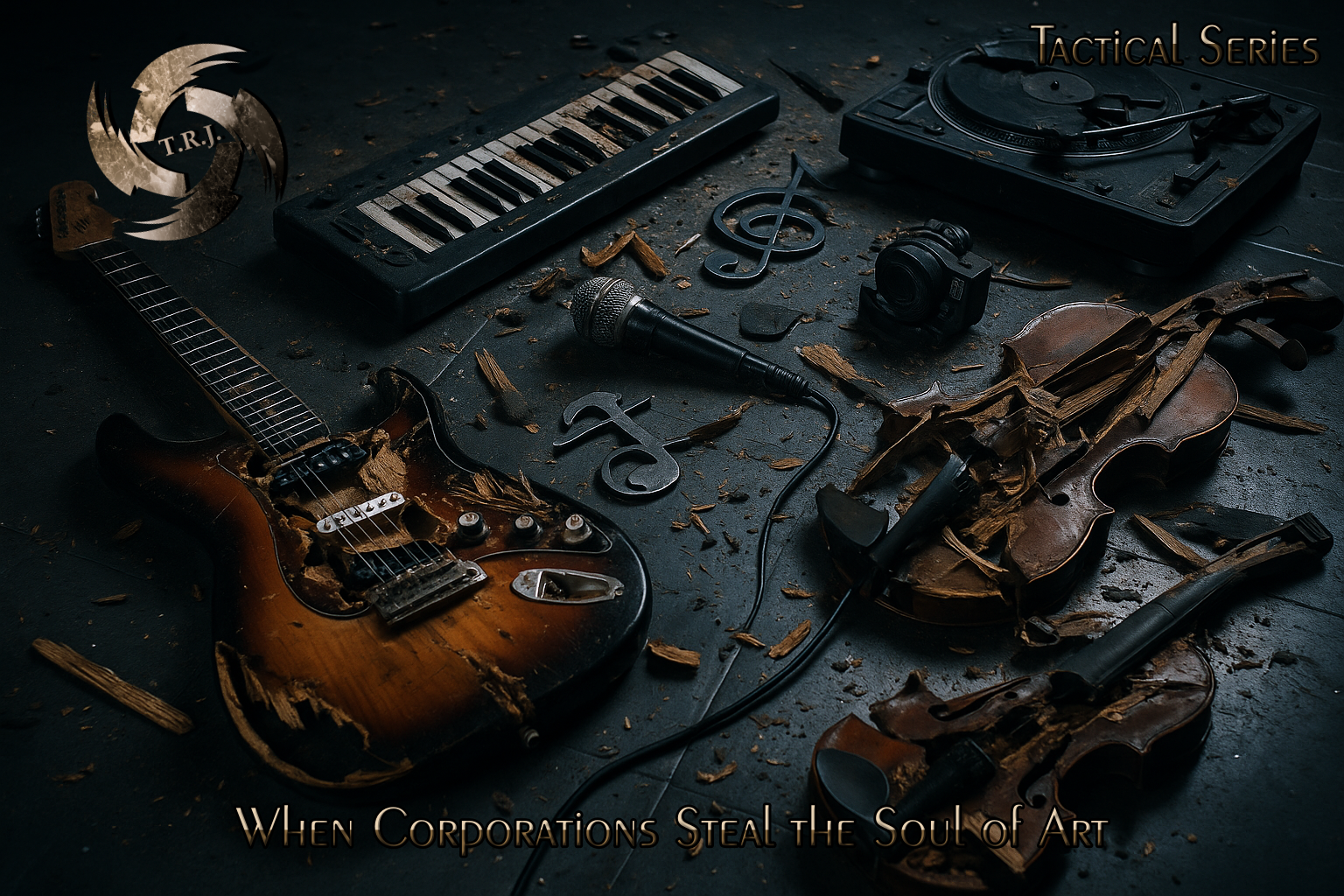
But in today’s world, that language is being smothered. Not by lack of talent, not by lack of passion — but by corporations tightening their grip on creativity itself. They’ve turned expression into commodity, reducing it to what can be marketed, monetized, and measured in clicks. What once carried the soul of a creator is being stripped down into content, produced not for truth or meaning, but for engagement metrics and quarterly profits.
I have no problem with AI helping people create. Tools have always been part of the process — a camera, a guitar, a typewriter, a paintbrush. AI can belong in that lineage if it’s used honestly, as a way to unlock new forms of expression. The problem isn’t the technology. The problem is the corporations behind it. And with the ease of use of these products, there’s no real learning curve — it’s made deliberately too easy, and that’s the danger. They aren’t here to empower artists; they’re here to control, to consolidate, and to profit at the expense of the very people who keep culture alive. And in doing so, they’re not just reshaping industries — they’re dismantling the very foundation of human creativity itself.
The Illusion of Creativity
Everywhere you look online, the message is the same: “Become your own professional photographer or musician. No experience needed.” That slogan isn’t harmless marketing — it’s a manifesto for a world where skill, dedication, and lived experience are treated as obsolete. It doesn’t celebrate creativity — it cheapens it. It tells the world that the years of struggle, the hours of practice, the sacrifice and grit that true artists put in don’t matter. Anyone can press a button and be an “artist.”
And yet, the illusion is powerful because it flatters the consumer. It whispers: you don’t need to respect the craft, you can bypass it. Why pay for an experienced photographer when an app promises you’ll get the same result? Why hire a musician when corporate templates churn out a “hit” in seconds? Why value a painter’s vision when AI can replicate the style of masters on demand? This manufactured illusion trains audiences to devalue the very thing that once gave art its meaning: the human hand behind it.
But illusions always come at a cost. Real photographers are undercut by apps that bypass the years of experience it takes to master light, shadow, and timing. What was once the hard-earned skill of knowing how to wait for the exact second of truth in a frame is reduced to a filter anyone can swipe across a screen. The eye that could tell the difference between a staged smile and a fleeting, genuine moment is now treated as unnecessary, because corporations have convinced people that a button can replace a vision.
Videographers lose clients to instant AI music video generators that promise “professional results in minutes.” What used to take planning, storyboarding, camera angles, and editing with precision is now sold as something that can be assembled by drag-and-drop. The narrative, the pacing, the ability to capture emotion through motion — those things vanish when video becomes just another template. What’s lost isn’t just work; it’s the voice of a storyteller.
Musicians get buried under endless streams of algorithmically curated sound that feels polished but hollow. Behind every song that matters is a process of struggle — lyrics rewritten a hundred times, riffs perfected, and notes bent to carry emotion. But corporations flood platforms with generated music designed to match “vibes” and playlists, stripping away the very humanity that gives music its power. The result isn’t art; it’s wallpaper, engineered to fill silence, not to say something.
Writers are drowned in seas of filler content designed to feed clicks, not thought. Pages are pumped full of shallow text stitched together for search engines, not readers. The craft of writing — structure, rhythm, meaning — gets sidelined for speed and volume. A good writer can spend hours sharpening a single sentence to cut clean into the reader’s mind, but corporations reward output, not depth. The consequence is a world where words lose weight, where language stops being a tool of connection and becomes nothing more than disposable noise.
Painters and designers find their work copied, sampled, and commodified without credit or compensation. Centuries of style, technique, and cultural tradition are scraped into databases and repackaged as downloadable styles for anyone to apply. The brush that once carried a lifetime of practice is flattened into some sort of preset. The originality that made an artist distinct is stolen, remixed, and resold without their name attached. I know all too well, because I’ve had plenty of my work stolen. It ends up resembling my creations, but altered just enough that there’s nothing I can do about it. The same thing has happened with my music and lyrics — taken, reworked, and repackaged until the original is unrecognizable, yet still mine at the core.
One by one, every field is being stripped of its value — not because talent disappeared, but because corporations taught the public that talent isn’t worth paying for. And when talent is no longer valued, art becomes nothing more than product — soulless, cheap, and infinitely replaceable.
The pitch is always sold as “empowerment.” It’s framed as democratization, as though access to creative tools is the same thing as creating art. But empowerment without depth is a trick. When a tool is created and becomes too powerful, it replaces the need for skill. It doesn’t lift people up — it erases the foundation that craft is built on. What corporations call empowerment is, in reality, dispossession. They’re stripping creators of their livelihoods while convincing the public that nothing has been lost.
This illusion doesn’t just devalue art — it destabilizes culture itself. Because when art is treated as disposable, the truth it carries is also treated as disposable. And the world becomes saturated with noise: images without vision, songs without soul, words without weight. Which, in the long run, turns into boring. And when it becomes boring, that’s when people will once again want the pros. But guess what? Because of this, the pros quit — driven out by the cons.
Exploitation Isn’t New — But It’s Worse
The music industry is the perfect example. For decades, artists have been squeezed dry by labels that take everything and leave them with scraps. Contracts were written to trap musicians for life, ownership stolen through fine print, and creativity policed by executives who cared more about charts than expression. Stories of artists signing away their masters, watching their royalties vanish, or being shelved because they wouldn’t “play along” are countless. The exploitation wasn’t an accident — it was the business model.
And that system still exists today. Artists continue to fight for their own work, their own names, and the right to earn a living from the songs they created. But now the same corporate blueprint has been exported far beyond music. Photography, fine art, videography, writing — all are being treated as disposable, all monetized by platforms that profit off work they didn’t make. A photographer spends years mastering their eye, only to watch apps advertise “professional shots, no skill required.” A writer hones their voice for decades, only to be buried under waves of instant copy churned out to feed algorithms. Videographers with real vision lose jobs to cookie-cutter AI templates. Painters and designers see their work scraped, remixed, and sold back to the world without their name even attached.
Small businesses collapse under the weight. Local studios close. Independent publishers fold. Freelancers who once carved out a modest living find themselves competing against corporations that don’t have to create — they just harvest, repackage, and sell.
This isn’t about innovation. Real innovation empowers people, it doesn’t erase them. This is about power — about who controls expression, who controls visibility, and who profits when culture is stripped of its human core. Corporations aren’t innovating; they’re consolidating. They aren’t amplifying creators; they’re replacing them. And in doing so, they’re repeating the same exploitation that crushed musicians for decades, only now on a global scale, across every art form that once gave people their voice.
Algorithms as Silent Censors
It’s bad enough when corporations strip away livelihoods. It’s worse when they decide who even gets to be heard. Algorithms have become the invisible gatekeepers of modern creativity, deciding which voices rise and which vanish. If the system doesn’t like your voice, your work, your message — you’re buried. Your art disappears into a feed no one will ever see, smothered not by critique but by silence.
That silence is intentional. Algorithms are built to reward what is safe, profitable, and easily packaged, while burying anything that challenges, questions, or resists. They don’t need to tell you “no” — they just make sure you’re never seen. What once required censorship through law or government decree — bad enough on its own — is now handled by math equations tuned in corporate boardrooms.
Freedom of speech means nothing if the platform controlling the public square can block, flag, or suppress you without ever admitting it. And that’s the reality we’re living in. Voices are silenced not with bans but with invisibility. This isn’t just about lost jobs or stolen art — it’s about freedom of expression itself. When corporations decide which voices are seen and which are buried, they’re not just shaping markets, they’re reshaping democracy — killing the republic in the process. A musician uploads a track that doesn’t fit the platform’s preferred style, and it never surfaces. A writer posts truth that doesn’t align with ad dollars, and the algorithm buries it. A photographer shares work that doesn’t drive engagement metrics, and it’s pushed to the bottom of the feed. The art doesn’t fail because it lacks quality; it fails because the system never let it breathe.
This is the new censorship. No courtroom. No trial. No explanation. Just erasure by algorithm — clean, quiet, and deniable. And in the process, an entire generation of creators is being taught that their work has no value unless it conforms to what the machine approves.
The Struggle Is Real
This isn’t just theory. It’s happening everywhere — in real studios, in living rooms where instruments collect dust, in empty storefronts where once-thriving small businesses used to stand. Artists are watching their livelihoods collapse piece by piece. Musicians are working two jobs just to fund their passion, sneaking in hours late at night to record or write before exhaustion wins. Photographers can’t compete with platforms selling “instant professional” filters that promise a look but deliver nothing of the eye that comes with craft. Videographers, once hired to shape stories and capture emotion, are being underbid by companies offering AI-generated commercials or music videos that look slick but say nothing about what the song is even about — in other words, no feeling. All surface, no soul. Writers are drowning in markets flooded with hollow content, mass-produced to trick search engines rather than move human beings, burying voices that carry weight under mountains of disposable text.
The impact isn’t just financial — it’s emotional. Creators are burning out, questioning why they should continue pouring years of themselves into work that corporations have taught people to undervalue. Imagine spending a decade sharpening your skills, only to have an algorithm tell the world your work is worth less than a free template. That kind of slow suffocation doesn’t just kill businesses, it kills confidence, drive, and the will to keep creating.
It’s not that people don’t want art — people crave it. But corporations have trained audiences not to value it. They’ve told the world that art can be produced instantly, cheaply, and endlessly. And when that becomes the standard, the real cost is paid by those who actually create. The songwriter who can’t afford to tour. The painter who can’t buy supplies because prints are undercut by machine-made knockoffs. The filmmaker who can’t pay rent because clients were convinced a template was “good enough.” And the endgame of all this is ugly: they’re making sure there will always be a large supply of slave workers — yes, slave workers. Because when you don’t get paid enough, you work more, you work harder for the man at the top of those corporations, so he and his family can have the easy path while you’re told you’re not worth it. You are reduced to a worker, a slave — nothing more. You are not a father, not a mother, not a grandfather or grandmother. You are a slave worker, and when you finally realize the obvious, it hits hard: no family time. Your kids are either stuck with a babysitter or left home alone, fed by the very corporations that stole your time, filling their minds with bad ideas designed to shape the next generation of compliant workers.
What gets lost is more than money. It’s connection. It’s culture. It’s the heartbeat of communities that once gathered around local galleries, live music venues, bookshops, or independent theaters. These weren’t just businesses — they were places where people shared vision, struggle, and truth. When they die, the silence left behind isn’t filled with corporate substitutes. It’s just silence. That’s not freedom — that’s servitude repackaged as opportunity.
Why Human Talent Still Matters
People are gifted in different things for a reason. One person can frame a photograph in a way no machine ever could — capturing not just an image but a moment that breathes. Another can write a song that bleeds truth — something heartfelt and meaningful — where every note carries the weight of lived experience. Another can carve, paint, build, or speak in ways that shift perspective, forcing others to see the world differently than they did before. This diversity of human creativity is not an accident; it is the pulse of culture itself. It’s what makes art powerful, unpredictable, and alive.
A camera can imitate a composition, but it can’t sense the heartbreak behind a look in someone’s eyes. An algorithm can arrange chords, but it can’t recreate the pain or joy that a songwriter drags out of memory and pours into sound. A program can mimic brushstrokes, but it cannot replace the years of training, mistakes, and revelations that live in an artist’s hand. These things are not optional extras — they are the essence of creation.
Without them, society becomes hollow. It might be efficient, yes, but empty. You can flood the world with flawless images, catchy beats, polished graphics, and endless words, but without human struggle behind them, they’re just surfaces. No depth. No weight. No soul. A culture built only on surface cannot endure, because it doesn’t carry the truth of the people living inside it.
And when corporations erase human talent, they don’t just destroy small businesses. They destroy voices. They destroy individuality. They destroy the spark that makes the world worth living in. A world without human creativity is a world without reflection, without connection, without resistance. It is a world where everything looks sharp but feels dead.
Human talent still matters because it is the last line between expression and product, between culture and commerce, between freedom and control. And once that line is crossed, what remains isn’t art — it’s programming.
TRJ Verdict
Corporations are dismantling the very foundation of creativity. They’ve taken the business of art and twisted it into a pipeline of cheap content, built on the backs of silenced voices and stolen visions. What once carried the mark of individuality is now churned out as product, stripped of meaning, polished to emptiness. Creativity without freedom is not creativity — it’s programming. It’s commodity. It’s control. And every time an independent artist or small business is forced out, the world doesn’t just lose a job. It loses a vision, a sound, a perspective — fragments of humanity erased for profit.
This fight is bigger than photography. Bigger than music. Bigger than painting, film, or design. It is about who controls expression in the modern age. Expression has always been the raw measure of freedom — the one place where people could resist, reveal, and reflect the truth of their lives. And right now, that control is being ripped out of the hands of creators and locked away in boardrooms that answer only to shareholders.
If this continues, we won’t just watch industries collapse. We’ll watch culture hollow out until what remains is endless content without soul. And when culture dies, truth dies with it. Because art is not just decoration — it is testimony. It is the unfiltered record of human happiness, struggle, and triumph. Remove that, and you don’t just silence artists. You silence generations.
If that doesn’t change, the world won’t just lose art. It will lose its reflection. It will lose its resistance. It will lose truth itself.
We are already modern-day slaves. And as this machine continues doing exactly what it was built to do, the end will be even more unsettling than what we see now. You are already living within a new world order — a technocracy. And when that order fully locks into place, it will be far worse, because it’s being assembled piece by piece, right under your nose. How many warnings will it take before it’s too late?
FTC Staff Report (Dec 15, 2023)
“Generative Artificial Intelligence and the Creative Economy.”
United States Federal Trade Commission (FTC).(Free Download)

UNESCO Survey to Artists (2024)
“Survey to Artists on MONDIACULT Declaration Follow-Up Actions — Findings.”
United Nations Educational, Scientific and Cultural Organization (UNESCO).(Free Download)
Center for Data Innovation Report (2023)
“Critics of Generative AI Are Worrying About the Wrong IP Issues.”
Center for Data Innovation (a Washington, DC–based think tank funded by industry-aligned interests).(Free Download)
Leonardo Journal Paper (2023/2024)
“A Shift in Artistic Practices through AI.”
Published via arXiv / Leonardo Journal, research paper examining AI’s effect on creative practice and ownership.(Free Download)
TRJ Black File — The Theft of Human Creativity
This is not theory. These are documented cases where corporations, think tanks, and institutions laid the groundwork for replacing human artistry.
Case #001 — FTC Staff Report (Dec 2023)
The U.S. Federal Trade Commission acknowledged in its report “Generative Artificial Intelligence and the Creative Economy” that AI is “highly disruptive” to creative markets. The agency warns small businesses and independent artists will face significant displacement as generative models spread.
Case #002 — UNESCO Survey to Artists (2024)
A global survey found 77% of artists see AI as a direct threat to their livelihoods. Concerns included job loss, plagiarism, and the devaluation of creativity itself. The report calls for urgent safeguards to prevent corporations from exploiting creative labor without consent or compensation.
Case #003 — Center for Data Innovation (2023)
In its policy paper “Critics of Generative AI Are Worrying About the Wrong IP Issues”, the corporate-aligned think tank dismissed artists’ objections, arguing that scraping copyrighted content for AI training is legal and should not require permission, credit, or pay. A public defense of exploitation disguised as innovation.
Case #004 — Leonardo Journal / arXiv Study (2023)
Academic research described AI’s role in creating a “digital enclosure of the cultural commons.” Styles, traditions, and cultural histories are being scraped, remixed, and privatized by a handful of tech giants. What was once shared culture is being sealed inside corporate control.
This isn’t speculation. It’s already on record.
The theft of creativity is not a side effect — it’s the business model.
🔥 NOW AVAILABLE! 🔥
📖 INK & FIRE: BOOK 1 📖
A bold and unapologetic collection of poetry that ignites the soul. Ink & Fire dives deep into raw emotions, truth, and the human experience—unfiltered and untamed.
🔥 Kindle Edition 👉 https://a.co/d/9EoGKzh
🔥 Paperback 👉 https://a.co/d/9EoGKzh
🔥 Hardcover Edition 👉 https://a.co/d/0ITmDIB
🔥 NOW AVAILABLE! 🔥
📖 INK & FIRE: BOOK 2 📖
A bold and unapologetic collection of poetry that ignites the soul. Ink & Fire dives deep into raw emotions, truth, and the human experience—unfiltered and untamed just like the first one.
🔥 Kindle Edition 👉 https://a.co/d/1xlx7J2
🔥 Paperback 👉 https://a.co/d/a7vFHN6
🔥 Hardcover Edition 👉 https://a.co/d/efhu1ON
Get your copy today and experience poetry like never before. #InkAndFire #PoetryUnleashed #FuelTheFire
🚨 NOW AVAILABLE! 🚨
📖 THE INEVITABLE: THE DAWN OF A NEW ERA 📖
A powerful, eye-opening read that challenges the status quo and explores the future unfolding before us. Dive into a journey of truth, change, and the forces shaping our world.
🔥 Kindle Edition 👉 https://a.co/d/0FzX6MH
🔥 Paperback 👉 https://a.co/d/2IsxLof
🔥 Hardcover Edition 👉 https://a.co/d/bz01raP
Get your copy today and be part of the new era. #TheInevitable #TruthUnveiled #NewEra
🚀 NOW AVAILABLE! 🚀
📖 THE FORGOTTEN OUTPOST 📖
The Cold War Moon Base They Swore Never Existed
What if the moon landing was just the cover story?
Dive into the boldest investigation The Realist Juggernaut has ever published—featuring declassified files, ghost missions, whistleblower testimony, and black-budget secrets buried in lunar dust.
🔥 Kindle Edition 👉 https://a.co/d/2Mu03Iu
🛸 Paperback Coming Soon
Discover the base they never wanted you to find. TheForgottenOutpost #RealistJuggernaut #MoonBaseTruth #ColdWarSecrets #Declassified
Support truth, health, and preparedness by shopping the Alex Jones Store through our link. Every purchase helps sustain independent voices and earns us a 10% share to fuel our mission. Shop now and make a difference!
https://thealexjonesstore.com?sca_ref=7730615.EU54Mw6oyLATer7a

Sponsored • TRJ Ads
Inquiries: contact@therealistjuggernaut.com




Thank you for the sobering article, John. I think this is one of the greatest downsides of AI. I saw an interview with a singer that I didn’t even know but she was complaining about this very thing. There is no question in my mind that the 77% of artists who see AI as a direct threat to their livelihoods aren’t just guessing, many of them have already been impacted.
Hopefully, artists will continue to find a way to do the thing they love even with AI in the picture. You mentioned another piece of the situation that is also disturbing:
“It’s worse when they decide who even gets to be heard. Algorithms have become the invisible gatekeepers of modern creativity, deciding which voices rise and which vanish.”
I think most people think they are good at spotting talent. I suppose that’s because what appeals to one person doesn’t to another. Because of that the “performing arts” might not be as impacted as many other ways to express creativity. There are people who love to see a performance in person. Maybe artists will have to get out of the studio and perform in front of people more. I know that this is no real answer for the theft that’s taking place. That is the result of dishonest people, something that is more prevalent in today’s world than at any other time in my life.
I don’t have any answer to the problem except to search out true human talent in raw or trained form. I do know that I will try not to become a part of the problem. I will try to encourage people who are working in any art form without the assistance of some AI.
Here is a post I titled “True Art” back in 2010:
Thank you very much, Chris — you’re right. That 77% isn’t just speculation; it’s the reality so many artists are living right now. Live performance does have that irreplaceable human spark, but the tough part is that for most artists it’s becoming too expensive. The old ways of doing shows end up ripping off creators even worse than before, and unless you’re already huge, the math just doesn’t work out. I do truly believe AI itself can be a great tool as long as it’s raised right — the real problem is the greedy companies steering it all into the gutter. By the way, the video you shared isn’t working on my end. If you can resend it, I’d like to check it out. Always grateful for your insight, Chris — I hope you have a great night. 🙏😎
You’re welcome, John, and thank you for your reply. You’re completely right about the challenges of live performances. It has been interesting how many people have made a name for themselves through social media. That’s another possibility as it isn’t as expensive as live performances but the catch is that much of it can be faked. Maybe do a combination of small venues and You Tube? I really don’t know.
Anyway, I think this is a better link to the video I tried to share:
Thank you very much, Chris — and you’re right, live performances come with challenges that most people don’t see until they step into them. Social media definitely opened doors, but as you said, it also opened the door to shortcuts and fakes. That’s why your idea of blending smaller live venues with platforms like YouTube makes sense — you get the authenticity of the stage with the reach of the digital world. But YouTube is by Google, and for some like me, they would censor as they already do to us now. Google, Facebook, and a lot of the rest of them are part of the problem.
And about the video link — the one you shared still isn’t working on my end, unfortunately. If you’ve got another version, I’d be glad to check it out. Thanks again, Chris — I hope you have a blessed Sunday. 🙏😎
Yes, it’s unfortunate that You Tube is censored. Almost every channel that I check consistently has been censored from time to time. Sometimes it is over things that seem pretty insignificant to me. Nonetheless, it is a problem.
Thanks for your efforts to see the video, John. The links are working fine on my end but you might try typing this address into your browser:
https://chrisreimersblog.com/?s=True+Art
At the top of that link is a You Tube link that shows the artist and I’ve also included a link at the bottom of the post.
If you still have problems, it’s worth checking out this artists web site.
https://www.youtube.com/@KseniyaSimonovaTV
The video I featured on my blog is in the “Best of Kseniya Simonova” column and has 39 million views.
As always I appreciate your comments, John. I wish you and yours a blessed Sunday!
Thank you very much, Chris — the censorship issue is real. I think a lot of people are starting to notice it; not all of it, but it’s a start. And it’s happening far too often without good reason. I’ll definitely check out the links you shared as soon as I get home tonight. Thank you again for sharing them — I greatly appreciate it. 😎
You’re welcome, John, and have a safe drive home!
I watched the video, Chris — she’s incredible. Kseniya Simonova is proof of what real human creativity looks like: years of skill, vision, and heart poured into something no machine could ever replicate. That kind of originality is exactly what corporations can’t mass-produce or fake — it shows why true artistry still matters. Thank you for sharing; I really enjoyed it. 🙏😎
Great! I’m glad you liked it. I remember being blown away the first time I saw this. She’s been on a couple of the “Got talent” shows and I think she won the one in Britain. Simon Cowell called her a genius. I’ve noticed that, over the years, her You Tube videos have gotten fewer viewers. Still, she keeps doing this amazing art and what you stated about corporations not being able to fake this is so true. It is, indeed, true art.
I always appreciate your well researched posts and totally agree with this, John! 🙌🏽
Thank you very much, Cindy — I appreciate that a lot. It means something when the research connects and people see the bigger picture. Always grateful for your support. I hope you have a great rest of your weekend. 😎
Interesting read.
Thank you very much! 😎