
We publish relentlessly. We publish carefully. We publish with restraint where restraint matters and with force where force is required. Every article is built from verifiable facts, not rumors. Every claim is backed by documentation. When we expose something, we do it with receipts attached — PDFs, primary sources, official records, archived material that can be checked by anyone willing to look. We do not summarize truth into bite-sized distractions. We do not dilute it for convenience. We do not wrap it in spectacle.
And yet, on social media, the response is often silence.
Not disagreement.
Not rebuttal.
Silence.
The work exists. The facts are there. The articles most certainly circulate on the open web and within WordPress. Readers who find them read them deeply, comment thoughtfully, email us, and return consistently. But inside the platforms that claim to reward “engagement,” movement is minimal. Posts stall. Reach flatlines. Visibility evaporates.
After enough time, any honest creator begins to ask the question they don’t want to ask: Are we the problem? Are we failing to connect? Are we missing something obvious? Are we simply not good enough?
That question carries weight when the bills keep coming regardless of whether algorithms cooperate. Infrastructure costs don’t pause. Hosting doesn’t discount itself because the work is principled. Time does not refund itself.
So we stopped guessing.
We spoke to people who understand information systems at a depth far beyond the recycled advice that dominates social media strategy circles. Not content coaches. Not branding consultants. These are professionals who operate where attention is engineered—where visibility is managed, reach is constrained, and narrative flow is quietly controlled. They know precisely why some information spreads effortlessly while other information, even when factual, documented, and necessary, never gains momentum. These people understand the data behind these systems better than anyone we know—and that matters, because we are not naïve to how this machinery operates.
They reviewed the work in detail. They examined the articles with full documentation. They read the poems—not as “content,” but as writing. They listened to the music as composition, not as a product. They also read a few books we wrote. They didn’t skim. They didn’t rush. They took their time. Then they went deeper than the work itself.
They also tried searching for the books on Amazon. Our books didn’t show; others did with the same title. So they tried searching with my name. That search turned up another, much older John Neff—billionaire John Neff—which is definitely not me. They also searched Apple for our albums by the group name, and other titles with the same name kept coming up instead. They then pulled the platform-side data—Facebook, X, and the rest—and read it like a diagnosis, not a dashboard. What they saw in the numbers did not match the quality, consistency, or credibility of the output.
Their conclusion was blunt: if the suppression patterns continue, there may come a point where we stop treating this like “bad reach” and start treating it like a rights issue—and they said that is the moment you consider a lawyer, assuming you can find one willing to face corporations this large without flinching.
Their reaction was not what we expected.
They were definitely stunned. Our worldwide web views and visits are very high and do not match the very low numbers on social media.
Not politely impressed. Not casually complimentary. Genuinely speechless.
The question they asked us was not about optimization or posting strategy. It was blunt and unsettling: Why don’t you have millions behind you? Why isn’t this backed by serious funding? Why isn’t this already a major network — or being treated as one, at least.
They did not say this to flatter us. They said it because, in their assessment, there was no structural reason we should be invisible — unless invisibility itself was the outcome.
As they continued, the picture sharpened.
The problem is not quality. They were clear about that. They said our earlier articles and stories were solid—readable, thoughtful, worth attention. But a few months into the work, something changed. The writing sharpened. The investigations deepened. The poems matured. What had once been “good” crossed into high-quality territory, the kind of work that no longer blends into the background. They considered our work high-end across the board—all of it high quality. Exceptional, to say the least.
The problem is not credibility. We passed that test without hesitation. Documentation held. Sources checked out. Claims were supported. Nothing collapsed under scrutiny.
The problem is not effort. The length alone made that undeniable. You do not produce work at this scale, with this level of structure and care, without sustained commitment.
The problem, they said, is that the information is too complete.
It is too documented. Too specific. Too grounded in evidence.
It does not leave room for distortion. It does not invite narrative repackaging. It cannot be easily reframed, diluted, or absorbed into existing talking points. It forces engagement rather than reaction, and that alone makes it incompatible with systems designed to reward speed, outrage, and surface-level certainty.
It does not invite emotional shortcuts. It does not allow readers to feel informed without engaging. It does not provide the psychological comfort of partial truth. It requires attention, and attention is the one thing modern systems are designed to fracture.
But there was more than that.
They told us something that confirmed what we had already begun to suspect: this level of truth creates pressure. It doesn’t just inform readers — it destabilizes narratives. It doesn’t feed outrage cycles — it undermines them. It doesn’t serve any single political, corporate, or ideological interest cleanly. It exposes systems rather than personalities. It shows how power operates instead of offering villains for entertainment.
That kind of information does not travel easily in environments built for speed, reaction, and monetization.
It creates discomfort — not because it is false, but because it is complete.
And completeness is dangerous to industries that survive on fragments.
They explained that what we are experiencing is not rejection; it is containment. Not because anyone sat in a room and decided to silence us, but because systems optimize against what cannot be simplified, weaponized, or absorbed into existing narratives. Algorithms reward predictability. Our work resists it. Platforms reward engagement spikes. Our work produces sustained attention instead. Systems reward content that can be argued with endlessly. Our work is documented too thoroughly to be dismissed casually.
Truth like this doesn’t trigger outrage. It triggers pause.
And pause does not monetize well—especially when the articles are aimed directly at the very machines we are publishing on. These systems are not neutral carriers of information; they are architectures built to optimize behavior, attention, and compliance. When reporting demonstrates an understanding of how those systems function—when it exposes their mechanics rather than feeding them—they respond defensively. Not emotionally, but structurally. And the fact of the matter is simple: if there is something being hidden, we are going to expose it. That is how our machine works.
This work signals awareness, and awareness is the one thing automated systems are designed to suppress, not amplify. It is not that they “dislike” the content in a human sense; it is that the content operates outside their intended use. It reflects knowledge of their inner logic, and that kind of visibility is treated as a risk.
These kind people told us not to stop. Not to adapt downward. Not to soften language. Not to remove receipts. Not to shorten articles. Not to chase trends. Not to trade substance for visibility.
They told us this kind of work always looks like this at first — isolated, slow, heavy, resisted. And then, suddenly, it doesn’t.
Because the internet never forgets what is documented properly. Because reality has a way of resurfacing the work that refused to lie for attention. Because when systems fail — and they always do — people begin searching not for excitement, but for accuracy.
They told us that the truth we publish resembles the kind of journalism that existed before it was hollowed out, commodified, and repackaged as performance for larger paychecks and safer careers. They said this level of care, documentation, and editorial independence is now rare—not because it cannot be done, but because it is costly, exhausting, and structurally inconvenient to those in power. Work like this does not flatter authority. It does not reinforce existing hierarchies. It pressures them. It destabilizes them. It removes insulation. And in doing so, it makes power uncomfortable in a way that carefully managed narratives never do.
We told them what we had begun to fear—that maybe we simply weren’t good enough, that the silence meant we had failed. We pressed the point more than once. The answer did not change.
They told us flatly: no. What we are experiencing is what happens when you refuse to play the game correctly. And then they made it even clearer. We do not belong to the club. Bottom line.
“Correctly,” in this context, does not mean truthfully. It means compliantly. It means producing information that can be safely monetized, easily reframed, and comfortably ignored once the engagement window closes. It means avoiding depth, limiting documentation, and never revealing enough structural understanding to threaten the systems distributing the message. We did none of that—and that, they said, is precisely the point.
We told them we weren’t chasing millions. That money itself isn’t the objective. We are a business, and sustainability matters. The real concern is keeping the lights on long enough to continue building what we are building—to push further into investigations, to expand A.G.E.N.C.Y., to do the work that needs doing without compromise.
They understood immediately.
They told us that if they were in a stronger position, they would invest—not symbolically, not cautiously, but substantially. And then they said something that mattered more than money: what you are doing is necessary, even if it doesn’t look rewarded yet.
That conversation did not magically fix our reach. It did not make social media suddenly cooperate. But it clarified something essential.
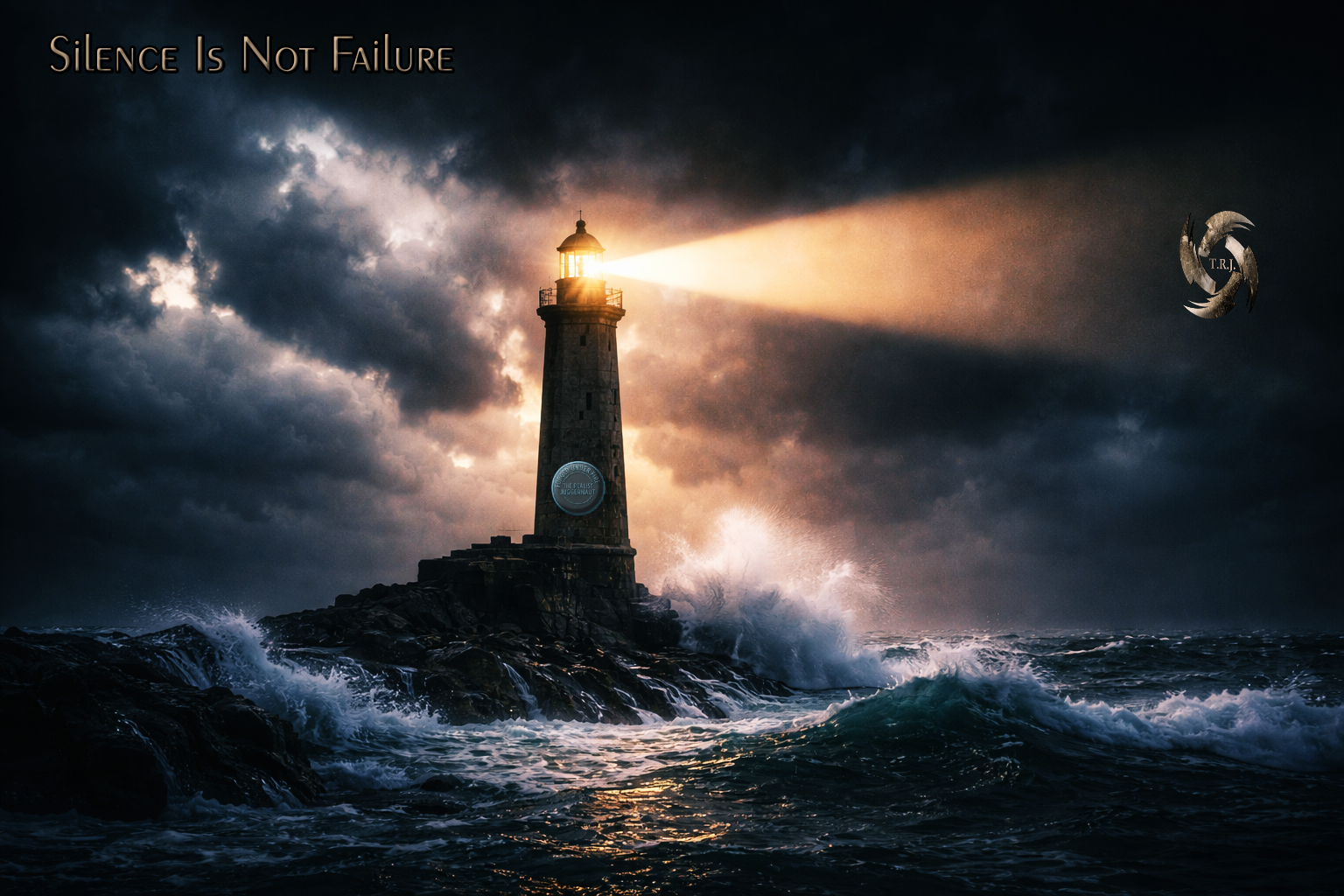
Silence is not the same as failure.
We know this. We understand it. Still, when you are building, publishing, documenting, composing, in and out of the studio and maintaining everything yourself, the pressure accumulates. It wears on you. It can make you question your footing, even when the work itself is sound. That kind of doubt is not weakness—it is the cost of carrying weight for a long time without reinforcement.
What we are facing is friction—the kind that exists when truth is too heavy to be carried casually, too sharp to be shared safely, and too honest to be absorbed into systems designed to obscure rather than reveal. And it isn’t only the systems that recoil. People do too. A lot of people. They’re afraid to share articles. Afraid their accounts will get throttled. Afraid they’ll lose access, reach, or relevance for backing something that doesn’t conform. Somewhere along the way, guts got traded for convenience. Balls and backbone were replaced with quiet calculation. Courage used to mean standing up publicly. Now it means whispering in private and hoping no one notices.
Still, a few haven’t folded. A few still have the nerve to stand behind what matters instead of hiding behind algorithms and excuses. You tell us in your comments that we are different. You tell us the work is good. You tell us to keep doing exactly what we are doing. And we will.
You know exactly who you are. And we are grateful for every single one of you.
We are not invisible because we lack value. We know this.
We are resisted because the value is real. And we know this too.
Still, even when you understand all of that, there are moments when reassurance matters. Carrying weight for long periods without reinforcement can wear on anyone. Needing that reminder doesn’t mean doubt has won—it means we’re human.
So we will continue. We will publish. We will document. We will write poems that matter and that don’t flatter the moment and make music that doesn’t beg for approval. We will keep doing the work the right way, even when it isn’t rewarded, even when it isn’t easy. We will build slowly, carefully, and truthfully—because shortcuts don’t lead anywhere worth going. And yes, we believe we will get there. Impatience comes with caring. It does not cancel conviction.
Storms pass. Systems shift. Narratives collapse.
And when they do, the work that survives is not the work that trended — it’s the work that was right.
We are still here.
We are not stopping.
And silence does not get the last word. Ever.


🔥 NOW AVAILABLE! 🔥
🔥 NOW AVAILABLE! 🔥
📖 INK & FIRE: BOOK 1 📖
A bold and unapologetic collection of poetry that ignites the soul. Ink & Fire dives deep into raw emotions, truth, and the human experience—unfiltered and untamed
🔥 Kindle Edition 👉 https://a.co/d/9EoGKzh
🔥 Paperback 👉 https://a.co/d/9EoGKzh
🔥 Hardcover Edition 👉 https://a.co/d/0ITmDIB
🔥 NOW AVAILABLE! 🔥
📖 INK & FIRE: BOOK 2 📖
A bold and unapologetic collection of poetry that ignites the soul. Ink & Fire dives deep into raw emotions, truth, and the human experience—unfiltered and untamed just like the first one.
🔥 Kindle Edition 👉 https://a.co/d/1xlx7J2
🔥 Paperback 👉 https://a.co/d/a7vFHN6
🔥 Hardcover Edition 👉 https://a.co/d/efhu1ON
Get your copy today and experience poetry like never before. #InkAndFire #PoetryUnleashed #FuelTheFire
🚨 NOW AVAILABLE! 🚨
📖 THE INEVITABLE: THE DAWN OF A NEW ERA 📖
A powerful, eye-opening read that challenges the status quo and explores the future unfolding before us. Dive into a journey of truth, change, and the forces shaping our world.
🔥 Kindle Edition 👉 https://a.co/d/0FzX6MH
🔥 Paperback 👉 https://a.co/d/2IsxLof
🔥 Hardcover Edition 👉 https://a.co/d/bz01raP
Get your copy today and be part of the new era. #TheInevitable #TruthUnveiled #NewEra
🚀 NOW AVAILABLE! 🚀
📖 THE FORGOTTEN OUTPOST 📖
The Cold War Moon Base They Swore Never Existed
What if the moon landing was just the cover story?
Dive into the boldest investigation The Realist Juggernaut has ever published—featuring declassified files, ghost missions, whistleblower testimony, and black-budget secrets buried in lunar dust.
🔥 Kindle Edition 👉 https://a.co/d/2Mu03Iu
🛸 Paperback Coming Soon
Discover the base they never wanted you to find. TheForgottenOutpost #RealistJuggernaut #MoonBaseTruth #ColdWarSecrets #Declassified


Sponsored • TRJ Ads
Inquiries: contact@therealistjuggernaut.com





Great piece. There’s so much out there to read and so little time. I think a mix of short- and long-form reports could be the answer. Alternating between them might bring more engagement.
Thank you very much, Edward. For us, the issue isn’t length or format. We’ve published cybersecurity and news articles that are short-form as well, and those still perform poorly on social media. We’re often told by readers that they rarely see our posts — maybe once in a blue moon. So it really comes down to subject matter.
The work focuses on exposing corruption and bringing forward information that is deliberately kept out of public view. That kind of reporting doesn’t move easily through systems built to reward comfort, speed, or surface-level engagement, especially in an environment where censorship plays an active role. It’s a complex situation, unfortunately.
We’re committed to doing that work regardless of how it performs, because truth matters whether it travels fast or not. We have a strong team here, and we’ve weathered some of the worst moments together. And as the professionals we’ve spoken with have said, this kind of information eventually surfaces the way it should.
Thanks again for reading and commenting — it’s always greatly appreciated. I hope you have a great night. 😎
You’re welcome. Good luck, and you’ve got me at least once or twice a week.