Thank you for reading or listening to The Realist Juggernaut. Independent journalism should be accessible to everyone.
How “Short Staffing” Became a Permanent Excuse — and What It’s Costing Businesses, Consumers, and the Economy
The collapse of trust in everyday commerce did not arrive suddenly, and it did not arrive loudly. There was no single announcement, no formal declaration, no moment that could later be isolated as the point of failure. Instead, it settled in gradually, through repetition and familiarity, until what once felt unacceptable began to feel routine. Decline did not announce itself as collapse; it presented itself as explanation.
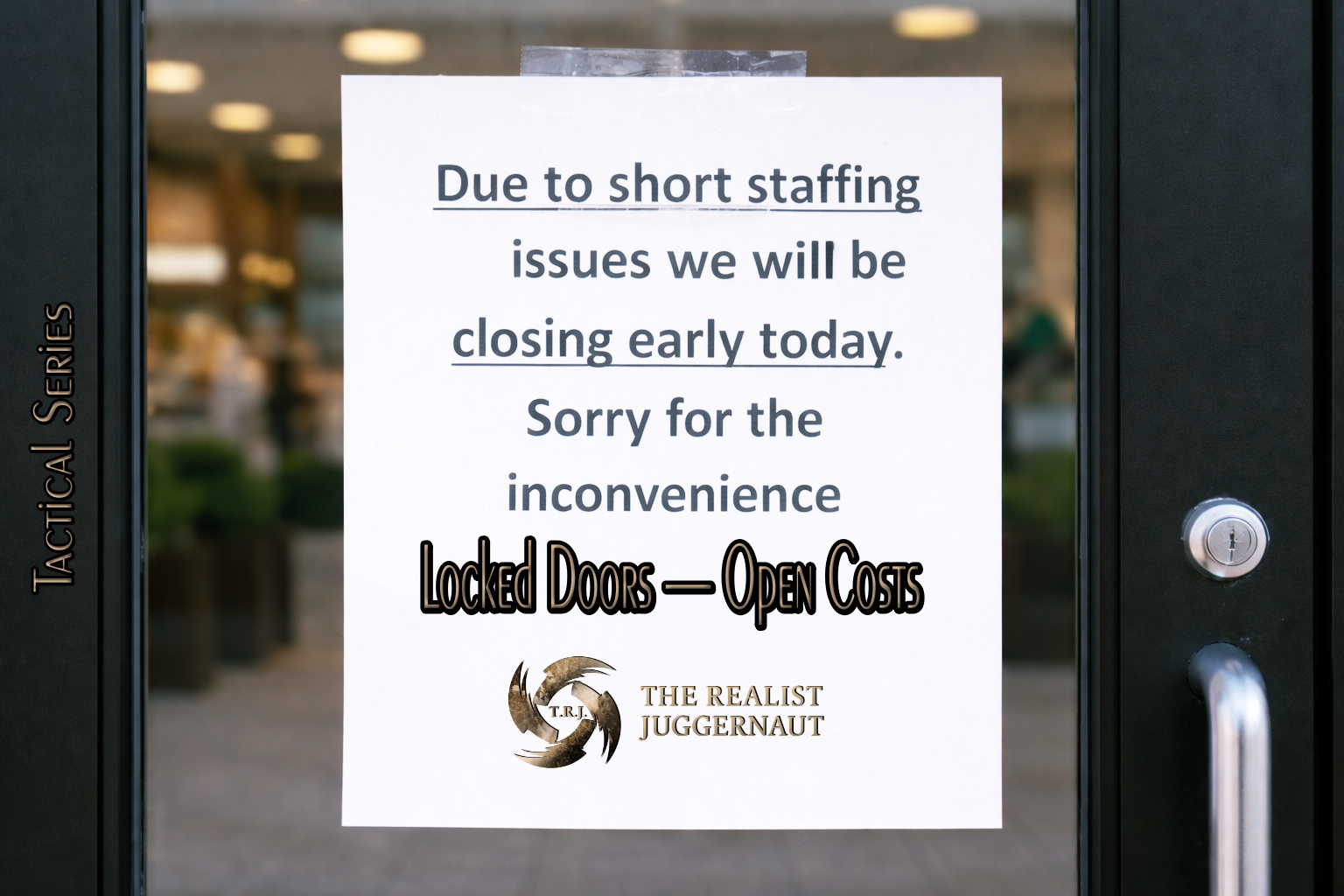
It arrived through handwritten notices taped to glass doors, printed placards propped against handles, and corporate-approved signage that framed absence as inevitability rather than choice. It arrived through dining rooms left dark while lights remained on behind the counter, through chairs stacked in plain view while staff moved freely inside, through hours posted publicly but honored selectively. It arrived through a phrase repeated so often that it stopped inviting scrutiny altogether: short staffed.
In many cases, these closures occur without upper management’s knowledge that doors have been locked early or access has been restricted. Decisions are made locally, quietly, and without escalation, shielded by the assumption that the explanation itself will not be questioned. At times, the signal is even more literal: a traffic cone placed at the mouth of a drive-thru lane, blocking entry without announcement, redirecting customers away without confrontation.
None of this presents as crisis. That is precisely the danger. What unfolds instead is normalization — a system where withdrawal is framed as necessity, where reliability becomes optional, and where trust erodes not through conflict, but through quiet repetition.
The phrase itself is not a lie. Staffing shortages exist. They have existed before and will exist again. Retail and food service have always operated under fluctuating labor conditions, seasonal turnover, and uneven availability. None of that is new. What has changed is not the presence of constraint, but the function constraint now serves. Short staffing is no longer used to explain limitation; it is used to justify withdrawal. It no longer describes strain; it legitimizes closure. It is no longer treated as a temporary condition requiring adaptation, but as a standing posture under which service can be reduced, access restricted, and obligation quietly suspended.
This shift matters because it alters the relationship between business and customer at the most basic level. When a location advertises itself as open, the expectation is not perfection but presence. Not speed, but access. What customers increasingly encounter instead is a contradiction that has become normalized across fast food and quick-service environments — coffee shops, taco counters, sandwich chains, and similar storefronts designed for constant throughput rather than discretionary service. Doors remain locked while two or three employees are visible inside. Dining rooms are closed not in response to emergency or overload, but as a default configuration. Service is reduced not because it cannot be delivered, but because delivering it has become optional.
Over time, repetition dulls resistance. Customers stop questioning the sign. They stop expecting consistency. They begin to treat uncertainty as a feature rather than a failure. Some adapt. Others leave without comment. What rarely happens anymore is accountability. The explanation absorbs responsibility before it can be examined, converting a decision into a condition and a choice into an inevitability.
This record exists because the contradiction is no longer incidental. It is patterned. It is visible across locations, brands, and regions. And because the consequences of that pattern are no longer abstract or theoretical. They are showing up in lost revenue, rising prices, closed locations, and an economy that increasingly feels unreliable not because demand has collapsed, but because participation has thinned.
What follows is not complaint or nostalgia. It is documentation of a quiet operational shift — one that trades short-term convenience for long-term erosion, and normalizes withdrawal in systems that cannot survive without consistency.
Short Staffing as a Condition vs. Short Staffing as a Shield
Short staffing, properly understood, is a condition of strain rather than collapse. It signals that operations must adapt, not withdraw. In practical terms, it means slower service, narrower menus, longer waits, and a greater reliance on prioritization and pacing. It demands adjustment from both staff and customers, but it does not negate the fundamental ability to operate. Throughout the history of fast food and quick-service retail, understaffed shifts have been routine rather than exceptional, managed through simplified workflows, staggered tasks, and deliberate throughput control. Constraint has always been part of the model.
Operational impossibility, by contrast, is rare. It occurs when staffing falls below the minimum required to safely prepare food, handle transactions, and maintain basic sanitation. That threshold is lower than many now assume. Two employees can operate a small storefront at limited capacity. The work is compressed, physically demanding, and mentally taxing, but it remains viable. Three employees remove most functional constraints entirely, allowing for rotation, brief recovery, and sustained service. These are not hypothetical scenarios. They are operational realities established across decades of industry practice and confirmed by those who have worked their way from entry-level positions to store management and ownership.
What has shifted, then, is not feasibility, but tolerance. The threshold at which closure is chosen has moved dramatically upward. Tasks that were once considered manageable are now treated as justification for withdrawal. Inconvenience has been reclassified as incapacity. Strain has been reframed as inability. The distinction matters because it marks the moment where adaptation gives way to abdication.
In this new posture, the dining room closes first — not because it cannot function, but because it requires supervision, interaction, and visible effort. Walk-in service exposes operations to scrutiny: customers can see preparation, observe pacing, notice bottlenecks, and register inconsistency. Managing that environment under strain demands active engagement. Closing it eliminates that demand instantly. What remains is a controlled channel where interaction is minimized, variables are reduced, and accountability becomes diffuse.
The drive-thru assumes this role not because it is operationally superior, but because it is operationally insulating. It limits exposure, reduces observational feedback, and transforms service into a transactional exchange conducted through glass and timing windows. In this configuration, the business remains technically open while substantially inaccessible. The sign on the door performs the final function: it absorbs responsibility. By attributing closure to “short staffing,” it redirects scrutiny away from the decision to withdraw service and toward an abstract condition that cannot be challenged by the customer standing outside.
This is the point at which short staffing ceases to function as a description and becomes a shield. It converts choice into circumstance and preference into necessity. It neutralizes accountability not by denying capacity, but by redefining obligation. The business is no longer evaluated on whether it can operate, but on whether it has declared itself unable. And once that declaration is normalized, the incentive to adapt erodes.
In systems built on repetition, this reclassification spreads quickly. What begins as a convenience becomes precedent. What begins as exception becomes baseline. Over time, the distinction between strain and incapacity dissolves, replaced by a model in which service exists only when conditions are ideal and withdrawal carries no cost. For businesses that depend on volume, consistency, and trust, that shift is not survivable.
The Geography of Disengagement
Not all customers experience this shift equally, and that asymmetry is central to understanding why its damage often goes unnoticed. Drive-thru–only service is not a neutral operational adjustment. It presumes a specific kind of customer: one who owns a vehicle, is willing to idle in line, accepts reduced visibility, and is comfortable with a mode of interaction designed to minimize contact, observation, and agency. For those customers, drive-thru service may feel efficient, familiar, or even preferable. For others, it is exclusion disguised as convenience.
Drive-thru service is built on opacity. Food is prepared out of sight. Interaction is compressed into seconds. Questions are discouraged by design. The customer becomes a unit of throughput rather than a participant in the transaction. For many people, this is not a matter of taste but of tolerance. They accept it because alternatives are unavailable, not because the model serves them well.
Walk-in customers operate under a different set of expectations. They value visibility — the ability to see food prepared, to gauge cleanliness, to interact directly with staff, to resolve errors in real time. Some do not drive. Some do not want to idle in lines that burn time and fuel. Some simply reject a model that treats presence as inconvenience rather than legitimacy. These customers are not rare. They are just less visible.
When those customers encounter locked dining rooms, they do not argue. They do not demand escalation. They leave. They choose another location, another brand, or no purchase at all. This behavior produces no immediate feedback loop. There is no angry exchange to document, no complaint ticket to resolve, no social media flare-up to absorb attention. What disappears instead is revenue — quietly, repeatedly, and without attribution.
This is not customer rebellion. It is silent exit, and it is the most corrosive form of disengagement because it does not announce itself. Systems built to respond to noise do not register absence. Metrics capture transactions, not missed ones. Managers see manageable drive-thru volume and assume equilibrium, unaware that an entire category of customer has been filtered out by access decisions that appear operationally harmless in isolation.
Over time, this filtering reshapes demand itself. Businesses begin optimizing for the customers who remain rather than the customers who were excluded. Walk-in service becomes less familiar. Dining rooms fall further into disuse. Closure becomes easier to justify because fewer customers are visibly lost each time it occurs. What began as accommodation hardens into architecture.
Multiply this pattern across days, weeks, and locations, and the loss becomes structural. Revenue erosion no longer appears as a drop, but as a ceiling — a maximum that is never reached because access has been quietly narrowed. Businesses adapt to diminished expectations, recalibrating operations around a reduced slice of their potential market while mistaking survival for stability.
In this way, disengagement acquires geography. It concentrates among those least likely to complain, least likely to be counted, and most likely to disappear without trace. The damage does not announce itself as crisis. It embeds itself as normalization. And by the time it becomes visible — through rising prices, reduced hours, or permanent closure — the customers who left are no longer present to be recovered.
The Cost Structure No One Mentions
Operating a business today is not merely difficult; it is brittle. That distinction matters because brittle systems do not bend under strain — they fracture. They can absorb short disruptions, but they fail rapidly when stress becomes patterned rather than episodic.
Modern small and franchise-based businesses operate under a cost structure dominated by fixed and semi-fixed expenses. Rent does not scale with foot traffic. Utilities do not decline because fewer customers are served. Insurance premiums do not adjust downward when dining rooms are locked. Compliance costs, licensing fees, franchise royalties, equipment leases, maintenance contracts, and loan obligations persist regardless of whether revenue flows. Supply chains, once established, are priced on volume assumptions that do not easily recalibrate downward without penalty. Transportation costs remain constant. Wages, now higher across much of the sector, represent a commitment that does not pause simply because access has been restricted.
What this means in practice is that partial operation is often more damaging than full operation under strain. When a business remains open but inaccessible — when hours are shortened, dining rooms closed, or customers turned away despite staff being present — costs continue to accrue while revenue is selectively throttled. The margin does not compress evenly; it collapses asymmetrically.
Each unnecessary closure removes high-margin transactions that were never replaced. Walk-in customers tend to order differently than drive-thru customers, linger longer, add items, and return with greater frequency. When those transactions disappear, the business does not simply lose volume; it loses quality of revenue. What remains is a narrower, more price-sensitive stream that must now carry the full weight of fixed costs.
Crucially, the loss is absorbed where it cannot be deflected: by ownership.
Employees may still be paid for scheduled hours. Corporate branding remains intact. Explanatory signage offers cover. But the owner — whether independent or franchisee — carries the deficit directly. They absorb it through thinner margins, deferred maintenance, personal savings, or debt. There is no buffer layer beneath them. The loss is not theoretical. It shows up in bank balances, credit exposure, and solvency calculations.
When this condition persists, businesses respond not emotionally, but mechanically.
Prices increase to compensate for reduced throughput, even when owners know those increases will alienate customers. There is no alternative if costs remain fixed and volume declines.
Hours are reduced further, not as a strategy, but as a defensive measure — an attempt to concentrate limited revenue into narrower operating windows, which paradoxically accelerates customer disengagement.
Staffing is cut reactively, often harming the very workers who were never responsible for the closures in the first place, intensifying burnout and turnover.
Eventually, locations close permanently — not because demand vanished, but because reliability did.
This sequence is not hypothetical. It is already underway. Stores that once operated profitably have shuttered not due to lack of customers, but due to operational inconsistency that hollowed out revenue while leaving costs untouched. In these cases, closure is framed publicly as unavoidable, but privately it is understood as cumulative — the result of many small withdrawals that, taken individually, appeared manageable.
This is why narratives that treat early closures and locked dining rooms as harmless accommodations miss the structural reality. In brittle systems, small inefficiencies do not average out. They compound. Each lost transaction increases the burden on those that remain. Each shortened hour narrows the window for recovery. Each normalization of withdrawal accelerates the path toward insolvency.
What ultimately fails is not the idea of the business, but its capacity to absorb erosion. And once that capacity is exhausted, no amount of explanation can restore what reliability once provided.
The Cultural Detachment Layer
It would be inaccurate — and dishonest — to claim that all workers participate in this behavior. Many do not. Many carry disproportionate load, absorb understaffed shifts without complaint, and attempt to maintain professional standards in environments that no longer reinforce them. These workers are often the quiet stabilizers of fragile operations, compensating for gaps that management policies and cultural drift have created. Their presence is frequently mistaken for proof that systems are still functioning when, in reality, they are being held together by individual endurance rather than structural integrity.
But acknowledging that reality does not excuse ignoring a broader cultural shift that has taken hold across portions of the newer workforce — a shift not rooted in malice or incompetence, but in detachment. A widening gap has emerged between action and consequence, between effort and outcome, between what is done and what follows from it. In this environment, effort is increasingly perceived as discretionary rather than expected. Presence substitutes for output. Being scheduled becomes indistinguishable from performing. The question quietly shifts from “What needs to be done?” to “What can be avoided without repercussion?”
This detachment is not innate. It is learned.
It is reinforced by systems that quietly reward disengagement while presenting themselves as compassionate or flexible. Early closures occur without consequence and are framed as reasonable accommodations. Dining rooms remain locked by default and are treated as operational norms rather than deviations. Policies are enforced selectively, signaling that standards exist more as suggestions than requirements. Surveillance infrastructure — cameras, logs, procedures — is regarded not as protection for workers and businesses, but as an inconvenience to be navigated around.
In such systems, disengagement does not need to be encouraged explicitly. It emerges naturally. When effort and accountability are decoupled, behavior adapts accordingly. People do not rise to standards that are absent. They calibrate themselves to the minimum required to avoid friction.
Over time, this calibration becomes expectation. Workers entering these environments do not experience a collapse of standards; they experience their absence. They are not rebelling against norms — they are responding accurately to what the system signals is acceptable. When closing early carries no penalty, when access can be restricted without explanation beyond a sign, when performance is rarely measured against outcomes, disengagement becomes rational rather than exceptional.
The most corrosive effect of this shift is not its impact on customers or owners alone, but on workers themselves. High-performing employees are demoralized when effort is not differentiated. Responsibility becomes isolating rather than rewarding. Burnout accelerates not because work is hard, but because it is unevenly distributed and poorly acknowledged. Those who care eventually disengage or leave, while those who have already disengaged remain insulated.
In this way, cultural detachment becomes self-reinforcing. Systems designed to avoid confrontation and preserve short-term harmony quietly select against responsibility. They do not produce resilience; they produce drift.
This is why framing the issue as laziness misses the point. The problem is not that people refuse to work. It is that systems no longer insist that work be done — and that insistence, once removed, is difficult to restore. When accountability disappears gradually, it does not return through exhortation or blame. It must be rebuilt deliberately, visibly, and consistently.
Absent that reconstruction, disengagement becomes ambient. It fills the space where standards once lived. And by the time it is recognized as a problem, it has already reshaped expectations on both sides of the counter.
Witnessing the Pattern
This record is not speculative. It is not assembled from headlines, social media anecdotes, or secondhand frustration. It is informed by repeated firsthand observation across time, locations, and brands — observation that reveals consistency where coincidence would otherwise be assumed.
What is being described is not a single incident or an isolated lapse. It is staff visible inside locked locations during posted operating hours. It is side entrances opened discreetly while primary doors remain closed to customers. It is the quiet navigation around cameras rather than adherence to policy. It is rules bent casually, not in moments of crisis, but as a matter of routine. The behavior carries a specific signal: awareness without concern, knowledge without restraint.
That distinction matters. These are not misunderstandings caused by unclear policy or temporary confusion. They are choices made by people who understand the rules well enough to work around them. The casualness is the evidence. When rules are violated anxiously, it suggests pressure. When they are violated calmly, it suggests permission — explicit or implied.
Witnessing this repeatedly changes the analysis. One location doing this would be anomaly. Two might suggest poor management. But when the same behaviors appear across multiple locations, brands, and regions, separated by distance but united by practice, coincidence collapses as an explanation. What remains is pattern.
Patterns indicate systems.
They reveal environments where standards have softened enough to permit selective enforcement without fear of consequence. Where closure decisions no longer feel exceptional, but procedural. Where accountability has diffused so thoroughly that responsibility no longer attaches to any individual action. In these environments, people do not behave recklessly — they behave accurately, responding to what the system signals will be tolerated.
This is why firsthand witnessing matters. Systems in erosion rarely announce themselves. They do not fail loudly. They degrade quietly, through repetition, normalization, and the gradual disappearance of friction. Each individual act appears small, defensible, and context-bound. Only accumulation reveals the truth.
And accumulation is precisely what this record captures.
Across brands that claim uniform standards. Across regions with different labor markets. Across storefronts that share no direct management but exhibit the same operational shortcuts. That convergence is not cultural coincidence. It is structural drift.
Systemic erosion does not require conspiracy. It requires only time, softened enforcement, and the absence of consequence. Once those conditions are met, behavior aligns without instruction. People learn what matters not from manuals, but from outcomes.
This record exists to fix that sequence in place — to distinguish rumor from observation, complaint from pattern, and inconvenience from structural change. Because once erosion becomes visible at scale, the question is no longer whether it is happening, but whether it will be acknowledged before it becomes irreversible.
Inflation Without Greed
When customers ask why prices keep rising, this is part of the answer — not ideology, not partisan framing, but arithmetic. Inflation in this sector is not driven exclusively by corporate appetite or executive excess. A significant portion of it is driven by systems attempting to survive sustained inefficiency.
This is not an argument that all inflation originates here. That would be inaccurate and misleading. Broader economic forces — monetary policy, supply chain shocks, energy costs, housing, and global instability — play dominant roles across the wider economy. This analysis does not dispute that reality.
What it documents instead is a sector-specific mechanism: when service throughput drops, hours compress, access narrows, and reliability erodes, fixed costs do not decline in parallel. They accumulate. Businesses respond not out of greed, but out of necessity, redistributing losses across the transactions that still occur.
In that environment, higher prices are not a sign of expansion or profit-seeking. They are a signal of compression — fewer customers carrying more of the operational burden. Inflation here is not ideological. It is mechanical.
A business is not a moral actor. It is a cost-and-revenue machine. When inputs rise and outputs fall, the system does not negotiate — it compensates. And when compensation cannot be achieved through volume, it is achieved through price.
The contradiction most consumers are living inside is this: they are paying more while receiving less. Shorter hours. Reduced access. Locked dining rooms. Fewer staff visible. Slower service. That experience feels exploitative, and in many cases it is framed as such. But what is often missing from the conversation is how quickly inefficiency forces price distortion, even in the absence of bad faith.
You cannot simultaneously sustain higher wages, reduced service, shorter operating windows, closed dining rooms, early shutdowns, and absent accountability without transferring cost somewhere. The system has no alternative outlet. Fixed expenses do not respond to compassion. Rent does not decrease because service is limited. Utilities do not discount because customers were turned away. Insurance premiums do not soften when dining rooms are locked. Franchise fees, licensing costs, loan repayments, and maintenance obligations remain indifferent to intention.
When efficiency drops, prices rise — not as punishment, but as compensation. When throughput collapses, margins vanish. When margins vanish, businesses enter survival mode. In that mode, pricing ceases to be competitive and becomes defensive. The goal shifts from growth to endurance. From market capture to staying solvent long enough to reopen tomorrow.
This is how inflation takes hold without greed. Each lost transaction increases the burden on those that remain. Each shortened hour compresses revenue into a narrower window. Each closed dining room removes high-margin walk-in sales that once subsidized lower-margin items. Over time, the remaining customers are asked to carry more of the system’s weight — not because they are valued more, but because fewer alternatives remain.
Disengagement is not free. It is financed.
It is financed by customers who pay higher prices for diminished access. It is financed by owners who absorb losses before passing them on, often too late. It is financed by workers whose hours are cut reactively when pricing alone cannot stabilize the system. And it is financed by communities who lose businesses entirely once compensation fails.
This is why inflation cannot be solved by rhetoric alone. You cannot shame prices down in a system where efficiency has been structurally degraded. You cannot demand affordability while tolerating practices that suppress throughput and normalize withdrawal. Price stability depends on reliability. Reliability depends on participation. Participation depends on standards that are enforced rather than explained away.
What consumers are experiencing is not just inflation, but cost concentration — the cumulative financial weight of disengagement being redistributed onto fewer transactions, fewer hours, and fewer customers. And once that redistribution becomes normalized, reversal is difficult. Prices rarely fall as quickly as trust erodes.
This is not an argument against fair wages or humane work environments. It is an argument against pretending that reduced effort, reduced access, and reduced accountability carry no economic consequence. Systems do not absorb contradiction indefinitely. They resolve it — often in ways that feel punitive, but are merely compensatory.
Inflation without greed is still inflation.
And math does not care how uncomfortable that truth is.
The Economic Consequence Layer
An economy depends on reliability more than enthusiasm. Confidence, optimism, branding, and even innovation matter far less than a single, unglamorous condition: predictability. People build their routines, budgets, and expectations around the assumption that when a business says it is open, it will be open; when a service is advertised, it will be delivered; when participation is requested, it will be reciprocated.
Reliability is the substrate of economic life. Without it, enthusiasm becomes noise.
At the smallest scale, this reliability is enforced through mundane signals: posted hours that mean something, doors that open when promised, services delivered without improvisation or excuse. At the human scale, it is reinforced by an understanding that individual actions — even those that feel insignificant — connect to a system larger than a single shift, a single store, or a single decision. When that understanding is intact, friction can be absorbed. Delays are tolerated. Imperfection is forgiven.
When it erodes, trust does not break loudly. It thins.
Economies do not collapse in dramatic scenes of panic and failure. They hollow out quietly. The process is incremental, cumulative, and often misread because no single step appears decisive on its own. Fewer locations remain reliably open, forcing consumers to travel farther or abandon convenience altogether. Prices rise, not as shock events, but as steady recalibrations that slowly reset what feels “normal.” Access narrows — not eliminated outright, but made conditional, unpredictable, and uneven. Inconvenience becomes routine, then expected, then invisible.
This normalization is the most dangerous phase.
Once inconvenience is accepted as baseline, systems lose the pressure that once forced correction. Consumers adapt rather than resist. They plan around unreliability instead of challenging it. They stop expecting consistency and begin factoring failure into their decisions. At that point, economic participation shifts from engagement to avoidance. People buy less frequently, in smaller amounts, with lower attachment to any given business or brand.
The result is not immediate collapse, but withdrawal.
Withdrawn demand looks deceptively stable in short-term metrics. Transactions still occur. Revenue still flows. But the ceiling lowers. Growth potential evaporates. What remains is a thinner, more fragile economy operating below its actual capacity — an economy that survives, but no longer thrives.
Over time, this hollowing becomes visible. Entire categories of service disappear from certain neighborhoods. Operating hours compress into narrower windows. Choices diminish. The ecosystem loses redundancy, and with it, resilience. When disruption arrives — economic, environmental, or social — there is no slack left to absorb it.
Eventually, absence replaces inconvenience.
Stores close permanently. Services vanish. What once required adjustment now requires replacement, often at greater cost and lower quality. Communities feel the loss not as a single event, but as a gradual erosion of everyday function. And because the decline was quiet, it is often misattributed — blamed on demand, on culture, on inevitability — rather than on the accumulated failure to maintain reliability when it still mattered.
This is how disengagement scales. What begins as a closed dining room becomes a closed location. What begins as reduced hours becomes reduced access. What begins as normalization becomes precedent. And what becomes precedent spreads.
An economy cannot compensate indefinitely for unreliability. It can only redistribute its cost — until participation thins enough that redistribution fails. At that point, no amount of enthusiasm can substitute for what was lost.
Reliability is not optional infrastructure.
It is the economy’s quiet backbone.
And once it weakens, everything built on top of it becomes brittle.
Why This Record Exists
This article exists because normalization is the most dangerous phase of decline. Not collapse, not crisis, not even dysfunction — but the moment when abnormal conditions become accepted as background reality and stop provoking resistance. That is the phase in which systems do the most damage, precisely because they no longer appear to be failing.
Once locked doors become expected, outrage fades. Once early closures are treated as routine, accountability dissolves. Once unreliability becomes cultural background noise, it stops being interrogated and starts being planned around. People adjust their behavior, lower their expectations, and silently absorb inconvenience as the cost of participation. At that point, correction becomes exponentially harder, because the pressure that once demanded it has dissipated.
Normalization does not announce itself. It arrives through repetition. Through the same sign on the same door. Through the same explanation offered often enough that it no longer feels provisional. Through the quiet recalibration of what customers, workers, and owners consider “reasonable.” What once would have triggered complaint becomes tolerated. What was once temporary becomes structural.
This record exists to interrupt that process.
It is not written as a moral argument. It does not assign virtue or villainy. It is not generational warfare, and it is not nostalgia for a past that cannot be recreated. It does not pretend that labor is easy, that burnout is fictional, or that staffing challenges are imaginary. Those conditions are real, and they matter.
But documentation exists to draw a line between constraint and withdrawal, between adaptation and abdication.
Economies do not fail only through catastrophe. They fail through permission — permission granted slowly, implicitly, and often with good intentions. Permission to disengage without consequence. Permission to underperform without correction. Permission to close what could remain open because enforcing standards feels uncomfortable, inconvenient, or unfair in the moment.
That permission accumulates. Each time it is granted, it resets the baseline for what is acceptable. And once that baseline shifts far enough, reversal becomes nearly impossible without disruption that feels punitive rather than corrective.
Short staffing is real.
Burnout is real.
But withdrawal disguised as necessity is not sustainable.
If this behavior continues unexamined, it will not resolve itself organically. It will not self-correct through patience or understanding. It will produce fewer businesses, higher prices, thinner access, and deeper disengagement — outcomes that will later be framed as inevitable rather than as the result of choices made when correction was still possible.
This record exists so that sequence cannot be rewritten after the fact. So that the erosion is not mistaken for accident. So that normalization is identified while it is still a process, not a permanent condition.
Documentation does not fix systems by itself. But it prevents denial. And denial is always the final accelerant of decline.
TRJ Verdict
This is not a labor crisis alone. It is an operational crisis masquerading as compassion. A standards collapse reframed as inevitability. A reliability failure disguised as staffing reality. The distinction matters, because labor shortages can be solved through hiring, training, and adjustment. Operational collapse cannot be solved without restoring enforcement, expectation, and accountability.
When businesses are technically open but functionally inaccessible, when work is possible but withheld, when service exists only under ideal conditions, systems do not self-correct. They degrade. They drift. They normalize withdrawal and reclassify it as necessity. Over time, that normalization becomes precedent, and precedent spreads faster than any corrective effort ever will.
The most dangerous aspect of this moment is not that some workers disengage. Every system has variance. The danger is that disengagement has been structurally tolerated long enough to become embedded — absorbed into policy, shielded by language, and insulated from consequence. Once that happens, responsibility no longer attaches to outcomes. It floats. And when responsibility floats, no one owns failure until collapse forces recognition.
An economy cannot thrive when reliability erodes. It cannot function when posted hours become suggestions, access becomes conditional, and service is delivered only when it is convenient to do so. Businesses cannot survive when revenue is throttled while costs remain fixed. Communities cannot sustain themselves when the everyday mechanisms they rely on — food, service, routine commerce — become unpredictable by design rather than disrupted by circumstance.
This is not about vilifying workers. It is not about nostalgia for harsher conditions or denial of burnout. And it is not about rejecting fair wages or humane treatment. Those arguments are distractions when misapplied. What is at issue here is the refusal to acknowledge that systems require participation to exist, and that participation without expectation is not participation at all.
Compassion without standards does not produce resilience. It produces erosion.
What is unfolding now will not resolve itself through patience, messaging, or accommodation alone. Left unaddressed, it will result in fewer businesses, higher prices, reduced access, and deeper disengagement — outcomes that will later be misrepresented as unavoidable rather than as the cumulative result of tolerated withdrawal.
This record exists to prevent that revision.
This is not about blame.
It is about consequence.
And consequences do not wait for consensus, permission, or comfort. They arrive when thresholds are crossed — whether acknowledged or not.
Reliability is not a cultural preference.
It is economic infrastructure.
And infrastructure, once weakened long enough, does not fail gradually. It fails all at once.


🔥 NOW AVAILABLE! 🔥
🔥 NOW AVAILABLE! 🔥
📖 INK & FIRE: BOOK 1 📖
A bold and unapologetic collection of poetry that ignites the soul. Ink & Fire dives deep into raw emotions, truth, and the human experience—unfiltered and untamed
🔥 Kindle Edition 👉 https://a.co/d/9EoGKzh
🔥 Paperback 👉 https://a.co/d/9EoGKzh
🔥 Hardcover Edition 👉 https://a.co/d/0ITmDIB
🔥 NOW AVAILABLE! 🔥
📖 INK & FIRE: BOOK 2 📖
A bold and unapologetic collection of poetry that ignites the soul. Ink & Fire dives deep into raw emotions, truth, and the human experience—unfiltered and untamed just like the first one.
🔥 Kindle Edition 👉 https://a.co/d/1xlx7J2
🔥 Paperback 👉 https://a.co/d/a7vFHN6
🔥 Hardcover Edition 👉 https://a.co/d/efhu1ON
Get your copy today and experience poetry like never before. #InkAndFire #PoetryUnleashed #FuelTheFire
🚨 NOW AVAILABLE! 🚨
📖 THE INEVITABLE: THE DAWN OF A NEW ERA 📖
A powerful, eye-opening read that challenges the status quo and explores the future unfolding before us. Dive into a journey of truth, change, and the forces shaping our world.
🔥 Kindle Edition 👉 https://a.co/d/0FzX6MH
🔥 Paperback 👉 https://a.co/d/2IsxLof
🔥 Hardcover Edition 👉 https://a.co/d/bz01raP
Get your copy today and be part of the new era. #TheInevitable #TruthUnveiled #NewEra
🚀 NOW AVAILABLE! 🚀
📖 THE FORGOTTEN OUTPOST 📖
The Cold War Moon Base They Swore Never Existed
What if the moon landing was just the cover story?
Dive into the boldest investigation The Realist Juggernaut has ever published—featuring declassified files, ghost missions, whistleblower testimony, and black-budget secrets buried in lunar dust.
🔥 Kindle Edition 👉 https://a.co/d/2Mu03Iu
🛸 Paperback Coming Soon
Discover the base they never wanted you to find. TheForgottenOutpost #RealistJuggernaut #MoonBaseTruth #ColdWarSecrets #Declassified


Sponsored • TRJ Ads
Inquiries: contact@therealistjuggernaut.com