
Thank you for reading or listening to The Realist Juggernaut. Independent journalism should be accessible to everyone.
A Public Health Event, Not a Minor Recall
What began as a routine federal inspection did not announce itself as a crisis. There was no immediate public alert, no sweeping warning issued to consumers, and no sense, at first glance, that anything structurally significant had been uncovered. Yet behind the procedural language of inspection reports and compliance checks, a far more serious reality was taking shape — one that would ultimately expand into one of the broadest contamination-driven recall actions tied not to manufacturing failure, but to distribution collapse.
The inspection revealed conditions that no longer fit within the category of isolated sanitation lapses. Instead, federal investigators documented an environment in which rodent droppings, rodent urine, and bird waste were present within storage areas used to warehouse FDA-regulated goods destined for retail shelves. These were not peripheral spaces or exterior loading zones. They were active storage areas where consumable and non-consumable products alike were staged, handled, and prepared for distribution.
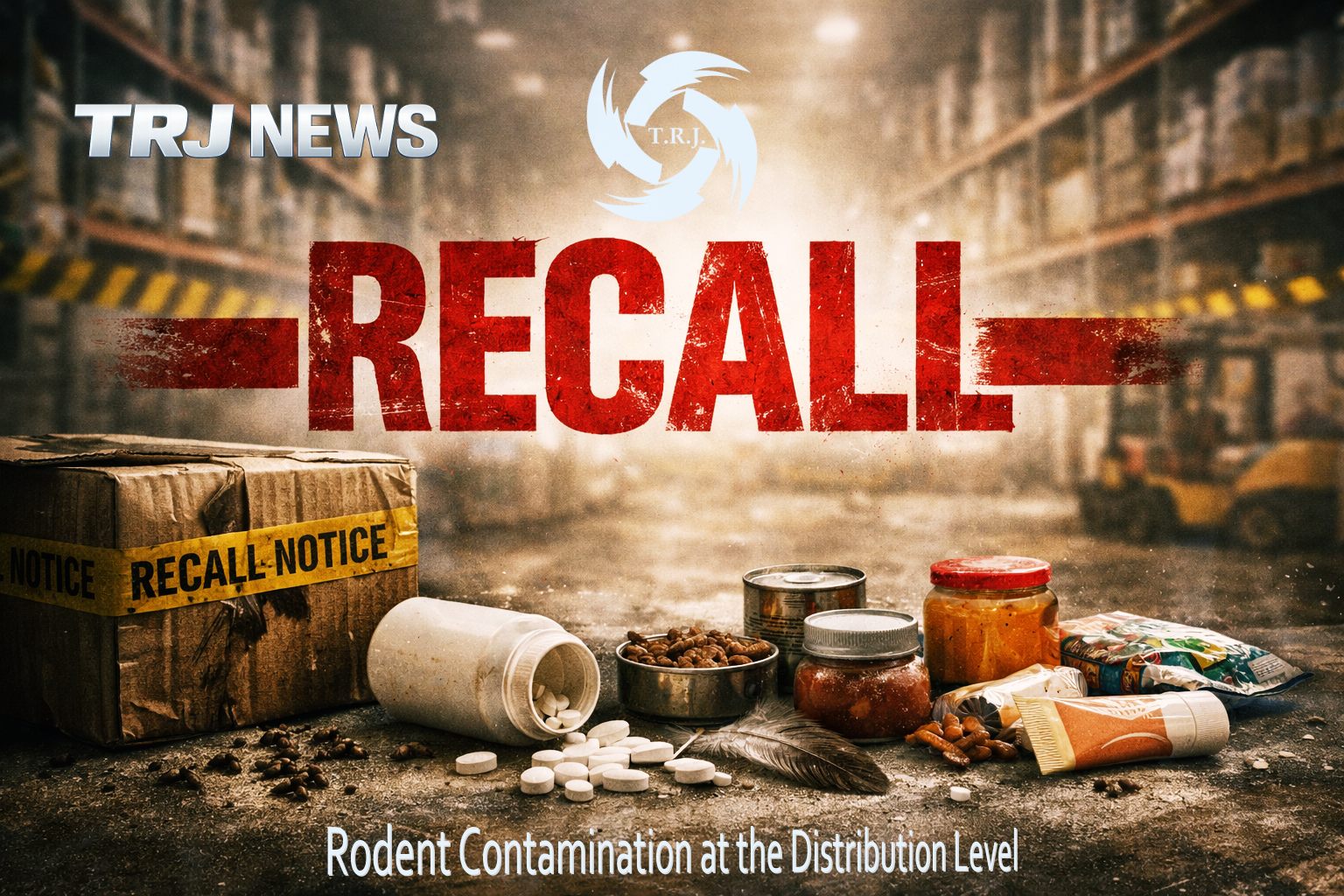
As inspectors traced the exposure window and assessed the inventory that had passed through the facility during that period, the scope widened rapidly. The issue was no longer confined to a single product line, a single brand, or even a single category of goods. It extended across food and beverages, over-the-counter medications, dietary supplements, cosmetics, personal care items, pet products, and health-related consumer goods — nearly 2,000 individual products, each with its own distribution path, retail endpoint, and consumer base.
The trigger was not a contaminated ingredient. It was not a production-line failure, a mislabeled additive, or a breakdown at the factory level. It was something far less visible to the public and far more destabilizing in its implications: systemic contamination at the distribution layer, where products from hundreds of unrelated manufacturers converge under one roof, handled in shared environments before reaching stores.
The U.S. Food and Drug Administration confirmed that all FDA-regulated products stored or distributed through the affected facility during the identified exposure window were deemed potentially unsafe and placed under recall classification. This determination was not precautionary theater. It was rooted in established federal standards that treat rodent and bird waste as direct contamination vectors capable of transferring harmful pathogens through contact, handling, and surface exposure.
This was not a theoretical risk, nor a speculative one. It was a documented contamination event, validated through inspection findings and formalized through recall action. The implications extend beyond any single product on a shelf. They reach into the structural integrity of the supply chain itself, where failures at one unseen node can quietly compromise thousands of consumer goods before the public ever becomes aware.
Where the Failure Occurred
The recall traces back to a single point in the supply chain that consumers rarely see and almost never scrutinize: a regional distribution facility operated by Gold Star Distribution, Inc. From this location, products were routed to retailers across Minnesota, Indiana, and North Dakota, moving quietly through the final stage before reaching store shelves and, ultimately, households.
Unlike manufacturing plants, which typically handle a limited range of tightly controlled product lines, distribution centers function as convergence points. Under one roof, they store and move products from dozens — sometimes hundreds — of unrelated brands, spanning food, medicine, supplements, cosmetics, and pet products. This concentration is efficient for commerce, but it creates an outsized vulnerability when sanitation fails. A breakdown at this level does not remain contained. It propagates outward, simultaneously affecting unrelated products that share nothing in common except physical proximity.
According to FDA inspection findings, the conditions inside the Gold Star Distribution facility had deteriorated beyond acceptable regulatory thresholds. Investigators documented active rodent presence, not merely signs of past infestation. Rodents were not confined to exterior areas or isolated corners of the building. Evidence indicated sustained activity within zones used to store FDA-regulated goods.
Inspectors identified accumulated rodent droppings in product storage areas, alongside evidence of rodent urine exposure — a critical distinction under federal safety standards. Rodent urine is treated as a high-risk contaminant due to its ability to spread pathogens invisibly across surfaces, packaging, and handling equipment. The presence of bird droppings in areas designated for consumable goods further compounded the risk, signaling a breakdown not only in pest control but in environmental containment.
These findings mattered not because of their appearance, but because of their implications. Distribution facilities rely on constant movement: pallets shifted, cases opened, products handled, and packaging surfaces touched repeatedly before shipment. Under such conditions, contamination does not need to penetrate packaging to pose a risk. External exposure alone is sufficient to compromise product safety when contamination is persistent and widespread.
The FDA concluded that the facility’s conditions were capable of contaminating sealed, semi-sealed, and externally handled products alike, eliminating the assumption that packaging integrity alone could mitigate risk. This assessment placed the contamination squarely within the scope of federal recall authority.
As a result, the FDA initiated a Class II recall, a designation reserved for situations where exposure may lead to temporary or medically reversible adverse health consequences. While not the most severe classification, it is not routine. It reflects a determination that the risk was credible, non-trivial, and grounded in documented exposure, not hypothetical modeling.
In practical terms, this meant that any FDA-regulated product that passed through the facility during the identified exposure window was considered potentially unsafe — not because it could be proven individually contaminated, but because the environment in which it was stored failed to meet the minimum standards required to protect public health.
This was not a single-point lapse. It was a systemic sanitation failure at a node designed to move vast quantities of consumer goods efficiently. When that node failed, the consequences were not isolated to one brand or one category. They spread outward, quietly and indiscriminately, across the retail landscape.
Why Rodent and Bird Waste Is a Serious Health Threat
Rodent and bird contamination is often dismissed in public discourse as a cleanliness issue — an unpleasant but superficial problem that can be solved with removal, wiping, or disposal. In reality, federal health agencies treat it very differently. The presence of rodent or bird waste in environments where consumer goods are stored is classified as a biological hazard, not because of how it looks, but because of what it carries and how easily it spreads beyond visible traces.
Rodents and birds are established reservoirs for a range of pathogens that pose direct risks to human and animal health. These organisms do not remain confined to droppings or urine in a static form. They move. They migrate across surfaces, into dust, onto packaging, and into the air of enclosed spaces. Once present in a storage environment, they can persist long after the waste itself is no longer visible.
Among the pathogens associated with rodent and bird contamination are Salmonella and E. coli, bacteria commonly linked to foodborne illness but capable of being transmitted through surface contact rather than ingestion alone. Leptospirosis, spread through rodent urine, can enter the body through small breaks in the skin or mucous membranes. Campylobacter infections are frequently associated with contaminated food handling environments. Hantavirus, while rare, carries severe consequences when exposure occurs, particularly in enclosed or poorly ventilated spaces where aerosolized particles can accumulate.
What makes these risks especially dangerous is that visible contact is not required. Consumers do not need to see droppings, smell urine, or observe damaged packaging for exposure to occur. Pathogens can be transferred through handling contaminated outer packaging, through contact with surfaces touched repeatedly during distribution, or through microscopic breaches that develop in packaging materials under pressure, stacking, or environmental stress.
In enclosed facilities, dried droppings and urine can break down into fine particles that become airborne, settling invisibly onto products and packaging. These particles can later be transferred during unpacking at retail locations or during food preparation in homes, creating exposure pathways far removed from the original contamination site.
The risk does not distribute evenly across populations. Children, whose immune systems are still developing, face higher vulnerability to dehydration and infection. Older adults often experience more severe outcomes from gastrointestinal illness. Pregnant individuals face additional risks from bacterial exposure that can affect fetal health. Immunocompromised individuals may be unable to fight infections that others recover from without complication. Pets, which often consume the same food repeatedly from the same batch, can experience concentrated exposure, sometimes before human illness draws attention to the source.
This is why federal standards treat rodent and bird contamination as grounds for recall even when no illness has yet been reported. The danger lies not in a single dramatic exposure event, but in silent, repeated contact — small doses, transferred incrementally, across products that move from warehouse to shelf to home without visible warning.
In that context, contamination at the distribution level represents more than a regulatory violation. It represents a break in the protective barrier that consumers rely on to separate daily life from environmental hazards they cannot see, measure, or control.
Scope of the Recall: What Was Affected
The recall does not target a single product line, a single brand, or even a single category of consumer goods. It applies broadly and deliberately to all FDA-regulated products that were stored or distributed through the contaminated facility during the identified exposure period. That distinction matters, because it shifts the recall from a narrow corrective action into a wide-radius public health response.
At the center of this action is the recognition that contamination at the distribution level does not discriminate. Products that share nothing in common — different manufacturers, different ingredients, different intended uses — can still be compromised simply by occupying the same physical environment. When sanitation fails in that environment, the unit of risk is no longer the product itself, but the space through which the product passed.
As investigators mapped inventory movement through the facility, the scale of potential exposure expanded rapidly. Pallets arrived from unrelated manufacturers. Cases were stacked, shifted, staged, and re-routed. Products intended for grocery shelves moved alongside over-the-counter medications, dietary supplements, cosmetics, and pet food. The facility functioned as a convergence point, and during the exposure window, everything that converged there was subject to the same environmental conditions.
The result was a recall encompassing thousands of individual SKUs, each documented at the UPC level. These were not hypothetical entries or precautionary placeholders. They were specific, traceable products that had already entered commerce, already been distributed, and in many cases already been purchased and consumed before the recall became public.
What makes this scope especially consequential is its diversity. The affected items were not limited to discretionary snacks or low-risk goods. They included daily-use foods, staple products, medications taken for pain or illness, supplements consumed routinely, infant and child-adjacent items, and pet products used repeatedly over time. Exposure, therefore, was not confined to a single consumer behavior or moment. It was embedded in ordinary routines.
Because the contamination occurred at the storage and handling stage, individual product testing could not reliably isolate risk. The FDA’s determination reflected this reality. Rather than attempting to separate “likely contaminated” items from “probably safe” ones, the agency treated the exposure environment itself as compromised. Any FDA-regulated product that passed through that environment during the exposure period was included.
This is why the recall appears so expansive on paper. It is not the result of regulatory overreach or indiscriminate action. It is the logical consequence of a failure that occurred after production but before retail, at a point where separation between product categories collapses and shared risk replaces individual assurance.
In practical terms, this means the recall is not defined by brand recognition or consumer familiarity. It is defined by time, place, and movement — by which products were present, when they were present, and how they moved through a facility that no longer met the minimum conditions required to protect public health.
Affected Product Categories Include:
Food & Beverages
- Cereals
- Snack foods
- Candy and confectionery
- Shelf-stable meals
- Condiments
- Bottled drinks
- Sports beverages
Medications & Supplements
- Over-the-counter pain relievers
- Cold and allergy medications
- Vitamin products
- Fortified lozenges and gums
Cosmetics & Personal Care
- Body sprays
- Hygiene products
- Cotton and cosmetic accessories
Pet Products
- Canned and dry pet food
- Animal supplements
Because the contamination occurred at the storage and handling level, brand reputation or factory cleanliness does not mitigate risk. Products manufactured correctly can still become unsafe if exposed to contaminated environments during distribution.
Brand Names Cited in Public Reporting
While the recall is not nationwide for these brands, FDA records and confirmed reporting identified products from well-known household names among those stored at the affected facility, including:
- Cheerios
- Pringles
- Skittles
- Rice Krispies
- Lucky Charms
- Froot Loops
- Nutella
- Kraft Mac & Cheese
- Coca-Cola and Diet Coke products
- Gatorade
- Arizona Iced Tea
- Advil
- Tylenol
- Benadryl
- Excedrin
- Pet food brands distributed through the facility
These brand names appear in reporting solely because their products passed through the contaminated distribution warehouse, not because the manufacturers themselves initiated recalls or experienced production-level failures. The contamination occurred at the storage and handling stage, after products had already left factory control.
The complete list of affected products is documented in the official FDA recall attachment, which enumerates every recalled item at the SKU and UPC level. That document is freely downloadable and has been made available directly on our site for transparency and public verification. Inclusion on the list reflects distribution exposure, not brand misconduct or manufacturing contamination.
This distinction is critical. The recall is not driven by brand identity or consumer visibility, but by time, location, and movement through a compromised environment, as established in the FDA’s own records and preserved here in full.
What This Recall Does Not Mean
It is critical to be precise:
- This is not a nationwide recall of the named brands
- This is not evidence of contaminated production lines
- This does not mean all products from these brands are unsafe
- This is location-specific and lot-specific
However, precision does not reduce seriousness. A recall affecting nearly 2,000 SKUs across multiple categories represents a significant breakdown in supply-chain sanitation, not a minor procedural lapse.
What Consumers Should Do Immediately
Consumers in Minnesota, Indiana, and North Dakota should take this seriously.
Recommended actions:
- Check FDA recall listings for exact UPC and SKU matches
- Do not consume, use, or donate recalled products
- Dispose of them safely to avoid secondary exposure
- Contact retailers or distributors for refund or replacement guidance
- If illness occurred after consumption or use, seek medical or veterinary care
Even if no symptoms are present, retained products remain a contamination risk.
The Larger Issue: Distribution as a Blind Spot
This incident exposes a critical vulnerability in the modern supply chain — one that remains largely invisible to consumers and, too often, insufficiently scrutinized until after harm has already occurred. Public understanding of food and product safety failures tends to focus on farms, factories, or foreign manufacturing sources. Those are the places people imagine when contamination is discussed. Distribution rarely enters the conversation, despite the fact that it sits directly between production and consumption.
Distribution hubs operate in the background, out of public view and largely outside consumer awareness. They are not brand-facing environments. They do not appear on packaging. They are not marketed, photographed, or visited by the people whose lives they quietly shape. Yet they function as critical convergence points, where products from hundreds of unrelated manufacturers are stored together, handled by shared labor forces, and moved through common physical spaces before reaching retail shelves.
When sanitation collapses at this level, the consequences are fundamentally different from a failure at a single factory. A manufacturing defect typically affects one product line or one brand. A distribution failure affects everything that passes through the space, regardless of origin. The risk is not limited by ingredients, processes, or corporate quality controls upstream. It is dictated by proximity, duration, and environmental exposure.
A single unsanitary warehouse can compromise hundreds of brands not because those brands failed independently, but because they were temporarily bound together by shared storage conditions. It can affect thousands of unrelated products that share no common formulation, use, or consumer demographic. It can expose millions of consumers precisely because the failure occurs so late in the supply chain, after products have already been dispersed across regions and retail networks. And it can evade public awareness until after exposure has occurred, because distribution-level failures leave no visible mark on packaging and no immediate signal to the end user.
This is what makes distribution such a dangerous blind spot. The system is designed for efficiency and throughput, not for transparency. Oversight exists, but it is periodic, not continuous. Consumers have no practical way to know where a product was stored, what it was stored alongside, or what conditions surrounded it in the final stages before purchase. Trust is implicit and automatic.
The recall did not stem from innovation failure, experimental ingredients, or production shortcuts. It did not involve cutting-edge processes or untested supply chains. It was the result of basic sanitation breakdown — pest control failures, environmental neglect, and structural oversight gaps — the most fundamental safeguards in any food and consumer goods system.
That such a breakdown could reach this scale under modern regulatory frameworks is not a footnote. It is a warning. It demonstrates that even in highly regulated markets, the spaces that matter most are often the ones least examined, and that the weakest link in the supply chain is not always where the public is taught to look.
Conclusion: A Real Health Risk, Quietly Normalized
This recall is not internet panic. It is not exaggeration, and it is not fear-bait engineered for attention. It is a documented public health event, anchored in physical contamination, validated by federal inspection, and formalized through recall action. The facts exist independent of headlines or social media amplification. They exist in inspection findings, recall classifications, and thousands of SKU-level entries that trace exposure through the supply chain.
What makes this event unsettling is not that contamination occurred — contamination, while unacceptable, is not unprecedented. What makes it unsettling is how quietly it unfolded, how late it entered public awareness, and how easily it blended into the background noise of routine recalls and regulatory notices. The scale was vast, the categories affected were diverse, and the exposure pathways were real, yet the moment passed without the kind of sustained scrutiny that such a failure should provoke.
The danger here is not universal. Not every product was affected. Not every consumer was exposed. The risk is localized in time and place, bounded by distribution routes and storage windows. But localization does not negate consequence. For the individuals and households who purchased affected products, for those who consumed them, handled them, or fed them to children or pets, the risk was not abstract. It was personal, immediate, and unknowable at the point of use.
This is where normalization becomes dangerous. When contamination events of this scale are absorbed into the system as routine corrections rather than structural warnings, the underlying conditions that allowed them to occur remain intact. The recall becomes the endpoint instead of the beginning of accountability. The system moves on without asking whether the safeguards consumers rely on are sufficient — or whether they are simply assumed to be.
The lesson here is simple, and it is uncomfortable precisely because it challenges a deeply ingrained belief. Food safety does not end at the factory door. It does not conclude when a product leaves a production line or passes an initial quality check. It extends through storage, handling, and distribution — through the unseen spaces where products wait, move, and intermingle before they ever reach a shelf.
When sanitation collapses downstream, the entire consumer trust model collapses with it. Not because every product becomes unsafe, but because the assurance that separates daily life from unseen hazard is quietly breached. Trust, once compromised at scale, is not restored by recall notices alone. It demands recognition of the failure as systemic, not incidental — and a willingness to treat distribution not as a logistical afterthought, but as a core pillar of public health protection.
This recall should not be remembered as a list of products. It should be remembered as evidence of how fragile safety becomes when the spaces we never see are allowed to fail without consequence.
TRJ Verdict
This was not a fluke. It was not bad luck. It was not an isolated lapse in an otherwise sound system. What this recall exposed is something far more consequential: a structural weakness that has been quietly normalized inside modern supply chains.
The failure did not occur at the margins. It occurred at the center — at a distribution node designed to handle volume, velocity, and efficiency at scale. That node failed its most basic obligation: to maintain an environment that does not actively endanger the public. When that obligation collapses, every downstream assurance becomes conditional, and every upstream safeguard becomes irrelevant.
The regulatory response followed protocol. Inspections were conducted. Findings were documented. A recall was issued. Products were listed. On paper, the system worked. But systems are not judged solely by whether they respond after failure. They are judged by whether they prevent failures from reaching the public in the first place. On that measure, this system failed.
What makes this incident especially telling is how easily it fit into the background. Thousands of products, spanning food, medicine, infant-adjacent goods, and pet products, moved through a contaminated environment, entered commerce, and were consumed before public awareness ever caught up. The recall arrived not as a warning, but as a retroactive correction — a signal that exposure had already occurred.
This is the cost of treating distribution as an afterthought. The supply chain has evolved to optimize speed and consolidation, while oversight has remained episodic and compartmentalized. Manufacturers are audited. Ingredients are traced. Labels are scrutinized. Yet the spaces where products converge, sit, and intermingle — the final choke points before public exposure — operate with far less scrutiny than their impact warrants.
In this model, risk is managed statistically rather than structurally. The assumption is not that failures will be prevented, but that they will be absorbed. Recalls become routine. Exposure becomes acceptable so long as it remains unconfirmed. Accountability becomes diffuse, spread thin across logistics providers, regulators, and procedural language.
That is not a food safety model. It is a damage containment model.
The deeper danger is not rodent contamination itself. It is the quiet acceptance of conditions that allow such contamination to persist long enough to matter. It is the normalization of late discovery. It is the idea that trust can be restored through documentation alone, without addressing the architectural weaknesses that made the failure possible.
This case demonstrates that consumer trust is being asked to bridge gaps it cannot see and risks it cannot assess. When that trust is breached, the burden falls not on the system that failed, but on the public that assumed it was protected.
The verdict is simple and unavoidable:
If distribution remains a blind spot, recalls will continue to function as apologies rather than safeguards.
If sanitation failures at scale are treated as procedural errors instead of systemic warnings, exposure will remain inevitable.
And if oversight continues to focus on where products are made rather than where they are moved, stored, and consolidated, the next recall will not be an anomaly — it will be an expectation.
This was not just a recall.
It was a signal.
And signals, when ignored, do not disappear. They compound.
Official FDA attachment listing every recalled SKU and UPC (Free Download)


🔥 NOW AVAILABLE! 🔥
🔥 NOW AVAILABLE! 🔥
📖 INK & FIRE: BOOK 1 📖
A bold and unapologetic collection of poetry that ignites the soul. Ink & Fire dives deep into raw emotions, truth, and the human experience—unfiltered and untamed
🔥 Kindle Edition 👉 https://a.co/d/9EoGKzh
🔥 Paperback 👉 https://a.co/d/9EoGKzh
🔥 Hardcover Edition 👉 https://a.co/d/0ITmDIB
🔥 NOW AVAILABLE! 🔥
📖 INK & FIRE: BOOK 2 📖
A bold and unapologetic collection of poetry that ignites the soul. Ink & Fire dives deep into raw emotions, truth, and the human experience—unfiltered and untamed just like the first one.
🔥 Kindle Edition 👉 https://a.co/d/1xlx7J2
🔥 Paperback 👉 https://a.co/d/a7vFHN6
🔥 Hardcover Edition 👉 https://a.co/d/efhu1ON
Get your copy today and experience poetry like never before. #InkAndFire #PoetryUnleashed #FuelTheFire
🚨 NOW AVAILABLE! 🚨
📖 THE INEVITABLE: THE DAWN OF A NEW ERA 📖
A powerful, eye-opening read that challenges the status quo and explores the future unfolding before us. Dive into a journey of truth, change, and the forces shaping our world.
🔥 Kindle Edition 👉 https://a.co/d/0FzX6MH
🔥 Paperback 👉 https://a.co/d/2IsxLof
🔥 Hardcover Edition 👉 https://a.co/d/bz01raP
Get your copy today and be part of the new era. #TheInevitable #TruthUnveiled #NewEra
🚀 NOW AVAILABLE! 🚀
📖 THE FORGOTTEN OUTPOST 📖
The Cold War Moon Base They Swore Never Existed
What if the moon landing was just the cover story?
Dive into the boldest investigation The Realist Juggernaut has ever published—featuring declassified files, ghost missions, whistleblower testimony, and black-budget secrets buried in lunar dust.
🔥 Kindle Edition 👉 https://a.co/d/2Mu03Iu
🛸 Paperback Coming Soon
Discover the base they never wanted you to find. TheForgottenOutpost #RealistJuggernaut #MoonBaseTruth #ColdWarSecrets #Declassified


Sponsored • TRJ Ads
Inquiries: contact@therealistjuggernaut.com






“What makes these risks especially dangerous is that visible contact is not required. Consumers do not need to see droppings, smell urine, or observe damaged packaging for exposure to occur.”
I would assume that someone will at least lose their job over this. It has got to be someone’s job to insure that places like this are not contaminated. Someone did not do their job. There must be rules about sanitary conditions in distribution facilities like this. Whether it was facility inspectors who missed this or facility administrators who didn’t see to it that inspections were done in a timely manner, someone should be held accountable for this. What a mess this has created and who knows how many health issues people will have because of it.
Thank you for posting the Recall List Download.
I appreciate the articles you have published today, John. I hope you have a great evening and a great weekend as well! May God bless you and yours!
You’re very welcome, Chris. Facilities like this don’t operate without rules, and contamination at this scale doesn’t happen in a vacuum — as you rightly pointed out. There are federal sanitation standards, inspection requirements, pest-control obligations, and internal compliance responsibilities specifically designed to prevent exactly this kind of failure.
When those safeguards break down, accountability has to exist somewhere — whether at the facility management level, within inspection oversight, or in how compliance was monitored and enforced. A failure this widespread means something systemic was missed, ignored, or deprioritized, and that deserves scrutiny.
What makes it especially troubling, as you noted, is that exposure doesn’t require obvious signs. That’s why these standards exist in the first place, and why the consequences extend beyond logistics into real public health risk.
Thanks again, Chris. I appreciate you taking the time to engage so thoughtfully with the article and for acknowledging the recall list. Thank you as well for your kind words. I hope you have a great evening and a great weekend ahead as well. God bless you and yours always. 😎
This is so true…
“A failure this widespread means something systemic was missed, ignored, or deprioritized, and that deserves scrutiny.”
You’re welcome, John, and thank you for the additional information and for your kind words. I wish you a great evening and may God bless you and yours as well!