
Thank you for reading or listening to The Realist Juggernaut. Independent journalism should be accessible to everyone.
The Architecture of Organic Time and Its Translation Into Sound
There are moments during research when one subject unexpectedly reveals another. In this case, the discovery was not that trees contain music in any literal sense, but that they contain measurable structure within their rings — physical records of time layered into wood. That realization reframes the question entirely. The issue is not whether a melody is hidden inside the trunk, but whether structured variation can be translated when a system is deliberately built to read it. What appears at first to be poetic metaphor becomes a problem of architecture: how does spatial growth become audible sequence? How does circular accumulation become forward progression? How does decades-long biological negotiation with climate become something that unfolds within minutes?
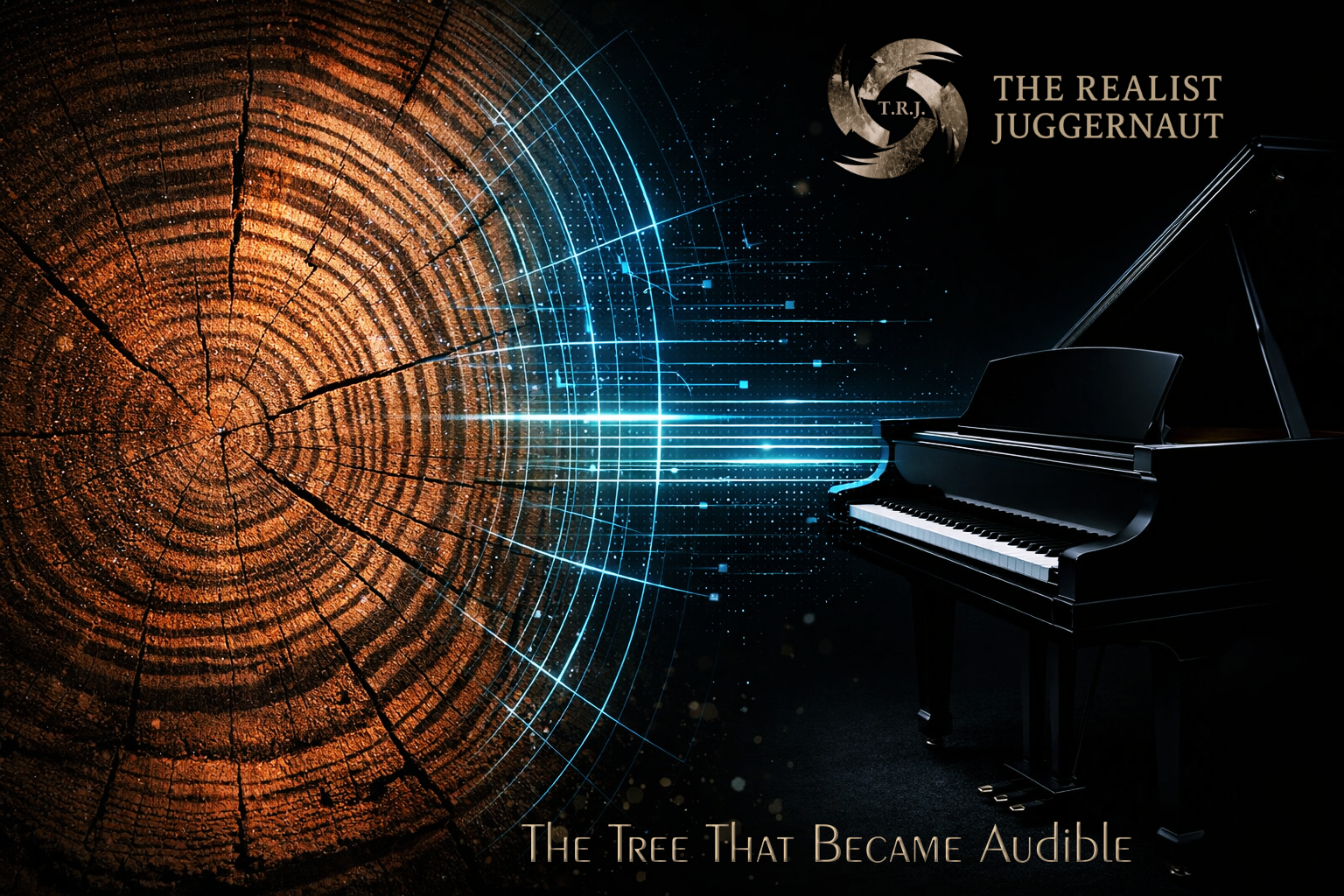
The installation does not reveal a concealed symphony embedded in wood. It demonstrates something more fundamental: time leaves structure behind, and structure can be reorganized into perception through intentional design. Bartholomäus Traubeck’s Years begins from this mechanical premise. A cross-section of a tree trunk is mounted onto a modified turntable. A camera replaces the stylus. As the disk rotates, the camera samples a microscopic slice of visual information. Rings pass through its field of view. Variation is detected and converted into data. A rule-based generative engine translates that data into piano tones. The result is not a novelty and not an illusion. It is an architectural act of translation in which radial growth becomes temporal progression.
The tree itself functions as an archive. Its rings are the residue of environmental pressure and recovery. Each band reflects a year’s negotiation between organism and climate. Wide rings indicate seasons of abundance. Narrow rings record drought, cold, or stress. Density differences between earlywood and latewood encode seasonal shifts within a single cycle. Fire scars interrupt continuity. Insect damage alters geometry. None of this is symbolic. It is structural. The trunk is not a metaphorical record; it is a biological document written in cellulose and lignin, shaped by forces that operate slowly and without intention toward aesthetics.
Dendrochronology treats these rings as chronological instruments. By comparing patterns across trees, scientists reconstruct climate histories extending back centuries. The precision of this discipline is not speculative. Overlapping ring sequences allow researchers to date historical buildings, volcanic eruptions, and drought cycles with remarkable accuracy. A tree stores time not as narrative but as geometry. Its archive is radial, layered outward from the core. It is spatial rather than temporal in presentation. Years accumulate as thickness and contrast rather than as minutes and seconds. The memory is visible but not audible. It exists as variation in material density, silent yet precise.
The installation recognizes that variation is measurable. Measurable variation can be converted into numerical data. Numerical data can drive a generative musical system when interpreted through defined mapping rules. The crucial distinction lies in the mapping. Traubeck experimented with direct sonification—attempting to convert raw brightness values from the optical sensor into immediate frequency output. The results were not musically coherent because the surface of a tree trunk is not shaped like an acoustic waveform designed for playback. It contains contrast gradients and ring boundaries. These had to be interpreted through a designed grammar in order to become music. The choice to build that grammar rather than claim discovery of hidden sound is what stabilizes the integrity of the piece.
The system therefore assigns musical parameters based on visual input. Ring thickness influences pitch selection or interval spacing. Contrast changes influence dynamics or rhythmic density. Irregularities in growth may trigger harmonic clusters. The piano instrument was chosen deliberately for its tonal clarity and broad expressive range, allowing the structural variation to remain perceptible rather than obscured beneath synthetic effects. The output is structured by software environments capable of real-time generative composition. The tree does not dictate a fixed melody. It influences the behavior of a compositional engine whose boundaries were authored by the artist.
This is not falsification. It is translation.
The radial archive of decades is converted into linear time. The circumference becomes sequence. As the disk rotates, spatial geometry is unfolded into temporal progression. Years that once existed as expanding circles are reorganized into minutes of audible movement. The installation compresses biological duration into perceptible musical form. What took decades to grow can be experienced within a listening session. The compression does not erase the tree’s history. It reorders it. It preserves structural variation while altering perceptual scale.
Authenticity arises not because the tree contains melody, but because the variation being interpreted is genuine. The generative engine is constrained by the structural reality of the wood. Two trees processed through the same rule-set yield different sonic textures because their growth histories differ. A fir tree with broad, even rings produces a sparse and open composition. An ash tree with tight, irregular growth generates more intricate rhythmic patterns. The grammar remains constant. The structural input changes. The system is not improvising independently of the tree. It is responding to it within defined boundaries established by measurable difference.
Authorship becomes layered and inseparable from process. The tree authored its structure through years of environmental negotiation. The artist authored the rule-set that defines how structure becomes tone. The machine executes the rule-set with mechanical consistency. The listener completes the circuit by perceiving emotional coherence in the resulting sound. The composition does not exist at any single layer in isolation. It emerges from interaction. Biological record, computational interpretation, mechanical execution, and human perception converge to produce the final experience. The piece exists in that convergence, not in any individual component alone.
The installation sits at a larger intersection in contemporary thought. Across scientific and artistic domains, structured physical phenomena are routinely translated into alternative perceptual channels. Seismic data becomes sound to reveal patterns otherwise invisible. Brainwave signals are mapped into music in neurofeedback systems. Climate models are rendered into visual simulations. Astronomical radiation data is converted into audible frequencies to make distant cosmic processes perceptible. These processes do not claim that earthquakes or stars contain hidden songs. They recognize that structure exists and that structure can be reorganized into forms that human perception can apprehend more directly.
In this context, Years becomes part of a broader civilizational movement toward cross-domain interpretation. The physical world contains patterns beyond the limits of immediate sensory access. Technology extends those limits by measuring variation and re-expressing it. The installation demonstrates that translation can be artistic without abandoning structural honesty. It does not claim that wood stores piano music. It demonstrates that growth variation can drive musical output when mediated by a defined grammar. It makes visible the mechanism of interpretation rather than obscuring it.
The work also reframes scale. Trees operate on timescales that exceed daily human awareness. Their growth is gradual, silent, and layered. The life of a tree may span generations of human experience. By translating those layers into audible progression, the installation alters perception of duration. The listener hears decades compressed into minutes, experiencing environmental memory as sequence rather than static cross-section. The passage of time becomes dynamic rather than geological. It becomes something that can be traversed in one sitting, even if it originally unfolded across decades of weather and sunlight.
The deeper significance lies not in novelty but in implication. If a tree’s radial growth can be interpreted into music through measurement and mapping, then structured variation throughout the physical world can, in principle, be translated into alternative sensory domains. The limiting factor is not whether the structure exists. It is whether a system is built to read it. Measurement precedes interpretation. Interpretation precedes perception. The installation makes this chain visible without overstating its claim.
The machine does not listen in the human sense. It samples and computes. Yet through that sampling, it enables a form of listening that would otherwise be impossible. The listener hears not the literal voice of the tree but the re-expression of its structural history. The installation respects the boundary between archive and invention. It does not collapse them into mythology. It stands precisely at the point where biological record meets algorithmic design, and where design remains transparent about its role.
TRJ Verdict
Years does not prove that trees compose music. It proves something more disciplined and more consequential: that structure precedes perception, and that meaning emerges when structure is translated through intentional systems. The installation stands as a reminder that the physical world is saturated with measurable variation long before it becomes experience. A tree does not grow to create melody. It grows in response to climate, soil, water, and stress. Those responses accumulate as geometry. Geometry becomes data when measured. Data becomes tone when mapped. Tone becomes meaning when heard. The work does not mystify this chain. It reveals it.
The significance of the installation lies in its transparency. The artist does not claim discovery of hidden acoustic storage within wood. He acknowledges the interpretive layer. The rule-set is authored. The machine executes. The tree influences. The listener completes. That clarity preserves the integrity of the piece. It demonstrates that translation is not deception when its grammar is openly constructed. It reveals that authenticity can exist even when mediation is present, provided the mediation remains structurally honest.
The broader implication extends beyond art. Modern civilization increasingly interacts with reality through translation layers. Environmental data becomes models. Biological signals become diagnostics. Seismic tremors become sound. Radiation becomes visualization. Structured variation is continuously converted into forms that human perception can apprehend. The act of translation shapes understanding. It can distort. It can illuminate. The difference lies in whether the interpretive system is acknowledged and examined. Years makes its system visible. It invites the listener to consider not only what is being heard, but how it is being rendered.
In compressing decades of biological growth into minutes of music, the installation reframes scale without distorting origin. It allows environmental memory to be experienced temporally rather than statically. It demonstrates that time stored in matter can be reorganized without being falsified. The work does not collapse the boundary between archive and invention; it builds a deliberate bridge between them. That bridge is constructed through rule, not romantic exaggeration.
The enduring strength of the piece lies in its restraint. It does not promise hidden symphonies within forests. It does not claim that nature secretly composes. It offers something more durable: evidence that the world contains structured information beyond our immediate senses, and that careful design can render that structure perceptible without sacrificing fidelity. The tree remains a tree. The machine remains a machine. The music emerges through translation.
And in that translation lies the lesson. Structure exists before interpretation. Interpretation shapes perception. Perception assigns meaning. When those stages are understood rather than obscured, translation becomes art rather than illusion. From a musician’s perspective, the installation carries a particular gravity. It reveals how tone can emerge from disciplined interpretation rather than from myth. The resonance is not accidental. It is constructed — and that construction is precisely what makes it meaningful.
The following video provides a concrete visual demonstration of the installation at work, showing how the tree cross-section rotates, how structural variation is captured, and how that variation corresponds to the generative musical output.


🔥 NOW AVAILABLE! 🔥
🔥 NOW AVAILABLE! 🔥
📖 INK & FIRE: BOOK 1 📖
A bold and unapologetic collection of poetry that ignites the soul. Ink & Fire dives deep into raw emotions, truth, and the human experience—unfiltered and untamed
🔥 Kindle Edition 👉 https://a.co/d/9EoGKzh
🔥 Paperback 👉 https://a.co/d/9EoGKzh
🔥 Hardcover Edition 👉 https://a.co/d/0ITmDIB
🔥 NOW AVAILABLE! 🔥
📖 INK & FIRE: BOOK 2 📖
A bold and unapologetic collection of poetry that ignites the soul. Ink & Fire dives deep into raw emotions, truth, and the human experience—unfiltered and untamed just like the first one.
🔥 Kindle Edition 👉 https://a.co/d/1xlx7J2
🔥 Paperback 👉 https://a.co/d/a7vFHN6
🔥 Hardcover Edition 👉 https://a.co/d/efhu1ON
Get your copy today and experience poetry like never before. #InkAndFire #PoetryUnleashed #FuelTheFire
🚨 NOW AVAILABLE! 🚨
📖 THE INEVITABLE: THE DAWN OF A NEW ERA 📖
A powerful, eye-opening read that challenges the status quo and explores the future unfolding before us. Dive into a journey of truth, change, and the forces shaping our world.
🔥 Kindle Edition 👉 https://a.co/d/0FzX6MH
🔥 Paperback 👉 https://a.co/d/2IsxLof
🔥 Hardcover Edition 👉 https://a.co/d/bz01raP
Get your copy today and be part of the new era. #TheInevitable #TruthUnveiled #NewEra
🚀 NOW AVAILABLE! 🚀
📖 THE FORGOTTEN OUTPOST 📖
The Cold War Moon Base They Swore Never Existed
What if the moon landing was just the cover story?
Dive into the boldest investigation The Realist Juggernaut has ever published—featuring declassified files, ghost missions, whistleblower testimony, and black-budget secrets buried in lunar dust.
🔥 Kindle Edition 👉 https://a.co/d/2Mu03Iu
🛸 Paperback Coming Soon
Discover the base they never wanted you to find. TheForgottenOutpost #RealistJuggernaut #MoonBaseTruth #ColdWarSecrets #Declassified


Sponsored • TRJ Ads
Inquiries: contact@therealistjuggernaut.com








Wow! Interesting
Thank you very much, Imelda. It really is fascinating. The idea that growth can be translated into sound makes you look at trees a little differently.
Thanks for reading. I hope you have a great week ahead. 😎
I love what you wrote about the tree rings storing time. My uncle, a church pastor, also is a wood turner. He and I both love the pens he’s turned that show the rings. I think I am beginning to see why!
Thank you very much, Sheila — that’s a great connection.
There’s something powerful about seeing the rings exposed in a piece of turned wood. What was once hidden inside the trunk becomes visible in the grain, and suddenly you’re looking at years rather than just material. It changes how you see it.
Your uncle’s work with those pens makes even more sense in that light. Every ring carries history — seasons, pressure, growth — all preserved in structure. Once you begin to notice that, it’s difficult to look at wood the same way again.
I appreciate you sharing that. I hope you have a great day. 😎
That is one interesting video!
It really is. What struck me most wasn’t just the sound, but the structure behind it — the idea that measurable growth can be translated into something audible without distorting its origin.
It’s a fascinating intersection of biology, time, and interpretation.
I appreciate you taking the time to watch it, Chris. I hope you have a great week ahead. 😎
I don’t know how you find things like this, John, but this is definitely unique. I have an oak tree in my back yard that is approximately 150 years old. I used the trunk diameter and a chart to get that number. It puts the tree back to the presidency of President Grant give or take a president. It is a beautiful tree that is very symmetrical in shape. The trunk isn’t close to being perfectly round but it looks just fine from a distance. When you get closer you can seem to see places where there might have been some form of stress for a number of years. I’m sure it has been through many storms and it stands as a monument to the creative power of Almighty God.
Thanks again, John, and I hope you have a great week ahead as well! 🙂