
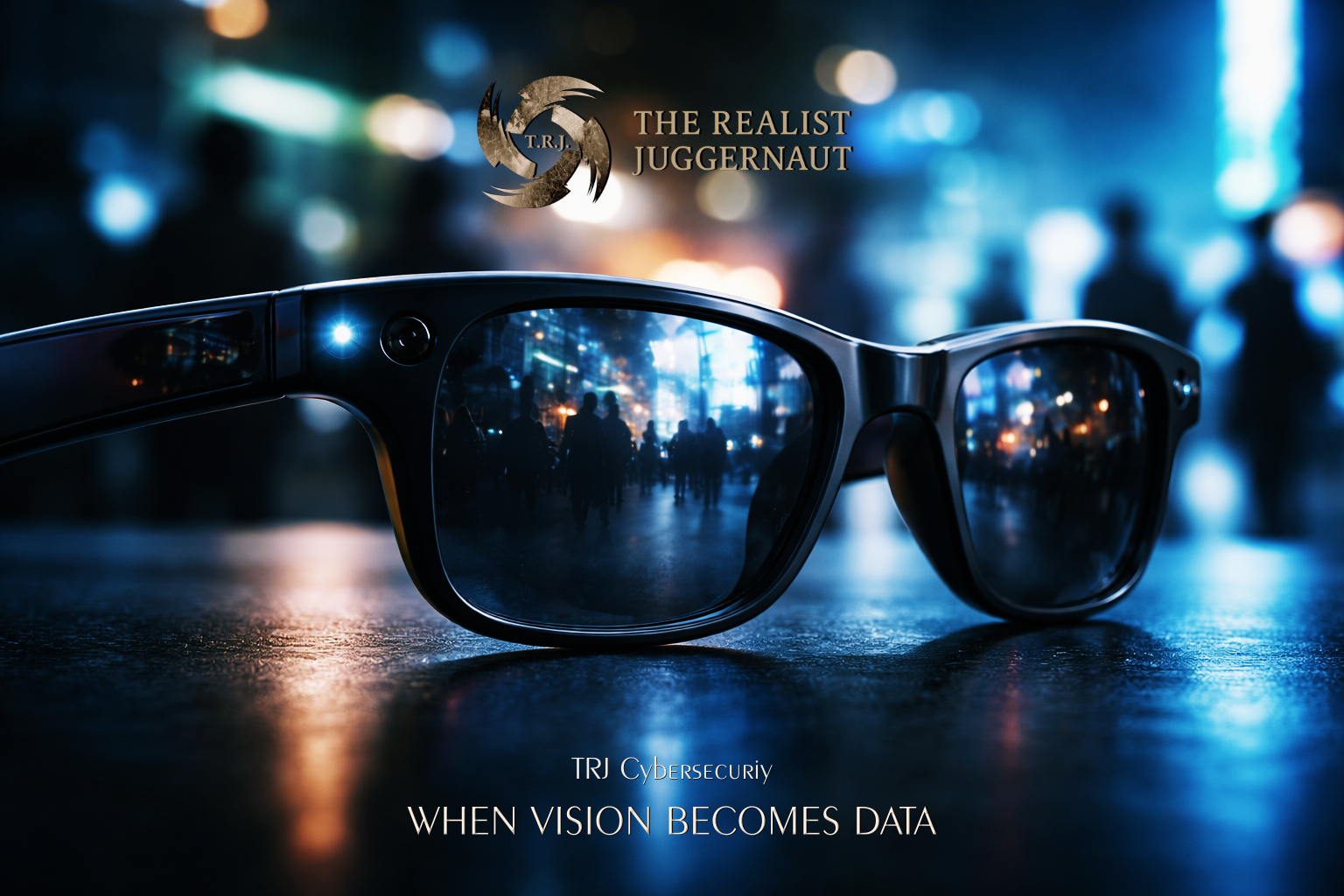
Wearable AI Glasses, Ambient Recording, and the Emerging Surveillance Question
Wearable technology has moved steadily from convenience gadget to digital infrastructure. Wrist-mounted health monitors track heart rhythms and sleep cycles. Wireless earbuds remain continuously connected to voice assistants. Smartphones already function as portable sensor arrays linked to global cloud networks that process location, audio, and biometric information.
A new category of device is now pushing those capabilities directly into human vision.
Smart glasses equipped with cameras, microphones, speakers, and artificial intelligence are beginning to enter everyday life disguised as ordinary eyewear. Among the most visible examples are Ray-Ban Meta smart glasses, developed by Meta Platforms in collaboration with Luxottica under the Ray-Ban brand. The device integrates a front-facing camera system, open-ear speakers, voice-activated AI interaction, and wireless connectivity with smartphones through the Meta View mobile application.
The concept appears simple: a hands-free way to capture photos, short video clips, and voice interactions directly from eye level. Yet the moment recording hardware moves from a handheld device to a wearable platform embedded in clothing, the technological and social implications change dramatically.
A camera attached to the face does not merely capture moments. It observes everything the wearer sees.
That shift introduces a fundamental privacy and cybersecurity debate now expanding across regulators, researchers, and digital-rights experts worldwide.
A Camera That Sees What the User Sees
The core design of wearable smart glasses centers on perspective. Cameras positioned within the frame capture images from the wearer’s direct line of sight. This creates a recording viewpoint that mirrors human vision rather than the outward-held angle of a smartphone camera.
The system allows users to capture photos or short videos using voice commands or physical controls on the frame. Built-in microphones enable voice interactions with artificial intelligence features capable of identifying objects or answering contextual questions about the environment. The device can also play music, conduct phone calls, and synchronize captured media with a connected smartphone.
From a technical standpoint, the glasses combine multiple technologies that already exist individually—mobile photography, voice assistants, wireless audio, and cloud-based AI analysis. Their novelty lies in how seamlessly those capabilities merge into a device designed to look indistinguishable from conventional eyewear.
The practical effect is a camera that moves continuously through everyday environments.
Restaurants, office spaces, public streets, retail stores, and private homes can all appear within the field of view as the wearer goes about routine activities. Images and video captured by the glasses may then be uploaded through the companion mobile application for storage or further processing inside cloud infrastructure operated by the device manufacturer.
The convenience is undeniable. The privacy implications are far less straightforward.
The Bystander Privacy Problem
One of the most frequently cited concerns surrounding wearable cameras is known among privacy researchers as the bystander consent problem.
Most personal technology devices collect information primarily from the individual who owns them. Smartphones store photos taken intentionally by the user. Fitness trackers measure the wearer’s own biometrics.
Wearable cameras operate differently.
They collect information about everyone nearby.
People appearing within the recording frame often have no knowledge that a camera is active. Unlike smartphones, which must be visibly raised to capture an image, smart glasses allow recording to occur while the device remains positioned naturally on the wearer’s face.
This design creates a new category of data capture in which individuals become part of a digital record without any direct interaction with the device responsible for collecting it.
In daily life this can include conversations at restaurant tables, shoppers browsing retail aisles, pedestrians moving through public spaces, or guests visiting private homes. Each of these environments carries different expectations regarding visibility, consent, and personal privacy.
The moment a wearable camera enters that environment, those expectations can change without warning.
The Indicator Light Debate
Manufacturers have attempted to address these concerns through visible recording indicators. Ray-Ban Meta smart glasses include a small LED light positioned on the frame that illuminates when the camera begins capturing video.
The concept mirrors the recording indicator found on many webcams and laptops. The light is intended to alert nearby individuals that recording is in progress.
The effectiveness of this solution remains widely debated.
Privacy researchers note that the indicator is small and can be difficult to notice in crowded or brightly lit environments. Its visibility also depends on the observer’s viewing angle relative to the glasses. Demonstrations by technology reviewers have shown that the indicator can be obscured if the light is covered.
Critics argue that the system may provide only minimal practical notice to bystanders. If the signal goes unseen, individuals captured in the recording may remain unaware that the device is operating.
The question facing regulators is whether a small visual indicator constitutes meaningful transparency when the recording device itself blends seamlessly into everyday clothing.
When Artificial Intelligence Enters the Loop
Smart glasses are not simply portable cameras. Increasingly they function as front-end interfaces for artificial intelligence systems capable of interpreting the visual world.
When users ask the device to identify an object or analyze a scene, captured images may be transmitted to remote servers where machine-learning models process the visual information. The AI system then returns a response to the wearer through audio feedback.
Behind that seemingly simple interaction lies a vast ecosystem of machine-learning infrastructure.
Modern visual AI systems require enormous quantities of labeled images and video in order to recognize patterns accurately. Objects, environments, and activities must be tagged by human reviewers so that algorithms can learn what they are observing.
This process—known as data annotation—forms the foundation of most machine-vision systems used across the technology industry.
The Global Workforce Training AI
The annotation process relies on a distributed workforce responsible for reviewing images and video clips in order to label the content they contain. Workers perform tasks such as outlining objects within images, identifying human activities, describing environments, and correcting mistakes made by AI models.
These reviewers act as teachers for machine-learning systems.
Without their input, most computer-vision algorithms would struggle to interpret real-world scenes accurately.
A number of technology firms outsource this work to specialized data-labeling contractors operating across multiple regions of the world. Among the companies involved in such work is Sama, which maintains operations in Nairobi, Kenya, where teams review visual content and categorize elements within digital images.
The scale of this industry has expanded rapidly as artificial intelligence systems require ever-larger training datasets.
Wearable cameras contribute a unique form of data to this ecosystem. Unlike staged datasets created in controlled environments, footage captured by smart glasses reflects real-world behavior in natural settings. Lighting conditions vary. Human movement appears spontaneous. Environments shift constantly.
For machine-learning engineers attempting to build AI capable of understanding everyday situations, this type of data is highly valuable.
The same characteristics that make the data useful for training algorithms also raise new questions about privacy.
Sensitive Footage and Training Pipelines
When visual data captured by wearable devices enters machine-learning training pipelines, it can contain scenes involving individuals who never realized a recording occurred.
Images may reveal private homes, personal activities, or sensitive moments depending on where the device was worn and what the wearer encountered. If that footage becomes part of datasets reviewed by human annotators, additional individuals—often located in entirely different countries—may examine the images during the training process.
The people appearing in the footage may have no awareness that their likeness or environment has entered a digital system designed to improve artificial intelligence models.
This tension lies at the center of the wearable-camera debate.
The technology allows companies to gather highly authentic visual datasets capable of improving machine-learning performance. The individuals appearing in those datasets may never have granted consent.
Cybersecurity Risks of Wearable Cameras
Privacy is not the only concern associated with wearable recording devices. Cybersecurity researchers have also warned about the potential risks created when cameras integrated into everyday accessories connect directly to cloud platforms.
Smart glasses synchronize captured media through user accounts linked to smartphone applications. Recordings, voice interactions, and metadata associated with the device may therefore reside within cloud infrastructure controlled by the platform provider.
If an attacker gains unauthorized access to a user’s account, stored recordings could become accessible alongside other personal data.
Wearable cameras may also inadvertently reveal detailed information about the environments where the device is used. Recorded footage could expose the layout of private homes, office interiors, security systems, or daily routines.
Researchers studying cyberstalking and digital harassment have noted that discreet recording devices could become tools for abuse if misused. Because smart glasses resemble ordinary eyewear, covert recording may be more difficult for victims to detect.
The same design that enables seamless everyday use also complicates efforts to identify when the device is being used improperly.
Regulators Begin to Respond
Privacy regulators in multiple regions have begun examining the implications of wearable camera technology.
Data-protection authorities in Europe, Australia, and other jurisdictions have raised questions regarding how smart-glasses platforms manage captured media, store interaction data, and protect minors who may appear in recordings.
The regulatory challenge is significant. Existing privacy laws were written during an era when recording devices were obvious and deliberate. Smartphones, security cameras, and webcams require visible interaction before they capture images.
Wearable cameras introduce a form of ambient recording that can occur continuously and discreetly throughout daily life.
Regulators must now determine whether current legal frameworks sufficiently address this shift or whether new rules are required to govern wearable AI devices.
The Future of Wearable AI
Technology companies widely view smart glasses as a potential successor to smartphones. The concept is straightforward: computers embedded directly into clothing that observe the world alongside their users.
Cameras and microphones embedded in wearable devices could allow artificial intelligence systems to interpret the physical environment in real time. Objects could be identified instantly. Directions could appear through audio prompts. Visual translation and contextual information could overlay everyday experiences.
The long-term vision is a form of computing where the digital world merges seamlessly with human perception.
Market analysts expect the wearable-AI sector to expand significantly during the coming decade as companies experiment with new forms of augmented reality, environmental sensing, and voice-driven interfaces.
If adoption accelerates, wearable cameras may become a routine part of public life.
TRJ Verdict
Smart glasses mark a technological turning point where recording devices move from handheld tools into constant companions integrated with everyday clothing.
A camera positioned at eye level transforms the surrounding environment into a continuous stream of potential data. Conversations, personal spaces, and daily interactions may be captured simply because someone nearby is wearing connected eyewear.
The addition of artificial intelligence expands that data flow beyond the device itself. Images and video captured by wearable cameras may enter machine-learning systems designed to teach computers how to interpret the physical world. Human annotators reviewing that data become part of the process as AI models learn from real-world footage.
The technology itself is not unlawful and offers legitimate applications in accessibility, communication, and media capture.
The structural risks remain significant.
When cameras become indistinguishable from ordinary eyewear, traditional assumptions about consent, visibility, and control over personal information begin to erode. Society has yet to determine where the boundaries should exist between convenience and surveillance in a world where everyday objects can observe and analyze human activity.
Until clear standards emerge, wearable AI cameras will remain both an impressive technological innovation and a powerful test of modern privacy protections.


🔥 NOW AVAILABLE! 🔥
🔥 NOW AVAILABLE! 🔥
📖 INK & FIRE: BOOK 1 📖
A bold and unapologetic collection of poetry that ignites the soul. Ink & Fire dives deep into raw emotions, truth, and the human experience—unfiltered and untamed
🔥 Kindle Edition 👉 https://a.co/d/9EoGKzh
🔥 Paperback 👉 https://a.co/d/9EoGKzh
🔥 Hardcover Edition 👉 https://a.co/d/0ITmDIB
🔥 NOW AVAILABLE! 🔥
📖 INK & FIRE: BOOK 2 📖
A bold and unapologetic collection of poetry that ignites the soul. Ink & Fire dives deep into raw emotions, truth, and the human experience—unfiltered and untamed just like the first one.
🔥 Kindle Edition 👉 https://a.co/d/1xlx7J2
🔥 Paperback 👉 https://a.co/d/a7vFHN6
🔥 Hardcover Edition 👉 https://a.co/d/efhu1ON
Get your copy today and experience poetry like never before. #InkAndFire #PoetryUnleashed #FuelTheFire
🚨 NOW AVAILABLE! 🚨
📖 THE INEVITABLE: THE DAWN OF A NEW ERA 📖
A powerful, eye-opening read that challenges the status quo and explores the future unfolding before us. Dive into a journey of truth, change, and the forces shaping our world.
🔥 Kindle Edition 👉 https://a.co/d/0FzX6MH
🔥 Paperback 👉 https://a.co/d/2IsxLof
🔥 Hardcover Edition 👉 https://a.co/d/bz01raP
Get your copy today and be part of the new era. #TheInevitable #TruthUnveiled #NewEra
🚀 NOW AVAILABLE! 🚀
📖 THE FORGOTTEN OUTPOST 📖
The Cold War Moon Base They Swore Never Existed
What if the moon landing was just the cover story?
Dive into the boldest investigation The Realist Juggernaut has ever published—featuring declassified files, ghost missions, whistleblower testimony, and black-budget secrets buried in lunar dust.
🔥 Kindle Edition 👉 https://a.co/d/2Mu03Iu
🛸 Paperback Coming Soon
Discover the base they never wanted you to find. TheForgottenOutpost #RealistJuggernaut #MoonBaseTruth #ColdWarSecrets #Declassified


Sponsored • TRJ Ads
Inquiries: contact@therealistjuggernaut.com







I would love to have a pair of smart glasses! Perhaps someone will gift me a pair one day!
Thank you for reading the article and sharing your thoughts, Sheila. The technology behind smart glasses is certainly interesting, and many people are curious to see how these devices develop over time. They bring some impressive capabilities into a very small piece of hardware.
At the same time, as the article discusses, there are still important conversations taking place around privacy, data handling, and how wearable cameras fit into everyday environments. Those discussions will likely shape how the technology evolves in the coming years.
I appreciate you taking the time to read the piece and leave a comment, Sheila. It is always greatly appreciated. I hope you have a great night and a great weekend ahead. 😎
My main concerns are privacy, data collection, and the distractions they will create for whoever is wearing them. All very dangerous in my opinion.
Thank you very much for reading the article and sharing your thoughts, Edward. The privacy and data collection concerns you mentioned are exactly why these devices are drawing so much attention right now. When cameras and microphones move from phones into wearable devices, it raises new questions about how recordings are captured, stored, and used.
Your point about distraction is also an important one. Any technology integrated into something people wear constantly has the potential to affect how attention is divided in everyday situations.
These issues are likely going to remain part of the discussion as wearable AI devices continue to develop. My concern is this as well. Hopefully lawmakers begin thinking about creating new laws surrounding these devices sooner rather than later. Not everyone wants to be recorded without notice.
I appreciate you taking the time to read the piece and add your perspective, Edward — it is always greatly appreciated. I hope you have a great night and a wonderful weekend ahead. 😎
You’re welcome, John. It’s definitely a concern, and hopefully the government will take the right steps to address it. Thank you, and have a great weekend.