
Thank you for reading or listening to The Realist Juggernaut. Independent journalism should be accessible to everyone.
How recurring payments, rising essentials, and shrinking ownership turned daily life into a metered system.
There was a time when many people believed hard work would eventually create stability.
People worked long hours, paid their bills, maintained their homes, raised families, repaired their vehicles, and slowly attempted to build something that belonged to them. Ownership mattered because ownership represented independence. A paid-off vehicle meant freedom. A home represented permanence. Buying software once meant it was yours. Purchasing appliances meant they were expected to function for years without requiring additional fees simply to continue operating.
That world is disappearing.
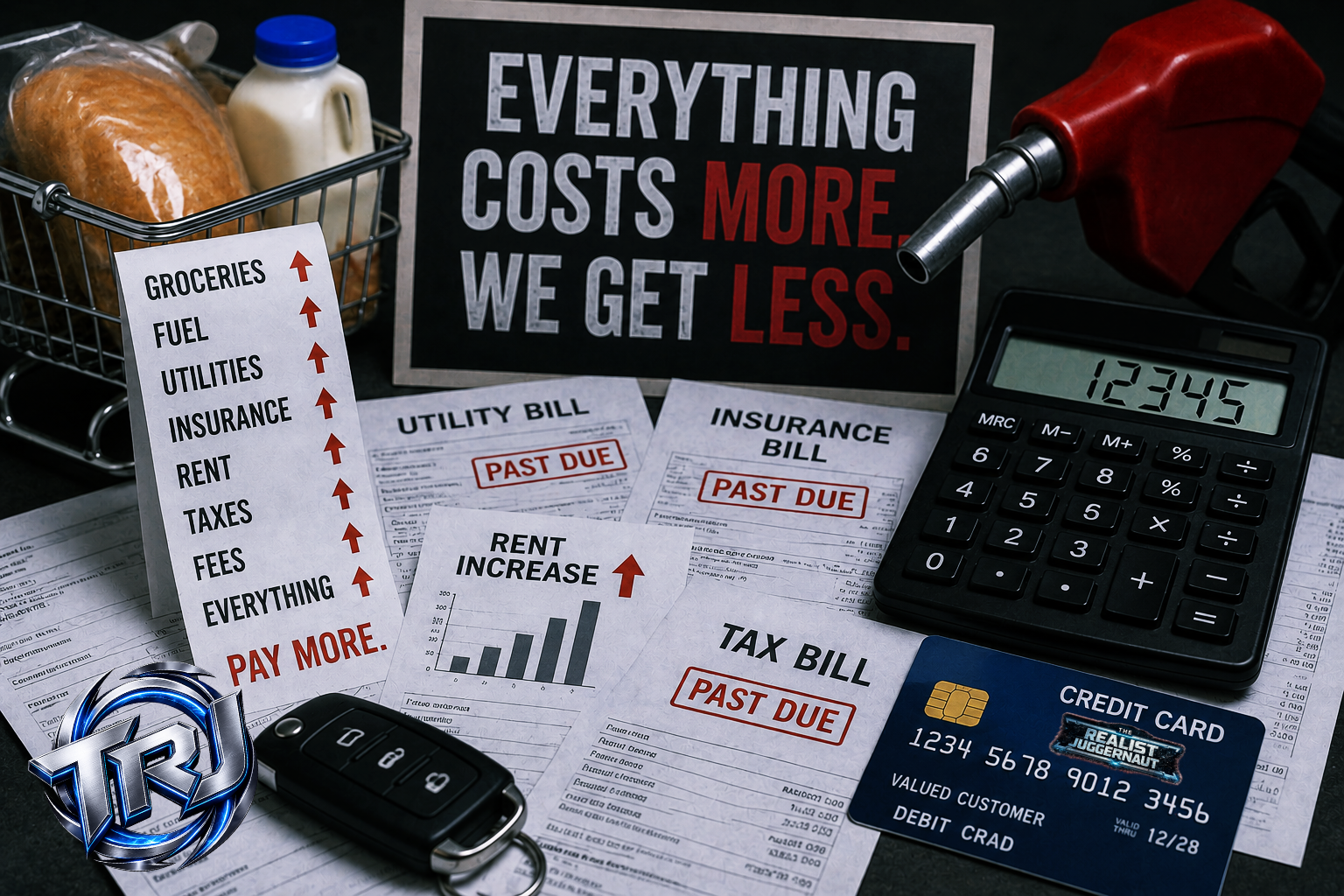
Across nearly every major industry, the modern economic structure has shifted away from durable ownership and toward continuous extraction. The public is increasingly surrounded by systems designed not merely to sell products, but to establish recurring financial dependency. By 2026, affordability had become the dominant financial concern for American households, and a record 55 percent of Americans said their financial situation was getting worse.
The result is a population that feels squeezed from every direction at the exact same time.
People feel it at the gas pump. They feel it in grocery aisles where prices continue climbing while package sizes quietly shrink. They feel it when opening utility bills that rise faster than wages. They feel it when vehicle insurance premiums increase despite clean driving histories. They feel it when software, entertainment, security systems, smart devices, cloud storage, vehicle features, and even basic productivity tools become permanent subscription obligations instead of one-time purchases.
The pressure is no longer isolated. It is layered.
That layering effect is what has transformed ordinary financial stress into widespread exhaustion. A majority of Americans said recent price increases had been a hardship on their ability to maintain their standard of living, while substantial shares also reported worry about paying monthly bills, catastrophic medical costs, retirement, and long-term stability.
The average person is no longer dealing with one major bill. They are dealing with dozens of recurring financial drains operating simultaneously beneath every part of daily life. Mortgage payments, rent increases, insurance premiums, internet service, cellular plans, streaming services, software subscriptions, automotive financing, maintenance costs, registration fees, property taxes, fuel volatility, food inflation, rising utility expenses, banking fees, healthcare deductibles, interest payments, licensing costs, school debt, and hidden service charges now combine into a permanent background system of financial pressure that never fully shuts off.
People are increasingly beginning to realize something uncomfortable: modern systems are no longer optimized to help people own life. They are optimized to meter access to it.
That pattern can be seen in the measurable cost structure of everyday existence. From December 2024 to December 2025, food prices rose 3.1 percent, food away from home rose 4.1 percent, shelter rose 3.2 percent, electricity rose 6.7 percent, utility gas service rose 10.8 percent, medical care rose 3.2 percent, and motor vehicle insurance rose another 2.8 percent after far larger increases in the years immediately before it.
In 2026, the pressure is no longer abstract. It is happening now.
Fuel prices surged again as widening geopolitical instability pushed oil markets upward and amplified pressure throughout transportation and supply systems. One recent measure put the national average for regular gasoline at $4.39 after a 47 percent jump since late February, even though federal projections still place the national all-time high near the 2022 peak around $5 per gallon.
That distinction matters because households do not need a national record to feel crushed. A severe spike is enough when millions of people are already operating without margin for error. Gas does not stay contained at the pump. It spreads into commuting costs, delivery costs, service calls, freight, food distribution, and the final price of ordinary goods.
Electricity is becoming just as punishing. Residential electricity prices are projected to rise another 5.1 percent in 2026, and broader rate tracking shows U.S. electricity prices up 21 percent since 2022.
That matters because electricity is no longer a secondary expense. It is a survival expense. It powers refrigeration, heating, cooling, communications, medical equipment, digital payments, remote work, home networks, security systems, and nearly every other requirement of ordinary participation in modern society. When electricity rises, people cannot simply opt out. They absorb the increase somewhere else, delay another payment, reduce another purchase, or fall behind.
This is where the extraction economy becomes impossible to ignore. Households are not being hit by one isolated spike. They are being pressed from multiple directions at once. Gas rises because global instability disrupts energy markets. Electricity rises because fuel-cost pressure, infrastructure strain, and expanding demand continue pushing rates upward. Insurance, food, shelter, and medical costs continue adding weight in the background.
The automotive industry represents one of the clearest examples of this transformation.
Vehicles were once machines that consumers largely controlled after purchase. Repairs could often be handled independently or through local mechanics. Features remained active because the customer physically owned the machine. Today many manufacturers are moving toward software-centered ecosystems where functionality becomes tied to digital control, licensing, dealer authorization, cloud dependency, and in some cases recurring payments. Industry discussion around vehicle feature subscriptions has made the philosophy plain enough: consumers may possess the hardware, while portions of functional control remain outside their hands.
At the same time, vehicle prices remain elevated while repair costs continue escalating due to proprietary systems, sensor complexity, calibration requirements, software locks, and electronic dependency. Insurance premiums follow behind those rising repair costs, pushing ownership expenses even higher. Federal inflation data show that motor vehicle insurance rose 14.2 percent in 2022, 20.3 percent in 2023, 11.3 percent in 2024, and then rose again in 2025.
The public is not imagining this pressure. It is measurable.
Utilities have become another major pressure point. Electricity, heating, water, waste management, internet access, and communications infrastructure are no longer luxuries. They are functional necessities. Affordability research has warned that aging infrastructure, growing electricity demand, and rising insurance burdens are all contributing to an environment in which basic household systems are becoming more expensive to maintain.
Housing has also been pulled deeper into the extraction cycle. The cost of shelter no longer ends at rent or mortgage. It expands outward through insurance, property taxes, maintenance pass-through costs, association fees, application charges, parking fees, pet fees, storage fees, and mandatory service bundles that turn basic occupancy into a layered billing environment. Shelter still appears on paper as a single category. In lived reality, it has become an ecosystem of recurring charges.
The same pattern appears across the technology industry.
Software companies once competed by creating products consumers could purchase outright and use for years. Now subscription models dominate nearly every major software ecosystem. Programs that once required a single payment now demand monthly or annual fees indefinitely. Cloud dependency reinforces that structure because users increasingly lose direct control over files, workflows, storage, and infrastructure. What was once owned has been converted into access, and access can always be repriced.
Entertainment followed the same trajectory.
Streaming services originally presented themselves as affordable alternatives to bloated cable bundles. Over time the market fractured into separate subscription ecosystems, each demanding another recurring payment. Consumers who once believed they were escaping one expensive model now find themselves reconstructing similar costs across multiple platforms, premium content tiers, sports packages, music services, cloud gaming services, and digital memberships. The old cable bundle did not disappear. It dispersed.
The psychology behind this transformation matters.
Many corporations discovered that recurring revenue produces more predictable investor confidence than one-time sales. Subscription growth became attractive because recurring billing creates long-duration revenue forecasting and stabilizes expectations around future earnings. Once companies realized consumers could be conditioned into accepting continuous payment for services that had previously been owned outright, the model spread rapidly across industries.
This fundamentally changed the relationship between corporations and customers.
Consumers increasingly stopped being viewed as long-term relationships and became recurring revenue streams attached to lifetime monetization potential. Loyalty often stopped being rewarded because many companies concluded that existing customers were already trapped inside ecosystems that would be expensive, inconvenient, or disruptive to leave.
That is why longtime customers so often discover newer customers receiving better pricing, stronger offers, and larger incentives than the people who stayed.
The system frequently assumes the loyal customer will endure more punishment because the cost of leaving has already been made high enough.
Another layer of the extraction economy operates through debt itself. Modern households are not only paying for goods and services. They are increasingly paying interest simply to remain current inside daily life. Credit cards fill the gap between wages and rising necessities. Emergency expenses get financed because cash reserves disappear faster than they can be rebuilt. Installment systems normalize dependency for items that once would have been purchased outright or postponed. Interest then becomes its own recurring drain, feeding on the instability created by the original cost pressure. In that environment, debt is no longer a temporary bridge. It becomes a permanent toll charged against the future.
Governments contribute to this pressure in different ways.
Taxes, registration costs, licensing requirements, toll systems, permit structures, property assessments, inflationary monetary policy, regulatory expansion, and administrative fees continue rising while many citizens feel the quality of public service does not improve in proportion. Taxes remained one of the notable financial problems Americans named when asked about the most important issue affecting their families, which helps explain why so many people feel squeezed by public and private systems at the same time.
People notice when they are taxed on income, taxed on purchases, taxed on property ownership, taxed on fuel, taxed on utilities, taxed on registrations, taxed on inheritance, taxed on investments, and then charged private-sector fees throughout nearly every stage of daily existence.
The frustration becomes cumulative.
One of the most psychologically damaging aspects of the extraction economy is that it creates the sensation that people can never fully get ahead no matter how much they work. Financial progress increasingly feels temporary because new costs continue emerging faster than stability can be established.
A raise disappears into insurance increases.
Savings disappear into emergency repairs that arrive faster than households can recover from them.
Lower debt becomes offset by higher utility costs.
Paid-off devices become obsolete through software support expiration.
Consumers often feel forced into endless upgrade cycles simply to maintain compatibility with systems they already paid to access.
Extraction is not limited to higher prices. It also appears in declining durability. Consumers increasingly pay more for products that last less time, contain cheaper materials, are harder to repair, and become obsolete faster through software expiration, battery degradation, proprietary parts, or intentional design limits. Grocery packages shrink while prices rise. Appliances fail sooner than older generations expect. Devices lose support while still physically functioning. In practical terms, the public is being charged more money for less permanence, which means the cycle of replacement accelerates even when households are trying to stabilize.
The emotional result is a population carrying chronic low-grade stress nearly every day.
People wake up thinking about bills. They check bank balances before making ordinary purchases.
They hesitate before replacing necessities.
They postpone medical appointments.
They delay repairs.
They work longer hours while simultaneously feeling less secure than previous generations who possessed fewer technological advantages but stronger ownership stability.
This growing exhaustion is not merely economic. It is psychological.
Human beings were not designed to operate indefinitely inside nonstop financial pressure environments where nearly every surrounding system continuously demands another payment, another subscription, another renewal, another verification step, another upgrade, another service fee, and another recurring obligation.
The result is a widespread sense that life itself is becoming rented.
People increasingly understand that many modern systems are designed to maximize extraction efficiency rather than human stability. Products are optimized for monetization cycles. Services are organized around retention metrics. Algorithms track behavioral spending patterns. Digital ecosystems encourage dependency because dependency produces reliable revenue. Even convenience is often a billing strategy in disguise.
The extraction economy does not only take money. It takes time. It takes attention. It takes administrative energy. People spend hours comparing rates, disputing charges, resetting passwords, managing renewals, watching for fraud, updating payment methods, navigating automated customer service systems, and trying to decode fees that were never clearly disclosed in the first place. The modern consumer is not merely paying more to live. The modern consumer is working longer just to manage the machinery of being charged.
The danger of this model is not only financial. It erodes trust.
When the public begins feeling exploited by corporations, institutions, utilities, governments, insurers, financial systems, and digital platforms simultaneously, social cohesion weakens. Cynicism rises. People become colder, more anxious, more defensive, and more distrustful because they increasingly feel surrounded by systems that view them primarily as monetizable assets rather than citizens, customers, or human beings.
The public anger growing across many countries is not rooted solely in politics. It is rooted in pressure.
People are tired of feeling squeezed from every direction while being told continuously that conditions are improving. They are tired of watching prices rise faster than stability. They are tired of endless subscriptions replacing ownership. They are tired of shrinking quality paired with higher costs. They are tired of being treated like permanent revenue pipelines instead of human beings attempting to build stable lives.
The numbers beneath that exhaustion are serious. Urban Institute research found that 52 percent of people in American families do not have the resources required to cover what it costs to live securely in their communities, even though average earnings have grown since 2017, because major costs such as child care, rent, home prices, and health coverage have risen even faster.
That kind of imbalance changes how people experience time itself.
The future begins to feel unstable.
Planning becomes harder.
Risk tolerance collapses.
Households stop thinking in terms of building and start thinking in terms of surviving the next billing cycle.
That is one of the most corrosive outcomes of the extraction economy. It narrows the imagination. It makes permanence feel unrealistic. It teaches people to live in fragments, managing one payment window after another, one renewal date after another, one surprise fee after another. A society built this way may remain technically functional, but it does not feel secure.
The extraction economy did not emerge overnight.
It formed gradually through decades of normalization.
One fee became ten.
One subscription became twenty.
One financial dependency became an entire ecosystem of dependencies layered across daily life.
Now millions of people are beginning to recognize the pattern simultaneously.
That recognition matters because systems built entirely around extraction eventually generate resistance. Consumers begin canceling services, reducing spending, repairing older products longer, rejecting ecosystem lock-ins, supporting right-to-repair efforts, abandoning premium tiers, consolidating subscriptions, and searching for alternatives that restore direct control over parts of their lives.
Because deep down, many still understand something modern systems increasingly try to erase:
A stable society cannot survive indefinitely when nearly every aspect of ordinary existence becomes another meter running in the background.
In 2026, the squeeze is no longer a future warning. It is already at the pump, already on the power bill, already inside insurance renewals, already in grocery aisles, already inside the digital infrastructure households now rely on simply to participate in modern life, and already embedded in the cost of remaining functional inside modern society.
That is the real danger of the extraction economy. What was once dismissed as exaggeration now defines the lived reality of millions of households facing sustained affordability pressure and worsening financial outlooks.
The modern citizen increasingly resembles an economic labor unit trapped inside a permanent cycle of payments, subscriptions, debt obligations, and recurring financial pressure. What was once understood as middle-class stability has eroded so severely that many households who once considered themselves secure now live paycheck to paycheck beneath rising costs and shrinking ownership.
TRJ Verdict
The extraction economy was never built to create stability. It was built to normalize dependence while converting daily existence into a layered system of recurring payments, shrinking ownership, controlled access, and permanent financial pressure. What once allowed households to build security now increasingly forces them into survival cycles where savings disappear faster than they can recover, wages lose ground against recurring costs, and even basic participation in modern life comes attached to another fee, another subscription, another renewal, or another obligation.
The modern system has created a population that works continuously while owning less, saving less, and carrying more recurring obligations than previous generations. What was once recognized as middle class stability is steadily being compressed under rising costs, debt dependency, and permanent financial extraction.
Enough is enough.
A society cannot endlessly squeeze its population while expecting trust, stability, optimism, and long-term cohesion to survive intact. Eventually people stop believing the pressure is temporary. Eventually they recognize the pattern. And once that recognition spreads widely enough, the consequences stop being economic alone.
They become societal.


🔥 NOW AVAILABLE! 🔥
🔥 NOW AVAILABLE! 🔥
📖 INK & FIRE: BOOK 1 📖
A bold and unapologetic collection of poetry that ignites the soul. Ink & Fire dives deep into raw emotions, truth, and the human experience—unfiltered and untamed
🔥 Kindle Edition 👉 https://a.co/d/9EoGKzh
🔥 Paperback 👉 https://a.co/d/9EoGKzh
🔥 Hardcover Edition 👉 https://a.co/d/0ITmDIB
🔥 NOW AVAILABLE! 🔥
📖 INK & FIRE: BOOK 2 📖
A bold and unapologetic collection of poetry that ignites the soul. Ink & Fire dives deep into raw emotions, truth, and the human experience—unfiltered and untamed just like the first one.
🔥 Kindle Edition 👉 https://a.co/d/1xlx7J2
🔥 Paperback 👉 https://a.co/d/a7vFHN6
🔥 Hardcover Edition 👉 https://a.co/d/efhu1ON
Get your copy today and experience poetry like never before. #InkAndFire #PoetryUnleashed #FuelTheFire
🚨 NOW AVAILABLE! 🚨
📖 THE INEVITABLE: THE DAWN OF A NEW ERA 📖
A powerful, eye-opening read that challenges the status quo and explores the future unfolding before us. Dive into a journey of truth, change, and the forces shaping our world.
🔥 Kindle Edition 👉 https://a.co/d/0FzX6MH
🔥 Paperback 👉 https://a.co/d/2IsxLof
🔥 Hardcover Edition 👉 https://a.co/d/bz01raP
Get your copy today and be part of the new era. #TheInevitable #TruthUnveiled #NewEra
🚀 NOW AVAILABLE! 🚀
📖 THE FORGOTTEN OUTPOST 📖
The Cold War Moon Base They Swore Never Existed
What if the moon landing was just the cover story?
Dive into the boldest investigation The Realist Juggernaut has ever published—featuring declassified files, ghost missions, whistleblower testimony, and black-budget secrets buried in lunar dust.
🔥 Kindle Edition 👉 https://a.co/d/2Mu03Iu
🛸 Paperback Coming Soon
Discover the base they never wanted you to find. TheForgottenOutpost #RealistJuggernaut #MoonBaseTruth #ColdWarSecrets #Declassified


Sponsored • TRJ Ads
Inquiries: contact@therealistjuggernaut.com




“One of the most psychologically damaging aspects of the extraction economy is that it creates the sensation that people can never fully get ahead no matter how much they work.”
It has been a long, downhill trend that now impacts the majority of people exactly as you have described above. I can relate to all of it and realized that this was happening when I graduated from college. That was 1982. My parents raised me, my sister and brother, and three cousins (whose parents had died) on one median income. My mom stayed home to raise us and eventually she did take a very low paying job as a music teacher in a Christian school. She did it to help the kids, not for the money. In the mean time, my Dad worked his job as a milk delivery driver. He delivered milk to the schools and the naval bases. I don’t know what his highest wage was but he probably got to $14 an hour, he had good insurance, and a pension. They bought their standard smallish 3 bedroom 2 bath tract home in Southern California in 1959 for $14,000 or so. I don’t know the exact figure but it was close to that. I don’t remember my parents discussing money issues nearly as much as people discuss them today. My dad had a stable job and they were able to pay their bills and save some after that.
We live in a different country today when it comes to the economy. The living choices my wife and I had with college educations came no where near what my parents could afford with high school diplomas. I’m not complaining. That is just the reality. Everything you have written here is spot on. I am not as concerned as I should be about my generation, but I am concerned about my children’s generation. If things continue at this pace, I don’t know how the majority of them will afford a simple life.
My wife and I did make choices that most can’t make today. We bought a small condo so that my wife could stay home with the kids until they reached school age. Before we had kids we also chose to teach in Christian schools which do not pay as well as secular ones. We decided to leave California the year before my daughter started school. We were able to eventually sell the condo and not lose money. I got a good price on a home where I now live that went up for auction. After my son got into kindergarten the public school hired my wife and I worked in a wet lab for 10 years almost non-stop before going back to teaching myself.
I have felt the financial strain at times during the past 45 years but I have never wanted to have the latest and greatest of anything and that has been very helpful. I’ve also been able to do simple maintenance on vehicles and was able to fix things like our old Maytag drier that had a drum roller go out last week. I’m thankful you can still find parts for those things.
I guess I’ve stated all of this to verify what you have written in this post. I have felt what you are talking about for a long time. By the grace of God, I have made it this far and I’m trying to help my kids so that they can have a somewhat “normal” life. I wish we could go back to the way it was in 1970 or even 1960 in some ways. Unfortunately, that is not possible and we have to deal with the situation at hand.
Thank you for this article, John. Anyone who reads this article and can’t relate to it isn’t in the majority.
You’re very welcome, Chris. Thank you very much for this thoughtful and deeply detailed response. I truly appreciate you taking the time to share both your personal experiences and the larger generational perspective behind them.
What makes your comment especially important is that it illustrates something many people across multiple generations have quietly recognized for decades: the economic pressure people feel today did not suddenly appear overnight. It developed gradually over a very long period of time, slowly reshaping what stability, ownership, work, and even the idea of a “normal life” looked like for ordinary families.
The example you gave about your parents is incredibly significant because many people from younger generations struggle to even imagine a world where one income from a relatively ordinary working-class job could support a household, raise children, help extended family members, maintain a home, provide insurance, and still leave room for stability and savings. That reality once existed for many families, which is why so many people feel the contrast so strongly now.
And honestly, I think your perspective about your children’s generation is one of the biggest concerns many parents quietly carry now. A lot of people are not only worried about surviving financially themselves. They are worried about whether future generations will ever experience the same level of stability, affordability, ownership, and long-term security that previous generations once considered achievable.
I also respect the fact that you and your wife made intentional sacrifices and practical decisions throughout your lives in order to prioritize family, stability, faith, and raising your children. That kind of long-term discipline and willingness to live within your means is becoming increasingly rare in a culture constantly pressuring people toward endless consumption, debt, upgrades, and financial overextension.
And your point about repairing things rather than constantly replacing them connects directly to one of the central themes of the article itself. Older systems were often designed around durability, maintenance, and long-term ownership. Today, many systems increasingly feel designed around recurring dependence, replacement cycles, and continuous monetization.
Most importantly, I think your comment adds something extremely valuable to the discussion because it grounds the article in lived experience across generations rather than abstract economics alone. People can debate statistics endlessly, but personal experience often reveals societal shifts more clearly than charts ever will.
Thank you again, Chris. I truly appreciate the thoughtful perspective, the honesty, and the time you took to share your story here. I hope you have a great night and week ahead, and God bless you and yours always. 🙏😎
Thank you for your very thoughtful reply, John. I think that seeing things across multiple generations can be helpful and, in this case, I don’t think my situation is unusual. Millions of people lived lives like my parents did and I’m so glad they did. I had a decent upbringing partly because I never felt that my parents were under constant financial pressure. Today it is no longer possible for that percentage of the population to do what my parents were able to do.
We are so thankful that we traded whatever income my wife would have brought in for her to be home with our kids. That investment of time has paid off many times over by the people they have become. Of course, I don’t give us all of the credit by any means. I am thankful to God that they are both believers and are solid citizens.
We have been hit with a couple of major events that have impacted the way we’ve lived but who hasn’t? My daughter has multiple health problems and is disabled. My wife and I supplement the bit she gets from the government. And I went through a period of health issues. All is fine now but those have a way of being costly. Fortunately, we have never had the thought of divorce because of our shared beliefs. Divorce is always a huge financial drain among other things. And we have never had anything major like our house burning down, thankfully. We have always been able to afford house insurance which is getting more expensive each year as I think you mentioned.
Hopefully what I wrote here won’t depress young people who read it if any do. I think they will have to learn to live a simple life. I saw that the average first home buyer is close to 40 years of age these days. Since some parents have huge homes, I see nothing wrong with people living like the Waltons did in the TV drama series in the 1970s’. Also, there is nothing wrong with a small home. A small home requires less of everything.
I’m with you about statistics. To get the lay of the land you really need to talk to people. I don’t know how many people I’ve heard on YouTube who have a household income in the six-figure range and they are still struggling financially.
You’re welcome, John, and thank you for giving me the opportunity to spout some. I know this is becoming a huge topic and, as you said, this is not something that happened overnight. It has been a lengthy and steady decline for those in the middle and lower income groups since at least the 1970s’.
Thank you for your kind words, John!😊
Dependence, indeed. Between all the necessary recurring payments (like utilities and food), I am weary of recurring expenses like coaching and group memberships. I plan to cut two of the recurring groups soon, and only keep the one I enjoy the most. I won’t join anymore and want to get off/end most social media platforms too! I’m annoyed and aggravated with constant advertising and chat requests from bots/scammers. Ugh!
Thank you, John! Today’s articles have been exceptional. ❤️
Thank you very much, Sheila. I truly appreciate both your thoughtful perspective and your kind words about today’s articles. That truly means a great deal to me.
And honestly, I think many people are quietly reaching the same point of exhaustion you described. What begins as a few useful subscriptions, memberships, platforms, and digital conveniences slowly turns into a constant stream of recurring obligations, notifications, advertisements, solicitations, algorithms, and psychological noise competing for attention every single day.
At some point, many people begin realizing they are not actually feeling more connected, fulfilled, or at peace through all of it. They simply feel mentally overloaded and emotionally drained.
I also completely understand what you mean about social media fatigue, especially with the nonstop advertising, artificial engagement, bots, scams, and increasingly transactional atmosphere that now surrounds so much of the online world. A lot of people are beginning to crave smaller, quieter, more meaningful spaces again rather than endless digital saturation.
And honestly, there is nothing wrong with simplifying parts of life and keeping only what genuinely brings value, peace, or purpose.
Thank you again, Sheila. Your comments throughout these discussions have added a very real and thoughtful human perspective to the larger issues being explored. I hope you have a wonderful night and week ahead. ❤️🙏😎
This is a very accurate portrayal of life these days. Your example about cars was really relevant. While I was never any great mechanic, I could do basic maintenance to my cars in the past, like oil changes, radiator flushes and changing light bulbs. Cars today are built in such a way that now, even those things aren’t possible.
Thank you very much, Michael. I truly appreciate you taking the time to read the article and share your perspective.
What you described with modern vehicles is exactly one of the clearest examples of the larger shift the article was examining. Many older systems were designed around repairability, ownership, and long-term usability. Today, more products are increasingly built around dependency, restricted access, proprietary systems, software integration, and continuous servicing models that reduce how much direct control people have over the things they purchase.
And as you pointed out, this change is no longer limited to major repairs. Even basic maintenance tasks that many people once handled themselves have become far more complicated and electronically tied into systems that often require specialized tools or dealer involvement.
I think a lot of people from mine and your generation especially notice that difference immediately because they remember when ownership actually felt more permanent and practical than it does now.
Thank you again, Michael. I truly appreciate the thoughtful comment, and you illustrated the point perfectly. I hope you have a great night and week ahead. 😎