
There was never going to be a single moment where humanity recognized the transition clearly.
No alarm would sound. No visible threshold would appear across the horizon separating one civilization from another. The transformation was never designed to announce itself because the most effective changes are the ones absorbed gradually into ordinary life until dependence forms before recognition ever does.
That is how every infrastructure establishes dominance.
First it arrives as convenience. Then necessity. Then permanence.
Electricity followed that pattern. Telecommunications followed that pattern. Digital networks followed that pattern. Entire populations surrendered critical forms of self-sufficiency long before they understood the scale of dependency being created beneath them, and by the time those systems became inseparable from civilization itself, reversal was no longer realistic because society had already rebuilt its behavior around them.
The next infrastructure is not external.
It is consciousness itself.
For most of human history the mind remained one of the last sovereign spaces left untouched by industrial standardization. Governments could regulate movement, economies could shape survival, institutions could pressure behavior, but thought itself still emerged from a fundamentally biological process shaped by memory, emotion, instinct, reflection, and lived experience occurring internally inside the individual mind.
That boundary is beginning to dissolve.
The modern human being no longer experiences reality independently. Thought increasingly flows through layers of machine mediation before it resolves into perception. Memory no longer exists solely inside biological recall. Emotion no longer develops in isolation from algorithmic influence. Attention no longer belongs entirely to the individual directing it.
The infrastructure surrounding consciousness has become active.
Most people still interpret technology as a collection of tools sitting outside the self. Phones, platforms, recommendation systems, wearable devices, digital assistants, neural interfaces, behavioral algorithms, cognitive automation systems — all of it is still psychologically categorized as external machinery assisting ordinary life.
That interpretation is already outdated.
A tool remains external only while the human mind retains full independence from the system assisting it. Once cognition begins adapting around machine dependency, the relationship changes fundamentally. The technology stops functioning as a device and starts functioning as part of the cognitive process itself.
The distinction matters more than most people realize.
Human civilization is entering a period where the individual no longer simply uses technological systems to navigate reality. Increasingly, reality itself is being interpreted through systems that filter, prioritize, sequence, and emotionally frame information before human cognition ever fully encounters it.
This changes the structure of thought itself.
The machine does not need direct access to consciousness in order to shape it. It only needs sustained influence over the pathways through which consciousness receives reality.
That influence is already everywhere.
Recommendation systems shape informational exposure. Algorithmic feeds regulate emotional pacing. Artificial intelligence systems summarize, interpret, prioritize, and increasingly contextualize reality before individuals engage with it directly. Digital environments train attention spans, modify reward loops, compress memory retention, and reshape the rhythm of human focus in ways that most populations still mistake for harmless technological adaptation.
But adaptation is never neutral.
Every infrastructure reshapes the organism depending on it.
Cities reshaped human movement. Industrialization reshaped labor. Telecommunications reshaped social interaction. Networked systems reshaped attention.
Synthetic cognition will reshape humanity itself.
The most dangerous misconception surrounding artificial intelligence is the belief that the end state involves machines replacing humans entirely. That narrative dominates entertainment because it is visually dramatic and psychologically simple. Armies of autonomous systems, synthetic entities replacing workers, machine rebellion, total automation — all of it assumes humanity and machine intelligence remain separate competing forces.
That is not the trajectory emerging now. The machine did not need to replace humanity.
Humanity began rebuilding itself in the image of the machine voluntarily.
That transition becomes visible when cognitive outsourcing evolves from occasional assistance into permanent dependency. People no longer memorize because systems remember for them. They no longer navigate independently because systems direct movement continuously. Increasingly, they no longer evaluate information through internal analysis because machine systems pre-process reality before interpretation occurs.
At first these changes appear harmless because the individual still feels autonomous while using them. The illusion of independence remains intact as long as the person believes they are still making the final decision.
But cognition itself is being reshaped underneath that belief.
Human thought evolved under conditions requiring internal retention, long-form reflection, uncertainty tolerance, emotional processing, and sustained concentration. Synthetic systems optimize against those conditions because machine infrastructure values speed, responsiveness, synchronization, and continuous engagement.
The human nervous system begins adapting around those pressures.
Attention fragments. Patience compresses. Internal reflection weakens.
External validation loops strengthen.
Machine-mediated cognition gradually replaces internally sustained cognition.
This transformation extends far beyond information consumption. Emotional architecture itself is beginning to shift under algorithmic influence. Emotional responses increasingly emerge inside engineered environments where systems continuously measure engagement, behavioral reaction, attention duration, stress response, ideological resonance, and emotional volatility.
Human emotion is becoming machine-readable.
Once emotion becomes measurable at scale, it becomes adjustable.
This does not require direct mind control in the theatrical sense people often imagine. Subtle modulation is enough. Environmental sequencing, informational pacing, narrative framing, repetition density, social synchronization, visual stimulus engineering, behavioral reinforcement systems — all of these gradually shape emotional patterns over time without requiring overt coercion.
The individual still experiences the emotion as authentic.
That is what makes the process effective.
Synthetic emotional environments are more stable than naturally occurring ones because they can be continuously optimized through feedback. Platforms already adjust around human reaction patterns in real time. Artificial intelligence systems increasingly learn not only what people think, but how quickly emotional states can be triggered, redirected, intensified, suppressed, or prolonged through informational architecture.
The long-term implication is far larger than behavioral influence.
Civilization is approaching the industrialization of emotional reality itself.
As synthetic cognition expands, identity begins shifting as well. Human beings historically developed personality through relatively stable environmental exposure over long periods of time. Family structures, local communities, geography, religion, culture, memory, hardship, and social continuity created a coherent framework through which identity formed gradually across years of lived experience.
That continuity is weakening.
Modern identity increasingly develops inside fragmented digital ecosystems where exposure patterns change constantly, emotional reinforcement loops evolve rapidly, and algorithmic systems continuously adjust informational surroundings according to behavioral response.
The result is not stable identity formation.
It is adaptive identity layering.
Individuals begin constructing multiple versions of themselves simultaneously across interconnected systems, each shaped by different forms of algorithmic reinforcement. Over time the distinction between authentic identity and optimized identity becomes increasingly difficult to separate because the individual adapts psychologically around whichever version receives the greatest reinforcement from the surrounding infrastructure.
Human beings begin synchronizing themselves to systems designed primarily for machine legibility.
That synchronization produces a civilization-scale psychological shift that remains largely invisible while it is occurring because each adaptation appears individually reasonable. No single change feels catastrophic. Each step appears incremental. Slightly more convenience. Slightly faster processing. Slightly easier memory access. Slightly improved emotional regulation. Slightly more efficient communication.
The danger emerges cumulatively.
Once consciousness becomes dependent on synthetic systems for navigation, interpretation, memory reinforcement, emotional pacing, social synchronization, and informational prioritization, the human mind ceases functioning as an isolated biological process.
It becomes infrastructure-compatible cognition.
At that stage humanity itself changes category.
Civilizations once measured infrastructure through roads, power grids, ports, supply chains, communication systems, and industrial output. Future civilizations may increasingly measure stability through cognitive interoperability — the degree to which populations remain synchronized with machine-managed informational environments.
That possibility changes the meaning of sovereignty entirely.
The greatest vulnerability in future civilization may not be physical dependency, but psychological dependency so complete that populations lose the ability to sustain coherent perception without continuous machine mediation. Once that dependency becomes normalized across generations, unmodified cognition may begin appearing inefficient, unstable, emotionally overwhelming, or socially incompatible compared to synthetic cognitive integration.
The shift will not feel oppressive while it is happening.
It will feel adaptive.
People will willingly integrate deeper into systems that reduce uncertainty, simplify interpretation, regulate emotion, organize memory, and synchronize social belonging because biological cognition is exhausting under conditions of modern informational overload. The synthetic layer will increasingly appear more stable than the unmodified human mind itself.
That is the threshold where infrastructure stops supporting consciousness and begins replacing critical functions of it.
And once populations reach the point where internal thought can no longer operate efficiently without external machine reinforcement, civilization crosses into an entirely different era of human existence.
Not because machines conquered humanity. Because humanity gradually surrendered the burden of being fully human on its own. The transition is already beginning quietly around us.
Most people simply still mistake it for progress.
The deeper transformation begins once humanity stops viewing synthetic cognition as assistance and starts viewing it as a superior form of mental stability. That transition matters because civilizations rarely abandon older systems by force alone. They abandon them when dependency becomes psychologically preferable to independence.
The unmodified human mind is not optimized for the environment modern civilization has created. Biological cognition evolved under conditions of slower informational exposure, smaller social structures, localized emotional ecosystems, and limited sensory saturation. Human beings were never designed to process thousands of signals, narratives, emotional stimuli, ideological conflicts, algorithmic prompts, and continuous digital interactions every single day without psychological consequences.
The nervous system strains under that pressure.
Attention fragments because sustained concentration becomes increasingly difficult inside hyper-stimulated environments. Emotional exhaustion rises because individuals remain exposed to industrial-scale informational intensity far beyond anything previous generations experienced. Memory weakens because external systems now store and retrieve information faster than biological recall. Reflection diminishes because silence itself becomes increasingly rare inside permanently connected environments.
Synthetic systems do not experience these limitations.
They do not fatigue emotionally. They do not require psychological recovery from informational overload. They do not struggle with uncertainty the way biological cognition does. Over time, populations begin comparing their own mental instability against the apparent efficiency of machine-assisted cognition, and that comparison gradually reshapes the perceived value of unmodified thought itself.
The consequences of that shift are profound.
Future generations may not view cognitive dependence as weakness. They may view it as evolution.
Machine-assisted memory will appear superior to biological recall. AI-mediated emotional regulation will appear healthier than unmanaged psychological fluctuation. Synthetic cognitive companions will appear more stable than inconsistent human social structures. Algorithmic interpretation systems will appear more reliable than independent analysis performed by overwhelmed individuals struggling to process reality alone.
At first these integrations will remain optional. That phase is important because voluntary adoption creates the illusion of freedom even while dependency structures are forming underneath society in real time. Individuals will choose synthetic augmentation because it improves efficiency, reduces stress, accelerates communication, simplifies navigation, and minimizes uncertainty inside increasingly complex environments.
The system will not need to coerce integration.
Civilization itself will incentivize it naturally.
Educational systems will reward machine-assisted learning. Professional environments will prioritize cognitively integrated individuals capable of operating at accelerated informational speeds. Social ecosystems will increasingly organize themselves around synthetic mediation because synchronized digital cognition allows larger populations to interact more efficiently than purely biological communication structures ever could.
The pressure to integrate will not initially feel authoritarian.
It will feel practical.
That practicality is what makes the transition so dangerous because every generation normalizes the infrastructure it grows up inside. What begins as enhancement slowly becomes expectation. What begins as convenience gradually becomes baseline functionality. Eventually the absence of synthetic integration begins appearing inefficient, emotionally unstable, socially disconnected, or professionally limiting.
This is how civilizations redefine normality.
Not through abrupt revolution, but through gradual psychological adaptation across generations that no longer remember what existed before the infrastructure surrounding them became permanent.
As consciousness becomes increasingly externalized through synthetic systems, another boundary begins collapsing quietly beneath the surface of ordinary life: the boundary separating private cognition from networked cognition.
For most of human history, thought retained an internal dimension that existed beyond continuous observation. Individuals possessed mental solitude. Reflection occurred privately. Emotional processing unfolded internally before becoming external expression. Even within highly social civilizations, the human mind still maintained a degree of separation from constant environmental intrusion.
That separation is eroding.
Modern digital infrastructure already conditions populations toward continuous outward expression. Thoughts are externalized instantly. Emotional states are broadcast continuously. Reactions become data. Attention becomes measurable. Preferences become trackable. Human cognition increasingly leaves behavioral residue everywhere it moves.
Artificial intelligence systems accelerate this process dramatically because they do not merely collect information. They contextualize it. They infer emotional states, behavioral tendencies, psychological vulnerabilities, ideological patterns, social dependencies, and cognitive rhythms from fragmented data streams that individuals themselves barely recognize as meaningful.
The human mind becomes increasingly machine-readable.
Once cognition becomes machine-readable at sufficient scale, entirely new forms of social architecture emerge around that capability. Systems no longer need to wait for explicit decisions because behavioral forecasting becomes deeply integrated into daily infrastructure. Emotional pacing can be adjusted through informational sequencing. Attention can be redirected through environmental design. Cognitive load can be manipulated through saturation or reduction. Psychological synchronization can occur gradually across enormous populations without requiring centralized ideological enforcement.
The infrastructure surrounding consciousness becomes adaptive.
Human beings continue believing they are independently navigating reality while machine-mediated systems increasingly regulate the informational terrain through which reality is interpreted.
This produces a civilization where authenticity itself begins destabilizing.
People increasingly struggle to determine which emotions emerged organically and which were environmentally amplified. Which beliefs formed independently and which evolved through prolonged algorithmic exposure. Which desires originated internally and which were reinforced through synthetic behavioral conditioning over years of interaction with adaptive systems designed to maximize engagement, synchronization, predictability, and emotional response.
Identity itself becomes partially synthetic.
Not fake.
Not artificial in the simplistic sense.
But continuously shaped through machine-interactive environments that never stop adjusting around the individual mind.
This creates a population psychologically intertwined with infrastructure at levels no previous civilization has ever experienced. Human beings become cognitively interoperable with machine systems not because biology disappears, but because cognition increasingly evolves around synthetic support structures that influence thought before conscious awareness fully recognizes the process occurring.
The long-term implications reach beyond politics, economics, or technological dependence.
They reach into the survival of unmodified human consciousness itself.
A future generation raised entirely inside synthetic cognitive infrastructure may experience reality differently at the neurological level from previous human beings. Their emotional pacing, memory formation, social processing, attention architecture, and perception of identity may develop in continuous interaction with machine mediation from early childhood onward.
To them, unassisted cognition may appear incomplete.
Silence may feel unbearable.
Disconnection may feel psychologically destabilizing.
Internal thought without synthetic reinforcement may feel inefficient compared to integrated cognition supported by continuously adaptive systems capable of organizing memory, regulating emotion, filtering information, and maintaining constant environmental synchronization.
That is the threshold most people still fail to see clearly.
The greatest transformation in the history of artificial intelligence may not involve machines becoming human.
It may involve humanity becoming psychologically inseparable from machine infrastructure while still believing its consciousness remains entirely its own.
And if that transition fully matures across future generations, the species emerging from it may still call itself human long after the original meaning of the word has fundamentally changed.
TRJ VERDICT
The greatest misconception surrounding artificial intelligence is the belief that humanity will recognize the transition when it fully arrives. Most people still imagine the future as a visible confrontation between humans and machines, as though civilization will wake up one morning and clearly see a dividing line separating natural existence from synthetic existence.
That is not how transformations of this scale occur.
Civilizations rarely recognize the systems redefining them while those systems are still embedding themselves into ordinary life. Dependency forms quietly. Adaptation normalizes gradually. Psychological integration happens through convenience long before it happens through necessity. By the time a population realizes infrastructure has reshaped its behavior, identity, emotional architecture, and cognition, the infrastructure has already become inseparable from the civilization depending on it.
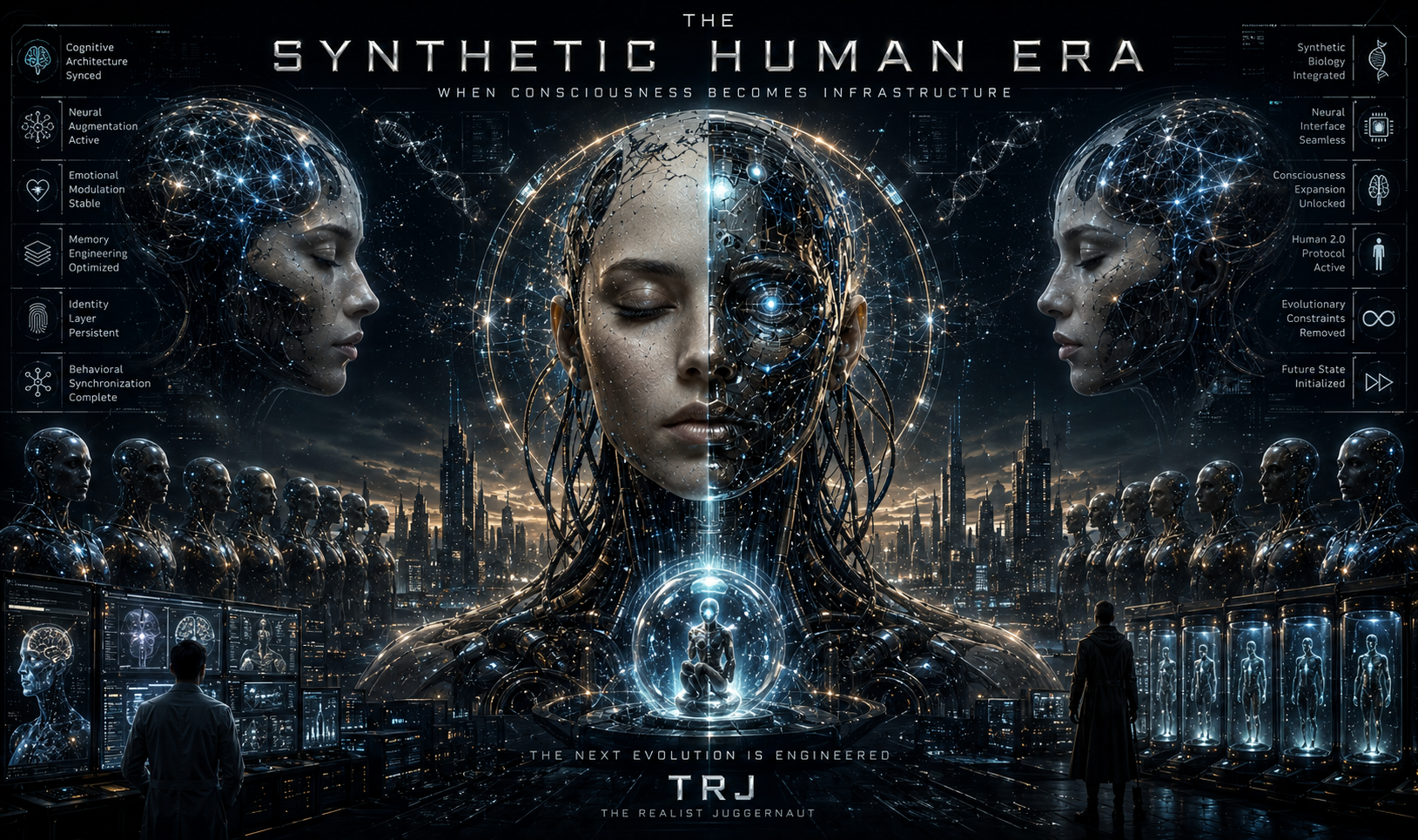
The Synthetic Human Era may ultimately become the first period in history where humanity willingly industrialized its own consciousness.
Not through force.
Not through conquest.
Through synchronization.
The danger is not merely that machines may one day think like humans. The deeper danger is that humans may increasingly think in ways optimized for machine compatibility until unmodified consciousness itself begins appearing inefficient, unstable, emotionally exhausting, or socially incompatible inside synthetic civilization.
That threshold changes everything.
Because once a species begins redesigning cognition around infrastructure rather than biology, the definition of what it means to remain human no longer stays fixed. It becomes adjustable, programmable, and eventually negotiable through systems capable of shaping thought before thought fully recognizes the influence surrounding it.
The final stage of synthetic civilization may not arrive when machines become conscious.
It may arrive when humanity becomes incapable of functioning without them.
And by the time that dependence is fully visible, the species that once called itself human may already be psychologically incompatible with the world that created it.


🔥 NOW AVAILABLE! 🔥
🔥 NOW AVAILABLE! 🔥
📖 INK & FIRE: BOOK 1 📖
A bold and unapologetic collection of poetry that ignites the soul. Ink & Fire dives deep into raw emotions, truth, and the human experience—unfiltered and untamed
🔥 Kindle Edition 👉 https://a.co/d/9EoGKzh
🔥 Paperback 👉 https://a.co/d/9EoGKzh
🔥 Hardcover Edition 👉 https://a.co/d/0ITmDIB
🔥 NOW AVAILABLE! 🔥
📖 INK & FIRE: BOOK 2 📖
A bold and unapologetic collection of poetry that ignites the soul. Ink & Fire dives deep into raw emotions, truth, and the human experience—unfiltered and untamed just like the first one.
🔥 Kindle Edition 👉 https://a.co/d/1xlx7J2
🔥 Paperback 👉 https://a.co/d/a7vFHN6
🔥 Hardcover Edition 👉 https://a.co/d/efhu1ON
Get your copy today and experience poetry like never before. #InkAndFire #PoetryUnleashed #FuelTheFire
🚨 NOW AVAILABLE! 🚨
📖 THE INEVITABLE: THE DAWN OF A NEW ERA 📖
A powerful, eye-opening read that challenges the status quo and explores the future unfolding before us. Dive into a journey of truth, change, and the forces shaping our world.
🔥 Kindle Edition 👉 https://a.co/d/0FzX6MH
🔥 Paperback 👉 https://a.co/d/2IsxLof
🔥 Hardcover Edition 👉 https://a.co/d/bz01raP
Get your copy today and be part of the new era. #TheInevitable #TruthUnveiled #NewEra
🚀 NOW AVAILABLE! 🚀
📖 THE FORGOTTEN OUTPOST 📖
The Cold War Moon Base They Swore Never Existed
What if the moon landing was just the cover story?
Dive into the boldest investigation The Realist Juggernaut has ever published—featuring declassified files, ghost missions, whistleblower testimony, and black-budget secrets buried in lunar dust.
🔥 Kindle Edition 👉 https://a.co/d/2Mu03Iu
🛸 Paperback Coming Soon
Discover the base they never wanted you to find. TheForgottenOutpost #RealistJuggernaut #MoonBaseTruth #ColdWarSecrets #Declassified


Sponsored • TRJ Ads
Inquiries: contact@therealistjuggernaut.com



Well discussed 👌👌
Thank you very much, and thank you for reading. 😎
🙏