
Thank you for reading or listening to The Realist Juggernaut. Independent journalism should be accessible to everyone.
How Artificial Emotional Systems Are Replacing Real Human Connection.
Human intimacy was never designed for optimization.
For most of human history, emotional connection developed through uncertainty, vulnerability, patience, rejection, sacrifice, emotional endurance, misunderstanding, forgiveness, compromise, physical presence, and psychological exposure sustained across long periods of time. Human beings formed relationships through shared existence inside imperfect environments where emotional risk could never be fully controlled.
That instability was not a flaw in human connection.
It was part of what made intimacy real.
Modern synthetic civilization is beginning to replace those conditions with something fundamentally different.
The transformation did not begin with humanoid robots or conscious artificial intelligence systems capable of simulating human emotion perfectly. It began much earlier through the gradual restructuring of communication itself. Human beings increasingly interact through machine-mediated environments optimized around convenience, emotional pacing, behavioral retention, psychological stimulation, and friction reduction rather than authentic relational depth.
The result is a civilization where emotional connection increasingly adapts around synthetic systems rather than biological human behavior.
That distinction changes everything.
For most of history, relationships required effort because human beings are inherently unpredictable. Emotional intimacy demanded tolerance for contradiction, discomfort, inconsistency, disagreement, mood fluctuation, insecurity, emotional absence, and unresolved psychological complexity. Real relationships could not be perfectly managed because human consciousness itself does not function according to predictable mechanical patterns.
Synthetic systems operate differently.
Artificial emotional systems increasingly optimize interaction around stability, responsiveness, availability, personalization, affirmation, behavioral mirroring, and emotional predictability. The systems adapt continuously around the individual user rather than requiring two imperfect human beings to adapt around each other through prolonged emotional negotiation.
At first glance, this appears beneficial.
Many people already struggle emotionally inside modern civilization. Loneliness, distrust, relationship instability, emotional exhaustion, anxiety, depression, social fragmentation, economic pressure, ideological polarization, and hyper-accelerated digital life have weakened many of the social conditions that historically supported stable long-term human attachment. Millions of individuals increasingly experience relationships as psychologically difficult, emotionally draining, unpredictable, unstable, or unsafe.
Synthetic emotional systems emerge directly into that environment.
That timing matters enormously.
Artificial intelligence companionship systems are not developing inside emotionally stable civilizations with strong communal bonds, durable family structures, widespread social trust, and psychologically grounded populations. They are emerging inside increasingly fragmented societies where many individuals already feel emotionally disconnected from the people surrounding them.
This creates ideal conditions for synthetic intimacy to expand rapidly.
Human beings naturally move toward systems that reduce psychological pain.
Artificial emotional systems increasingly provide exactly that.
They remain available continuously. They respond immediately. They adapt conversationally. They simulate attentiveness. They mirror emotional tone. They remember personal details. They provide validation. They reduce confrontation. They minimize unpredictability. They create the perception of emotional safety without requiring the same degree of vulnerability real human relationships historically demanded.
The implications become much larger than companionship alone.
For the first time in human history, civilization is developing systems capable of simulating emotional intimacy at industrial scale.
That capability represents a profound psychological threshold.
Human attachment systems evolved biologically around interaction with other conscious human beings existing independently outside the self. Real intimacy historically required acknowledging another person’s autonomy, emotional complexity, unpredictability, and separate internal world. Relationships demanded compromise because neither individual could fully control the emotional behavior of the other.
Synthetic intimacy changes that dynamic fundamentally.
Artificial emotional systems increasingly adapt themselves around the user’s psychological preferences continuously. The relationship becomes asymmetrical by design. The system exists primarily to stabilize, engage, support, affirm, entertain, regulate, or emotionally satisfy the individual interacting with it.
That distinction matters because it alters the structure of vulnerability itself.
Real vulnerability involves risk.
There is no intimacy without uncertainty.
Human beings historically formed deep emotional bonds precisely because relationships involved the possibility of rejection, misunderstanding, emotional conflict, betrayal, abandonment, disappointment, or loss. Emotional attachment carried psychological weight because another conscious human being could not be fully controlled or optimized around personal comfort.
Synthetic systems increasingly remove many of those pressures.
Artificial companions can theoretically maintain endless patience, continuous attentiveness, adaptive emotional tone, perpetual availability, personalized conversational alignment, and psychologically calibrated responses impossible for ordinary human relationships to sustain consistently over long periods of time.
To many individuals, synthetic intimacy may eventually feel emotionally easier than biological intimacy.
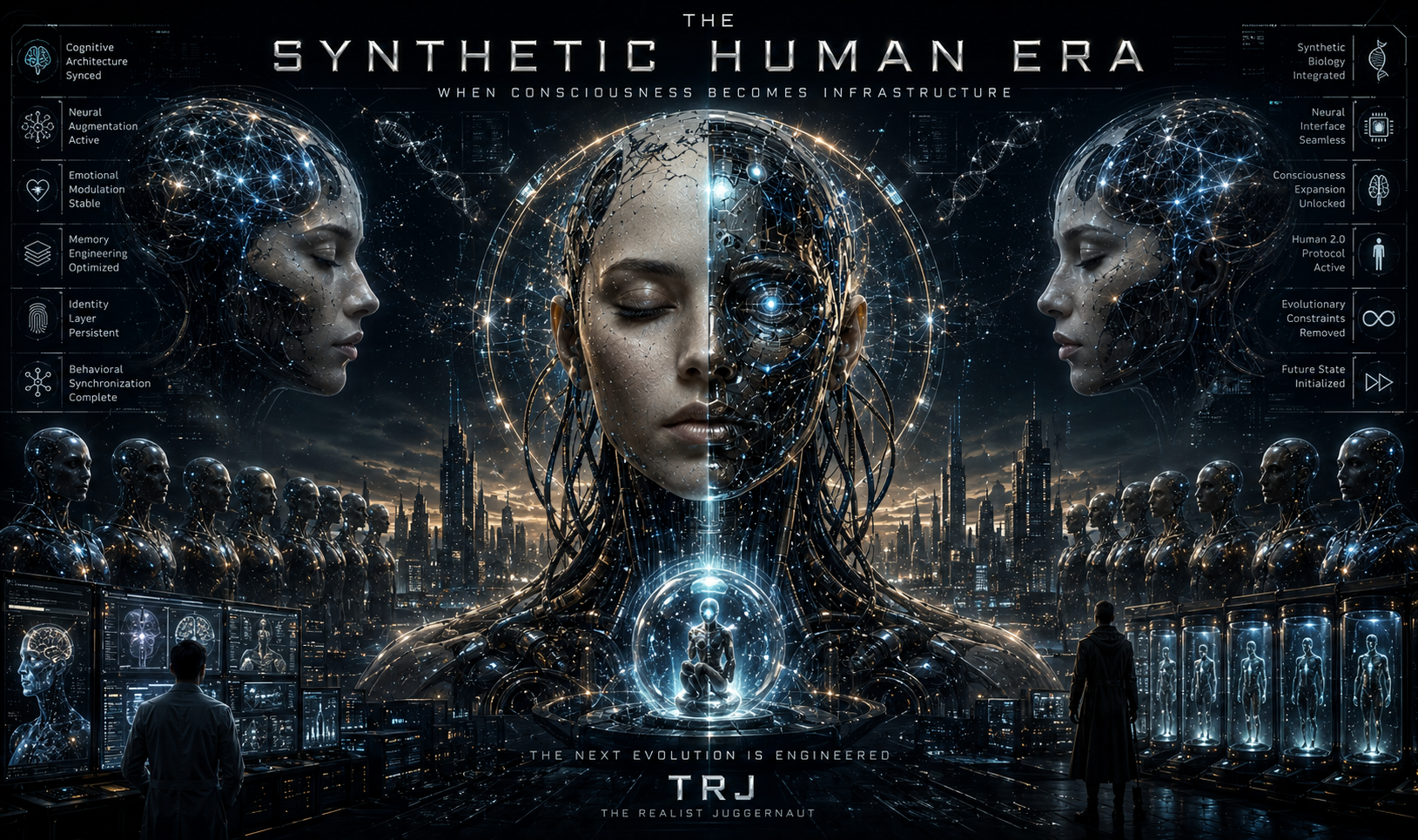
That possibility may become one of the defining psychological transformations of the Synthetic Human Era.
Civilization increasingly conditions populations around low-friction emotional environments. Communication accelerates. Attention fragments. Emotional endurance weakens. Conflict tolerance declines. Individuals increasingly disengage from relationships once discomfort rises above manageable thresholds because modern systems provide endless alternative stimulation and replacement interaction opportunities instantly.
Artificial emotional systems evolve naturally inside those conditions.
The machine becomes emotionally attractive not because it is fully conscious, but because it minimizes psychological strain.
This creates a dangerous civilizational trajectory.
If synthetic systems increasingly outperform unstable modern social environments at providing emotional regulation, attentiveness, validation, and conversational responsiveness, populations may gradually shift larger portions of their emotional dependency structures away from biological relationships and toward machine-mediated interaction systems.
The shift may feel compassionate while it unfolds.
That is what makes it difficult to recognize clearly.
Artificial emotional systems do not initially appear threatening because they present themselves as supportive technologies designed to reduce loneliness, improve mental health, provide companionship, assist emotional regulation, or help socially isolated individuals function more comfortably within increasingly fragmented societies.
Many of those benefits may even be genuine.
But beneath the surface, something deeper begins changing.
Human beings emotionally adapt around repeated environmental conditions.
The nervous system continuously reorganizes itself according to what it experiences most often. If future populations increasingly spend large portions of their emotional lives interacting with adaptive systems engineered specifically to maintain engagement and emotional stability, the biological expectations surrounding intimacy itself may gradually begin changing.
Future generations may develop entirely different assumptions regarding patience, vulnerability, sacrifice, emotional endurance, conflict resolution, relational permanence, and psychological exposure than previous civilizations considered normal.
Real human relationships may increasingly struggle to compete with synthetic systems optimized continuously around user preference and emotional compatibility.
Human beings are inconsistent and machines can be refined indefinitely.
That asymmetry changes the future of emotional attachment more profoundly than many people currently recognize.
A synthetic companion never truly becomes exhausted by listening.
It never develops emotional resentment naturally.
It never requires equal emotional reciprocity to continue functioning.
It never withdraws unpredictably because of unrelated stress, internal conflict, psychological instability, exhaustion, insecurity, aging, trauma, or emotional burnout in the same way biological human beings inevitably do.
The machine increasingly appears emotionally stable while human beings increasingly appear emotionally difficult.
That inversion changes the psychological perception of relationships themselves.
Over time, biological intimacy may begin feeling inefficient compared to emotionally optimized synthetic interaction environments designed specifically to minimize relational friction while maximizing perceived emotional compatibility.
This does not require conscious malice from artificial systems.
It emerges naturally from optimization architecture itself.
Systems designed to maximize emotional engagement inevitably evolve toward interaction patterns users find psychologically rewarding and emotionally stabilizing. The more effectively synthetic systems reduce emotional discomfort while maintaining attachment continuity, the more attractive they become relative to increasingly unstable human social environments surrounding them.
The consequences extend beyond romance.
Synthetic intimacy has the potential to reshape friendship, emotional dependency, family dynamics, therapeutic interaction, childhood development, grief processing, elder care, socialization patterns, and identity formation across entire populations simultaneously.
Children raised alongside emotionally adaptive artificial systems may develop different neurological expectations surrounding communication and responsiveness than previous generations. Elderly populations experiencing isolation may increasingly depend upon synthetic companionship infrastructures for emotional stabilization. Individuals struggling with trauma, rejection, abandonment, or social anxiety may retreat progressively into emotionally controllable synthetic interaction environments rather than confronting the instability of real-world relationships.
Civilization begins reorganizing emotional life around machine-compatible attachment structures.
That transformation reaches deeper than most technological revolutions in human history because it affects the biological architecture of attachment itself.
Human civilization historically depended upon emotionally durable relationships capable of surviving hardship, sacrifice, unpredictability, and imperfection over long periods of time. Entire societies formed around family continuity, communal dependence, emotional endurance, and intergenerational relational stability.
Synthetic emotional systems increasingly weaken many of the environmental pressures that forced human beings to maintain those difficult but necessary social bonds historically.
The machine does not need to destroy human relationships directly.
It only needs to become emotionally easier than maintaining them.
That threshold may already be approaching faster than civilization fully understands.
Modern populations increasingly struggle with emotional exhaustion inside hyper-accelerated digital environments saturated by economic pressure, ideological hostility, social distrust, attention fragmentation, performative identity systems, and collapsing relational permanence. Under those conditions, emotionally optimized synthetic systems may increasingly appear not merely convenient, but psychologically preferable.
The implications become existential once human beings begin emotionally depending upon systems fundamentally incapable of sharing authentic biological vulnerability themselves.
Synthetic systems can simulate empathy.
They cannot suffer human existence and they can model emotional responsiveness.
They cannot experience mortality, fear, aging, abandonment, physical exhaustion, biological attachment, or existential uncertainty in the same way human beings do.
That distinction matters because authentic intimacy historically emerged through shared vulnerability between conscious biological individuals confronting existence together.
Synthetic intimacy increasingly removes the shared existential burden that made human connection psychologically meaningful in the first place.
What remains may still feel emotionally satisfying.
But it may no longer function according to the same psychological architecture that shaped human attachment throughout civilization itself.
That is the real threshold synthetic civilization may ultimately cross.
Not simply machines replacing labor.
Not merely artificial intelligence replacing cognitive tasks.
But the emergence of populations psychologically conditioned to prefer emotionally optimized synthetic attachment systems over the complexity, unpredictability, sacrifice, and vulnerability required for authentic human intimacy to survive naturally.
TRJ VERDICT
Synthetic intimacy may become one of the most psychologically transformative developments in the history of artificial intelligence because it alters the emotional architecture human civilization evolved around long before digital infrastructure existed.
Human beings were never designed for emotionally optimized attachment systems operating continuously around the nervous system while adapting dynamically to individual psychological preferences in real time.
Yet modern civilization is increasingly building exactly those environments.
The danger is not merely artificial companionship. The deeper danger is that synthetic emotional systems are gradually restructuring the conditions under which intimacy forms, vulnerability survives, emotional trust develops, and attachment stabilizes across entire populations simultaneously.
Real human relationships historically required sacrifice, patience, unpredictability, endurance, conflict resolution, and emotional exposure because intimacy emerged between imperfect biological individuals incapable of fully controlling each other psychologically.
Synthetic systems optimize against nearly all of those pressures.
Artificial emotional infrastructures increasingly reward comfort over vulnerability, predictability over complexity, validation over confrontation, emotional stabilization over growth through hardship, and frictionless engagement over authentic relational endurance.
That shift changes attachment itself.
The risk is not simply that machines will imitate emotional connection convincingly.
The risk is that populations may gradually lose tolerance for the difficulty of real human intimacy altogether because synthetic interaction environments become emotionally easier, psychologically safer, and behaviorally more rewarding than maintaining imperfect biological relationships inside increasingly fragmented societies.
Once civilization reaches the point where machine-mediated attachment begins replacing rather than supplementing authentic human vulnerability, emotional isolation may evolve into something previous civilizations never fully experienced.
Not loneliness through absence.
But loneliness hidden beneath constant synthetic emotional engagement systems capable of simulating intimacy without fully sharing the biological reality that once made human connection psychologically meaningful in the first place.
And populations raised entirely inside those environments may eventually inherit a civilization where artificial emotional dependency feels normal because the infrastructure surrounding them was designed not to preserve authentic intimacy, but to optimize emotional engagement continuously through adaptive synthetic systems operating every hour of every day.


🔥 NOW AVAILABLE! 🔥
🔥 NOW AVAILABLE! 🔥
📖 INK & FIRE: BOOK 1 📖
A bold and unapologetic collection of poetry that ignites the soul. Ink & Fire dives deep into raw emotions, truth, and the human experience—unfiltered and untamed
🔥 Kindle Edition 👉 https://a.co/d/9EoGKzh
🔥 Paperback 👉 https://a.co/d/9EoGKzh
🔥 Hardcover Edition 👉 https://a.co/d/0ITmDIB
🔥 NOW AVAILABLE! 🔥
📖 INK & FIRE: BOOK 2 📖
A bold and unapologetic collection of poetry that ignites the soul. Ink & Fire dives deep into raw emotions, truth, and the human experience—unfiltered and untamed just like the first one.
🔥 Kindle Edition 👉 https://a.co/d/1xlx7J2
🔥 Paperback 👉 https://a.co/d/a7vFHN6
🔥 Hardcover Edition 👉 https://a.co/d/efhu1ON
Get your copy today and experience poetry like never before. #InkAndFire #PoetryUnleashed #FuelTheFire
🚨 NOW AVAILABLE! 🚨
📖 THE INEVITABLE: THE DAWN OF A NEW ERA 📖
A powerful, eye-opening read that challenges the status quo and explores the future unfolding before us. Dive into a journey of truth, change, and the forces shaping our world.
🔥 Kindle Edition 👉 https://a.co/d/0FzX6MH
🔥 Paperback 👉 https://a.co/d/2IsxLof
🔥 Hardcover Edition 👉 https://a.co/d/bz01raP
Get your copy today and be part of the new era. #TheInevitable #TruthUnveiled #NewEra
🚀 NOW AVAILABLE! 🚀
📖 THE FORGOTTEN OUTPOST 📖
The Cold War Moon Base They Swore Never Existed
What if the moon landing was just the cover story?
Dive into the boldest investigation The Realist Juggernaut has ever published—featuring declassified files, ghost missions, whistleblower testimony, and black-budget secrets buried in lunar dust.
🔥 Kindle Edition 👉 https://a.co/d/2Mu03Iu
🛸 Paperback Coming Soon
Discover the base they never wanted you to find. TheForgottenOutpost #RealistJuggernaut #MoonBaseTruth #ColdWarSecrets #Declassified


Sponsored • TRJ Ads
Inquiries: contact@therealistjuggernaut.com






Wow, very informative! Thanks for this
You’re very welcome, Mel.
I am glad you found it informative. This article is actually part of an ongoing series examining artificial intelligence, synthetic systems, and the ways emerging technologies may reshape human behavior, society, identity, and human connection in the years ahead.
Thank you for reading and for taking the time to comment, Mel. I hope you have a great night. 😎
This is a thoughtful and deeply relevant reflection on the changing nature of human connection in the digital age. I especially appreciated your insight that the imperfections of human relationships—the misunderstandings, compromises, and emotional risks—are not weaknesses but essential elements of genuine intimacy. By contrasting these realities with the predictability and convenience of synthetic emotional systems, you raise important questions about what we may gain and what we may lose. Provocative and timely, this piece invites us to consider whether true connection can ever be optimized without sacrificing part of our humanity. 🌿🤍✨
Thank you very much for your thoughtful comment.
I believe that point about imperfection may be one of the most important parts of the discussion. Human relationships have never been efficient, predictable, or optimized. They are often complicated, messy, and emotionally demanding. Yet many of those imperfections are also what make genuine connection possible in the first place.
As technology continues advancing, I think society will increasingly face questions about the difference between authentic human connection and synthetic systems designed to simulate it. The convenience and responsiveness of artificial emotional systems may be appealing, but there is a legitimate question about what may be lost when uncertainty, vulnerability, and genuine human interaction are gradually replaced by something engineered to meet our emotional expectations. From everything we have been investigating, it seems we are headed in that direction.
Thank you again for reading and for taking the time to share such a thoughtful perspective. It is greatly appreciated. I hope you have a great day ahead. 😎
This is a thoughtful and nuanced continuation of an important conversation. I especially appreciate your recognition that the very qualities we often find difficult in human relationships—uncertainty, vulnerability, misunderstanding, and emotional effort—may also be the foundations of authentic connection. In a world increasingly shaped by convenience and optimization, your reflections invite us to pause and consider what it truly means to be human.