
Thank you for reading or listening to The Realist Juggernaut. Independent journalism should be accessible to everyone.
The Georgia investigation is the latest in a growing series of cases examining how powerful surveillance technologies are monitored, audited, and protected from misuse.
Five former Georgia police officers have been arrested following an investigation into the alleged misuse of a law enforcement license plate reader database, adding to a growing number of cases raising questions about oversight, accountability, and the expanding use of automated surveillance technology.
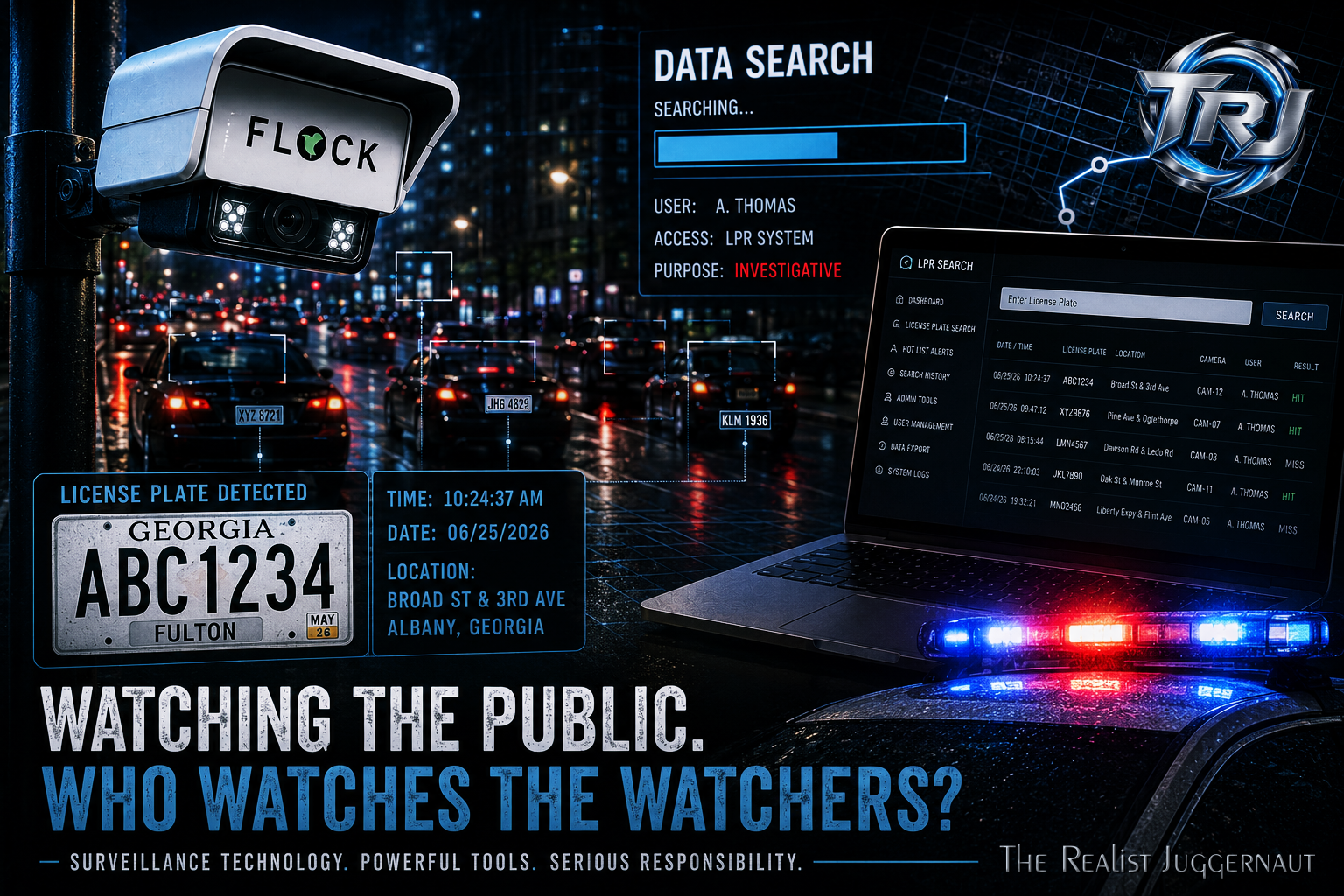
The Georgia Bureau of Investigation (GBI) announced that five former Albany Police Department officers have been charged with multiple counts of Misuse of License Plate Data and one count each of Violation of Oath of Office following an investigation into their use of the department’s Flock Safety automated license plate reader system. The Albany Police Department operates a network of more than 100 Flock surveillance cameras throughout the city, a system intended to assist officers in identifying vehicles connected to criminal investigations, recovering stolen vehicles, locating missing persons, and supporting other legitimate public safety operations.
According to the GBI, those charged are:
- Tytianna Davis, 27, charged with five counts of Misuse of License Plate Data and one count of Violation of Oath of Office.
- Jade Jackson, 32, charged with two counts of Misuse of License Plate Data and one count of Violation of Oath of Office.
- Nicholas Richardson, 30, charged with 11 counts of Misuse of License Plate Data and one count of Violation of Oath of Office.
- Brittney Smith, 23, charged with one count of Misuse of License Plate Data and one count of Violation of Oath of Office.
- Issac Whitus, 24, charged with two counts of Misuse of License Plate Data and one count of Violation of Oath of Office.
According to investigators, the criminal investigation began on June 25 after the Albany Police Department requested that the GBI conduct an independent investigation following an internal compliance audit of the department’s Flock license plate reader system. Authorities say the audit identified multiple instances in which retained license plate reader data was accessed for purposes unrelated to legitimate law enforcement activities. City officials have stated that requesting an outside agency to investigate was appropriate because the matter involved police officers and required an independent review.
The former officers were arrested on July 6 and booked into the Dougherty County Jail. All five are no longer employed by the Albany Police Department. According to the GBI, the investigation remains active and will be presented to the Dougherty Judicial Circuit District Attorney’s Office for review once it is complete. Separately, the Albany Police Department has stated that misuse of license plate reader technology is unacceptable and has indicated it will strengthen oversight, reinforce employee training, and review policies governing access to sensitive investigative systems.
Powerful Technology Built for Public Safety
Automated License Plate Reader (ALPR) systems have become one of the fastest-growing investigative technologies used by law enforcement agencies throughout the United States. Once limited to a relatively small number of jurisdictions, these systems are now deployed by thousands of police departments, sheriff’s offices, state agencies, and public safety organizations as part of a broader effort to improve criminal investigations and enhance situational awareness.
Using high-speed digital cameras combined with optical character recognition software, ALPR systems automatically photograph passing vehicles, convert license plate images into searchable text, and record the date, time, and precise location of each scan. The collected information can then be compared against databases containing records of stolen vehicles, wanted persons, missing persons alerts, AMBER Alerts, felony warrants, and other investigative notifications generated by law enforcement agencies.
Modern ALPR platforms extend well beyond real-time alerts. Many systems retain historical records that allow investigators to search where and when a particular vehicle was previously observed, reconstruct travel patterns, identify vehicles seen near crime scenes, establish investigative timelines, and compare sightings across multiple jurisdictions. Depending on departmental policies and system configurations, participating agencies may also share information through regional or nationwide networks, significantly expanding the amount of searchable data available during an investigation.
For investigators, these capabilities have become valuable force multipliers. Rather than relying solely on eyewitness accounts or manually reviewing hours of surveillance footage, officers can often identify investigative leads within minutes by searching historical license plate records. The technology has assisted in recovering stolen vehicles, locating missing and endangered individuals, identifying suspects, corroborating witness statements, and supporting investigations involving violent crimes, property crimes, and organized criminal activity.
Supporters of the technology argue these capabilities have transformed modern policing by allowing investigators to analyze information that would have been virtually impossible to collect manually. As the systems continue expanding and integrating with broader investigative networks, they are expected to play an increasingly important role in criminal investigations. At the same time, the growth of these capabilities has intensified discussions surrounding privacy, data retention, oversight, and the responsibility that accompanies access to such powerful investigative tools.
Accountability Is Just as Important as Capability
Like nearly every form of modern surveillance technology, automated license plate reader systems rely heavily on public trust. While these systems have become valuable investigative tools for law enforcement, their effectiveness ultimately depends upon public confidence that they are being used responsibly, lawfully, and only for legitimate investigative purposes.
That trust is built on clear policies governing who may access the information, when searches are permitted, how long data is retained, how information may be shared with other agencies, and whether every database search is recorded and subject to routine review. Without those safeguards, even the most advanced technology can become vulnerable to misuse.
According to investigators, this case came to light because of an internal audit conducted by the Albany Police Department. Authorities say the audit identified multiple instances in which retained license plate reader data was accessed for purposes unrelated to legitimate law enforcement activities. The investigation demonstrates how internal oversight mechanisms are intended to identify activity that falls outside established policy and ensure those entrusted with access remain accountable for how these powerful systems are used.
Audit logs have become one of the most important safeguards built into modern automated license plate reader systems. Every search performed by an authorized user generates a digital record documenting who accessed the system, when the search occurred, and the information that was retrieved. Those records allow supervisors, investigators, and oversight personnel to review database activity and determine whether access was consistent with departmental policy and authorized investigative purposes.
The value of those audit trails extends beyond identifying potential misconduct. They also help protect officers who use the system appropriately by providing an objective record demonstrating that searches were conducted as part of legitimate investigations. In that sense, accountability safeguards serve both the public and law enforcement professionals who follow established procedures.
Cases such as this demonstrate why those safeguards exist. Technology alone cannot prevent misuse, nor can it exercise judgment, ethics, or discretion. Effective oversight depends upon agencies routinely reviewing audit logs, enforcing departmental policies, providing ongoing training, and taking appropriate action whenever unauthorized activity is identified.
As surveillance technologies continue expanding and investigative databases become increasingly interconnected, accountability must evolve alongside them. Powerful investigative tools can strengthen public safety, but maintaining public trust requires demonstrating that access is continuously monitored, transparently reviewed, and subject to meaningful consequences whenever established policies are violated.
Part of a Broader Pattern
The Albany investigation is not the only recent case involving alleged improper access to automated license plate reader databases.
In neighboring Cherokee County, three sheriff’s office employees were arrested following an internal audit that investigators say uncovered unauthorized use of an automated license plate reader system for non-law enforcement purposes. Those cases resulted in criminal charges that included misuse of license plate data and violations of oath of office.
The issue has extended well beyond Georgia. Earlier this year in Milwaukee, Wisconsin, a police officer was criminally charged after prosecutors alleged he repeatedly used a Flock Safety automated license plate reader system to track individuals for personal reasons. Following the investigation, the Milwaukee Police Department reduced the number of employees authorized to access the system, implemented additional user agreements, expanded audit procedures, and strengthened oversight governing access to the database.
Beyond individual misuse cases, concerns have also emerged regarding who can access the data collected by these systems. Earlier this year, the Mountain View Police Department in California suspended its Flock camera program after city officials said they discovered federal agencies had accessed license plate data without the city’s authorization. The department cited a loss of confidence in the system’s safeguards while officials reviewed future use of the technology.
Although each case involves different facts and circumstances, they collectively highlight the growing importance of oversight as automated license plate reader networks continue expanding across the country. More agencies now participate in regional and nationwide information-sharing systems, allowing investigators to search larger volumes of historical vehicle data across multiple jurisdictions. Those capabilities have proven valuable in solving crimes, recovering stolen vehicles, locating missing persons, and identifying suspects. At the same time, the expanding reach of these systems places greater responsibility on agencies to ensure every search is conducted for a legitimate law enforcement purpose and remains subject to meaningful oversight.
Modern license plate reader platforms are designed with audit trails that record user activity, allowing agencies to review searches and identify irregular patterns. The recent investigations in Georgia, Wisconsin, and California demonstrate why those safeguards are increasingly important. Technology can provide accountability tools, but those tools are effective only when agencies routinely review access logs, investigate irregularities, and enforce policies governing the use of sensitive investigative databases.
As automated surveillance technology continues to evolve, the discussion extends well beyond the cameras themselves. It increasingly centers on governance, transparency, auditing, training, and accountability. Public confidence depends not only on whether these systems help solve crimes, but also on whether those entrusted with access use them responsibly and whether agencies act decisively when that trust is violated.
Oversight Extends Beyond the Technology
Whether involving allegations or proven misconduct, cases involving the misuse of automated license plate reader systems often shift public attention away from those responsible for the misuse and toward the technology itself.
In reality, automated license plate reader systems simply collect and organize information according to their programming. They capture license plate numbers, record the time and location of each observation, and make that information searchable according to the permissions established by the agencies operating the system. Decisions regarding when to access the database, why a search is performed, whether access complies with departmental policy, and how the information is ultimately used are made entirely by the individuals operating the system.
For that reason, many experts argue the discussion should focus not only on the capabilities of the technology but also on training, supervision, internal auditing, access controls, and the legal consequences for anyone found to have abused authorized access. Expanding surveillance capabilities without expanding oversight creates unnecessary risk, particularly as more agencies gain access to increasingly interconnected investigative databases.
Technology cannot exercise judgment, ethics, or discretion. It cannot determine whether a search is justified, whether access complies with departmental policy, or whether a user’s actions are appropriate under the law. Those responsibilities belong entirely to the individuals entrusted with access to the system and to the agencies responsible for supervising its use.
The same technology that can help recover a stolen vehicle or locate a missing child can also be misused if proper safeguards are ignored. That reality underscores why strong internal controls, routine audits, comprehensive training, and meaningful accountability are essential components of every surveillance program.
Public confidence depends not only on whether these systems help solve crimes, but also on whether agencies demonstrate a willingness to investigate allegations of misuse, enforce established policies, and hold individuals accountable whenever violations occur. Maintaining that trust will remain just as important as the technology itself as automated surveillance systems continue expanding across the country.
A Concern TRJ Has Raised for Years
TRJ has repeatedly examined the rapid expansion of automated license plate reader systems and other forms of public surveillance. While these technologies have proven their value in locating stolen vehicles, identifying suspects, and supporting criminal investigations, we have consistently raised questions about oversight, accountability, data retention, and the growing amount of information being collected on the public.
One question has remained constant throughout our reporting:
Who watches the watchers?
Every expansion of surveillance authority increases the responsibility to ensure those systems are used lawfully and only for legitimate investigative purposes. Every documented case involving the misuse of automated license plate reader systems reinforces an uncomfortable reality: public confidence cannot be maintained through technology alone. It must be earned through transparency, rigorous oversight, routine auditing, and meaningful accountability for anyone who abuses authorized access.
According to investigators, the Albany case alleges that authorized users accessed retained license plate reader data for non-law enforcement purposes. If those allegations are proven in court, the case serves as a reminder that the greatest vulnerability in any surveillance system is rarely the camera itself. It is the individual entrusted with access to the information.
Technology can record license plates, compare data, and assist investigations, but it cannot make ethical decisions. Responsibility ultimately rests with the people operating these systems and the agencies charged with ensuring they are used appropriately.
As automated license plate reader networks continue expanding across the country, cases such as this reinforce why transparency, routine auditing, independent oversight, and meaningful accountability remain essential. Powerful investigative tools can strengthen public safety, but only when the public can trust that those tools are being used responsibly and within the limits established by law.
When Trust Is Broken
TRJ has consistently supported the difficult work performed by the overwhelming majority of law enforcement officers who serve their communities honorably and professionally. Their work is essential to public safety, and many put their lives on the line every day to protect people they have never met. Unfortunately, many good officers are also subjected to unnecessary disrespect and hostility simply because they wear the badge. That is unfair and unacceptable. Law enforcement officers should be treated with respect, but respect is a two-way street. It must be demonstrated by both the public and those entrusted with enforcing the law.
At the same time, public trust cannot be based solely on a badge. Trust is earned through integrity, accountability, professionalism, and equal application of the law. When officers violate the very laws they are sworn to uphold, misuse investigative tools, or abuse the authority entrusted to them, the damage extends far beyond a single incident. Every such case weakens confidence in the profession as a whole.
That perspective is not based solely on news reports. It is also shaped by personal experience.
Over the years, I have witnessed officers talking on their phones while driving, speeding without responding to an emergency, and driving at excessive speeds through traffic without emergency lights or sirens activated. I have also been stopped on multiple occasions for alleged equipment violations, only to discover after the stop that the lights officers claimed were not working were functioning normally. There were two occasions when the lights genuinely required repair, and I acknowledge those instances.
I have also experienced what I believe was profiling on multiple occasions. During one traffic stop on a rainy night, a New York State Trooper insisted I had been using my cellphone while driving. My wife, who was seated in the passenger seat, repeatedly explained that she—not I—had been using her phone. Despite her statements, the trooper continued attempting to persuade me to admit to something I had not done for nearly twenty minutes. I stood my ground, and the traffic stop ended without a single citation. In my view, I had been pulled over for no legitimate reason. Encounters like that stay with you. They create uncertainty every time you see emergency lights appear in your rearview mirror, even when you know you have done nothing wrong.
Perhaps the most serious incident occurred years ago when I became the subject of a police response after an officer accused me of attempting to run him over. I have always maintained that accusation was completely false. At the time, the officer had another vehicle stopped on a busy roadway. As I approached, I was attempting to safely merge into the left lane to comply with New York’s Move Over Law, but heavy traffic prevented me from doing so immediately. I cautiously slowed and edged toward the left lane while remaining well aware of the officer’s location and maintaining a safe distance. At no point did I attempt to strike or endanger him.
Despite that, I was accused of trying to run the officer down. I was forced to defend myself in court, spending a considerable amount of time and money fighting charges that I knew were untrue. I refused to accept a plea agreement for a lesser offense because doing so would have required admitting guilt for something I did not do. My confidence in fighting those charges was also rooted in my professional driving experience. I have spent many years driving professionally and have completed numerous defensive and safety driving courses. I understood the situation I was in, I was fully aware of my surroundings, and I knew I had not driven my vehicle in a manner that endangered the officer.
During the court proceedings, the officer’s account did not withstand scrutiny. The court dismissed every charge related to the incident. The only citation that remained involved a cracked windshield located at the very top of the glass, an area that did not obstruct my view of the roadway.
I write this not to shine a light on myself, but to illustrate how quickly an encounter with law enforcement can escalate. Looking back, I cannot help but wonder how much more difficult those situations could have become had today’s interconnected surveillance systems and searchable databases existed in the form they do now. The officers involved in my situation could have made it far more personal with access to the kinds of technologies discussed in this article. That possibility alone reinforces why independent oversight and accountability matter. That is precisely why oversight matters. Powerful technologies in the hands of honorable professionals can protect communities. The same technologies, if misused by someone willing to abuse their authority, have the potential to magnify the consequences far beyond what was possible in the past.
That experience is one I will never forget. It reinforced my belief that while the overwhelming majority of law enforcement officers serve honorably, accountability is essential whenever the authority entrusted to an officer is misused. Unfortunately, I never witnessed that accountability in my own case. From my perspective, there were no consequences for what I maintain were false accusations or an abuse of authority. That absence of accountability is one of the reasons I believe independent oversight remains essential as automated license plate reader systems and other advanced surveillance technologies continue expanding across the country.
It is equally important to recognize that a strong law enforcement presence remains essential to maintaining public safety in a free nation. We are free to live our lives, travel, work, worship, speak, and assemble within the boundaries of the law because those laws exist and are enforced. Those who choose to commit crimes often do so with the intent to harm others, whether through violence, theft, fraud, or other unlawful acts. The overwhelming majority of law enforcement officers work every day to protect their communities from those threats, and that responsibility deserves both respect and support.
Supporting law enforcement does not mean abandoning accountability. In fact, accountability strengthens the profession. Holding those who abuse their authority responsible helps protect the integrity of the badge and reinforces public confidence in the overwhelming majority of officers who serve honorably and professionally. Public safety and accountability are not opposing principles—they are complementary, and both are essential to preserving the freedoms that define our nation.
Ironically, law enforcement has long been part of my own family’s history. My grandfather served as a police officer for twenty-five years. I was raised to respect those who wear the badge, and despite my experiences, I continue to believe the overwhelming majority of officers serve honorably and deserve that respect.
Those experiences also help explain why many citizens struggle to place complete trust in law enforcement and why the continued expansion of surveillance technology concerns them. For people who have experienced misconduct, false accusations, profiling, or abuses of authority, concerns about being monitored, tracked, or subjected to unauthorized database searches are not abstract policy debates. They are rooted in real experiences. Every documented case involving the misuse of authority reinforces that mistrust and makes it more difficult for the public to place confidence in increasingly powerful surveillance systems.
That is precisely why oversight matters.
Powerful investigative technologies can play an important role in protecting communities, but every expansion of surveillance authority should be accompanied by equally strong accountability, independent oversight, meaningful audits, and real consequences for anyone who abuses that authority. Public safety and civil liberties are not opposing goals. Both depend on maintaining confidence that the law applies equally to everyone—including those entrusted with enforcing it. Without that accountability, every documented case of misconduct risks undermining the trust that honorable officers work every day to earn.
Trust is not weakened by those who question authority. Trust is weakened when authority is abused. Every documented case involving misconduct, every unauthorized database search, every false accusation, and every abuse of power leaves another crack in the relationship between law enforcement and the communities they serve.
For me, that mistrust did not disappear when I walked out of the courtroom. It has stayed with me ever since. I have never fully gotten over the day an officer accused me of trying to run him down. Although the court dismissed the charges related to that accusation, the experience changed me. To this day, every time I see emergency lights appear behind me, my heart begins pounding. The memory of officers surrounding me with weapons drawn while I sat there wondering what was happening has never left me.
There has not been a single year that I have not been stopped by law enforcement. To this day, it still happens at least twice a year. Every traffic stop brings back those memories. Even though I know I have done nothing wrong, my heart still begins pounding the moment I see emergency lights appear in my rearview mirror. That experience never truly leaves you. I still respect law enforcement, and I continue to believe the overwhelming majority of officers serve honorably. But experiences like mine explain why trust, once broken, is extraordinarily difficult to rebuild. That is why accountability is not optional—it is essential.
TRJ Verdict
The arrests of five former Albany police officers are about far more than one criminal investigation. They serve as another reminder that every expansion of surveillance technology must be matched by an equal expansion of accountability, transparency, and independent oversight.
Automated license plate reader systems have become powerful investigative tools that assist law enforcement in recovering stolen vehicles, locating missing persons, identifying suspects, and solving crimes that might otherwise remain unsolved. Those capabilities provide real public safety benefits and have earned these systems an increasingly important role in modern policing.
Power always carries responsibility.
Every documented case involving the misuse of these systems—whether through unauthorized database searches, personal use, or violations of established policies—has the potential to erode public confidence not only in the technology itself but also in the institutions entrusted with its use. Trust cannot be demanded simply because a system exists or because someone wears a badge. It must be earned every day through professionalism, ethical conduct, transparency, meaningful oversight, and the consistent enforcement of the law.
TRJ has long maintained that the greatest risk posed by surveillance technology is not the camera mounted on a pole or the software behind the database. The greatest risk has always been the possibility that powerful investigative tools could be misused by the very people entrusted with access to them. Cases such as this demonstrate why those concerns deserve continued public attention.
As automated surveillance systems continue expanding across the United States, agencies will undoubtedly gain even greater investigative capabilities. The challenge moving forward will not be whether the technology becomes more powerful—it will. The challenge will be ensuring that the safeguards, audits, accountability, and oversight evolve just as rapidly. Public safety and civil liberties should never be viewed as competing interests. A society that values both requires investigative tools that are effective, oversight that is meaningful, and a justice system willing to hold everyone accountable under the same law.
Technology will continue evolving. Whether public confidence evolves with it will depend entirely on the integrity of those entrusted to use it.


🔥 NOW AVAILABLE! 🔥
🔥 NOW AVAILABLE! 🔥
📖 INK & FIRE: BOOK 1 📖
A bold and unapologetic collection of poetry that ignites the soul. Ink & Fire dives deep into raw emotions, truth, and the human experience—unfiltered and untamed
🔥 Kindle Edition 👉 https://a.co/d/9EoGKzh
🔥 Paperback 👉 https://a.co/d/9EoGKzh
🔥 Hardcover Edition 👉 https://a.co/d/0ITmDIB
🔥 NOW AVAILABLE! 🔥
📖 INK & FIRE: BOOK 2 📖
A bold and unapologetic collection of poetry that ignites the soul. Ink & Fire dives deep into raw emotions, truth, and the human experience—unfiltered and untamed just like the first one.
🔥 Kindle Edition 👉 https://a.co/d/1xlx7J2
🔥 Paperback 👉 https://a.co/d/a7vFHN6
🔥 Hardcover Edition 👉 https://a.co/d/efhu1ON
Get your copy today and experience poetry like never before. #InkAndFire #PoetryUnleashed #FuelTheFire
🚨 NOW AVAILABLE! 🚨
📖 THE INEVITABLE: THE DAWN OF A NEW ERA 📖
A powerful, eye-opening read that challenges the status quo and explores the future unfolding before us. Dive into a journey of truth, change, and the forces shaping our world.
🔥 Kindle Edition 👉 https://a.co/d/0FzX6MH
🔥 Paperback 👉 https://a.co/d/2IsxLof
🔥 Hardcover Edition 👉 https://a.co/d/bz01raP
Get your copy today and be part of the new era. #TheInevitable #TruthUnveiled #NewEra
🚀 NOW AVAILABLE! 🚀
📖 THE FORGOTTEN OUTPOST 📖
The Cold War Moon Base They Swore Never Existed
What if the moon landing was just the cover story?
Dive into the boldest investigation The Realist Juggernaut has ever published—featuring declassified files, ghost missions, whistleblower testimony, and black-budget secrets buried in lunar dust.
🔥 Kindle Edition 👉 https://a.co/d/2Mu03Iu
🛸 Paperback Coming Soon
Discover the base they never wanted you to find. TheForgottenOutpost #RealistJuggernaut #MoonBaseTruth #ColdWarSecrets #Declassified


Sponsored • TRJ Ads
Inquiries: contact@therealistjuggernaut.com







John, interesting post. Not surprised at all about these data being used for personal reasons in a violation of public trust. “Who watches the watchers?” indeed.
And it’s only in a free society where this is even an issue. Too many questions = free trip to a camp somewhere.
Once again, TRJ is the canary in the coal mine…
Thank you very much, Darryl.
Powerful investigative tools can play an important role in solving crimes and protecting the public, but they also require equally strong oversight and accountability. Unfortunately, cases like this show that oversight cannot be taken for granted. The technology itself isn’t the problem—how it is used, who has access to it, and whether those entrusted with that access are held accountable, ultimately determines whether the public maintains confidence in these systems.
I also appreciate your kind words about TRJ. Our goal has always been to examine issues that deserve closer attention, provide additional context, and encourage thoughtful discussion about topics that affect all of us. As this platform continues to grow, our voice will only become louder, and we’ll continue shining a light on the stories that deserve to be heard.
Thank you again for reading, Darryl. I greatly appreciate your continued support, and I hope you have a great night. 😎