
Thank you for reading or listening to The Realist Juggernaut. Independent journalism should be accessible to everyone.
Roger Scott Craig, Liverpool Express and a Conversation That May Be Only the Beginning
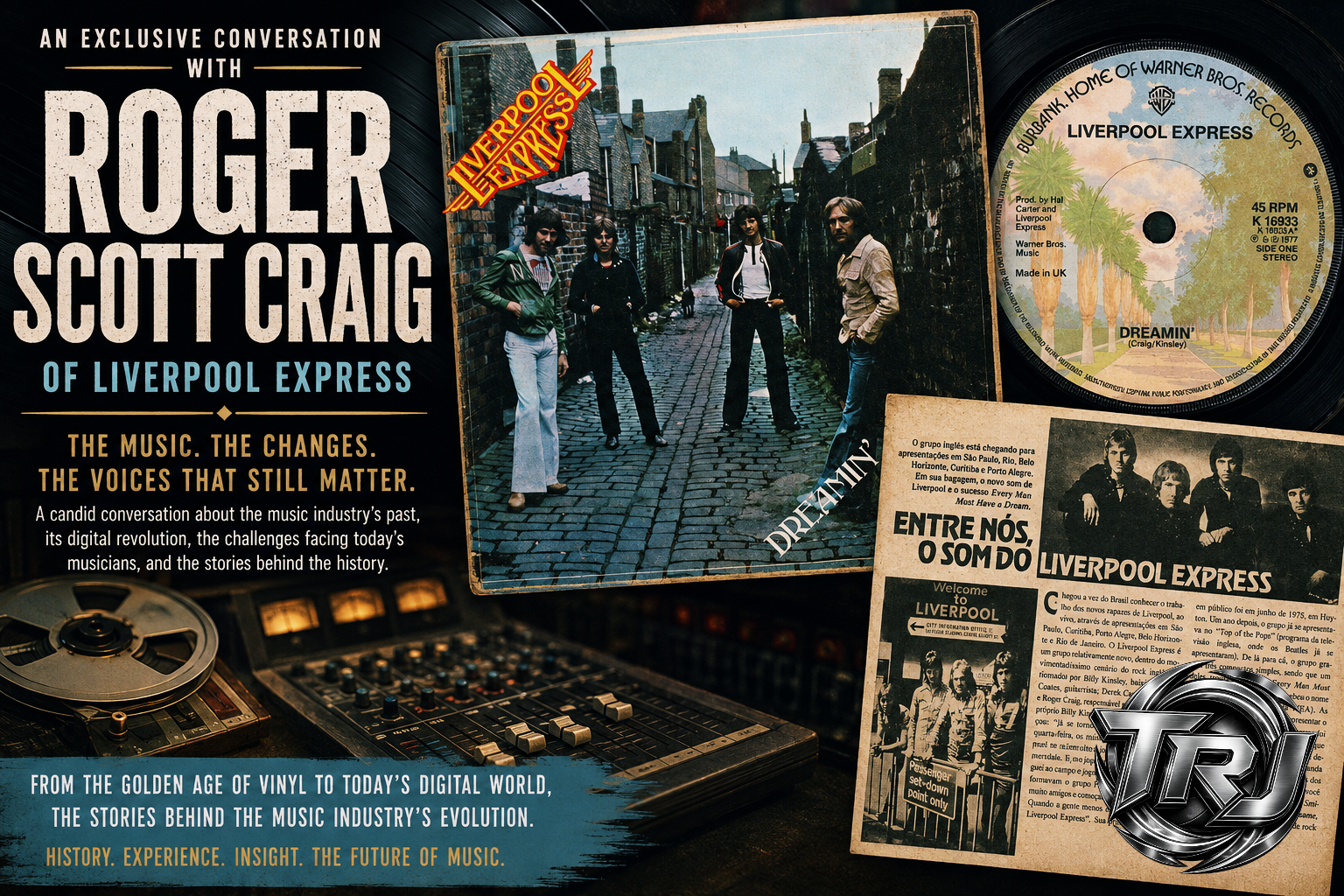
There are moments in journalism when an interview begins long before the first formal question is ever asked. A conversation starts, history begins unfolding naturally, and somewhere along the way it becomes apparent that the story sitting in front of you is considerably larger than the original reason for making contact. On August 6, 2026, at around 5:30 p.m. EDT, that is essentially what happened when I finally had the opportunity to sit down face-to-face over FaceTime with the legendary musician and longtime music-industry veteran Roger Scott Craig, best known for his work with Liverpool Express.
What was originally intended to be an introductory conversation became more than 90 minutes of discussion about music, musicians, the business that surrounds them, the transformation of the industry, the consequences of the digital revolution, and the experiences that shaped both of our perspectives. Roger also shared some incredible stories from his years in the business, including his experiences involving the Beatles, Tom Petty and other iconic figures, along with stories surrounding his own career and signing with Warner Bros. Records. This was not intended to be the official interview, which I’m sure will come later if everything continues moving in the direction we hope. Instead, this was an opportunity for Roger and me to get to know one another, establish some common ground, and determine whether there was enough substance behind our previous discussions and back-and-forth exchanges through email to justify going further. There was, and Roger also managed to tolerate me for more than 90 minutes, which may qualify as an accomplishment all by itself. LOL.
All joking aside, what struck me most was how natural the conversation felt despite Roger having spent decades working alongside some of the biggest names in the music industry. I never felt as though I had to alter my personality, perform some particular role that did not reflect who I am, or treat Roger differently because of the people he has known or the things he has accomplished. He was simply cool, genuine and remarkably down-to-earth on many levels, which allowed our conversation to move well beyond music and the industry into other subjects as well. There were even a few points when I caught myself talking over him somewhat, which anyone who knows my personality probably will not find particularly surprising. Roger did not appear bothered by it in the slightest, and that natural back-and-forth made the conversation feel less formal and more reflective of two musicians from different generations speaking openly about the industry.
I came away from the conversation with an even greater appreciation for the person behind the history. Roger was remarkably easy to talk with. There was no manufactured celebrity persona, no sense that I was expected to sit quietly while someone recited a résumé, and no attempt to turn the conversation into a monument to past accomplishments. We talked as two musicians who came from very different periods of the business but who have watched many of the same fundamental problems affect artists from different sides of the industry. That distinction became important as the conversation continued because Roger Scott Craig is not simply someone with interesting stories about what happened decades ago. He remains deeply interested in what is happening to musicians now, what happened to the business that once surrounded them, and what could still be done to address some of the problems that have followed artists into the modern streaming era.
For longtime musicians and serious followers of music history, Roger’s name may already be familiar. Others may have forgotten him over the years, and an entire younger generation of musicians and listeners may never have heard his name at all. That does not diminish the significance of the history surrounding him. If anything, it illustrates one of the reasons these stories need to be preserved while the people who lived them are still here to tell them. Music history has a peculiar way of remembering the people standing beneath the brightest lights while gradually forgetting many of the musicians, managers, executives, producers, songwriters, engineers, promoters and industry figures who helped build the machinery surrounding those careers. Decades pass, business structures disappear, record companies merge or vanish, technology replaces technology, and new generations inherit the music without necessarily inheriting the history that produced it. That is where conversations with people such as Roger become important.
During our discussion, I told Roger something directly that I believe deserves to be repeated publicly: he is still relevant. He is not simply someone who once was. There is an important difference between respecting someone’s history and treating that person as though their usefulness ended with the era in which they became known. Roger possesses something that cannot be recreated through an Internet search, an archive, an artificial intelligence system, or a stack of old music magazines: lived experience. He remembers the personalities, relationships, decisions, arguments, successes, failures and atmosphere surrounding periods of the music industry that younger musicians can only study retrospectively. More importantly, he still cares about what happened afterward, and that became one of the strongest threads running through our conversation.
There was a time when the music industry operated on a relatively straightforward model, at least in terms of how music was produced, distributed and purchased. That is not to suggest that record companies themselves always operated under straightforward or equitable business practices, because the industry’s history contains plenty of contractual disputes, questionable deals and artists who received far less than the value their work generated. The system had serious flaws, but compared with the fragmented, algorithm-driven and highly complex structure musicians face today, there was at least a clearer path connecting the creation of music, its distribution, its purchase and the revenue generated from it.
Artists recorded albums, record labels pressed and distributed physical records, retailers stocked their shelves, radio stations helped introduce music to the public, and consumers purchased singles or albums to take home and own. Revenue flowed through a system built around the sale of physical music, with record labels, distributors, retailers, publishers, songwriters and artists occupying established positions within the business. The system was far from perfect, and artists frequently fought over contracts, royalties, ownership and control of their work, but there was a much clearer connection between someone purchasing music and revenue being generated from that purchase.
As technology evolved, the physical formats changed with it. Vinyl records were joined by cassette tapes and later compact discs, each extending the same fundamental commercial model into another generation. Consumers still generally paid for a physical copy of an album or single, record stores remained an important part of music culture, radio airplay could drive sales, and a successful release could generate substantial revenue through purchases rather than requiring millions of individual digital plays. Unauthorized copying existed, particularly as cassette recording became commonplace, but distribution remained constrained by the physical world. Someone could duplicate an album for a friend or circulate unauthorized copies, but doing so still required equipment, physical media, time and direct distribution.
The Internet eventually shattered many of those physical limitations. Once music could be converted into compressed digital files and duplicated almost instantly, a song no longer needed a record pressing plant, cassette deck, compact-disc burner, shipping network or retail shelf to travel from one person to another. The arrival of widespread Internet access and peer-to-peer file sharing pushed that transformation even further, fundamentally altering the relationship between music and ownership. Napster became one of the defining symbols of that period, demonstrating how quickly enormous collections of music could move between users without the physical manufacturing, retail distribution or individual purchases that had supported the recorded-music business for generations. The larger story did not begin and end with Napster, but its arrival demonstrated that the transition was no longer simply from one music format to another. It had changed the economics of copying and distributing recorded music itself.
The industry eventually developed legal digital alternatives, followed by the streaming ecosystem that dominates music consumption today. Piracy did not simply disappear because legitimate streaming became convenient. The economic relationship between artists, platforms, labels, distributors and listeners was reconstructed around access rather than traditional ownership, and musicians entered a system in which enormous numbers of plays could be required before streaming revenue became financially meaningful. Roger has been raising concerns surrounding these changes and their consequences for years, which is one of the reasons our conversation cannot simply become another nostalgic look backward at the music business.
Nostalgia may be enjoyable, but nostalgia alone does nothing for the musician uploading a song today and trying to understand why thousands of streams can produce an amount of money that bears little resemblance to what those numbers appear to represent. It does nothing for songwriters attempting to build sustainable careers or independent musicians competing inside systems governed by recommendation algorithms, playlists, short-form content, platform incentives and an almost incomprehensible volume of newly released material. Most importantly, nostalgia does nothing to answer the larger question of how the industry arrived here.
Those questions are worth pursuing, but they cannot be responsibly answered in a single article, a single interview, or even a single documentary without considerable groundwork. As a longtime musician myself, these issues also run much deeper for me than simple journalistic curiosity. I have experienced firsthand many of the frustrations that musicians continue to face, and I know I am far from alone. Artists throughout the United States and around the world have struggled with an industry that has changed dramatically around them, often leaving the people who actually create the music questioning where they fit within the economic structure their work continues to support. Because let’s face the real music here: without musicians, there would be nothing worth listening to when you are down, nothing to lift you when you need it, and none of the music running beneath podcasts, short films, major motion pictures, television productions, advertisements and countless other forms of entertainment.
Music is not simply a product placed into the background of our lives; it helps define those moments, gives emotion to images, creates atmosphere where none previously existed, and often communicates something that words alone cannot express. Without real musicians, we also risk losing something technology cannot authentically manufacture—the natural feel of an instrument being played, the imperfections that give a performance character, the emotion behind a voice, and the human input that transforms sound into something another person can actually feel. Technology can imitate, reproduce and now generate convincing approximations of those things, but when human creation is gradually replaced by something faux, we have to ask what remains of the reality that made music meaningful in the first place.
That was one of the most sobering realities Roger and I discussed, because the media environment itself has changed almost as dramatically as the music industry. There was a period when landing a major story, securing a recognizable name, or producing an important interview could itself generate substantial attention. That is no longer guaranteed. An extraordinary piece of journalism can disappear beneath the digital noise within hours or even minutes, while a historically important interview can compete for attention with millions of videos, posts, advertisements, breaking-news alerts, entertainment stories and algorithmically recommended distractions. The quality and significance of information do not automatically determine how widely that information travels.
Algorithms now exert considerable influence over what people encounter, what remains visible, what disappears, what receives repeated exposure, and what never reaches the audience most likely to care about it. Search engines, social platforms, streaming services and recommendation systems operate according to different incentives, which means a serious project that ignores those realities can contain extraordinary material and still fail to develop the audience necessary to make an impact. I had to be straightforward with Roger about that because if we are going to pursue something surrounding these issues, it has to be built properly.
There is no value in gathering decades of extraordinary music-industry history, assembling respected participants, and recording hours of testimony only to release everything at once without a strategy capable of sustaining public attention. There are many chapters to this history, including Napster, the transformation from physical ownership to digital consumption, the rise of streaming economics, artist compensation, piracy, record-company structures, technology, management, songwriting, publishing, touring, artificial intelligence, and the growing influence of algorithms. Each subject can stand on its own while contributing another piece to a much larger examination of how the music industry changed.
The people who lived through those changes remain an essential part of understanding that history. Documents, statistics and financial records can establish what happened on paper, but they cannot fully capture what it was like to experience those changes from inside the music industry. There are stories, experiences and perspectives that have rarely reached the broader public, and some may challenge what people believe they already know about how the industry evolved.
The history surrounding these changes is far more complicated than any single explanation could capture. People who experienced the same periods of the music industry often walked away with very different memories, conclusions and opinions about what happened, who benefited and what ultimately went wrong. Those differences are part of the history itself, and they become more important as the industry moves further away from the era in which many of these decisions were made. Some of the people who witnessed those changes firsthand are still here, still carrying stories from behind the scenes, and still capable of adding details that have never become part of the broader public conversation.
A subject this extensive requires more than a single perspective because the transformation of the music industry did not occur through one event, one company, one technological development or one generation of musicians. Understanding how the industry reached its present condition requires examining decades of interconnected changes alongside the experiences of the people who actually lived through them, including musicians and others who witnessed the business changing from within.
There is considerably more to this story than what can be addressed here in a single article, and if the right people are willing to participate, some of that history may finally be told from perspectives the public has rarely had an opportunity to hear. Because let’s face another uncomfortable reality: when people challenge powerful interests within mainstream media and the major record industry, their stories can be buried, marginalized or simply denied the exposure necessary to reach a meaningful audience. When the institutions with enormous influence over promotion, distribution and public visibility decide that a particular voice is inconvenient, that person can seemingly disappear from the broader conversation until the public begins treating them as though they no longer matter. Being pushed out of the spotlight does not erase someone’s accomplishments, invalidate what they witnessed or make their story any less important. Sometimes the people history appears to have forgotten were never irrelevant at all; the machinery controlling attention simply stopped putting them in front of us.
And let’s face another reality: once someone has been pushed aside or their voice has been buried, very little is usually done to correct it while they are still alive to tell their own story. Then, when a legendary musician or industry figure dies, the same machinery that allowed their voice to fade can suddenly rediscover their importance. Tributes appear, retrospectives are produced, old interviews resurface, documentaries revisit their careers, and their history becomes valuable all over again—except the person who actually lived that history is no longer here to speak for themselves, challenge the narrative, correct the record, or benefit from the renewed attention.
Their story can continue generating headlines, audiences and money far beyond the grave while the opportunity to recognize and listen to them during their lifetime has already been lost. So, with that said, we are not wasting our time here. If everything comes together as we hope, we intend to bring forward another truth that deserves to be heard—not after the people who lived it are gone, but while they are still here to tell it themselves.
Near the end of our conversation, it became clear that there is considerably more worth exploring, but where those discussions ultimately lead is something that should be allowed to develop naturally and privately. There are possibilities ahead, but this is far too early to define them publicly or make promises about what may eventually emerge. What matters right now is that the conversation has begun, the interest is genuine, and there is a shared belief that parts of this story still need to be told. If everything comes together as we hope, our readers and listeners will know when the time is right.
For that reason, I am not going to make promises about what this ultimately becomes. There is a mission behind these discussions, but the final form has not been determined. For those who may still question whether my conversation with Roger was real, I can put that question to rest: it was very real, it was recorded with his knowledge and permission, and Roger Scott Craig is very much alive and well. He is enjoying his life, and out of respect for his privacy, exactly where he is living will remain his business. What matters here is Roger himself, the history he carries, and what he may choose to share with us going forward.
My interest in pursuing that history is also personal because I am not approaching the music industry solely as a journalist examining it from the outside. I am a musician, and while my experiences are very different from Roger’s, many of the frustrations we discussed were remarkably familiar to me. I understand what it means to believe deeply in something you created and to watch an industry place highly complicated systems between musicians and the audiences they are trying to reach. Technology was supposed to democratize music by giving independent artists access to distribution that previous generations could only obtain through record companies, yet that same technological revolution created an environment in which millions of musicians now compete for fractions of attention across platforms governed by algorithms, playlists, recommendation systems and business models they have little ability to influence.
That common ground allowed portions of our conversation to move naturally beyond the traditional relationship between journalist and interview subject. At times, we were simply two musicians discussing an industry we experienced from very different places and periods. Those were among the parts of the conversation I appreciated most because music means something different when you have actually spent a great deal of your life creating it. To the platforms distributing it, a song may ultimately become another digital file, stream, data point or piece of content competing for attention. To the musician who created it, that same song may represent months or years of work, personal experience, sacrifice, failure, persistence and a moment of creativity that can never be recreated exactly as it originally occurred. When the economic structure surrounding music begins treating those creations primarily as interchangeable units of digital consumption, the discussion about what happened to the industry becomes about considerably more than nostalgia.
After my conversation with Roger, he sent me a video showing the incredible view from the home he built and told me that he was “living the dream.” Looking at the view he shared, I certainly wouldn’t disagree with him in the slightest. There was also something fitting about seeing a man who lived through an extraordinary period of music history enjoying what he has built while still thinking about musicians, the industry and issues he believes remain unresolved. Roger may have decades of history behind him, but our conversation reinforced something I told him directly: I do not consider him someone who simply “once was.” His experience remains relevant because many of the changes he witnessed continue shaping the lives and careers of musicians today.
That said: something tells me Roger still has quite a bit left to say.





🔥 NOW AVAILABLE! 🔥
🔥 NOW AVAILABLE! 🔥
📖 INK & FIRE: BOOK 1 📖
A bold and unapologetic collection of poetry that ignites the soul. Ink & Fire dives deep into raw emotions, truth, and the human experience—unfiltered and untamed
🔥 Kindle Edition 👉 https://a.co/d/9EoGKzh
🔥 Paperback 👉 https://a.co/d/9EoGKzh
🔥 Hardcover Edition 👉 https://a.co/d/0ITmDIB
🔥 NOW AVAILABLE! 🔥
📖 INK & FIRE: BOOK 2 📖
A bold and unapologetic collection of poetry that ignites the soul. Ink & Fire dives deep into raw emotions, truth, and the human experience—unfiltered and untamed just like the first one.
🔥 Kindle Edition 👉 https://a.co/d/1xlx7J2
🔥 Paperback 👉 https://a.co/d/a7vFHN6
🔥 Hardcover Edition 👉 https://a.co/d/efhu1ON
Get your copy today and experience poetry like never before. #InkAndFire #PoetryUnleashed #FuelTheFire
🚨 NOW AVAILABLE! 🚨
📖 THE INEVITABLE: THE DAWN OF A NEW ERA 📖
A powerful, eye-opening read that challenges the status quo and explores the future unfolding before us. Dive into a journey of truth, change, and the forces shaping our world.
🔥 Kindle Edition 👉 https://a.co/d/0FzX6MH
🔥 Paperback 👉 https://a.co/d/2IsxLof
🔥 Hardcover Edition 👉 https://a.co/d/bz01raP
Get your copy today and be part of the new era. #TheInevitable #TruthUnveiled #NewEra
🚀 NOW AVAILABLE! 🚀
📖 THE FORGOTTEN OUTPOST 📖
The Cold War Moon Base They Swore Never Existed
What if the moon landing was just the cover story?
Dive into the boldest investigation The Realist Juggernaut has ever published—featuring declassified files, ghost missions, whistleblower testimony, and black-budget secrets buried in lunar dust.
🔥 Kindle Edition 👉 https://a.co/d/2Mu03Iu
🛸 Paperback Coming Soon
Discover the base they never wanted you to find. TheForgottenOutpost #RealistJuggernaut #MoonBaseTruth #ColdWarSecrets #Declassified


Sponsored • TRJ Ads
Inquiries: contact@therealistjuggernaut.com



Excellent article! I wonder what Roger would think of artists like Tom MacDonald who is making a living from music streams and downloads? Not needing the music industry at all.
Thank you very much, Sheila.
That is an excellent question. Tom MacDonald is certainly a great example of an artist who has successfully built his career independently, and I would genuinely be interested in hearing Roger’s thoughts on him and other artists who have taken a similar path.
I would make one distinction, though. Independent artists have not necessarily escaped the music industry; they are operating within a very different version of it. The traditional record-label structure may no longer stand between the artist and the audience in the same way, but streaming platforms, distributors, digital services, royalty structures, copyright administration and promotion have created an entirely different ecosystem around independent musicians. That road has opened tremendous opportunities, but it has also created new ways for artists to be taken advantage of, sometimes substantially.
Being a musician myself, and as you and your husband know as well, there is a tremendous amount of work involved in doing everything independently. Tom has clearly found a model that works extremely well for him, and what he has accomplished is impressive. He has also had family and friends helping him along the way, which is a support system many musicians simply do not have. Tom and several other artists also emerged during a period when political and cultural tensions created a substantial audience for the subjects they were addressing. They recognized that audience and successfully built upon it, but not every musician will have those same circumstances or opportunities.
If and when I get the opportunity to speak with Roger again, I will definitely ask him what he thinks about Tom and the independent path he has taken. I think his perspective on that could make for a very interesting part of the conversation.
Thank you again for reading and commenting, Sheila. I greatly appreciate it. I hope you have a great night and a great weekend. 😎