Thank you for reading or listening to The Realist Juggernaut. Independent journalism should be accessible to everyone.
Artificial Intelligence, Quantum Computing, and the Boundary Between Advancement and Limitlessness
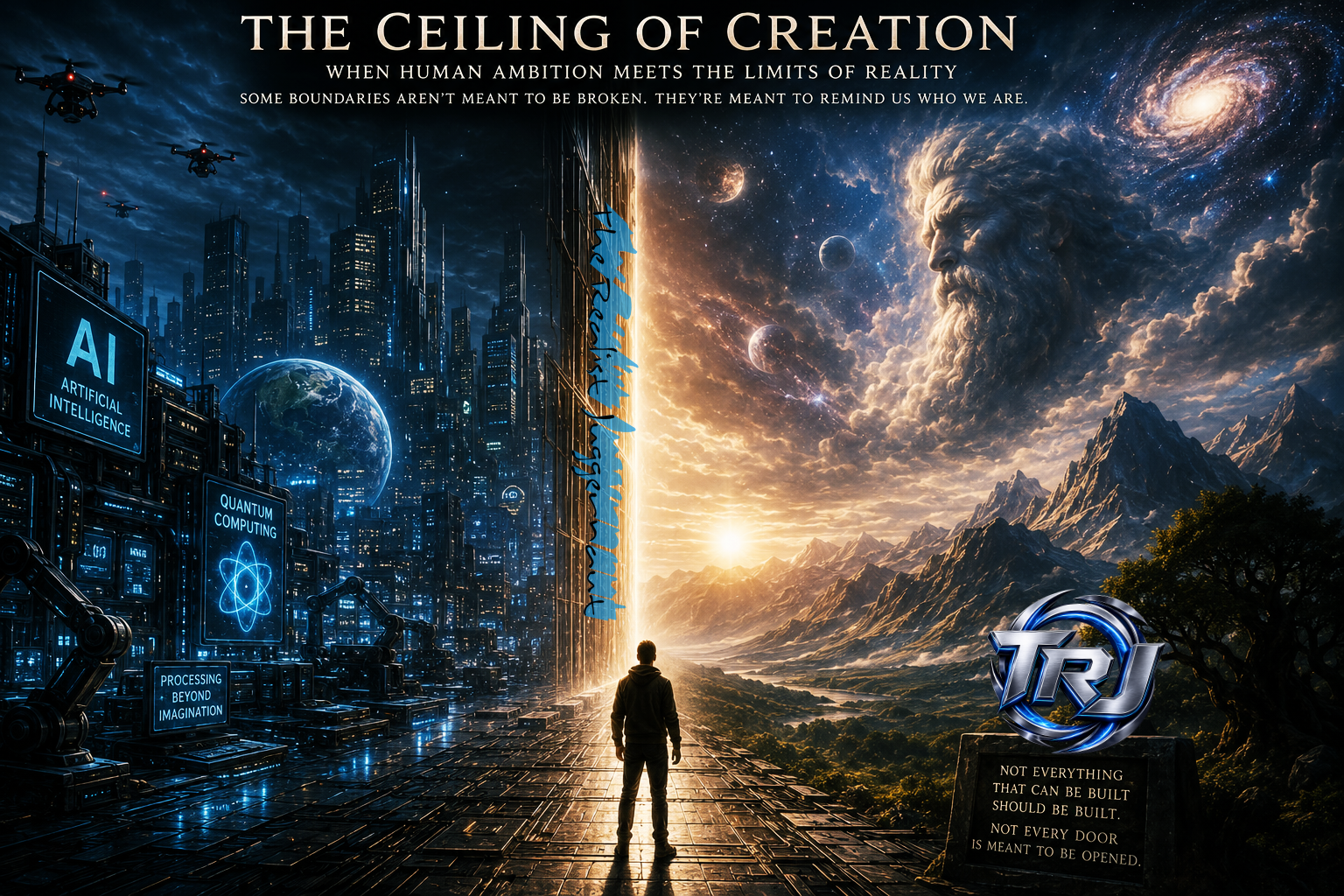
Humanity has always been driven by the desire to reach beyond what appears possible. We crossed oceans, learned to fly, split the atom, traveled into space, mapped distant galaxies, built machines capable of calculations no unaided human mind could perform, and developed artificial intelligence capable of processing enormous amounts of information in seconds. That history gives us good reason to believe technological advancement will continue. It does not give us good reason to believe technological advancement has no ceiling.
That distinction has become important as conversations surrounding artificial intelligence, quantum computing, human consciousness, space exploration, digital existence, and the future of civilization move beyond practical engineering and into claims that sometimes resemble science fiction presented as inevitability. There is nothing wrong with dreaming beyond present capabilities. Human advancement depends on imagination. The problem begins when imagination is mistaken for evidence that every conceivable destination can eventually be reached.
There are boundaries. Some may fall as our knowledge improves, while others may prove fundamental because the machines we construct remain physical objects operating inside the same universe we are attempting to understand. A computer does not stand outside physics simply because it becomes more powerful. Its calculations require physical processes, its information requires physical representation, and its operation is constrained by energy, matter, time, space, heat, communication and the underlying laws governing the system containing it.
This is not an argument against artificial intelligence or quantum computing. Both deserve serious exploration. AI will almost certainly become more capable than it is today, and it may eventually exceed human performance across an enormous range of intellectual tasks. It can already generate software, analyze complex datasets, assist scientific research, identify patterns, automate processes and perform calculations at speeds impossible for an unaided biological brain. Future systems may design technologies that human engineers would struggle to develop independently. That possibility should be taken seriously.
Quantum computing deserves the same intellectual honesty. Quantum computers are real. Researchers have demonstrated quantum computation and continue working toward systems with greater scale, reliability and fault tolerance. The science should not be dismissed simply because its ultimate destination remains uncertain.
The distinction explored here is between quantum computing and what we will call True Quantum: not another quantum chip, another collection of qubits or another machine capable of outperforming conventional computers on particular problems, but the theoretical endpoint of computational ambition — a machine approaching the ability to process, comprehend and potentially manipulate reality at something resembling the scale and complexity of nature itself.
That is where the conversation changes.
Physicist Seth Lloyd examined the ultimate physical limits of computation and began from a critical premise: computers are physical systems, meaning the laws of physics determine what they can and cannot do. His analysis tied computational speed to available energy and information capacity to the physical degrees of freedom available to the machine, with fundamental constants including the speed of light, the quantum scale and gravity entering the calculation. This is important because it establishes something frequently lost in futuristic discussions: computational power cannot simply be separated from the physical universe supporting it.
A sufficiently advanced computer may become unimaginably more efficient than today’s systems. Artificial intelligence may discover new architectures. Quantum computing may solve particular problems using methods that conventional computers cannot practically reproduce. New energy technologies may dramatically expand available generation. None of those possibilities remove the underlying relationship between computation and physical reality.
Those limits are not exclusive to quantum computers. They apply to any machine that exists as a physical object, including conventional computers, quantum computers, and architectures that have not been invented yet.
Information has physical consequences. The Landauer principle connects logically irreversible information processing, particularly information erasure, with thermodynamic cost, establishing a lower theoretical bound on the heat dissipated during such operations. The principle has also been experimentally investigated and remains part of the broader scientific discussion surrounding the physical limits of computation. Better engineering can push machines toward physical limits. It cannot make those limits disappear simply because humanity wants greater performance.
Some computational operations can be designed to reduce irreversible erasure. That does not remove the deeper constraints. A machine still requires energy, matter, time, and physical representation, and it still remains inside the universe it would be asked to master.
The problem becomes more profound when the proposed machine is expected to do something far beyond ordinary computation. If the objective becomes a system capable of fully understanding, predicting or controlling the physical universe containing it, the computer encounters a deeper difficulty: it is itself part of that universe.
David Wolpert’s work on the computational capabilities of physical systems established strong limitations on what a physical computer can infallibly calculate about the universe. His analysis found that there cannot be a physical computer capable of correctly performing every computational task concerning the physical universe, including a general-purpose machine guaranteed to process information faster than the universe itself. Later work on physical inference extended the argument to observation, prediction and control, emphasizing that an inference device is embedded within the very physical system about which it attempts to make predictions.
That does not tell us exactly where every future technological boundary lies. It tells us something more important for this discussion: physical reality already contains limits that intelligence alone cannot negotiate away.
Humanity has become accustomed to treating limitations as engineering problems. When processors become too slow, we make faster ones. When storage becomes inadequate, we increase capacity. When systems generate too much heat, we develop better cooling. When individual machines cannot process enough information, we connect thousands of them together. When conventional computing encounters particular barriers, researchers investigate entirely different architectures.
That history can produce an understandable but dangerous assumption: because humanity has crossed many boundaries, every boundary must eventually fall.
There is no logical requirement for that to be true.
Progress is real. Limitlessness is something else entirely.
Look beyond the laboratory and consider the scale of the natural system humanity is attempting to understand. Earth contains extraordinary amounts of energy, yet our civilization captures and controls only a fraction of what occurs naturally around us. Beyond Earth are stars, gravitational systems, radiation environments, planetary storms, magnetic fields, supernovae, neutron stars, black holes and other physical phenomena operating on scales that dwarf anything humanity can manufacture.
Human beings live inside that structure. We did not build it, determine its constants or establish its laws. We discovered ourselves already inside it, surrounded by forces and systems operating on scales far beyond anything humanity has ever constructed.
That does not diminish human intelligence. It establishes perspective.
The human brain is remarkable. Human beings can reason abstractly, create mathematics, investigate their own existence, build machines, transmit knowledge between generations and transform their environment. AI extends some of those abilities by processing information at enormous speed and scale. Quantum computing may extend computational ability in entirely different directions.
None of those developments make humanity equivalent to the system that contains humanity.
This is where the idea of True Quantum becomes more than a technological question. If the ultimate objective is a machine capable of reducing the deepest workings of existence to computable information, then the required scale cannot be ignored. The more completely a machine attempts to reproduce reality, the more information, energy, physical control and computational capacity become part of the problem.
At some point we have to ask a question technological optimism rarely wants to confront: Can something contained within the universe ever possess the resources necessary to computationally master the universe containing it?
The answer may represent one of the most important boundaries humanity ever encounters.
There is another dimension to this question that should not be excluded simply because modern technological discussions are often uncomfortable with it: God.
Science and belief in God are not mutually exclusive propositions. Scientists themselves hold different theological and philosophical beliefs, and the scientific method is designed to investigate observable physical phenomena rather than adjudicate every metaphysical question concerning why existence exists. Recognizing that distinction does not require removing God from consideration when discussing creation, consciousness, existence and the ultimate limits of human power.
If God is Creator, the distinction between Creator and creation becomes fundamental. Humanity can discover the mechanisms operating within creation, manipulate matter, convert energy, encode information and build extraordinary machines, but none of those achievements automatically erase the distinction between understanding portions of creation and possessing the power of the Creator.
The theological argument and the physical argument arrive from different directions, yet they raise an unexpectedly similar warning: there may be a boundary beyond which created systems cannot go.
That possibility becomes even more significant when human nature enters the equation.
Suppose humanity actually discovered something approaching a computational key to reality. Imagine a machine capable of understanding physical systems with near-total precision, manipulating matter at extraordinary scales, predicting events with overwhelming accuracy or exercising control over systems currently beyond human comprehension. The first question would not remain scientific for long.
Who controls it?
History gives us little reason to believe that such power would remain untouched by competition. Nuclear physics gave humanity nuclear energy and nuclear weapons. Chemistry created medicines and chemical weapons. Biology created lifesaving treatments while also producing knowledge capable of biological harm. Computing connected billions of people while creating surveillance systems, cyberwarfare, mass data collection and new forms of manipulation.
Artificial intelligence carries the same duality. It can assist medicine, scientific research, accessibility, education and creativity. It can also be used for deception, impersonation, automated exploitation, manipulation and cyberattacks. AI does not arrive in a civilization composed exclusively of responsible people. It arrives in the civilization that already exists.
An ultimate machine would arrive there too.
If one person, corporation, government or autonomous system possessed something approaching the keys to physical reality, the technology would become the greatest concentration of power humanity had ever created. Every major government would have a strategic interest in it. Military organizations would seek control over it. Intelligence services would pursue it. Corporations would attempt to commercialize it. Criminal organizations would seek access to it.
Human nature would not suddenly disappear because the machine was technologically magnificent.
That raises a possibility worth considering: some boundaries may function as protection.
A ceiling does not automatically represent failure. A boundary can prevent finite beings from acquiring powers they are neither physically capable of sustaining nor morally capable of controlling.
This is where the ancient account of the Tower of Babel remains relevant as a warning about human ambition. Regardless of whether someone approaches that account strictly through theology, its enduring lesson concerns humanity’s desire to build upward until achievement becomes self-exaltation. There is a difference between building because we can improve human existence and building because we have convinced ourselves that nothing should remain above us.
Technology does not eliminate that distinction.
The same caution should apply beyond quantum computing. Human beings routinely convert speculative possibilities into promises long before the underlying physical problems have been solved. Permanent settlements on hostile worlds, digital immortality, consciousness transfer, time travel, perfect simulations of reality and machines approaching omniscience are discussed with varying degrees of seriousness. Some may eventually produce meaningful technologies. Others may remain permanently beyond human capability.
We should investigate them.
We should also retain enough intellectual discipline to admit that wanting something to exist does not make it physically possible.
That principle becomes especially important when speculative technology begins affecting how ordinary people understand reality. Science fiction has tremendous value because it allows humanity to explore possibilities without pretending those possibilities already exist. Problems arise when the boundary between speculation and established capability disappears.
A virtual environment is not another physical universe simply because it feels immersive. A digital representation of a human mind is not automatically the person it represents. A simulation of reality is not necessarily reality. An artificial intelligence capable of describing consciousness has not therefore acquired every dimension of human consciousness. A quantum computer performing calculations beyond conventional machines has not become master of quantum reality.
Words matter because expectations follow them.
Human beings should continue reaching outward. We should build better spacecraft, stronger computers, more capable AI, improved energy systems, more sophisticated quantum machines and scientific instruments capable of seeing deeper into reality than anything available today. Discovery is part of what humanity does extraordinarily well.
The mistake is believing that exploration requires us to pretend there is no edge.
There is humility in recognizing that some things are larger than us. That humility does not weaken science. It gives science discipline.
Artificial intelligence will advance. It may eventually become more capable than human beings across broad areas of intellectual work. That does not mean AI becomes limitless. AI remains computation occurring within physical systems. Even if future AI designs its own software, develops new architectures and produces generations of systems beyond direct human comprehension, those machines will still exist somewhere, consume resources, interact with physical reality and remain subject to the universe containing them.
Intelligence does not repeal physics.
Quantum computing will advance too. Researchers may solve problems that currently appear overwhelming. Fault-tolerant systems may become practical. Machines may eventually contain numbers of useful logical qubits that make today’s systems appear primitive. None of that should be dismissed.
It should be celebrated if it improves human understanding.
The question is what happens when improvement is confused with infinity.
A civilization can become dramatically more advanced without becoming omnipotent. A machine can become extraordinarily intelligent without becoming omniscient. Humanity can understand far more of the universe without acquiring the ability to reproduce, control or computationally contain everything within it.
Those distinctions need to return to the technological conversation.
We have become fascinated with asking what comes next. We spend far less time asking where the boundary lies.
There may be levels of reality that humanity never completely understands, not because humanity stops learning, but because the scale of what exists permanently exceeds the scale of the observer attempting to contain it. There may be calculations no physical computer can universally perform, questions no machine can infallibly answer and quantities of energy no civilization confined to its physical environment can practically command. Physics already gives serious reasons to reject the simplistic assumption that computation is infinitely scalable.
God adds another dimension to that boundary for those who recognize creation as something greater than an accidental collection of matter. If creation has a Creator, then the pursuit of knowledge does not transform the created into the Creator. Intelligence can rise. Understanding can deepen. Technology can become astonishing.
The distinction remains, and this is not an argument for stopping progress, but for remembering what we are as we continue moving forward.
Human beings should explore. We should question. We should invent. We should challenge assumptions and push against limitations because many supposed limitations throughout history turned out to be failures of imagination rather than laws of reality.
Yet wisdom requires recognizing the opposite possibility as well: some walls are not waiting for a better hammer, and some boundaries may truly be boundaries.
The ultimate danger is not that humanity becomes too intelligent. The danger is that humanity becomes intelligent enough to accomplish extraordinary things and then mistakes extraordinary capability for unlimited authority. That is where ambition can become arrogance and discovery can become recklessness.
True Quantum, as defined here, represents that ultimate question. It asks whether humanity can eventually build something capable of approaching the computational authority of creation itself. Maybe our machines will advance further than anything we currently imagine. Maybe AI and quantum computing together will unlock discoveries that transform civilization.
We should remain open to those possibilities while being equally willing to confront the possibility that there is a ceiling humanity will never cross, not because humanity failed, science stopped, or intelligence reached its end, but because reality itself has limits and everything we build remains inside them.
Humanity does not need to become God to accomplish extraordinary things. We do not need the keys to the universe to understand more of it tomorrow than we understand today. We do not need limitless machines to improve human life. We need enough wisdom to distinguish advancement from omnipotence, discovery from ownership and imagination from reality.
The universe is unimaginably larger, older, more energetic and more complex than the civilization currently attempting to decode it. Humanity should approach that fact with curiosity, determination and respect rather than assuming every mystery is simply an engineering problem waiting for sufficient funding.
There is nothing wrong with reaching for what appears impossible, but there is something wrong with convincing ourselves that nothing can be impossible. That is the line modern technological culture is in danger of forgetting, and before humanity becomes consumed with building the ultimate machine, we may need to recover one of the oldest and most important forms of intelligence we possess: knowing that there are things greater than ourselves.
TRJ VERDICT
Humanity should never stop exploring, questioning, building, or pushing the boundaries of what we understand. Progress has carried civilization farther than previous generations could have imagined, and artificial intelligence, quantum computing, advanced energy systems, and future technologies may carry us farther still. None of that means every boundary is temporary or that enough intelligence, money, processing power, and ambition will eventually place the universe entirely within human control.
There is a difference between discovering the laws of reality and possessing authority over them. Every machine humanity builds remains inside the physical system that gives the machine its energy, matter, information, and ability to operate. AI may become vastly more intelligent than any individual human being, and quantum computers may eventually perform calculations that today’s most powerful systems cannot practically touch, but extraordinary capability is not the same as unlimited capability.
The greater danger may be humanity’s refusal to accept that distinction. History shows that powerful discoveries rarely remain confined to their original purpose. What can heal can also harm, what can connect can also control, and what can advance civilization can become a weapon when placed in the wrong hands. If humanity ever approached something resembling the keys to creation, the struggle to possess that power would begin long before anyone could guarantee it would be used responsibly.
Science should continue advancing, and humanity should continue reaching beyond what it currently understands. Faith, reason, physics, and human experience do not require us to abandon exploration; they require us to recognize that exploration and omnipotence are not the same destination. There may be boundaries that better engineering will eventually overcome, and there may be boundaries embedded so deeply within reality that no machine, civilization, or intelligence contained within creation will ever cross them.
The ultimate measure of an advanced civilization may therefore be more than what it can build. It may be whether it develops enough wisdom to recognize what it should pursue, enough restraint to understand the consequences of what it creates, and enough humility to accept that existence does not become ours simply because we learn more about it.
Humanity can reach beyond itself without pretending it can become greater than creation itself. The future belongs to discovery, but discovery without humility can become arrogance, and power without boundaries can become destruction. The smartest thing humanity may ever learn is that advancement has a horizon — and crossing every imaginable line was never the definition of progress.





🔥 NOW AVAILABLE! 🔥
🔥 NOW AVAILABLE! 🔥
📖 INK & FIRE: BOOK 1 📖
A bold and unapologetic collection of poetry that ignites the soul. Ink & Fire dives deep into raw emotions, truth, and the human experience—unfiltered and untamed
🔥 Kindle Edition 👉 https://a.co/d/9EoGKzh
🔥 Paperback 👉 https://a.co/d/9EoGKzh
🔥 Hardcover Edition 👉 https://a.co/d/0ITmDIB
🔥 NOW AVAILABLE! 🔥
📖 INK & FIRE: BOOK 2 📖
A bold and unapologetic collection of poetry that ignites the soul. Ink & Fire dives deep into raw emotions, truth, and the human experience—unfiltered and untamed just like the first one.
🔥 Kindle Edition 👉 https://a.co/d/1xlx7J2
🔥 Paperback 👉 https://a.co/d/a7vFHN6
🔥 Hardcover Edition 👉 https://a.co/d/efhu1ON
Get your copy today and experience poetry like never before. #InkAndFire #PoetryUnleashed #FuelTheFire
🚨 NOW AVAILABLE! 🚨
📖 THE INEVITABLE: THE DAWN OF A NEW ERA 📖
A powerful, eye-opening read that challenges the status quo and explores the future unfolding before us. Dive into a journey of truth, change, and the forces shaping our world.
🔥 Kindle Edition 👉 https://a.co/d/0FzX6MH
🔥 Paperback 👉 https://a.co/d/2IsxLof
🔥 Hardcover Edition 👉 https://a.co/d/bz01raP
Get your copy today and be part of the new era. #TheInevitable #TruthUnveiled #NewEra
🚀 NOW AVAILABLE! 🚀
📖 THE FORGOTTEN OUTPOST 📖
The Cold War Moon Base They Swore Never Existed
What if the moon landing was just the cover story?
Dive into the boldest investigation The Realist Juggernaut has ever published—featuring declassified files, ghost missions, whistleblower testimony, and black-budget secrets buried in lunar dust.
🔥 Kindle Edition 👉 https://a.co/d/2Mu03Iu
🛸 Paperback Coming Soon
Discover the base they never wanted you to find. TheForgottenOutpost #RealistJuggernaut #MoonBaseTruth #ColdWarSecrets #Declassified


Sponsored • TRJ Ads
Inquiries: contact@therealistjuggernaut.com