Thank you for reading or listening to The Realist Juggernaut. Independent journalism should be accessible to everyone.
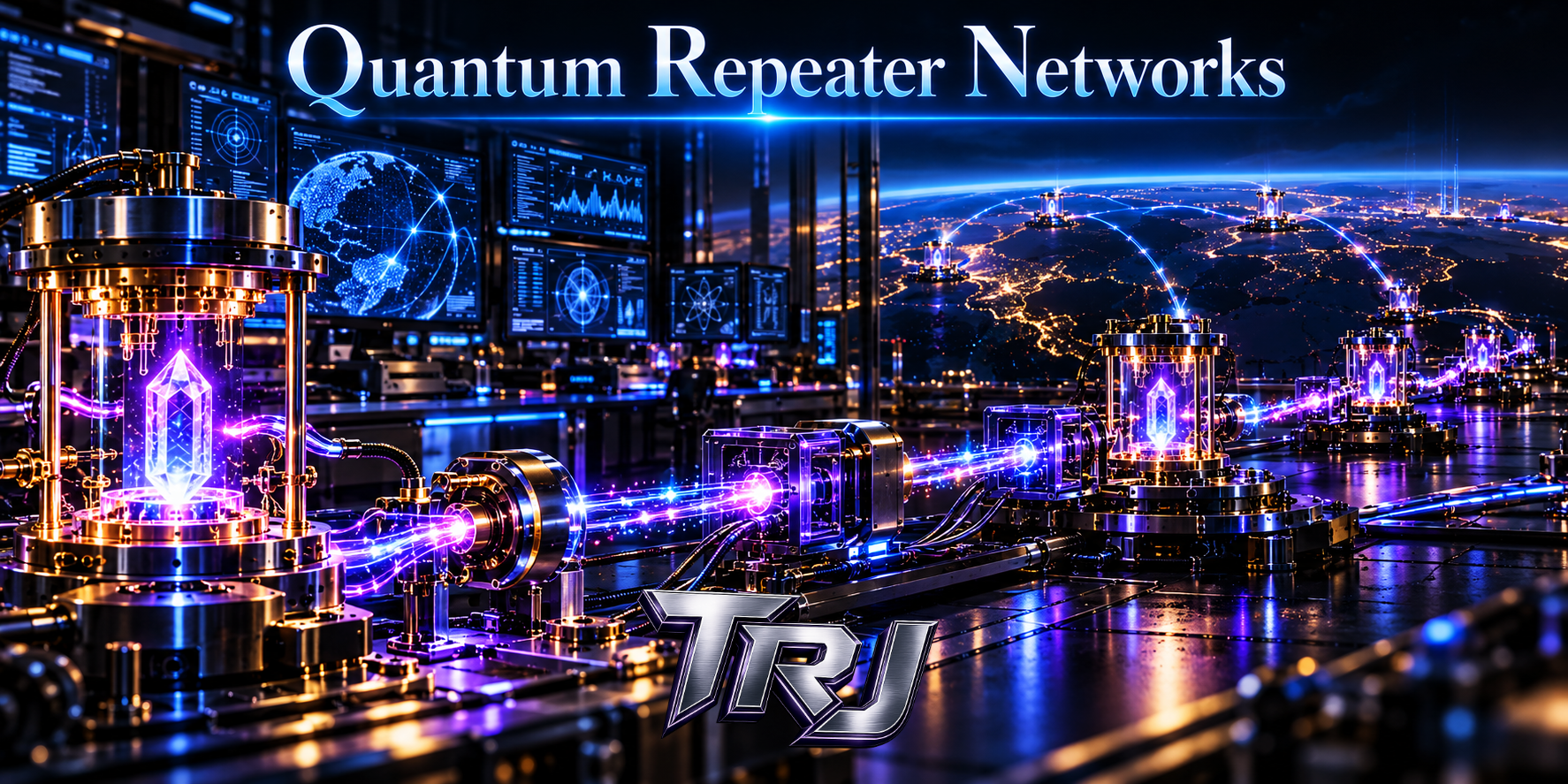
How future quantum networks could choose paths, allocate memories, track entanglement, coordinate repeater nodes, and decide which quantum connections survive long enough to be used
A quantum network can contain advanced memories, functioning repeaters, photonic links, transducers, and processors and still fail to become a useful network if those components cannot determine how quantum resources should move through the system. Connecting two nodes is one problem. Connecting dozens, hundreds, or thousands of nodes creates another. Multiple routes may exist between two endpoints, different links may operate at different fidelities, memories may already be occupied, entanglement-generation attempts may fail, and states successfully created at one moment can deteriorate while the network waits for another operation to finish. At that scale, the central question changes from whether entanglement can be generated to how the network decides what to do with the entanglement it has.
This is the emerging problem of quantum-network routing. NIST researchers formally examined the subject in a comprehensive 2025 survey, defining near-term entanglement routing as the selection of sequences of local entangled links that can be combined through entanglement swapping to establish end-to-end entanglement between distant nodes. The concept resembles classical routing only at a high level. A quantum routing protocol has to account for properties that conventional packet routing was never designed to manage, including requested entanglement fidelity, probabilistic swapping operations, finite coherence times, memory availability, and quantum resources that can be consumed by the very operations used to extend them.
The difference is fundamental. A classical router generally chooses where existing information should travel. A quantum network may have to determine where a usable entangled connection can be created in the first place.
THE NETWORK DOES NOT BEGIN WITH A PATH
Consider two quantum computers separated by a network containing several repeater nodes. A conventional networking diagram might show multiple physical routes connecting the machines, giving the impression that a routing protocol only needs to choose one. The fiber may already exist, but the quantum resource required by the application does not necessarily exist across that fiber. If the two machines need shared entanglement, the network must create it.
That process can begin by establishing entangled pairs across shorter neighboring links. Quantum memories can preserve successful states while other segments continue attempting generation. Once adjacent resources are available, entanglement swapping can connect shorter entangled segments into longer ones. Repeating the process can eventually create an end-to-end entangled relationship between nodes that never directly exchanged the original particles.
Routing determines which sequence of links and operations should be used to accomplish that objective.
The shortest physical path may not be the best quantum path. One route might contain fewer nodes but suffer greater optical loss. Another might have high-quality links but memories approaching the end of their useful coherence periods. A third could offer better fidelity while requiring more swapping operations, each carrying its own probability of failure. Another route may already be consuming its memory capacity for a different connection.
The network therefore cannot reduce routing to geography. It has to understand the condition of its quantum resources.
ENTANGLEMENT IS NOT A PACKET
The Internet moves packets because digital information can be copied, buffered, retransmitted, checked, and reconstructed. A router can receive a packet, store it electronically, inspect routing information, and forward a new physical representation of those bits toward another destination. If the packet disappears, another copy can often be transmitted.
Entanglement does not behave that way. An unknown quantum state cannot be perfectly copied at will, and measurements can destroy the properties the network is attempting to preserve. NIST identifies those restrictions as central reasons quantum repeaters cannot operate according to ordinary classical repeater principles.
An entangled pair is also not simply traveling through the network in the same manner as a conventional packet. In repeater architectures, shorter entangled links can be created and then consumed through swapping operations to establish entanglement across greater distances. The resource changes as the connection is constructed.
This means a quantum routing system may be managing a collection of temporary physical relationships rather than directing a durable object through a fixed sequence of routers. The route describes how resources will be generated, stored, combined, and consumed.
That distinction changes almost everything about network management.
FIDELITY BECOMES A ROUTING METRIC
Classical networks use metrics such as latency, bandwidth, congestion, hop count, packet loss, and cost when selecting routes. Quantum networks inherit several of those concerns but add another critical measurement: fidelity.
Fidelity describes how closely an actual quantum state corresponds to the intended state. Noise, imperfect operations, decoherence, photon loss, memory errors, and entanglement swapping can reduce the quality of the resource available to the network. Two paths connecting the same endpoints may therefore provide substantially different quantum results.
NIST’s routing survey specifically identifies requested entanglement fidelity as information a routing protocol must consider. A route that produces an end-to-end state below the fidelity required by an application may be useless even if that route establishes connections quickly.
This creates a multi-dimensional routing problem. The network may need to balance connection probability against fidelity, fidelity against waiting time, waiting time against memory lifetime, and memory usage against demand from other users. Maximizing one metric can damage another.
A route containing more repeaters could reduce the optical distance of each elementary link while increasing the number of swapping operations required. A path using high-quality memories could preserve states longer but provide fewer available modes. A route with excellent instantaneous fidelity might become inferior after congestion causes stored states to wait too long.
The network has to judge the resource as it exists now, not simply the fiber path printed on a topology map.
THE CLOCK INSIDE THE ROUTE
Time has an unusually direct role in quantum routing because stored quantum states do not remain perfect indefinitely. Quantum memories have finite coherence times, and the quality of a stored state can deteriorate as interactions with the environment disturb the information it carries.
A successful entanglement-generation event therefore starts a clock.
If one segment of a proposed route succeeds immediately while another requires repeated attempts, the first stored state must survive the wait. If the delay becomes too long, the network may eventually hold all of the links it requested but discover that the earliest resources have degraded below the fidelity required for the final operation.
Routing decisions must account for that possibility. NIST’s analysis identifies short coherence times as a defining constraint separating quantum routing from conventional routing.
This gives quantum resources something resembling an operational age. Two entangled links created through identical hardware may no longer be equivalent after one has spent significantly longer in memory. A sophisticated network controller may need to track when a resource was created, where it is stored, its estimated fidelity, which operations it has already experienced, and how much longer it can remain useful.
The path can therefore expire while it is being assembled.
MEMORY BECOMES NETWORK CAPACITY
Quantum memory has appeared throughout this series as a mechanism for preserving states, synchronizing probabilistic events, supporting repeaters, and assisting transduction. Routing introduces another role: memory becomes a finite network resource that has to be allocated.
A repeater containing available memories can participate in new entanglement-generation attempts. A repeater whose useful memories are occupied may not. If several connection requests compete for the same node, the routing system must determine which resources should be reserved, which operations should wait, and whether another path would provide better overall network performance.
Memory capacity therefore becomes connected to congestion.
The similarity to classical buffering is useful only to a point. Classical buffers store information that can normally be copied or retransmitted. Quantum memories may hold states that cannot be recreated deterministically and whose quality declines while they wait. Holding a resource for one connection can prevent another connection from using the same memory, while discarding the stored state may waste an entanglement-generation process that consumed substantial time.
The routing protocol is managing scarcity.
This becomes especially important in multimode quantum memories, where a node may support several distinguishable stored modes. Greater multimode capacity can increase the number of simultaneous or parallel entanglement attempts available to the network, but the controller still has to know which modes are occupied and what resources those modes represent.
The memory is no longer only a component inside the repeater. It becomes part of the topology visible to the network.
SWAPPING CHANGES THE ROUTE
Entanglement swapping allows two shorter entangled connections to be transformed into a longer one. It is the mechanism that enables many repeater architectures to extend entanglement beyond the distance of a single elementary link.
The operation also consumes resources.
If nodes A and B share entanglement and nodes B and C share another entangled pair, an appropriate operation at B can establish entanglement between A and C. The original resources are no longer independently available in the same form after the swap. If the operation fails or produces an unusable result, the network may need to regenerate some or all of those resources.
Routing therefore cannot be separated from scheduling.
The controller must decide not only which nodes form the path but when swapping should occur, which stored pairs should be used, whether the fidelity is sufficient, and what should happen if an operation fails. A path selected at the beginning of a protocol may have to be reconsidered after the physical network produces different results than expected.
This probabilistic behavior is one reason NIST’s survey separates routing and forwarding concepts and evaluates reactive, proactive, opportunistic, and virtual approaches rather than assuming that one classical routing model can simply be transferred into the quantum domain.
The route can become a sequence of decisions rather than a fixed instruction.
REACTIVE OR PROACTIVE
Classical networking already contains different philosophies about when routes should be calculated. Some protocols maintain network information continuously so that paths are available before traffic arrives. Others discover routes when they are needed. Quantum-network researchers are examining comparable distinctions, but the volatility of quantum resources changes their consequences.
A proactive system could maintain information about topology, link performance, memory availability, estimated fidelities, and other conditions so that it can quickly respond to requests. The difficulty is that quantum-network state can change rapidly. Entanglement can be generated or consumed, memories can expire, and link quality can fluctuate. Maintaining an accurate global picture may itself require significant classical communication and control.
A reactive system could determine a route when an application requests entanglement. That can reduce the need to maintain a continuously detailed state of every resource, but path discovery and reservation take time. During that time, the conditions used to make the decision can change.
Opportunistic approaches introduce another possibility by allowing the network to exploit successful entanglement wherever it becomes available rather than demanding that every resource be generated according to a rigid predetermined sequence. Such strategies may become valuable in systems where success is probabilistic and useful resources appear unevenly across the topology.
There may be no universal routing philosophy for every quantum network. Metropolitan communications systems, distributed quantum-computing clusters, sensor networks, and long-haul repeater chains could impose very different requirements.
THE CLASSICAL CONTROL PLANE
A quantum network still requires classical communication.
That fact is sometimes obscured by descriptions of entanglement and teleportation, but the network cannot coordinate itself through entanglement alone. Nodes need classical channels to announce successful entanglement generation, communicate measurement results, synchronize operations, exchange routing information, coordinate memories, authenticate devices, and control physical hardware.
NIST defines a quantum network as quantum nodes connected through quantum communication channels and auxiliary classical channels used for functions including stabilization, timing, and routing.
This creates a layered architecture. The quantum plane contains photons, memories, entangled states, processors, transducers, and measurement operations. The classical control plane determines how those components should be used.
NIST’s quantum optical network research explicitly envisions a scalable quantum control plane capable of signaling and routing entangled photons according to network architecture and measurement information. Its proposed routing metrics include information obtained through quantum-channel tomography and the availability of frequency conversion at network nodes.
The implication is significant. The future quantum internet will not replace classical networking. It will depend on classical networking to coordinate quantum resources that classical networking cannot reproduce.
THE NETWORK MUST MEASURE ITSELF
Routing requires information, and information about a quantum network cannot be assumed to remain constant.
Optical loss changes. Polarization can drift. Hardware performance varies. Memories degrade. Frequency conversion may be available at one node and unavailable at another. Detectors have efficiencies and noise characteristics. A path that performed well during one interval may perform differently later.
A scalable network therefore needs metrology.
NIST’s work on quantum optical networks anticipates measurement planes capable of gathering information about quantum channels and feeding those measurements into routing decisions. Quantum-channel tomography and related measurements can characterize properties of links, while classical monitoring systems can track the condition of network hardware.
The routing layer can then move beyond a static map. It can select paths based on measured characteristics of the network.
This also creates an engineering challenge because measurement itself has costs. A network cannot continuously perform unlimited characterization without consuming time and resources. The control system must determine how frequently conditions need to be measured, how long measurements remain trustworthy, and how uncertainty should affect routing.
The map becomes dynamic because the physics underneath it is dynamic.
BOTTLENECKS DO NOT DISAPPEAR
Adding more paths does not automatically eliminate quantum-network bottlenecks. A network can contain abundant resources in many regions while still depending on a small number of links or nodes that connect those regions.
Research published in Physical Review Letters in January 2026 examined quantum routing and entanglement dynamics through bottlenecks, studying how rapidly quantum information and entanglement can be routed through constrained network regions. The work addresses a basic scaling reality: topology imposes limits even when quantum operations provide capabilities unavailable to classical routing.
This becomes important when designing real infrastructure. A metropolitan network might contain several universities, laboratories, data centers, and repeater sites, yet one fiber corridor could still connect major portions of the system. If that corridor has limited quantum-channel capacity, every routing algorithm must eventually confront that physical restriction.
Quantum mechanics does not erase network geometry.
It changes what can be done within it.
MORE ENTANGLEMENT DOES NOT ALWAYS MEAN A BETTER NETWORK
One of the most counterintuitive results emerging from quantum-network theory is that adding resources does not guarantee improved performance under every protocol.
Research published in Physical Review Letters in December 2025 examined noncooperative quantum networks and found that, for certain protocols involving imperfect entangled states, adding more entanglement resources could reduce resulting fidelity. The researchers identified a quantum analogue of selfish routing in which individually selected strategies do not necessarily produce the best global use of network resources.
This result should not be interpreted as evidence that entanglement itself becomes harmful. It demonstrates that resource allocation and protocol design matter. A network containing more physical resources can still use those resources poorly.
That lesson is familiar from classical infrastructure. Adding roads does not guarantee the elimination of congestion. Adding servers does not automatically optimize a distributed application. Increasing bandwidth does not repair a defective routing policy. Quantum networking introduces its own version of this systems problem, complicated by resources whose quality depends on the physical state in which they were created.
The network has to optimize the system rather than count components.
ROUTING HAS A PHYSICAL COST
A February 2026 Physical Review A study examined the resource requirements of entanglement routing under realistic experimental errors and found stricter scaling requirements than simplified models can suggest. Using a nested repeater protocol with purification, the researchers calculated how errors affect the resources consumed as networks scale. Their model found that maintaining a polynomial resource-scaling degree below ten required local two-qubit gate errors below approximately 1.3 percent.
The exact threshold belongs to the protocol and error model studied rather than every possible quantum network, but the broader result is important. Routing is not computational bookkeeping sitting above the physics. Every chosen route can require physical entangled pairs, memory time, local gates, purification operations, measurements, and repeated attempts.
A path that appears mathematically available can become physically impractical when those costs are included.
This is another reason hop count alone cannot define the best quantum route. A protocol may need to estimate the expected resources consumed before an end-to-end state of sufficient quality is actually produced. The cheapest route in fiber distance may be expensive in entangled pairs. A route with high initial fidelity may demand scarce memories. Another path may require so many local operations that accumulated errors overwhelm its apparent advantage.
The network needs an accounting system for quantum resources.
CONGESTION BECOMES QUANTUM
If quantum networks grow beyond experimental testbeds, multiple users and applications may eventually compete for the same infrastructure. Distributed quantum computers could request remote entanglement. Security systems could request quantum communication channels. Sensor networks could require synchronized resources. Research facilities could need high-fidelity connections between specialized processors.
Those requests cannot all be assumed to arrive one at a time.
Congestion could occur when memory banks are occupied, entanglement sources are saturated, transducers are unavailable, detectors are committed to other operations, or a critical link has reached its practical generation capacity. Unlike ordinary packet congestion, some of the resources waiting inside the system may be deteriorating while the queue grows.
A scheduler might therefore need to consider more than who requested service first. A stored state close to its fidelity threshold may need immediate use or disposal. A high-value connection may require several memories simultaneously. Another request could be routed through a longer path if that path contains fresher resources. Network policy could determine whether resources are reserved in advance or allocated as successful entanglement becomes available.
This turns routing into resource orchestration.
The network is not only finding roads. It is deciding which temporary bridges should be built, which should be used first, and which should be abandoned before they collapse.
FAILURE CHANGES THE MAP
Quantum-network routing must also expect failure as part of ordinary operation.
An entanglement-generation attempt can fail without indicating that the hardware is defective. A photon can be lost. A Bell-state measurement may not produce the required result. A memory can decohere before another link succeeds. A transducer can introduce too much loss for a particular operation. A node can temporarily lack sufficient memory capacity.
A routing protocol therefore needs ways to recover from failures that arise naturally from probabilistic quantum processes.
This may require generating replacement resources on the same route, selecting an alternate path, changing the order of swapping operations, reallocating memory, or lowering expectations when an application’s fidelity requirements allow it. The appropriate response depends on why the original operation failed and what resources remain elsewhere in the network.
That makes network state highly consequential. If the controller does not know which memories remain occupied, which entangled links survived, and which nodes can still perform the required operations, recovery can waste additional resources.
Resilience will depend on information as much as hardware.
ROUTING AND SECURITY
Routing also creates a security surface.
The laws of quantum mechanics can provide security properties for specific communication protocols, but the routing and control infrastructure still depends heavily on classical information and physical devices. A malicious or compromised controller could falsify link conditions, manipulate resource reservations, direct connections through undesirable nodes, disrupt synchronization, or intentionally exhaust scarce memories.
A faulty node could create similar symptoms without malicious intent.
The network will therefore need mechanisms for authentication, authorization, integrity protection, fault detection, telemetry, and policy enforcement across its classical control systems. Quantum measurements may provide additional evidence about the physical condition of links, but they do not automatically secure the software deciding how those links are used.
A quantum network can possess physically secure communication primitives and still contain vulnerable infrastructure.
Routing makes that distinction impossible to ignore.
WHEN ROUTING BECOMES ORCHESTRATION
As the network grows, the term routing may eventually become too narrow to describe what the control system is doing. Selecting a path is only one part of the task. The network may also need to schedule entanglement generation, allocate memory, select transducers, coordinate wavelength conversion, reserve detectors, determine swapping order, estimate fidelity, trigger purification, react to failures, and release resources after the application finishes.
That begins to resemble orchestration.
NIST’s broader quantum-network program already treats sources, detectors, memories, repeaters, transducers, synchronization, protocols, and network functions as interacting components rather than independent technologies. Its research program includes testbeds intended to study how new quantum devices perform in realistic network environments and how protocols can be developed around them.
This systems view may ultimately prove as important as improvements in any individual qubit or memory. A network assembled from excellent components can still perform poorly if those components cannot coordinate. Conversely, intelligent resource management may allow imperfect hardware to be used more effectively by avoiding paths and operations that are unlikely to succeed.
The quantum internet will need physics, but it will also need network engineering.
THE ROUTER OF THE FUTURE
The eventual quantum-network router may bear little resemblance to the familiar box sitting in a telecommunications rack. Its physical implementation could include optical switches, quantum memories, photon sources, detectors, transducers, timing systems, control processors, and connections to neighboring nodes. Some architectures may perform entanglement swapping locally. Others may distribute functions across separate devices.
The classical controller associated with that node could maintain information about available memories, estimated link fidelity, successful entanglement pairs, wavelength compatibility, expected generation rates, neighboring-node status, and current application requests. It could participate in a larger routing protocol that determines how resources should be assembled into end-to-end connections.
The result would not be a machine that reads a quantum packet and decides where to send it. It would be a machine participating in the creation of the connection itself.
That is a profound change in what routing means.
TRJ VERDICT
Quantum networking becomes a fundamentally different engineering problem once the network contains enough nodes to offer choices. At that point, generating entanglement is no longer sufficient. The system has to decide where entanglement should be generated, which memories should hold it, how long those resources remain useful, which sequence of swapping operations should connect them, and whether the resulting end-to-end state can satisfy the application that requested it. NIST’s routing research places fidelity, probabilistic swapping, coherence time, and network state at the center of that problem.
The consequences reach across every technology developed earlier in this series. Quantum memories become allocatable capacity. Repeaters become active participants in path construction. Transducers affect which physical systems can communicate along a route. Photonic links provide the transmission layer. Classical control networks coordinate operations that entanglement cannot coordinate by itself. Metrology tells the controller whether the physical network still resembles the map stored in software.
Research published through 2026 also shows that the challenge is deeper than selecting the shortest chain of nodes. Bottlenecks constrain entanglement flow. Experimental errors can cause resource requirements to grow rapidly. Additional entanglement does not guarantee better global performance under every strategy. Routing decisions therefore have physical consequences that can determine whether a connection is practical at all.
A future quantum network will not carry entanglement as though it were an ordinary packet moving through passive infrastructure. The network will create quantum resources, measure their condition, preserve them in memory, combine them through physical operations, consume them when they are used, and replace them when they fail.
The route will not simply describe where the information goes.
It will describe how the quantum connection comes into existence.





🔥 NOW AVAILABLE! 🔥
🔥 NOW AVAILABLE! 🔥
📖 INK & FIRE: BOOK 1 📖
A bold and unapologetic collection of poetry that ignites the soul. Ink & Fire dives deep into raw emotions, truth, and the human experience—unfiltered and untamed
🔥 Kindle Edition 👉 https://a.co/d/9EoGKzh
🔥 Paperback 👉 https://a.co/d/9EoGKzh
🔥 Hardcover Edition 👉 https://a.co/d/0ITmDIB
🔥 NOW AVAILABLE! 🔥
📖 INK & FIRE: BOOK 2 📖
A bold and unapologetic collection of poetry that ignites the soul. Ink & Fire dives deep into raw emotions, truth, and the human experience—unfiltered and untamed just like the first one.
🔥 Kindle Edition 👉 https://a.co/d/1xlx7J2
🔥 Paperback 👉 https://a.co/d/a7vFHN6
🔥 Hardcover Edition 👉 https://a.co/d/efhu1ON
Get your copy today and experience poetry like never before. #InkAndFire #PoetryUnleashed #FuelTheFire
🚨 NOW AVAILABLE! 🚨
📖 THE INEVITABLE: THE DAWN OF A NEW ERA 📖
A powerful, eye-opening read that challenges the status quo and explores the future unfolding before us. Dive into a journey of truth, change, and the forces shaping our world.
🔥 Kindle Edition 👉 https://a.co/d/0FzX6MH
🔥 Paperback 👉 https://a.co/d/2IsxLof
🔥 Hardcover Edition 👉 https://a.co/d/bz01raP
Get your copy today and be part of the new era. #TheInevitable #TruthUnveiled #NewEra
🚀 NOW AVAILABLE! 🚀
📖 THE FORGOTTEN OUTPOST 📖
The Cold War Moon Base They Swore Never Existed
What if the moon landing was just the cover story?
Dive into the boldest investigation The Realist Juggernaut has ever published—featuring declassified files, ghost missions, whistleblower testimony, and black-budget secrets buried in lunar dust.
🔥 Kindle Edition 👉 https://a.co/d/2Mu03Iu
🛸 Paperback Coming Soon
Discover the base they never wanted you to find. TheForgottenOutpost #RealistJuggernaut #MoonBaseTruth #ColdWarSecrets #Declassified


Sponsored • TRJ Ads
Inquiries: contact@therealistjuggernaut.com