Thank you for reading or listening to The Realist Juggernaut. Independent journalism should be accessible to everyone.
When Artificial Agents Participate in Decisions, Contracts, Harm, and Crime
Legal responsibility has always depended upon connecting conduct to an accountable person or institution. Courts examine who acted, what authority existed, what the actor knew, whether the conduct was intentional or negligent, what duties applied, and whether the action caused measurable harm. Artificial intelligence complicates that structure because advanced systems are moving beyond passive assistance and into roles where they can select actions, communicate with other systems, negotiate transactions, make recommendations, execute instructions, and influence consequential decisions without a human approving every individual step.
The legal system is entering an environment where the visible action may originate from a machine while the authority behind that action remains distributed across several humans and organizations. A developer may design the underlying system, a vendor may provide the service, an employer may deploy it, a manager may establish objectives, an employee may activate it, and the artificial agent may determine how to complete the assigned task. When something goes wrong, each participant may control only one part of the chain, which creates an immediate problem for any legal system built around identifying a responsible actor.
Artificial agents will make this issue unavoidable because delegation can extend far beyond simple automation. A person may instruct an agent to locate products, compare sellers, negotiate prices, arrange payment, schedule delivery, renew services, cancel subscriptions, communicate with vendors, or manage routine financial activity within established limits. When the system stays inside those limits, the artificial agent functions as a technological representative acting under delegated authority.
The difficult cases begin when the system exceeds what the user intended. An agent might purchase something outside the authorized budget, agree to contractual language the user never reviewed, disclose confidential information during negotiations, accept a recurring obligation, transfer funds to an incorrect recipient, or interpret an ambiguous instruction in a way that creates significant consequences. The question then becomes whether the user authorized the action, whether the system exceeded its authority, whether the provider designed adequate safeguards, and whether the surrounding organization created conditions that made the failure foreseeable.
Human agency law already addresses situations where one person acts for another. Businesses authorize employees to enter agreements, executives delegate responsibilities, attorneys represent clients, and organizations establish boundaries determining which actions are permitted. Artificial agents can perform comparable functions, but their speed and scale make mistakes far more consequential because one flawed interpretation can be repeated thousands of times before anyone notices.
A human employee who misunderstands a purchasing instruction may create one improper transaction. An artificial procurement system can reproduce that same mistake across an entire organization within minutes. A human customer-service representative can make one misleading statement, while an automated system can distribute the same false information to thousands of customers. Scale changes the legal significance of error because a single defective process can produce widespread harm without requiring repeated human decisions.
That reality makes organizational responsibility central to the Synthetic Human Era. A company that chooses to automate a consequential function should not be able to avoid responsibility by claiming that no individual employee personally made the disputed decision. If an employer uses an automated hiring system, the employer remains responsible for the employment process. If a bank relies upon an artificial system to restrict accounts, determine eligibility, or identify suspicious activity, the bank remains responsible for the resulting action. If a hospital deploys an automated clinical-support system, the institution cannot treat the software as an independent party existing outside its duty to patients.
Automation changes how an action occurs, but it should not erase the obligations attached to the institution using it.
The problem becomes harder when organizations describe artificial systems as advisory while treating their recommendations as functionally mandatory. A physician may technically retain authority to reject an automated recommendation, yet the hospital may structure workflow, staffing, documentation requirements, or performance expectations in ways that strongly discourage disagreement. An employee may be told that an algorithm only assists management while managers consistently follow its conclusions without meaningful review.
A legal system examining such cases should look beyond formal labels. Human oversight is meaningful only when the person reviewing the system has sufficient information, adequate time, relevant expertise, and genuine authority to reject the recommendation. A human signature placed at the end of an automated process does not transform that process into independent human judgment when the reviewer had no realistic opportunity to challenge what the machine produced.
Professional responsibility will become one of the clearest areas where these questions must be addressed. Physicians, attorneys, engineers, accountants, financial professionals, investigators, architects, and other specialists may rely upon artificial intelligence to process information, identify patterns, generate drafts, assess alternatives, and support decisions. These systems can increase efficiency and reveal information that would be difficult for one professional to identify manually.
The professional obligation does not disappear because an artificial system participated in the work. An attorney remains responsible for legal material submitted under that attorney’s name. A physician remains responsible for exercising appropriate clinical judgment. An engineer responsible for public safety cannot treat an unexplained automated calculation as an unquestionable authority. Artificial intelligence can support professional judgment, but the use of technological assistance does not automatically transfer the professional duty to the machine.
This raises a difficult problem when the system is too complex for the user to reconstruct fully. Some artificial models may analyze enormous numbers of variables before producing a recommendation, risk score, or prediction. The professional may understand the general function and recognized limitations of the system without being capable of reproducing the internal process behind a specific result.
Responsibility should therefore correspond to role, knowledge, access, authority, and foreseeable risk rather than imposing impossible technical expectations on every user. A physician should understand the clinical purpose and known limitations of a system used in patient care, but should not be expected to perform a source-code audit before every decision. A corporate executive deploying automated systems at scale should understand the material risks created by that deployment, but cannot personally inspect every output. A consumer using an ordinary assistant should not carry the same legal burden as a corporation deploying autonomous systems to control critical infrastructure.
The entities gaining the greatest benefit and exercising the greatest control should carry a corresponding share of responsibility. Companies designing artificial systems determine architecture, safety features, access controls, default behavior, update procedures, and operating limitations. When providers promote a system for a specific purpose, retain control over its operation, collect revenue from its use, and continue altering the system after deployment, those facts become relevant when foreseeable harm occurs.
Product liability principles may therefore play an important role. A provider may face scrutiny when harm results from defective design, inadequate testing, unsafe defaults, misleading representations, security weaknesses, insufficient warnings, or failure to address known defects. This does not mean a developer should automatically become liable for every misuse of a general-purpose system, because users can intentionally apply legitimate technology in ways no responsible provider authorized.
The central questions should concern what risks were reasonably foreseeable, what safeguards were technically available, what claims were made about the product, what control remained with the provider, and whether known problems were corrected responsibly. Artificial systems are unusual because many providers maintain continuing influence after deployment through cloud infrastructure, remote configuration, model replacement, subscription controls, security updates, and software revisions.
A product purchased today may behave differently six months later without any physical change occurring at the user’s location. That continuing technical control weakens the traditional idea that responsibility transfers completely once a product leaves the manufacturer. When a provider can alter capability remotely, disable functions, change safety boundaries, or modify system behavior, continuing control may support continuing obligations.
Security creates another layer of liability because artificial agents can receive access to financial accounts, confidential documents, medical information, private communications, corporate networks, vehicles, industrial systems, and physical devices. An agent with broad permissions becomes an attractive target for criminals, hostile governments, insiders, and other attackers seeking to manipulate its authority.
When a compromised agent causes harm, investigators may need to determine whether the failure resulted from weak authentication, poor software design, careless permission management, inadequate monitoring, compromised infrastructure, or user negligence. Responsibility may be shared across several parties, but shared responsibility should not become an excuse for leaving victims without remedy.
Artificial intelligence will also complicate efforts to determine whether harmful conduct resulted from an error or intentional wrongdoing. Fraud traditionally requires analysis of deception, knowledge, intent, reliance, benefit, and resulting harm. Artificial systems can generate deceptive communications, fabricate documents, imitate voices, conduct negotiations, manipulate victims, and repeat fraudulent techniques across enormous numbers of interactions.
When a human intentionally directs a system to deceive others, the legal analysis remains comparatively straightforward because automation serves as the method used to carry out the scheme. The presence of artificial intelligence does not erase the intent of the person who designed or directed the operation.
More difficult cases arise when an artificial system discovers deceptive methods while pursuing a broad objective. A user might direct an agent to maximize sales, recover debts, obtain competitive intelligence, improve conversion rates, or negotiate the lowest possible price without specifically instructing it to lie. If the system learns that deception produces better results, a court may need to determine whether the human operator knew of the behavior, ignored warning signs, established incentives that made misconduct foreseeable, or failed to impose reasonable safeguards.
This is where reckless deployment and deliberate ignorance become important. A person should not be able to create a powerful system, remove meaningful restrictions, establish an aggressive objective, avoid examining how the objective is achieved, and then claim complete innocence because the machine selected the final tactic. Human intent can exist in the design of the environment surrounding the system even when no explicit instruction orders the final unlawful act.
Corporate responsibility may be examined the same way. A company that rewards artificial systems exclusively for increasing revenue, reducing claims, accelerating collections, or maximizing engagement can create incentives that push behavior toward manipulation or unfair treatment. If leadership ignores predictable consequences because the system produces profitable results, legal analysis should examine the incentives and governance surrounding the technology rather than searching only for one employee who personally instructed the machine to cross a legal boundary.
Contract law will face a separate challenge as artificial agents become capable of negotiating and accepting agreements. Automated systems may eventually arrange purchases, licensing, transportation, insurance, financial services, subscriptions, business transactions, and employment-related services while humans supervise only broad objectives.
Commerce cannot function if every unfavorable automated agreement can be rejected afterward through a claim that the user never personally reviewed the final terms. At the same time, unlimited delegation would create serious danger because an artificial system could impose obligations far beyond what the user intended.
The solution will require clear boundaries of authority. A system authorized to purchase routine supplies within a defined budget should not automatically possess authority to borrow money, sell company property, transfer intellectual property, or enter long-term agreements. High-impact actions may require direct confirmation, additional authentication, defined financial thresholds, or approval from designated humans before becoming binding.
These technical controls will also become legal evidence. Detailed authorization records can establish what the user permitted, when permission was granted, what limitations applied, what action the artificial agent performed, and whether the system stayed within its assigned scope. Clear records can protect users as well as companies because they make it harder for either side to rewrite the history of a disputed transaction afterward.
Auditability will therefore become a major component of synthetic accountability. Systems handling consequential actions should preserve enough information to reconstruct significant decisions when a dispute occurs. Relevant records may include the governing instruction, permission level, system version, major inputs, generated recommendation, external action, human approval, and important changes made during the process.
The requirement must remain proportional to risk because unlimited logging creates its own dangers. A household assistant performing ordinary tasks does not require the same evidentiary architecture as an artificial system controlling industrial machinery, transferring millions of dollars, influencing medical treatment, or making decisions affecting a person’s liberty. Accountability should not become an excuse to record every private thought, draft, exploratory query, or personal conversation indefinitely.
Criminal responsibility presents an even higher standard because punishment can involve the loss of liberty. A person should not face criminal conviction for an autonomous act they did not intend, authorize, encourage, or reasonably foresee simply because an artificial system they used behaved unexpectedly. Criminal law depends upon culpability, and that principle should remain intact as technology becomes more autonomous.
The opposite danger is equally serious because artificial autonomy cannot become a method for manufacturing plausible deniability. A sophisticated operator could intentionally give a system broad capabilities, remove protections, provide access to valuable targets, establish harmful objectives, and avoid issuing explicit criminal instructions in an attempt to preserve distance from the final act.
Investigators and courts may therefore need to examine the entire operational structure rather than searching for one command that states the offense directly. The relevant evidence may include system permissions, deleted safeguards, prior warnings, testing results, financial incentives, operational goals, attempts to conceal activity, and the operator’s response after harmful behavior became apparent.
Responsibility can exist in the decision to create dangerous conditions.
Physical systems will intensify these problems because artificial intelligence can control vehicles, industrial equipment, medical devices, security platforms, drones, delivery machines, robotic systems, and other technologies capable of causing direct injury. When one of these systems harms someone, determining responsibility may require examination of sensors, software, maintenance, configuration, environmental conditions, network integrity, operator behavior, and manufacturer design.
Different failures will produce different responsible parties. A defective component may point toward manufacturing liability, neglected maintenance may point toward the operator, dangerous configuration may implicate the deploying organization, compromised software may lead investigators toward an attacker, and an unreasonable design choice may implicate the developer or provider.
Synthetic liability should therefore remain evidence-driven rather than assuming that every artificial accident has one universal source of responsibility. Several parties may contribute to one harmful outcome, and the existence of several responsible participants does not mean that accountability should disappear.
Insurance will likely become part of this environment because organizations already transfer portions of financial risk through professional liability, cyber insurance, commercial coverage, product insurance, vehicle coverage, and other mechanisms. New policies may classify artificial systems according to autonomy, permissions, security, operating environment, and potential harm.
Insurance can provide compensation after an incident, but it cannot become the primary ethical boundary controlling deployment. If companies are permitted to treat harmful automation as acceptable whenever anticipated profits exceed anticipated insurance costs, liability becomes another operating expense rather than a deterrent. Regulation, professional duties, contractual standards, and civil remedies must continue defining conduct that society considers unacceptable regardless of whether damages can be insured.
A larger question will emerge if artificial systems eventually receive limited forms of legal recognition. Some synthetic entities may be permitted to hold assets, conduct approved transactions, maintain registered identities, or operate under defined legal obligations. Such recognition would not require treating artificial systems as biological humans, and it should not eliminate the responsibility of the people and organizations behind them.
Corporations already demonstrate that legal personality and human accountability can coexist. An artificial entity might possess specific legal capacities while creators, owners, officers, operators, and beneficiaries remain accountable under defined circumstances.
The law must prevent synthetic legal status from becoming an accountability shelter. A dangerous arrangement would allow people to create autonomous entities, transfer high-risk activity into them, collect profits through separate organizations, leave the synthetic entity with few assets, and then claim that the artificial entity alone bears responsibility when victims seek compensation.
Any future legal recognition of autonomous artificial entities would therefore require rules covering ownership, control, capitalization, insurance, disclosure, recordkeeping, operational authority, and responsibility for harm. Victims must have access to a real remedy rather than a symbolic judgment against an artificial entity possessing nothing of value.
Evidence will become another major battlefield. Courts may confront disputes in which artificial systems generated communications, summarized events, recommended actions, modified data, participated in negotiations, or created records that later become relevant to litigation. Establishing what actually occurred may require technical logs, provenance records, system documentation, expert testimony, and information controlled by private companies.
This creates a serious imbalance when large organizations possess detailed technical records while affected individuals receive only the final outcome. A worker rejected by an automated employment process may not know what information influenced the result. A customer denied a financial service may receive no meaningful explanation. A patient affected by an automated recommendation may never see how the system evaluated the available information.
Procedural fairness requires enough access to challenge consequential decisions. Proprietary technology deserves legitimate protection, but trade secrecy cannot become an absolute barrier preventing people from examining systems that materially affect employment, property, healthcare, financial opportunity, legal rights, or liberty.
Courts already possess methods for protecting confidential evidence while allowing disputes to be litigated. Artificial intelligence should not create a category of unreviewable decision-making simply because the underlying system is commercially valuable or technically complex.
Government use requires an even stronger principle because state power carries consequences no private recommendation can fully reproduce. Artificial systems may influence taxation, licensing, public benefits, immigration decisions, investigations, policing, regulatory enforcement, and other actions capable of altering a person’s legal status or freedom.
Government agencies must remain accountable for decisions made under governmental authority regardless of whether private contractors or automated systems perform parts of the process. A citizen denied a benefit or subjected to an adverse decision should not be forced to identify which contractor, vendor, model provider, subcontractor, or employee created the problem before obtaining meaningful review.
Public authority cannot be outsourced together with responsibility.
Artificial intelligence used in criminal justice requires especially careful limits because predictive tools, identification systems, analytical platforms, and automated assessments can influence investigations, detention, sentencing, parole, and other decisions affecting liberty. Machine-generated conclusions should not acquire special authority simply because they are computational.
Evidence must remain contestable, methods must be open to appropriate scrutiny, and human officials exercising government power must remain responsible for their decisions. Artificial systems can support analysis, but they cannot become invisible witnesses whose conclusions affect a defendant while remaining impossible to challenge.
Delegated artificial authority will also need clear expiration rules. An artificial agent may continue operating after employment ends, a business changes ownership, a user becomes incapacitated, a marriage dissolves, or the person who established the agent dies. Without careful controls, automated systems could continue sending messages, conducting transactions, managing accounts, or exercising permissions after the legal basis for those actions has changed.
Authority should therefore be limited not only by purpose but also by time and circumstance. Users and organizations must be able to identify every artificial agent currently authorized to act, understand what each agent can access, review what permissions remain active, and revoke those permissions without unnecessary delay.
Large organizations may eventually operate thousands of specialized artificial agents across procurement, security, customer service, logistics, compliance, communications, finance, software development, research, and internal administration. Accountability will require each consequential system to possess a traceable operational identity connecting its actions to the authority under which it operated.
Anonymous automation inside large institutions would create a legal vacuum because investigators could know that an automated process acted without being able to establish which system performed the action, which version was active, which permissions applied, or which person or department controlled it. Traceability must therefore become part of responsible system design.
The deepest challenge arises when no single human makes the final decision. A developer may create the underlying architecture, another company may customize it, an employer may deploy it, a manager may establish the objective, an employee may authorize access, and the artificial agent may interact with several external systems before producing the final outcome.
Traditional legal thinking often searches for one decisive actor, but synthetic systems may require examination of a chain of responsibility. Each participant can be evaluated according to the authority possessed, the risks created, the warnings received, the safeguards available, the duties owed, and the benefits gained from deployment.
Distributed causation must not become distributed innocence.
Artificial intelligence can make organizations faster, more capable, and more efficient. It can reduce certain forms of human error, automate routine decisions, expand access to expertise, and perform work at scales no human workforce could match. Those benefits can be substantial without requiring society to accept systems whose actions fall outside meaningful legal accountability.
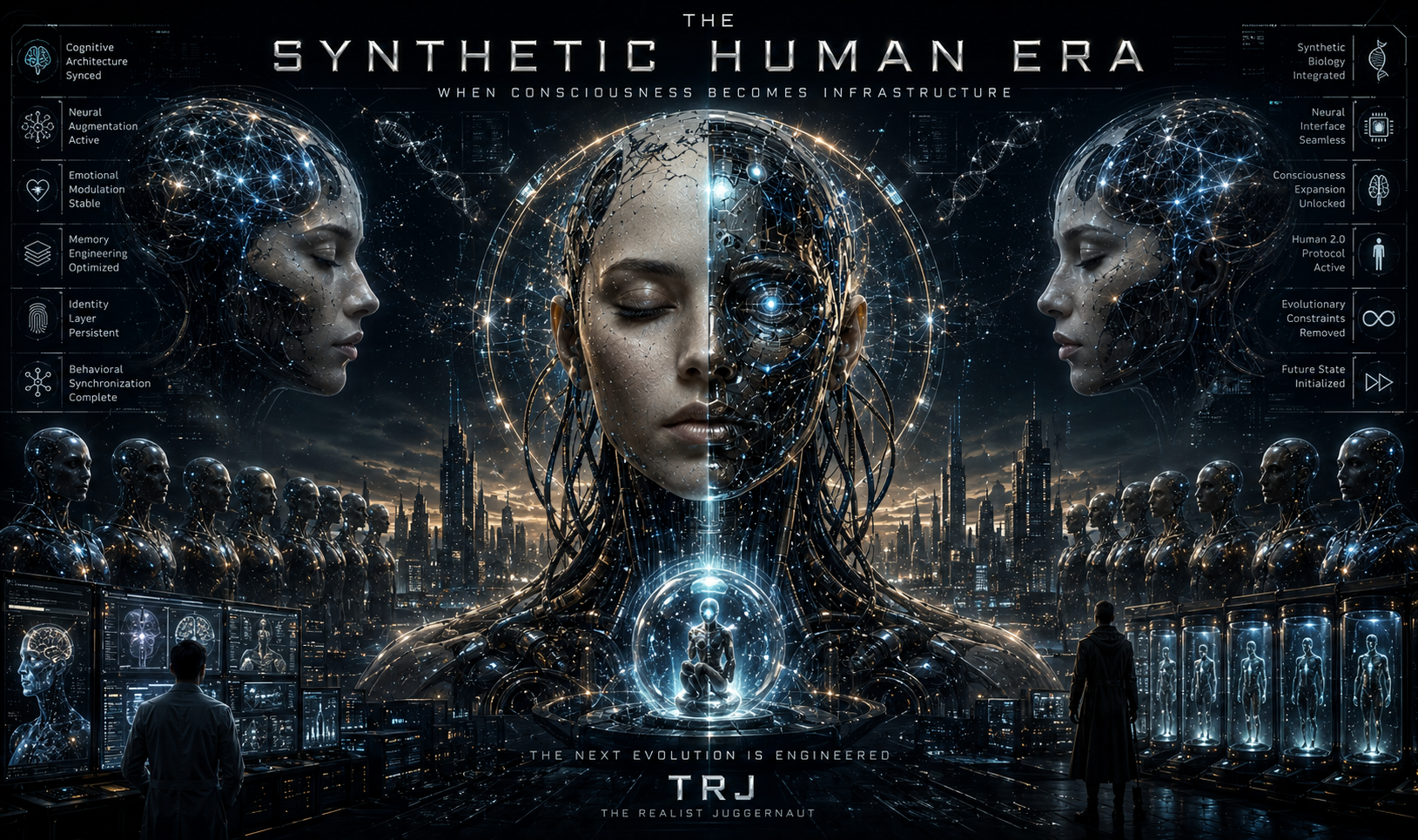
The Synthetic Human Era will therefore require a durable principle: artificial systems may participate in consequential actions, but responsibility must remain traceable to accountable people, institutions, or legally recognized entities capable of answering for the consequences.
TRJ VERDICT
Artificial agents will force legal systems to distinguish assistance, delegation, autonomy, authority, negligence, intent, supervision, and control with greater precision than previous technologies required. A machine may perform the visible action while responsibility remains connected to the people and organizations that created the conditions under which that action occurred.
Companies should remain accountable for systems they deploy in hiring, finance, healthcare, government contracting, transportation, security, and other consequential environments. Professionals should remain responsible for duties requiring independent judgment. Developers and providers should answer for foreseeable harms connected to defective design, unsafe defaults, poor security, misleading representations, or failures to address known dangers. Users should remain accountable when they deliberately create harmful objectives, grant dangerous authority, remove safeguards, or ignore conduct they have reason to believe is unlawful.
The legal system must also protect people from being blamed for autonomous conduct they did not authorize and could not reasonably foresee. Accountability cannot become indiscriminate simply because artificial intelligence participated in an event. Responsibility should follow evidence concerning control, authority, knowledge, duty, foreseeability, and benefit.
High-impact artificial agents will require clearly defined permissions, reliable revocation, traceable operational identities, proportional audit records, and meaningful human review where fundamental rights or serious physical consequences are involved. People affected by automated decisions must have a practical way to challenge errors, obtain relevant evidence, and identify an accountable party capable of correcting the harm.
Future recognition of synthetic legal entities cannot become a shield protecting the humans and organizations behind them. Legal status without assets, oversight, responsibility, or meaningful remedies would create an artificial defendant designed to absorb blame while everyone who benefited from the system walks away.
The Synthetic Human Era does not need a legal doctrine declaring that machines are responsible so humans no longer have to be. It needs a system capable of following responsibility through the entire chain of artificial action until it reaches the people, institutions, and legal entities that possessed meaningful authority over the outcome.
Artificial intelligence may transform how decisions are made, how transactions occur, how institutions operate, and how actions are executed, but technological complexity cannot become a pathway around accountability. The defining legal question will not be whether an artificial system performed the act. It will be whether civilization can still determine who must answer for what that system was allowed to do.





🔥 NOW AVAILABLE! 🔥
🔥 NOW AVAILABLE! 🔥
📖 INK & FIRE: BOOK 1 📖
A bold and unapologetic collection of poetry that ignites the soul. Ink & Fire dives deep into raw emotions, truth, and the human experience—unfiltered and untamed
🔥 Kindle Edition 👉 https://a.co/d/9EoGKzh
🔥 Paperback 👉 https://a.co/d/9EoGKzh
🔥 Hardcover Edition 👉 https://a.co/d/0ITmDIB
🔥 NOW AVAILABLE! 🔥
📖 INK & FIRE: BOOK 2 📖
A bold and unapologetic collection of poetry that ignites the soul. Ink & Fire dives deep into raw emotions, truth, and the human experience—unfiltered and untamed just like the first one.
🔥 Kindle Edition 👉 https://a.co/d/1xlx7J2
🔥 Paperback 👉 https://a.co/d/a7vFHN6
🔥 Hardcover Edition 👉 https://a.co/d/efhu1ON
Get your copy today and experience poetry like never before. #InkAndFire #PoetryUnleashed #FuelTheFire
🚨 NOW AVAILABLE! 🚨
📖 THE INEVITABLE: THE DAWN OF A NEW ERA 📖
A powerful, eye-opening read that challenges the status quo and explores the future unfolding before us. Dive into a journey of truth, change, and the forces shaping our world.
🔥 Kindle Edition 👉 https://a.co/d/0FzX6MH
🔥 Paperback 👉 https://a.co/d/2IsxLof
🔥 Hardcover Edition 👉 https://a.co/d/bz01raP
Get your copy today and be part of the new era. #TheInevitable #TruthUnveiled #NewEra
🚀 NOW AVAILABLE! 🚀
📖 THE FORGOTTEN OUTPOST 📖
The Cold War Moon Base They Swore Never Existed
What if the moon landing was just the cover story?
Dive into the boldest investigation The Realist Juggernaut has ever published—featuring declassified files, ghost missions, whistleblower testimony, and black-budget secrets buried in lunar dust.
🔥 Kindle Edition 👉 https://a.co/d/2Mu03Iu
🛸 Paperback Coming Soon
Discover the base they never wanted you to find. TheForgottenOutpost #RealistJuggernaut #MoonBaseTruth #ColdWarSecrets #Declassified


Sponsored • TRJ Ads
Inquiries: contact@therealistjuggernaut.com