Thank you for reading or listening to The Realist Juggernaut. Independent journalism should be accessible to everyone.
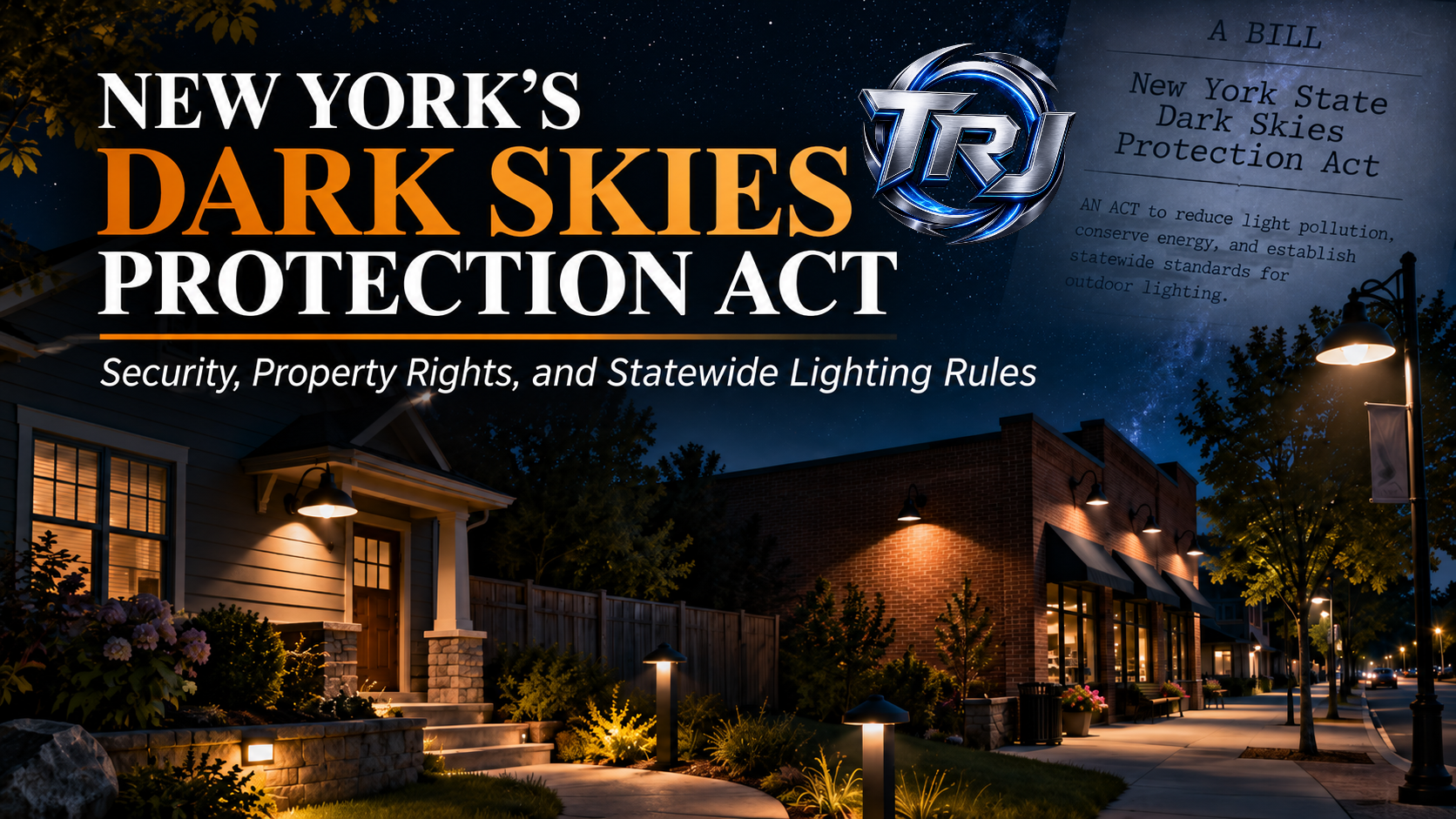
New York’s proposed Dark Skies Protection Act would impose statewide outdoor lighting requirements on homeowners, businesses, and municipalities beginning in 2028. The legislation raises serious concerns about government overreach, property rights, nighttime security, and mandatory compliance costs. New Yorkers have legitimate reasons to protect their homes and businesses, and the state must not disregard those needs while expanding its regulatory authority over private property.
ALBANY, N.Y. — New York lawmakers are considering legislation that would expand state regulatory authority over outdoor lighting at residential, commercial, industrial, and municipal properties. The proposed Dark Skies Protection Act would establish statewide shielding requirements beginning January 1, 2028, restrict certain noncompliant fixtures during overnight hours, and impose additional limitations on recreational facilities. Although presented as an environmental protection measure, the proposal raises substantial questions about mandatory changes to existing security arrangements, the financial burden on property owners, and whether lawmakers have adequately considered the practical consequences for residents and businesses that depend on nighttime illumination.
Assembly Bill A4615, introduced February 4, 2025, by Assemblymember Deborah Glick, would amend the New York State Environmental Conservation Law by establishing a new article governing outdoor lighting. Senator Patricia Fahy introduced corresponding legislation, S9637, on March 31, 2026, with an amended version, S9637A, issued May 8. The Assembly proposal was referred to the Codes Committee on February 10, 2026, following consideration by the Environmental Conservation Committee. The amended Senate legislation remains in the Environmental Conservation Committee. Neither measure has passed both legislative chambers or become law.
The legislation’s stated purpose is to preserve darker night skies, improve environmental conditions for birds and other wildlife, reduce unnecessary energy consumption, and limit excessive artificial illumination. Its supporters identify glare, interference with astronomical visibility, unwanted illumination of neighboring properties, and wasted electricity as concerns associated with poorly directed outdoor lighting. The proposed requirements would cover numerous fixtures, including floodlights, spotlights, landscape lighting, parking lot illumination, architectural lighting, and certain streetlights.
Under the proposed law, outdoor fixtures generally would need to be shielded so their emitted light is directed below a horizontal plane extending from the lowest point at which the fixture produces illumination. This requirement would regulate the direction of light rather than prohibit outdoor illumination altogether. Properly shielded fixtures could continue operating, subject to other applicable requirements. Property owners using equipment that projects light outward or upward could therefore face modifications to systems already installed and functioning.
Noncompliant lighting would remain permissible under specific operating conditions. Such fixtures would need to be extinguished between 11 p.m. and sunrise or use motion-activated controls equipped with an automatic shutoff operating after less than 15 minutes. Homeowners and businesses relying on continuously operating, unshielded floodlights could be required to install shielding, replace fixtures, adjust their equipment, or change how their lighting systems operate. The legislation does not establish that existing security installations would automatically qualify for an exemption based solely on their protective purpose.
The proposed law does not require every homeowner to extinguish exterior lights overnight, and it does not categorically prohibit residential security lighting. Nevertheless, its restrictions could affect property owners whose existing systems illuminate wide areas around driveways, entrances, parking lots, detached structures, and other vulnerable locations. For residents concerned about burglary, vandalism, trespassing, and personal safety, maintaining visibility around their property can be an important protective measure rather than a decorative preference.
Continuous exterior lighting can assist residents in observing approaching individuals, identifying unusual activity, and navigating outdoor areas after dark. It can also support surveillance equipment that depends on available illumination to produce usable images. Any mandatory changes to these systems should therefore be evaluated according to their actual security functions. Compliance with a technical shielding requirement does not, by itself, establish that a modified installation will provide the same visibility or surveillance coverage as the system it replaces.
Motion-activated lighting presents additional operational considerations. Its effectiveness depends on sensor placement, detection range, equipment reliability, and the physical layout of a property. Buildings, vegetation, fencing, and other obstructions can interfere with detection coverage, while a sensor may activate only after movement has entered its designated area. Properties with long driveways, extensive grounds, multiple entrances, or detached buildings may require additional equipment to achieve dependable coverage. The proposed legislation does not establish individualized security-performance standards addressing these conditions.
The state’s responsibility for public safety becomes especially important when evaluating the proposed restrictions. If mandatory lighting changes reduce the effectiveness of existing protective arrangements, lawmakers should determine whether additional police patrols, expanded law enforcement resources, or other security measures would be necessary to compensate for those changes. The legislative text contains no comprehensive public safety assessment establishing how such circumstances would be addressed. Before imposing new obligations, the state should demonstrate that its requirements will not create avoidable security deficiencies or transfer additional protective responsibilities to property owners without adequate consideration.
The statewide scope of the legislation raises another concern. Residential neighborhoods, isolated rural properties, industrial facilities, commercial establishments, and densely developed urban areas operate under substantially different conditions. A fixture illuminating a remote driveway may serve a different purpose from a light projecting into neighboring homes along a closely developed street. Applying the same technical requirements across these settings could produce different compliance challenges, especially where property owners depend on existing installations to monitor large or difficult-to-access areas.
The amended Senate legislation recognizes several circumstances warranting exemptions. These include lighting necessary for worker safety, airport navigation, emergency response operations, tunnels and roadway underpasses, certain municipal construction activities, and streetlights for which appropriate manufacturer shielding is unavailable. Exemptions also cover specified lower-wattage fixtures, certain geographically limited installations, and lighting determined to have cultural or historical significance. These provisions acknowledge that restrictions on illumination can interfere with essential activities, although they do not establish a comprehensive exemption for every residential or commercial security application.
Property owners whose security lighting falls outside the listed exemptions would need to determine whether existing equipment meets the shielding standard or can operate under the permitted shutoff provisions. The Department of Environmental Conservation would have discretionary authority to exempt certain fixtures when suitable shielded alternatives are not reasonably available. That authority could address equipment availability, but the bill does not establish a separate process through which property owners could obtain individualized exemptions based specifically on demonstrated security risks.
Outdoor recreational facilities would face additional restrictions. The proposal generally would prohibit illumination at amphitheaters, arenas, and similar public or private facilities between 11 p.m. and 5 a.m., except when qualifying recreational, sporting, or other activities began before 11 p.m. and remained underway. Such restrictions could require facilities to review late-night operating practices, including activities that depend on exterior illumination outside scheduled events. The proposed language does not comprehensively resolve every situation involving nighttime access, maintenance, or facility-specific security needs.
The potential financial burden extends beyond the purchase of replacement lighting fixtures. Depending on the existing installation, compliance could involve electrical modifications, professional installation, automated controls, additional sensors, or changes to fixture positioning. Businesses operating extensive perimeter lighting or large parking areas may encounter substantially different expenses from individual homeowners. The legislative text provides no comprehensive statewide cost estimate or dedicated financial assistance program addressing the expenses that mandatory compliance could impose.
Local regulatory authority adds another dimension. Under S9637A, municipalities with existing light-pollution restrictions equal to or more stringent than the proposed statewide standards would not be subject to the new article. This arrangement would preserve certain established local regulations while introducing broader requirements elsewhere. Residents and businesses could therefore face differing obligations depending on their municipality, making clear guidance about applicable standards particularly important.
The U.S. Department of Energy recognizes that outdoor lighting serves legitimate purposes involving safe navigation, hazard detection, visibility, security, and reassurance. Its Light at Night guidance also identifies environmental consequences associated with unnecessary, excessive, misdirected, and poorly timed artificial illumination. The department discusses responsible lighting principles that emphasize directing illumination where needed, using appropriate levels of light, and selecting suitable controls. These principles provide technical context for outdoor lighting decisions, but they do not constitute a property-specific evaluation of whether New York’s proposed statutory requirements would preserve the effectiveness of existing security installations.
That unresolved issue requires consideration beyond general lighting-design recommendations. A fixture can satisfy a shielding requirement while still needing appropriate placement, sufficient illumination, and reliable operation to serve its intended purpose. Surveillance-camera performance, pedestrian visibility, building access, and perimeter monitoring must be evaluated according to actual conditions. The proposed legislation does not create a mandatory individualized security review before compliance is required, leaving property owners responsible for determining whether modifications will meet their needs.
If enacted, the January 1, 2028, effective date would provide a period for residents, businesses, and municipalities to prepare. The Department of Environmental Conservation would be required to develop educational materials describing compliant fixtures, permissible alternatives, and available exemptions. The amended Senate bill does not establish a comprehensive statewide inspection schedule or detailed property-by-property enforcement procedures. These omissions leave questions about how compliance would be evaluated and how disagreements over particular installations would be handled.
The Dark Skies Protection Act also reflects a continuing legislative effort rather than an entirely new proposal. Similar measures appeared during the 2021–2022 and 2023–2024 legislative sessions. The current Assembly proposal advanced beyond the Environmental Conservation Committee in February 2026, while the Senate version underwent amendment in May. The continued introduction of related measures demonstrates sustained legislative interest, although neither current bill has completed the process required for enactment.
The Dark Skies Protection Act raises a fundamental question about the relationship between government authority and the people it serves. In the United States, government derives its authority from the people, and elected officials are accountable for how that authority is exercised. New Yorkers should not be expected to surrender control over established security arrangements or assume additional expenses simply to satisfy a statewide environmental mandate whose practical consequences have not been fully assessed. The proposed restrictions extend beyond environmental policy into decisions affecting private property, personal protection, and local conditions. Those concerns provide substantial grounds for opposing the legislation in its present form.
TRJ Verdict
New York’s proposed Dark Skies Protection Act represents an unnecessary expansion of statewide regulatory authority over existing security arrangements. The legislation introduces obligations affecting privately owned equipment without providing a comprehensive assessment of the consequences for property protection. Its exemptions and permitted alternatives do not resolve the broader concern that residents and businesses could face mandatory changes to systems they have independently selected, purchased, and maintained.
The legislation contains no comprehensive evaluation of how the proposed requirements could affect crime prevention or the effectiveness of existing security systems. That omission is particularly concerning for residents and businesses in areas where nighttime security is already a significant consideration. Any statewide restriction affecting protective equipment deserves examination of its real-world consequences, not assumptions that compliance will leave public safety unaffected.
The issue extends beyond lighting regulations to the protection of individual rights against unnecessary government intervention. Environmental policy does not automatically justify restrictions affecting privately maintained security measures, particularly when the state has not established that existing local approaches are inadequate. New Yorkers should not be subjected to additional regulatory obligations without a compelling and clearly demonstrated public necessity.
The Realist Juggernaut opposes New York’s proposed Dark Skies Protection Act. New Yorkers should retain the ability to maintain reasonable security lighting without unnecessary statewide interference. Protecting human life, safeguarding private property, and respecting the rights of the people must remain paramount. Government exists to serve the people, not to place additional burdens on those already taking responsible measures to protect themselves, their families, and their livelihoods.
New York State Assembly. Assembly Bill A4615 — Dark Skies Protection Act. 2025–2026 Legislative Session. Introduced February 4, 2025, by Assemblymember Deborah Glick. Official legislative text, 3 pages. (Free Download)
New York State Senate. Senate Bill S9637A — Dark Skies Protection Act. 2025–2026 Legislative Session. Introduced March 31, 2026, by Senator Patricia Fahy. Amended legislative text, 3 pages. (Free Download)
U.S. Department of Energy (DOE), Solid-State Lighting Research and Development Program. Light at Night. Official federal guidance examining outdoor lighting, public safety, environmental impacts, energy efficiency, and responsible lighting practices. 4 pages. (Free Download)




🔥 NOW AVAILABLE! 🔥
🔥 NOW AVAILABLE! 🔥
📖 INK & FIRE: BOOK 1 📖
A bold and unapologetic collection of poetry that ignites the soul. Ink & Fire dives deep into raw emotions, truth, and the human experience—unfiltered and untamed
🔥 Kindle Edition 👉 https://a.co/d/9EoGKzh
🔥 Paperback 👉 https://a.co/d/9EoGKzh
🔥 Hardcover Edition 👉 https://a.co/d/0ITmDIB
🔥 NOW AVAILABLE! 🔥
📖 INK & FIRE: BOOK 2 📖
A bold and unapologetic collection of poetry that ignites the soul. Ink & Fire dives deep into raw emotions, truth, and the human experience—unfiltered and untamed just like the first one.
🔥 Kindle Edition 👉 https://a.co/d/1xlx7J2
🔥 Paperback 👉 https://a.co/d/a7vFHN6
🔥 Hardcover Edition 👉 https://a.co/d/efhu1ON
Get your copy today and experience poetry like never before. #InkAndFire #PoetryUnleashed #FuelTheFire
🚨 NOW AVAILABLE! 🚨
📖 THE INEVITABLE: THE DAWN OF A NEW ERA 📖
A powerful, eye-opening read that challenges the status quo and explores the future unfolding before us. Dive into a journey of truth, change, and the forces shaping our world.
🔥 Kindle Edition 👉 https://a.co/d/0FzX6MH
🔥 Paperback 👉 https://a.co/d/2IsxLof
🔥 Hardcover Edition 👉 https://a.co/d/bz01raP
Get your copy today and be part of the new era. #TheInevitable #TruthUnveiled #NewEra
🚀 NOW AVAILABLE! 🚀
📖 THE FORGOTTEN OUTPOST 📖
The Cold War Moon Base They Swore Never Existed
What if the moon landing was just the cover story?
Dive into the boldest investigation The Realist Juggernaut has ever published—featuring declassified files, ghost missions, whistleblower testimony, and black-budget secrets buried in lunar dust.
🔥 Kindle Edition 👉 https://a.co/d/2Mu03Iu
🛸 Paperback Coming Soon
Discover the base they never wanted you to find. TheForgottenOutpost #RealistJuggernaut #MoonBaseTruth #ColdWarSecrets #Declassified


Sponsored • TRJ Ads
Inquiries: contact@therealistjuggernaut.com