Thank you for reading or listening to The Realist Juggernaut. Independent journalism should be accessible to everyone.
What It Could Mean to Remain Entirely Biological in a Synthetic Civilization
Human beings have always used technology to extend what the body can do. Tools multiplied strength, writing preserved knowledge beyond memory, medicine treated disease, and communication systems carried voices across distances no unaided person could reach. Using those technologies did not require people to consider themselves something other than human. The tool remained recognizable as something they used, even when daily life depended upon it. A deeper question emerges when technological assistance moves beyond the surrounding environment and becomes a persistent part of perception, cognition, physical capability, and personal decision-making: what happens to the person who chooses not to integrate?
The last unmodified human does not need to be the final biological individual alive. The phrase describes a possible social position long before it describes a population count. Someone could remain surrounded by millions of other people while becoming an exception within institutions designed around technologically expanded capabilities. Their body would still function, their mind would still reason, and their rights might remain formally recognized. The difficulty would arise because the civilization around them had stopped accommodating the pace, privacy, attention, and physical limits of an unaided person.
That future is not an established destination. Technologies capable of producing broad, dependable enhancement beyond ordinary human abilities should not be treated as completed systems simply because they can be imagined. Restoring a lost function is not evidence that unlimited improvement is close, and success within one narrowly defined task does not establish general superiority. The question deserves examination because institutions can change their expectations well before the most ambitious technology arrives. A population does not need universal neural implants to begin treating continuous artificial assistance as the normal condition of participation.
“Unmodified” also requires careful definition. No person develops outside environmental influence, and ordinary medical care already changes the conditions under which biological life continues. A surgical implant, a prosthetic limb, prescribed medication, or an assistive device does not make someone less human. Treating technological dependence as a measure of human purity would demean people whose independence depends upon medical support. For this discussion, the unmodified person is someone who declines elective, persistent technological integration intended to expand or direct their capacities beyond what they personally choose to maintain. The issue is authority over the self, not a contest over whose body contains the least technology.
A person could embrace artificial intelligence, use advanced equipment, support medical research, and still refuse a system that continuously interprets their neural activity or mediates their perception. Another could accept an intervention that restores movement while rejecting unrelated monitoring features. Someone else could welcome extensive augmentation. Those decisions need not express hostility toward one another. Freedom becomes meaningful when people can draw different boundaries without being forced into a single approved relationship with technology.
The pressure to conform would probably arrive through practical arrangements before explicit commands. A service might introduce a faster channel for users with integrated assistants, then reduce staffing for everyone else. A school might organize instruction around immediate access to personalized machine support. A professional network could expect members to process information continuously through systems that prepare responses before conscious review. Each change could offer genuine convenience. Together, they could leave the person who declines integration facing longer delays, fewer opportunities, and growing difficulty performing ordinary tasks.
This is where the subject moves beyond the inequality examined in The Augmented Class Divide. Unequal access concerns people prevented from obtaining capabilities they want. The last unmodified human raises the position of someone who does not want those capabilities, even when access is available. Lower prices would not resolve their objection. Public subsidies would not answer it. A society could distribute enhancement widely and still become coercive if participation required accepting a technological relationship the individual had deliberately refused.
Infrastructure would determine much of that freedom. Consider a future transportation system that delivers navigation, hazard warnings, and boarding instructions primarily through persistent sensory interfaces. Its designers might regard external signs and audible announcements as redundant. An unintegrated traveler would encounter an environment built around information they cannot receive. The immediate problem would not be an inadequate body. It would be a design decision that converted one method of perception into the presumed method for everyone.
Public services could create similar barriers if access depended upon a personal agent authorized to negotiate with other automated systems. The person seeking assistance might be expected to arrive with records already organized, permissions already exchanged, and eligibility questions already answered. Anyone acting directly would require additional time. Institutions under pressure to reduce costs could begin treating that time as an unreasonable burden rather than part of serving the public. A service could remain officially open while its practical operation discouraged those unwilling to delegate personal affairs to software.
Maintaining alternatives would carry real costs, and those costs deserve honest assessment. Human-accessible procedures require staff, documentation, physical controls, understandable interfaces, and adequate time for review. Not every specialized system can support every possible method of use. Essential services still require a stronger obligation than optional conveniences because exclusion from healthcare, public administration, transportation, or basic financial activity can undermine a person’s independence. Efficiency cannot be judged solely by how smoothly a system serves people who accept its preferred form of integration.
Communication would introduce another form of separation. If persistent assistants became common, conversations could occur between people receiving different layers of interpretation. One participant might have every statement summarized, checked against personal records, translated, and supplemented with suggested responses. Another might be relying upon memory and direct attention. Neither would necessarily be dishonest, but their experience of the exchange could differ substantially. The unaided participant might believe they were sharing a private moment while the other person’s system was recording and analyzing it.
Consent would therefore concern more than the person wearing or carrying the technology. A device integrated into one individual can collect information about everyone nearby. Friends, relatives, patients, clients, and strangers may become inputs without choosing to participate. Someone declining personal augmentation would have limited protection if other people’s systems could reconstruct their voice, behavior, routines, and relationships. Preserving a boundary around the self would require rules addressing what integrated systems may capture from those who never agreed to use them.
Private relationships would test those boundaries in ways technical policy cannot fully settle. One person may find machine-supported communication reassuring because it helps them organize thoughts or navigate disability. Another may want certain conversations to occur without automated interpretation. Neither need be dismissed. Respect would depend upon negotiating the conditions of an encounter rather than assuming that ownership of a device grants unrestricted permission to process everyone present. A technological capability can be valuable without belonging in every intimate moment.
The unmodified person could also become a cultural object. Refusing integration might attract admiration, ridicule, suspicion, or commercial interest. Media could present such individuals as evidence of courage or backwardness. Businesses might sell access to supposedly untouched human experience. The person’s decision would risk becoming a public performance they never intended to create. Remaining unmodified would then require defending the right to an ordinary life, not accepting a permanent role as a symbol in someone else’s argument about the future.
An opposing purity movement could be just as damaging. People who use neural assistance, advanced prosthetics, or other integrated systems must not be treated as contaminated, spiritually empty, or incapable of authentic feeling. The human being cannot be reduced to an inventory of components. A defense of biological autonomy loses its purpose when it becomes permission to demean those who choose differently. The same principle must protect the person seeking beneficial integration and the person refusing it: neither should have to surrender their dignity to justify the condition of their own body.
Children would face a particularly difficult inheritance because early decisions could shape capacities and dependencies before they can evaluate the consequences. Parents routinely make medical and educational choices, but a persistent system that stores developmental information, structures attention, or becomes central to communication could create commitments extending far beyond childhood. The relevant questions would include reversibility, data retention, continued support, and the child’s eventual ability to withdraw. An intervention described as expanding future opportunity should also preserve the future adult’s authority to reconsider it.
Refusal would need protection over time rather than at a single enrollment moment. Someone could decline integration when it offers little benefit and later choose it for medical or personal reasons. An enthusiastic user could develop objections after years of dependence. Age, disability, experience, faith, and changing priorities can alter the decision. A credible framework would allow movement in both directions where medically and technically feasible, with honest disclosure when an intervention cannot be reversed. Consent becomes inadequate when entering a system is easy but leaving means losing records, essential functions, or access to ordinary life.
The freedom to remain unmodified would not eliminate personal responsibility. A person declining a necessary safety measure cannot assume that every activity must remain available under unchanged conditions. Certain tasks require demonstrable abilities, and institutions have obligations to protect others. Restrictions should be tied to the actual demands and risks of the activity, supported by evidence, and open to reasonable alternatives. Refusal alone should not serve as proof of incompetence when the person can perform the required work safely through another method.
Communities would also need to preserve capabilities outside integrated networks. Libraries, practical education, direct communication, physical navigation, accessible public spaces, and opportunities to learn without continuous automated guidance would support more than those who refuse augmentation. They would provide resilience when systems fail, become unavailable, or produce results that require independent challenge. A civilization that retains multiple ways of knowing and acting is better positioned to recognize its own technical mistakes than one that has made every alternative obsolete.
There is also a question of experience that cannot be settled through output measures. A person may value remembering without assistance, finding a route through observation, creating work through sustained effort, or making a decision without receiving a generated recommendation. Such preferences do not establish that assisted activity is empty. They establish that people can value the process of living differently. The shortest route to a result is not automatically the most meaningful route for the person taking it.
Unassisted thought should not be romanticized as flawless. Human memory fails, judgment can be distorted, and physical limitations can cause profound suffering. Technology can offer extraordinary relief and new forms of independence. The argument for choice does not require defending every limitation as desirable. It requires recognizing that an improvement in measurable performance does not authorize institutions to decide which experiences, vulnerabilities, or internal processes another person must surrender.
The last unmodified human would therefore reveal something about the society surrounding them. If that individual could still obtain care, travel, learn, work within their abilities, maintain relationships, and participate in public life, technological transformation would have preserved room for disagreement. If every meaningful path required integration, the language of personal choice would conceal an imposed condition. The decisive issue would be whether progress had expanded the range of lives people could lead or narrowed it around one technical model.
TRJ VERDICT
The Last Unmodified Human is a question about the limits of institutional authority over human development. Advanced technology can restore independence, improve health, extend communication, and support abilities that injury or disease has taken away. Those achievements deserve support. Their value does not grant governments, employers, manufacturers, or cultural majorities the authority to make elective integration a prerequisite for ordinary human standing.
Protecting choice requires more than a consent form. Essential services must retain usable access routes, integrated devices must respect the privacy of people around them, and institutions must justify requirements through the actual demands of an activity. People considering permanent interventions deserve clear information about reversibility, maintenance, dependency, and long-term support. Children must retain room to develop an independent judgment about systems selected before they could understand them.
That protection must work in both directions. An augmented person does not become less human because technology supports their life, and an unmodified person does not become less deserving because they decline additional capability. Human dignity cannot depend upon either technological purity or technological compliance. A civilization capable of extraordinary transformation should also be capable of accommodating a person who chooses a different pace and draws a different boundary.
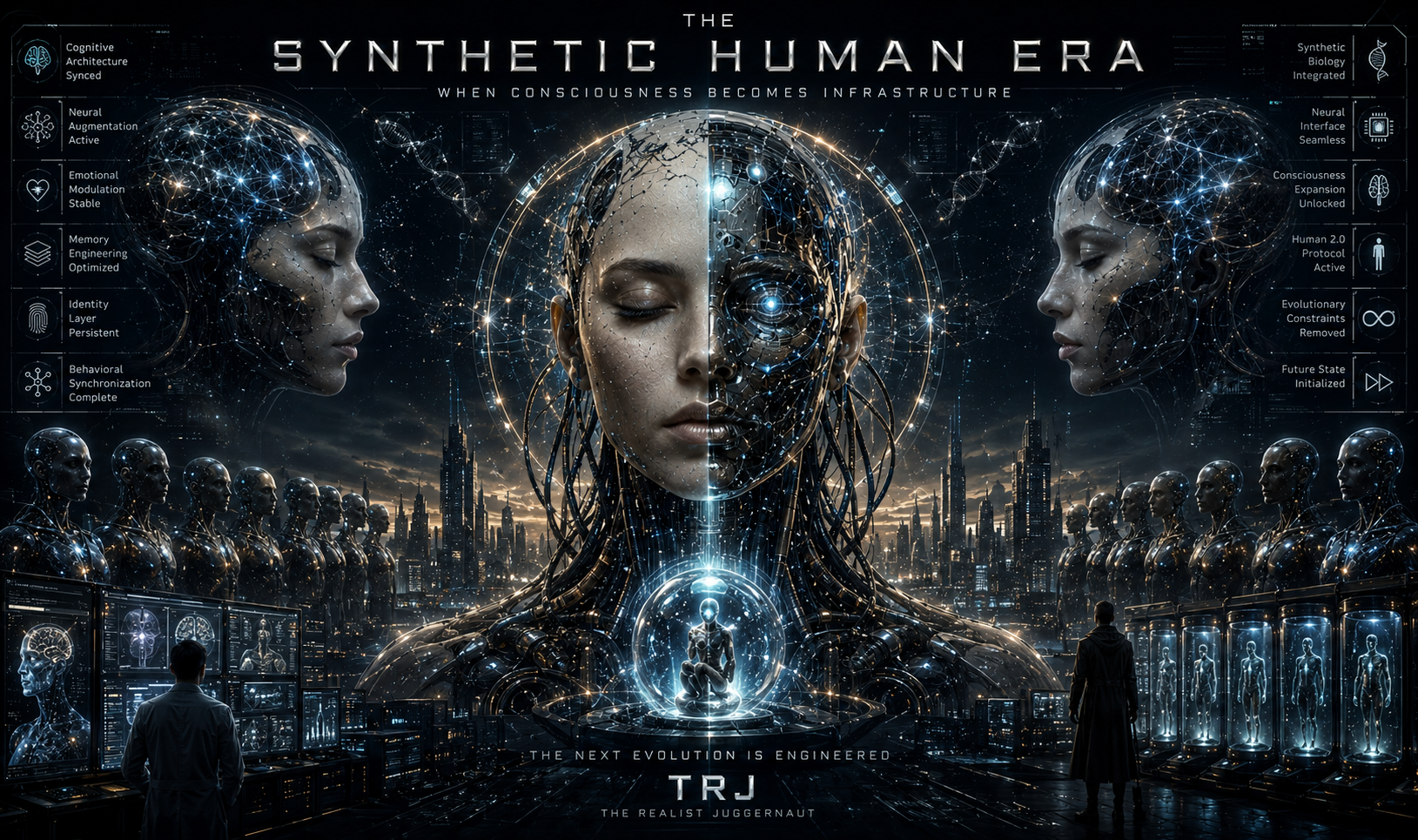
The final test of the Synthetic Human Era will not be how far humanity can be changed. It will be whether a person can refuse that change and still belong.





🔥 NOW AVAILABLE! 🔥
🔥 NOW AVAILABLE! 🔥
📖 INK & FIRE: BOOK 1 📖
A bold and unapologetic collection of poetry that ignites the soul. Ink & Fire dives deep into raw emotions, truth, and the human experience—unfiltered and untamed
🔥 Kindle Edition 👉 https://a.co/d/9EoGKzh
🔥 Paperback 👉 https://a.co/d/9EoGKzh
🔥 Hardcover Edition 👉 https://a.co/d/0ITmDIB
🔥 NOW AVAILABLE! 🔥
📖 INK & FIRE: BOOK 2 📖
A bold and unapologetic collection of poetry that ignites the soul. Ink & Fire dives deep into raw emotions, truth, and the human experience—unfiltered and untamed just like the first one.
🔥 Kindle Edition 👉 https://a.co/d/1xlx7J2
🔥 Paperback 👉 https://a.co/d/a7vFHN6
🔥 Hardcover Edition 👉 https://a.co/d/efhu1ON
Get your copy today and experience poetry like never before. #InkAndFire #PoetryUnleashed #FuelTheFire
🚨 NOW AVAILABLE! 🚨
📖 THE INEVITABLE: THE DAWN OF A NEW ERA 📖
A powerful, eye-opening read that challenges the status quo and explores the future unfolding before us. Dive into a journey of truth, change, and the forces shaping our world.
🔥 Kindle Edition 👉 https://a.co/d/0FzX6MH
🔥 Paperback 👉 https://a.co/d/2IsxLof
🔥 Hardcover Edition 👉 https://a.co/d/bz01raP
Get your copy today and be part of the new era. #TheInevitable #TruthUnveiled #NewEra
🚀 NOW AVAILABLE! 🚀
📖 THE FORGOTTEN OUTPOST 📖
The Cold War Moon Base They Swore Never Existed
What if the moon landing was just the cover story?
Dive into the boldest investigation The Realist Juggernaut has ever published—featuring declassified files, ghost missions, whistleblower testimony, and black-budget secrets buried in lunar dust.
🔥 Kindle Edition 👉 https://a.co/d/2Mu03Iu
🛸 Paperback Coming Soon
Discover the base they never wanted you to find. TheForgottenOutpost #RealistJuggernaut #MoonBaseTruth #ColdWarSecrets #Declassified


Sponsored • TRJ Ads
Inquiries: contact@therealistjuggernaut.com