Thank you for reading or listening to The Realist Juggernaut. Independent journalism should be accessible to everyone.
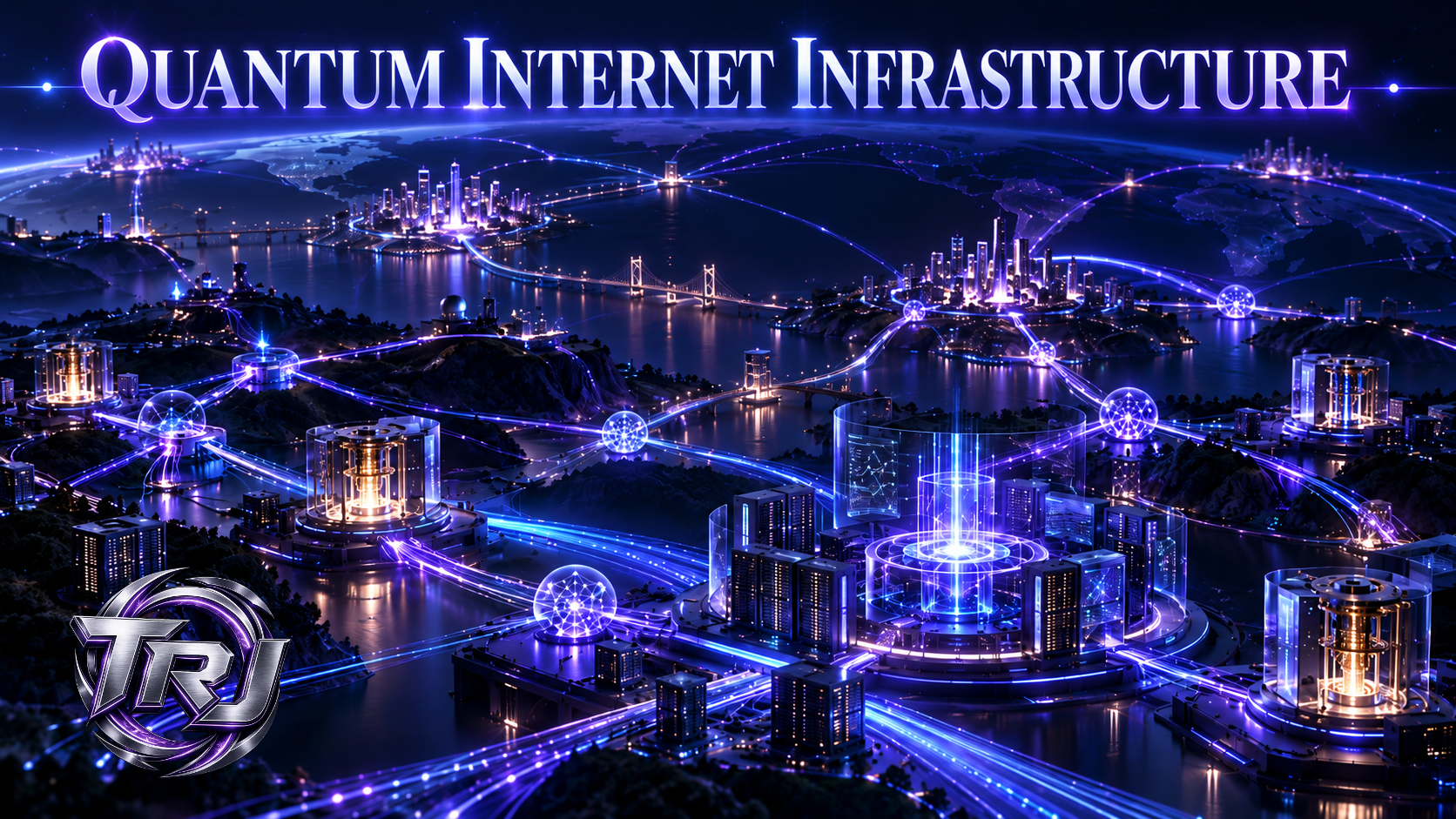
From long-distance fiber-optic transmission and integrated photonic networks to satellite-assisted quantum communication, researchers are developing the infrastructure needed to connect regional quantum systems across vast distances and establish the foundations of a future worldwide quantum internet
The development of quantum networking is approaching a geographical challenge that will determine whether the technology can progress beyond metropolitan research facilities and specialized communication corridors. Scientists have demonstrated quantum communication through existing telecommunications fiber, connected quantum memories across separate locations, and established experimental networks involving multiple institutions. These accomplishments demonstrate that quantum technologies can operate across physical distances, but connecting individual cities does not automatically create a national or global infrastructure. The next stage involves developing long-distance backbone networks capable of linking geographically separated quantum systems while preserving the physical properties necessary for communication, computation, and scientific measurement.
A quantum internet backbone would serve as the long-distance infrastructure connecting regional quantum networks. In conventional telecommunications, backbone systems transport large volumes of digital information between metropolitan areas, national networks, international exchanges, and intercontinental communication facilities. Their architecture combines high-capacity optical transmission, strategically located equipment, and established procedures for maintaining connectivity across enormous distances. Quantum networking requires a related geographical structure, but the methods used to transport and preserve quantum information introduce substantially different engineering requirements.
Photons traveling through optical fiber experience transmission loss that accumulates with distance. Quantum states cannot be regenerated through unrestricted measurement and copying, and the successful delivery of a photon does not necessarily establish that its quantum information remains suitable for the intended operation. Satellite links can extend communication beyond the practical reach of many direct fiber arrangements, but they introduce limitations associated with orbital motion, atmospheric conditions, optical alignment, and intermittent communication windows. Connecting these environments into one operational system will require an architecture that accounts for the capabilities and restrictions of each transmission method.
Research published during 2025 and 2026 demonstrates significant progress toward solving parts of this problem. Scientists have achieved coherent quantum key distribution across a 254-kilometer commercial telecommunications network in Germany, demonstrated quantum communication between China and South Africa through a microsatellite, and reported integrated photonic communication experiments extending to 540 kilometers of optical fiber. These achievements involve different technologies and operational objectives, but they collectively establish a developing foundation for long-distance quantum infrastructure.
The central challenge is no longer confined to transmitting quantum signals across greater distances. Researchers must determine how regional networks can be connected through intermediate infrastructure, how communication resources can be maintained across national boundaries, and how terrestrial and orbital systems might eventually operate within a coordinated architecture. The success of this work will influence whether quantum networking remains concentrated in geographically limited installations or develops into a technology capable of supporting applications across the world.
The Geography of a Quantum Internet Backbone
The geographical structure of a future quantum internet will depend on how quantum resources move between participating locations. A metropolitan network may connect laboratories, universities, research centers, and specialized computing facilities within one urban region. A regional backbone would extend those connections to other cities, while national and international systems would need to coordinate communication across substantially longer distances and more complicated operating environments.
The physical infrastructure needed for this expansion cannot be designed solely around geographical proximity. Existing telecommunications corridors, available optical fibers, equipment locations, environmental conditions, and institutional access arrangements all influence where quantum connections can realistically be established. Researchers must also account for the properties of the quantum devices located at each endpoint, including their optical interfaces, available memories, communication protocols, and the performance requirements of the applications they are intended to support.
Different applications place different demands on backbone infrastructure. A quantum key distribution system may establish secret key material across a long-distance optical link without requiring the network to distribute entanglement between stored quantum processors. A distributed quantum computing application may need high-quality entanglement shared between specific machines, with sufficient coordination to execute remote operations. A network supporting specialized scientific measurements may require synchronized observations, calibrated equipment, and reliable communication between geographically separated instruments. The physical infrastructure must therefore be evaluated according to the particular quantum resources it can deliver.
This introduces an important consideration for network design. A fiber route that performs effectively for one type of quantum communication may be unsuitable for another application involving different quantum states or hardware requirements. The availability of a long-distance optical path establishes a potential physical connection, but not universal compatibility between the quantum systems at its endpoints.
A practical backbone will need to combine geographically appropriate infrastructure with equipment capable of supporting defined operations. Its architecture may include metropolitan access networks, long-distance optical corridors, intermediate facilities, and satellite-assisted connections where terrestrial transmission presents significant limitations. The objective is to establish a network whose geographical reach is matched by its ability to deliver useful quantum capabilities.
Germany’s 254-Kilometer Quantum Communication Demonstration
A major development in long-distance terrestrial quantum communication was reported in April 2025, when researchers demonstrated coherent quantum key distribution through a 254-kilometer commercial telecommunications network extending between Frankfurt and Kehl, Germany. The experiment, published in Nature by Mirko Pittaluga and colleagues, established an important example of how advanced quantum communication protocols can operate through existing telecommunications infrastructure.
The experiment employed a twin-field quantum key distribution system, an approach that uses optical interference measurements involving signals transmitted from separate communicating parties. The protocol relies on carefully controlled optical coherence, allowing the participating systems to establish secure key material through measurements conducted at an intermediate location. This architecture offers a means of extending quantum key distribution beyond certain limitations associated with direct point-to-point transmission.
Maintaining optical coherence over hundreds of kilometers is an important technical challenge. Environmental disturbances and changes in fiber characteristics can alter the phase relationship between optical signals, interfering with the measurements required by the protocol. The experimental system addressed these difficulties through a practical phase-stabilization architecture and equipment designed to operate without cryogenic single-photon detectors.
The study reported a secure key distribution rate of 110 bits per second across the 254-kilometer deployed network. Although this rate is modest compared with conventional digital transmission speeds, the experiment’s objective was the generation of secure cryptographic key material rather than the direct transmission of ordinary application data. The result demonstrated that coherent quantum communication could function across a substantial commercial fiber route using a practical combination of stabilization and detection technologies.
The study also established progress toward making advanced quantum communication systems compatible with the infrastructure already used by telecommunications providers. It demonstrated a particular cryptographic protocol under measured operating conditions, rather than a general-purpose quantum backbone capable of transporting arbitrary qubits or connecting distant quantum computers.
Its significance lies in showing that long-distance quantum communication can be engineered around existing fiber infrastructure without requiring every component to remain inside an isolated laboratory. The findings provide valuable evidence for evaluating the technical requirements of future regional and national quantum communication corridors.
Integrated Photonics Extends Long-Distance Network Possibilities
The physical size and complexity of quantum communication equipment will become an important factor as networks expand. Systems built around large experimental optical assemblies can demonstrate exceptional scientific performance, but replicating those arrangements across numerous facilities creates challenges involving equipment cost, installation, calibration, maintenance, and manufacturing consistency.
Integrated photonics offers an approach to reducing some of these burdens. The technology incorporates optical functions into compact photonic circuits fabricated on suitable material platforms, allowing components involved in generating, manipulating, or detecting light to be assembled into more standardized systems. For quantum networking, integrated photonics may help reduce the complexity associated with deploying specialized optical equipment across larger communication infrastructures.
In June 2026, a study published in Nature Photonics reported a photonic integrated long-distance quantum communication network. Led by Likang Zhang and colleagues, the investigation examined an integrated architecture designed for quantum key distribution across extended optical fiber links. The experiment demonstrated communication over fiber lengths reaching 540 kilometers, with reported secret key rates exceeding the applicable repeaterless channel-capacity benchmark under the tested configuration.
The system used a spine-leaf network architecture, a design familiar from conventional data-center networking but adapted to the requirements of the demonstrated quantum communication protocol. In this arrangement, central infrastructure supports connections involving multiple communicating users, creating a framework for investigating how shared quantum communication equipment can accommodate more than a single pair of endpoints.
The researchers also evaluated the network’s ability to support up to 50 users participating in secure video communication at metropolitan distances through performance simulations. This assessment examined the potential integration of quantum key distribution with conventional encrypted communication services. It did not mean that video images were transmitted as quantum states or that all 50 users shared a general-purpose entanglement network.
The experiment is important because it connects long-distance quantum communication performance with questions of equipment integration and multi-user operation. A backbone architecture must eventually support more than exceptional transmission performance between two dedicated laboratory instruments. It needs a practical relationship between long-distance infrastructure and the regional systems serving participating organizations.
Integrated photonics may contribute to that objective by reducing hardware complexity and supporting more reproducible equipment manufacturing. Its effectiveness will depend on the performance of the complete communication system, including optical coupling, signal stabilization, detectors, and the specialized components that cannot yet be integrated into a single photonic platform.
The 540-kilometer experimental result represents progress in long-distance quantum key distribution, not proof of an operational 540-kilometer entanglement-based quantum computing backbone. Its contribution is the demonstrated performance of an integrated photonic communication architecture and the engineering possibilities associated with scaling supported cryptographic services.
Why Satellites Change the Geography of Quantum Communication
Long-distance optical fiber remains central to the development of terrestrial quantum networks, but satellite communication introduces an alternative transmission environment with important geographical advantages. Fiber-based communication experiences attenuation as light travels through the transmission medium. Quantum signals also encounter losses associated with optical connections, equipment interfaces, and detection. Even when exceptionally low-loss fiber is used, the cumulative effects become substantial across long distances, particularly when a system depends on detecting individual photons or preserving fragile quantum correlations.
A satellite link can transmit photons through free space, where much of the path may lie above Earth’s atmosphere. This changes the distribution of transmission losses. Instead of experiencing fiber attenuation throughout the full distance, an optical satellite link is affected by beam spreading, pointing errors, atmospheric absorption, turbulence, and the efficiency of the transmitting and receiving equipment.
These characteristics create opportunities for communication across distances that would be especially challenging for direct terrestrial quantum links. The advantage is not unlimited. A satellite must maintain accurate optical alignment with its ground station, and atmospheric conditions can interfere with the received signal. Low-Earth-orbit spacecraft also move rapidly relative to the ground, creating limited communication windows during individual passes. Ground stations need appropriate optical equipment, tracking systems, and operating conditions to establish successful connections.
The role of satellites is therefore different from that of a continuously connected terrestrial fiber network. An orbital communication system can provide access across large geographical regions, but its availability depends on spacecraft position, ground-station visibility, environmental conditions, and the number of satellites supporting the service.
A future hybrid quantum backbone could potentially combine terrestrial fiber networks with satellite links, allowing regional infrastructure to exchange supported quantum communication resources across long distances. Such arrangements would need to coordinate communication sessions and manage interruptions while preserving the security and performance properties of the selected protocols.
The most important contribution of satellites is the possibility of connecting geographical regions that cannot easily be served through direct terrestrial quantum transmission. Their integration would change how network engineers approach distance, connectivity, and the location of major quantum communication facilities.
The China–South Africa Quantum Microsatellite Breakthrough
A significant demonstration of satellite-assisted quantum communication was published in March 2025, when researchers reported real-time quantum key distribution using a compact microsatellite and portable optical ground stations. The research, published in Nature by Yao Li, Wen-Qi Cai, Jian-Guo Ren, and colleagues, described a satellite communication architecture developed to reduce the equipment size and complexity associated with earlier experimental quantum communication spacecraft.
The microsatellite carried a quantum communication payload weighing approximately 23 kilograms. Its supporting ground stations weighed approximately 100 kilograms, representing substantial reductions compared with the much larger systems used in earlier satellite quantum communication experiments.
These reductions are important because future orbital networks would require equipment that can be manufactured, launched, operated, and replaced at economically sustainable levels. Large, highly specialized spacecraft and ground installations can establish scientific feasibility, but their cost and complexity influence the practicality of extending coverage across multiple geographical regions.
The experiment demonstrated quantum key distribution between the satellite and several ground stations, establishing up to 1.07 million bits of secure key material during a single satellite pass. The satellite system combined quantum transmission with bidirectional classical optical communication, enabling key processing and secure communication while the satellite connection remained active.
The system also established secret key material between locations in China and South Africa separated by more than 12,900 kilometers. The resulting keys were used to support one-time-pad encryption of images exchanged between the participating locations.
This achievement demonstrated an important capability for long-distance quantum-secured communication. It established that compact satellite equipment could participate in a cryptographic system spanning separate hemispheres, using space-to-ground quantum links and coordinated ground infrastructure.
The result must be interpreted according to the architecture actually demonstrated. Establishing cryptographic keys between distant ground stations does not mean that an entangled quantum state was stored and maintained between quantum processors in China and South Africa. Satellite-assisted key distribution and end-to-end entanglement distribution are different technical achievements, with different requirements for the infrastructure supporting them.
The experiment also depended on the satellite’s role within the key-establishment architecture. Where a satellite operates as a trusted intermediate component, its security becomes part of the system’s overall security assumptions. Protecting the endpoint equipment, classical communication, key-management systems, and satellite operations remains essential.
The significance of the demonstration lies in the geographical reach achieved using a compact orbital platform. It provides evidence that satellite-assisted quantum communication can connect locations separated by continental distances and may eventually contribute to a broader network combining terrestrial and orbital infrastructure.
The Architecture of a Hybrid Terrestrial–Space Backbone
A worldwide quantum network may ultimately require a combination of communication environments rather than one universal transmission method. Terrestrial fiber provides stable physical routes between established facilities, supports continuous operation where appropriate equipment is available, and can be integrated with existing telecommunications infrastructure. Satellite links offer opportunities to establish connections across geographical barriers, remote regions, and distances that present substantial challenges for direct fiber-based quantum communication.
A hybrid architecture would need to coordinate these environments according to the capabilities of the quantum services being delivered. Consider a proposed network connecting research facilities in North America, Europe, and Asia. Regional fiber systems could connect laboratories and computing centers to major communication hubs. Long-distance terrestrial routes could connect facilities within each continent, while satellite-assisted links could provide supported communication capabilities between distant regions.
Such a system would not automatically function as a worldwide distributed quantum computer. Its capabilities would depend on whether the transmission technologies could establish the particular resources required by participating applications.
For cryptographic key distribution, satellite and terrestrial networks could potentially operate through coordinated key-management infrastructure. The system would need to account for the security assumptions associated with different transmission paths and intermediate facilities. For entanglement-based computing applications, an architecture would need to preserve suitable quantum correlations across its links and endpoints, potentially involving specialized quantum memories and additional technologies not required for conventional QKD services.
The operational challenge would also involve the timing of available connections. A terrestrial network may maintain continuous physical connectivity, while a low-Earth-orbit satellite may be accessible to a particular ground station only during limited intervals. Hybrid network management would need to account for those differences when scheduling supported communication sessions.
Weather introduces an additional consideration. Optical ground stations may experience reduced availability during cloud cover or other atmospheric disturbances, requiring careful site selection and potentially multiple geographically distributed receiving stations.
The design problem is therefore broader than choosing between fiber and satellites. Researchers must identify which transmission methods can support a particular application, where intermediate infrastructure should be located, and how the resulting system can maintain useful performance under changing operating conditions.
Intercontinental Entanglement Remains a Separate Engineering Goal
The expansion of quantum key distribution does not establish that a general-purpose quantum internet can already distribute entanglement between arbitrary locations worldwide. Entanglement-based networking introduces requirements that are not satisfied simply by providing a secure cryptographic connection. Two separated quantum processors may need access to a particular entangled state, with sufficient fidelity and timing coordination to perform operations involving both systems.
The challenge becomes more demanding when intermediate connections are involved. Quantum repeaters are intended to help extend entanglement distribution beyond the limitations of direct transmission by creating and coordinating quantum correlations across shorter segments. The effectiveness of this approach depends on the available quantum memories, local operations, communication delays, and the successful combination of entangled resources.
Connecting a metropolitan network to a continental backbone introduces another level of complexity. Regional systems may use different memory technologies, communication wavelengths, and operational procedures. A long-distance connection must deliver resources compatible with the equipment located at its endpoints.
Satellite-assisted entanglement distribution may eventually provide additional approaches to this problem. Space-based photon sources have already demonstrated entanglement distribution across substantial distances, establishing the scientific basis for investigating larger orbital quantum networks. Developing a system that connects distributed quantum memories through an operational satellite infrastructure is a more demanding objective.
Such an architecture would need precise optical tracking, sufficient photon collection efficiency, appropriate quantum memory interfaces, and coordination between distant ground facilities. The performance of each component would influence whether a useful entangled resource could be established and maintained.
The practical significance is that worldwide quantum cryptographic communication and worldwide entanglement-based computing cannot be treated as interchangeable milestones. Both are legitimate research objectives, but progress toward one does not automatically complete the technical requirements of the other. A comprehensive quantum internet backbone would ultimately need to support clearly defined quantum resources across geographically separated networks, with performance demonstrated for the applications that depend on them.
Locating the Infrastructure of a Future Quantum Backbone
The geographical placement of quantum networking facilities will have substantial consequences for the cost, performance, and reliability of future long-distance systems. Existing telecommunications infrastructure provides potential routes between population centers and research institutions, but not every location along those routes is equally suitable for quantum communication equipment.
Some installations may require access to specialized optical systems, environmentally controlled laboratories, reliable electrical infrastructure, and personnel trained to maintain quantum devices. Hardware involving cryogenic detectors or certain quantum memories may impose additional requirements involving refrigeration, vibration control, and equipment maintenance. These considerations affect where facilities can be installed and how frequently they can be serviced.
Terrestrial network planning must also account for physical distance and the characteristics of the available fiber. Two cities separated by a relatively short geographical distance may be connected through a much longer actual fiber route. The path may include optical equipment or network segments unsuitable for a particular quantum protocol, requiring dedicated fiber access, equipment modifications, or alternative routing arrangements.
Long-distance backbone development will consequently depend on cooperation between research institutions, telecommunications operators, infrastructure owners, and organizations responsible for maintaining the participating facilities. These relationships will influence access to fiber routes, equipment locations, and maintenance operations.
Satellite networks introduce related planning decisions. Optical ground stations need access to suitable locations with acceptable atmospheric conditions and clear observation paths. Establishing several stations across different geographical regions could improve opportunities for communication when weather prevents operation at one location, although doing so introduces additional equipment and management costs.
The resulting infrastructure may develop around a combination of research centers, major telecommunications corridors, specialized data facilities, and geographically advantageous optical ground stations. The network’s architecture will reflect not only the capabilities of quantum technology but the practical requirements of constructing and maintaining equipment across extensive territories.
The Economics of Continental and Global Expansion
Constructing a large-scale quantum network will require substantial investment in specialized components, physical infrastructure, software integration, and operational support. The costs will vary according to the technologies selected and the services being offered, making it difficult to establish a universal economic model for future quantum backbone deployment.
A terrestrial system using existing optical fibers may avoid some construction expenses, but the available infrastructure may still require modifications to accommodate quantum communication. The equipment needed for stable optical transmission, precise synchronization, specialized detection, and quantum-state management can introduce costs beyond those associated with conventional networking services.
Satellite-assisted communication involves a different financial structure. Spacecraft development, launch expenses, optical ground stations, tracking equipment, and orbital operations must be considered alongside the useful lifetime of the deployed hardware. Smaller satellite payloads and more compact ground equipment may improve the economics of future systems, but they do not eliminate the financial demands of establishing reliable orbital coverage.
Network expansion also creates questions about how resources should be shared. An infrastructure serving several institutions may distribute operating costs across multiple users, provided the equipment can support the required workloads. Some quantum communication services may be scheduled or allocated according to available capacity, while others may require dedicated equipment or communication paths.
The economic viability of these arrangements will depend on their operating performance and the value of the applications they support. Scientific institutions may justify long-distance quantum connections through specialized research capabilities unavailable through conventional communications. Organizations evaluating QKD services must consider whether the security properties, deployment costs, and operational requirements are appropriate for their needs. Distributed quantum computing may eventually create demand for high-quality interconnections between processing facilities, but that market depends on significant progress in the underlying computing and networking technologies.
Public research investment remains important because many of these applications have not reached commercial maturity. Experimental infrastructure can establish the technical requirements needed for future development while providing scientific institutions with opportunities to test emerging equipment.
The broader economic challenge is determining which network capabilities should be developed first and where investment can produce meaningful technical progress. A successful backbone will require an architecture that can expand as hardware improves and applications become more capable, rather than depending on extensive infrastructure commitments unsupported by demonstrated demand.
Measuring Progress Toward a Worldwide Quantum Internet
A satellite system distributing cryptographic keys between distant locations performs a different operation from a fiber network establishing entanglement between stored quantum memories. A communication experiment involving hundreds of kilometers of fiber may demonstrate impressive transmission performance while operating under conditions different from those encountered in a commercial telecommunications network.
Meaningful comparisons must therefore consider the actual operation demonstrated, the equipment involved, and the conditions under which the experiment was conducted. For terrestrial communication systems, important measurements include the delivered quantum resource, transmission distance, operating stability, resource-generation rate, and the degree to which the apparatus depends on specialized laboratory conditions. Satellite systems require additional evaluation of communication windows, atmospheric losses, pointing accuracy, ground-station availability, and the amount of useful key material or quantum information delivered during an orbital pass.
A future backbone would need to be assessed at the system level. Individual high-performing links are valuable, but practical applications may depend on resources originating across several connected regions. The performance of the complete route could be constrained by one limited segment or by the interaction between different technologies.
Developing reliable measurements across these environments will help researchers identify which improvements produce the greatest benefits. It will also provide a more accurate basis for deciding when particular network capabilities are ready to progress beyond experimental deployment.
TRJ VERDICT
The development of a quantum internet backbone represents a major geographical and engineering expansion of quantum networking research. Metropolitan experiments have established that quantum communication can operate across existing infrastructure, but the construction of national and international networks requires technologies capable of connecting geographically separated systems while maintaining the physical properties necessary for useful quantum operations.
Recent research provides substantial evidence of progress. The successful implementation of coherent quantum key distribution across 254 kilometers of deployed German telecommunications fiber demonstrates that advanced quantum protocols can operate through practical long-distance infrastructure. Integrated photonic communication experiments extending to 540 kilometers establish additional possibilities for reducing hardware complexity and developing architectures capable of supporting multiple users.
Satellite-assisted quantum communication has demonstrated an even greater geographical reach. The 2025 microsatellite experiment connecting China and South Africa established secure cryptographic key material between locations separated by more than 12,900 kilometers, providing important evidence that compact orbital platforms can contribute to worldwide quantum communication.
These achievements are not equivalent to a completed global entanglement network. Long-distance quantum key distribution, satellite-assisted communication, and distributed quantum computing have different physical and operational requirements. Future backbone architectures must accommodate those requirements without treating success in one application as proof that every other quantum networking capability has become available.
The most promising development path involves combining the strengths of different transmission environments. Terrestrial fiber can provide connections between established facilities, while satellite infrastructure offers opportunities to connect geographically distant regions. Intermediate quantum equipment, specialized optical interfaces, and coordinated network operations may eventually support more advanced applications requiring shared quantum resources across multiple locations.
The construction of such systems will also depend on economic feasibility, infrastructure access, equipment reliability, and the ability to coordinate institutions operating in different jurisdictions. A worldwide network cannot be established through transmission-distance records alone. It must be supported by an architecture capable of delivering useful resources consistently across its participating systems.
The Realist Juggernaut concludes that the next major frontier in quantum networking is the development of infrastructure capable of connecting regional quantum systems across national and continental boundaries. Research has established that quantum communication can extend far beyond individual metropolitan networks, with terrestrial and satellite technologies demonstrating complementary capabilities. The decisive achievement will come when these technologies can operate together as a reliable, coordinated backbone, transforming geographically separated quantum installations into components of a genuinely interconnected quantum infrastructure.





🔥 NOW AVAILABLE! 🔥
🔥 NOW AVAILABLE! 🔥
📖 INK & FIRE: BOOK 1 📖
A bold and unapologetic collection of poetry that ignites the soul. Ink & Fire dives deep into raw emotions, truth, and the human experience—unfiltered and untamed
🔥 Kindle Edition 👉 https://a.co/d/9EoGKzh
🔥 Paperback 👉 https://a.co/d/9EoGKzh
🔥 Hardcover Edition 👉 https://a.co/d/0ITmDIB
🔥 NOW AVAILABLE! 🔥
📖 INK & FIRE: BOOK 2 📖
A bold and unapologetic collection of poetry that ignites the soul. Ink & Fire dives deep into raw emotions, truth, and the human experience—unfiltered and untamed just like the first one.
🔥 Kindle Edition 👉 https://a.co/d/1xlx7J2
🔥 Paperback 👉 https://a.co/d/a7vFHN6
🔥 Hardcover Edition 👉 https://a.co/d/efhu1ON
Get your copy today and experience poetry like never before. #InkAndFire #PoetryUnleashed #FuelTheFire
🚨 NOW AVAILABLE! 🚨
📖 THE INEVITABLE: THE DAWN OF A NEW ERA 📖
A powerful, eye-opening read that challenges the status quo and explores the future unfolding before us. Dive into a journey of truth, change, and the forces shaping our world.
🔥 Kindle Edition 👉 https://a.co/d/0FzX6MH
🔥 Paperback 👉 https://a.co/d/2IsxLof
🔥 Hardcover Edition 👉 https://a.co/d/bz01raP
Get your copy today and be part of the new era. #TheInevitable #TruthUnveiled #NewEra
🚀 NOW AVAILABLE! 🚀
📖 THE FORGOTTEN OUTPOST 📖
The Cold War Moon Base They Swore Never Existed
What if the moon landing was just the cover story?
Dive into the boldest investigation The Realist Juggernaut has ever published—featuring declassified files, ghost missions, whistleblower testimony, and black-budget secrets buried in lunar dust.
🔥 Kindle Edition 👉 https://a.co/d/2Mu03Iu
🛸 Paperback Coming Soon
Discover the base they never wanted you to find. TheForgottenOutpost #RealistJuggernaut #MoonBaseTruth #ColdWarSecrets #Declassified


Sponsored • TRJ Ads
Inquiries: contact@therealistjuggernaut.com