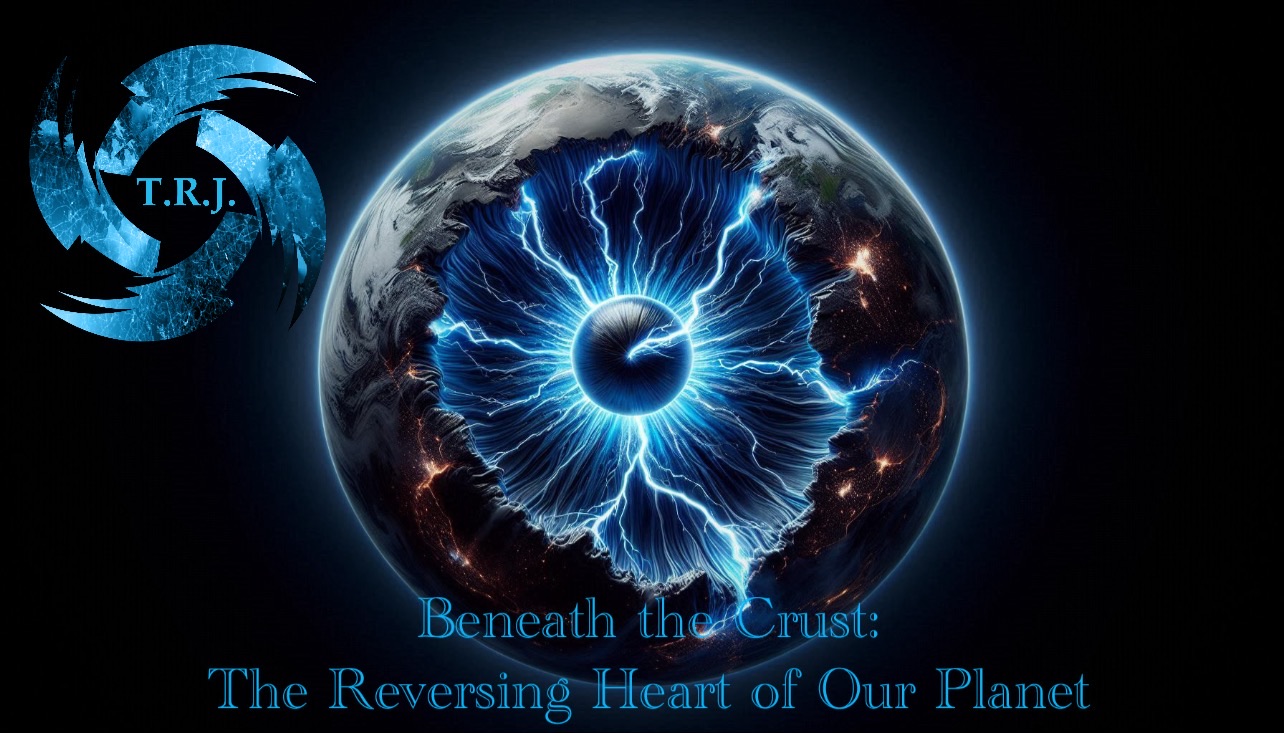
Beneath the surface of our ever-dynamic Earth lies a marvel of nature’s engineering: the inner core. This solid sphere, composed of iron and nickel, has been the silent engine driving the geomagnetic forces that envelop our planet. Yet, scientists have uncovered a startling shift in this subterranean world—the inner core has not only decelerated but also commenced a reverse rotation relative to the Earth’s mantle.
This revelation holds profound significance for the geomagnetic field, the invisible protector that shields us from solar winds and cosmic radiation. The field itself is born from the dynamo effect, a complex interaction between the rotating inner core and the fluid motions of the molten outer core. Any alteration in the core’s rotation could potentially weaken this magnetic defense, leaving us more exposed to the whims of the sun and the stars.
Furthermore, the inner core’s rotation is intricately linked to the mantle’s movement, a relationship that subtly dictates the length of our days. As the core’s rotation slows and reverses, it could disrupt this delicate balance, potentially leading to minute changes in the Earth’s rotation speed. Although these changes are expected to be infinitesimal, they underscore the delicate dance of celestial mechanics that govern our perception of time.
The fluctuations in the inner core’s rotation are part of a larger geophysical ebb and flow that spans decades. These natural oscillations have been part of Earth’s rhythm for eons, yet our ability to perceive and comprehend them is a feat of modern science, enabled by sophisticated seismic monitoring and analysis.
In June 2024, a study emerged from the depths of geophysical research, shedding light on the inner core’s enigmatic behavior. It revealed that around 2008, the inner core began to decrease its speed, moving slower than the Earth’s surface, and eventually started to rotate in the opposite direction. This study, a collaborative effort led by the University of Southern California, utilized an extensive dataset of seismic data recorded around the South Sandwich Islands from repeating earthquakes, as well as data from twin Soviet nuclear tests, to arrive at this groundbreaking conclusion.
In essence, the inner core’s recent behavioral shift is a reminder of Earth’s perpetual state of flux. It underscores the need for continued exploration and understanding of the planet’s innermost secrets. As we stand on the threshold of new geological insights, we are reminded of the dynamic ballet beneath our feet—a ballet that choreographs the very forces of life and time.
Sponsored • TRJ Ads
Inquiries: contact@therealistjuggernaut.com