
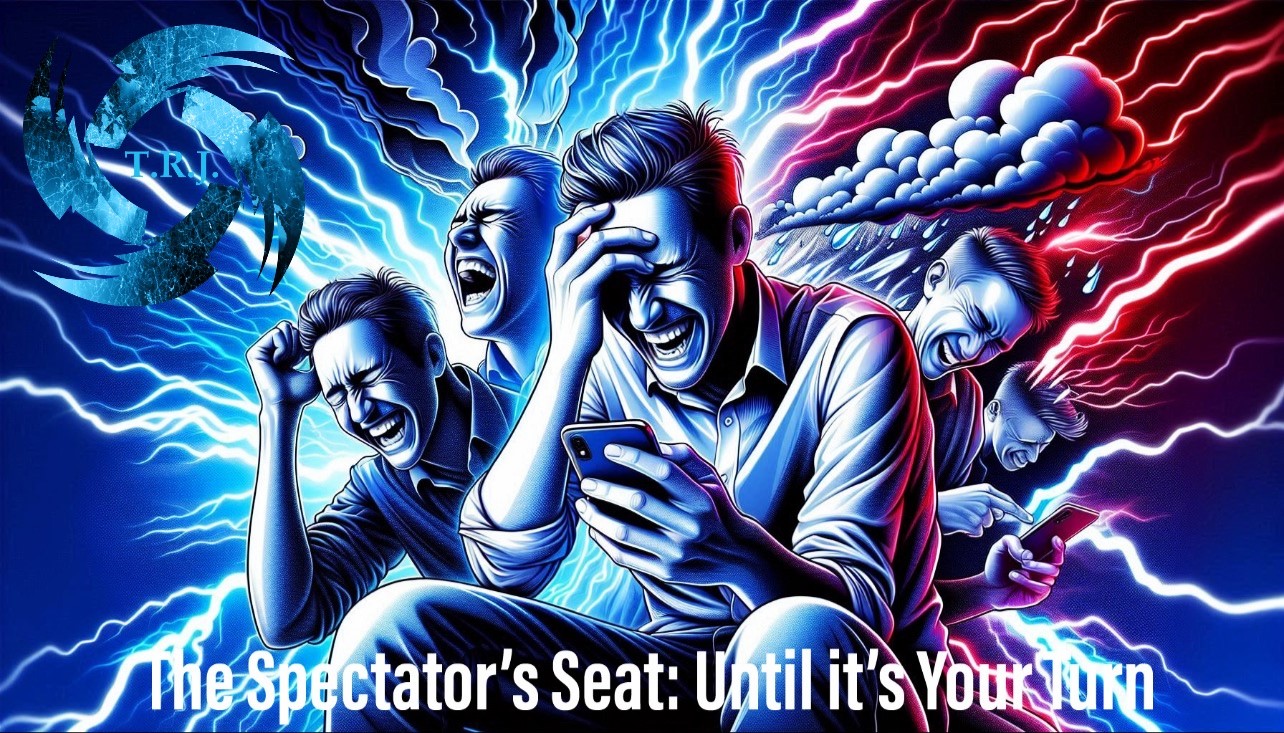
There’s something unsettling about the way people treat the pain of others. In this digital age, where every moment of suffering can be broadcast to millions, it seems that hardship has become a form of entertainment. People love to sit back and watch the chaos unfold—like a twisted spectator sport. The further they are from the hurt, the more they relish in the drama. But when it’s their turn in the spotlight? That’s when the mood changes.
It’s easy to laugh at the misfortune of others. We see it everywhere—reality TV shows built on heartbreak, viral videos of people’s worst moments, the endless social media posts that turn pain into a punchline. There’s a certain thrill in watching someone else’s life fall apart while feeling safe and sound in your own bubble. It’s human nature, some would argue, to be drawn to drama. After all, it’s been happening for centuries, from the gladiator games of ancient Rome to the gossip-filled tabloids of modern times.
But we’ve reached a new level—one where we don’t just watch, we engage. We share, comment, react, and turn suffering into a trending topic. There’s no real connection to the human being behind the screen, no empathy for what they’re going through. The focus is purely on the spectacle. People love to pile on, to kick someone while they’re down, to tear apart a life they don’t truly understand. It’s fun, it’s entertaining—until it’s not.
Until it happens to them.
Because one day, it will. Life has a funny way of balancing the scales, and when it’s your turn in the hot seat, when the world seems to take pleasure in your pain, that’s when reality hits. That’s when you realize how cold and unforgiving the audience really is. The same people who cheered when others fell are now watching your downfall with the same lack of compassion.
There’s something deeply wrong with a society that thrives on the suffering of others. It’s as if we’ve lost our sense of community, of shared humanity. Instead of lifting each other up, we tear each other down. It’s like people have forgotten that we’re all in this together. Or maybe they just don’t care, as long as it’s someone else taking the hit.
We’ve seen it time and time again—people who live for drama, who feed off negativity, who take joy in others’ failures. They talk behind your back, smile in your face, and secretly hope you fall harder than they ever will. It’s a toxic mindset, and yet it’s one that’s more common than we like to admit. Why? Because misery loves company, and nothing makes some people feel better than knowing they’re not the only ones struggling.
But here’s the harsh truth: pain isn’t a game. It’s not something to be exploited for likes, shares, or a fleeting moment of superiority. The suffering of others isn’t your personal soap opera. It’s real. It’s raw. And it’s something every single one of us will experience at some point in our lives. So, why do we treat it like entertainment? Why do we laugh at someone else’s misfortune, knowing full well how it feels to be on the receiving end?
The answer lies in the distance. When it’s happening to someone else, it feels far away, like a story in a book or a movie on a screen. There’s a detachment, a buffer that makes it feel less real. It’s easy to judge, to criticize, to laugh, when you’re safely out of the line of fire. But the moment it gets personal, the moment it’s your turn to face the storm, that distance collapses. And suddenly, it’s not so funny anymore.
The irony is that when people are finally in that vulnerable position, they expect sympathy, understanding, and compassion—the very things they withheld from others. They cry out, “Why is this happening to me?” as if they’ve forgotten all the times they were content to watch others suffer in silence. They demand justice, fairness, and kindness, but when they were in the spectator’s seat, they offered none of those things.
It’s a harsh wake-up call, but it’s one that more people need to hear. Because the reality is, suffering isn’t a spectacle. It’s not something to be enjoyed from the sidelines. It’s part of the human experience, and it affects all of us, whether we like it or not. And the sooner we stop treating it like a game, the better off we’ll all be.
Imagine a world where we didn’t take pleasure in other people’s pain. Where we didn’t gossip about their missteps or celebrate their failures. A world where empathy wasn’t an afterthought but the first reaction. It’s not a utopian fantasy—it’s something we can strive for right now. But it starts with each of us taking a hard look at the way we react to other people’s struggles. Are we part of the problem, or part of the solution?
Because here’s the truth: It could happen to you. And when it does, how would you want the world to react? With cruelty, indifference, and judgment? Or with understanding, support, and kindness?
The next time you’re tempted to join the crowd, to laugh at someone else’s expense, remember that one day, the roles could be reversed. And when that day comes, you’ll want to be treated better than you treated others. So, maybe it’s time to break the cycle. Maybe it’s time to stop being a spectator and start being human again.
And for those of you who take pleasure in others’ pain, who thrive on watching suffering unfold—read this again. Let it sink in. Because sooner or later, you’ll find yourself in the very position you’ve enjoyed watching from afar.

Sponsored • TRJ Ads
Inquiries: contact@therealistjuggernaut.com






I see you added the like button to your posts now. I’m glad to see that. I rarely comment on your posts (you have a prodigious output) but the like button is the way I can show that I’ve read the article anyway.
Cheers!
Thank you very much! Actually, the like button has always been there, but it was conflicting with another plugin, and it took some time to figure out which one was causing the issue. I’m glad it’s working now, and I appreciate you using it to show your support! It means a lot to know you’re reading my posts, even when you’re not commenting. Cheers, and thanks again! 😎
Thank you, John Neff.
You’re welcome! 😎
There is a group of people I know and others I met on Facebook. We have caring, loving hearts. Any suffering, whether animal, human, or even some insects, causes me to tear up or cringe. I can not bear mistreatment of humans, animals, or insects. I catch insects with a cup; slide a piece of paper under the cup; flip the cup and release the critter to the outside. I try not to kill bugs, unless they can harm me or my cat or some other creature. I love life and assume at least some beings love theirs too. I never try to hurt someone or something; I know what it feels like from abuse and meanness. I will never be mean or heartless. I am empathic and sensitive to other’s feelings. There are and always have been good people who care for and help others. We are trying to counter the meanness and cruelty of some others. I love life and living creatures. I will never hurt an animal or torture an insect. I will not and can not do that. There are still good people in the world.
Thank you very much for sharing your heartfelt comment. It’s refreshing to hear that there are still people out there who deeply care about all forms of life, be it human, animal, or even the smallest of insects. It takes a great deal of empathy and compassion to live by such principles, and it’s inspiring to know that you and others are working to counter the cruelty that exists in the world. Your words remind us that, despite the challenges, there is still goodness and kindness among us. Thank you again for being a beacon of that light. Have a wonderful day! 😎
Thank you, John! I was raised in a loving family. I knew I wanted to be a nurse and help people. I can’t be a nurse now that I’m 73, but I can be a Lightworker, being kind, polite, friendly, and helpful. It is my calling now. Thank you for the hard work you and your people do. There is a lot of suffering in the world now.
Thank you very much for your comment! And you’re welcome. It’s wonderful to hear that you continue to make such a positive impact as a Lightworker. Kindness, politeness, and a helping hand can make all the difference, especially with the amount of suffering in the world today. Your dedication to helping others, whether as a nurse or in your current role, is truly inspiring. I appreciate your kind words and support—it means a lot. I hope you have a fantastic day! 😎
I have to keep on believing that. 😐
I’m afraid there’s something base in human nature that hasn’t changed since the days when people sat in Roman amphitheatres to watch men fighting to the death, or people being mauled by lions, or other forms of gratuitous violence. Civilisation tries to suppress it, but it finds an outlet in the ways you describe. And if we haven’t lost it in all the preceding centuries, I don’t see us doing so anytime soon. Some of us have lost the instinct though, so there’s some hope for the dim, distant future.
Thank you for such a profound reflection. It’s true—there seems to be something deep-rooted in human nature that draws people to violence and spectacle, much like in the days of Roman amphitheaters. Despite the progress of civilization, these instincts find new outlets in modern society, often through entertainment, social media, or even the drama-driven algorithms that we see today. While it can be disheartening, the fact that some of us have moved beyond those base instincts does give a glimmer of hope. Perhaps over time, as more people evolve past this need for conflict-driven entertainment, we’ll begin to see real change. But like you said, it’s a long road ahead unfortunately.
Hope is all we have, unfortunately. 😌
Absolutely true. Hope often feels like the only thing we can cling to, especially in times where everything else seems uncertain or out of our control. But sometimes, hope is enough to keep us going and pushing forward, even if the odds seem stacked against us.