
Thank you for reading or listening to The Realist Juggernaut. Independent journalism should be accessible to everyone.
The Strike You Don’t See Coming
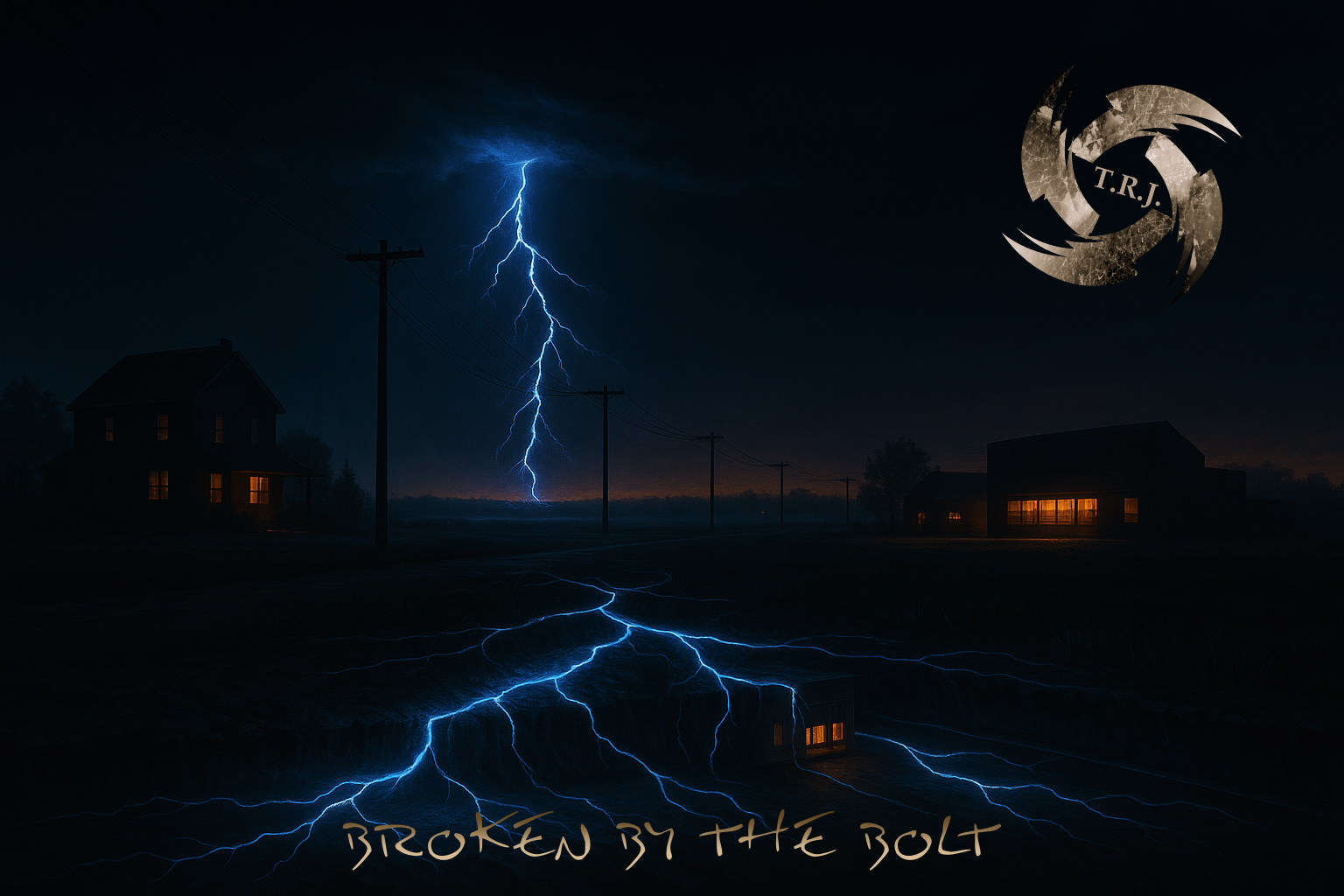
Lightning is supposed to announce itself with violence. A tree split into jagged halves, a transformer exploding in a shower of sparks, rooftops igniting into flame, fields set ablaze. Those are the images most people think of when they hear about a lightning strike — loud, visible, undeniable.
But not all strikes follow that script. Sometimes the danger moves in silence, cloaked in distance. That’s what happened here. No scorched siding, no shattered windows, no blackened crater in the yard. From miles away, a single bolt punched the atmosphere, found a line, and fed itself into the grid. Electricity doesn’t care about geography; it travels along the infrastructure we all rely on — through utility poles, buried cables, transformers, and substations. By the time it reached us, there was no fireball, no crash, no flash. Only the quiet sabotage of copper veins inside our walls snapping under a pressure they were never meant to endure.
The wires didn’t burn. They broke. Hidden behind drywall, they severed like tendons cut under strain with an electrical, static boom — a silent snap that carried the weight of a hammer blow. No smoke. No flame. Just copper veins gone brittle under a surge they were never built to withstand.
Outlets fell silent. Circuits went lifeless. What looked solid on the outside had already collapsed within, like a bone hollowed out by force. Power folded in on itself, leaving workstations black, screens empty, and the hum of productivity silenced. In less than a second, an entire workflow froze — not from fire or flood, but from the invisible violence of redirected energy. Equipment was spared only because industrial-grade surge protectors stood between the surge and the silicon. Without them, the damage would have gone from inconvenient to catastrophic: motherboards fried, backups corrupted, and data vaporized in microseconds.
What makes this unnerving is that it wasn’t random — it was inevitable. This wasn’t a freak accident; it was the raw, uncompromising math of physics doing exactly what it’s designed to do. Voltage always seeks a path, and the grid gives it one, whether through a nearby pole or an underground conduit ten towns over. That invisible highway makes lightning not just a threat to what it touches, but to everything connected downstream.
And that’s the lesson most people don’t see: fragility. We like to think of modern infrastructure as hardened, armored, untouchable. Yet a single atmospheric discharge can expose how brittle the system really is. No matter how advanced our devices, no matter how careful our planning, a force measured in millions of volts can still bend steel, split rock, and fracture the hidden arteries of power we depend on to exist.
How Lightning Travels Beyond Its Target
Most people picture lightning as a single, surgical strike: a jagged bolt slams into a tree, the tree burns, and the story ends. But lightning doesn’t just hit things. It rides them. It hunts for highways. And in the modern world, no highway is better built for its purpose than the electrical grid — a continent-spanning lattice of copper, aluminum, steel, and buried cabling that practically invites the storm inside.
Step 1: Entry into the Grid
The strike doesn’t need to be direct. It can hit a utility pole, a transformer casing, or even a saturated patch of ground where buried conductors lie waiting. Once inside, the energy doesn’t dissipate. It surges forward, feeding into wires that are designed to carry electricity in bulk. Lightning is opportunistic — it doesn’t stop at the point of impact. It spreads.
Step 2: Propagation Along Overhead Lines
Those wooden poles lining the streets may look old-fashioned, but they are the expressways of power. A single strike can send a surge racing down those overhead conductors for miles, moving faster than you can blink. The electricity we depend on usually flows at a calm, steady 120 volts into our homes and businesses. But a lightning surge doesn’t play by those rules. It’s a spike carrying tens of thousands of volts compressed into milliseconds, a violent pulse that burns through insulation and leaps across gaps like a predator breaking cages.
Step 3: Underground Conduits
Cities and suburbs tuck much of their wiring beneath the ground, hidden in ducts and bundled channels. It feels safer. It isn’t. Underground cables are shielded, but shielding is not invincible. When a surge rips through, it doesn’t just follow one wire — it couples into its neighbors. Moisture-rich soil lowers resistance, waterlogged ground turns into a conductor, and weak grounding systems act like open doors. The result? The surge snakes its way through subterranean arteries, invisible but unstoppable.
Step 4: Home and Business Entry
Every building has a point of connection — the service drop, where outside lines hand off power to inside circuits. Grounding rods and surge arrestors are supposed to be the guardians, shunting excess energy into the soil. And often, they succeed. But no defense is flawless. A fraction of that surge almost always leaks through, slipping into branch circuits, crawling into outlets, arcing across fragile wiring. Sometimes it cooks devices. Other times, as in this case, it doesn’t fry the gear — it snaps the wiring itself, breaking lifelines inside the walls like veins rupturing under pressure.
That’s the brutal truth: the bolt doesn’t have to touch the property. It doesn’t need to arc across the sky and strike the roof. The grid delivers it. Miles away, an atmospheric discharge can enter the network and ride its engineered veins until it finds the weakest point. That point might be your transformer, your panel, or the hidden wires you never see until they fail.
Lightning doesn’t just strike. It travels. And it travels farther than most people are willing to believe.
Why Wires Broke but Equipment Survived
The irony is brutal: the infrastructure failed, but the machines it was supposed to protect lived on. Inside the walls, hidden copper veins snapped under pressure, yet the racks of electronics — the gaming rig, the mixer, the monitors, the backup supplies — walked away intact.
Surge Protectors as Sacrificial Shields
That survival wasn’t luck. Every piece of critical gear was riding behind industrial-grade surge suppression, rated to withstand catastrophic spikes. These devices don’t prevent the surge from arriving — they meet it head on. Inside a quality surge protector are metal oxide varistors (MOVs) or equivalent suppression components that act like electrical shock absorbers. The moment the incoming voltage spikes beyond the safe range, these components clamp down, redirecting the excess energy into ground. They sacrifice themselves in the process, burning up their capacity so that the load they guard never sees the killer wave.
Instead of frying a motherboard, melting a PSU, or cooking the delicate audio circuitry of a mixer, the surge dissipated across components designed to die in silence. The machines behind them didn’t even blink.
Why the Wires Gave Out
But the wiring inside the walls plays by different rules. House and business wiring isn’t designed to absorb or clamp catastrophic energy — it’s a passive conductor. When lightning’s voltage spike rushed through, the wires became unwilling participants in a physics experiment.
The copper itself can stretch its tolerance for only so long. Stress points — where insulation is thinner, bends are tighter, or connections were already under load — became the failure zones. Instead of dispersing the surge safely, those points fractured under instantaneous pressure. Insulation blistered. Conductors snapped like tendons under strain.
Think of it as a shockwave inside a sealed tube: the outer casing looks fine, but inside, the blast rips apart the structure. The insulation may remain visually intact, but the copper veins inside are split, useless, and dangerous. The wiring essentially sacrificed itself — not by design, but by sheer physical weakness under stress.
The Paradox of Protection
So the paradox emerges: the expensive machines lived because they had engineered guardians. The wiring failed because it had none. The load survived, but the highway collapsed.
And that paradox is a reminder for every homeowner, business, or creator relying on electricity: protecting equipment with surge strips is only half the battle. Without whole-building surge suppression, without hardened grounding systems, the veins inside your walls can still rupture even if your devices remain pristine.
It’s the difference between a shield designed to take the blow and a pathway never built for war.
Why This Isn’t Rare
It feels rare — almost unfair — when a single home or business is crippled by a lightning surge while the neighbors carry on without interruption. From the outside, it looks like bad luck, the electrical equivalent of winning the wrong lottery. But the science behind it is less about chance and more about physics.
The Path of Least Resistance
When lightning energy enters the grid, it doesn’t flow evenly like water filling a pipe. It surges, probes, and searches. Electricity follows the path of least resistance, and in a network as vast and irregular as our utility systems, those paths are anything but symmetrical. One building may sit at the end of a feeder line that acts like a funnel, concentrating the brunt of the surge. A neighbor across the street, tied into a different branch or with more favorable resistance, may only see a flicker of the lights.
Branch Circuits as Bottlenecks
Distribution networks aren’t uniform. Every pole, junction box, and splice creates slightly different conditions — a microscopic bump here, a bit of corrosion there. These variations create bottlenecks, and bottlenecks concentrate stress. A building unlucky enough to sit downstream from one of these points can become the endpoint where a surge finally dumps its energy. To the untrained eye, it looks like random devastation. To an engineer, it’s the inevitable result of unequal distribution.
The Grounding Factor
Grounding is supposed to be the universal equalizer — the escape hatch that sends excess voltage harmlessly into the earth. But not all grounds are equal. A fresh copper rod sunk into moist soil provides a low-resistance path that bleeds off energy efficiently. An old, corroded rod surrounded by dry, compacted earth can act more like a resistor, bottling the surge inside the building instead of letting it escape. Two houses on the same street can have radically different grounding quality, and in a lightning event, that difference can be the line between a harmless flicker and a snapped wire.
The Illusion of Randomness
To the victim, it feels random. To the unaffected neighbor, it looks like a miracle. But in reality, it’s infrastructure physics unfolding silently behind the walls. The grid is not a smooth highway — it’s a patchwork of weak spots, variable resistances, and uneven protections. Lightning simply exploits what’s already there.
Why It Happens More Than People Think
Every summer storm, every rolling thunderhead, sends millions of volts looking for pathways. Utility operators record thousands of “voltage events” every year, but only a fraction reach the threshold of frying equipment or snapping wires. Most of the time, it’s absorbed by arrestors, transformers, or the earth itself. But when the stars align — degraded grounding, unlucky circuit placement, stressed copper — the surge pushes through. And when it does, it looks like freak misfortune when in fact it’s the natural outcome of systemic vulnerability.
The truth is this: lightning damage doesn’t need a direct hit to strike. It only needs the right conditions, and those conditions are far more common than most people realize.
Insurance and Coverage
Electrical damage from lightning is one of the most frequent storm-related claims filed with insurers, ranking alongside roof damage and flooding in terms of annual volume. But the fine print matters — and the way coverage plays out can be just as unpredictable as the strike itself.
Direct vs. Indirect Strikes
Policies often make a distinction between direct and indirect lightning events. A direct strike — the bolt hitting the building itself — is universally covered. But what most people don’t realize is that the vast majority of claims come from indirect surges, where lightning miles away enters through utility lines. Fortunately, most commercial and homeowner policies now include indirect surges under the umbrella of “lightning damage,” but some carriers still attempt to challenge these claims, especially if they can attribute the event to utility infrastructure rather than the weather itself.
Equipment vs. Wiring
Coverage isn’t uniform across what’s damaged. Insurers tend to prioritize equipment — the servers, computers, mixers, appliances — because those are classified as contents. But wiring inside the walls often gets shuffled into the “structure” category, subject to different deductibles or even excluded under certain commercial policies. A fried motherboard may be reimbursed in days, but broken copper in the walls might get buried under lengthy adjuster debates about building codes, replacement costs, and depreciation.
The Proof Burden
Utilities almost never admit responsibility. If a surge came through their lines, don’t expect them to hand you a letter confirming it. That leaves property owners holding the burden of proof. To build a claim, documentation is everything: electrician reports, damaged breakers, scorched outlets, even lab tests on failed surge components. Each piece becomes part of a chain of evidence that ties the damage back to a lightning surge rather than faulty maintenance or old age. Without that chain, claims risk being delayed, underpaid, or denied.
Business Downtime: The Hidden Cost
For businesses, the hardest hit rarely shows up in the adjuster’s calculations. It isn’t the cost of replacing wiring or buying a new computer — it’s the downtime. Hours of lost productivity can cascade into missed deadlines, botched client deliverables, lost sales, and payroll stress. Business interruption insurance can cover some of that gap, but not all policies include it, and even when they do, insurers often demand proof of “actual income loss” that takes weeks of forensic accounting to demonstrate. By then, the damage to reputation or client trust may already be done.
Common Caveats
- Policy Caps: Some policies cap lightning damage reimbursement at lower thresholds than other perils.
- Negligence Clauses: If the insurer determines the property lacked adequate grounding or surge protection, they may reduce payout.
- Replacement vs. Actual Cash Value: Equipment may be reimbursed at depreciated value unless replacement cost coverage is specified.
- Excluded Items: Certain electronics, like gaming rigs or specialized sound systems, may fall under “high-value” equipment needing separate riders.
The Reality Check
Lightning is both one of the most insurable and one of the most contentious perils. On paper, most policies say “covered.” In practice, owners often fight tooth-and-nail to prove it, and even when successful, the payout rarely reflects the true scale of the loss. The copper in the walls can be repaired. The servers can be replaced. But the hours, the missed opportunities, and the strain on staff and clients? Those are almost never covered.
The Backup That Saved the Day
Here’s the critical lesson: when the wires broke, the systems didn’t. The difference wasn’t luck — it was preparation.
Surge Defense as First Shield
Every workstation, mixer, monitor, and backup supply sat behind industrial-grade surge protection. These weren’t cheap strips bought off a shelf — they were designed to clamp catastrophic spikes in microseconds. When the surge hit, the protectors took the punishment, sacrificing their components to bleed excess voltage harmlessly away. What could have been a pile of fried circuit boards was reduced to nothing more than tripped breakers and scorched sacrificial fuses.
Layered Backup Plans
Behind that first shield was another: data redundancy and backup systems. Even if the worst had happened and equipment had failed, critical files and operational data were already mirrored and stored. That meant the core of the business — the intellectual capital, the work itself — was never at risk. Wires can be replaced. Machines can be swapped. But lost archives? Those are irreplaceable.
Continuity, Not Catastrophe
So when the strike bent the copper and snapped the lifelines inside the walls, the operation bent but didn’t break. Equipment stayed safe. Files remained intact. Repairs were made, downtime was measured in hours, not days or weeks. And the return to normal wasn’t a desperate scramble, it was a controlled recovery.
That’s the real difference between surviving a strike and being destroyed by it: defense in layers, preparation ahead of disaster, and an understanding that lightning isn’t a “what if” — it’s a “when.”
TRJ Verdict
Lightning isn’t random chaos. It’s predictable energy looking for pathways — and in the 21st century, those pathways are everywhere. They run across the poles outside our windows, under the asphalt we drive on, through the circuits stapled inside our walls, and into every machine we depend on to work, create, and connect.
What happened here wasn’t “bad luck.” It was the grid doing what physics dictates it must do: channel energy along the easiest highway available. Human systems were simply caught in the middle, and this time, the middle happened to be a single property.
The difference between disaster and disruption came down to preparation. Surge protectors absorbed the blast. Backup systems preserved the work. Insurance will help close the financial gap. Without those layers, this would have been the kind of strike that rewrites balance sheets and forces companies to their knees.
But the real verdict reaches further: resilience is no longer a luxury. Lightning, cyberattacks, infrastructure failures — they’re all just different faces of the same truth. The shocks are coming. They will hit when you least expect them, often from miles away, and they will test not just your hardware but the planning you put in place long before the first spark flew.
The lesson is brutal but clear: lightning doesn’t have to hit you to take you down. It only has to find the wires you forgot were already carrying its charge.


🔥 NOW AVAILABLE! 🔥
📖 INK & FIRE: BOOK 1 📖
A bold and unapologetic collection of poetry that ignites the soul. Ink & Fire dives deep into raw emotions, truth, and the human experience—unfiltered and untamed.
🔥 Kindle Edition 👉 https://a.co/d/9EoGKzh
🔥 Paperback 👉 https://a.co/d/9EoGKzh
🔥 Hardcover Edition 👉 https://a.co/d/0ITmDIB
🔥 NOW AVAILABLE! 🔥
📖 INK & FIRE: BOOK 2 📖
A bold and unapologetic collection of poetry that ignites the soul. Ink & Fire dives deep into raw emotions, truth, and the human experience—unfiltered and untamed just like the first one.
🔥 Kindle Edition 👉 https://a.co/d/1xlx7J2
🔥 Paperback 👉 https://a.co/d/a7vFHN6
🔥 Hardcover Edition 👉 https://a.co/d/efhu1ON
Get your copy today and experience poetry like never before. #InkAndFire #PoetryUnleashed #FuelTheFire
🚨 NOW AVAILABLE! 🚨
📖 THE INEVITABLE: THE DAWN OF A NEW ERA 📖
A powerful, eye-opening read that challenges the status quo and explores the future unfolding before us. Dive into a journey of truth, change, and the forces shaping our world.
🔥 Kindle Edition 👉 https://a.co/d/0FzX6MH
🔥 Paperback 👉 https://a.co/d/2IsxLof
🔥 Hardcover Edition 👉 https://a.co/d/bz01raP
Get your copy today and be part of the new era. #TheInevitable #TruthUnveiled #NewEra
🚀 NOW AVAILABLE! 🚀
📖 THE FORGOTTEN OUTPOST 📖
The Cold War Moon Base They Swore Never Existed
What if the moon landing was just the cover story?
Dive into the boldest investigation The Realist Juggernaut has ever published—featuring declassified files, ghost missions, whistleblower testimony, and black-budget secrets buried in lunar dust.
🔥 Kindle Edition 👉 https://a.co/d/2Mu03Iu
🛸 Paperback Coming Soon
Discover the base they never wanted you to find. TheForgottenOutpost #RealistJuggernaut #MoonBaseTruth #ColdWarSecrets #Declassified
Support truth, health, and preparedness by shopping the Alex Jones Store through our link. Every purchase helps sustain independent voices and earns us a 10% share to fuel our mission. Shop now and make a difference!
https://thealexjonesstore.com?sca_ref=7730615.EU54Mw6oyLATer7a

Sponsored • TRJ Ads
Inquiries: contact@therealistjuggernaut.com








Thank you for this very informative post, John. Thank heavens for surge protectors. I think we have about eight or nine around here so, if something like this happened to me, hopefully the damage wouldn’t be too bad. The lightning “protection” that was on top of the house when we moved in would probably not be that effective in any case. It’s a series of 5 aluminum (by appearance) spikes across the peak of the roof and tied to an old TV antennae. These are all connected together by decent sized wire and it has a ground wire that runs down into the ground. Of course, none of these would help against a strike like the kind you have discussed here. My fuse box has the old type of fuses which I kind of like because I can always check them for heat if I feel one of the circuits are overloaded.
I hope you never have to experience this again!
You’re very welcome, Chris — and I’m glad to hear you’ve got that many surge protectors in place. That’s exactly the kind of layered defense that makes the difference between inconvenience and disaster. You’re right about those old aluminum lightning rods too — they’re better than nothing, but they won’t absorb or redirect the kind of surge we’re talking about here. Same with the older fuse boxes: I like your point about being able to check them for heat, but against a lightning-driven voltage wave, they’d trip too late to save the wiring.
The real protection comes from grounding integrity paired with suppression at every level — panel, circuit, and device. The fact you’re thinking about it already puts you ahead of most. Hopefully, you’ll never see a strike like this up close, but if it comes, it sounds like you’ve done the smart work to make sure the fallout stays minimal. 😎
Thank your for your informative reply, John. Thanks for your hopes that I never have to experience what you have and I certainly hope it’s something you never see again.
You’re very welcome, Chris — I hope I never have to see that again either. Good thing we were here at the time it happened. 🙏😎