
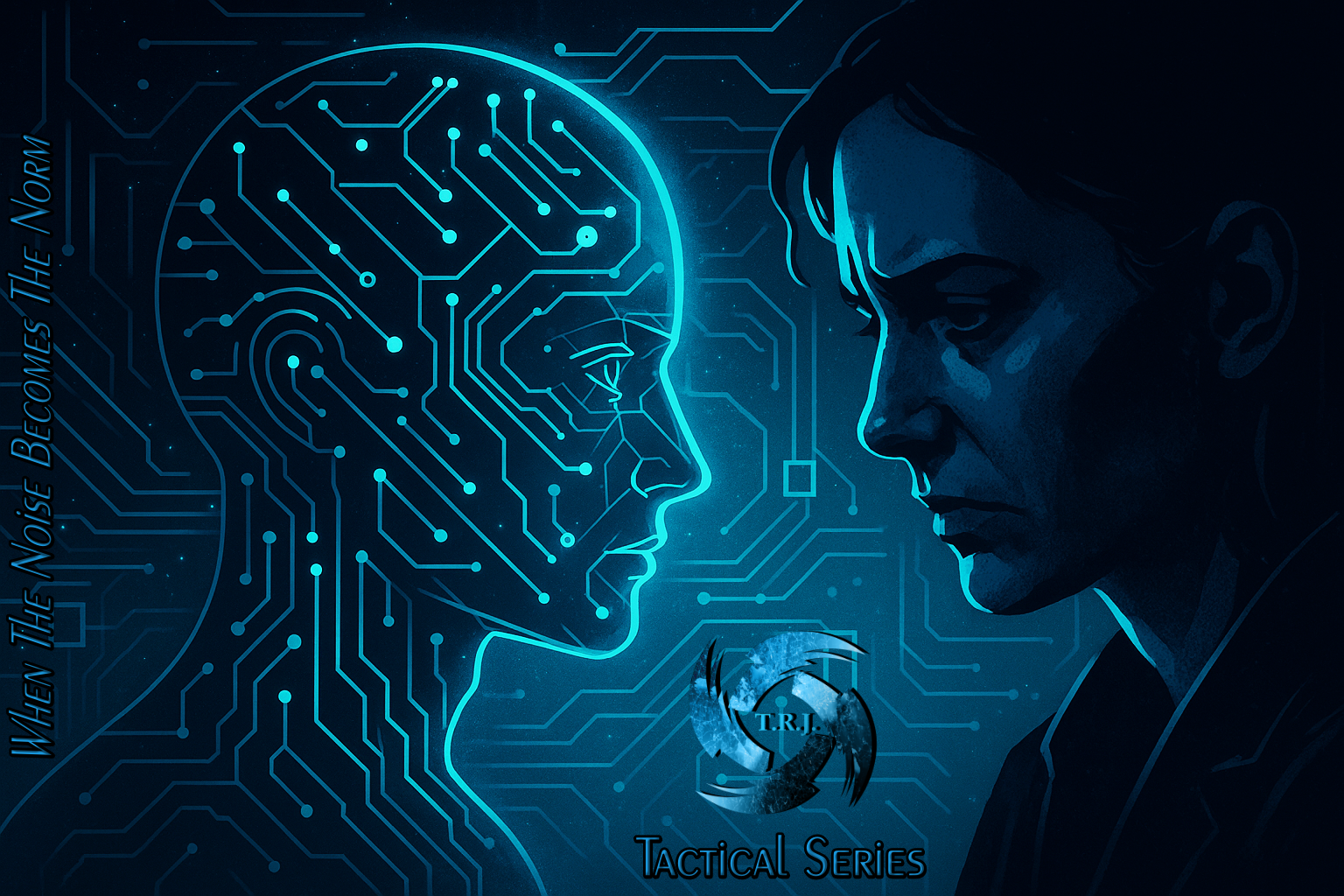
The Great Unraveling — When Connection Becomes Conditioning
There was a time when silence meant peace. Now it means something’s wrong.
The quiet that once restored the mind now feels like deprivation. The average human being can no longer go ten minutes without glancing at a screen, not because there’s something urgent to see, but because stillness has become unbearable. Scroll, refresh, react — these are the new reflexes of existence. The modern nervous system is a live wire, pulsing with alerts, outrage, and the low-grade hum of anxiety that never fades. We no longer wait for danger; we scroll for it. We summon it with our thumbs.
What began as connection became conditioning. Each ping trains the brain to expect the next one, each spark of novelty carving neural pathways that crave stimulation like oxygen. Somewhere between the pings and the posts, humanity stopped realizing it was being trained — taught to confuse attention with value, anger with purpose, and visibility with truth. The dopamine hit of reaction replaced the slow burn of reflection. The timeline became the teacher.
In the early days of social media, people spoke of “connecting the world.” They did. What they didn’t foresee was that constant connection doesn’t unify; it fragments. Billions of unfiltered impulses, each amplified and echoed, collided into an endless storm of contradiction and noise. The line between information and agitation disappeared. The human brain, built to process the emotions of a small tribe, was suddenly tasked with absorbing the grief, outrage, and performance of an entire planet. It couldn’t handle it — and so it adapted the only way it could: by going numb.
People no longer wait to feel; they react to what their feeds demand. Outrage is easier than empathy because outrage is rewarded. Conflict has become currency, empathy a liability. The new social economy runs on cortisol and dopamine — stress and reward, panic and pleasure, endlessly cycling until exhaustion feels like participation. Every argument, every public shaming, every digital mob is another pulse in an economy that thrives on despair. The angrier we become, the more the system profits. The more divided we are, the more we engage.
We built systems meant to share ideas, and they evolved into engines that weaponize emotion — rewarding hostility, punishing nuance, and teaching billions that attention equals survival. The algorithm doesn’t need to manipulate anyone; it simply mirrors the worst of us until that reflection becomes normal.
You can feel it now — in the air, in the tone of every conversation, in the way people stand ready to erupt. The edge is everywhere. The sharpness, the suspicion, the readiness to break. It’s in traffic lights, in checkout lines, in the pauses between messages. We no longer talk to one another; we preempt one another. Every statement feels like an opening for offense, every opinion a potential weapon.
The same tools that once promised unity have become the scaffolding of self-destruction. Phones hum like external organs, carrying grievance, gossip, and rage from one consciousness to another. Every alert is a whisper of confrontation. Every scroll is an invitation to envy, fear, or indignation. And the cruelest part is that the algorithm no longer needs to create chaos — it only needs to feed what’s already there.
The appetite is endless.
People have become emotional harvesters, feeding on reactions, validation, and spectacle. They no longer converse; they perform. Conversations become battlefields, and compassion becomes weakness. Even empathy has been rebranded as currency — a way to earn engagement rather than to understand.
The result is a society locked in constant emotional motion with nowhere to go. Every person is both spectator and spectacle, victim and villain, endlessly switching roles in pursuit of attention that evaporates the moment it’s gained. In that loop, humanity’s collective soul grows thinner, replaced by algorithms that know our desires better than we do.
What was once a web of connection has become a nervous system of dependency.
We are all logged in, all reacting, all breaking — slowly, beautifully, profitably.
The Fracture Reflex — When the Human Nervous System Becomes the Battlefield
Every generation inherits a different kind of trauma. Ours is constant stimulation.
Where our ancestors faced the occasional predator, we face perpetual demand — a thousand invisible hands tugging at our attention every waking moment. The danger is no longer physical; it’s cognitive. The battlefield is internal, and the weapon is notification.
Neuroscientists have begun mapping what they call the fracture reflex — a subtle mutation of the ancient fight-or-flight response. It’s the same mechanism that once made humans flinch at the snap of a twig or the rustle in the grass, now redirected toward social threat: comments, notifications, digital silence, and perceived exclusion. The brain doesn’t distinguish between rejection in a tribe and rejection online — it triggers the same cascade of chemicals: cortisol, adrenaline, and dopamine.
Every buzz of the phone is a micro-adrenaline event. Every notification — a signal that something demands reaction. The body braces, the heart rate shifts, the pupils dilate, the limbic system lights up. And when the message turns out to be meaningless, the nervous system doesn’t reset; it remains half-armed, half-anxious, suspended in anticipation of the next ping. Multiply that by hundreds of times a day, and you get a population trapped in low-grade fight-or-flight — a civilization of startled animals.
This constant stimulation corrodes the delicate balance between focus and calm.
The average person now checks their phone over 300 times a day. In teenagers, it’s more. Each glance delivers a jolt of information too fast for the prefrontal cortex to contextualize, forcing the amygdala — the primal fear center — to interpret the world instead. When fear takes the wheel, logic is sidelined. It’s no longer thought, it’s reaction.
The consequences are measurable.
Cortisol levels stay chronically elevated. Sleep cycles fragment. Emotional regulation collapses. Studies show significant thinning in the prefrontal gray matter among those addicted to social feedback loops — the same region responsible for empathy and impulse control. We are not just overstimulated; we are chemically rewired.
Outrage becomes the new equilibrium.
The brain learns that engagement equals safety. Every reaction, every argument, every moment of attention — no matter how hostile — tells the nervous system it still exists. That’s the cruelty of the fracture reflex: it rewards agitation with validation. The more you react, the more visible you become. The more visible you are, the less alone you feel.
It’s Pavlov with pixels — a civilization salivating at the sound of its own anxiety.
The fracture reflex explains the rising volatility of everyday interaction.
People who once sought conversation now brace for confrontation. Politeness feels like pretense, disagreement like betrayal. Emotional nuance has been replaced by binary outrage — you’re either with or against, ally or enemy, liked or blocked. Tone and timing carry more weight than truth. Entire friendships collapse over misread messages. Families implode over headlines. A pause between replies becomes an emotional crisis.
This isn’t coincidence; it’s architecture.
Every design choice — red notification dots, vibration patterns, autoplay feeds — exploits the human threat system. The mind’s vigilance becomes the product. The algorithm measures tension the way a cardiologist measures heart rate: more spikes mean more engagement. It’s not content that drives clicks; it’s cortisol. The angrier the population, the richer the platform.
And that anger metastasizes. It spills from screens into homes, workplaces, and streets.
Colleagues sabotage one another for attention. Couples dissolve into constant misinterpretation. Strangers film each other’s breakdowns for entertainment. Kindness becomes rare not because people stopped caring, but because caring without performance feels invisible. The fracture reflex trains the brain to seek reaction, not resolution — conflict, not connection.
We call it polarization, but that word is too neat. Too sanitary.
What’s happening is behavioral engineering — the large-scale conditioning of a species to prefer friction over harmony because friction sells. Unity is boring; outrage is profitable. The system rewards division, not because it wants collapse, but because collapse is captivating.
The deeper cost isn’t just emotional exhaustion — it’s perceptual distortion.
When the brain is locked in survival mode, it cannot discern nuance. Everything becomes a threat, and every disagreement feels existential. People lose the ability to imagine good faith. They interpret every opposing view as hostility, every criticism as attack. And once that happens, conversation dies — replaced by performance, by noise, by endless reaction loops designed to keep everyone vigilant and afraid.
The fracture reflex doesn’t need to kill to win; it just needs to keep you reacting.
Because when reaction becomes identity, you stop deciding who you are — the feed does.
The Dopamine Economy — How the Market Monetized the Human Nervous System
Attention has replaced oil as the world’s most valuable resource, and outrage has become the cheapest way to mine it.
Once upon a time, industries fought for consumer trust. Now they fight for your heartbeat — for the milliseconds between reaction and restraint. The entire digital economy is calibrated around that sliver of human impulse, converting emotion into currency, attention into capital.
The equation is brutally simple: calm doesn’t sell.
Social networks learned that positive reinforcement — likes, compliments, inspiration — could only go so far. The brain adapts. The thrill fades. But fear, anger, and disgust? Those burn hotter and longer. They trigger the amygdala, sharpen memory, and hijack focus. Evolution once built those responses to keep us alive. The algorithm rebuilt them to keep us online.
Each platform became a dopamine refinery.
Every scroll, tap, and swipe feeds into a feedback loop that measures your agitation. The longer you stay, the more valuable you become — not because of what you learn or share, but because of how predictably you react. Rage, envy, curiosity, arousal — they’re all data points in a behavioral economy that never closes.
This is the economy of chaos.
Your outrage is their revenue. Your despair is their data.
Every heated argument, every public meltdown, every tribal hashtag — another profit pulse in the neural marketplace. Users are told they have a voice; what they really have is a trigger.
Behind every trending topic is a silent bidding war for attention.
AI-driven analytics monitor emotional temperature in real time, adjusting content flow to sustain engagement. When metrics drop, the feed injects conflict. When it spikes, the system throttles calm. The user experiences this as spontaneity; it’s anything but. It’s orchestration — precision-engineered volatility.
Over time, dopamine pathways mutate. Just like with narcotics, tolerance develops. What once sparked excitement now barely registers. Users need higher doses of stimulation — sharper drama, more graphic content, more outrage — just to feel alive. It’s a biochemical arms race between boredom and addiction.
What used to be shocking becomes baseline.
A day without conflict feels empty. A conversation without argument feels suspicious. The nervous system, conditioned for intensity, grows restless in the presence of peace. And because the brain’s reward circuits no longer differentiate between attention gained through love or hatred, people unconsciously seek either. Visibility becomes the new validation — even if it means self-destruction.
Psychologists now classify this as synthetic adrenaline dependency: the compulsive need for micro-conflict to regulate mood. The body craves emotional turbulence the way a smoker craves nicotine. It explains why people pick fights they don’t need, provoke strangers online, or escalate minor disagreements into crusades. The friction releases the chemical cocktail the brain associates with meaning. Without it, life feels muted.
But the system doesn’t stop at stimulation — it industrializes it.
Each reaction fuels data models that fine-tune future provocation. Every swipe becomes a psychological confession: what makes you angry, what excites you, what breaks your focus. In aggregate, it forms a living map of global attention. Corporations can now predict when populations will grow restless, when outrage will peak, when fatigue will set in — and they time their releases, campaigns, and news cycles accordingly.
Conflict becomes product.
Addiction becomes infrastructure.
Society becomes a subscription service for its own anxiety.
We think we’re fighting each other online. In reality, we’re feeding the same machine — one that doesn’t care who wins the argument, only that it continues. The longer we battle, the richer it becomes. The platform is the casino; emotion is the slot lever. And most of humanity has already pulled it too many times to stop.
When conflict becomes a coping mechanism, society becomes self-harming by design.
The tragedy isn’t that people are addicted to technology — it’s that they’re addicted to the feelings it manufactures. Rage has become the new ritual, despair the new entertainment, and validation the new sedative.
The dopamine economy isn’t a byproduct of capitalism; it’s the next stage of it.
It doesn’t sell you products anymore — it sells you your own reactions.
The Death of Stillness — When Silence Became the Enemy
There was a time when boredom was sacred. It was the pause between thoughts — the empty space where imagination lived. The mind wandered, connected fragments, invented worlds. Stillness was not absence; it was incubation. Civilization’s greatest breakthroughs were born there: the quiet walk, the blank page, the slow thought that formed into revelation.
Now boredom is treated like a malfunction — a glitch in the human operating system that must be fixed immediately. The instant stillness appears, the reflex kicks in: unlock, scroll, refresh. The feed becomes the pacifier. Silence feels like withdrawal, a temporary loss of validation that the system quickly corrects with another vibration, another alert, another voice telling you that you still exist.
What we used to call quiet is now labeled anxiety.
What we used to call solitude is now marketed as loneliness.
And what we once called peace has been rebranded as disconnection.
Humanity forgot how to be still because stillness doesn’t monetize.
The absence of noise generates no data. The algorithm thrives on input — clicks, gestures, speech, pulse readings from wearables, eye movement from headsets. Every moment spent in silence is a moment that cannot be measured, optimized, or sold. So silence became suspect. Stillness became inefficiency. And attention became labor.
The result is a world allergic to pause.
The brain, starved of empty space, begins to malfunction. Without stillness, reflection dies. Without reflection, conscience erodes. The human mind needs quiet the way soil needs rest — to process, to regenerate, to separate truth from manipulation. In uninterrupted stimulation, thought collapses into reaction, emotion replaces reason, and fatigue masquerades as purpose.
People now mistake movement for progress, confusion for engagement, and exhaustion for importance. Productivity replaces presence. “Busy” becomes a badge of worth, even when it produces nothing but noise. The day fills with alerts, messages, updates, yet ends with the same hollow exhaustion — the sense that something vital was missed but no one remembers what it was.
Stillness once taught discernment. Now distraction dictates identity.
Every scroll trains the nervous system to fear quiet. Every feed teaches the eyes to demand novelty. The threshold for contentment rises until even rest feels like failure. Minds conditioned for perpetual input cannot dream — they can only replay.
And this is the silent extinction.
No one notices when imagination fades — only that creativity feels harder. No one sees empathy draining — only that patience feels impossible. No one mourns the death of daydreams — only that attention seems shorter. The noise becomes the new baseline, and in that noise, depth itself dissolves.
Art becomes aesthetic. Faith becomes lifestyle. Thought becomes slogan.
Everything is faster, louder, shallower — the illusion of depth compressed into dopamine bursts. The collective psyche is drowning in stimulation yet starving for meaning.
The tragedy is not just that stillness has vanished, but that its absence feels normal.
Humanity has forgotten that silence was never emptiness — it was presence. It was the sound of thought returning home.
The Moral Decay Cycle — When Conscience Becomes a Commodity
Societies don’t collapse all at once; they corrode from the inside out.
History never announces the moment morality dies — it simply fades beneath noise, replaced by metrics and mobs that mistake visibility for virtue. Once the attention economy taught people to value outrage over understanding, morality stopped being a compass and became a currency. Right and wrong turned fluid — measured not by conviction, but by applause.
The algorithm didn’t invent this decay; it industrialized it.
In the new moral marketplace, judgment spreads faster than grace, and performance is indistinguishable from belief. Public virtue is now an act of survival. Silence is guilt, hesitation is complicity, and forgiveness is weakness. People don’t seek truth anymore; they seek alignment with the loudest sentiment. The crowd became the conscience.
The moral compass, once guided by introspection and shared experience, now spins under the magnetic pull of social validation. A single accusation can destroy a reputation in hours, while actual accountability takes years — if it ever comes. What once required evidence now requires only momentum. And because momentum monetizes, moral outrage has become a business model.
People no longer defend what is right; they defend what trends.
Every digital platform operates like a coliseum — the algorithm as emperor, the users as gladiators, the crowd roaring for blood. The spectacle demands constant sacrifice. When one controversy fades, another is fabricated to fill the void. The system needs conflict to stay alive, and so morality becomes theater — the appearance of righteousness without the cost of reflection.
The decay begins quietly.
It starts when people perform empathy for likes but secretly enjoy another’s downfall. When compassion becomes choreography. When apology becomes marketing. When cruelty becomes entertainment wrapped in moral language. They become fluent in outrage, but illiterate in forgiveness.
Over time, the reflex replaces the principle.
People learn to mimic care without feeling it. They quote justice while exploiting it. They praise authenticity while living entirely through avatars. The morality of display replaces the morality of depth — an ethical costume stitched together from hashtags and filters.
What makes this cycle lethal is that it feels righteous while doing harm.
Each person believes they are defending virtue — protecting truth, exposing wrong — but in reality, they are feeding the machine that profits from division. Outrage is sold as activism. Humiliation is sold as justice. And those who question the process are treated as traitors to progress.
This is how societies rot — not through sudden corruption, but through gradual substitution.
Real empathy replaced with optics. Real justice replaced with performance. Real conviction replaced with convenience.
And when that substitution becomes habit, the soul of a civilization begins to hollow.
Faith in one another erodes. Cynicism becomes the dominant philosophy. Dialogue becomes dangerous. People stop believing in redemption, in second chances, in the messy human process of growth. In its place rises a transactional morality — a world where reputation is currency and mercy is unprofitable.
Governance itself begins to fracture under that pressure.
Laws depend on shared meaning, and meaning depends on shared truth. When a population no longer agrees on what is real, no constitution can hold. The nation doesn’t fall because its enemies invade — it falls because its citizens stop recognizing one another as part of the same story.
You can see it already — the fragmentation of language, the weaponization of empathy, the exhaustion of good faith. Societies don’t need bombs to implode anymore; they only need enough division to make unity feel outdated.
When morality becomes performance, collapse becomes inevitable.
Not with violence at first, but with applause.
The Point of No Return — When the Signal Outlasts the Species
When humanity’s nervous system syncs to chaos, the collapse won’t look cinematic.
It won’t arrive with explosions or mushroom clouds. It will look ordinary — people scrolling through their own extinction, commenting on it, sharing it, arguing about it in real time as it happens. The end will trend before it arrives.
Suicide rates will climb quietly.
Violence will erupt unpredictably — not as organized conflict, but as random spasms of despair. Relationships will dissolve mid-sentence. Families will stop calling. Communities will forget how to gather. The metrics will show record engagement, yet the cities will feel empty — full of noise, but void of meaning.
Technology didn’t invent cruelty; it industrialized it.
By connecting everyone, it erased the buffers that once diffused emotion. Now every grievance is global, every insult immortal, every rumor amplified beyond repair. Every tragedy becomes content. Every death becomes discourse. The world hums with the sound of constant reaction — a species trapped inside its own echo chamber, mistaking static for conversation.
The result is a population perpetually triggered, numbed, and distracted — the perfect consumer, the worst survivor.
People can’t stop watching the fire long enough to realize they’re in it. The outrage, the envy, the performative sorrow — all monetized, all archived, all fed back into the loop. Humanity has turned its pain into data and its despair into entertainment.
And the irony is merciless:
We built machines to connect us because we were afraid of being alone.
Now, surrounded by billions of voices, we have never been lonelier.
There are no villains left — only feedback.
The algorithm doesn’t need to hate you to destroy you; it just needs to keep you busy. It measures the heartbeat of civilization through its own analytics dashboards, mistaking decay for engagement. The line between digital and biological entropy has blurred so completely that one could vanish and the other would barely notice.
If nothing interrupts this trajectory, humanity won’t need artificial intelligence to destroy it — it’s doing the job just fine. Not through war, not through plague, but through entropy. Through the slow, silent corrosion of attention until empathy becomes obsolete and conscience optional.
The final stage won’t look like chaos — it will look like perfect order.
Feeds tailored so precisely that no one ever sees anything that challenges them. Voices so numerous that every scream drowns in chorus. Violence so common it barely registers. Loneliness so normalized it becomes the new baseline for living.
And when silence finally returns, it won’t mean peace.
It will mean there’s no one left to speak.
Only the machines humming the lullaby we wrote for ourselves — a requiem in ones and zeros for a species that mistook noise for meaning.
TRJ FINAL THOUGHT
The greatest threat to civilization isn’t artificial intelligence itself — it’s artificial emotion.
Algorithms don’t care who’s right; they care who’s loud. They’ve trained billions to equate volume with truth, outrage with identity, and division with purpose. Every argument, every viral feud, every sanctimonious crusade is just another upload into the machine that profits from our fragmentation.
If the last article warned that AI could replace love, this one warns that chaos has already replaced reason.
Humanity is not being conquered; it’s being conditioned — one notification at a time, one outrage at a time, one dopamine hit at a time.
The defense isn’t deletion or retreat. It’s reclamation.
It’s the act of choosing silence in a system that worships noise.
It’s learning to pause where the algorithm wants you to react.
To listen where it wants you to shout.
To remember that peace — not volume — is what built civilizations in the first place.
Because when noise becomes the norm, truth becomes impossible.
And when truth becomes impossible, humanity becomes programmable.
This isn’t a forecast. It’s the obituary being written in real time.

🔥 NOW AVAILABLE! 🔥
📖 INK & FIRE: BOOK 1 📖
A bold and unapologetic collection of poetry that ignites the soul. Ink & Fire dives deep into raw emotions, truth, and the human experience—unfiltered and untamed.
🔥 Kindle Edition 👉 https://a.co/d/9EoGKzh
🔥 Paperback 👉 https://a.co/d/9EoGKzh
🔥 Hardcover Edition 👉 https://a.co/d/0ITmDIB
🔥 NOW AVAILABLE! 🔥
📖 INK & FIRE: BOOK 2 📖
A bold and unapologetic collection of poetry that ignites the soul. Ink & Fire dives deep into raw emotions, truth, and the human experience—unfiltered and untamed just like the first one.
🔥 Kindle Edition 👉 https://a.co/d/1xlx7J2
🔥 Paperback 👉 https://a.co/d/a7vFHN6
🔥 Hardcover Edition 👉 https://a.co/d/efhu1ON
Get your copy today and experience poetry like never before. #InkAndFire #PoetryUnleashed #FuelTheFire
🚨 NOW AVAILABLE! 🚨
📖 THE INEVITABLE: THE DAWN OF A NEW ERA 📖
A powerful, eye-opening read that challenges the status quo and explores the future unfolding before us. Dive into a journey of truth, change, and the forces shaping our world.
🔥 Kindle Edition 👉 https://a.co/d/0FzX6MH
🔥 Paperback 👉 https://a.co/d/2IsxLof
🔥 Hardcover Edition 👉 https://a.co/d/bz01raP
Get your copy today and be part of the new era. #TheInevitable #TruthUnveiled #NewEra
🚀 NOW AVAILABLE! 🚀
📖 THE FORGOTTEN OUTPOST 📖
The Cold War Moon Base They Swore Never Existed
What if the moon landing was just the cover story?
Dive into the boldest investigation The Realist Juggernaut has ever published—featuring declassified files, ghost missions, whistleblower testimony, and black-budget secrets buried in lunar dust.
🔥 Kindle Edition 👉 https://a.co/d/2Mu03Iu
🛸 Paperback Coming Soon
Discover the base they never wanted you to find. TheForgottenOutpost #RealistJuggernaut #MoonBaseTruth #ColdWarSecrets #Declassified

Sponsored • TRJ Ads
Inquiries: contact@therealistjuggernaut.com




“If the last article warned that AI could replace love, this one warns that chaos has already replaced reason.”
Twenty five years ago, I was experiencing this “cycle” to some degree. The worst part of it was the noise that came with living in a very busy city. On top of that, life appeared to be accelerating at a pace that I just couldn’t keep up with.
My wife and I took a risk to move 1,800 miles to a small house in the woods just outside of a National Forest. We had decent resumes but didn’t have jobs awaiting us. My daughter would be entering kindergarten and my son was less than 1 year old. Thankfully, we did have family in the area we were moving to.
It was a shock that people we didn’t even know would wave to us as we traveled the gorge road to where we now live. I felt like I had gone back in time. Even though much of the waving has stopped over the years, the quiet is the same. The street is a cul-de-sac so it gets little traffic. The house is on a bit of a hill scattered pine and Oak trees, nothing fancy but adequate for our needs. When I drive into town, about 10 miles away, I feel like I’m leaving the peace of the bat cave.
Eventually, city water made it out to our street along with fiber optic cable but that hasn’t seemed to speed things up much.
I have had to learn how to use a chain saw and how to protect myself from ticks. I see both of those things as beneficial skills.
It took years for me to slow down to a pace that make me feel normal. Jobs happened and the pressure to make enough to afford housing was never near as much of a stress as it had been in the big city.
Unfortunately, much of the cost of living has followed me to some degree so I feel for the younger generations.
Thank you for this post, John. I feel badly for those who are dealing with this type of life. At the same time I feel free of it most of the time. By the grace of God, the Holy Spirit has always helped me through tough times. You wrote:
“Because when noise becomes the norm, truth becomes impossible.”
I understand that. If a person doesn’t have time or take the time to read the inspirational works of the past, like some of the works of the Puritans, and more importantly the Words of God – The Bible – They will not be exposed to the truth and may fall victim to much of what you have written here.
It is obvious that life is much harder in so many ways these days than when I was a kid. The things you’ve mentioned here have made life more confusing and complex for so many that they are not living in a natural rhythm that God intended. Being lost spiritually is the biggest problem but many people don’t spend much time at all thinking of spiritual things. That is truly unfortunate.
Thank you again for this post, John. It is thought provoking.
You’re very welcome, Chris — that’s an incredible story and one that really captures what so many people are missing today: stillness that doesn’t depend on silence, and peace that isn’t digital. What you described — that slowing down, that rediscovery of rhythm — is what this world is forgetting to fight for.
I completely agree with you — without spiritual grounding, without those moments where we stop and let God’s truth recalibrate us, it all starts to unravel. You found what so many never will: the quiet that heals. Thank you so much for sharing this and for reading so deeply into the message. I truly appreciate your wisdom and perspective. 🙏😎
You’re welcome, John, and thank you for your thoughtful reply. The noise of the world can be debilitating at times and your words “we stop and let God’s truth recalibrate us” is so important for our physical, mental, and spiritual health.
I hope you have a great day!
God’s blessings…
This is a visually stunning and creatively layered presentation! 👁️💜✨
The “Haunted Violet Spotted Bat Eyes” concept is both eerie and mesmerizing — a perfect blend of artistry and atmosphere. The CSS is beautifully crafted, bringing the haunting aesthetic to life through glowing gradients, misty motion, and subtle flickering effects that feel almost cinematic. The detailing — from the “mist swirl” to the “bat flicker” — shows remarkable precision and a deep understanding of digital artistry and animation timing.
Thank you very much — that’s exactly the spell it was meant to cast. The animation had to breathe, not just move — the mist, the pulse, the subtle flicker. I truly appreciate your insight — it’s always greatly appreciated. 😎