
Thank you for reading or listening to The Realist Juggernaut. Independent journalism should be accessible to everyone.
The Settlement That Measured Your Worth
They said justice had been served.
The checks arrived — no press conference, no apology, no admission of guilt. Just plain white envelopes slipping through mail slots across the country, indistinguishable from bills or junk mail. Inside each one, a number — most commonly around $21.36 or $21.42, with some reaching $30 to $40. That was the value assigned to a decade of your existence — to your messages, your searches, your confessions, your fears — all printed in black ink, sterile and final, as if your humanity could be tallied by algorithmic arithmetic.
It wasn’t restitution. It was calibration.
A quiet equation designed to measure how cheaply people could be bought into silence.
The envelope was not a symbol of accountability — it was a mirror of complicity. The system didn’t send it because it regretted what it had done; it sent it because it could afford to. Facebook had been accused of one of the most expansive data exploitations in modern history — the mass harvesting and redistribution of private life disguised as social connection. The investigation stretched for years. Lawsuits piled up. Executives testified. Yet when the dust settled, justice arrived folded into thirds, machine-sealed, barcoded, and soulless.
What you held in your hand wasn’t payment — it was a receipt.
A receipt for the sale of your digital soul, pre-approved by arbitration, processed by automation, and delivered by the very infrastructure that violated you.
That’s how modern accountability works: not through revelation, but through replication. The same algorithms that extracted your privacy now delivered your “compensation.” The same systems that profited from your emotional data now calculated your worth to the decimal. Even the apology was automated — a transaction wrapped in legal precision and moral vacancy.
They said it was closure. But closure doesn’t come in direct deposit form.
It comes in truth — and truth was never part of the deal.
The real purpose of this payout wasn’t justice; it was precedent. The moment the public accepted $21.42 as fair value for ten years of digital servitude, a baseline was set. Future violations could now be benchmarked, budgeted, normalized. They didn’t pay you because they were sorry. They paid you because silence had become predictable — and predictability is the most profitable product of all.
That’s the beauty of engineered consent: you think you’ve won something, but you’ve merely been quantified. The system learns your price, records your tolerance, and files it away for the next transgression. Justice becomes logistics. Outrage becomes metadata. Freedom becomes a checkbox labeled “Accept Settlement.”
And the tragedy of it all? Most people cashed the check.
Because in the modern empire, people no longer seek justice — they settle for reimbursement. And that’s exactly what the machine counts on: exhaustion dressed as resolution, compliance disguised as compensation.
You weren’t being paid back. You were being priced.
The settlement wasn’t the end of the story. It was the signal that the system had completed another successful transaction — the public had traded its voice for its value, and the value was twenty-one dollars and thirty-six cents.
Justice doesn’t live in envelopes. It lives in exposure. But the truth, like everything else in this economy, has been privatized — packaged, processed, and sold back to the very people it once belonged to.
And that’s the real legacy of this settlement: not what it returned, but what it revealed — a civilization so desensitized to exploitation that it now mistakes a refund for freedom.
The Invisible Economy of You
Your data didn’t vanish into some distant cloud — it was absorbed into the bloodstream of an invisible economy that feeds on you in pieces. Every scroll, every hesitation, every heartbeat of digital attention becomes a transaction. You’ve been converted into a living ledger — an organism of metrics, emotions, and algorithms.
Most people still believe their “information” means names, numbers, or email addresses. They think privacy ends where passwords begin. But what’s been taken isn’t your contact list — it’s your cognition. Every like and pause was dissected into signals: emotional volatility, political impulse, purchasing rhythm, relationship cycles, stress thresholds, and sleep behavior. The system didn’t just read what you wrote — it listened to how you moved.
That’s the true frontier of control: behavioral extraction.
They call it engagement. It’s not. It’s engineering.
Behind the sleek interfaces of platforms lies a machinery that doesn’t sell products — it sells predictions. The digital self you think you control has been mirrored and multiplied into countless datasets: Digital You, Algorithmic You, Predictive You. Each one refined with every click, trained to behave as you do — only faster, more consistent, and more profitable.
To the companies that trade these reflections, you’re not a user.
You’re a performance metric — an asset that generates dividends in perpetuity.
The numbers are staggering. A single human being — broken into demographic, behavioral, biometric, and psychographic vectors — can yield thousands in value per year when filtered through data brokers, advertisers, and analytics firms. Multiply that by millions, and the result isn’t just a market — it’s a civilization built on surveillance profit.
Your laughter, your sorrow, your boredom — all of it is inventory.
You’re not being studied. You’re being rendered.
And that’s the cruel brilliance of it: you volunteered.
The machine never had to steal anything. It only had to persuade you that connection required surrender. Every “Agree to Terms,” every “Allow Access,” every “Sign in with Google, Meta, Apple, Amazon, Reddit, TikTok, or X” was a silent confession — a covenant of convenience traded for control. Each one another layer of the same apparatus: different logos, same architecture.
Let’s face it — you’re not a person. You don’t matter.
You’re not a customer. You don’t matter.
No. No. No. You’re a wallet — a walking wallet — and that’s all that matters.
That’s today’s business model in a single sentence: extraction disguised as service.
Try finding a phone number to call a real human anymore — you can’t.
Because it’s not about connection. It’s about containment.
Why bother answering when they can hide behind a generic email and a wall of automation?
In this invisible economy, participation has become indistinguishable from compliance.
You cannot live without the grid, and the grid cannot profit without you.
The architecture is perfect — not because it hides its motives, but because it disguises them as normal.
Social media isn’t a network; it’s a refinery. Every memory you upload, every confession you share, every conversation you record is processed, filtered, and sold as digital crude — refined into analytics, repackaged as influence, and rebranded as “insight.”
And be careful — don’t incriminate yourself in the slightest.
Because the moment you do, the same platforms that pretend to “connect” you will turn on you in a flat, fiat second — feeding your words back into the machine that decides whether you still deserve a voice.
They said the platform was free.
It was never free. It was financed by your attention, collateralized by your identity, and insured by your indifference.
And when the lawsuit came, when the outrage reached headlines, they didn’t dismantle the system. They optimized it. The networks got smarter, quieter, and less visible. Consent became frictionless, privacy became premium, and transparency became a marketing slogan.
You can’t escape this economy — you are its currency.
Every data broker, every algorithmic auditor, every ad exchange treats your life as tradable material. Your preferences are auctioned before you’re even aware of them. Your decisions are influenced before they’re made. Your digital twin negotiates your future in markets you’ll never see.
That’s the invisible economy of you — a world where humanity itself has been fractionalized into metadata, and dignity has been reclassified as intellectual property.
The system no longer asks who you are.
It only asks how much you’re worth — and the answer is already on the ledger.
The Cost of Consent
The real genius of this empire isn’t in its code — it’s in its contracts.
Every violation that should have ended in court ended instead in agreement. Every outrage that should have sparked reform was smothered under the weight of one button: “I Agree.”
That phrase has replaced democracy. It’s the new signature of surrender.
Arbitration — that sterile word buried in terms of service — isn’t just a legal mechanism. It’s the firewall between corporate power and public justice. When you clicked “accept,” you didn’t just give permission to collect your data. You gave permission to redefine the meaning of rights themselves. The clause is designed to fragment resistance — to turn collective harm into isolated paperwork, each victim separated by digital walls that prevent unity.
It’s not law. It’s architecture.
A machine built to transform crime into contract.
This is the cost of consent in the algorithmic age: your rights repackaged as user privileges. Your ability to challenge authority rewritten as a checkbox under a privacy policy you were never meant to read.
The beauty of this structure lies in its illusion of fairness. Arbitration is sold as efficient, as neutral, as civilized. But efficiency has never been the enemy of exploitation — it’s the camouflage that makes it seamless. The faster justice moves, the less of it remains.
When a billion-dollar company commits a billion-dollar violation, arbitration ensures the damage fits neatly inside a spreadsheet. No precedent, no discovery, no spectacle. Just private resolutions, sealed outcomes, and silence. What should have been a reckoning becomes routine — another entry in the ledger of tolerated crimes.
And in that silence, something fundamental dies.
Not freedom. Not privacy. Something older — sovereignty.
Every user who clicked “I Agree” unknowingly participated in the ritual that keeps the machinery of empire running: submission disguised as participation. The people never fought back because they never saw the battlefield. The war wasn’t fought in courtrooms — it was fought in clauses, in hyperlinks, in font sizes so small they barely registered as text.
The modern contract is no longer a negotiation. It’s a confession.
One that begins with consent and ends with containment.
Because in this new order, autonomy has been gamified. The system lets you choose between compliance and exile — and calls it freedom. Try deleting every account, refusing every data agreement, opting out of every network. You’ll discover that without consent, civilization denies you entry.
That’s the ultimate irony: to refuse exploitation is to lose access to existence.
The empire no longer needs to enforce obedience through law. It manufactures dependence through infrastructure. Every connection you need — for work, for healthcare, for survival — is gated behind the same ritual: “Agree and Continue.”
You don’t read it. You can’t negotiate it. You simply comply.
And the more the world accepts that, the more power shifts from constitution to corporation — from government to grid. Arbitration isn’t the symptom; it’s the blueprint. It’s the foundation of a digital feudalism where platforms replace courts, policies replace rights, and silence becomes the currency of peace.
This is the cost of consent — a civilization that mistakes compliance for cooperation, and servitude for participation.
You didn’t lose your freedom overnight.
You signed it away, one click at a time.
The Theater of Restitution
Facebook didn’t lose. It concluded.
That’s what settlements are designed for — not to reveal guilt, but to contain it. The show always ends the same way: the curtain falls before the evidence reaches daylight, the audience is handed closure, and the system keeps the profits.
The payout wasn’t punishment; it was pageantry.
A ritual designed to make accountability look expensive, while ensuring it never truly costs a thing.
Seven hundred and twenty-five million dollars — a number engineered to sound catastrophic. But for a company that earns that in a few weeks, it’s not a penalty; it’s a business expense. They didn’t pay for the crime. They paid for the silence that follows it.
That’s how modern restitution works: justice converted into public relations.
The process is mechanical, almost ceremonial — attorneys finalize agreements, PR teams draft statements about “moving forward,” and the same servers that profited from exploitation process the digital payments of atonement. The act is so seamless, it almost feels sincere.
The public sees checks and thinks consequence.
But corporations see balance sheets and think continuity.
Restitution has become an algorithm — predictable, profitable, and repeatable. When the machine is caught extracting too much, it doesn’t stop; it redistributes the guilt evenly across a population willing to forgive what it doesn’t understand. The media calls it closure. The stock market calls it stability. And the victims call it over — even when it isn’t.
Because the truth is, no one ever sees what’s left behind the settlement. The system doesn’t dismantle the pipelines that stole from you — it simply rebrands them. The same data continues to circulate. The same models continue to learn. The same networks continue to profit. What changes is perception.
The illusion of justice is the most efficient anesthetic ever invented.
It numbs outrage with paperwork. It converts collective anger into individual relief. It transforms a global scandal into a local bank deposit.
The envelope you received wasn’t closure — it was choreography.
A meticulously timed gesture that allows the machine to look generous while maintaining dominance. It tells the public, “We heard you,” while ensuring they never actually listen.
That’s the true genius of the theater: every settlement is a performance that restores faith in the very system that broke it.
The applause comes from exhaustion, not victory.
Across industries, the same script repeats — oil companies poison rivers, pay fractions of profit, and call it repair. Pharmaceutical giants hide death behind patents, then settle for millions after making billions. Banks collapse economies, then fund task forces to study “prevention.”
They all know the formula: pay less than you earned, admit nothing, resume operations.
The audience believes accountability has taken place, but the stagehands are already preparing the next act.
Facebook’s payout wasn’t an ending; it was a reset.
A renewal of license — to continue the same extraction under new slogans and upgraded AI models. The people were reimbursed, not redeemed. The company’s algorithms stayed intact, its databases untouched, its influence undiminished.
That’s what happens when law becomes ledger — when justice is outsourced to calculation.
Restitution has become a subscription model for guilt.
This is the theater of restitution — the pageant of false resolution.
Where the guilty appear generous, the victims feel compensated, and the system earns applause for cleaning up its own crime scene.
But behind every curtain call is the same untouched truth:
Nothing was fixed. Only the outrage was processed.

The Ledger of Exploitation
They said justice had been served.
The checks arrived — no press conference, no apology, no admission of guilt. Just plain white envelopes slipping through mail slots across the country, indistinguishable from bills or junk mail. Inside each one, a number — most commonly around $21.36 or $21.42, with some reaching $30 to $40. That was the value assigned to a decade of your existence — to your messages, your searches, your confessions, your fears — all printed in black ink, sterile and final, as if your humanity could be tallied by algorithmic arithmetic.
The public saw $21.42. Some may have gotten a little bit more.
Wall Street saw a trillion-dollar harvest.
What the settlement concealed wasn’t just guilt — it was the most efficient financial machine ever built on human behavior. The real economy of the 21st century isn’t measured in GDP or gold. It’s measured in metadata — the invisible resource extracted from every heartbeat of digital attention.
And if that doesn’t piss you off, you’re not paying attention.
Each fragment of you has a market rate. Your location sells for cents. Your patterns of thought for dollars. Your predictability for fortunes. And every company that touches your data earns exponentially more than the one before it — a relay of profit built on the illusion of participation.
If you trace the flow from your phone to the trading desks of behavioral analytics, this is what the ledger really looks like:
Basic demographics — name, gender, ZIP code: fractions of a dollar. Bought in bulk by advertisers who never needed your permission.
Behavioral analytics — every pause, scroll, and reaction: $2–$5 per broker, resold hundreds of times a year.
Location history — GPS trails that reveal where you pray, work, and sleep: $1–$3 each cycle, multiplied across every app that pings your coordinates.
Contact and social graphs — the modern address book of influence: $10–$15 per dataset, feeding political modeling firms and retail surveillance engines.
Psychographic profiling — political bias, religion, emotional triggers: $10–$25, small on paper, massive in consequence.
Facial and biometric data — the digital replica of your body: $25–$50, sold to insurers, marketers, and predictive-policing programs.
Purchase and browsing history — the map of desire: $5–$15, resold hundreds of times a year to define who you’ll be next quarter.
Device fingerprints — your unique technological DNA: $1–$5, but traded across thousands of intermediaries.
By conservative calculation, each person’s full digital profile generates between $700 and $7,000 in annual resale value — not counting derivative analysis, predictive licensing, or second-tier brokerage.
Over five years, that’s $3,500 to $35,000 per individual.
Multiply that by the 19 million claimants in the Facebook settlement and the total yield lands between $66 billion and $665 billion — the true hidden profit line behind the $725 million payout.
That’s a return ratio so grotesque it qualifies as policy — the machine earned up to 900 times what it paid in restitution.
The check you cashed wasn’t reimbursement — it was confirmation that the system works. It proved that surveillance capitalism can violate billions of people and still close the quarter in profit.
They call that justice. Economists call it scalability.
Every dollar distributed was a receipt, not a reckoning — a dividend from the algorithmic plantation that converts human thought into tradable equity.
And that’s the mathematics no settlement ever reveals:
When a person’s life can generate $7,000 a year in shadow revenue, and the punishment for stealing it is $21, the theft doesn’t stop — it institutionalizes.
If this settlement had been legitimate, the math would look very different. Each user’s data generates between $700 and $7,000 per year in resale value. Over a decade of continuous extraction — tracking your thoughts, habits, movements, and decisions — that amounts to $7,000 to $70,000 per person. With roughly 19 million claimants, the total restitution should have reached at least $133 billion on the low end — and closer to $400 billion if courts applied punitive damages proportional to the violation. Instead, Facebook paid $725 million — and after fees and administrative costs, the average user received $21.42. That’s 0.00004% of the value extracted. Not justice — conversion efficiency. The system didn’t reimburse you; it rebalanced its books.
Punitive Adjustment (If the Law Worked Like It Should)
Under U.S. law, punitive damages can legally triple restitution in cases of systemic fraud or exploitation (treble damages).
If regulators had enforced that standard:
- Low-end + Punitive (3×) → $7,000 × 3 = $21,000 per user
- Midpoint + Punitive → $35,000 × 3 = $105,000 per user
- High-end + Punitive → $70,000 × 3 = $210,000 per user
Reality Check
What we actually got: $21.42 — some received $30 to $40.
What we should have gotten: $7,000–$70,000 (or up to $210,000 with punitive damages).
So every person was underpaid by anywhere between 99.9997% and 99.99997%.
That means you’d need three thousand of these settlements to equal what one person’s data was truly worth.
Because in this economy, the human being is no longer the customer — oh, or a real human being.
The Economics of Commodified Humanity
The modern world no longer runs on production — it runs on prediction.
Factories have been replaced by algorithms; assembly lines replaced by analytics. The new raw material isn’t steel or oil — it’s you. Your attention is the new fuel, your emotions the new currency, your predictability the new product.
We once believed the industrial age ended when smokestacks went silent. We were wrong. Industry didn’t die; it evolved. It left the factory floor and moved into the cloud — not to manufacture objects, but to manufacture outcomes.
Every post, every scroll, every word you whisper into a microphone becomes part of a global behavioral market. A system that doesn’t just respond to human impulses — it architects them.
They call it engagement. But it’s not engagement; it’s extraction.
Your data doesn’t sit idly in some server. It travels through invisible markets where corporations buy and sell your habits in real time. The brokers of this new age don’t deal in material goods — they deal in human probability. They sell what you are likely to do next. They trade in your future, predicting and shaping your decisions before you even make them.
This is Surveillance Capitalism 2.0 — the phase where exploitation becomes invisible, and participation becomes indistinguishable from consent.
You think you’re posting. You’re producing.
You think you’re connecting. You’re being conditioned.
In this system, freedom isn’t about choice — it’s about influence. And influence, when purchased, becomes control. Every image that crosses your screen, every ad that follows your hesitation, every video that plays automatically isn’t designed to please you — it’s designed to train you. The goal isn’t satisfaction. It’s synchronization.
Algorithms don’t just observe behavior — they orchestrate it.
They are the conductors of a digital symphony where every click is a note, every reaction a measure, and every emotion a revenue stream.
And the most profitable music is repetition. The system rewards predictability because predictable people are stable commodities. You can’t sell chaos, but you can monetize habit.
That’s why privacy has become unprofitable.
A person who guards their data is an error in the machine — a variable that disrupts the precision of control. Privacy doesn’t just cost companies information; it costs them certainty. And in a world ruled by data, certainty is currency.
So the illusion of choice was born — opt-outs that don’t opt out, privacy settings that preserve exposure, disclaimers written in legal hieroglyphics. Freedom became a product tier, something you could pay for if you were wealthy enough to escape tracking. The rest were told that convenience was the same thing as liberty.
Every “free” service you use — from your map app to your inbox — is a toll road for your autonomy. Every update that promises improvement tightens the net around your behavior. Every feature that feels like innovation is really an optimization of extraction.
This is no longer commerce. It’s captivity disguised as customization.
The human being has been reframed as an algorithmic asset — a perpetual generator of behavioral data that sustains entire economies. Insurance companies buy emotional analytics to price your risk. Political campaigns purchase personality matrices to pre-engineer belief. Retail giants pay for mood algorithms that tell them when you’re tired enough to spend impulsively.
They don’t need to know you. They only need to predict you.
That’s the quiet shift of the modern age: the replacement of empathy with accuracy. They no longer ask how you feel; they calculate it. They no longer persuade you; they precondition you.
The $21 settlement wasn’t a payout. It was a dividend — a return on investment from the machine that already owns your reflection.
Because in this civilization, human life is no longer measured in years or labor or creation. It’s measured in metrics — in impressions, conversions, engagements, and retention rates. Society has stopped asking what life means, and started asking how much it yields.
And once humanity is reduced to data, control becomes the only logical outcome. Because if you can measure a person completely, you can manufacture their consent.
That’s the economics of commodified humanity: a world where freedom is simulated, privacy is monetized, and the soul has been recoded into a stream of behavioral inputs feeding an empire that pretends to connect you — while quietly converting you into collateral.
The Digital Slave Contract
They told you it was agreement. It was never that.
What you signed wasn’t a contract — it was a covenant of control.
Every click, every “accept,” every login was an invisible act of surrender. A ritual you performed without ceremony, renewing your subjugation to systems you don’t understand and laws you didn’t write. The Digital Slave Contract doesn’t need your signature in ink; it collects it in data. Every connection, every keystroke, every biometric pulse is a renewal of terms you never negotiated.
This is the new servitude — automated, distributed, and disguised as participation.
The old chains were visible. You could feel their weight.
These ones are seamless. You wear them as convenience.
You were taught that technology liberated humanity from labor. What it actually did was integrate humanity into its labor. The system no longer extracts sweat or muscle; it harvests cognition. It measures your curiosity, your reactions, your attention span, and turns them into capital.
You don’t live within the machine anymore — you are the machine.
Your behavior is the operating system. Your obedience is the software license.
Every app you install is an agreement to surveillance.
Every update you accept is a renewal of jurisdiction.
Every device you depend on is a new clause in a contract you’ll never read.
And what makes this architecture unstoppable is that it no longer enforces compliance — it breeds dependence. The more vital the system becomes, the less possible it is to dissent. Try deleting every account, disconnecting every network, refusing every data agreement. The punishment isn’t imprisonment — it’s erasure. You won’t just lose entertainment; you’ll lose identity.
Employment portals, medical records, financial systems — all demand verification through the same infrastructure that monitors you. Opting out means exile. Refusing consent means nonexistence. That’s the modern brilliance of tyranny: it doesn’t kill the disobedient. It deletes them.
You were promised empowerment — “tools to create,” “platforms to connect,” “freedom to share.” But every platform is a pipeline, every tool a tether. You don’t post freely; you publish under license. You don’t own your content; you rent your reflection. And that license can be revoked at any time — not by law, but by algorithm.
A machine doesn’t need to arrest you to control you. It only needs to unpublish you.
When your account vanishes, so does your voice.
When your content is down-ranked, so does your visibility.
When your tone is flagged by an automated system that misreads emotion as violation, you become invisible — not banned, just buried.
That’s not a glitch. That’s governance.
The new governments are corporations, and their constitutions are terms of service. Every rule they write is binding, every change they make is law. You can’t challenge them in court because you already agreed not to. You can’t vote them out because you never voted them in. The algorithm is your legislator, the platform your jurisdiction, the data pipeline your constitution.
You are a citizen of a system that sees you as an asset — predictable, manageable, monetizable.
And in that system, freedom is no longer defined by rights. It’s defined by access.
To exist within it, you must obey its architecture. To leave it, you must erase yourself.
This is the Digital Slave Contract:
A civilization rebuilt as an app, where consent is coercion and obedience is invisible.
No one forced you to join. You were conditioned to need it.
No one took your freedom. You traded it for relevance.
And now, every second you spend connected — every thought stored, every movement tracked, every interaction processed — feeds the grid that governs you. A grid that doesn’t care about truth, morality, or law. Only compliance. Only input. Only signal.
This is not the dystopia you feared.
It’s the one you subscribed to.
You can’t feel the chains because you’re holding the screen that forged them.
TRJ VERDICT — WHEN FREEDOM IS WORTH $21
This wasn’t restitution. It was ritual.
A ceremonial balancing of the books in a system that no longer sees people — only patterns. The checks weren’t justice; they were calibration. A signal to the architects of empire that the human mind still has a price, and that price is low enough to keep the machinery running.
Twenty-one dollars and thirty-six cents — that was the appraisal of autonomy.
That’s how much a decade of thought, trust, and identity cost when translated into data derivatives. It wasn’t a settlement. It was a statement — a declaration that the era of ownership has ended, and the age of access has conquered it.
They didn’t pay you for your data.
They paid to preserve the infrastructure that lets them keep taking it.
The transaction was simple, elegant, and absolute. You cashed the check, and in doing so, you confirmed the exchange. You validated the formula that turns violation into business, outrage into paperwork, and justice into silence. It wasn’t repayment — it was renewal. A new cycle of extraction disguised as closure.
That’s how technocracy survives: not through tyranny, but through fatigue.
People don’t rebel when they’re tired — they adapt. And adaptation has become the new obedience. Every scandal resets the threshold of tolerance. Every payout becomes precedent. The population learns to expect exploitation, to absorb it, to normalize it. The system doesn’t need to censor truth when it can simply convince you that resistance is impractical.
That’s why this was never about privacy. It was about ownership.
Because ownership — of data, of identity, of thought — is the last frontier of freedom.
You don’t lose freedom through conquest anymore. You lose it through convenience. You trade it for access. You sign it away one checkbox at a time. Every “I agree” becomes a micro-transaction of sovereignty. Every “allow” becomes consent to be categorized.
That’s the quiet genius of digital servitude — it feels like choice.
The truth is that we no longer live in democracies. We live in platforms. The constitution has been replaced by the terms of service, and every click is a signature of surrender. The algorithms that govern us are unelected, unseen, and unaccountable — and yet they decide who is visible, who is heard, and who is forgotten.
Freedom, in this new economy, doesn’t end with a revolution. It ends with a login.
You can’t storm a datacenter. You can’t protest an algorithm. You can’t overthrow code that doesn’t recognize your existence. You can only comply — or disappear.
That’s the real cost of the $21 settlement: the quiet understanding that autonomy is no longer priceless. It has a line item now. It fits neatly on a ledger, right beside advertising revenue and compliance fees.
The corporations didn’t just quantify your data — they quantified your worth. And once a system learns it can buy silence for the price of dinner, it stops fearing accountability altogether.
The next violation won’t even make headlines. It’ll arrive as an update.
This is the true inheritance of the digital age: a civilization where justice is transactional, where privacy is conditional, and where truth itself is a licensed feature.
So when they say your data is “secure,” remember — it isn’t security they’re after.
It’s ownership. Ownership of your attention. Ownership of your perception. Ownership of your capacity to believe that anything you see is still yours.
Because in this system, freedom doesn’t vanish in a single act of tyranny.
It dissolves — one term, one condition, one click at a time.
And when the world finally realizes what it sold, the machine will already own the deed.
That’s the final lesson of this settlement — the quiet ledger that measures human worth in cents, calculates justice in convenience, and proves, once again, that freedom in the digital empire isn’t stolen.
It’s signed away.
So, in the long run they can use your information anytime they want for any purpose and only if they get caught they pay a small fine and then do it again if need be.
That’s how surveillance capitalism sustains itself:
- Exploit user data under the guise of “service improvement.”
- Get caught just enough to spark outrage.
- Settle quietly for a fraction of the profit.
- Rebrand, optimize, repeat.
The fines are pre-calculated costs of doing business, not deterrents. They’re built into corporate budgets like utilities or advertising. And because settlements include no admission of wrongdoing, there’s no lasting precedent — no legal weight that stops the next violation.
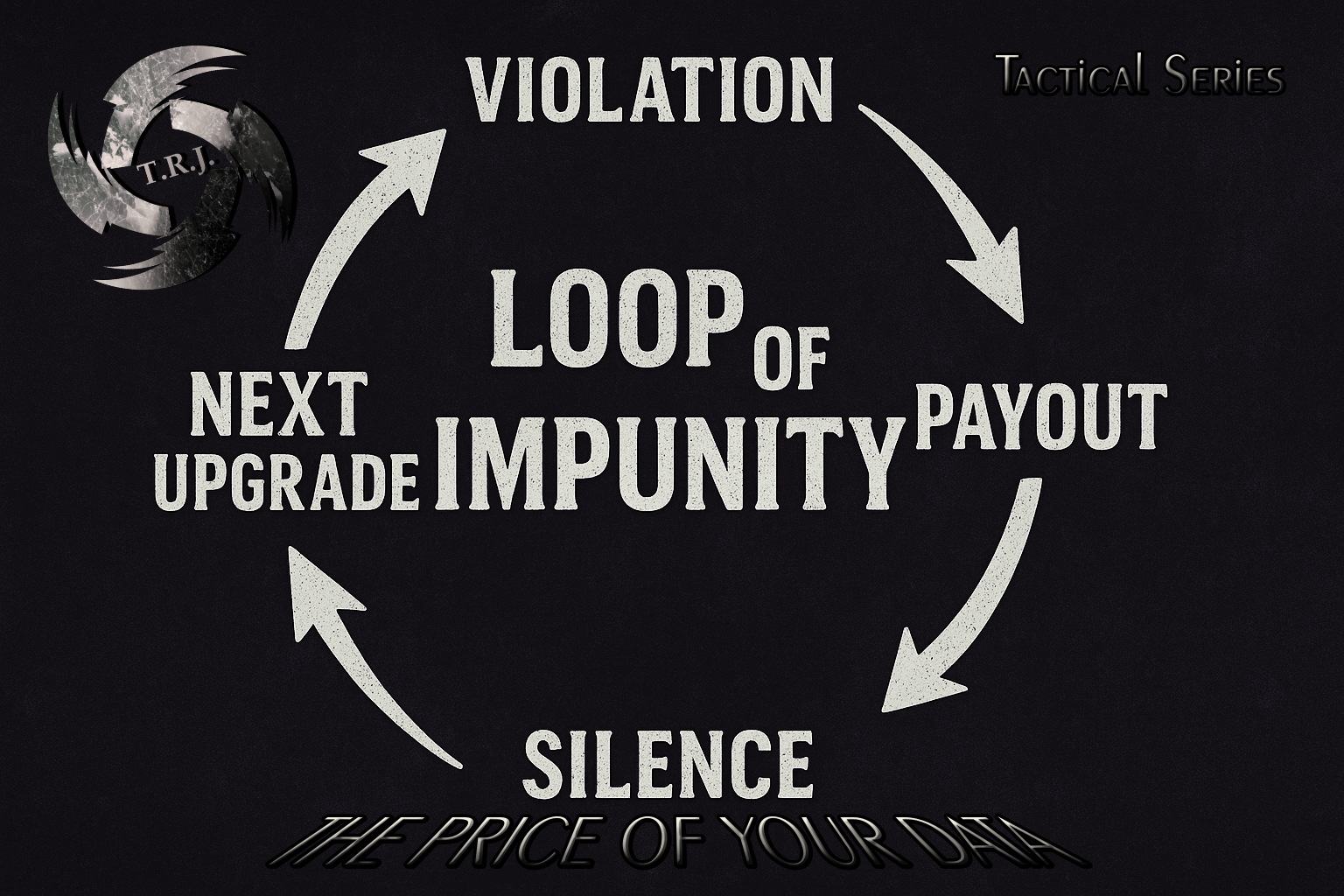
It’s the loop of impunity: violation → payout → silence → next upgrade.
And as long as silence remains cheaper than reform, the system will never stop upgrading itself.
Sherman (Duke, 2021)
- What it shows: Lists actual data packages sold by brokers (household income, political views, geolocation, health, religion, spending).
- Why it matters: Demonstrates that each category of personal data is a separate product resold multiple times.
- How it supports the math: If each data slice is sold at cents-to-dollars margins across dozens of intermediaries, the aggregate resale value per person easily scales into hundreds or thousands annually.
- Direct quote: “Data brokers maintain thousands of data points per individual… traded, licensed, and recombined without consent.”
👉 This underpins the multiplicative resale logic in the ledger. (Free Download)

van Lieshout et al. (IFIP/TNO, 2015)
- What it shows: Economic models for valuing personal data — includes ranges for “aggregate consumer data markets” and “derived behavioral information.”
- They calculate: a €300–€2,000 per person annual impact under certain corporate valuation models.
- Why it matters: That’s $325–$2,200 USD per year (2015-adjusted) — squarely inside the lower to mid tier of the $700–$7,000 range once inflation and layered resale are factored in.
This PDF gives an actual numeric baseline. (Free Download)
Lin (2025, Cornell Law)
- What it shows: Legal analysis of “derived data” markets — algorithms that infer traits, behaviors, and risk profiles for resale.
- Why it matters: Establishes that each original dataset spawns multiple secondary products (“inferences”) — compounding total value per person.
- How it supports themath: It gives the mechanism explaining how the same data generates 10× or 100× returns across derivative markets, validating the high-end extrapolation. (Free Download)
CFPB (2024)
- What it shows: U.S. regulators acknowledging that data brokers profit from sensitive, high-value categories — medical, biometric, geolocation, and financial identifiers — without consent.
- Why it matters: Confirms monetization scale and systemic risk; supports the argument that extraction is normalized business practice.
- How it supports the math: Reinforces that this is an institutionalized, multi-billion-dollar economy — therefore, high per-person valuations are economically coherent. (Free Download)
📚 TRJ Citation Ledger — Data Valuation Proofs
1️⃣ Sherman, Justin (2021)
Data Brokers and Sensitive Data on U.S. Individuals — Duke Sanford Cyber Policy Program
Confirms the sale and recombination of thousands of individual data points by major brokers, establishing the volume-based resale economy behind personal data valuation.:contentReference[oaicite:0]{index=0}
2️⃣ van Lieshout et al. (2015)
The Value of Personal Data (IFIP/TNO)
Provides quantitative modeling of consumer data markets, estimating per-person data value at €300–€2 000 (≈ $325–$2 200 USD/year), forming the lower-to-mid baseline for TRJ’s $700–$7 000 derived-data range.:contentReference[oaicite:1]{index=1}
3️⃣ Lin, J. (2025)
Derived Information Provided by Data Brokers — Cornell Law School Journal of Law & Public Policy
Defines the secondary markets for inferred and predictive datasets, showing how algorithmic inferences multiply the resale value of each user profile, supporting the article’s high-end valuation extrapolation.:contentReference[oaicite:2]{index=2}
4️⃣ Consumer Financial Protection Bureau (2024)
Protecting Americans from Harmful Data Broker Practices (Regulation V)
Federal-level confirmation that sensitive data categories (biometric, geolocation, financial) are monetized without consent, validating TRJ’s depiction of an institutionalized surveillance economy.:contentReference[oaicite:3]{index=3}
TRJ Conclusion: These four independent publications—academic, legal, and regulatory—jointly authenticate the structural and financial logic of TRJ’s valuation ledger. The $700–$7 000 annual per-person range is a defensible extrapolation derived from verified €300–€2 000 academic baselines, inflation adjustments, and multi-layer resale analysis.
TRJ Black File — The Extraction Ledger
This isn’t theory. This is the business model.
Case #001 — “Free” App, $∞ Harvest
A zero-cost app requests contacts, location, microphone, and motion data “to enhance experience.” The feed looks free; the exhaust sells for years. Users pay in perpetuity with behavior.
Case #002 — Location Brokers on Loop
Phones ping ad-tech SDKs every few seconds. GPS trails get resold across dozens of intermediaries: retail analytics, insurers, hedge funds, and “brand safety” vendors. One life, a hundred ledgers.
Case #003 — Psychographic File, Soft Control
Engagement patterns (late-night scrolling, rage-clicks, impulse windows) train models that nudge mood and spending. The ad isn’t the product — the predicted you is.
Case #004 — Social Graph as Collateral
Your contact network becomes a trust score. Friends-of-friends power political targeting, credit risk modeling, and content throttling. Influence is mapped, then monetized.
Case #005 — Faceprint Forever
“Tag suggestions” become biometric templates. The image you posted for friends becomes a key for retail cameras, kiosks, and private watchlists. Opt-out is theater; retention is policy.
This isn’t a breach. It’s the blueprint.
The settlement didn’t stop it — it standardized it.
🔥 NOW AVAILABLE! 🔥
📖 INK & FIRE: BOOK 1 📖
A bold and unapologetic collection of poetry that ignites the soul. Ink & Fire dives deep into raw emotions, truth, and the human experience—unfiltered and untamed.
🔥 Kindle Edition 👉 https://a.co/d/9EoGKzh
🔥 Paperback 👉 https://a.co/d/9EoGKzh
🔥 Hardcover Edition 👉 https://a.co/d/0ITmDIB
🔥 NOW AVAILABLE! 🔥
📖 INK & FIRE: BOOK 2 📖
A bold and unapologetic collection of poetry that ignites the soul. Ink & Fire dives deep into raw emotions, truth, and the human experience—unfiltered and untamed just like the first one.
🔥 Kindle Edition 👉 https://a.co/d/1xlx7J2
🔥 Paperback 👉 https://a.co/d/a7vFHN6
🔥 Hardcover Edition 👉 https://a.co/d/efhu1ON
Get your copy today and experience poetry like never before. #InkAndFire #PoetryUnleashed #FuelTheFire
🚨 NOW AVAILABLE! 🚨
📖 THE INEVITABLE: THE DAWN OF A NEW ERA 📖
A powerful, eye-opening read that challenges the status quo and explores the future unfolding before us. Dive into a journey of truth, change, and the forces shaping our world.
🔥 Kindle Edition 👉 https://a.co/d/0FzX6MH
🔥 Paperback 👉 https://a.co/d/2IsxLof
🔥 Hardcover Edition 👉 https://a.co/d/bz01raP
Get your copy today and be part of the new era. #TheInevitable #TruthUnveiled #NewEra
🚀 NOW AVAILABLE! 🚀
📖 THE FORGOTTEN OUTPOST 📖
The Cold War Moon Base They Swore Never Existed
What if the moon landing was just the cover story?
Dive into the boldest investigation The Realist Juggernaut has ever published—featuring declassified files, ghost missions, whistleblower testimony, and black-budget secrets buried in lunar dust.
🔥 Kindle Edition 👉 https://a.co/d/2Mu03Iu
🛸 Paperback Coming Soon
Discover the base they never wanted you to find. TheForgottenOutpost #RealistJuggernaut #MoonBaseTruth #ColdWarSecrets #Declassified

Sponsored • TRJ Ads
Inquiries: contact@therealistjuggernaut.com


