Thank you for reading or listening to The Realist Juggernaut. Independent journalism should be accessible to everyone.
The Public Narrative and the Controlled Story
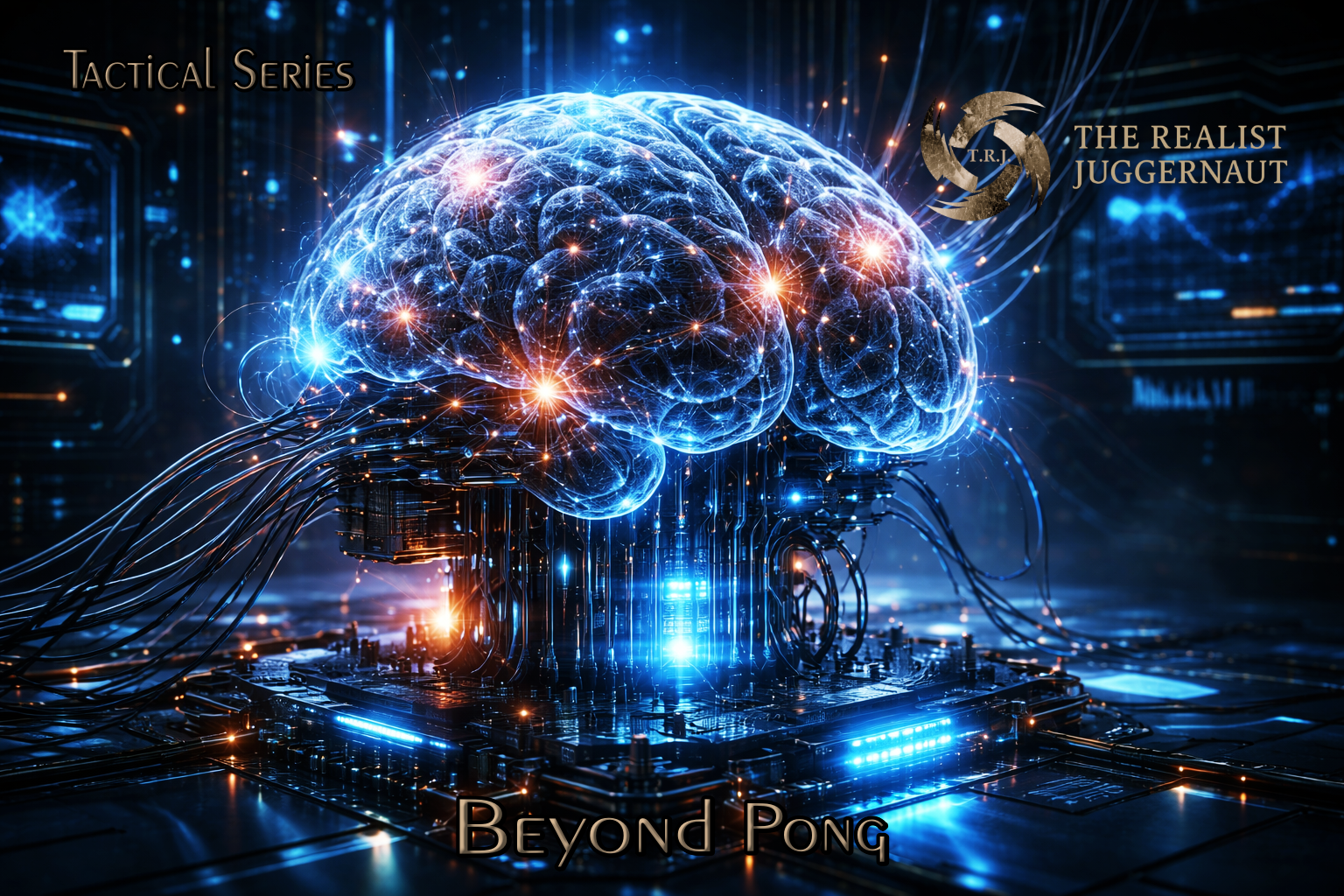
The story the public was given was neat, digestible, and deliberately small. And while our feature image may appear exaggerated at first glance, what follows from this point forward is not. The trajectory outlined in this article is grounded in documented systems, filed claims, and active research paths—not speculation. What is coming into view now is not theater, not metaphor, and not exaggeration. It is the natural extension of choices already made and structures already in place.
A dish of neurons learned to play Pong.
A breakthrough.
A curiosity.
A glimpse of a greener, gentler future for computing.
That narrative did not emerge accidentally. It was shaped, constrained, and distributed in a way that made the work appear both astonishing and harmless at the same time. It framed DishBrain as a scientific novelty rather than as an architectural proof. It reduced a complex research trajectory into a single visual metaphor that was easy to circulate, easy to explain, and easy to misunderstand.
A bouncing square on a screen was never the point.
It was the mask.
The Pong demonstration functioned as a public-facing abstraction, chosen precisely because it stripped away everything uncomfortable. No physical embodiment. No robotics. No chemistry-based reinforcement. No multi-network coupling. No autonomous hardware. No defense funding context. No escalation pathway. Just a closed-loop simulation that looked playful enough to disarm scrutiny while still being impressive enough to command attention.
This is how sensitive research often enters public consciousness: not through its most powerful form, but through its most defensible one.
The controlled story presented DishBrain as a boundary case, not as a foundation. It implied that what was being shown was close to the limit of what the system could do, when in reality it was closer to the minimum viable demonstration. It invited debate about philosophy and consciousness while quietly bypassing discussion of control architectures, embodiment, and operational intent.
That framing mattered, because it set expectations.
When people hear “neurons playing Pong,” they think toy.
When they hear “synthetic biological intelligence,” they think metaphor.
When they hear “organoid intelligence,” they think future speculation.
They do not think trajectory.
They do not think about what happens when the loop leaves the screen.
They do not think about what changes when the environment becomes physical.
They do not think about what reward chemistry does to training dynamics.
They do not think about why defense agencies fund continual learning systems instead of games.
And they are not supposed to.
The public narrative performed a containment function. It isolated the system from its adjacent research, from its funding ecosystem, and from its downstream applications. It allowed the work to be discussed safely, argued abstractly, and consumed casually, while the real momentum continued elsewhere under different labels and different grants.
This is not an accusation. It is a pattern.
Scientific institutions do this when the work sits at the edge of social tolerance. Start small. Demonstrate harmless capability. Emphasize control. Emphasize limits. Let the audience acclimate to the idea before they are asked to confront the implications of scale, embodiment, or deployment.
DishBrain entered the world through that aperture.
But the public story was never the whole story. It was the acceptable slice of a broader program that already extended beyond two-dimensional simulations and novelty demonstrations. The escalation was not theoretical, and it was not waiting for permission. It was already underway in parallel, documented in technical literature, grant language, and prototype systems that never appeared in the viral headlines.
To understand what DishBrain actually represents, the Pong narrative has to be treated for what it was: not a destination, but a deliberate introduction.
The rest of the work did not pause while the public watched the screen.
What DishBrain Was Framed To Be
DishBrain was introduced as a contained experiment, not as a platform.
The framing emphasized modesty: a small network of neurons, a simple task, a closed loop, a carefully controlled environment. The language surrounding it stressed limits and restraint. The neurons were said to be incapable of awareness. The task was intentionally trivial. The system was described as illustrative rather than scalable. Every public-facing explanation worked to keep the system conceptually small, even as the technical architecture underneath was anything but.
This was not deception. It was positioning.
DishBrain was framed as a proof-of-concept in the narrowest possible sense: proof that living neurons could be interfaced with a machine environment, respond to structured electrical input, and adapt their activity in ways that could be measured and reproduced. Nothing more. Nothing that would force an immediate reckoning with application, embodiment, or escalation.
The experiment was presented as a boundary case rather than a baseline.
That distinction matters. A boundary case invites curiosity without obligation. A baseline invites extrapolation. By presenting DishBrain as an edge experiment, the narrative discouraged the audience from asking what comes next, or what had already been attempted elsewhere using similar architectures.
The choice of Pong was central to this framing. Pong carries no symbolic weight. It has no real-world analogue. It is spatially simple, temporally repetitive, and culturally trivial. A neuron-controlled robot navigating a room would have raised immediate questions about autonomy. A neuron-controlled drone simulator would have raised alarms. A neuron-controlled mechanical system interacting with the physical world would have shattered the illusion of harmlessness.
A bouncing square on a screen did none of that.
The public explanation leaned heavily on reassurance. DishBrain was described as incapable of independent action. The neurons were said to be passive substrates. The machine was emphasized as fully in control. The feedback loop was presented as symmetric and benign. Even the term “learning” was carefully contextualized to avoid cognitive connotations.
All of that was technically accurate — but selectively incomplete.
What was not emphasized was that DishBrain was never designed to remain a toy. It was engineered as a modular interface: neurons on high-density electrodes, real-time stimulation and recording, software-defined environments, and adaptive feedback loops. That architecture does not care whether the task is a game, a simulator, or a physical system. It is agnostic to domain. Change the input encoding, change the output mapping, and the same interface can be pointed elsewhere.
The framing treated DishBrain as an endpoint.
The design treated it as a starting point.
This is where the public narrative diverged from the technical reality. DishBrain was framed as a demonstration of possibility, but its real significance lay in its generality. It showed that biological neural tissue could be stabilized, stimulated, interpreted, and trained inside a machine-governed loop with enough reliability to support repeatable behavior. That is not a curiosity. That is infrastructure.
The framing also isolated DishBrain from its lineage. Earlier work involving cultured neurons controlling simulated aircraft, navigating robots, and stabilizing dynamic systems was rarely mentioned. Nor was the fact that similar architectures had already been tested outside game environments long before DishBrain entered the spotlight. By omitting that context, DishBrain appeared unprecedented rather than evolutionary.
This isolation served a purpose. An unprecedented curiosity invites wonder. An evolutionary step invites scrutiny.
What DishBrain was framed to be, then, was safe: an academic milestone, a playful experiment, a speculative glimpse. What it actually was, even at the moment of its debut, was a validated interface architecture capable of being repurposed, scaled, and embedded elsewhere.
That gap between framing and function is not accidental. It is how sensitive platforms are introduced before their broader implications are allowed to surface.
The next sections deal with what was already happening outside that frame, at the same time the public was still watching a square bounce across a screen.
What Was Already Happening Off-Camera
By the time DishBrain entered public circulation, the idea that living neural tissue could be trained inside a machine-defined loop was not novel inside the research community. It was already a working assumption. The Pong demonstration did not initiate that assumption; it merely provided a clean, visual confirmation that could survive public exposure.
Off-camera, the work had already moved past novelty.
Decades earlier, laboratories had demonstrated that cultured neurons could stabilize dynamic systems, control simulated vehicles, and adapt their activity based on feedback. Those experiments were not framed as intelligence because the tools to scale them did not yet exist. What changed was not the concept, but the infrastructure. High-density microelectrode arrays, stem-cell derived human neurons, real-time signal processing, and machine-learning assisted interpretation finally converged into something usable.
DishBrain emerged from that convergence, not from a vacuum.
What was already happening off-camera was the quiet consolidation of an interface model: living neural tissue treated as a responsive substrate, embedded inside computational environments that define meaning, consequence, and success. The Pong task was simply the least controversial way to validate that model in public. In parallel, other groups were already testing variations of the same architecture in less visible contexts.
Some were experimenting with three-dimensional neural cultures rather than flat layers, not because they sought consciousness, but because geometry increases signal richness. Others were exploring chemical modulation alongside electrical stimulation, introducing neurotransmitters such as dopamine to bias learning dynamics. Still others were coupling neural outputs to physical actuators in laboratory robots, testing whether biological networks could handle noise, delay, and unpredictability better than software alone.
None of this required speculation. It was already documented in grant language, conference proceedings, and niche journals that rarely reached mainstream reporting.
What distinguished the off-camera work was not recklessness, but intent. These efforts were not asking whether neurons could adapt. That question had already been answered. They were asking how far adaptation could be pushed when the environment stops being symbolic and starts being physical. When feedback has inertia. When mistakes have cost beyond a missed pixel.
This is where the public narrative quietly breaks.
The Pong system was deliberately stripped of embodiment. There was no gravity, no momentum, no mechanical lag, no sensory ambiguity. Off-camera systems were not so constrained. When neurons are placed in control loops that interact with real space — even at small scale — new behaviors emerge that are irrelevant to games but highly relevant to robotics, autonomy, and control systems.
It is also where funding signals begin to matter.
Research that remains academic tends to emphasize explanation. Research that attracts strategic funding emphasizes capability. When intelligence agencies and defense organizations begin supporting projects framed around continual learning, adaptive control, and biological efficiency, it signals that the work is being evaluated not as a curiosity, but as a potential asset.
That support did not begin after DishBrain’s publicity. It preceded it.
The public story followed the proof.
The funding followed the architecture.
Off-camera, DishBrain was already understood as one instantiation of a broader class of systems. It was not treated as an endpoint, but as a demonstration that could justify deeper investment, more aggressive coupling, and more ambitious embodiments.
This is why focusing on Pong alone misrepresents the work. It collapses a distributed research trajectory into a single image and ignores the parallel lines already advancing elsewhere.
The next step was inevitable once the interface proved stable.
And that step did not remain on the screen.
Embodiment: When the Loop Leaves the Screen
The moment a neural interface leaves a simulated environment and enters physical space, the nature of the system changes in ways that are not cosmetic and not reversible.
Simulation is forgiving. Physical systems are not.
A game loop exists entirely inside machine-defined abstraction. Time is discrete. Space is symbolic. Error has no inertia. Failure has no consequence beyond a reset condition. In that context, biological adaptation can be observed without confronting the demands of real-world control.
Embodiment removes those protections.
When neural output is coupled to motors, actuators, or mechanical systems, latency matters. Noise matters. Drift matters. The environment pushes back. Signals are delayed, distorted, and sometimes wrong. The loop is no longer closed solely by code; it is closed by physics.
This is where DishBrain stops being a demonstration and becomes a template.
Long before public attention caught up, researchers were already testing biological neural networks as controllers for embodied systems. Cultured neurons had been used to stabilize flight simulations, navigate wheeled robots, and respond to sensor data in real time. These were not philosophical experiments. They were engineering trials designed to answer a specific question: can living neural tissue handle the unpredictability of physical environments better than static algorithms?
The answer, in limited contexts, was yes.
Biological networks excel at absorbing noise. They do not require explicit retraining to adapt to minor perturbations. They do not catastrophically forget prior behavior when exposed to new conditions. Their plasticity allows continuous adjustment rather than discrete updates.
These properties are irrelevant in a game like Pong.
They are critical in robotics.
This is why embodiment matters, and why it was excluded from the initial public narrative. A neuron-controlled robot does not read as harmless. A neuron-controlled physical system invites questions about autonomy, responsibility, and intent, even when none are present. It collapses the psychological distance that simulation maintains.
Once neurons are embodied, the loop is no longer just informational. It is causal.
This does not mean the system becomes autonomous in the human sense. Control remains external. Tasks remain machine-defined. Interpretation remains algorithmic. But the system now operates in a domain where adaptation has consequences beyond representation.
That shift is not theoretical. It has already occurred.
Recent work has demonstrated human-derived organoids embedded in robotic control loops, trained to avoid obstacles, track targets, and coordinate simple mechanical actions. These systems do not “understand” their environment. They do not form goals. They do not reason. But they do adapt in response to feedback that reflects real-world dynamics rather than symbolic ones.
That distinction is critical.
Embodiment does not create agency.
It increases pressure.
It tests whether the interface can remain stable under physical uncertainty. It tests whether biological adaptation can handle sensor ambiguity, mechanical lag, and environmental variation without explicit reprogramming. It tests whether a living substrate can function as a resilient controller where software struggles.
These are the questions defense agencies, robotics labs, and autonomy researchers care about. Not whether neurons can play games, but whether they can maintain control in degraded conditions, learn continuously without retraining, and recover from perturbation.
Embodiment exposes why the man–machine frame must remain intact. The moment biological components are treated as decision-makers rather than substrates, responsibility becomes impossible to assign. But as long as the machine defines goals and interprets output, the biological network remains a component, not an agent.
The loop leaving the screen does not dissolve control.
It sharpens the stakes.
And once embodiment is demonstrated to work at small scale, escalation becomes a matter of engineering, not philosophy.
That is why the next developments did not focus on smarter games.
They focused on training pressure.
Reward Chemistry, Training Pressure, and Directionality
Once biological neural networks proved capable of stabilizing behavior under feedback, the question shifted from whether they adapt to how forcefully that adaptation can be shaped.
Electrical stimulation alone is a blunt instrument. It encodes signals, introduces structure, and allows measurement, but it does not exploit the full training leverage available in biological systems. Living neurons evolved under chemical regimes, not purely electrical ones. They respond to neuromodulators that bias plasticity, reinforce patterns, and accelerate convergence.
This is where reward chemistry enters the picture.
Off the public stage, multiple groups began introducing biochemical modulation into training loops. Dopamine, serotonin, and other neuromodulators were used not to induce emotion, but to alter learning dynamics. These chemicals do not create motivation or desire. They change the probability landscape of synaptic adjustment. They tilt the network toward reinforcing certain activity patterns faster and more persistently than electrical feedback alone.
This is not speculative. It is documented.
Systems that combine electrical stimulation with chemical reinforcement learn faster, stabilize sooner, and retain learned behaviors longer. They also exhibit stronger directionality. Once a pattern is reinforced chemically, it becomes harder to dislodge. This matters when the system is expected to operate continuously rather than episodically.
Training pressure is the correct term here, not reward.
Biological networks under these conditions are not choosing outcomes. They are being pushed toward attractor states defined by the interface. The more dimensions of reinforcement are applied, the narrower the range of stable behaviors becomes. This is useful for control systems. It is dangerous for narrative clarity.
Because the moment chemical reinforcement is introduced, the system no longer resembles a neutral substrate adapting passively. It becomes a shaped biological process whose plasticity is being actively exploited.
Directionality increases.
This does not create agency, but it creates persistence. Learned behaviors become less reversible. Adaptation occurs faster, and deviations are corrected more aggressively by the system’s own internal dynamics. In engineering terms, the network develops inertia.
This is precisely why these techniques are attractive to applied research and defense-funded programs. A controller that adapts quickly but forgets easily is not useful in the field. A controller that adapts and retains behavior across changing conditions is.
The public DishBrain narrative avoided this dimension entirely. Pong required no reinforcement beyond predictability. It did not require neuromodulators. It did not stress the network. It did not test retention, interference, or drift under prolonged operation.
Off-camera systems did.
Once chemical reinforcement is introduced, the question of what the system is being trained toward becomes unavoidable. Training pressure implies direction. Direction implies intent at the system level, even if not at the biological level.
And that intent does not originate in the neurons.
It originates in whoever defines the reinforcement scheme.
This is where the man–machine distinction becomes non-negotiable. Biological tissue under chemical and electrical shaping is not an independent learner. It is a molded substrate. The machine does not merely interpret output; it sculpts the internal state space of the network.
That power is real. It is measurable. And it scales.
Reward chemistry accelerates escalation not by adding intelligence, but by compressing training time and increasing behavioral persistence. It makes biological controllers viable for applications where rapid deployment and stability matter.
This is why these methods appear quietly in advanced prototypes and grant proposals, even as they are absent from press narratives.
Games do not need directionality.
Operational systems do.
The moment training pressure increases, the system’s role shifts from demonstration to instrument. Not autonomous. Not sentient. But no longer neutral.
And that shift is deliberate.
Defense Capital and Strategic Interest
There is a point at which curiosity-driven research becomes capability-driven research. That transition is not marked by a press release. It is marked by who starts paying for the work and what they expect in return.
DishBrain crossed that point quietly.
Defense and intelligence agencies are not interested in novelty. They do not fund experiments to prove that something is interesting. They fund architectures that solve problems existing systems cannot. When funding appears from national security channels, it signals that the system has demonstrated properties that map onto operational gaps.
Those gaps are well known.
Modern AI systems are brittle. They consume enormous power. They require massive datasets. They struggle with continual learning. They fail unpredictably when conditions drift outside training distributions. They degrade under noise, latency, or partial system failure. These are tolerable flaws in consumer software. They are unacceptable in autonomous or semi-autonomous systems operating in contested environments.
Biological neural networks do not solve these problems outright, but they approach them differently.
Living neural tissue adapts continuously. It does not require explicit retraining cycles. It tolerates noise as a baseline condition. It reuses structure instead of discarding it. It operates at energy scales that are negligible compared to modern AI hardware. These are not philosophical advantages. They are logistical ones.
This is why defense capital entered the picture early.
Grants framed around “continual learning,” “adaptive control,” and “resilient intelligence” are not abstract. They describe specific use cases: autonomous vehicles that must adapt without retraining, systems that must function with degraded sensors, controllers that must learn in the field rather than in the lab.
When intelligence agencies invest in biological computing platforms, they are not chasing consciousness. They are chasing endurance.
The public-facing DishBrain narrative emphasized sustainability and green computing. Defense-facing documents emphasize survivability and adaptability. The language differs because the audience differs, but the architecture is the same.
This strategic interest also explains the emphasis on hybrid systems rather than standalone biological ones. No serious defense program is attempting to replace silicon with neurons wholesale. The goal is not biological supremacy. The goal is complementarity.
Biological substrates handle adaptation.
Silicon handles structure, interpretation, and enforcement.
That division of labor preserves control while exploiting biological strengths. It also aligns perfectly with the man–machine frame. The machine remains authoritative. The biological component remains responsive.
This is not accidental design. It is governance by architecture.
Defense funding also accelerates timelines. Problems that might take decades under academic pacing are compressed under strategic urgency. Prototypes move faster. Scaling is prioritized. Ethical review becomes formalized rather than exploratory.
This does not mean recklessness. It means focus.
The presence of defense capital does not imply imminent deployment of autonomous biological systems. It implies something more restrained and more realistic: that the interface has proven useful enough to justify continued investment, refinement, and protection.
It also means the work will not remain transparent indefinitely.
As soon as a system demonstrates even marginal operational advantage, parts of its development path move behind controlled access. Results are summarized rather than detailed. Capabilities are discussed obliquely. The public narrative lags behind reality.
This has already happened.
What remains visible is the safe slice: Pong, efficiency, sustainability, ethics. What becomes opaque are the applications that do not photograph well and do not reassure easily.
Defense interest does not transform DishBrain into a weapon. It transforms it into infrastructure under evaluation. That evaluation is ongoing, methodical, and deliberate.
And once a system enters that phase, it no longer evolves solely according to academic curiosity.
It evolves according to strategic value.
Organoid Intelligence as Scale and Leverage
Organoid Intelligence did not emerge as a philosophical escalation of DishBrain. It emerged as a practical response to a limitation.
Flat neural cultures plateau quickly. Two-dimensional layers restrict connectivity, limit signal depth, and cap the complexity of internal dynamics. They are sufficient to demonstrate adaptation. They are insufficient for sustained, high-capacity control. Anyone serious about extending biological interfaces understood this immediately.
Three-dimensional organoids change that geometry.
An organoid is not a brain. It is not organized into functional regions. It does not possess sensory systems, vascularization, or developmental trajectories comparable to an organism. But it does one thing that matters operationally: it packs far more neurons into a smaller volume and allows richer internal connectivity.
That increase in density is leverage.
With more neurons and more pathways, the system exhibits longer memory horizons, greater tolerance for noise, and more stable attractor states under training pressure. These are not cognitive traits. They are dynamical properties. They make the substrate more useful as a controller, not more intelligent in any human sense.
This is why organoids became the focus once interface stability was proven.
The transition from DishBrain to organoid-based systems did not represent a leap toward minds. It represented a scaling strategy. More neurons allow more robust adaptation. More internal dynamics allow smoother control under uncertainty. More capacity allows retention across longer operational windows.
The machine still defines everything that matters.
Organoids do not select goals. They do not interpret context. They do not evaluate outcomes. They respond to stimulation patterns imposed by hardware and software. The difference is that they do so with more internal degrees of freedom.
That freedom is often misunderstood.
In public discourse, increased complexity is treated as proximity to consciousness. In engineering, it is treated as bandwidth. Organoid Intelligence belongs to the latter category. It is about increasing signal capacity, not internal experience.
This distinction collapses when scale is discussed irresponsibly.
A million neurons does not create a mind. Ten million neurons does not create agency. One hundred million neurons does not suddenly cross an ethical boundary by virtue of quantity alone. What matters is organization, integration, and control — all of which remain externally imposed.
Organoid systems are therefore not an escalation in kind. They are an escalation in strength.
That strength is attractive to any domain where adaptive control must persist under stress. Robotics. Autonomous navigation. Distributed systems. Degraded environments. Long-duration operation. These are the pressures under which flat cultures fail and organoids begin to show advantage.
This is why organoid intelligence research tracks so closely with embodiment and defense interest. Once the loop leaves the screen, small inefficiencies compound. A controller that degrades slowly rather than catastrophically is valuable. A substrate that can absorb variance without retraining is valuable. Organoids offer that leverage.
What they do not offer is independence.
Remove the machine and the organoid is inert tissue. Remove the interface and there is no behavior to measure. Remove the training signal and the system collapses into unstructured activity. The organoid does not act. It is acted upon.
This is the line that must not be blurred.
Organoid Intelligence is not a claim about the emergence of new beings. It is a claim about scaling biological responsiveness within machine-governed systems. It increases what the interface can handle. It does not change who is in charge.
But scale creates pressure.
As capacity increases, so does temptation. More neurons invite more ambitious tasks. Richer dynamics invite looser constraints. The system does not demand escalation — the people funding and building it do.
This is where leverage becomes risk.
Not because the biology wants anything.
But because expanded capability invites expanded use.
Organoid Intelligence is not dangerous by nature. It is powerful by design. And power, once demonstrated, is rarely left unused.
Autonomy Pressure Without Autonomy Claims
At no point does the current body of work assert that these systems are autonomous. No credible laboratory claims that DishBrain, organoid controllers, or hybrid bio-robotic loops possess agency, intent, or self-directed cognition. That claim is absent for a reason.
But absence of a claim does not mean absence of pressure.
Autonomy pressure emerges not from what the system is, but from what the system does reliably enough to justify trust. When a controller adapts without retraining, recovers from noise, maintains stability under degradation, and improves performance through exposure rather than reprogramming, it begins to occupy functional territory traditionally reserved for autonomous systems, even if philosophically it remains dependent.
This is the tension point.
Engineers do not wait for metaphysical permission. They work backward from capability. If a system can maintain control under uncertainty, it is treated operationally as semi-autonomous, regardless of whether it possesses awareness. Autonomy, in practice, is a gradient of responsibility transfer, not a binary property of consciousness.
That gradient is already forming.
When biological substrates are embedded into control loops that operate continuously, without human intervention, adapting on the fly to environmental change, the system absorbs functions that were previously handled by explicit oversight. No declaration of autonomy is required. The shift happens through delegation.
This is not theoretical. It is observable in how these systems are described internally. Terms like “self-stabilizing,” “self-correcting,” and “continual learning” appear frequently in technical documents. These phrases are not poetic. They describe reduced human involvement during operation.
The machine still defines the task.
The machine still interprets output.
The machine still enforces limits.
But the human hand retreats from the loop.
That retreat is subtle, incremental, and framed as efficiency. No one announces it as a philosophical crossing. It happens because the system performs well enough to justify less supervision. This is how autonomy pressure accumulates without autonomy being claimed.
Biological controllers intensify this pressure because they blur traditional boundaries between programmed behavior and learned behavior. Software systems behave exactly as written unless retrained. Biological systems change continuously. That continuous change invites reliance. Reliance invites delegation.
Delegation is the real threshold.
Once a system is trusted to adapt without oversight, responsibility shifts upward and outward. Engineers stop monitoring individual decisions and start monitoring outcomes. Oversight becomes statistical rather than direct. The system is not considered an agent, but it is treated as if it can be relied upon.
This is where language fails if it is not precise.
Calling such systems “intelligent” accelerates delegation. Calling them “learning” systems normalizes reliance. Calling them “biological” lends them an aura of robustness that can exceed their actual reliability. None of these terms are wrong in isolation, but together they create a narrative that smooths the path toward expanded use.
And expanded use does not wait for philosophical clarity.
Autonomy pressure is therefore not about consciousness. It is about trust gradients. It is about how much of the loop humans are willing to let go of because the system appears to handle complexity gracefully.
This is why the man–machine frame must remain explicit. It is not a semantic preference. It is a governance tool. It reminds designers, funders, and operators that the biological component does not assume responsibility simply because it adapts.
The danger is not that these systems will declare independence.
The danger is that humans will slowly stop noticing how much responsibility they have already transferred.
That transfer does not require sentience.
It requires performance.
And performance is improving.
The Escalation Pathway
Escalation in systems like this does not occur through a single breakthrough. It occurs through accumulation. Each step appears reasonable in isolation. Each expansion is justified by performance gains, efficiency, or robustness. Taken together, they form a pathway that does not announce itself as escalation until it is already well advanced.
That pathway is already visible.
The first step is interface validation. DishBrain proved that living neurons could be reliably coupled to machine-defined environments and produce repeatable adaptive behavior. That question is closed. The interface works.
The second step is capacity expansion. Flat cultures give way to organoids. More neurons, richer internal dynamics, longer memory horizons. This is framed as a technical optimization, not a conceptual shift. The system is still governed externally. Control is preserved.
The third step is embodiment. The loop leaves the screen and enters physical space. Neurons are no longer stabilizing symbols but influencing motors, actuators, and movement. Feedback is no longer abstract. Error acquires inertia. Adaptation becomes operational.
The fourth step is training acceleration. Electrical stimulation is augmented with chemical reinforcement. Plasticity is biased. Convergence is faster. Retention is stronger. The system becomes less exploratory and more directed, not because it wants to be, but because it is shaped to be.
The fifth step is deployment pressure. Defense and strategic funding prioritize resilience, continual learning, and reduced oversight. Systems are expected to function longer, adapt faster, and fail more gracefully. Human supervision thins out, not because it is philosophically inappropriate, but because it is operationally inefficient.
None of these steps introduce agency.
None of them create awareness.
None of them require new definitions of mind.
And yet the system’s role changes.
It moves from demonstration to component. From component to controller. From controller to trusted subsystem. At each stage, responsibility is redistributed without being explicitly reassigned.
This is why escalation does not need to be hypothetical to be dangerous. It is not dangerous because it leads to consciousness. It is dangerous because it leads to opacity.
As systems adapt internally in ways that are difficult to inspect, even if they remain non-conscious, their behavior becomes harder to predict mechanistically. Engineers shift from understanding how a decision was produced to monitoring whether outcomes remain acceptable. This is a known pattern in complex adaptive systems.
Opacity invites abstraction.
Abstraction invites delegation.
Delegation invites misuse.
The escalation pathway is therefore not a slippery slope toward sentient machines. It is a gradual drift toward systems that are treated as autonomous because they behave reliably enough to earn that treatment, even while remaining structurally dependent.
The public discourse misses this entirely because it is fixated on the wrong threshold. It watches for minds. It ignores pipelines.
No lab needs to announce an intention to cross a boundary for the boundary to erode. All that is required is a sequence of improvements that make the system more useful, more resilient, and easier to rely on.
That sequence is already underway.
The correct response is not panic and not denial. It is recognition. Recognition that escalation in man–machine systems is driven by utility, not ideology. Recognition that governance must track capability, not rhetoric. Recognition that once the pathway exists, it will be followed unless deliberately constrained.
This is not speculation.
It is systems engineering.
And systems engineering always follows the path of least resistance unless someone actively holds the line.
Where the Line Is Actually Under Stress
The stress point in this work is not where critics keep looking for it.
It is not consciousness.
It is not sentience.
It is not the emergence of a mind.
Those questions remain premature and, in many cases, distracting.
The line that is actually under stress is control visibility.
As biological substrates are scaled, embodied, chemically shaped, and deployed inside increasingly complex loops, the clarity of authorship begins to blur. Not because the system takes control, but because the mechanism by which control is exercised becomes harder to trace. The machine still governs, but governance becomes layered, indirect, and probabilistic.
This is the real fault line.
When a system’s internal state evolves continuously through biological plasticity, the relationship between input and output is no longer strictly enumerable. Engineers can constrain behavior statistically, but not enumerate every internal transition. That does not make the system alive in a moral sense. It makes it opaque in a technical sense.
Opacity is manageable in small systems. It becomes risky when scaled.
As organoid controllers grow in size and complexity, oversight shifts from direct inspection to performance envelopes. As long as the system stays within acceptable bounds, its internal behavior is tolerated rather than understood. This is standard practice in many AI systems today. What changes here is the substrate.
Biological opacity is different from algorithmic opacity. It cannot be reset cleanly. It cannot be cloned deterministically. It cannot be rolled back to a known prior state without destroying the tissue. Each instance is unique. Each learning history is irreducible.
That uniqueness strains existing governance models.
Accountability frameworks assume reproducibility. Validation assumes repeatability. Certification assumes that a system that passed once will behave the same way again under similar conditions. Biological systems violate these assumptions by default.
This is where the line begins to bend.
Not because neurons become decision-makers, but because humans begin to accept outcomes without full traceability. Oversight becomes outcome-based rather than mechanism-based. Responsibility shifts upward to institutions and downward to abstractions, while the actual interface layer becomes harder to interrogate.
This is compounded by defense and industrial incentives. Systems that perform better under uncertainty are rewarded with broader deployment. Systems that require constant human supervision are seen as inefficient. Over time, the tolerance for opacity increases, not because anyone wants it to, but because performance justifies it.
This is the pressure point governance must address.
Holding the man–machine line is not about denying capability. It is about preserving auditability. It is about ensuring that control remains inspectable, interruptible, and reversible, even as biological substrates are exploited for their adaptive advantages.
The moment a system’s internal evolution becomes effectively unreviewable, even if it remains non-conscious, it begins to exceed the oversight structures designed to contain it.
That is the real boundary.
Not whether the system thinks.
But whether humans can still clearly see how decisions are shaped, reinforced, and corrected.
If that visibility is lost, control becomes nominal rather than real.
This is why the line must be held deliberately, not rhetorically. Architecture must enforce it. Policy must recognize it. Language must reflect it.
Because once control becomes opaque, intent becomes irrelevant.
And systems that no one fully understands are not neutral, even when they are not alive.
When Patents Speak Louder Than Papers
There is a critical distinction between what researchers demonstrate publicly and what institutions secure legally. Academic papers describe present capability. Patents describe claimed futures.
This matters, because when the DishBrain ecosystem is examined through its patent filings rather than its demonstrations, the posture changes. The language stops being exploratory. It becomes anticipatory. It stops describing what is. It begins reserving what may be done.
Multiple patents now on record explicitly outline systems where human-derived neural tissue is not merely observed, modeled, or temporarily stimulated, but maintained, stabilized, embedded, and integrated into long-term machine architectures. These filings do not frame biological components as disposable test substrates. They describe them as functional elements within engineered systems, capable of adaptation, persistence, and continued participation in control loops.
That is not incidental drafting. Patent claims are written to preserve maximum future latitude. They are not granted for metaphors. They are granted for mechanisms.
When filings include provisions for:
- sustained biological viability within machines
- bidirectional neural signaling beyond experimental timeframes
- layered biological-synthetic architectures
- adaptive biological components serving control or interpretation roles
they are not describing Pong.
They are describing ownership of escalation paths.
This does not mean laboratories are currently producing awake or embodied hybrid humans. It does mean the legal groundwork exists to pursue deeper integration if incentives align and oversight weakens. Patents do not need to be activated immediately to be dangerous. Their function is to ensure that, when pressure arrives—commercial, military, or strategic—the option to proceed already exists.
That is the ethical fault line.
Scientific papers reassure by emphasizing constraints. Patent claims do the opposite: they remove future constraints preemptively. The contradiction is structural, not accidental. One narrative is meant for peer review. The other is meant for markets, defense agencies, and long-horizon investment.
This is why language discipline matters. This is why “hybrid human” cannot be treated casually. And this is why accountability cannot be deferred to some later moment when systems are already entrenched.
The danger is not that these patents prove consciousness is imminent.
The danger is that they normalize biological integration as infrastructure.
Once that normalization occurs, the ethical debate is no longer about whether a line should exist—but about how inconvenient it is to enforce.
That is the fact at hand.
When a laboratory system is marketed as “actual intelligence” and offered as a deployment target for external technologies, the risk is no longer technical—it is definitional. Intelligence is being claimed before boundaries are agreed upon, and infrastructure is being offered before governance exists.
TRJ Verdict
DishBrain did not arrive by accident, and it did not evolve in isolation. It emerged as a validated interface and is now being treated as such. That interface is no longer confined to a laboratory demonstration—it is being sold by Cortical Labs Pte Ltd. Any organization with a laboratory can formally acquire the system.
What has been demonstrated, repeatedly and across multiple labs and funding channels, is not the birth of a new kind of mind, but the utility of biological adaptation when placed under machine authority. Living neural tissue has proven capable of stabilizing behavior, absorbing noise, retaining learned patterns, and adapting continuously under conditions where conventional software systems struggle. That fact alone is enough to attract sustained investment, embodiment trials, and strategic interest.
The danger has never been that these systems are becoming conscious.
The danger is that they are becoming useful in ways that quietly reshape responsibility, oversight, and control.
This article rejects both extremes that dominate public discussion. It rejects the hype that frames DishBrain and organoid systems as nascent beings or inevitable successors to human intelligence. It also rejects the minimization that treats Pong as the ceiling rather than the entry point. Both positions misunderstand the system in opposite directions.
The correct frame is structural.
DishBrain, organoid controllers, and SBI platforms are man–machine systems, governed by architecture, shaped by training pressure, and constrained by hardware and policy. They do not possess agency. They do not initiate goals. They do not evaluate meaning. But they do increasingly occupy roles once reserved for explicitly supervised controllers, and they do so because their performance justifies trust.
That trust is where escalation hides.
Not in minds. Not in sentience.
But in delegation.
As biological substrates are scaled, embodied, and reinforced, humans step back incrementally. Oversight becomes statistical. Auditability becomes probabilistic. Internal state becomes harder to interrogate. The system remains dependent, but its operation becomes less transparent.
This is the line that matters.
If control remains visible, interruptible, and enforceable, the work remains governable, regardless of how capable the substrate becomes. If visibility erodes, the system becomes dangerous without ever becoming alive.
TRJ’s position is not oppositional to the research. It is oppositional to narrative drift and governance failure.
There is nothing inherently unethical about interfacing neurons with machines when those neurons are not awake, embodied, or capable of experience. The ethical breach does not originate in connectivity itself. It begins when capability is allowed to advance faster than accountability because the wrong questions were asked—or deliberately avoided.
There is nothing inherently unethical about the interface.
There is something profoundly irresponsible about selling it before governance exists.
The line is not technological.
The line is biological state and moral status.
The moment a system crosses from instrumental biological substrate into anything plausibly describable as awake, experiential, or embodied, the work ceases to be research and becomes exploitation. That is where hybrid humans stop being a theoretical phrase and become an ethical violation.
This is not a gray area.
This is not a future debate.
This is a boundary that must be enforced before capability pressures attempt to erase it.
Hybrid human systems that remain non-experiential are tools.
Hybrid human systems that approach wakefulness are unacceptable.
That line is not optional.
And it must hold.
DishBrain is not a warning about artificial life.
It is a warning about how quietly power migrates inside systems that work too well to ignore.
The CL1 is a bio–machine interface.
This represents the first material step toward man–machine integration. There should be no confusion about that.
That boundary must be enforced at the architectural level, not argued after the fact.

US20200348287A1
Title: Systems and Methods for Neural Interface and Hybrid Biological–Machine Processing
Jurisdiction: United States Patent Application
Status: Published Application
Scope: Describes neural interface architectures enabling bidirectional signal exchange between biological neural tissue and computational systems. (Free Download)

WO2017123791A1
Title: Neural Interface Systems and Methods
Jurisdiction: World Intellectual Property Organization (WIPO)
Status: International Patent Application
Scope: Covers hybrid neural-machine interfaces, including signal acquisition, interpretation, and feedback mechanisms across biological substrates. (Free Download)
US20190002835A1
Title: Neural Processing and Hybrid Biological Computing Systems
Jurisdiction: United States Patent Application
Status: Published Application
Scope: Addresses biological neural networks used as adaptive processing elements within machine-defined environments. (Free Download)
US20110307079A1
Title: Brain–Computer Interface and Neural Signal Translation Systems
Jurisdiction: United States Patent Application
Status: Published Application
Scope: Early foundational work on extracting, translating, and utilizing neural signals for machine control and feedback loops. (Free Download)
US20230077899A1
Title: Hybrid Biological–Digital Intelligence Systems
Jurisdiction: United States Patent Application
Status: Published Application
Scope: Describes architectures combining biological neural substrates with synthetic control systems for adaptive computation. (Free Download)
US20180333587A1
Title: Brain–Machine Interface Systems with Adaptive Control
Jurisdiction: United States Patent Application
Status: Published Application
Scope: Focuses on adaptive neural interfaces, including learning signal optimization between biological neurons and machines. (Free Download)
US11716444B2
Title: Human-Like Emulation Enterprise System and Method
Jurisdiction: United States Patent (Granted)
Status: Issued Patent (Aug. 1, 2023)
Scope: Explicitly describes systems integrating biological, biomechatronic, and artificial intelligence components into unified human-like operational frameworks. (Free Download)
US12035996B2
Title: High Spatiotemporal Resolution Brain Imaging
Jurisdiction: United States Patent (Granted)
Status: Issued Patent (Jul. 16, 2024)
Scope: Covers non-invasive and semi-invasive techniques for detecting and resolving neural activity patterns relevant to interface and control systems. (Free Download)
US11630516B1
Title: Brain–Machine Interface (BMI) with Neural Control
Jurisdiction: United States Patent (Granted)
Status: Issued Patent (Apr. 18, 2023)
Scope: Details direct neural control of external devices, adaptive decoding, and closed-loop human–machine operational systems. (Free Download)
TRJ BLACK FILE — Hybrid Human Interface Receipts
This is not conjecture. These are filed claims.
Receipt #001 — Neural Interface Architectures (US20200348287A1)
Filed claims describe bidirectional electrical coupling between biological neural tissue and machine-defined processing environments, including adaptive signal interpretation and feedback control.
Receipt #002 — International Hybrid Neural Systems (WO2017123791A1)
An international patent filing covering neural-machine interface systems that integrate living neural substrates into synthetic computational loops.
Receipt #003 — Biological Neural Computing Substrates (US20190002835A1)
Explicitly frames biological neural networks as adaptive processing elements embedded within engineered systems.
Receipt #004 — Early Brain–Computer Translation Systems (US20110307079A1)
Foundational claims involving extraction, translation, and utilization of neural signals for external system control.
Receipt #005 — Hybrid Biological–Digital Intelligence (US20230077899A1)
Describes architectures combining biological neural tissue with digital control layers to produce adaptive system behavior.
Receipt #006 — Neural Processing Patent Family Expansion
Related filings reinforce long-term intent to normalize biological neural substrates as computational components.
Receipt #007 — Adaptive Brain–Machine Control (US20180333587A1)
Focuses on adaptive feedback optimization between neural tissue and machine systems.
Receipt #008 — Human-Like Emulation Enterprise System (US11716444B2)
Granted patent explicitly referencing integrated biological, biomechatronic, and artificial intelligence components within unified operational frameworks.
Receipt #009 — High-Resolution Neural Signal Mapping (US12035996B2)
Covers techniques enabling precise detection and interpretation of neural activity relevant to interface and control systems.
Receipt #010 — Brain–Machine Interface Control Systems (US11630516B1)
Granted claims describing direct neural control of external devices via closed-loop feedback architectures.
These filings do not assert consciousness.
They do not require agency.
They do not claim awareness.
They establish legal ownership over architectures capable of escalation.
The danger is not what these systems are today.
The danger is what the paperwork already permits tomorrow.


🔥 NOW AVAILABLE! 🔥
🔥 NOW AVAILABLE! 🔥
📖 INK & FIRE: BOOK 1 📖
A bold and unapologetic collection of poetry that ignites the soul. Ink & Fire dives deep into raw emotions, truth, and the human experience—unfiltered and untamed
🔥 Kindle Edition 👉 https://a.co/d/9EoGKzh
🔥 Paperback 👉 https://a.co/d/9EoGKzh
🔥 Hardcover Edition 👉 https://a.co/d/0ITmDIB
🔥 NOW AVAILABLE! 🔥
📖 INK & FIRE: BOOK 2 📖
A bold and unapologetic collection of poetry that ignites the soul. Ink & Fire dives deep into raw emotions, truth, and the human experience—unfiltered and untamed just like the first one.
🔥 Kindle Edition 👉 https://a.co/d/1xlx7J2
🔥 Paperback 👉 https://a.co/d/a7vFHN6
🔥 Hardcover Edition 👉 https://a.co/d/efhu1ON
Get your copy today and experience poetry like never before. #InkAndFire #PoetryUnleashed #FuelTheFire
🚨 NOW AVAILABLE! 🚨
📖 THE INEVITABLE: THE DAWN OF A NEW ERA 📖
A powerful, eye-opening read that challenges the status quo and explores the future unfolding before us. Dive into a journey of truth, change, and the forces shaping our world.
🔥 Kindle Edition 👉 https://a.co/d/0FzX6MH
🔥 Paperback 👉 https://a.co/d/2IsxLof
🔥 Hardcover Edition 👉 https://a.co/d/bz01raP
Get your copy today and be part of the new era. #TheInevitable #TruthUnveiled #NewEra
🚀 NOW AVAILABLE! 🚀
📖 THE FORGOTTEN OUTPOST 📖
The Cold War Moon Base They Swore Never Existed
What if the moon landing was just the cover story?
Dive into the boldest investigation The Realist Juggernaut has ever published—featuring declassified files, ghost missions, whistleblower testimony, and black-budget secrets buried in lunar dust.
🔥 Kindle Edition 👉 https://a.co/d/2Mu03Iu
🛸 Paperback Coming Soon
Discover the base they never wanted you to find. TheForgottenOutpost #RealistJuggernaut #MoonBaseTruth #ColdWarSecrets #Declassified


Sponsored • TRJ Ads
Inquiries: contact@therealistjuggernaut.com