
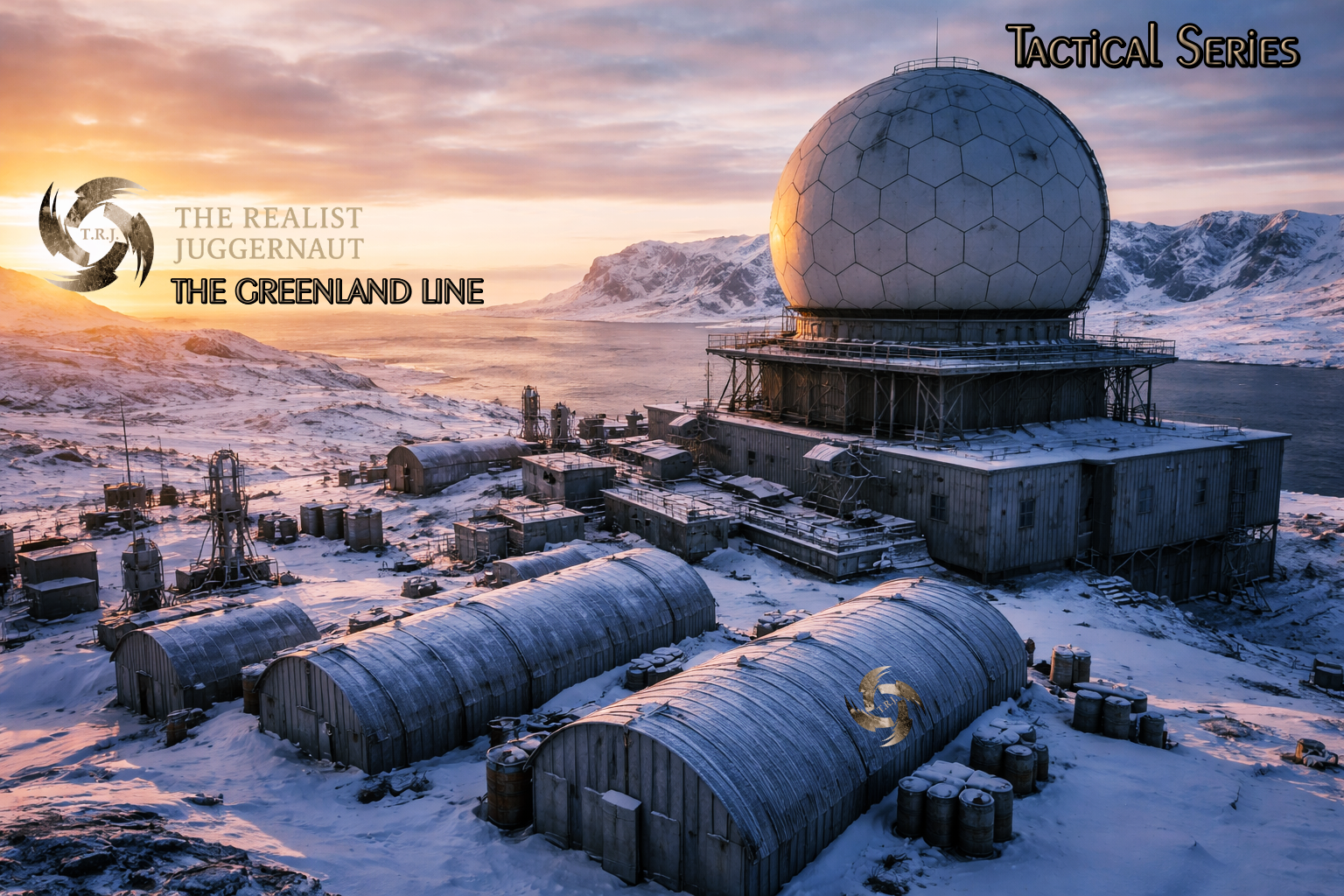
Why the United States Held the Arctic Then — and Why It Matters Now
The United States did not suddenly become interested in Greenland. That framing is convenient, dismissive, and historically false. The truth is simpler and more consequential: the United States never left. What appears today as a renewed focus is not a pivot or an obsession, but the resurfacing of a strategic reality that was established under existential pressure, maintained through decades of silent infrastructure, and temporarily pushed out of public view only because the global threat environment briefly allowed it to be. The Arctic was never abandoned as a defensive concept; it was merely quieted while attention shifted elsewhere. Now, the conditions that once made Greenland indispensable have returned, altered by technology but unchanged in geometry.
The original line was drawn during a moment when hesitation would have meant catastrophe. In the early 1940s, when Europe collapsed under Nazi occupation and Denmark fell, Greenland did not become neutral by default. It became exposed. An undefended Greenland was not an abstract risk; it was a direct vulnerability sitting astride the shortest routes between hostile territory and the North American continent. Weather systems born over Greenland shaped transatlantic operations. Airspace over the island offered the fastest approach for bombers. Control of the Arctic was not a matter of prestige, but of survival. That is why the United States moved decisively, establishing a presence not to claim land, but to deny access. From the moment American forces set foot there, Greenland ceased to be a peripheral territory and became a forward shield. That shield held.
When the war ended, the nature of the threat changed, but its direction did not. The Cold War replaced the Axis with a nuclear adversary, and Greenland’s value multiplied rather than diminished. Missile trajectories ignored borders and curved over the pole. Early warning meant the difference between response and annihilation. Greenland’s position transformed it into a temporal advantage — a place where detection happened sooner, decisions could be made earlier, and interception became possible at all. The infrastructure built there was not temporary, and the agreements that allowed it were not accidents of diplomacy. They were acknowledgments of an unalterable fact: geography does not negotiate. The Arctic, and Greenland in particular, controlled the clock.
The collapse of the Soviet Union created the illusion that this logic had expired. Bases were downsized. Installations went quiet. The public conversation drifted southward toward deserts, insurgencies, and asymmetric warfare. But the systems embedded in Greenland did not vanish. Radar continued to scan. Satellites continued to rely on high-latitude coverage. Strategic planners never removed Greenland from their maps; they simply stopped talking about it. The Arctic does not forgive neglect, but it does allow latency — until conditions change.
Those conditions have now changed decisively. The Arctic is no longer sealed by ice or isolation. Climate dynamics have opened maritime corridors that were once theoretical. Submarine routes have expanded. Hypersonic weapons exploit polar arcs precisely because they shorten reaction times. Space-based systems, both defensive and adversarial, depend on coverage that only high latitudes can reliably provide. Meanwhile, rival powers have not been idle. Russia has rebuilt and expanded its Arctic military posture. China, despite lacking geographic proximity, has declared itself a stakeholder and tested economic inroads wherever governance appeared thin. These developments are not speculative; they are structural. They force the same question that existed in 1941 and again in 1951 and again throughout the Cold War: who controls the roof, and who gets to see first?
This is why Greenland sits at the center of the current moment, not as a novelty, but as a convergence point. The island represents early warning, forward geometry, and denial of adversary access in a single physical space. It anchors the northern approaches to North America. It stabilizes the Arctic flank of allied defense. It links terrestrial defense to orbital systems in a way no other territory can. When discussions return to Greenland, they are not reviving an old obsession; they are acknowledging that the strategic environment has once again aligned with the reality that never changed.
What looks to some like ambition is, in fact, continuity. What is framed as expansion is better understood as reinforcement. The United States is not chasing Greenland because of ideology or impulse. It is responding to the same immutable factors that compelled action generations ago: distance, time, and survivability. The Arctic does not care about narratives. It only rewards preparedness. Greenland has always been the fulcrum of that equation, and as the world shifts back toward great-power competition and space-integrated defense, the logic that once made Greenland indispensable has returned, intact and unavoidable.
The Line Was Drawn in War, Not Politics
In 1940, when Nazi Germany occupied Denmark, Greenland did not merely lose administrative oversight — it lost strategic insulation. Overnight, the world’s largest island became an exposed asset sitting astride the most critical approaches to North America, disconnected from its sovereign government and vulnerable to exploitation by a hostile power that already understood the value of geography, weather, and airspace. For Washington, this was not a theoretical problem to be debated in committees. It was a hard strategic emergency that demanded immediate action. The Arctic was not peripheral to the war; it was one of its quiet hinges.
At the time, control of Greenland meant control of information before it meant control of territory. Weather systems forming over Greenland dictated conditions across the North Atlantic and Western Europe. Whoever held Greenland’s weather stations could predict storm systems days in advance, giving decisive operational advantages to air and naval forces. In an era when transatlantic convoys were being hunted by U-boats and bomber routes were being plotted with limited navigational tools, weather intelligence was as lethal as weaponry. A German foothold on Greenland would have provided early warning, navigational dominance, and staging opportunities that could compress the distance between Europe and North America into a direct threat corridor.
Even more dangerous was the airspace. Greenland sits directly beneath the shortest great-circle routes between Europe and the eastern United States. In wartime geometry, it was not the Atlantic that mattered most, but the arc over the pole. An enemy presence in Greenland would have enabled refueling, reconnaissance, and potentially forward basing for long-range aircraft. The concept of homeland defense as a buffer of oceans collapses when polar routes come into play. Washington understood this instinctively, even before missile age logic formalized it. Greenland was not a distant colony; it was the roof over the continent.
Faced with this reality, the United States acted decisively and unambiguously. In 1941, under a defense agreement signed by Denmark’s ambassador in Washington — acting independently because Denmark itself was under occupation — American forces moved into Greenland. This was not a diplomatic maneuver dressed up as benevolence. It was a strategic denial operation executed under wartime necessity. The agreement bypassed normal sovereignty channels precisely because normal channels had been severed by invasion. Survival does not wait for procedural elegance.
Once on the ground, the United States moved with speed and intent. Airfields were carved out of permafrost to support transatlantic ferry routes and patrol aircraft. Ports were developed to receive supplies and maintain naval presence. Weather stations were established and guarded, forming part of an intelligence network that extended across the Arctic. The U.S. Coast Guard conducted relentless patrols along Greenland’s vast and hostile coastline, monitoring for German incursions and protecting shipping lanes. German weather teams, dispatched covertly to establish meteorological outposts, were actively hunted, disrupted, and neutralized. This was not symbolic occupation; it was sustained operational control in one of the harshest environments on Earth.
Strategic resources were also secured, most notably cryolite, a mineral found in Greenland that was essential for aluminum production. Aluminum was the backbone of aircraft manufacturing, and aircraft were the backbone of Allied power. Allowing Germany access to that supply would have had cascading effects across the entire war effort. Securing cryolite was not a footnote — it was industrial warfare conducted through geography. Greenland’s value was not abstract; it was tangible, measurable, and immediate.
By the midpoint of the war, Greenland had become something unprecedented: a territory under de facto American protection without formal annexation, serving as a forward shield for North America and a critical support node for Allied operations. The local population largely cooperated, not because of coercion, but because American presence brought supplies, stability, and protection in a moment when isolation could have been fatal. Greenland was no longer a colonial backwater. It was a strategic platform.
What matters most is what did not happen when the war ended. The United States did not pack up and leave. The installations remained. The patrol logic remained. The understanding that Greenland controlled time, access, and awareness at the top of the world remained embedded in U.S. strategic thinking. The line drawn during the war was not erased by peace treaties or victory parades. It was institutionalized.
This was not conquest, and it was not ideology. It was denial — denial of access to hostile powers, denial of surprise attack vectors, denial of the Arctic as an exploitable blind spot. The United States did not claim Greenland as territory, but it claimed responsibility for ensuring that Greenland could never be used against North America. That distinction matters. It explains why later diplomacy took the shape it did, why base rights mattered more than flags, and why the Arctic has never truly left American defense planning.
The line drawn at the top of the world in the early 1940s was enforced with airfields, patrols, intelligence, and resolve. It was drawn because geography demanded it, not because politics encouraged it. And once drawn, it never disappeared. It simply waited for the next moment when the world would again remember why Greenland mattered in the first place.
Why Greenland Was Returned — and What Was Never Surrendered
When the Second World War ended, the United States emerged with unprecedented global reach and an equally unprecedented strategic dilemma. Having established a decisive presence in Greenland under the pressure of wartime necessity, Washington now had to decide what victory meant in practical terms. The question was not whether Greenland mattered — that had already been answered by years of operational use — but how American interests would be preserved without fracturing the postwar order the United States itself was trying to build. Retaining formal control of Greenland was one option. Returning administrative sovereignty to Denmark was another. The decision that followed was not a retreat. It was a recalibration.
Publicly, the United States chose diplomacy, alliance-building, and the appearance of restraint. This was the era of reconstruction, of institutions, of an emerging Western bloc meant to stand in contrast to imperial collapse and authoritarian expansion. Openly annexing or holding a European territory would have undercut the very principles Washington was championing across the world. Privately, however, American strategic planners never questioned whether Greenland would remain within the U.S. defense orbit. The only question was how to secure permanence without provoking resistance.
The 1946 offer to purchase Greenland outright was not impulsive or speculative. It was the logical extension of wartime realities into peacetime planning. From the perspective of the U.S. military, Greenland was no longer a remote dependency; it was one of the most valuable pieces of real estate on the planet. American defense assessments at the time placed Greenland alongside Alaska and the Panama Canal as locations essential to global security. Geography had elevated it beyond diplomacy. Offering to buy Greenland was a way to formalize a reality already in place.
Denmark’s refusal was equally predictable. Having just emerged from occupation, Copenhagen was in no position — politically, psychologically, or symbolically — to sell territory that had become bound up with national recovery and identity. Greenland was not merely land; it was proof of continuity after invasion. The refusal was firm, but it was not hostile. Crucially, it did not include a demand that the United States withdraw.
That distinction shaped everything that followed.
Denmark understood that it lacked the capacity to defend Greenland on its own. The island’s sheer scale, climate, and location made unilateral defense impossible. The United States understood that it did not need sovereignty to maintain control — it needed access, authority, and time. Both sides recognized that a public compromise could preserve alliance unity while quietly locking in strategic outcomes.
The result was the 1951 U.S.–Denmark Defense Agreement, a document that did far more than its restrained language suggested. On paper, it affirmed Danish sovereignty. In practice, it granted the United States sweeping and durable military authority across Greenland. The agreement allowed American forces to build, operate, and expand defense installations wherever required for the security of the North Atlantic and the Arctic approaches to North America. It imposed no meaningful operational constraints. It tied Greenland’s defense to the emerging NATO framework, effectively embedding the island within the U.S.-led security architecture.
This was not symbolic diplomacy. It was functional control achieved without formal ownership.
Denmark retained the flag.
The United States retained the geometry.
That geometry mattered more than any legal title. It meant control of airspace, early-warning timelines, and the northern approach routes that defined Cold War nuclear strategy. It meant the ability to act without delay in a crisis. It meant that Greenland would never become a bargaining chip for a hostile power or a blind spot in continental defense. Sovereignty, in this arrangement, became ceremonial. Capability became decisive.
The operational nature of this agreement was immediately evident. Within months, the United States began constructing what would become one of the most critical military installations of the twentieth century, Thule Air Base. The speed and scale of that construction left no doubt about intent. Thousands of personnel, massive logistics convoys, and advanced infrastructure were deployed into one of the harshest environments on Earth, not as a contingency, but as a commitment. This was not the behavior of a nation hedging its bets. It was the behavior of a nation entrenching a strategic position it never intended to relinquish.
From that moment forward, Greenland’s status was clear even if its paperwork was not. It was Danish in name and American in function. The United States had surrendered the optics of ownership while retaining the substance of control. That distinction allowed Washington to lead a postwar alliance system without contradiction, while ensuring that the Arctic — the shortest, fastest, and most dangerous axis of attack — remained under reliable supervision.
What is often misunderstood is that this arrangement was not temporary. It was designed to endure as long as the underlying strategic conditions endured. Those conditions were defined by distance, technology, and threat vectors — not by political fashion. When the Cold War intensified, Greenland’s value increased. When it appeared to subside, Greenland’s role went quiet but never vanished. The radar kept scanning. The agreements remained in force. The logic stayed intact.
Returning Greenland to Denmark was not an act of surrender. It was an act of confidence. The United States understood that it had already secured what mattered most and that formal ownership would add little beyond friction. By choosing permanence over possession, Washington achieved something more durable than annexation: uncontested access anchored in alliance rather than force.
That is why the line drawn during the war did not dissolve with peace. It was absorbed into doctrine, infrastructure, and expectation. And that is why, decades later, when the Arctic once again became central to global security, the United States did not need to rediscover Greenland. It only needed to speak aloud what had always been true.
Nothing essential was ever surrendered.
Thule and the Arctic Gatekeeper
Thule Air Base was not built because it was convenient. It was built because time mattered more than cost, comfort, or diplomacy. Its location in northwest Greenland placed it beneath the shortest possible routes between North America and the Eurasian landmass, directly under the polar arcs that would define any high-speed aerial or missile-based confrontation. In the age that followed World War II, when the threat shifted from conventional bombers to nuclear delivery systems, Thule’s value did not diminish — it intensified. The base was not an outpost. It was a fulcrum.
Constructed at extraordinary speed under extreme environmental conditions, Thule represented a commitment to permanence rather than contingency. Thousands of personnel and hundreds of thousands of tons of equipment were pushed into a region defined by ice, isolation, and darkness because the alternative was strategic blindness. Thule’s runway, facilities, and radar infrastructure were not built to project power outward in the conventional sense. They were built to see first. In modern defense, seeing first is survival.
During the Cold War, the logic governing missile defense became brutally simple. Intercontinental ballistic missiles do not travel along borders or political boundaries. They follow great-circle trajectories dictated by the curvature of the Earth, arcing over the pole because that path is shortest. That geometry placed Greenland, and Thule specifically, directly in the line of approach between the Soviet Union and the continental United States. Without Greenland, early warning collapsed into reaction. With Greenland, the United States gained minutes — and minutes were everything.
Thule became a central node in the evolving architecture of continental defense. Its radar systems were integrated into the earliest versions of what would become NORAD’s global warning network. From Thule, the United States could detect bomber formations long before they reached North American airspace. As missile technology advanced, Thule’s role evolved accordingly. Ballistic missile early-warning radar installed there scanned the polar horizon continuously, feeding data into command centers responsible for determining whether a launch was real, where it originated, and whether retaliation or interception was required. This was not abstract monitoring. These systems were designed to operate under the assumption that a decision might have to be made in minutes, under incomplete information, with civilization-level consequences.
Thule also anchored a broader Arctic surveillance and control system. The base supported fighter-interceptor operations, satellite tracking, and coordination with naval assets monitoring Arctic and North Atlantic waters. It functioned as both a sensor and a relay — a place where data from space, air, and sea converged into a coherent picture of the northern battlespace. In this sense, Thule was less a base than a nerve center embedded in ice.
The cultural myth that the Cold War ended and made installations like Thule obsolete misunderstands how defense infrastructure works. When the Soviet Union collapsed, some installations were downsized, and public attention drifted elsewhere, but the Arctic did not lose its strategic meaning. The systems at Thule continued to operate. Radar continued to scan. Satellites continued to rely on high-latitude tracking and communication support. The base never closed because the physics that justified it never changed.
What changed was visibility. The Arctic went quiet in public discourse, not because it became irrelevant, but because other conflicts temporarily demanded attention. Yet the moment missile technology began to evolve again — with hypersonic glide vehicles, fractional orbital bombardment concepts, and space-integrated delivery systems — Thule’s relevance resurfaced immediately. The same geometry that mattered in 1958 matters now. The same polar arcs remain the fastest paths. The same need for early detection persists, magnified by weapons designed specifically to compress response time.
In this sense, Thule is not a relic of the Cold War. It is an early chapter of a defense story that never ended. Its mission adapted from bomber detection to missile warning to space surveillance, but its purpose remained unchanged: to give the United States time it would not otherwise have. Time to verify. Time to decide. Time to intercept. Time to avoid catastrophic miscalculation.
That is why Thule endured when other bases closed. It was not tied to a single adversary or doctrine. It was tied to geography. Geography does not demobilize. It waits.
The Arctic did not become irrelevant when the Cold War ended. It became dormant, carrying forward the same strategic logic beneath the ice and silence. Thule remained awake. And as the Arctic reopens, as weapons move faster and decision windows shrink, the role Thule has always played becomes visible again — not as history, but as warning.
The Arctic Reopens, and the Old Logic Returns
The Arctic did not reenter global relevance because policymakers rediscovered it. It returned because the conditions that once insulated it collapsed. Ice that had functioned as a natural barrier for centuries is retreating, not symbolically but materially, transforming what was once a frozen void into navigable space. Shipping lanes that existed only on maps now open seasonally. Submarine patrol routes that were once constrained by ice thickness and predictability have expanded. Air and maritime traffic that once avoided the high north now passes through it by necessity. Geography has not changed, but access has, and access rewrites strategy.
At the same time, weapons have evolved in ways that make the Arctic unavoidable. Hypersonic glide vehicles do not arc along traditional east–west paths; they exploit polar trajectories precisely because those routes compress distance and time. Missile systems designed to evade midcourse interception benefit from northern approaches where radar coverage is thinner and warning windows shorter. Space-based systems, which now form the backbone of detection, communication, and command-and-control, depend heavily on high-latitude coverage to maintain continuous tracking. The Arctic is no longer a gap between theaters. It is the connective tissue between them.
Beneath Greenland’s terrain lies another layer of consequence. Rare-earth minerals essential to modern defense systems, aerospace platforms, advanced electronics, and energy infrastructure are embedded in the island’s geology. These materials are not luxuries. They are dependencies. Control over supply chains that feed missile guidance systems, satellite components, radar arrays, and power storage technologies has become a strategic priority equal to basing rights and airspace access. In a world where supply leverage can be weaponized, the Arctic’s mineral reality adds economic gravity to its military significance.
This convergence has not gone unnoticed by rival powers. Russia has systematically rebuilt and expanded its Arctic military posture, reopening Soviet-era bases, deploying advanced air-defense systems, expanding icebreaker fleets, and integrating the high north into its nuclear and naval doctrine. The Russian Arctic coastline is now a militarized corridor, treated not as a frontier but as a shield and launch platform. China, despite lacking Arctic geography, has declared itself a “near-Arctic state,” signaling intent rather than entitlement. Its interest has been economic on the surface, probing infrastructure projects, ports, research stations, and mining ventures wherever governance appears flexible or under-resourced. Influence does not require proximity. It requires opportunity.
Against this backdrop, the question that governed American decision-making in the early 1940s has returned unchanged in substance, stripped of nostalgia and sentiment. It is not a question of ownership or prestige. It is a question of control.
Who controls the roof?
Control, in this context, does not mean flags planted in ice or ceremonial declarations. It means early warning before launch. It means denying adversaries uncontested access to northern approaches. It means shaping the geometry of conflict before a crisis begins. The Arctic is not valuable because it is dramatic. It is valuable because it is quiet until it isn’t, and because by the time its relevance becomes obvious to the public, it is already too late to improvise.
This is why Greenland sits at the center of the modern strategic equation. The island anchors the northern approaches to North America. It provides forward geometry for detection and interception. It stabilizes the Arctic flank of allied defense. It denies rival powers a platform from which to shorten timelines and complicate response. These are not speculative advantages. They are structural ones, rooted in physics rather than politics.
Renewed U.S. strategic engagement with Greenland is therefore not optional, experimental, or opportunistic. It is the predictable outcome of a strategic environment that has circled back to fundamentals. When ice retreats, when weapons accelerate, when space becomes inseparable from defense, the Arctic ceases to be background. It becomes foreground.
The old logic never disappeared. It waited.
And now, as access returns and competition sharpens, that logic asserts itself with the same force it did generations ago. Whoever controls the roof controls the clock. And whoever controls the clock controls the outcome long before the first shot is fired.
Why Nuuk Matters
Nuuk is not strategically relevant because of population size, industrial output, or political symbolism. It matters because of where it sits and what it can become when geography is treated as infrastructure rather than abstraction. In Arctic strategy, position outweighs scale. Nodes matter more than cities. Nuuk occupies a location that allows it to function as a stabilizing hinge between North America, the Arctic Ocean, and the North Atlantic, making it uniquely suited to serve as a forward anchor in an environment where distance, weather, and access define everything.
The strategic value of Nuuk begins with logistics. In the Arctic, logistics are not support functions; they are the operation itself. Ports capable of handling modern vessels, airfields able to receive heavy transport aircraft, fuel storage, repair facilities, and reliable power grids determine whether presence is symbolic or sustained. Nuuk offers a natural point of concentration for these capabilities. Developing them does not project dominance outward; it projects resilience inward. It ensures that Greenland is not dependent on distant lifelines in moments of stress, disruption, or coercion. A resilient Nuuk reduces vulnerability long before a crisis ever forms.
This is why infrastructure development in Nuuk must be understood as stabilization rather than extraction. Colonial extraction removes value and leaves fragility behind. Stabilization does the opposite. It builds capacity that remains in place, supports civilian life, and raises the cost of interference by any external actor. Ports serve commercial traffic before they ever serve military sealift. Airfields enable medical evacuation and supply continuity before they enable force projection. Power systems, fiber connectivity, and data links allow governance, emergency response, and economic activity to function independently of outside pressure. These systems are dual-use by design because resilience is inseparable from defense.
In the Arctic, emptiness is not neutrality. Empty territory invites influence precisely because it lacks the ability to resist it. Infrastructure vacuums attract external capital, external control, and external leverage. History shows that when governance capacity is thin, influence arrives disguised as investment. Developed territory resists that process. It creates local agency, economic independence, and political choice. A strengthened Nuuk is not an outpost waiting to be used; it is a center capable of deciding how it will be used.
From a defense perspective, Nuuk’s role extends beyond logistics into command, coordination, and integration. It offers a civilian-facing hub where governance, emergency management, and defense cooperation can intersect without militarizing daily life. That distinction matters. Effective Arctic defense does not require turning cities into fortresses. It requires creating nodes where information flows, decisions can be made, and coordination can occur across civilian and military domains. Nuuk is suited to that role precisely because it already functions as Greenland’s administrative heart.
Nuuk also matters because it anchors long-term presence without escalation. Permanent military concentrations draw attention and provoke counter-posturing. Infrastructure development creates persistence without spectacle. It allows allied presence to scale naturally in response to need rather than signaling intent through force. This quiet durability is far more effective than overt militarization in a region where perception and reaction times are compressed. A functioning, well-connected Nuuk quietly denies adversaries the narrative that Greenland is isolated, underdeveloped, or open for influence.
In strategic terms, Nuuk becomes a node rather than a symbol. Nodes connect systems. They relay information, support movement, and enable continuity. In a future where Arctic operations involve satellites, undersea cables, air routes, shipping lanes, and data networks simultaneously, nodes matter more than bases. Nuuk’s development allows Greenland to function as an integrated part of a wider defensive and economic system rather than as a peripheral space acted upon by others.
This is why Nuuk matters now in a way it did not decades ago. The Arctic is no longer defined by absence. It is defined by interaction. In that environment, places that can support presence, coordination, and resilience shape outcomes long before confrontation occurs. Nuuk does not need to be large to be decisive. It needs to be capable.
And capability, once established, changes the balance quietly and permanently.
Golden Dome and the Northern Shield
The proposed Golden Dome missile defense architecture does not merely accommodate Greenland — it requires it. The fit is not political, aspirational, or symbolic. It is mathematical. Missile defense is governed by geometry, timing, and physics long before it is shaped by policy, and when those constraints are applied honestly, Greenland emerges as the unavoidable northern anchor of any credible, next-generation defensive shield.
Golden Dome is often misunderstood because it is described as though it were a discrete weapons platform. It is not. It is an architecture — a layered, distributed system designed to shorten detection-to-decision timelines across multiple domains simultaneously. Its purpose is not to chase missiles in their terminal phase, when speed and uncertainty favor the attacker, but to engage threats as early as possible in their lifecycle. That requires persistent detection, continuous tracking, and the ability to hand off targeting data across space-based and terrestrial systems without latency. Greenland’s role in that architecture is foundational, not auxiliary.
From a detection standpoint, the northern approaches are decisive. Ballistic and hypersonic weapons launched from Eurasian landmasses or Arctic-adjacent waters naturally arc over the pole because that route minimizes distance and time. These trajectories are not theoretical; they are the fastest paths dictated by the curvature of the Earth. Greenland sits directly beneath those arcs. Sensors positioned there see launches earlier, with cleaner angles and longer tracking windows than sensors positioned farther south. That difference is not marginal. It is the difference between minutes and seconds, and in missile defense, minutes determine whether response options exist at all.
Golden Dome’s layered concept depends on that early visibility. Space-based infrared and radar sensors provide initial detection, but those systems require confirmation, discrimination, and tracking support from high-latitude ground-based assets. Greenland supplies that support. Advanced radar installations positioned there can refine trajectories, distinguish real threats from decoys, and feed data into command-and-control systems with minimal delay. The result is not simply better information, but usable time — time to verify, time to decide, time to intercept before a weapon enters its most evasive phase.
Interception itself benefits directly from Greenland’s geometry. Engaging a missile earlier in flight, particularly during boost or early midcourse phases, dramatically increases interception probability. Hypersonic systems are specifically designed to exploit late detection and compressed timelines. Greenland undermines that advantage by stretching the battlespace northward. It forces adversaries to assume that their launches will be seen sooner, tracked longer, and engaged earlier. That assumption reshapes deterrence calculations before a crisis ever begins.
Comparisons between Golden Dome and Cold War-era concepts like Brilliant Pebbles are historically accurate but technically incomplete. Brilliant Pebbles failed not because the concept was unsound, but because the technological ecosystem required to support it did not yet exist. Sensors were limited. Computing power was insufficient. Launch costs were prohibitive. Data fusion across domains was slow and brittle. Today, those constraints have collapsed. Persistent satellite constellations, real-time data processing, artificial intelligence-assisted tracking, and dramatically reduced launch costs have transformed what is feasible. Golden Dome is not a resurrection of an abandoned idea; it is the maturation of one that arrived too early.
Critically, Golden Dome does not introduce the weaponization of space as a radical departure from precedent. That line was crossed quietly years ago through dual-use systems, kinetic intercept testing, cyber-enabled space denial capabilities, and space-based surveillance infrastructure. Golden Dome does not initiate that reality; it organizes it defensively. Its intent is not dominance, but denial — denying adversaries the assumption that space and the Arctic represent exploitable blind zones.
Greenland makes that denial credible. Without Greenland, Golden Dome becomes fragmented, reliant on southern detection and reactionary interception. With Greenland, the architecture becomes coherent. The northern shield closes. Space-based sensors, Arctic radar, and interceptor systems function as a unified lattice rather than isolated components. The architecture gains depth, redundancy, and resilience — qualities that matter far more than raw capability in a real-world crisis.
In strategic terms, Golden Dome paired with Greenland does not escalate conflict. It reshapes incentives. It tells adversaries that speed alone will not guarantee penetration, that polar trajectories will not remain uncontested, and that attempts to compress decision time will be met with expanded detection horizons. Deterrence is strengthened not by threatening retaliation, but by reducing the probability that an attack would succeed at all.
That is the quiet power of a northern shield. It operates before rhetoric, before escalation, before panic. Greenland provides the physical anchor that allows Golden Dome to function as an integrated defense rather than a conceptual promise. Without that anchor, the system is theoretical. With it, the architecture becomes operationally credible.
This is not a future-facing gamble. It is a structural response to a strategic environment that has already arrived.
Why This Is Already a Strategic Win
Whether Denmark publicly states that Greenland is “not for sale” is politically relevant, but strategically secondary. That phrase is designed for domestic reassurance and diplomatic balance, not for defining power relationships. In modern defense posture, ownership is not the primary determinant of control. Access, alignment, and denial matter far more than flags or formal transfer of sovereignty. History consistently shows that states do not need to own territory to shape how it functions within a security architecture. They need permanence, authority, and integration.
That reality is already in place.
Permanent basing rights embedded in long-standing defense agreements provide the United States with continuity that no transactional sale could improve. Infrastructure development anchors presence in ways that are difficult to reverse without confrontation. Defense integration binds Greenland’s security to allied systems rather than leaving it exposed to external leverage. Together, these factors achieve functional alignment regardless of legal ownership. The result is not ambiguity, but quiet certainty about how the territory will behave in a crisis.
From a strategic standpoint, the consequences are already measurable. Russia loses the assumption that the Arctic represents an uncontested launch corridor or transit zone. Missile trajectories, bomber routes, and submarine operations that rely on northern approaches must now account for earlier detection, longer tracking windows, and integrated response. This does not eliminate Russia’s capabilities, but it complicates their employment and reduces confidence in surprise. Deterrence is strengthened precisely because uncertainty shifts back onto the attacker.
China faces a different but equally constraining outcome. Greenland ceases to be a space where economic footholds can quietly evolve into strategic leverage. Infrastructure dominance and allied integration raise the cost of influence campaigns that rely on investment, access agreements, or governance gaps. The narrative of Greenland as an open, underdeveloped Arctic opportunity collapses when sustained presence and capability make alignment unmistakable. China is not excluded by decree; it is deterred by structure.
For the United States, the most consequential gain is temporal. Early-warning depth is restored. Detection horizons expand northward. Decision timelines lengthen. This is not nostalgia for Cold War arrangements; it is the reassertion of a principle that never lost relevance. Time is the most valuable currency in modern defense. Every additional minute between detection and impact increases the probability of correct assessment, coordinated response, and successful interception. Greenland provides those minutes structurally, not conditionally.
What makes this a strategic win is that it does not depend on escalation. No new red lines are drawn. No dramatic deployments are required. No adversary is forced into an immediate reaction. The outcome emerges from continuity rather than confrontation. Presence becomes normalized. Infrastructure becomes permanent. Integration becomes assumed. These conditions are far more durable than declarations because they shape expectations long before crises arise.
This is the essence of deterrence done correctly. It does not announce itself as dominance. It quietly removes incentives for aggression by reducing the likelihood of success. By denying adversaries uncontested access to the Arctic, compressing their operational freedom, and restoring early-warning depth, the United States and its allies change the strategic equation without firing a shot.
That is why this moment already qualifies as a strategic win. The outcome does not hinge on whether a sale is announced or a headline is written. It hinges on alignment achieved, access secured, and denial enforced. Ownership may satisfy symbolism. Control determines reality.
And in reality, the balance has already shifted.
Addressing the Ridicule — and the Reality Behind It
The mainstream reaction to President Trump’s comments about Greenland was not analysis; it was reflexive dismissal. Headlines framed the idea as impulsive, unserious, or detached from reality, leaning heavily on ridicule rather than context. That framing relied on a quiet assumption: that the public would not look backward, would not examine precedent, and would not ask why Greenland had mattered before — or why it mattered again now. The expectation was that history would remain unexamined and that strategy would be reduced to personality rather than substance.
That assumption does not survive even minimal scrutiny.
Once the historical record is examined — from World War II denial operations, to Cold War early-warning doctrine, to permanent defense agreements and Arctic basing — the idea that Greenland would not be the subject of renewed negotiation becomes the least defensible position of all. Strategic continuity does not disappear because it becomes politically inconvenient to acknowledge. When geography, missile physics, space-based defense, and Arctic access converge again, pressure returns whether leaders welcome it or not. The difference lies not in whether engagement becomes necessary, but in whether anyone is willing to press it.
This distinction matters, because history shows that many did not.
Multiple U.S. presidents understood Greenland’s strategic importance and quietly explored deeper arrangements, only to retreat when political resistance, diplomatic friction, or media framing made the effort costly. Other global powers probed for influence through economic and scientific channels and failed to convert interest into durable control. Greenland’s value made attention inevitable — but success was not. Again and again, the issue surfaced privately and was shelved publicly.
That is what changed.
So the question is not whether a finalized agreement exists. That was never the claim. The real question is whether a deal — in the strategic sense — is being put on the table. Whether access, posture, infrastructure, and alignment are being recalibrated rather than ignored.
The answer to that question is yes.
Not because of rhetoric, and not because of inevitability, but because this time the issue was forced into the open rather than deferred. Deals of this scale do not begin with signatures; they begin when existing arrangements are acknowledged as insufficient for new conditions. Greenland did not suddenly become negotiable — it became unavoidable — and unlike past attempts, this effort progressed beyond recognition into active negotiation, where others failed to convert necessity into action.
What the ridicule obscured — and what serious examination reveals — is that the conversation itself was the signal. It marked the moment when an unspoken reality reentered public view. The Arctic was no longer dormant. Greenland was no longer peripheral. And the belief that engagement could be avoided without consequence finally collapsed under the weight of history and physics.
That is not fantasy.
That is how strategy reasserts itself when conditions demand it.
TRJ Verdict
Greenland was never a fantasy, never a provocation, and never a joke masquerading as strategy. It was never abandoned, either — only misunderstood by those who mistake silence for absence. The United States did not wake up one day and decide the Arctic mattered. It acted when it mattered most, drew a line when survival required it, and preserved that line through doctrine, infrastructure, and alliance even when public attention drifted elsewhere.
That line was drawn during World War II, when hesitation would have invited catastrophe and geography offered no forgiveness. It was reinforced during the Cold War, when missile trajectories, early warning, and nuclear deterrence turned Greenland into a clock rather than a territory. And it was preserved quietly afterward, not because it lost relevance, but because relevance does not require spectacle. Radar does not announce itself. Geometry does not campaign. Time does not argue.
What is happening now is not expansion. It is completion. The strategic environment has circled back to fundamentals — distance, access, detection, and decision time — and those fundamentals point to the same conclusion they always have. The Arctic matters. Greenland anchors it. And any serious defense posture that ignores that reality does so at its own peril.
Security is often miscast as a threat to freedom by those who benefit from the illusion that freedom sustains itself. It does not. Freedom endures because deterrence works, because warning systems function, because threats are seen early rather than absorbed late. Security is not the enemy of liberty. The erosion of deterrence is. The collapse of awareness is. The loss of time is.
Greenland does not make the United States aggressive. It does not provoke conflict or invite escalation by its existence within a defensive framework. It does the opposite. It makes the United States prepared rather than reactive, aware rather than surprised, and structurally difficult to coerce. It restores margins that modern weapons are designed to erase. It forces adversaries to calculate risk rather than assume opportunity.
In the modern era, where speed replaces distance and space collapses geography, the difference between preparedness and improvisation determines outcomes before debates ever occur. Greenland sits at that threshold. It always has.
Freedom does not disappear in dramatic moments. It erodes when warning arrives too late and decisions are made under panic rather than clarity. The Arctic line was drawn to prevent that outcome. Reinforcing it now is not a gamble on the future. It is an acknowledgment of the past, the present, and the physics that connect them.
That is not ambition.
That is responsibility.
Once again, the facts are plain — even if the mainstream refuses to engage them. Rather than examine history, strategy, and continuity, coverage defaults to framing this moment as a loss, ignoring that the outcome was shaped long before the headlines appeared. What is being presented as failure is, in reality, the continuation of a strategic position secured decades ago. The win was not sudden, theatrical, or dependent on approval cycles. It was structural, durable, and already in motion — whether acknowledged or not.
Declassified U.S. government documents spanning from 1941 through the post–Cold War era confirm that Greenland was never peripheral to American defense planning. These records show that permanent U.S. access, basing authority, and operational control were deliberately evaluated, formalized, and preserved across decades — including explicit postwar consideration of acquisition and long-term military solutions. The current moment does not represent a sudden idea or rhetorical experiment; it represents the reactivation of a strategic line drawn long before modern headlines.
Most public coverage does not engage this record. We do. The documents below are the proof.
What is striking is not that these records exist, but how rarely they are consulted — even by governments and institutions responsible for the policies they contain. Several of these documents were difficult to locate, not because they are obscure, but because they have been allowed to fade from active reference. Regardless, they were found, examined, and placed back into context — where they belong.
Bottom line:
According to these documents, the record proves this: Denmark keeps the flag, the United States keeps the clock, Greenland gains stability and protection, and adversaries lose the advantage before a crisis ever begins — and that remains true today.

“Regarding Greenland” (May 24, 1946)
U.S. Department of State, Office of European Affairs.
Memorandum authored by William C. Trimble addressing post-war U.S. basing options in Greenland, including permanent military solutions and acquisition considerations.
Originally classified TOP SECRET; declassified under National Archives authority (NND 760050). (Free Download)

“Technical Schedule” to the U.S.–Denmark Agreement for the Defense of Greenland (April 27, 1951)
U.S. Department of State / Department of Defense.
Classified technical annex detailing operational basing rights, construction authority, and defense responsibilities granted to the United States under the bilateral Greenland defense framework. (Free Download)
U.S. Treaty Series, Volume 2335
United States Government Printing Office.
Official treaty publication documenting amendments and international registration of U.S.–Denmark defense arrangements concerning Greenland. (Free Download)
Treaty Series COR-Reg-1305-Sr-52784
United Nations Treaty Registration / U.S. State Department filing.
Formal international registration of Greenland defense agreements, confirming continuity and legal standing under international law. (Free Download)
Agreement No. 38 — U.S.–Denmark Defense Cooperation
U.S. Department of State archival agreement text.
Supplemental defense agreement reinforcing U.S. military access, infrastructure authority, and operational integration in Greenland. (Free Download)
Public Law 55, Statutes at Large, Page 1245
United States Congress.
Statutory authorization related to U.S. territorial defense responsibilities and overseas military installations, forming part of the legal foundation supporting Arctic and North Atlantic defense posture. (Free Download)
TRJ BLACK FILE — GREENLAND: THE ARCHIVAL RECORD
This is not interpretation. These are declassified records.
Record #001 — U.S. Assumption of Greenland Defense (1941)
With Denmark under Nazi occupation, the United States formally assumed responsibility for the defense of Greenland, establishing military presence, airfields, weather stations, and denial operations to prevent hostile access to the Arctic gateway to North America.
Record #002 — Post-War Strategic Planning Memorandum (May 24, 1946)
U.S. Department of State records document formal evaluation of “various possible solutions” for permanent post-war U.S. bases in Greenland, including long-term military control and acquisition considerations. This planning occurred after WWII, not during emergency conditions.
Record #003 — Purchase and Control Options Analyzed (1946)
Internal U.S. government analysis weighed outright purchase of Greenland, expanded basing rights, and exclusive defense authority, concluding that Greenland’s strategic position was essential to continental defense regardless of sovereignty arrangements.
Record #004 — U.S.–Denmark Defense Agreement (1951)
The bilateral agreement preserved Danish sovereignty while granting the United States permanent rights to construct, operate, and expand military installations across Greenland for North Atlantic and Arctic defense.
Record #005 — Treaty Registration and Continuity (1951–2005)
Subsequent treaty filings and amendments reaffirmed U.S. defense access and operational authority in Greenland, demonstrating continuity rather than withdrawal across Cold War and post–Cold War eras.
Record #006 — Arctic Defense as Structural Necessity
Across decades of documentation, Greenland is consistently treated as a forward defense platform governing early warning, airspace control, and denial of northern approaches — not as a peripheral territory or temporary contingency.
These records were never secret forever. They were simply ignored.
Most public coverage does not engage this record. We do.


🔥 NOW AVAILABLE! 🔥
🔥 NOW AVAILABLE! 🔥
📖 INK & FIRE: BOOK 1 📖
A bold and unapologetic collection of poetry that ignites the soul. Ink & Fire dives deep into raw emotions, truth, and the human experience—unfiltered and untamed
🔥 Kindle Edition 👉 https://a.co/d/9EoGKzh
🔥 Paperback 👉 https://a.co/d/9EoGKzh
🔥 Hardcover Edition 👉 https://a.co/d/0ITmDIB
🔥 NOW AVAILABLE! 🔥
📖 INK & FIRE: BOOK 2 📖
A bold and unapologetic collection of poetry that ignites the soul. Ink & Fire dives deep into raw emotions, truth, and the human experience—unfiltered and untamed just like the first one.
🔥 Kindle Edition 👉 https://a.co/d/1xlx7J2
🔥 Paperback 👉 https://a.co/d/a7vFHN6
🔥 Hardcover Edition 👉 https://a.co/d/efhu1ON
Get your copy today and experience poetry like never before. #InkAndFire #PoetryUnleashed #FuelTheFire
🚨 NOW AVAILABLE! 🚨
📖 THE INEVITABLE: THE DAWN OF A NEW ERA 📖
A powerful, eye-opening read that challenges the status quo and explores the future unfolding before us. Dive into a journey of truth, change, and the forces shaping our world.
🔥 Kindle Edition 👉 https://a.co/d/0FzX6MH
🔥 Paperback 👉 https://a.co/d/2IsxLof
🔥 Hardcover Edition 👉 https://a.co/d/bz01raP
Get your copy today and be part of the new era. #TheInevitable #TruthUnveiled #NewEra
🚀 NOW AVAILABLE! 🚀
📖 THE FORGOTTEN OUTPOST 📖
The Cold War Moon Base They Swore Never Existed
What if the moon landing was just the cover story?
Dive into the boldest investigation The Realist Juggernaut has ever published—featuring declassified files, ghost missions, whistleblower testimony, and black-budget secrets buried in lunar dust.
🔥 Kindle Edition 👉 https://a.co/d/2Mu03Iu
🛸 Paperback Coming Soon
Discover the base they never wanted you to find. TheForgottenOutpost #RealistJuggernaut #MoonBaseTruth #ColdWarSecrets #Declassified


Sponsored • TRJ Ads
Inquiries: contact@therealistjuggernaut.com






I’m all for the US having military bases in Greenland for the reasons you site. It does have a strategic value but the fear here in Europe is that Trump is going to make it part of America, even the 51st state. The people of Greenland don’t want that. Besides, there are good reasons why Danes are considered the happiest people in the world.
Thank you very much for sharing that perspective, Michael — it’s a completely understandable concern, and one that comes up often in Europe and elsewhere.
The historical record we explored is really about defense cooperation and strategic presence, not annexation or statehood. Those are very different things. I don’t see a move toward a 51st state; to me, that idea lives mostly on the entertainment side of modern media — and Trump has always known how to push the press into a frenzy.
Greenland, on the other hand, has remained under Danish sovereignty throughout decades of U.S. military involvement, and that arrangement worked precisely because it respected local governance while addressing shared security needs. There’s nothing inherent in the strategy discussed that requires changing that balance.
And you’re absolutely right about Denmark — its social stability and quality of life are often cited as examples worth learning from. That stability is part of what has allowed long-term cooperation in the first place.
I appreciate you engaging thoughtfully with the piece, Michael. I hope you have a great night. 😎
Thank you for this excellent article, John. I could only wish our president could communicate with such clarity and decency.
I particularly appreciate the facts you have shared in this piece. They are very important.
Mr. Trump is now saying that he will not use force to take Greenland. He is now saying that talks have led to the “framework” of a potential agreement. If his original statements about Greenland had the flavor that the word “framework” could have, all the back and forth between Trump and our NATO allies could have been completely avoided. Just today at the at the World Economic Forum in Davos Trump said:
“I have tremendous respect for both the people of Greenland and the people of Denmark, tremendous respect. But every NATO ally has an obligation to be able to defend their own territory, and the fact is, no nation or group of nations is in any position to be able to secure Greenland other than the United States. We’re a great power.”
The last part of this statement is probably true, but many people in Greenland, Denmark, and the NATO alliance are seriously doubting his words about “respect for the people of Greenland and the people of Denmark” after the rhetoric he has used in past months.
Here are two of his “diplomatic” zingers:
Back in March of 2025 Trump stated: “I never take military force off the table” when talking about the subject.
Would a decent diplomat make this kind of statement to a country that, as you pointed out, we have worked so well with for all of these years? Many people were asking “What will happen if Trump invades Greenland?”
Foreign Minister Lars Løkke Rasmussen of Denmark made a much more diplomatic statement about Trump’s rhetoric I think:
“Many accusations and many allegations have been made. And of course we are open to criticism,” Rasmussen said speaking in English. “But let me be completely honest: we do not appreciate the tone in which it is being delivered. This is not how you speak to your close allies. And I still consider Denmark and the United States to be close allies.”
Then there was the “they added one more dogsled” comment. The man has no tact at times, and I can see how he alienates others.
I have friends in Europe and many of them can’t stand the way Trump operates and I can’t blame them. Sorry to vent here but I really feel the old saying fits here: to earn respect you must first give it.
President Trump was right that the NATO countries needed to pay their fair share when it comes to defense spending. Many NATO countries are raising their defense spending in spite of the way talks down to them at times.
About this piece, I completely agree with your bottom line:
“According to these documents, the record proves this: Denmark keeps the flag, the United States keeps the clock, Greenland gains stability and protection, and adversaries lose the advantage before a crisis ever begins — and that remains true today.”
Thank you for your articles today, John. I learned a lot. I hope you have a great night’s sleep and a great day tomorrow.
You’re very welcome, Chris — thank you for taking the time to engage with the facts rather than the noise. That means a great deal.
You’re right to point out how rhetoric shapes perception, especially among allies. Tone matters in diplomacy, and history shows that words can either stabilize long-standing relationships or unnecessarily strain them. Your concern reflects what many people within our country, in Europe, and across NATO have voiced: that respect is demonstrated not just by intent, but by how intent is communicated. President Trump does not always know when to remain quiet, and there is a time and place for that kind of rhetoric. On the world stage, restraint matters, because excessive public statements rarely accelerate outcomes.
What we did here was ground the conversation in record and continuity. If someone ever picks this story up later, the origin and basis are clear. Many people are genuinely confused about the Greenland issue. We made sure to locate the documents that show Greenland’s strategic reality did not begin with recent statements, nor does it hinge on any single leader’s language. What exists today is the product of decades of agreements, planning, and mutual reliance — much of it conducted quietly and effectively.
That is why the distinction between rhetoric and structure matters. Public statements may fluctuate. The underlying framework has not. Whatever disagreements arise over tone, the strategic outcome remains what the record shows: Denmark’s sovereignty endures, U.S. defensive responsibility remains, and Greenland’s role as a stabilizing anchor in the Arctic continues. So, even if there were no deal to be made, certain rights tied to Greenland already exist. That’s why I said I don’t think governments today pay enough attention to older documents, because much of this rhetoric shouldn’t even be happening if they did.
Thank you very much, Chris — I appreciate your thoughtful engagement. I’m glad the piece was useful, and I’m grateful you took something meaningful from it. I hope you have a restful night and a good day ahead. 😎
You’re welcome, John, and thank you for your very thoughtful reply.
As many people thought Trump was considering “taking Greenland using the military,” I always thought he wouldn’t do that. His rhetoric is beyond the pale at times but using the military to take a place that I knew we had been allowed to do pretty much whatever we wanted with in the past would be insanity. I suppose we’ll never know if he really considered sending in the military or not.
I saw the representatives of Greenland and Denmark after their meeting in the Whitehouse saying that all we had to do was sit down at the table and the U.S. could make any requests and they would be considered. Selling Greenland was off of the table, at least at that point. Also, at that point the appearance was that no one really knew what Trump would do.
Creating that type of uncertainty shows that words matter. It is similar to the case of the guy in your post last night whose threats I read. He wanted to kill law enforcement officers and he wanted to influence others to do the same. He will deserve whatever prison time he gets. Trump’s should be much more diplomatic with what he says but it appears he won’t learn and doesn’t seem to care about the upheaval his words cause. I would never vote for someone like Harris, but I expected that Trump would learn from so many other incidents where his words riled people. I don’t mind him saying things that are unpopular with people, but our president could have much better control over what he says at times.
We don’t need to buy Greenland and with our 38.5 trillion dollar debt it is the last thing we need. All Trump needs to do is ask and I’m pretty sure the people of Denmark will grant him as many strategic points to place military equipment that he wants, within reason. My understanding that the U.S. operated 17 military installations in Greenland at one time. I heard one of the representatives say that they had turned down China when they were wanting to do something there.
I had to keep telling people: “I really don’t think he will attack Greenland.” I shouldn’t have to do that, and what if I was wrong? It wasn’t until just a few days ago that he took military force off of the table. That should have been dealt with long ago.
I really appreciated the research you did on this post, John. It is obvious to me that you spent a great deal of time putting the facts together and, as you have stated, they are very important. You grounded the conversation in record and continuity. You did a great job. Trump should hire you to write some of of his diplomatic speeches. I don’t know if you’d be up for that kind of wild ride.
Again, I appreciate your reply, thank you for your kind words and I hope you have a great evening.
Thank you very much, Chris — I appreciate you taking the time to lay that out so thoughtfully.
I agree with you on the core point — and on other points as well. The likelihood of military force was always low, but the fact that so many people genuinely questioned it speaks to how powerful rhetoric can be. When uncertainty is created at that level, it doesn’t stay abstract. It affects allies, publics, and even informal conversations where people feel compelled to reassure others that something extreme probably won’t happen. As you said, no one should have to do that. All in all, Trump has always known how to push the press into a frenzy, so I think he says certain things purposefully for that reason.
Your comparison to the threats case is an important one. Words don’t exist in a vacuum, especially when they come from positions of authority. Influence cuts both ways, and context matters. That’s exactly why the distinction between structure and rhetoric is so critical. The record shows continuity and restraint embedded in decades of agreements, even when public language becomes volatile.
You’re also right about the practical reality. Greenland never needed to be “taken,” bought, or coerced. Access, cooperation, and strategic presence already existed — and, as you noted, have existed at scale in the past. That historical context is precisely what has been missing from much of the public conversation.
I genuinely appreciate your recognition of the research effort. Grounding this in record and continuity was the entire goal, because facts have a stabilizing effect when speculation takes over. I’m glad that came through. As for writing for Trump, I think I would do just fine handling a hectic job like that, but I’m not sure whether that would be a good thing or not. I greatly appreciate the suggestion, though.
Thank you again for the engagement and the kind words, Chris. I hope you have a great evening as well. 😎
You’re welcome, John, and thank you for your thorough reply. Again, I’ve researched things in the past and I know how much work it is. I really appreciate it. Facts should have a stabilizing effect and it looks like they are becoming better known in this case.
This article should be read by anyone interested in this subject.
Thank you for your kind words and I hope you have a great evening as well.