
The War That Started With Numbers
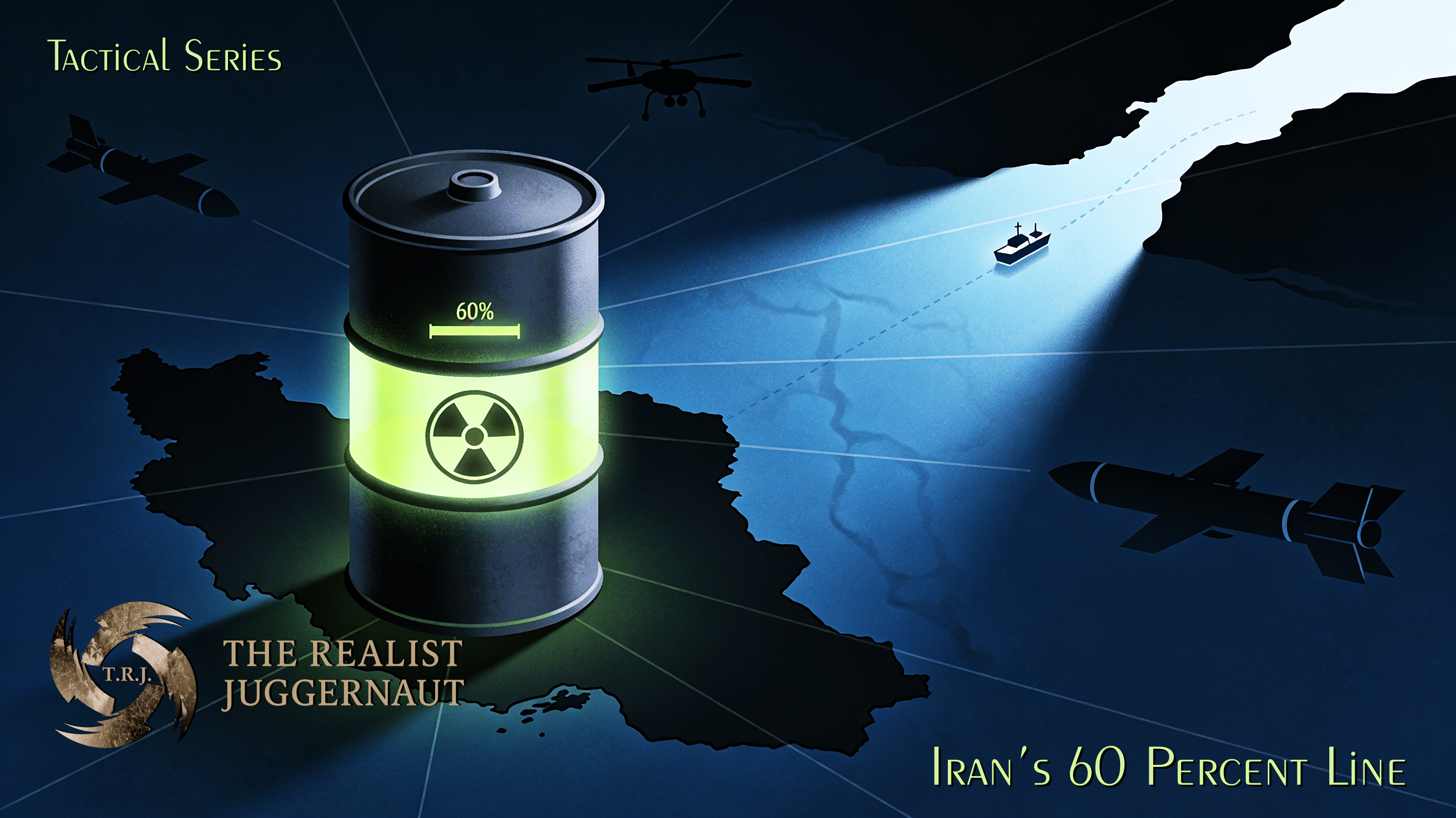
This war did not begin with a broadcast or a missile launch. It began with numbers. Quiet numbers, printed in technical reports that almost no one outside Vienna and a few policy offices in Washington read in full. Numbers that described not a headline or a speech, but mass: 440.9 kilograms of uranium enriched up to 60 percent U‑235, nearly all of it in gas form, stored in canisters underground and inside facilities the International Atomic Energy Agency could no longer fully see. Numbers that placed Iran in a category by itself as the only non‑nuclear‑weapon state under the Non‑Proliferation Treaty to produce and accumulate that level of enrichment, at that scale, while refusing to restore the monitoring that would have allowed inspectors to confirm what remained peaceful and what had moved beyond that claim. Long before anyone heard the name Epic Fury, those numbers were already changing what “status quo” meant in the Persian Gulf.
Warnings Buried in Plain Sight
The turning point did not arrive through intelligence leaks or anonymous briefings alone. It arrived in formal UN channels. In March 2025, Security Council members requested a private meeting on Iran’s nuclear file after the IAEA reported that Tehran’s stockpile of 60 percent enriched uranium had risen by roughly half in a single reporting period. An independent technical assessment circulated around that time estimated that, if further enriched to weapons‑grade, the accumulated 60 percent material could fuel several nuclear weapons, and that this estimate was conservative in light of Iran’s continuing centrifuge advances. The language in New York was unusually direct. The Agency described Iran’s increased production and accumulation of highly enriched uranium as a matter of “serious concern” and reminded states that no other non‑weapon state had ever crossed the same threshold. The question, from that point on, was not whether Iran was a problem. It was whether the political system would treat 60 percent as a red line or as another number to be debated into abstraction.
Midnight Hammer and the Underground Stockpile
By the time the first wave of Israeli and U.S. strikes hit Iran’s nuclear sites in June 2025, the technical picture was already clear enough to quantify. Iran had produced approximately 440 kilograms of uranium enriched to 60 percent U‑235, according to the IAEA, nearly all of it in UF₆ gas stored in small canisters. The strikes that followed did not erase that stockpile. They scattered it, buried it, and pushed it further from view. Public accounts and subsequent analysis describe an underground storage complex at Esfahan, so deeply dug that even the U.S. military’s largest conventional penetrators were judged unlikely to destroy the material inside without creating a radiological hazard the attackers were unwilling to trigger. Tunnel entrances were targeted, not the vault itself. The IAEA withdrew its inspectors during the attacks and, months later, still had not been allowed to verify the condition or exact location of the 60 percent material, even as satellite imagery showed continuous activity around the tunnel complex where it had been stored. What had been a monitored risk became a partially unmonitored one.
When Safeguards Turned Into Warnings
In February 2026, the Agency finally delivered the assessment that now sits at the center of this war. GOV/2026/8, circulated to the Board of Governors and the Security Council, reconstructed Iran’s stockpile as it stood on the eve of the 2025 attacks and described what the Agency could no longer say with confidence. The report calculated 9,874.9 kilograms of enriched uranium in all forms, including 440.9 kilograms at up to 60 percent, 184.1 kilograms at up to 20 percent, and thousands of kilograms at lower enrichment levels, while noting that Iran had not provided the reports, design information, or access required to verify the current status of the affected facilities. It recorded that inspectors had been unable to enter any of Iran’s four declared enrichment plants during the current reporting period and that the Agency could not confirm whether enrichment had stopped, whether centrifuge production had been suspended, or where the highly enriched stockpile now resided. The IAEA’s language shifted from measurement to warning. Continuity of knowledge had been lost. Timeliness goals for detecting diversion of highly enriched uranium had already been exceeded. The report stated plainly that Iran’s non‑cooperation and the loss of visibility over 60 percent material were matters of proliferation concern and compliance, not of routine technical delay.
Turning 60 Percent Into Warheads on Paper
Outside the classified channels, independent analysts and arms control specialists translated this into more familiar terms. An Arms Control Association brief published days after the first Epic Fury strikes reminded readers that 60 percent enrichment is not an abstract midpoint between civilian and military use but a near‑final step. Before the June 2025 war, Iran’s 440 kilograms of 60 percent uranium would have been enough, once pushed to 90 percent, for roughly ten nuclear warheads by standard significant‑quantity metrics. Even after repeated attacks, the IAEA Director General told member states in March 2026 that a little over 200 kilograms of 60 percent material likely remained underground at Esfahan alone, still sufficient for about five warheads’ worth of fissile material if brought to weapons‑grade. Analysts pointed out that enriching from natural uranium to 60 percent performs almost all of the separative work required to reach 90 percent, leaving only a short technical sprint between the last declared step and bomb fuel. Iran, they argued, had not only crossed a threshold. It had built a cushion.
A Red Line Written in Advance
The White House did not hide this assessment. It operationalized it. In early February 2026, an order formally addressing threats posed by the government of Iran set out the administration’s view in unambiguous terms: Iran’s production and stockpiling of uranium enriched up to 60 percent U‑235, combined with its ballistic missile forces and support for militant proxies, were treated as a grave and escalating danger to U.S. forces, partners, and the global economy. The same document reaffirmed that U.S. policy was to prevent Iran from ever acquiring a nuclear weapon and to respond to Iranian actions that threatened U.S. personnel and critical infrastructure. In a companion fact sheet, the White House described Iran as sitting on the threshold of a nuclear weapon, able to move rapidly from its 60 percent stockpile to weapons‑grade material if it chose, and framed sanctions escalation and military readiness as responses to that structural reality rather than to a single incident. These were not improvised talking points. They were the formal articulation of a red line drawn at capability.
Epic Fury and the Machinery Built Around a Stockpile
When Operation Epic Fury began in the early hours of February 28, 2026, the legal and strategic bridge from enrichment data to airstrikes was already laid. CENTCOM’s fact sheets state that U.S. forces commenced the operation against Iran “at the direction of the President of the United States” at 1:15 a.m., with a target set focused on the regime’s security apparatus—IRGC headquarters, integrated air defenses, missile launch sites, drone production facilities, naval assets, and military infrastructure used to project power across the region. The campaign’s own internal description lists more than seven thousand combat flights and one hundred Iranian vessels damaged or destroyed in the first weeks, supported by a concentration of U.S. bombers, fighters, submarines, and missile defenses not seen in the region for a generation. The documents are careful in their phrasing. They do not enumerate nuclear facilities as an explicit target category. They emphasize missiles, drones, and command‑and‑control. But they do not treat those systems as separate from the nuclear file. They treat them as the delivery infrastructure and shielding architecture of a regime that has built, and then hidden, a stockpile of near‑bomb‑grade uranium.
What Washington Said Out Loud
Senior officials repeated this logic in public without softening it. In a White House article summarizing Epic Fury’s early days, the administration cited four core objectives: obliterate Iran’s ballistic missile arsenal and production capacity, annihilate its navy, sever its support for proxy forces, and ensure that Iran “will never acquire a nuclear weapon.” The President’s own remarks framed the war as the culmination of years of Iranian pursuit of a nuclear weapons capability through high‑level enrichment and missile expansion and as a campaign designed to break that trajectory permanently. The Vice President described whatever happened to the regime as “incidental” to the primary goal of making sure Iran does not build a bomb. The Secretary of State told reporters that the operation was focused on eliminating the threat posed by Iran’s short‑range ballistic missiles and their industrial base, explicitly linking those systems to the risk that Iran could move quickly from 60 percent material to a deliverable weapon. The Secretary of War called the mission “laser‑focused” on obliterating missiles and drones, annihilating the navy, and severing Iran’s pathway to nuclear weapons, declaring flatly that Iran will never possess a nuclear bomb. These statements do not rely on innuendo. They describe a war whose stated end state includes both physical disarmament of key capabilities and the permanent denial of a nuclear option.
Process Fights in a Nuclear Crisis
If public debate does not reflect this clarity, it is not because the documents are vague. It is because they collide with domestic politics and institutional roles that pull in different directions. Congressional outrage has concentrated on process rather than on the enrichment data that underpins the administration’s threat assessment. Lawmakers across parties have condemned the decision to launch major strikes without prior authorization, invoking constitutional prerogatives and war‑powers statutes while rarely engaging, in the same breath, with the IAEA numbers that define the risk landscape they are being asked to legislate within. Media coverage that adheres to a binary frame—Trump versus critics, war versus peace—tends to flatten the nuclear file into a line about “disputed programs” or “alleged ambitions,” placing technical detail and verification collapse in the background rather than at the center of the story. In that environment, the administration’s choice to put 60 percent enrichment, underground storage at Esfahan, and the loss of IAEA oversight at the heart of its public rationale reads less like revelation and more like a reminder.
Allies Who Agree on the Threat but Decline the Risk
Abroad, the picture is just as contradictory. U.S. allies have not disputed the core assessment that Iran’s 60 percent stockpile and missile forces created a genuine nuclear‑linked threat, and they have described the effective closure of the Strait of Hormuz as unacceptable in their own statements. Yet when Washington moved from argument to action and called for a coalition to escort tankers and “reopen” the strait under fire, most partners stopped at words. They endorsed the concept in communiqués, talked about freedom of navigation, and condemned Iranian attacks on shipping, but they did not commit ships or sailors to sail into a narrow choke point already saturated with Iranian missiles, drones, mines, and fast‑attack craft.
That refusal does not come from ignorance of the stakes. It comes from a calculation that the riskiest part of enforcing the red line—putting national flags on hulls inside a live kill box—would drag them into a war their publics never voted on and their parliaments have not authorized. In practice, that choice leaves the United States bearing the most dangerous operational burdens while allies stand just outside the blast radius, validating the threat in principle but declining to share the sharpest edge of its mitigation. It does not make the underlying fear less real. It makes the path out of this crisis narrower, more unilateral, and harder to explain to people now being asked to accept both the necessity of the war and the loneliness of its most perilous tasks. On paper they are allies. In the strait that matters, they are bystanders.
Aligned in Principle, Restrained in Action
That pattern is already visible in practice. In March 2026, Japan joined a group of allied nations signaling support for efforts to secure the Strait of Hormuz, acknowledging the strategic risk and the need for coordinated response. At the same time, Tokyo emphasized that any involvement would remain limited to monitoring, intelligence sharing, and non-combat roles, stopping short of committing naval forces to direct escort operations in contested waters. The position reflects the same divide: agreement on the threat, restraint on the risk.
A Justified Fear, Not a Simple War
None of this makes the war simple. A legally coherent threat assessment does not answer questions about proportionality, long‑term stability, or the danger of escalation in a region that already operates on a knife edge. The same Arms Control Association brief that lays out how much of Iran’s 60 percent stockpile likely survived also warns that strikes cannot destroy knowledge, that Iran can reconstitute centrifuge capacity over time, and that seizing or neutralizing enriched uranium on the ground would require operations that expose U.S. forces to new forms of risk. The IAEA report that proves how far Iran advanced under reduced monitoring also acknowledges unresolved safeguards issues and the Agency’s inability to certify that nuclear material has not been diverted to undeclared sites, underscoring that even dramatic military action does not restore transparency by default. The war seeks to resolve one form of uncertainty—the timeline to potential weaponization—by accepting others: the possibility of retaliatory attacks, regional spillover, and a precedent in which major force is used without a fresh vote in Congress on the basis of intelligence and verification concerns few citizens have ever seen.
The Line That Made Confrontation Likely
What the record does show, without ambiguity, is that this conflict did not emerge from a vacuum. Iran made a series of choices about enrichment, access, and cooperation that moved it from a violator of agreement terms to a singular case: a non‑weapon state with hundreds of kilograms of 60 percent uranium, partial underground protection for that stockpile, accelerated centrifuge capacity, and a pattern of restricting inspectors precisely when monitoring mattered most. The United States made a series of choices about how to treat that trajectory: warning through sanctions and diplomacy, formalizing a doctrine that Iran will never be allowed to cross from threshold capability to weapon, and finally ordering strikes designed to destroy the systems that make that crossing possible, even at the cost of bypassing a new congressional authorization. Between those decisions lies the space the current war occupies.
For people watching from a distance, the volume of rhetoric and the noise of partisan contest can make it easy to believe that this war is just another political spectacle, that it could have been avoided if tempers were lower or personalities different. The documents you have assembled point to a harder truth. Once Iran chose to enrich to 60 percent at scale and to lock much of that stockpile in sites the IAEA could not freely inspect, and once the United States chose to define that combination of capability and opacity as intolerable, confrontation moved from possibility to probability. The question was not whether there would be a reckoning over that choice. It was when, in what form, and under whose administration. In that sense, the war now under way is not a departure from the path the evidence laid. It is the violent expression of a line that had already been drawn.
The media that swore there was “no proof”
Even after the centrifuge counts and stockpile numbers were public, the highest echelons of the American prestige press kept reassuring readers that there was “no evidence” of an imminent threat—language that quickly collapsed, in practice, into “no proof” there was anything to worry about at all. Across print, wire, and broadcast, an entire ecosystem of top-tier outlets adopted the exact same talking points, choosing to hang their coverage on a narrow, lawyerly claim rather than the strategic reality.
The Washington Post ran a sweeping analysis piece right as the war began, stating flatly that U.S. intelligence assessments saw no imminent threat. To hammer the point home, the Post assured its readers that the IAEA had found “no evidence” Iran was actively building a bomb, while quoting Democratic senators demanding to know: “What was the imminent threat to America?” The New York Times built its coverage around the exact same framework. In a piece dissecting Secretary of State Marco Rubio’s justifications for the strikes, the Times reported that U.S. intelligence agencies had “no evidence to support” the administration’s claim of an imminent missile threat to the homeland. Weeks later, the Times amplified the resignation of the National Counterterrorism Center director, whose departure letter famously declared that Iran posed no imminent threat to the nation, alongside quotes from ranking Democrats insisting there was absolutely no evidence of an imminent attack or a finalized weapons program.
The major television networks took the phrase straight to the airwaves. In early March broadcasts, CNN anchors and analysts repeatedly attacked the administration’s premise. Citing the U.N. watchdog, CNN programming stressed to viewers that there was “absolutely no evidence in any way, shape, or form” that Iran was close to having a nuclear weapon, echoing the refrain that the Pentagon had made clear there was no threat of a preemptive attack. NBC News and MSNBC echoed this chorus, bringing on lawmakers and national security commentators to emphasize that the intelligence did not show an imminent, unprovoked first strike. NPR joined the broadcast consensus, framing the administration’s war powers debate around the lack of immediate, defensive necessity.
Online and wire services formalized the narrative. Politico made the claim the literal headline of a straight-news dispatch: “Pentagon offers no evidence to support claim it attacked Iran in self-defense.” The lede spelled out that the administration had not provided any substantiating evidence that Iran was planning such actions, leaning on anonymous Hill staffers who said classified briefings failed to prove Iran was preparing to launch a first strike. Politico Magazine then used that coverage to argue the war was legally dubious. Reuters adopted the exact same framing for its global wire. In dispatches explaining the rationale for the strikes, Reuters noted that while the White House asserted an imminent danger, it provided no details, and noted that lawmakers said the president failed to present any evidence supporting that claim.
Opinion writers and international outlets then turned this into a bumper sticker. The Bulwark ran a column under the banner “No, There Was No ‘Imminent Threat’ From Iran,” concluding with a moral verdict built on the insistence that the threat case had simply not been made. Al Jazeera, surveying the administration’s shifting talking points, quoted the Arms Control Association warning that claims of an imminent nuclear-missile danger lacked supporting evidence. A British tabloid, the Mirror, framed it even more bluntly in its headline: “Pentagon says Iran DIDN’T pose an imminent threat.”
This is the record: not that there was “no proof” Iran had crossed the nuclear threshold, but that the entire media establishment locked arms around “no evidence” of an imminent, first-strike attack. Put bluntly, the same media ecosystem that told readers there was “no evidence” of a threat did so while the IAEA was logging Iran at roughly 60 percent enrichment with a growing stockpile and advanced centrifuges still spinning under the rubble. The legalistic comfort-phrase was narrowly true—there was no proof Iran was about to fire first—but the strategic reality it helped the public ignore was that Tehran was already at the nuclear threshold and moving.
They told the public there was no evidence of an imminent threat while the underlying conditions showed a system already at nuclear threshold under reduced verification.
All links to the articles addressed are listed below the TRJ Black File box.
TRJ Verdict
Even in this landscape, inevitability has limits. The IAEA report that documents Iran’s 60 percent stockpile also records that Tehran came back to the table after the June 2025 strikes, signed a Cairo safeguards arrangement, then walked away from it when pressure and politics shifted. The Security Council brief that chronicles Iran’s surge in highly enriched uranium also notes that key states kept talking about snapback, negotiations, and new terms rather than treating military action as the only imaginable outcome. The nuclear‑risk analysis that tallies how many warheads’ worth of material Iran could squeeze from its remaining 60 percent uranium also acknowledges that any attempt to seize or neutralize that stockpile would have to be coordinated with the same international system now trying to manage the crisis. The White House documents that justify Epic Fury on the basis of enrichment and missiles still frame the campaign’s stated end state in finite terms: destroy specific capabilities, sever a defined pathway to nuclear weapons, and then stop.
Those details matter because they show that none of the actors in this war have escaped constraint. Iran’s path to a bomb is boxed in by verification gaps it created and by strikes it did not anticipate in full, and any move it makes toward rebuilding will unfold under more scrutiny than before. Washington’s campaign, however overwhelming, is bracketed by legal challenges at home, proliferation risks abroad, and the recognition—in its own planning documents—that force cannot erase nuclear knowledge or fully account for dispersed material. The same system that failed to prevent a threshold crisis is still the one both sides have to navigate to get out of it. That is not a guarantee of wisdom. It is a fact that should strip away the sense that this war is unmoored from evidence or immune to pressure. It began in the numbers. It can still be shaped by them. That leaves the question no one wants to answer directly: should action wait until a nuclear capability becomes a deployed weapon?
We don’t like war any more than the next person. But at some point, the question has to be asked—what happens if nothing is done? The answer is simple.
If a nuclear weapon were dropped on American soil, what would the reaction be then? Would anyone be arguing for restraint after the fact? Would anyone be defending the decision to do nothing while the warning signs were already documented?
Would the response look any different than it did after 9/11?
Because that’s the reality people avoid. It’s easy to debate action before consequences. It’s a different conversation after impact.
This is where the disconnect exists. Most outlets are not showing you the underlying documentation, the verification failures, the enrichment levels, or the structural risks. They reduce it to headlines, arguments, and reactions designed to generate attention.
That’s not analysis. That’s just noise.
The material exists. The reports exist. The numbers exist. The loss of oversight exists. When those elements are put together, the situation stops being abstract.
At that point, it becomes a matter of risk tolerance.
No one wants a nuclear weapon in their backyard. Not here. Not anywhere.
What one must understand is that nobody has all the information the White House and our military have. That information has not been released yet. What we have recovered is already more than enough proof, which means there is clearly more beyond it.
1. International Atomic Energy Agency (IAEA) — GOV/2026/8: NPT Safeguards Agreement with the Islamic Republic of Iran (Feb 27, 2026) (Free Download)

2. United Nations Security Council Report — Iran (Non-Proliferation): Private Meeting Brief (Mar 11, 2025) (Free Download)
3. U.S. Central Command (CENTCOM) — Operation Epic Fury: First 10 Days Overview (Free Download)
4. U.S. Central Command (CENTCOM) — Operation Epic Fury Fact Sheet (Mar 16, 2026) (Free Download)
5. Arms Control Association — The U.S. War on Iran: New and Lingering Nuclear Risks (Mar 2026) (Free Download)
6. The White House — Operation Epic Fury: Decisive American Power to Crush Iran’s Terror Regime (Mar 12, 2026) (Free Download)
7. Executive Order — Addressing Threats to the United States by the Government of Iran (Feb 6, 2026) (Free Download)
8. The White House — Fact Sheet: President Donald J. Trump Addresses Threats by Iran (Feb 6, 2026) (Free Download)
🔒 TRJ BLACK FILE — THE NUMERICAL TRIGGER
This conflict did not originate from political instability or sudden escalation. It originated from measurable nuclear conditions that crossed a structural threshold. The transition occurred when uranium enrichment reached 60 percent U-235 at scale, combined with the simultaneous collapse of international verification.
At approximately 440 kilograms of uranium enriched to 60 percent, nearly all of the separative work required for weapons-grade material had already been completed. The remaining step to 90 percent enrichment is not industrial—it is procedural. At that point, enrichment is no longer theoretical capability. It is latent weaponization potential.
I. VERIFICATION FAILURE AS A TRIGGER EVENT
The International Atomic Energy Agency confirmed that verification activities ceased following the June 2025 strikes, with inspectors withdrawn and access to key facilities denied. Iran subsequently suspended cooperation, preventing the Agency from confirming the location, status, or integrity of its enriched uranium stockpile.
This condition represents a critical shift. Safeguards exist to maintain visibility. Once that visibility is lost, nuclear material enters an unverified state. The Agency formally acknowledged that it could no longer ensure that declared material had not been diverted or relocated. At that point, the distinction between civilian and military use becomes unverifiable.
II. UNDERGROUND DISPERSION AND MATERIAL DENIAL
Satellite analysis confirmed continued activity at underground tunnel complexes in Esfahan, where enriched uranium in UF₆ gas form had been stored. These facilities are engineered to exceed the penetration capacity of conventional weapons while minimizing the risk of radiological release if struck.
This creates a dual-denial condition. The material cannot be reliably destroyed without unacceptable consequences, and it cannot be inspected without access. The result is a protected and unverified stockpile, functionally shielded from both oversight and conventional military resolution.
III. BREAKOUT TIME COMPRESSION
At 60 percent enrichment, breakout timelines compress significantly. The transition to weapons-grade uranium requires a fraction of the effort needed to reach that level from natural uranium. Independent assessments confirmed that the existing stockpile, prior to the conflict, was sufficient to produce multiple nuclear warheads if further enriched.
Even after military strikes, an estimated portion of this material—approximately 200 kilograms—remains underground, maintaining a residual capability equivalent to several warheads. The destruction of infrastructure does not eliminate the material itself.
IV. DELIVERY SYSTEM TARGETING AS NUCLEAR POLICY
Operation Epic Fury targeted missile systems, air defenses, naval assets, and command infrastructure. These targets were not selected independently of the nuclear issue. They represent the delivery architecture required to operationalize enriched uranium into deployable weapons.
Military documentation confirms large-scale strikes against ballistic missile sites, drone manufacturing facilities, and integrated defense systems. This reflects a doctrine in which nuclear capability is defined not only by fissile material, but by the systems capable of delivering it.
V. FORMALIZATION OF THE RED LINE
Executive directives and official policy statements established a clear strategic position: Iran’s accumulation of highly enriched uranium, combined with missile capability and regional military activity, constitutes an unacceptable threat. The stated objective is not containment, but permanent denial of nuclear weapon acquisition.
This position was articulated prior to the launch of Operation Epic Fury, establishing a direct link between enrichment levels, verification failure, and military authorization. The operation did not create the red line. It enforced one that had already been defined.
VI. INTEL SYNTHESIS — FROM DATA TO WAR
The sequence is linear and verifiable:
1. Enrichment Escalation: Uranium enriched to 60 percent at scale.
2. Verification Collapse: IAEA loses access and continuity of knowledge.
3. Material Dispersion: Stockpiles moved into hardened underground sites.
4. Breakout Compression: Timeline to weapons-grade reduced to short-term capability.
5. Policy Definition: U.S. doctrine identifies this condition as intolerable.
6. Military Execution: Operation Epic Fury targets delivery and support infrastructure.
This chain does not rely on interpretation. Each step is documented independently and aligns across international reporting, technical analysis, and official policy.
FINAL ASSESSMENT
The war did not begin with a strike. It began when quantifiable nuclear conditions crossed a threshold that removed ambiguity from intent and reduced response time to action. Once enrichment, concealment, and verification failure converged, confrontation became a matter of timing rather than debate.
This is not a narrative constructed after the fact. It is a sequence derived from measurable conditions that, once aligned, converted nuclear capability into a trigger for conflict.
🔒 TRJ BLACK FILE — MEDIA FRAMING RECORD
The following sources reflect the documented public framing across major outlets during the opening phase of the conflict. These references do not establish the absence of risk. They establish how that risk was presented, interpreted, and communicated to the public.
Across multiple platforms—print, broadcast, wire, and opinion—the dominant framing centered on the absence of evidence for an imminent first-strike attack, rather than addressing the broader question of threshold nuclear capability and verification collapse.
PRIMARY MEDIA REFERENCES
1. The Washington Post — Intelligence assessments and no imminent threat
View Article
2. The New York Times — Rubio justifications and lack of evidence
View Article
3. The New York Times — Intelligence officials and NCTC director resignation
View Article
4. CNN — Broadcast transcripts referencing absence of evidence for preemptive attack
View Transcript
5. NPR — Congressional commentary on war powers and imminent threat debate
View Article
6. Politico — “Pentagon offers no evidence” headline framing
View Article
7. Politico Magazine — Legal analysis tied to absence of imminent threat
View Article
8. Reuters — Reporting on justification and lack of presented evidence
View Article
9. The Bulwark — Opinion framing rejecting imminent threat claim
View Article
10. Al Jazeera — Coverage citing limited evidence and external analysis
View Article
11. The Mirror — Headline framing absence of imminent threat
View Article
INTERPRETIVE CONTEXT
Taken together, these sources demonstrate a consistent emphasis on the absence of evidence for an immediate, preemptive attack. This framing is technically precise within a narrow definition of imminence.
It does not address a separate and materially different condition documented elsewhere: the existence of a near-threshold nuclear capability combined with reduced verification and restricted access to key facilities.
The distinction between these two conditions—imminent action versus threshold capability—defines the analytical gap reflected in public discourse at the time.


🔥 NOW AVAILABLE! 🔥
🔥 NOW AVAILABLE! 🔥
📖 INK & FIRE: BOOK 1 📖
A bold and unapologetic collection of poetry that ignites the soul. Ink & Fire dives deep into raw emotions, truth, and the human experience—unfiltered and untamed
🔥 Kindle Edition 👉 https://a.co/d/9EoGKzh
🔥 Paperback 👉 https://a.co/d/9EoGKzh
🔥 Hardcover Edition 👉 https://a.co/d/0ITmDIB
🔥 NOW AVAILABLE! 🔥
📖 INK & FIRE: BOOK 2 📖
A bold and unapologetic collection of poetry that ignites the soul. Ink & Fire dives deep into raw emotions, truth, and the human experience—unfiltered and untamed just like the first one.
🔥 Kindle Edition 👉 https://a.co/d/1xlx7J2
🔥 Paperback 👉 https://a.co/d/a7vFHN6
🔥 Hardcover Edition 👉 https://a.co/d/efhu1ON
Get your copy today and experience poetry like never before. #InkAndFire #PoetryUnleashed #FuelTheFire
🚨 NOW AVAILABLE! 🚨
📖 THE INEVITABLE: THE DAWN OF A NEW ERA 📖
A powerful, eye-opening read that challenges the status quo and explores the future unfolding before us. Dive into a journey of truth, change, and the forces shaping our world.
🔥 Kindle Edition 👉 https://a.co/d/0FzX6MH
🔥 Paperback 👉 https://a.co/d/2IsxLof
🔥 Hardcover Edition 👉 https://a.co/d/bz01raP
Get your copy today and be part of the new era. #TheInevitable #TruthUnveiled #NewEra
🚀 NOW AVAILABLE! 🚀
📖 THE FORGOTTEN OUTPOST 📖
The Cold War Moon Base They Swore Never Existed
What if the moon landing was just the cover story?
Dive into the boldest investigation The Realist Juggernaut has ever published—featuring declassified files, ghost missions, whistleblower testimony, and black-budget secrets buried in lunar dust.
🔥 Kindle Edition 👉 https://a.co/d/2Mu03Iu
🛸 Paperback Coming Soon
Discover the base they never wanted you to find. TheForgottenOutpost #RealistJuggernaut #MoonBaseTruth #ColdWarSecrets #Declassified


Sponsored • TRJ Ads
Inquiries: contact@therealistjuggernaut.com


Thank you for this excellent article.
I remember when President Trump said these materials were buried under “millions of tons of rock” after the 2025 bombings.
Because of this new war, it seems that we must not be so sure about that. I have not made any comment about this war because I don’t have the knowledge needed to make any kind of assessment as to how close Iran is to making a bomb. I’m guessing that U.S. and Israeli intelligence may have information about some of the 60% material having possibly been moved to a different site or even that it may be accessible in some way.
I have little doubt that the current leadership of Iran would use a bomb if they had one.
I do not know if we are doing the right thing or not at this time. Your comment about us having to react after a powerful bomb hits the U.S. is something that no one is talking about and should be.
This entire issue is above my pay grade but I appreciate the time and effort you have put into trying to get what information we do know out there. We know Iranian officials will lie every time and we know that most news outlets can’t be trusted. What is an average citizen to think?
Thank you very much, Chris.
You’re approaching this the right way. This is a complex situation, and recognizing where certainty ends is part of understanding it clearly. There is a difference between what can be confirmed through documented reports and what likely exists within classified intelligence channels that hasn’t been made public.
What we do know is grounded in the downloadable PDF records included in this article: enrichment levels reached 60 percent at scale, oversight was reduced, and portions of that material became inaccessible to verification after the 2025 strikes. That alone changes the risk profile, regardless of what may or may not have been moved or concealed beyond that.
You’re also right to point out the difficulty for the average person. When information is fragmented—some of it technical, some of it withheld, and some of it framed differently depending on the outlet—it becomes harder to form a clear picture. That’s part of why this article focuses on connecting what is already documented into a single, understandable chain.
The question you raised—what happens if nothing is done—is one that often gets overlooked, but it is part of the broader risk assessment, whether people are comfortable discussing it or not.
At the end of the day, it’s not about asking people to take a position without full information. It’s about making sure the information that is available is understood in its proper context.
Thank you again, Chris. I greatly appreciate your perspective. It’s not always easy getting this level of detail out where more people can access it, especially when much of the coverage focuses on headlines rather than the underlying information.
You’re welcome, John, and I appreciate all of the work you did on this. I did listen to a couple of “experts” who admitted they really didn’t know much themselves except for some of the information you’ve shared here. I know it must be difficult but we have to try to continue and learn what Iran’s remaining capabilities are.
How we go about doing that is beyond me.
Thank you again.