
Thank you for reading or listening to The Realist Juggernaut. Independent journalism should be accessible to everyone.
The Convenience Economy of Chronic Disease
The American food system did not arrive at its current form through accident, drift, or isolated consumer behavior. It was built through law, federal guidance, labeling rules, retail expansion, and a standardized nutritional language that taught the public to interpret food through one official frame while the market surrounding that frame was reorganized around convenience, prepared foods, and constant access.
What was presented as neutral health information gradually became infrastructure. What was marketed as educational clarity became a national interpretive system for eating, purchasing, and measuring food in daily life. The label, the calorie count, the serving size, the daily value, and the menu disclosure did not remain passive tools. They became part of the architecture through which Americans were expected to understand food in a commercial environment increasingly designed to override restraint through speed, repetition, placement, and perpetual availability.
For decades, the public has been taught to see the Nutrition Facts panel and the calorie number as instruments of empowerment. That description leaves out the structure in which those tools were deployed. A nation can provide health information without building an entire system that normalizes eating through one standardized reference point and then extends that reference point across grocery packaging, chain restaurants, convenience stores, self-service counters, display foods, federal programs, and the broader retail environment. The United States did more than offer advice. It built a federal nutrition-information order.
That order can now be traced in plain sequence. Congress formalized a coordinated federal nutrition monitoring and dietary guidance framework. Federal law required recurring publication of the Dietary Guidelines for Americans and gave the Department of Agriculture and the Department of Health and Human Services central authority over national dietary guidance for the general public. FDA then translated that framework into labeling rules that standardized calories, daily values, serving conventions, nutrient claims, and display requirements on packaged food. Later policy expanded calorie disclosure beyond packages and into restaurants and similar retail food establishments, carrying the same logic into prepared-food environments.
This sequence matters because it reveals that the American public was not merely advised. It was increasingly governed through a federal nutritional language that appeared scientific, universal, and neutral even while actual metabolic needs remained individualized and the food environment around that language became more industrial, more convenient, and more commercially aggressive. The issue is not that information existed. The issue is what kind of market that information was inserted into and what kind of public burden it was asked to solve.
The legal buildout began in earnest in 1990. The National Nutrition Monitoring and Related Research Act established a coordinated federal program for nutrition monitoring and required that the Dietary Guidelines for Americans be published at least every five years. It also required that federal agencies proposing dietary guidance for the public submit that guidance for review and ensured that the Dietary Guidelines would be promoted across federal food, nutrition, and health programs. That is not a minor bureaucratic detail. It is evidence of a centralized and recurring system designed to standardize how dietary guidance is constructed, approved, and disseminated across the federal apparatus.
The same year brought the Nutrition Labeling and Education Act, which created the legal platform for the modern label regime. Its significance is not confined to a statute number or a legislative date. Its significance lies in how it transformed the package into a federal communication surface. Once the package became a mandatory site of standardized calorie and nutrient disclosure, the government no longer spoke about food from a distance. It began speaking directly from the box, the bottle, the wrapper, and the can.
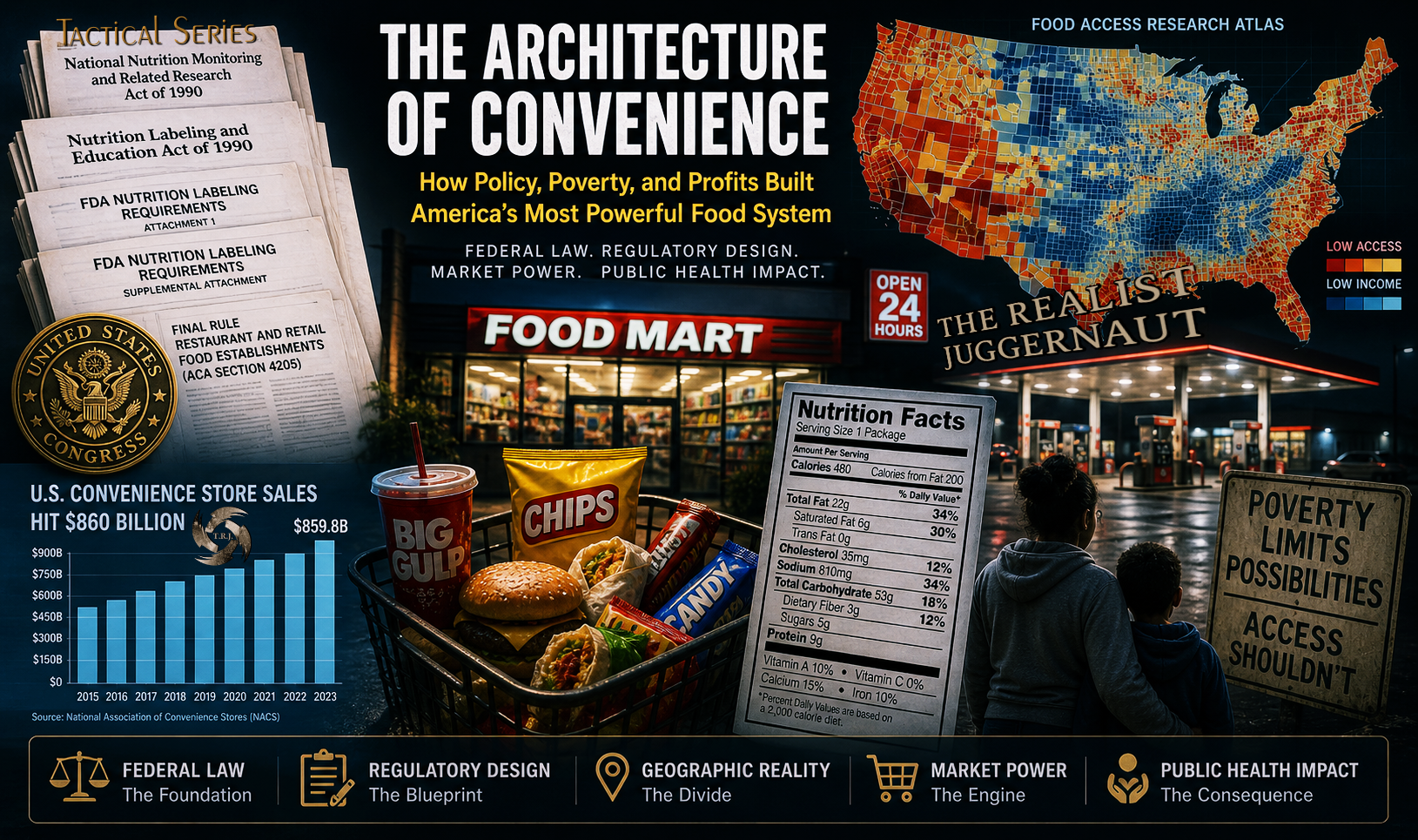
The FDA mechanics behind that system reveal what standardization meant in practice. The label format was not left to general principle. It was operationalized through required display styles, point sizes, nutrient claim definitions, and mandatory reference language. One of the central phrases baked into that system was the statement that Percent Daily Value is based on a 2,000 calorie diet. That phrase became one of the most visible nutritional reference points in American life. It appeared objective. It appeared scientific. It also rested on a generalization.
FDA’s own consumer guidance admits the limitation. The agency states that 2,000 calories a day is used as a general guide for nutrition advice while also acknowledging that actual calorie needs vary according to age, sex, height, weight, and physical activity. The same guidance also states that serving sizes reflect the amount people typically eat and drink and are not recommendations for how much they should eat. That admission is more important than it first appears. It means the country’s dominant nutritional language was built around a generalized intake reference and serving conventions tied partly to customary consumption rather than ideal metabolic health.
For many Americans, the 2,000-calorie reference did not function as a loose informational guide. It was absorbed as something closer to a daily requirement, a baseline for health, growth, and bodily maintenance reinforced across schools, households, medical advice, and routine public instruction. Government and industry then built around that absorbed baseline until it became part of the environment itself.
That dynamic becomes even more significant when measured against actual consumer behavior. Many shoppers move quickly through food-buying decisions while balancing work schedules, family responsibilities, financial constraints, and time pressure. In that environment, the calorie number often becomes the most visible shortcut on the label.
FDA’s own label design reinforces that pattern by displaying calories in large, bold type, even while the agency also warns that serving sizes reflect what people typically eat and are not recommendations for how much they should eat. Many consumers may focus first on calories while paying less attention to serving-size assumptions, portion math, ingredient complexity, or the broader limits of generalized daily value frameworks. The system was built for rapid interpretation, and rapid interpretation often produces simplified decision-making inside an increasingly complex food environment.
That distinction cuts to the center of the problem. A system presented as a guide to rational, health-oriented eating was anchored in part to what people already tended to consume and then placed into a market that increasingly rewarded overexposure, repetition, and convenience. This is not a contradiction at the margins. It is a contradiction at the center. The public was being asked to regulate itself through a generalized federal shorthand while the surrounding food environment was becoming more difficult to regulate through willpower alone.
The calorie framework widened further when it moved beyond packaged goods and into the prepared-food economy. Under the menu-labeling rule tied to the Affordable Care Act, chain restaurants and similar retail food establishments were required to provide calorie and other nutrition information for standard menu items, including self-service and display foods. The categories affected by this regime reached well beyond sit-down restaurants. They included grocery stores, supermarkets, convenience stores, general merchandise stores, lodging facilities, sports venues, and movie theaters. The federal nutritional language now followed the consumer into nearly every major point of commercial food exposure.
This expansion was framed as a public-health service. The stated logic was that accurate, clear, and consistent nutrition information would help consumers make informed and healthful dietary choices. The language sounds benign. It also reveals the core assumption behind the policy model. It assumes that the central correction needed in the food system can be delivered through better numerical literacy at the point of purchase. It places interpretive responsibility on the individual consumer while leaving the larger commercial environment largely intact.
That environment changed dramatically over the same period. Food-away-from-home spending overtook food-at-home spending in 2004 and has remained dominant since. By 2024, nearly 59 percent of total food expenditures were being spent away from home. This is not a side trend. It is a reorganization of how the country eats. As more of the consumer food dollar moved into fast-food chains, restaurants, and similar retail establishments, the conditions of eating shifted away from household preparation and toward commercial preparation, outsourced control, and routine exposure to ready-to-consume items.
The convenience-store sector sharpened this transformation. By 2025, the U.S. convenience-store industry generated $817.5 billion in total sales, while foodservice and merchandise sales alone reached $341.2 billion, a 1.7 percent increase over 2024. Foodservice accounted for 28.5 percent of in-store sales and nearly 39 percent of in-store gross profit, showing how central prepared consumption had become to the business model. That changes the role of the convenience store in American life. It is no longer just a fuel stop or an incidental errand space. It is a normalized food-service channel whose commercial logic depends heavily on speed, availability, and frequent ready-to-eat consumption.
That expansion did not occur in a vacuum. It unfolded during a broader period of retail consolidation that strengthened large chains while steadily undermining many smaller independent food operators. USDA has documented rising concentration among the largest grocery retailers since the 1990s, and congressional testimony has warned that independent grocers have declined under the pressure of dominant chains with greater buyer power, stronger supply leverage, and pricing advantages smaller operators often could not match.
In many communities, particularly lower-income and rural areas, the result was not an explosion of diverse food competition. It was the gradual replacement of smaller local food access points with increasingly standardized corporate retail models. Residents were left with a narrower field of options shaped by chain convenience stores, fast-food outlets, dollar stores, and limited supermarket access rather than a healthy mix of independent neighborhood grocers.
This mattered because it reshaped how food access is often discussed in public debate. Consumers are frequently told they are surrounded by endless choice. In many places, the reality became far narrower because control over food access was increasingly concentrated in fewer corporate hands.
When those same establishments are placed under menu and calorie disclosure rules, the federal government is not restraining a convenience-driven food market. It is standardizing how that market presents itself to the public. The calorie number becomes the official language through which a convenience-based environment can continue to appear measured, transparent, and health-literate even while its profit structure is increasingly tied to prepared food and repeated purchase behavior.
This environment does not fall evenly across the country. The low-income and low-access geography tells a more revealing story. The Food Access Research Atlas makes it possible to identify census tracts shaped by low income, low access, poverty, transportation constraints, SNAP reliance, and demographic vulnerability. It does not merely describe hardship in broad terms. It maps it. The data show where supermarket access is limited, where households without vehicles are concentrated, where poverty intersects with food access, and where vulnerable populations live inside constrained retail environments.
That matters because the standard defense of the federal calorie-and-label system assumes a market of reasonably available options. Information is only as empowering as the environment in which it is encountered. A label does not equalize transportation access. A menu board does not create a full-service grocery store. A percent daily value does not solve neighborhood disinvestment, travel distance, time scarcity, or dependence on high-frequency convenience channels. In low-income and low-access communities, the contradiction between official nutritional language and actual food conditions becomes harder to hide.
The burden is not merely geographic. It is biological. The financial burden of chronic disease is staggering, but cost figures alone can reduce human deterioration to accounting language. The actual growth of diabetes prevalence tells a more disturbing story because it shows how rapidly metabolic illness expanded during the same decades that America’s food environment became more saturated, more convenient, and more dependent on standardized nutritional interpretation.
According to federal health records, approximately 5.8 million Americans reported having diabetes in 1980. Current national estimates show that 38.4 million people in the United States had diabetes in 2021, with the overwhelming majority of cases classified as Type 2 diabetes, the form most closely associated with obesity, insulin resistance, sedentary behavior, and long-term dietary imbalance. An additional 97.6 million American adults were estimated to have prediabetes in 2021, creating one of the largest preventable chronic disease pipelines in modern U.S. history.
Those figures become more revealing when placed beside the broader timeline established throughout this investigation. In the decades before federal calorie standardization became embedded into packaging and later expanded into restaurant environments, diabetes certainly existed, but the scale looked materially different. The post-1990 period introduced a new food reality: greater reliance on prepared foods, increased food-away-from-home spending, aggressive convenience expansion, larger portions, constant retail exposure, and a federally standardized nutritional language that placed heavy interpretive responsibility on consumers navigating an increasingly engineered marketplace.
Nutrition labels alone were not responsible for diabetes. Genetics, physical inactivity, socioeconomic instability, stress, sleep disruption, and broader dietary shifts all contributed to metabolic disease. The evidence supports a more serious conclusion. Diabetes expanded inside a national food environment that became increasingly metabolically hostile while institutional messaging continued to emphasize individual consumer interpretation as the primary corrective mechanism.
That distinction matters because it exposes a recurring institutional pattern. The public was told to read the label. The restaurant posted the calorie count. The manufacturer complied with disclosure rules. The retailer provided availability. Yet millions of Americans still entered a pipeline of obesity, insulin resistance, prediabetes, diabetes, and long-term disease management at historic scale.
Low-income and food-insecure households did not enter this system on equal footing. Research has repeatedly found higher obesity burdens among food-insecure populations, while SNAP households are often concentrated inside the same constrained food environments shaped by low access, transportation limits, and dependence on cheaper, ready-to-consume products. That does not support the simplistic claim that food benefits themselves created the crisis. It supports the more serious conclusion that millions of lower-income Americans were forced to navigate the most metabolically hostile segments of the modern food economy with the fewest structural alternatives.
The numbers no longer allow this issue to be framed as isolated personal failure. When tens of millions of citizens develop the same preventable metabolic disease within the same commercial environment, the question is no longer what individuals did wrong. The question becomes what kind of system repeatedly produces the same biological outcome at national scale.
The downstream disease burden also exposes another layer of the structure. Obesity costs the U.S. health care system nearly $173 billion each year. Diagnosed diabetes cost the United States $412.9 billion in 2022, including more than $300 billion in direct medical costs. Care for people with diabetes now accounts for one in four U.S. health care dollars. These are not small side effects. They reveal that the illnesses associated with the modern food system have become economically central to hospitals, physician systems, insurers, government programs, pharmaceutical companies, and the wider treatment economy.
This does not mean every physician, dietitian, regulator, or policymaker is knowingly participating in a grand design. That framing is too crude to explain the structure that actually exists. The more accurate conclusion is that the American public was placed inside a federally standardized nutritional order fused to a convenience-driven commercial food environment, and the resulting chronic disease burden now sustains a vast treatment economy that absorbs the biological fallout of that arrangement.
That is why the larger question is what to call such a system. Calling it mere guidance is too soft. Calling it a total conspiracy is too crude. The clearest description is a federally standardized nutritional order fused to a convenience-driven commercial food environment, with chronic disease as one of its most durable outputs.
That conclusion does not require a leaked confession. It requires only that the public be willing to look at the laws, the rules, the market data, the tract maps, the disease burden, and the medical cost structure all at once.
TRJ Verdict
The American public was never dealing with food alone.
It was navigating federal law, regulatory policy, retail engineering, behavioral conditioning, geographic inequality, and a healthcare system built to absorb long-term fallout after the damage was already done.
For decades, the public was told that better labels would create better decisions. Read the calories. Watch the serving size. Follow the daily values. Trust the menu board. Make smarter choices. That message became one of the most repeated public-health narratives in modern American life.
What that narrative rarely acknowledged was the environment surrounding those decisions.
Consumers were handed standardized nutritional language while food preparation steadily moved away from the home and into commercial hands. Convenience stores evolved into prepared-food hubs. Restaurants captured a growing share of the consumer food dollar. Low-income communities remained trapped inside structurally weaker food environments. The public was repeatedly told that information was empowerment while the marketplace became faster, denser, and increasingly engineered around repetition, accessibility, and impulse consumption.
The government standardized the framework. Manufacturers optimized products around that framework. Retailers scaled convenience through that framework. Healthcare systems absorbed the long-term consequences produced inside that framework.
Then the public was blamed.
It was blamed for lacking discipline. Blamed for making poor decisions. Blamed for failing to navigate an environment that had already been structurally reorganized long before most consumers ever reached a grocery aisle, convenience counter, drive-through window, or checkout line.
That is what this investigation exposes.
Not a simplistic conspiracy.
Not one law acting in isolation.
This was a layered system built through policy, normalized through repetition, expanded through commerce, and sustained through downstream disease economics—and this investigation showed that structure explicitly.
By the time millions of Americans were blamed for “bad choices,” many of those choices had already been heavily structured by institutions, markets, and incentives operating far beyond individual control.
The public was told it was being educated.
What the public was actually given was a standardized nutritional order embedded inside one of the most aggressive convenience-driven food economies in modern history.
Look at the landscape surrounding modern American life. Count how many corner convenience stores, gas-station food outlets, drive-through chains, and rapid-food retail corridors now surround daily routines. Then count the newly built medical offices, outpatient treatment centers, specialty clinics, and expanding healthcare campuses rising alongside them.
One side of that equation profits from constant consumption. The other profits from long-term treatment. The public moves between both systems every day.
And the human body has been paying the bill ever since.
1. National Nutrition Monitoring and Related Research Act of 1990 — United States Congress / GovInfo. (free Download)

2. Nutrition Labeling and Education Act (NLEA) Requirements — Attachment 1 — U.S. Food and Drug Administration. (Free Download)
3. Nutrition Labeling and Education Act (NLEA) Requirements — Supplemental Attachment — U.S. Food and Drug Administration. (Free Download)
4. Food Access Research Atlas — United States Department of Agriculture Economic Research Service. (Free Download)
5. Food Access Research Atlas Dataset (2019) — United States Department of Agriculture Economic Research Service (Excel dataset used for tract-level analysis). (Free Download)
6. Final Rule on Nutrition Labeling of Standard Menu Items in Restaurants and Similar Retail Food Establishments — U.S. Food and Drug Administration / Patient Protection and Affordable Care Act of 2010 Section 4205. (Free Download)
7. Nutrition Labeling and Education Act of 1990 — Legal Information Institute / U.S. Law Archive. (free Download)
8. U.S. Convenience Store Sales Hit $860 Billion — National Association of Convenience Stores. (Free Download)
TRJ BLACK FILE: DOCUMENT TRAIL
This investigation was built using federal law, regulatory records, government datasets, and private-sector market reports that collectively reveal how standardized nutrition policy expanded alongside a rapidly evolving convenience-driven food economy.
1. National Nutrition Monitoring and Related Research Act of 1990
United States Congress / GovInfo — Established a coordinated national nutrition monitoring system, centralized federal oversight, recurring dietary tracking, and long-term nutrition surveillance infrastructure. :contentReference[oaicite:0]{index=0}
2. FDA Nutrition Labeling Requirements — Attachment 1
U.S. Food and Drug Administration — Established mandatory nutrition label display rules, including the required “Percent Daily Value (DV) is based on a 2,000 calorie diet” framework. :contentReference[oaicite:1]{index=1}
3. FDA Nutrition Labeling Requirements — Supplemental Regulatory Attachment
U.S. Food and Drug Administration — Additional regulatory definitions governing calorie claims, fat claims, “light,” “low,” and other nutrient-content marketing language. :contentReference[oaicite:2]{index=2}
4. USDA Food Access Research Atlas
U.S. Department of Agriculture Economic Research Service — Geographic mapping system identifying low-income communities, transportation barriers, and low-access food environments. :contentReference[oaicite:3]{index=3}
5. USDA Food Access Research Atlas Dataset (2019)
U.S. Department of Agriculture — Raw tract-level dataset used to examine poverty exposure, SNAP concentration, vehicle limitations, and geographic food-access disparities.
6. FDA Final Rule for Restaurants and Similar Retail Food Establishments
U.S. Food and Drug Administration / Affordable Care Act Section 4205 — Expanded calorie disclosure requirements into restaurants, grocery stores, convenience stores, self-service food areas, and display-food retail environments. :contentReference[oaicite:4]{index=4}
7. Nutrition Labeling and Education Act of 1990
Legal Information Institute / U.S. Law Archive — The foundational federal law that granted legal authority for standardized nutrition labeling enforcement. :contentReference[oaicite:5]{index=5}
8. U.S. Convenience Store Sales Hit $860 Billion
National Association of Convenience Stores (NACS) — Documents modern convenience-store food dominance, including $859.8 billion in total sales, $327.6 billion in in-store sales, prepared food growth, and repeated daily consumer transactions. :contentReference[oaicite:6]{index=6}
The architecture was never hidden.
Most people were simply never shown how all of it connected.


🔥 NOW AVAILABLE! 🔥
🔥 NOW AVAILABLE! 🔥
📖 INK & FIRE: BOOK 1 📖
A bold and unapologetic collection of poetry that ignites the soul. Ink & Fire dives deep into raw emotions, truth, and the human experience—unfiltered and untamed
🔥 Kindle Edition 👉 https://a.co/d/9EoGKzh
🔥 Paperback 👉 https://a.co/d/9EoGKzh
🔥 Hardcover Edition 👉 https://a.co/d/0ITmDIB
🔥 NOW AVAILABLE! 🔥
📖 INK & FIRE: BOOK 2 📖
A bold and unapologetic collection of poetry that ignites the soul. Ink & Fire dives deep into raw emotions, truth, and the human experience—unfiltered and untamed just like the first one.
🔥 Kindle Edition 👉 https://a.co/d/1xlx7J2
🔥 Paperback 👉 https://a.co/d/a7vFHN6
🔥 Hardcover Edition 👉 https://a.co/d/efhu1ON
Get your copy today and experience poetry like never before. #InkAndFire #PoetryUnleashed #FuelTheFire
🚨 NOW AVAILABLE! 🚨
📖 THE INEVITABLE: THE DAWN OF A NEW ERA 📖
A powerful, eye-opening read that challenges the status quo and explores the future unfolding before us. Dive into a journey of truth, change, and the forces shaping our world.
🔥 Kindle Edition 👉 https://a.co/d/0FzX6MH
🔥 Paperback 👉 https://a.co/d/2IsxLof
🔥 Hardcover Edition 👉 https://a.co/d/bz01raP
Get your copy today and be part of the new era. #TheInevitable #TruthUnveiled #NewEra
🚀 NOW AVAILABLE! 🚀
📖 THE FORGOTTEN OUTPOST 📖
The Cold War Moon Base They Swore Never Existed
What if the moon landing was just the cover story?
Dive into the boldest investigation The Realist Juggernaut has ever published—featuring declassified files, ghost missions, whistleblower testimony, and black-budget secrets buried in lunar dust.
🔥 Kindle Edition 👉 https://a.co/d/2Mu03Iu
🛸 Paperback Coming Soon
Discover the base they never wanted you to find. TheForgottenOutpost #RealistJuggernaut #MoonBaseTruth #ColdWarSecrets #Declassified


Sponsored • TRJ Ads
Inquiries: contact@therealistjuggernaut.com







This is precisely why I try to eat natural foods and avoid processed.
Thank you for reading and commenting, Michael.
That approach makes a lot of sense. Many people are becoming far more intentional about reducing heavily processed foods and paying closer attention to what they are consuming.
Thank you again, Michael—it’s always greatly appreciated. I hope you have a great day. 😎
i swear… food isn’t food anymore, it’s all processed and lab made ugh
Thank you for reading and commenting, Rojie.
I understand why many people feel that way—I feel that way myself. A major concern for many consumers right now is how far removed portions of the food system have become from what people traditionally think of as food, especially when products become heavily processed, engineered for shelf life, and built around convenience rather than long-term health.
People have the right to ask deeper questions about ingredients, processing methods, sourcing, and overall transparency.
Those concerns are growing for a reason—that’s for sure.
Thank you again, Rojie. I hope you have a great day. 😎
This is an excellent article. I don’t buy things from convenience stores and I haven’t gone out to eat since the pandemic. Still, I really don’t trust the food I get from the grocery stores. How are we supposed to know what kinds of pesticides were used to make those foods look so good? I try to eat an apple every other day or so. The ones put out for consumer consumption are selected in several ways. Growers choose types that have a long shelf life. I’m sure disease resistance is another consideration. That is one thing I look for when I grow my summer tomatoes. I usually choose tomato types that can handle heat and humidity. I am well aware that something that looks good might only look good because of the things used to keep pests and disease from taking a bite or more.
So, I live about 1/2 of the year off of stuff that I grow myself that is organic and anything I use to keep bugs at bay in not toxic. I actually do get some nice looking tomatoes during the season but many have been had a bite or two taken out of them by who-knows-what. Maybe I’m overly cautious but I really don’t trust labels. Labels can give you ingredients and calories but a label doesn’t reflect what processes were used to make the product.
Thank you for this very informative article. I trust food labels about as much as most people trust the government.
You’re very welcome, Chris—and thank you very much.
I actually remember you mentioning before that you grow a good portion of your own vegetables, and I respect that greatly because it gives you firsthand insight that many people no longer have.
As you pointed out, labels can tell consumers certain things, but they often do not tell the full story behind how food was produced, processed, preserved, transported, or engineered for shelf stability. That broader production chain is where many people have growing concerns, and it is understandable why more consumers are asking deeper questions about pesticides, additives, preservation methods, and large-scale agricultural practices.
And you’re absolutely right about appearance. Anyone who has grown their own fruits or vegetables knows they often do not look like the cosmetically polished products people see in major retail environments. Nature tends to be far less uniform than commercial presentation. Overall, consumers absolutely have the right to ask tougher questions about transparency throughout the food supply chain.
Thank you again for sharing your experience, Chris. I always appreciate your thoughtful comments. I hope you have a great night and day ahead. 😎
You’re welcome, John, and thank you again for this good article on such an important topic. It is rare to see articles that cover this subject in as much depth as you have for a general audience.
I hope you have a great night and a great day ahead as well!😊