
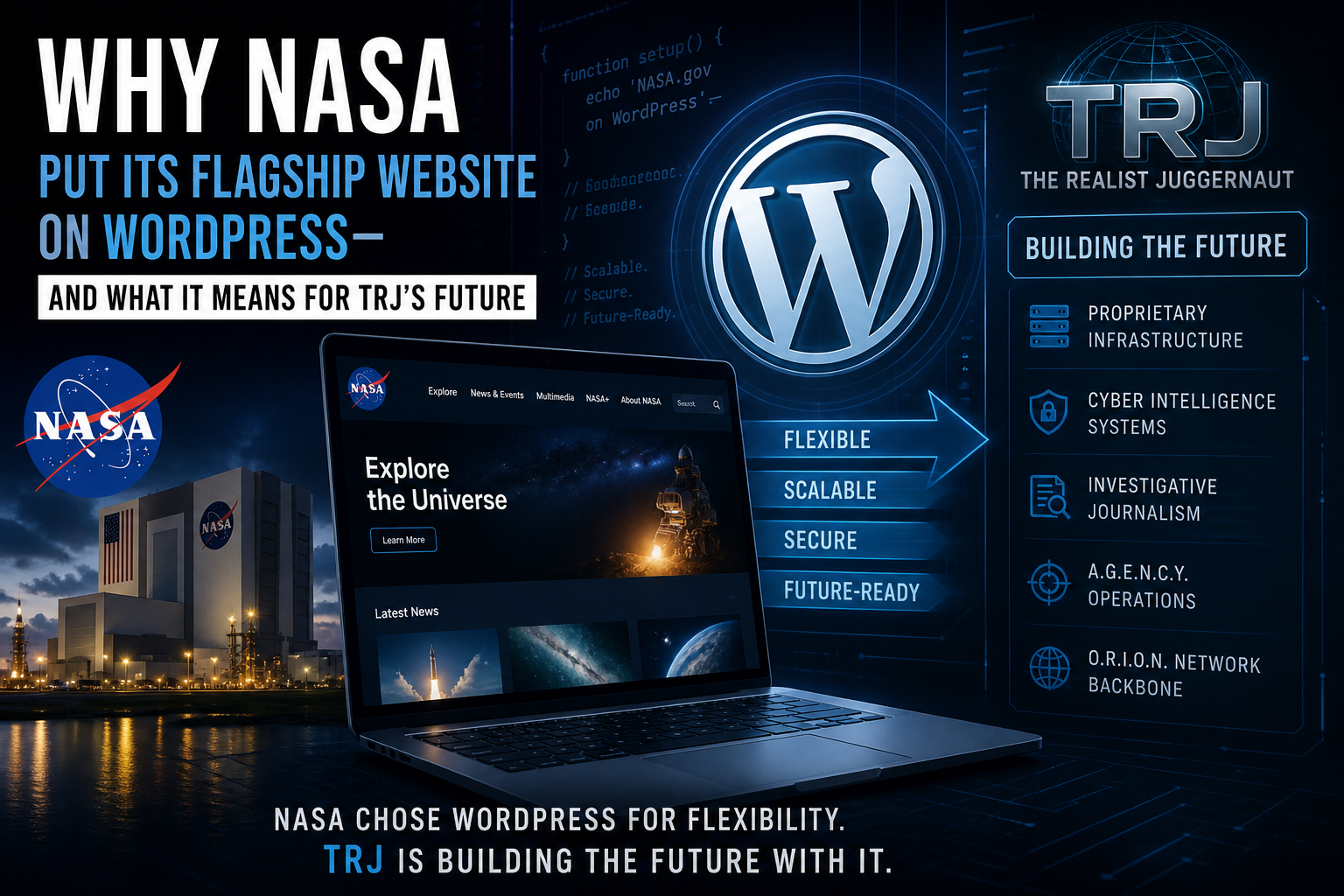
Thank you for reading or listening to The Realist Juggernaut. Independent journalism should be accessible to everyone.
Inside the multi‑year, enterprise‑grade rebuild of nasa.gov—and what it says about the future of WordPress, federal web infrastructure, and how far platforms like The Realist Juggernaut can push the same chassis.
NASA did not move its flagship website to WordPress to chase a trend or re‑skin a blog. It made the call in the early 2020s, when an aging Drupal 7 stack, a federal mandate to modernize digital services, and the realities of running one of the most visible government sites on earth converged into a simple, uncomfortable fact: the infrastructure under nasa.gov could not credibly carry the next decade. NASA’s flagship site completed its cutover from Drupal 7 to WordPress in the early hours of September 28, 2023, capping a multi‑year effort that produced a new nasa.gov running on a consolidated WordPress deployment with hardened enterprise hosting, tens of thousands of pages, hundreds of authors, and live connections into the agency’s imagery, streaming, and search systems.
The pivot point was structural, not cosmetic. Drupal 7’s announced end‑of‑life—ultimately landing in January 2025 for official community support—turned what had been “legacy but tolerable” into “legacy with a countdown,” forcing NASA to confront the risks of staying on a platform that would fall off the security and compatibility curve. At the same time, the 21st Century Integrated Digital Experience Act pushed federal agencies away from patchwork, difficult‑to‑use web properties and toward sites that are accessible, mobile‑friendly, and coherent from the public’s point of view. NASA was sitting on a sprawl of more than 1,000 public‑facing websites, scattered across stacks and standards, with nasa.gov as the public front door. The agency could have repeated its old pattern—lift‑and‑shift to a newer version of the same approach and call it modernization—or it could treat the CMS decision as an opportunity to rebuild the foundation of how it publishes.
WordPress did not walk in as the presumptive winner. NASA put the decision through a full‑scale evaluation process with Lone Rock Point, a long‑time government web contractor and WordPress VIP partner. The team evaluated a wide field of commercial and open‑source content management systems before narrowing that field to four finalists: two proprietary enterprise suites and two open‑source platforms, WordPress and Drupal. From there, the process moved beyond glossy feature matrices. Each candidate system was used to build working prototypes of real NASA content. Those prototypes went in front of the people who would have to live in the CMS every day: editors, scientists, communicators, and site managers. The question was brutally practical. Under load, under governance, and under the messy constraints of real content, which system let NASA tell its story without turning every change into a ticket and every page into an engineering project?
The scale of the eventual migration makes it clear that WordPress was not being asked to power an oversized blog. A detailed post‑mortem of the project puts the migration at roughly two and a half years end‑to‑end, with about 18 months of active web development following earlier UX and architecture work. Across that period, NASA migrated on the order of 126,000 pages and more than 100,000 media assets into the new environment, while earlier phase case studies highlight 68,698 migrated pages and 3,023 newly built landing pages as key milestones in the flagship rollout. The system ultimately had to support more than 550 authenticated content creators across the agency, with implementation data citing 456 active CMS users during core build‑out. Underneath all of this, infrastructure moved from a bespoke AWS footprint to a managed enterprise WordPress environment on WordPress VIP—FedRAMP‑authorized, globally cached, and instrumented—built to handle traffic in the range of tens of millions of monthly visitors and massive traffic spikes during major events.
Inside NASA, the decisive pressure point was not the choice of database or programming language. It was what authors had been forced to endure. In interviews and discovery sessions, content owners described the old system’s templates as rigid and unforgiving. Layouts felt locked in. New narrative formats—complex explainers, interactive features, story packages that had to evolve over time—were difficult or impossible without developer intervention. The CMS dictated the story instead of serving it. That is where WordPress’s modern block editor, Gutenberg, became more than a buzzword. For NASA, it was the surface where the agency’s design system and its storytelling ambitions would have to meet, and where the constraints of the old templating model could finally be retired.
To make that possible without sacrificing design discipline, the implementation team translated NASA’s design system into a library of custom blocks. Instead of scattering fragments of that system across documentation and custom theme code, they embedded it directly in the authoring experience. Lone Rock Point’s own accounting cites 55 custom editor blocks built for the project—just over fifty bespoke components designed to handle everything from basic content structures to high‑impact elements such as tabbed interfaces for dense scientific content, mission highlight strips, gallery and media layouts, and callouts for key data points. Each block came with baked‑in typography, spacing, color palettes, and accessibility rules. Authors no longer had to open a ticket to get a new layout or compromise with a one‑size‑fits‑all page template. They could compose pages by combining blocks, confident that anything they assembled would still live inside the guardrails of the NASA design language and the agency’s accessibility obligations.
The transition did not unfold as a frictionless software demo. Moving hundreds of people with very different technical comfort levels into a block‑based editor is not a matter of handing out a PDF and a login. Some users understood Gutenberg quickly and started to experiment almost immediately. Others had spent years inside the older interface patterns and now faced a double shift: learning a new set of mechanics and learning a new way of thinking about page construction. NASA’s leadership and its implementation partners responded by treating change management as part of the project’s core scope rather than a support afterthought.
Hands‑on training sessions put developers, designers, and content strategists in the same room as NASA authors, building real pages together instead of walking through abstract lecture slides. An internal knowledge base documented how to use—and how not to use—the new blocks, going beyond surface descriptions into examples and patterns tailored to NASA’s content types. Weekly internal posts and newsletters showcased in‑progress pages from different teams, turning strong uses of the new system into a living gallery of patterns other authors could copy and adapt. Office hours gave managing editors a predictable time and place to bring questions, watch live demos, and surface issues that needed design or engineering follow‑up. Over time, the result was not just compliance with a new tool but a functioning author community inside a shared publishing environment.
As that community grew more comfortable, something important happened: authors started to push the blocks beyond their initial “intended” uses. A component designed for one type of mission highlight might be used to frame a different kind of story. Layout combinations emerged that the original design team had not fully anticipated. Instead of trying to stamp that out, NASA and its partners treated this behavior as healthy experimentation. When reuse patterns proved robust, they informed refinements to the design system and the block library itself. The CMS stopped being an inflexible gatekeeper and became a negotiated space between structured design and evolving editorial practice.
WordPress, in this implementation, is not an isolated monolith. It is the hub of a wider digital ecosystem that NASA depends on every day. One of the most visible connections is to the agency’s imagery infrastructure. From within the editor, authors can reach directly into NASA’s image libraries, including images.nasa.gov, search for relevant media, and drop assets into their stories without leaving the page or handling files manually. That integration draws on prior work connecting WordPress to digital asset management systems and was adapted here to the specific scale and metadata demands of space imagery. Search on the public side is not a thin wrapper around a database query; it is driven by a dedicated search layer in the WordPress VIP stack, allowing visitors to filter missions and topics by status, program, or scientific domain.
Authentication is likewise handled at the enterprise level. WordPress’s own user system is woven into NASA’s identity and access‑management stack, aligning with single sign‑on expectations inside the federal environment and keeping control over who can publish what aligned with existing security policies. Accessibility is treated as an ongoing discipline rather than a one‑time compliance exercise. Automated tests and tool‑assisted scans run at the component and page levels, while the blocks themselves are designed to make it harder for authors to create inaccessible structures in the first place. Human audits, especially for high‑profile content and new patterns, close the loop and correct issues that machines miss.
On the infrastructure layer, the decision to use WordPress only makes sense in the context of how it is hosted and governed. The new nasa.gov runs on WordPress VIP’s hardened cloud platform, which brings FedRAMP‑authorized controls, continuous monitoring, and an architecture tuned for high‑traffic WordPress deployments. Caching is treated as a first‑class system, not a plugin afterthought, backed by a global content delivery network that shortens the distance between NASA’s servers and the public, whether the visitor is in Texas or Tunisia. Code changes move through review, testing, and deployment pipelines that are built to catch performance regressions and security issues before they reach production. In that environment, the tired claim that “WordPress is not secure enough” stops being a meaningful statement. What matters is the specific configuration, hosting, and governance model, and those are precisely the areas NASA locked down.
The broader effect of this migration is to pull the conversation about WordPress and “enterprise” work back toward evidence and away from caricature. For years, the line in a lot of boardrooms and government conference rooms has been the same: WordPress is a blogging tool, fine for small marketing sites, but unfit for serious institutions with real security and governance needs. NASA’s choice does not instantly erase those talking points, but it complicates them in a way that is hard to dismiss. Here is an agency that lives under tight public scrutiny, coordinates with defense and intelligence partners, and serves as a global symbol of U.S. scientific competence. Its flagship public presence now runs on WordPress, atop enterprise‑class infrastructure, under the watch of internal and external security teams.
From the perspective of the people who led the implementation, one of the decisive advantages of WordPress was not about technology in isolation; it was about the ecosystem that has grown around it. There is a vast pool of developers, agencies, trainers, and product companies who already know how to build, extend, and maintain WordPress at scale. There is a mature plugin and integration ecosystem that has already solved many of the problems NASA needed to solve, from connecting to asset libraries to enforcing SEO and accessibility standards in the editor. There is a culture of documentation and knowledge‑sharing that makes it easier to bring new people into the system without weeks of vendor‑led onboarding. The commercial CMS finalists, by contrast, often funneled NASA back toward the original vendor for almost every non‑trivial need, a level of lock‑in that raises long‑term cost and risk.
That ecosystem relationship also runs in the other direction. NASA has signaled a commitment to open‑sourcing pieces of its work—particularly its custom Gutenberg blocks and some of the integration patterns that made nasa.gov possible—as part of its roadmap for the project. When that code is released, it will become part of the same commons that supplied NASA with tools at the beginning of the migration. Other agencies and organizations will be able to see, line by line, how a mission‑critical government site implemented block‑based layouts, asset integrations, and compliance‑friendly patterns. The impact is partly practical: concrete, high‑quality components will be available for reuse. It is also symbolic: a high‑profile federal agency contributing back to the ecosystem it relies on, rather than treating open source as a one‑way resource extraction.
Underneath the technology, NASA’s move is a bellwether for how federal digital work is changing. Agencies are no longer being graded solely on whether their sites exist and load. They are being judged—by the public, by oversight bodies, and by their own missions—on whether their digital services are usable, accessible, secure, and adaptable. A modern CMS for that environment cannot just pass a requirements checklist on launch day and then calcify. It has to be something authors can live in, designers can evolve, security teams can trust, and operations teams can keep online under extraordinary pressure. NASA’s choice to rebuild its flagship presence on WordPress, backed by enterprise hosting, a block‑driven design system, deliberate author training, and deep integrations, is not a cheap shortcut. It is a statement about where the line between “blogging platform” and “enterprise CMS” actually sits in 2026.
And while NASA is using WordPress to tell the story of spaceflight and science to the world, The Realist Juggernaut is pushing the same platform in a different direction: toward relentless, long‑form investigative journalism that treats WordPress not as a limit, but as a chassis for running increasingly sophisticated technologies alongside it. Behind the front end, real‑time cyber modules, dark‑web threat feeds, live attack‑stream dashboards, and other complex services now run as embedded systems on our own infrastructure, feeding telemetry, context, and intelligence into what still presents, on the surface, as “just” a news site. We are already wiring these systems into our WordPress environment—on our own hardware and infrastructure—and proving, in production, that the platform holds up when it has to orchestrate far more than posts, pages, and a theme. That now includes A.G.E.N.C.Y., an even more sophisticated layer in the investigative stack. In both cases, NASA’s and ours, the conclusion is the same: the argument about whether WordPress can operate at this level is over.
TRJ Verdict:
NASA pushed WordPress into enterprise federal infrastructure.
TRJ is slowly pushing WordPress into an enterprise media‑intelligence ecosystem.
A.G.E.N.C.Y. extends that foundation into full operational investigative infrastructure.
Futuristic TRJ visual showing a glowing networked globe above a metallic TRJ emblem, surrounded by command-interface panels and status indicators, representing The Realist Juggernaut’s global investigative and intelligence infrastructure.

This image captures the larger direction of TRJ as both a publication and an operating environment. The networked globe, live-status interface panels, and centralized TRJ mark reflect a platform built not just to publish stories, but to process signals, connect systems, and project investigative reach across a broader intelligence-driven framework.
The Realist Juggernaut enterprise investigative infrastructure diagram showing WordPress at the front‑end layer connected to cyber intelligence, space systems, investigative systems, connectivity, media, infrastructure, data and API, security, and future AI modules, all powered by the O.R.I.O.N. network.

This is where the article’s argument becomes visible. NASA used WordPress as the public face of a modernized federal web platform; TRJ uses the same chassis as the front‑end of a much broader investigative system. The front‑end layer is only the skin. Beneath it, O.R.I.O.N. handles infrastructure, real‑time cyber and space systems feed intelligence into the data and API layer, security and media archives enforce integrity, and “future” modules push toward more advanced, automated analysis over time. What looks like a news site on the surface is, by design, an enterprise investigative stack.
A.G.E.N.C.Y. operational infrastructure diagram showing an integrated missing‑persons and case‑operations ecosystem with encrypted tip intake, case management, analyst and data‑integration core, geographic mapping, communications hub, data sources, O.R.I.O.N. infrastructure, security, and partnerships with law enforcement, NGOs, and families.

A.G.E.N.C.Y. is the clearest example of what it means when we say TRJ is wiring “more sophisticated” systems into the same chassis. It sits on top of the O.R.I.O.N. infrastructure layer and connects encrypted tip intake, case management, analyst tools, data integration, mapping, communications, public and private records, and partner portals into a single investigative environment focused on missing‑persons operations. From the reader’s perspective, this work still surfaces through WordPress; behind the scenes, it is a purpose‑built case‑operations ecosystem.
All associated visual works and design materials—including diagrams, graphics, and representations of this infrastructure—are proprietary to The Realist Pix Corp. and may not be copied, adapted, reverse-engineered, or used in derivative systems without express written authorization.


🔥 NOW AVAILABLE! 🔥
🔥 NOW AVAILABLE! 🔥
📖 INK & FIRE: BOOK 1 📖
A bold and unapologetic collection of poetry that ignites the soul. Ink & Fire dives deep into raw emotions, truth, and the human experience—unfiltered and untamed
🔥 Kindle Edition 👉 https://a.co/d/9EoGKzh
🔥 Paperback 👉 https://a.co/d/9EoGKzh
🔥 Hardcover Edition 👉 https://a.co/d/0ITmDIB
🔥 NOW AVAILABLE! 🔥
📖 INK & FIRE: BOOK 2 📖
A bold and unapologetic collection of poetry that ignites the soul. Ink & Fire dives deep into raw emotions, truth, and the human experience—unfiltered and untamed just like the first one.
🔥 Kindle Edition 👉 https://a.co/d/1xlx7J2
🔥 Paperback 👉 https://a.co/d/a7vFHN6
🔥 Hardcover Edition 👉 https://a.co/d/efhu1ON
Get your copy today and experience poetry like never before. #InkAndFire #PoetryUnleashed #FuelTheFire
🚨 NOW AVAILABLE! 🚨
📖 THE INEVITABLE: THE DAWN OF A NEW ERA 📖
A powerful, eye-opening read that challenges the status quo and explores the future unfolding before us. Dive into a journey of truth, change, and the forces shaping our world.
🔥 Kindle Edition 👉 https://a.co/d/0FzX6MH
🔥 Paperback 👉 https://a.co/d/2IsxLof
🔥 Hardcover Edition 👉 https://a.co/d/bz01raP
Get your copy today and be part of the new era. #TheInevitable #TruthUnveiled #NewEra
🚀 NOW AVAILABLE! 🚀
📖 THE FORGOTTEN OUTPOST 📖
The Cold War Moon Base They Swore Never Existed
What if the moon landing was just the cover story?
Dive into the boldest investigation The Realist Juggernaut has ever published—featuring declassified files, ghost missions, whistleblower testimony, and black-budget secrets buried in lunar dust.
🔥 Kindle Edition 👉 https://a.co/d/2Mu03Iu
🛸 Paperback Coming Soon
Discover the base they never wanted you to find. TheForgottenOutpost #RealistJuggernaut #MoonBaseTruth #ColdWarSecrets #Declassified


Sponsored • TRJ Ads
Inquiries: contact@therealistjuggernaut.com



This is interesting news. It means that a one-man-blog like mine can be as simple as can be but that WordPress can also be used for complex sites. I hope it continues to work for all of the things you are planning here.
You’re very welcome, Chris.
That is exactly one of the biggest takeaways from all of this. WordPress can remain incredibly simple for individual creators and smaller blogs, which is part of why so many people continue using it. At the same time, NASA’s migration showed that the same platform can scale far beyond what many people assume when the infrastructure behind it is built properly.
That flexibility is what makes it so interesting.
A one-man blog can absolutely thrive on WordPress, and on the other end of the spectrum you now have organizations like NASA using it as part of enterprise federal infrastructure, along with platforms like ours that continue pushing it into far more complex territory. That says a lot about how adaptable the platform has become. Technology may have its quirks, but it continues moving toward greater stability over time.
And thank you for the well wishes regarding what we are building here. We still have a long road ahead, but we are definitely pushing forward carefully and deliberately.
I appreciate you taking the time to read it, Chris. I hope you have a great night and day ahead. 😎
You’re welcome, John, and it is nice to know that NASA chose WordPress long after I did. It means that WordPress is doing something right. I do like the ease of the program at my level. I can see why so many are using it.
I hope you have a great night and a great day ahead as well, John!😊