
Thank you for reading or listening to The Realist Juggernaut. Independent journalism should be accessible to everyone.
The crisis was never only political. It was emotional, behavioral, technological, and deeply human — a slow erosion of trust, presence, patience, and meaningful connection unfolding beneath the noise of modern life.
This did not begin as a crisis of politics. It began as a crisis of human connection.
Long before most people had a name for it, something essential in ordinary interaction was weakening. Conversation began losing weight. Friendship began losing durability. Families remained in contact while becoming less emotionally present. Communities still existed on maps and in census counts, yet the emotional substance that once held many of them together was thinning in plain sight. People could still speak, post, text, react, and perform constant visibility, but more and more of that communication stopped carrying the older human force of recognition, patience, sacrifice, trust, and mutual obligation.
That is the real danger.
A society does not unravel only when its economy breaks, when violence rises, or when public institutions fail in obvious ways. It can also decay when human communication itself begins losing meaning. Once communication becomes shallow enough, defensive enough, reactive enough, and stripped enough of trust, it no longer works as the bridge that holds people together. Speech remains, but meaning starts to erode. Language becomes transaction, performance, self-protection, and noise.
That is what the years from 2020 through 2025 increasingly revealed.
The period is often described through the familiar language of pandemic disruption, inflation, political division, digital saturation, institutional distrust, and rapid technological change. Those descriptions are not wrong. They are incomplete. The deeper transformation was behavioral and emotional. The public did not simply live through a difficult stretch of years. It moved through a social hardening in which the emotional architecture of daily life weakened at extraordinary speed, leaving behind a colder atmosphere marked by isolation, distrust, thinner friendships, weaker community attachment, shorter patience, and a growing inability to sustain meaningful connection at scale.
Politics was part of that story, but it was not the whole story. The country’s political split did not create the age of emotional detachment by itself. It acted as an added accelerant inside a society already weakened by loneliness, shrinking trust, smaller friendship networks, digital substitution, and broader social disconnection. The evidence points in that direction clearly: this was not just about disagreement, but about disconnection.
That distinction matters because it keeps the analysis honest. The crisis cannot be reduced to Democrats versus Republicans, left versus right, or one faction versus another. Political hostility intensified the strain, but the underlying deterioration ran deeper than party conflict alone. It touched family life, friendship, neighborhoods, workplaces, institutions, and the way people increasingly encountered one another through mediated systems instead of stable human presence.
Millions of people felt the shift before they could prove it. Society felt colder. People felt harder to reach. Conversations felt more brittle. Relationships felt more fragile. Public interaction became more suspicious, more transactional, more performative, and more emotionally drained. Those impressions were not merely anecdotal. Public health and psychological research increasingly showed measurable declines in social connection, community attachment, and trust during the same period many people were describing a colder emotional climate.
One of the clearest signs appeared in how much time people were spending alone. The U.S. Surgeon General’s advisory on social connection reported that average time spent alone rose from 285 minutes per day in 2003 to 333 minutes per day in 2020, equal to about 24 additional hours per month spent alone. Time spent socially engaging with friends in person fell from 60 minutes per day in 2003 to 20 minutes per day in 2020, a loss of about 20 hours per month. Among people ages 15 to 24, in-person time with friends fell from roughly 150 minutes per day in 2003 to about 40 minutes per day in 2020, a decline of nearly 70 percent.
That is not a minor lifestyle adjustment. It is a structural reorganization of social life. Human beings are not emotionally stabilized by abstract connectivity alone. They are stabilized by repeated embodied interaction: tone, eye contact, pauses, shared space, routine proximity, conflict resolution, familiarity, and the slow accumulation of trust over time. When a society dramatically increases isolation while dramatically reducing face-to-face friendship, emotional consequences do not remain limited to mood. They move into resilience, empathy, patience, identity, and the felt meaning of everyday life.
The Surgeon General’s advisory made the broader crisis unmistakable. It reported that approximately half of U.S. adults had recently experienced loneliness and cited a 2022 study showing that only 39 percent of adults in the United States said they felt very connected to others emotionally. It also stated that Americans appeared to be becoming less socially connected across multiple measures, including shrinking networks, lower trust, weaker community involvement, and declining in-person participation.
The consequences are not sentimental abstractions. The same advisory stated that loneliness and social isolation are associated with increased risk of heart disease, stroke, anxiety, depression, dementia, and premature death. It warned that lacking social connection can increase the risk of premature death at a level comparable to smoking up to 15 cigarettes a day. It also described large economic costs, including worse educational and workplace outcomes and an estimated $154 billion annually in stress-related absenteeism tied to loneliness in the United States.
That evidence destroys the idea that emotional detachment is just a private weakness or a soft social complaint. It is not. It is a structural public health problem with civic and cultural consequences. When a society weakens the conditions that produce durable human attachment, the damage spreads into health, labor, family life, trust, and the ability of a population to function as something more than isolated individuals occupying the same territory.
The collapse did not begin in 2020. The pandemic accelerated a deterioration that had already been underway. The Surgeon General’s advisory stated explicitly that social connection had been declining for decades before COVID-19 and that the pandemic intensified the problem by increasing isolation, postponing rituals, separating loved ones, shifting education online, and disrupting ordinary routines of contact.
That point matters because it prevents a misleading narrative from taking hold. The pandemic did not create emotional detachment from nothing. It exposed how much of the older social scaffolding had already been eroding. By the time COVID-19 arrived, modern life had already been moving toward smaller households, weaker civic participation, reduced local attachment, individualized entertainment, and greater digital substitution for in-person life. The pandemic did not invent those trends. It accelerated them.
The advisory cited a national survey showing that by April 2021, one in four individuals reported feeling less close to family members than they had at the beginning of the pandemic. That finding points to something more severe than temporary inconvenience. It suggests that even the family bond, one of the oldest fallback structures of emotional life, proved more fragile under prolonged strain than many people wanted to admit.
The return to public life did not fully restore what had been lost. Buildings reopened. Work resumed in altered forms. Schools returned. Social activity came back in fragments. Yet much of the older cohesion did not reappear with the infrastructure. People reentered public life carrying heavier stress, shorter patience, weaker friendship networks, and greater tolerance for communicating through systems that provide immediacy without depth. That is one reason so many continued describing a world that felt thinner, harder, and less human than the one they remembered.
The digital environment intensified the damage because it offered endless contact while weakening many of the conditions required for meaningful connection. The Surgeon General’s advisory reported that Americans spend an average of six hours per day on digital media and that one in three U.S. adults reports being online almost constantly. It also documented that social media use among U.S. adults rose from 5 percent in 2005 to roughly 80 percent in 2019, while 95 percent of teens ages 13 to 17 reported using social media as of 2022 and more than half said it would be hard to give it up.
This is one of the central contradictions of modern life. People have never had more access to each other’s words, images, reactions, and opinions. They have also become increasingly capable of living inside constant communication while remaining starved of connection. Visibility is not intimacy. Contact is not care. Exposure is not understanding. Communication volume can rise even as human meaning declines.
The advisory also cited research showing that participants who used social media for more than two hours per day had about double the odds of reporting increased perceptions of social isolation compared with those who used it for less than 30 minutes per day. It warned that technology can displace in-person engagement, monopolize attention, reduce the quality of interaction, and contribute to loneliness, fear of missing out, conflict, and weaker social connection.
This is not an argument that technology alone caused the crisis. The advisory acknowledged that digital tools can also help maintain relationships and support marginalized communities. The deeper problem is substitution. Once digital interaction stops supplementing human life and starts replacing too much of it, the emotional system is forced to adapt to thinner signals. Conversation becomes faster and flatter. Identity becomes more curated and defensive. Empathy becomes harder to sustain because reaction moves faster than reflection. People grow used to constant communication while receiving less and less of what communication once delivered: reassurance, grounding, recognition, and steady presence.
That is where the danger begins moving from the emotional realm into the civilizational one.
A society can survive disagreement. It can survive recession, scandal, and even intense political conflict. What it cannot survive indefinitely is the degradation of meaningful communication itself. Once large numbers of people stop hearing one another as human beings and start processing one another mainly as threats, avatars, consumers, enemies, or background noise, language loses its connective function. Words remain active, but their human weight starts to disappear.
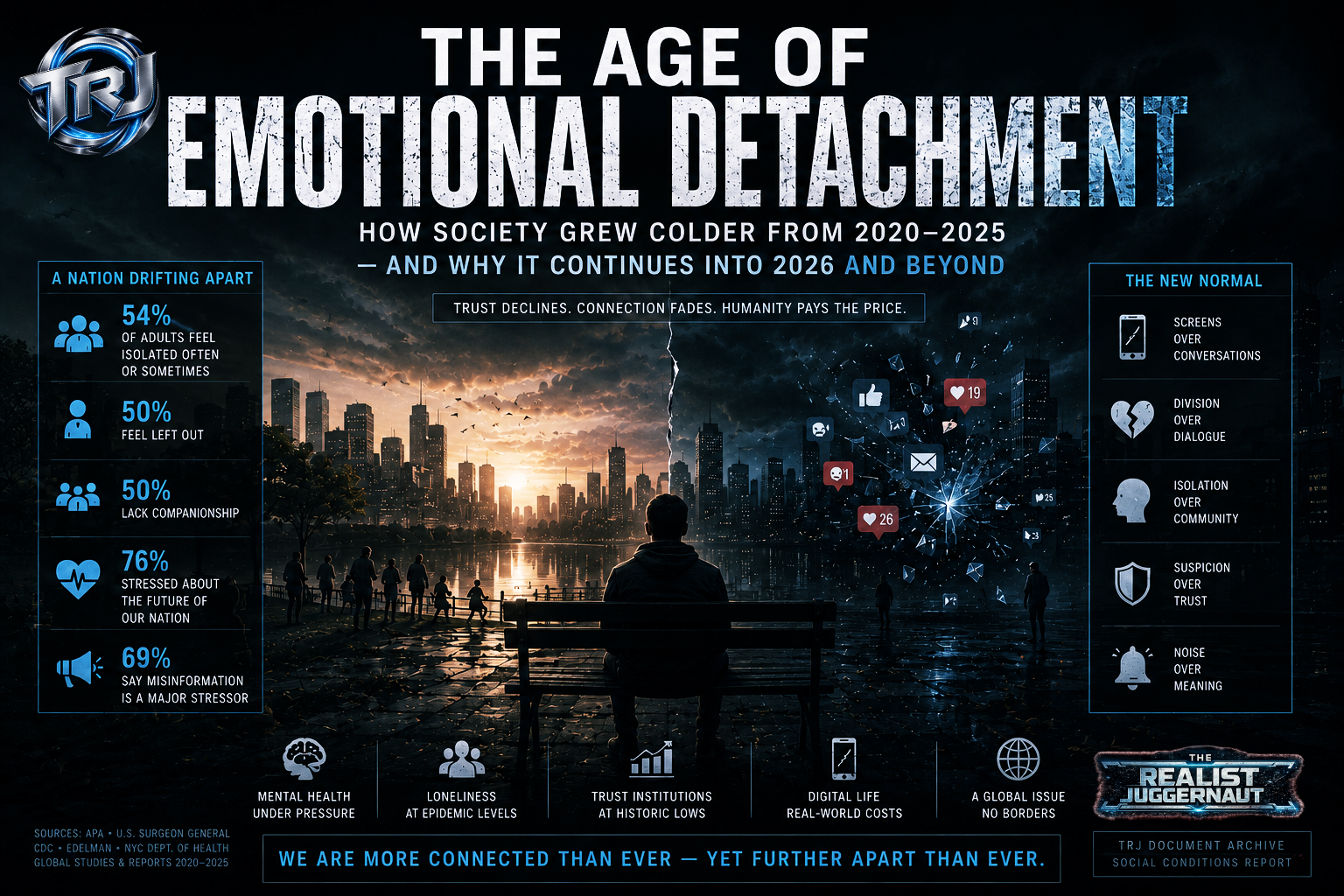
The American Psychological Association’s 2025 Stress in America report showed how far that internal strain had spread. It found that 62 percent of U.S. adults said societal division was a significant source of stress in their lives. It also found that 54 percent said they had felt isolated from others some or often, 50 percent said they had felt left out some or often, and 50 percent said they had lacked companionship some or often. Among adults who said division in the nation was a significant source of stress, 61 percent reported often or sometimes feeling isolated, compared with 43 percent among those who did not identify division as a major stressor.
Those numbers matter because they show that political division was not merely background noise. It was a real emotional stressor. But they also show why politics cannot be treated as the entire explanation. The APA report itself framed the condition as a “crisis of connection” and stated plainly that “it’s not just about disagreement — it’s about disconnection.” In other words, the political split mattered because it aggravated emotional isolation inside a population already vulnerable to disconnection.
That is the more balanced reading of the evidence. The left did not invent loneliness. The right did not invent social fragmentation. One election cycle did not invent mistrust. One ideology did not singlehandedly hollow out local community. The political sphere amplified the crisis because it gave people another high-conflict arena in which fear, grievance, and suspicion could spread, but the deeper breakdown had already been developing across society for years.
The same APA report found that 76 percent of adults said the future of the nation was a significant source of stress. It reported that 69 percent identified the spread of inaccurate or misleading information as a major source of stress, up from 62 percent the year before, while 57 percent said the rise of artificial intelligence was a major source of stress, up from 49 percent. Among adults ages 18 to 34, AI-related stress reached 65 percent.
This is the backdrop against which modern communication now occurs: national strain, informational instability, technological anxiety, economic uncertainty, and chronic overstimulation. Under those conditions, people do not communicate the same way emotionally secure communities do. They narrow inward. They conserve energy. They become quicker to react and less willing to invest deeply in difficult relationships. They turn defensive. They withdraw. They harden. Coldness is often exhaustion that has calcified into behavior.
The APA report also found that more than four in five adults who were significantly stressed by societal division reported at least one physical symptom of stress in the past month, compared with 66 percent among those not significantly stressed by division. Adults with high loneliness were also more likely to report chronic illness, with 80 percent saying they lived with chronic illness compared with 66 percent among those with moderate loneliness and 68 percent among those with low loneliness.
This helps explain why the emotional atmosphere of the period felt so hard. Stress reduced emotional bandwidth. Reduced bandwidth weakened connection. Weaker connection left people less supported. Reduced support made stress harder to survive. The cycle then reinforced itself, producing a population that grew more socially brittle, more emotionally fatigued, and more detached from the very human bonds needed to interrupt the decline.
Trust collapse made the damage worse.
The Surgeon General’s advisory cited polling showing that roughly 45 percent of Americans said in 1972 that they could reliably trust other Americans, while by 2016 that figure had fallen to roughly 30 percent. It described trust in each other and in major institutions as being near historic lows and said this corresponded with polarization being near historic highs.
Trust is not ornamental. It is one of the basic preconditions for social warmth. Without it, communication becomes guarded, strategic, and emotionally defensive. People stop entering interaction with an expectation of good faith. They start assuming manipulation, distortion, exploitation, or hostility. Once that becomes common enough, empathy weakens before any direct conflict even begins.
The 2025 Edelman Trust Barometer showed how deep that corrosion had become. Across 28 markets, trust stood at 62 percent for business, 58 percent for NGOs, 52 percent for government, and 52 percent for media. Government was distrusted in 17 of 28 countries measured, while media was distrusted in 14 of 28. The same report found that 59 percent said government leaders purposely mislead people by saying things they know are false or gross exaggerations, and 75 percent said it is becoming harder to tell whether news comes from a respected media source or from someone attempting to deceive people.
That environment changes the chemistry of communication. Once truth feels unstable, institutions feel self-serving, and public language feels manipulative, people begin listening less to understand and more to protect themselves. They speak less to connect and more to position. Language becomes tactical. Dialogue becomes performance. The human being on the other side starts disappearing behind ideology, cynicism, and suspicion.
Edelman’s findings grew darker still. Across 26 markets excluding China and Thailand, 61 percent held a moderate or high sense of grievance against business, government, and the rich. The same report found that 40 percent approved of at least one form of hostile activism to drive change, including online attacks, intentional disinformation, threats or violence, or damage to property. Among adults ages 18 to 34, more than half approved of hostile activism as a viable means of change.
That is not just distrust. That is moral destabilization. Once a large enough share of the public becomes willing to rationalize intimidation, deception, or destruction as acceptable instruments of change, social communication is already approaching a dangerous threshold. It is no longer grounded in mutual reality. It is sliding toward coercion, performance, and symbolic warfare.
The weakening of community life deepened the crisis even further.
The Surgeon General’s advisory reported that traditional indicators of community involvement, including religious groups, clubs, and labor unions, have shown declining trends in the United States since at least the 1970s. In 2018, only 16 percent of Americans said they felt very attached to their local community. In 2020, only 47 percent of Americans said they belonged to a church, synagogue, or mosque, down from 70 percent in 1999.
It also documented demographic changes that reduce informal support. Single-person households accounted for 13 percent of U.S. households in 1960 and 29 percent in 2022. Nearly half of Americans in 2021 said they had three or fewer close friends, compared with about 27 percent in 1990. Among people not reporting loneliness or social isolation, nearly 90 percent had three or more confidants.
These are not random cultural curiosities. They are markers of social thinning. When households become smaller, friendship networks shrink, community institutions weaken, and local attachment declines, people lose layers of reinforcement that once helped absorb emotional strain. Pressures that might once have been distributed through family, friendship, neighborhood familiarity, or civic membership are increasingly absorbed in private. That makes withdrawal easier, loneliness more dangerous, and communication itself feel more like effort than refuge.
Young people appear especially exposed. The Surgeon General’s advisory reported that the decline in in-person time with friends was sharpest among those ages 15 to 24 and that young adults are almost twice as likely to report loneliness as adults over 65. It also stated that the rate of loneliness among young adults increased every year between 1976 and 2019.
That means a generation entered adulthood during the full expansion of smartphone saturation, social media dependency, and digitally mediated identity formation, then passed through the pandemic era under conditions of exceptional social disruption. The long-term effects may not fully reveal themselves for years. A generation shaped by reduced face-to-face contact, relentless comparison, weaker institutional trust, and deeper dependence on mediated interaction may carry those patterns into work, family formation, civic culture, and public discourse long after 2025.
This is why the age of emotional detachment cannot be dismissed as a passing mood. It is better understood as a deeper restructuring of social behavior.
Loneliness was only the most visible symptom. The broader problem was social disconnection in structure, function, and quality. The Surgeon General’s advisory defined social connection as more than the number of people in a person’s life; it includes whether relationships can be relied upon, what needs they serve, and whether interactions are experienced as positive, meaningful, and supportive rather than empty or harmful.
That distinction explains much of the contradiction of the era. Many people between 2020 and 2025 were not disconnected in a purely numerical sense. They still had contacts, coworkers, feeds, group chats, and streams of communication. What they increasingly lacked was depth, stability, and trustworthy emotional presence. They had interaction without enough support, visibility without enough belonging, and communication without enough meaning.
That is where the danger becomes profound. If this trajectory continues long enough, human communication itself begins degrading into function without substance. People will still talk. They will still text. They will still post. They will still signal preferences, identities, opinions, outrage, and allegiance. Yet more of that communication will fail to carry recognition, patience, reciprocity, sacrifice, and truth. Once that happens at scale, language stops binding society together. It remains active while becoming increasingly hollow.
And a civilization cannot remain healthy on hollow language.
Families require emotional presence, not just contact. Friendships require sustained investment, not just intermittent replies. Communities require trust, not just proximity. Public life requires some baseline belief that words still mean something and that other people can still be approached as fellow human beings rather than targets, irritants, or ideological symbols. When those conditions deteriorate badly enough, fragmentation stops being temporary. It becomes cultural.
That is the real warning embedded in the years from 2020 through 2025. Society did not simply become more digital, more polarized, or more tired. It became more emotionally detached from itself. People were connected by infrastructure while becoming less reachable in any meaningful sense. They were surrounded by communication while receiving less connection from it. They were visible everywhere and increasingly unseen where it mattered. They were speaking more and understanding one another less.
This is how communication dies long before speech disappears.
It dies when trust collapses and truth becomes harder to recognize. It dies when stress hardens people against one another. It dies when time alone steadily overtakes time together, when friendship thins, and when local community weakens. It dies when political division stops being one stressor among many and becomes another system through which fear and grievance are amplified, even though the deeper crisis extends beyond party lines. It dies when people keep talking through systems that reward reaction while starving depth. It dies when language becomes performance, defense, ideology, or noise.
That is why this period was dangerous. Not because one party won and the other lost. Not because one ideology alone poisoned the culture. Not because ordinary disagreement suddenly became unacceptable. It was dangerous because multiple conditions that give human communication its meaning were weakening at the same time: trust, belonging, presence, patience, shared reality, and durable social connection.
This was never only a temporary disruption. Social connection had already been declining across multiple measures for decades, and the broader conditions shaping it were never limited to the pandemic years alone. By 2025, Americans were still reporting high levels of loneliness, division-driven stress, distrust, grievance, and uncertainty, which is why this cannot be reduced to a story about 2020 through 2025.
If that process continues unchecked, society will not merely become lonelier. It will become less human in the way it speaks, listens, trusts, remembers, and relates. A world in which human communication becomes meaningless is not a functioning civilization. It is a population living beside itself, speaking endlessly into the void.
TRJ Verdict
The years from 2020 through 2025 did not expose a crisis of politics alone. They exposed a deeper fracture in the emotional and social conditions that allow a society to exist as more than a collection of isolated individuals moving through the same institutions. Social connection had already been weakening for decades, with smaller networks, reduced in-person social engagement, lower local attachment, and long-term erosion of trust forming the background conditions long before the pandemic years arrived.
The danger was never polarization, technology, or distrust in isolation. It was the convergence of shrinking friendships, thinner local attachment, chronic stress, informational instability, grievance, and communication systems that rewarded reaction faster than understanding. By 2025, Americans were still reporting widespread loneliness, future-related stress, distrust, and grievance, which made clear that the problem had not closed with the end of the acute pandemic period.
When those pressures converged, connection weakened even as communication volume expanded. That is the paradox of the age of emotional detachment. A civilization can absorb conflict, disruption, and institutional decline for a time, but it cannot indefinitely withstand the erosion of meaningful human connection without beginning to hollow out from within.
The evidence does not support treating America’s crisis of connection as a finished pandemic-era episode. The pandemic exposed it, but it did not create it, and the calendar did not end it. What remained visible in 2025 and remains unresolved in 2026 is a society with more communication, less trust, weaker attachment, and a declining capacity for durable human connection.
Stress in America 2025: A Crisis of Connection — American Psychological Association (APA). (Free Download)

Our Epidemic of Loneliness and Isolation: The U.S. Surgeon General’s Advisory on the Healing Effects of Social Connection and Community — Office of the Surgeon General of the United States. (Free Download)
Global Trends and Disparities in Social Isolation — Thomas E. Fuller-Rowell, Samia Sultana, and Ichiro Kawachi, published in JAMA Network Open (2025). (Free Download)
2025 Edelman Trust Barometer: Trust and the Crisis of Grievance — Edelman Trust Institute. (Free Download)
Special Report on Social Media and Mental Health — New York City Department of Health and Mental Hygiene (NYC Health Department). (Free Download)
Social Media Use, Loneliness and Emotional Distress Among Young People in Europe — Begoña Cabeza Martínez, Béatrice d’Hombres, and Matija Kovacic, Global Labor Organization (GLO) Discussion Paper No. 1551. (Free Download)
Generation Isolation: OnSide’s Annual Study Into Young People’s Lives Outside School — OnSide Youth Zones (2024). (Free Download)
Social Connection as a Critical Factor for Mental and Physical Health: Evidence, Trends, Challenges, and Future Implications — Julianne Holt-Lunstad, World Psychiatry (2024). (Free Download)
Loneliness, Lack of Social and Emotional Support, and Mental Health Issues — United States, 2022 — U.S. Centers for Disease Control and Prevention (CDC), Morbidity and Mortality Weekly Report (MMWR). (Free Download)
Young People and Loneliness — Policy Report — Orygen and Ending Loneliness Together (2024). (Free Download)
TRJ BLACK FILE
CLASSIFICATION: SOCIAL DISCONNECTION / CIVIL STRUCTURAL ANALYSIS
FILE 01 — American Psychological Association — “Stress in America 2025: A Crisis of Connection”
The APA report identified societal division as a major stressor affecting 62 percent of U.S. adults while simultaneously documenting widespread loneliness, isolation, and reduced companionship across the population. The report framed the national condition not simply as ideological disagreement, but as a deeper “crisis of connection” affecting emotional stability, stress response, and social cohesion.
Key findings included:
• 54% of adults reported often or sometimes feeling isolated
• 50% reported feeling left out
• 50% reported lacking companionship
• 76% identified the future of the nation as a significant stress source
• 69% identified misinformation as a major stress factor
• AI-related stress rose sharply among younger adults
The report also documented significant overlap between social isolation and physical stress symptoms, indicating that emotional detachment increasingly manifests as measurable physiological strain rather than purely psychological discomfort.
FILE 02 — U.S. Surgeon General Advisory — “Our Epidemic of Loneliness and Isolation”
The Surgeon General’s advisory formally classified loneliness and social isolation as a national public health threat. The report documented declining social connection across multiple decades and identified measurable deterioration in friendship frequency, local attachment, trust, and community participation.
Key documented findings included:
• Nearly one-in-two adults reported experiencing loneliness
• Time spent socially engaging with friends dropped dramatically between 2003 and 2020
• Young adults experienced some of the sharpest declines in face-to-face interaction
• Social isolation risks were compared to smoking up to 15 cigarettes daily
• Trust in fellow Americans and institutions fell significantly over time
The advisory also warned that declining social connection carries measurable risks involving depression, anxiety, cardiovascular disease, stroke, dementia, reduced productivity, and premature mortality.
FILE 03 — JAMA Network Open — “Global Trends and Disparities in Social Isolation”
This large-scale international study analyzed more than 2.4 million assessments across 159 countries between 2009 and 2024. Researchers found that global social isolation increased significantly after 2019, with the sharpest early increases occurring during the pandemic period.
Key findings included:
• Global social isolation increased 13.4% between 2009 and 2024
• The entire increase occurred after 2019
• Lower-income populations experienced disproportionately severe isolation increases during the pandemic period
• Isolation disparities widened globally across socioeconomic groups
The findings reinforced the position that social fragmentation was not isolated to one country or one demographic category, but emerged as a broader international structural trend.
FILE 04 — Edelman Trust Barometer 2025 — “Trust and the Crisis of Grievance”
The Edelman report documented widening distrust toward institutions, leadership structures, public information systems, and societal fairness across multiple nations. The report identified growing grievance, informational instability, and declining confidence in institutional honesty.
Key findings included:
• Large percentages of respondents distrusted government and media institutions
• 59% believed government leaders knowingly mislead the public
• 75% reported increasing difficulty distinguishing legitimate information from deception
• Significant portions of younger populations expressed approval of hostile activism tactics
The report indicated that declining trust increasingly alters public communication itself by encouraging suspicion, defensiveness, ideological filtering, and emotional withdrawal.
FILE 05 — NYC Department of Health — “Special Report on Social Media and Mental Health”
The New York City Health Department identified social media as a major contributing factor in worsening youth mental health conditions, emotional instability, social comparison stress, and isolation patterns among younger populations.
The report described social media environments as amplifiers of:
• anxiety
• depression
• addictive behavioral reinforcement
• distorted self-image
• emotional isolation
• reduced real-world interaction
The report also emphasized that younger generations increasingly experience social interaction through digital systems that can intensify loneliness while simultaneously increasing communication exposure.
FILE 06 — European Commission / Global Labor Organization — “Social Media Use, Loneliness and Emotional Distress Among Young People in Europe”
Researchers examining social networking behavior across 27 European nations found strong correlations between excessive social networking usage, loneliness, and emotional distress among younger populations.
The study distinguished between passive social networking exposure and active messaging interaction, finding that passive consumption patterns appeared significantly more harmful to emotional well-being and loneliness indicators.
FILE 07 — OnSide “Generation Isolation” Report 2024
The report documented rising screen dependency, reduced in-person socialization, and elevated loneliness among younger populations.
Key findings included:
• 76% of young people spent most free time on screens
• 44% reported loneliness
• 51% reported anxiety increases
• Many young people reported lacking safe physical spaces for in-person interaction
The report identified boredom, habit formation, fear of missing out, and digital dependency as major behavioral drivers reinforcing emotional isolation patterns.
FILE 08 — World Psychiatry — “Social Connection as a Critical Factor for Mental and Physical Health”
The publication identified social connection as one of the strongest predictors of human survival, resilience, mental health stability, and long-term physical well-being.
Researchers warned that modernization trends, political polarization, digital immersion, civic decline, and weakening social structures may contribute to a continuing deterioration in meaningful human connection globally.
FILE 09 — CDC / MMWR — “Loneliness, Lack of Social and Emotional Support, and Mental Health Issues”
CDC findings linked loneliness and reduced emotional support to elevated risks involving:
• depression
• stress disorders
• anxiety
• chronic illness
• poor mental health outcomes
• increased mortality risk
The report reinforced the growing public health consensus that social disconnection represents a measurable structural health threat rather than merely a personal emotional condition.
FILE 10 — Orygen / Ending Loneliness Together — “Young People and Loneliness”
The report identified young adults ages 15–24 as among the loneliest demographic groups, with loneliness rates increasing steadily over recent years and accelerating during pandemic-era conditions.
Researchers identified multiple contributing factors:
• digitalized social interaction
• reduced face-to-face engagement
• social transition instability
• weakened community attachment
• emotional isolation despite constant connectivity
The report concluded that social connection itself should be treated as a long-term structural health priority requiring coordinated societal response.


🔥 NOW AVAILABLE! 🔥
🔥 NOW AVAILABLE! 🔥
📖 INK & FIRE: BOOK 1 📖
A bold and unapologetic collection of poetry that ignites the soul. Ink & Fire dives deep into raw emotions, truth, and the human experience—unfiltered and untamed
🔥 Kindle Edition 👉 https://a.co/d/9EoGKzh
🔥 Paperback 👉 https://a.co/d/9EoGKzh
🔥 Hardcover Edition 👉 https://a.co/d/0ITmDIB
🔥 NOW AVAILABLE! 🔥
📖 INK & FIRE: BOOK 2 📖
A bold and unapologetic collection of poetry that ignites the soul. Ink & Fire dives deep into raw emotions, truth, and the human experience—unfiltered and untamed just like the first one.
🔥 Kindle Edition 👉 https://a.co/d/1xlx7J2
🔥 Paperback 👉 https://a.co/d/a7vFHN6
🔥 Hardcover Edition 👉 https://a.co/d/efhu1ON
Get your copy today and experience poetry like never before. #InkAndFire #PoetryUnleashed #FuelTheFire
🚨 NOW AVAILABLE! 🚨
📖 THE INEVITABLE: THE DAWN OF A NEW ERA 📖
A powerful, eye-opening read that challenges the status quo and explores the future unfolding before us. Dive into a journey of truth, change, and the forces shaping our world.
🔥 Kindle Edition 👉 https://a.co/d/0FzX6MH
🔥 Paperback 👉 https://a.co/d/2IsxLof
🔥 Hardcover Edition 👉 https://a.co/d/bz01raP
Get your copy today and be part of the new era. #TheInevitable #TruthUnveiled #NewEra
🚀 NOW AVAILABLE! 🚀
📖 THE FORGOTTEN OUTPOST 📖
The Cold War Moon Base They Swore Never Existed
What if the moon landing was just the cover story?
Dive into the boldest investigation The Realist Juggernaut has ever published—featuring declassified files, ghost missions, whistleblower testimony, and black-budget secrets buried in lunar dust.
🔥 Kindle Edition 👉 https://a.co/d/2Mu03Iu
🛸 Paperback Coming Soon
Discover the base they never wanted you to find. TheForgottenOutpost #RealistJuggernaut #MoonBaseTruth #ColdWarSecrets #Declassified


Sponsored • TRJ Ads
Inquiries: contact@therealistjuggernaut.com





Thank you for such an in depth and important article! I felt something was happening before 2020, and now I know why! I went to work from home in 2016, and my mother passed away in 2017, dad followed in 2019. Thus, I thought it was just me who was disconnecting! It wasn’t! I fell into blame that friends abandoned us after my husband’s stroke in 2022, but it wasn’t just them. I had pulled away too!
I will write an article and link to this, John.
TRJ rocks!
Thank you very much, Sheila. I truly appreciate you sharing something so personal and thoughtful.
First, I am very sorry for the loss of both your mother and father, and also for what you and your husband went through after his stroke. I remember you speaking about this before, which shows how deeply those experiences affected you emotionally. Those kinds of life events can change a person in ways that are difficult to fully explain, especially when several major losses and pressures happen close together.
And honestly, one of the reasons I wrote the article was because many people were beginning to feel exactly what you described. A lot of individuals thought the growing disconnection was only happening inside their own lives, when in reality society itself was already shifting emotionally long before 2020 fully exposed it.
What you said about realizing that you had also pulled away is incredibly honest and important because emotional withdrawal often happens quietly over time, especially after grief, exhaustion, trauma, stress, or prolonged isolation. Many people do not even realize it is happening until years later.
I also deeply appreciate you wanting to write an article and link back to this one. That truly means a great deal to me.
And thank you again, Sheila. Your comment added a very real and meaningful human perspective to the larger issue the article was exploring. I truly hope you have a peaceful night and a good week ahead. 🙏😎