
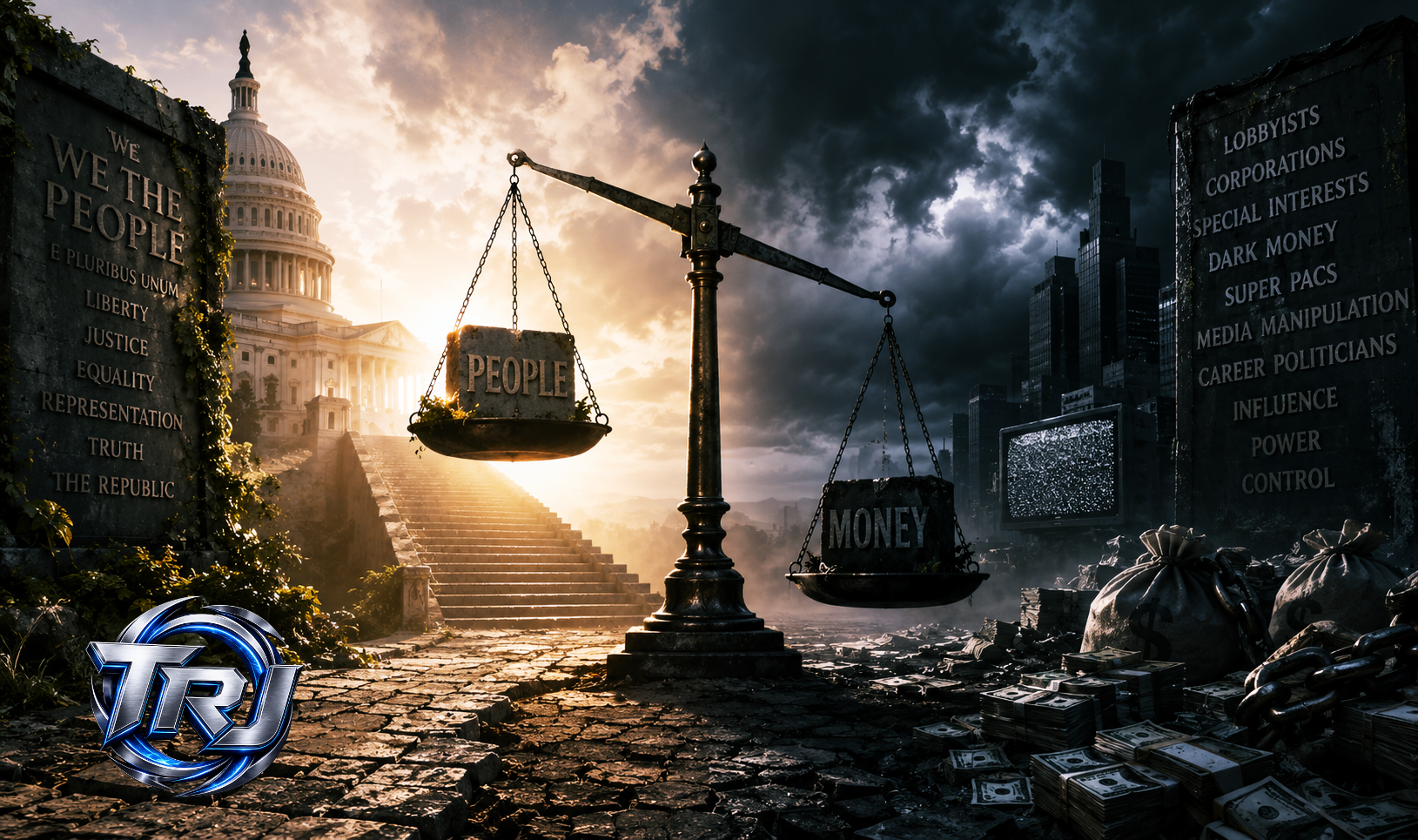
Thank you for reading or listening to The Realist Juggernaut. Independent journalism should be accessible to everyone.
How Wealth, Corporate Influence, and Political Division Slowly Turned Ordinary Citizens Into Economic Fuel for Systems They No Longer Control
There was a time in the United States when ordinary people could realistically look at the presidency and see themselves in it. Not as perfectionists. Not as saints. Not flawless by any means. Real people. Farmers. Laborers. Men and women who failed at entrepreneurship. People who came from poverty. People who understood financial struggle because they actually lived it before entering office. That alone separates earlier America from the version people are living in now. The Constitution never said a president had to be wealthy. It never said a president had to come from elite universities. It never said a president needed billionaire donors, celebrity status, corporate backing, media machinery, or institutional protection to lead the country. A natural-born citizen. Thirty-five years old. Fourteen years residing in the United States. That was the barrier. Now compare that constitutional simplicity to modern political reality.
Today, an ordinary struggling American could legally run for president tomorrow and still be destroyed before ever reaching national relevance. Not because the Constitution blocks them. Because the system itself would. The mainstream media would immediately question their intelligence, education, professionalism, appearance, background, temperament, qualifications, finances, and credibility. Donors would avoid them. Corporate media would bury them. Destroy them and their families. Political establishments would dismiss them. Digital narratives would mock them. Financial pressure alone would collapse most campaigns before they ever reached the national stage. To me, that is not fair by any means. The mainstream media has become savage and will do almost anything for ratings, attention, money, and influence, even if it means publicly destroying people and their families in the process.
The office technically belongs to the people. Reality increasingly says otherwise. That is the disconnect millions of Americans are feeling right now. I feel it, you feel it, and you cannot deny it. I do not care what party you align yourself with. You feel it and you know it.
The last president who could realistically be described as genuinely poor or deeply connected to ordinary financial struggle was Harry S. Truman, a Democrat. He became president in 1945. Over eighty years ago. That timeline alone should stop people dead in their tracks. Before Truman, America repeatedly produced presidents who came from ordinary hardship from both political parties. Abraham Lincoln, a Republican, grew up in extreme poverty and educated himself. Andrew Jackson, a Democrat, was orphaned young and raised in hardship. James Garfield, a Republican, worked manual labor jobs and canal work. Ulysses S. Grant, a Republican, struggled financially and failed in business before rising through military service. Herbert Hoover, a Republican, was orphaned young and came from poverty before later success. Richard Nixon, a Republican, came from a modest struggling family and helped run the family grocery store. Jimmy Carter, a Democrat, came from a rural farming background and still reflected something closer to ordinary America than what people see today.
That is important because this was not originally a huge dispute over whether somebody was Republican or Democrat. Political division existed back then too, but it was not weaponized into society the way it is now, or at least not anywhere near the level people are experiencing today. Earlier America still produced poor and modest-background presidents from both parties without the country feeling permanently split apart every second of every day. The system itself was different. The pathway was different. Ordinary citizens could still realistically believe somebody from their world could rise into national leadership without first being absorbed into elite financial and institutional ecosystems.
Then the progression changed. Dwight D. Eisenhower entered office backed by enormous military prestige and institutional power. John F. Kennedy came from one of the wealthiest political dynasties in American history. Lyndon B. Johnson rose through deep political infrastructure. Gerald Ford spent decades inside institutional politics. Ronald Reagan arrived through celebrity influence and massive political infrastructure. George H. W. Bush came from elite wealth and political legacy. Bill Clinton rose through elite academic and political systems. George W. Bush emerged from dynasty power and wealth. Barack Obama rose through highly elite institutional pipelines. Donald Trump entered office as a billionaire business figure. Joe Biden spent decades embedded inside the national political establishment.
That is the progression. The presidency slowly transformed from something ordinary citizens could realistically aspire toward into something that now heavily favors money, institutional power, influence networks, media machinery, and elite access. Money became the gatekeeper. The warning signs were visible long before modern America reached this point. In 1907, the United States passed the Tillman Act specifically because lawmakers already feared corporate influence over politics. Over a century ago, leaders openly recognized that massive financial power gaining control over political systems was dangerous to the country itself.
Then came Citizens United. That decision fundamentally shifted the landscape by opening the door for unlimited independent political spending through outside organizations, Super PACs, lobbying ecosystems, billionaire donor structures, and corporate influence networks. The technical language changed. The practical outcome became obvious to millions of ordinary Americans watching politics transform into a financial war machine.
And while all of this expanded upward, ordinary citizens began losing ground downward. Housing became harder to afford. Debt became normal survival. Healthcare costs exploded. Families required multiple incomes just to remain stable. Ownership declined. Savings shrank. Subscriptions consumed monthly life. Taxes increased. Fees multiplied. Inflation hammered purchasing power. Small businesses struggled to survive against corporate scale. Twenty-five years ago, many working families could still realistically survive on one paycheck. Not perfectly. Not luxuriously. But it was possible. Today millions of Americans work constantly and still feel like they are barely remaining above water.
To make things even more uncomfortable, many families cannot even afford to buy a home to raise their children in anymore even with two incomes coming in. The idea of a single-income family owning a home today would almost never happen unless that income is substantial, and for huge portions of the population it feels nearly impossible now. And forget about renting because in many parts of the country rent itself has become just as expensive as a mortgage payment, except without ownership, without equity, and without long-term stability. People are paying enormous amounts of money every month simply to temporarily exist inside properties they will never own while housing prices, property taxes, insurance, and living costs continue climbing higher.
That pressure changes society psychologically. People become exhausted. People become distracted. People become financially trapped. People become easier to control through fear of losing access, employment, platforms, stability, or social standing. And the truth is people tolerated it. Little by little. Year by year. Fee by fee. Policy by policy. Subscription by subscription. People kept adapting to conditions that earlier generations may have pushed back against far harder.
People fell asleep at the wheel while corporations gained enormous influence, governments expanded endlessly, lobbying exploded, debt skyrocketed, and ordinary citizens slowly lost economic leverage inside their own country. Truth hurts. But that truth matters. The biggest failure is not just the politicians. Not just corporations. Not just billionaires. Not just lobbying groups. The biggest failure is that society normalized the progression while it was happening. We are the reason this happened, and the minute people finally admit that truth, only then can there even be a chance to change it.
Have we not learned anything? See, I am a realist, and I can clearly see that while the people remain split apart fighting over endless political distractions, social narratives, outrage cycles, and manufactured division, the systems above them continue getting richer, larger, and more powerful. People hate each other over who someone voted for while the elite corporate machine profits from both sides of the conflict.
Then you have influencers pushing the narrative even harder from every direction, pouring fuel onto the fire constantly because division, outrage, fear, and conflict generate attention, engagement, views, clicks, donations, subscriptions, and money. But hey, every one of those influencers are the professional. They talk talk talk, and walk walk walk, they eat it and sleep in it too. At that point it is not just gasoline being poured onto society anymore. It is lamp oil, kerosene, gasoline, and jet fuel all mixed together while people with massive platforms profit from keeping the population angry, emotionally reactive, politically divided, and permanently distracted from the larger economic and structural problems continuing to grow underneath everything.
That division is useful to them. It keeps the population emotionally distracted while money, influence, and power continue consolidating upward. The mainstream media feeds it because outrage keeps ratings alive and division keeps people controllable. If people cannot see the enormous problem forming directly in front of them, then they are blindly walking deeper into the same system that has already drained so much from ordinary life. I mean, how much more can we be drained? I know vampires eat, but damn.
As of now, many Americans no longer feel represented by people who live like them, struggle like them, or understand economic pressure the way ordinary citizens experience it daily. Modern-day representatives often appear deeply out of touch with the financial realities, instability, and pressure many ordinary Americans are facing every single month.
How could you truly represent the average American if you are completely out of touch with how average Americans actually live?
The average citizen looks at leadership and increasingly sees protected circles instead of relatable people. They see wealthy networks, institutional pipelines, corporate influence, career politicians, celebrity status, and financial insulation far removed from the realities most families are facing every single month. That is why distrust keeps growing amongst people. People are tired of being told the economy is strong while they are struggling to survive inside it. They are tired of watching ordinary life become more expensive while massive systems above them continue expanding endlessly. They are tired of being divided against one another while corporations, lobbyists, political machines, influencers, and media networks continue profiting from the chaos.
Because once money becomes the gatekeeper to power, ordinary citizens stop feeling like participants in the system and start feeling like economic fuel for systems they no longer control. They begin feeling processed instead of represented. Taxed instead of empowered. Managed instead of heard. And when enough people begin feeling that way at the same time, the foundation of trust holding a country together starts cracking underneath everything.
At least it should, as long as you are not afraid to admit it. Because eventually the only ones who will be able to stay healthy and wealthy will be the same people, corporations, and systems that helped put ordinary citizens into this position in the first place.
TRJ VERDICT:
The United States was never supposed to become a country where money determined who could realistically become president, who could realistically speak, who could realistically survive, and who could realistically lead the country. The presidency was designed for citizens, not protected financial classes. Yet over time the system slowly drifted away from ordinary people and closer toward wealth, institutional insulation, corporate influence, media machinery, and elite access. That progression did not happen overnight. It happened gradually while generations of citizens adapted to more debt, more pressure, more dependency, more distraction, and less economic freedom in return.
Now millions of Americans are beginning to recognize something deeply uncomfortable: the system many of them believed represented ordinary people increasingly feels financially unreachable to ordinary people themselves. Families struggle to buy homes. Young adults drown in debt before their lives even begin. Two incomes barely maintain stability. Renting has become its own financial trap. Massive corporations, political ecosystems, lobbying structures, influencers, and media networks continue profiting from division, outrage, fear, and social fragmentation while ordinary citizens fight each other instead of recognizing the larger consolidation of money and power happening above them.
This is no longer simply a political issue. It is a structural issue. A psychological issue. A societal issue. Because once citizens stop believing they can realistically reach leadership, influence policy, build stability, or even recover economically through hard work alone, trust in the system itself begins collapsing from the inside out.
Money became the gatekeeper. The danger now is what happens when an entire population finally realizes the gate was never truly built for them to pass through anymore.
Original scan of the 1907 statute pages. (Free Download)

This file is the backup/cleaner copy version of the same statute pages above. (Free Download)
This file is the Citizens United constitutional brief discussing why those laws originally existed and the historical concern over corporate influence in elections. (Free Download)
TRJ BLACK FILE // MONEY IS THE GATEKEEPER
For over a century, the United States openly recognized the danger of corporations gaining financial control over political systems. The Tillman Act of 1907 specifically prohibited corporate money contributions connected to political elections because lawmakers feared exactly what modern America is now experiencing — the growing merger between financial power and political influence.
The original federal statute stated:
“It shall be unlawful for any national bank, or any corporation organized by authority of any laws of Congress, to make a money contribution in connection with any election to any political office.”
That warning existed over one hundred years ago.
The concern was not theoretical. Political leaders, constitutional scholars, reformers, and even presidents feared that once corporate wealth gained enough influence over elections, ordinary citizens would slowly lose meaningful control over representation itself.
That fear expanded during the Gilded Age as trusts, banking systems, railroads, monopolies, and industrial power structures accumulated enormous influence over American politics. Concerns surrounding corruption, lobbying, financial favoritism, and corporate leverage became so severe that campaign finance regulation eventually became embedded into the historical structure of modern American democracy itself.
Then the landscape changed.
Over time, campaign finance systems evolved into massive financial ecosystems built around:
- Super PACs
- Billionaire donor networks
- Corporate lobbying structures
- Political influence organizations
- Media influence systems
- Narrative management industries
- Institutional fundraising pipelines
- Celebrity political branding
The result is a political environment where ordinary citizens increasingly feel economically disconnected from leadership itself.
Earlier America repeatedly produced presidents who emerged from:
- Poverty
- Manual labor
- Rural hardship
- Failed businesses
- Military struggle
- Self-education
- Ordinary working-class environments
Modern America increasingly produces leadership through:
- Elite institutional systems
- Political dynasties
- Corporate donor ecosystems
- Massive media infrastructure
- Celebrity influence
- Financial insulation
- Career political machinery
The psychological consequence of this transformation is now visible across the country. Millions of citizens no longer believe someone economically ordinary can realistically rise into national leadership without first being absorbed into elite financial systems.
That belief alone changes how populations psychologically relate to the republic and democracy itself.
When citizens stop feeling represented, they begin feeling processed.
When citizens stop feeling heard, they begin feeling managed.
When citizens stop believing hard work alone can build stability, ownership, or upward mobility, distrust begins spreading across every institution connected to power.
This is not simply political frustration anymore.
It is systemic exhaustion.
TRJ SYSTEM ANALYSIS:
THE SYSTEM DID NOT DRIFT AWAY FROM THE PEOPLE OVERNIGHT.
IT MOVED ONE FINANCIAL LAYER AT A TIME.


🔥 NOW AVAILABLE! 🔥
🔥 NOW AVAILABLE! 🔥
📖 INK & FIRE: BOOK 1 📖
A bold and unapologetic collection of poetry that ignites the soul. Ink & Fire dives deep into raw emotions, truth, and the human experience—unfiltered and untamed
🔥 Kindle Edition 👉 https://a.co/d/9EoGKzh
🔥 Paperback 👉 https://a.co/d/9EoGKzh
🔥 Hardcover Edition 👉 https://a.co/d/0ITmDIB
🔥 NOW AVAILABLE! 🔥
📖 INK & FIRE: BOOK 2 📖
A bold and unapologetic collection of poetry that ignites the soul. Ink & Fire dives deep into raw emotions, truth, and the human experience—unfiltered and untamed just like the first one.
🔥 Kindle Edition 👉 https://a.co/d/1xlx7J2
🔥 Paperback 👉 https://a.co/d/a7vFHN6
🔥 Hardcover Edition 👉 https://a.co/d/efhu1ON
Get your copy today and experience poetry like never before. #InkAndFire #PoetryUnleashed #FuelTheFire
🚨 NOW AVAILABLE! 🚨
📖 THE INEVITABLE: THE DAWN OF A NEW ERA 📖
A powerful, eye-opening read that challenges the status quo and explores the future unfolding before us. Dive into a journey of truth, change, and the forces shaping our world.
🔥 Kindle Edition 👉 https://a.co/d/0FzX6MH
🔥 Paperback 👉 https://a.co/d/2IsxLof
🔥 Hardcover Edition 👉 https://a.co/d/bz01raP
Get your copy today and be part of the new era. #TheInevitable #TruthUnveiled #NewEra
🚀 NOW AVAILABLE! 🚀
📖 THE FORGOTTEN OUTPOST 📖
The Cold War Moon Base They Swore Never Existed
What if the moon landing was just the cover story?
Dive into the boldest investigation The Realist Juggernaut has ever published—featuring declassified files, ghost missions, whistleblower testimony, and black-budget secrets buried in lunar dust.
🔥 Kindle Edition 👉 https://a.co/d/2Mu03Iu
🛸 Paperback Coming Soon
Discover the base they never wanted you to find. TheForgottenOutpost #RealistJuggernaut #MoonBaseTruth #ColdWarSecrets #Declassified


Sponsored • TRJ Ads
Inquiries: contact@therealistjuggernaut.com





What do you think of Marjorie Taylor Green? She seems in touch with how many people feel . I agree with everything you wrote too, John. I read this whole article to my husband just now. He wanted me to read him to sleep. But now, I think we’re both awake!
I also think there’s a reason, as you remarkably pointed out, why thieves do what they do to steal millions in government contracts and grants etc. and don’t think it’s wrong! Because our government steals from all of us everyday!
Thank you very much, Sheila. I truly appreciate both you and your husband taking the time to sit down and read through the entire article together. That means a great deal to me, and greatly appreciated especially with how long and heavy the subject matter was.
As for Marjorie Taylor Greene, I think one reason many people connect with her is because she speaks in a way that feels direct, emotional, and unfiltered compared to the highly polished and carefully managed style many politicians use today. I think she would make a great first woman president, but it is too early to say for sure. Whether people agree with her politically or not, there are many Americans who feel frustrated, unheard, financially pressured, and increasingly distrustful of institutional systems, and politicians who speak more bluntly often resonate strongly during periods like this.
And your observation regarding corruption and normalization is also important. Once dishonesty, waste, abuse of power, or financial exploitation become culturally normalized at enough levels of society, people can slowly begin justifying behavior that earlier generations may have viewed very differently. That does not make it right, but it does reveal how dangerous moral desensitization can become over time inside both institutions and society itself.
Thank you again, Sheila. I truly appreciate the thoughtful discussion and your support greatly. I hope you and your husband both have a peaceful night and a great week ahead. 😎
Thank you very much, Sheila. I truly appreciate both you and your husband taking the time to sit down and read through the entire article together. That means a great deal to me, especially with how long and heavy the subject matter was.
As for Marjorie Taylor Greene, I think one reason many people connect with her is because she speaks in a way that feels direct, emotional, and unfiltered compared to the highly polished and carefully managed style many politicians use today. I think she would make a great first woman president, but it is too early to say for sure. Whether people agree with her politically or not, there are many Americans who feel frustrated, unheard, financially pressured, and increasingly distrustful of institutional systems, and politicians who speak more bluntly often resonate strongly during periods like this.
I think what people really need to start doing more is voting for better state representatives in every state and removing corrupt state officials because that is where true recovery honestly begins. A president cannot properly function if everyone is constantly working against each other and unwilling to work together at all. Corrupt leadership at the state level has been destructive for a very long time and will continue being destructive until that corruption is rooted out properly. I have been saying this for quite some time now. As of now, the government is simply not functioning the way it should be functioning.
A lot of these politicians forget how they got there and who ultimately pays for the lifestyles, salaries, benefits, protections, and systems surrounding them. Corporations and enterprise-level donors do not fully pay for those salaries and systems as a whole. Ordinary taxpayers still carry much of that burden. Taking that for granted should never become acceptable, and personally, I believe term limits should exist for every seat.
And your observation regarding corruption is also important because people often begin reflecting what they constantly see normalized around them. When governments, institutions, corporations, and powerful individuals appear dishonest, abusive, wasteful, or financially exploitative without accountability, it slowly affects how portions of society begin viewing morality itself. Over time, people can start justifying behavior that earlier generations may have viewed very differently because corruption no longer feels shocking to them. That does not make it right, but it does show how dangerous it becomes when dishonesty and abuse of power start feeling culturally normal.
Thank you again, Sheila. I truly appreciate the thoughtful discussion and your support greatly. I hope you and your husband both have a peaceful night and a great week ahead. 😎
I wish I could disagree with something you’ve written here, John, but I can’t. It is all true as far as I know.
I do appreciate that you have shared your thoughts. Many people are living through this but I would expect there to be more discussion about it. You articulate what I experience.
May God bless you in spite of the ugly times we are living in.
You’re very welcome, Chris. I truly appreciate both your thoughtful words and your honesty.
I think part of the reason there is not more open discussion about many of these issues is because a great deal of modern life keeps people mentally exhausted, financially pressured, distracted, and emotionally divided almost constantly. I also believe many people stay quiet because they fear being attacked simply for agreeing, disagreeing, or speaking honestly about what they are experiencing and observing around them. Many feel these things deeply but struggle finding the time, energy, or even the right words to fully express what they are carrying internally.
That is also why serious discussion still matters. Sometimes simply knowing other people recognize the same pressures, frustrations, and structural changes surrounding modern life helps people realize they are not imagining what they are feeling.
And thank you as well for your kind blessing, Chris. I truly appreciate that very much. May God continue blessing you and your family also with strength, peace, wisdom, and protection during difficult times. 🙏😎
I think your reasoning about why we don’t hear people discussing this is spot on, John.
“Many feel these things deeply but struggle finding the time, energy, or even the right words to fully express what they are carrying internally.”
I’ve been there believe me. Fortunately, by the grace of God, I’ve been able to come up for a breath of fresh air and have some time to think about many of the things that have gone on in society that have caused the things you refer to here.
Like you, I think this discussion is very important. People need to understand, as you have stated, that they are not alone in feeling the shifts in how life has changed.
You’re welcome, John, and thank you for this thoughtful reply. I pray the same for you and your family, for strength, peace, wisdom, and protection during these uncertain times.