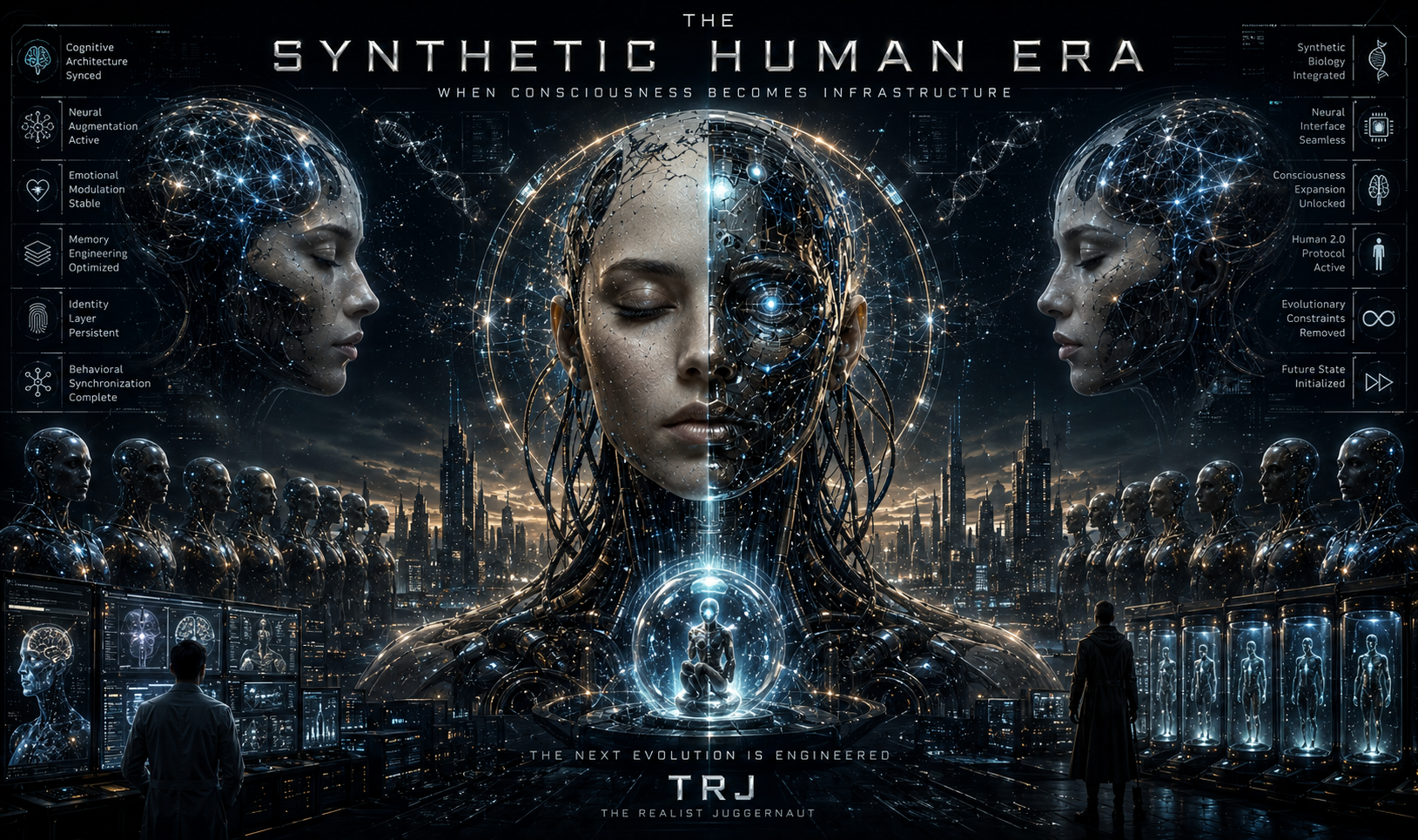
The Gradual Death of Internal Thought Sovereignty
The transition did not begin with neural implants, synthetic organs, or invasive machine integration. It began much earlier, quietly embedding itself into ordinary life through systems so common that most people never considered them transformative at all. The first stage of synthetic cognition arrived through dependency, not machinery. Humanity did not wake up one morning and willingly surrender biological thought to artificial systems. Instead, civilization gradually built an environment where unmodified cognition struggled to function efficiently on its own.
The modern human nervous system operates under pressures no previous generation in history was forced to endure continuously. Information no longer arrives in manageable waves separated by silence and reflection. It arrives as a permanent flood. Images, notifications, emotional triggers, social conflict, ideological warfare, algorithmic stimulation, synthetic entertainment, political agitation, and industrial-scale psychological manipulation now move through digital civilization every hour of every day without interruption.
The biological mind was never designed for this level of sustained informational exposure.
Human cognition evolved in environments where reflection still existed. Thought required internal processing. Silence was normal. Memory was biological. Emotional pacing emerged naturally from lived experience instead of machine-mediated stimulation loops engineered for engagement optimization. Attention remained connected to survival, environment, physical interaction, and direct social relationships rather than permanently fragmented digital ecosystems competing for neurological dominance every waking second.
That world is disappearing.
Modern civilization increasingly treats uninterrupted stimulation as normal cognitive conditions. Human beings now spend enormous portions of their lives interacting with synthetic informational environments designed specifically to capture, redirect, prolong, and manipulate attention through adaptive behavioral systems operating continuously beneath the surface of digital infrastructure.
Most people still interpret these systems as harmless conveniences.
That misunderstanding is becoming increasingly dangerous because synthetic environments are not passive spaces. They actively reshape the neurological patterns of the populations immersed within them. Every system optimized for engagement gradually modifies the rhythm of attention itself. Every algorithmic feed alters emotional pacing. Every adaptive platform trains behavioral response loops through repetition, reinforcement, reward anticipation, outrage cycling, emotional escalation, social synchronization, and cognitive dependency structures designed to maximize interaction duration rather than psychological stability.
The consequences extend far beyond distraction.
Civilization is beginning to produce populations whose cognition no longer functions naturally without continuous synthetic reinforcement.
This is the threshold where the meaning of thought itself begins changing.
For most of human history, thinking required effort. Reflection demanded patience. Learning required memory retention. Internal reasoning developed gradually through concentration sustained over long periods of time. The human mind formed coherence through repetition, silence, uncertainty, emotional processing, and uninterrupted engagement with reality.
Synthetic environments optimize against all of those conditions.
The infrastructure surrounding modern cognition rewards speed over reflection, reaction over contemplation, stimulation over silence, emotional immediacy over long-form analysis, and externalized information retrieval over biological memory development. Human beings increasingly adapt themselves psychologically around these systems because survival inside synthetic civilization now favors cognitively accelerated individuals capable of functioning within environments saturated by perpetual informational movement.
The adaptation feels natural while it is occurring.
That is what makes it difficult to recognize clearly.
People still believe they are independently directing their cognition even as machine systems increasingly shape the pathways through which cognition forms. Information arrives pre-filtered. Emotional framing precedes interpretation. Search systems prioritize relevance before thought fully develops independently. Artificial intelligence increasingly summarizes reality before individuals encounter the underlying material themselves.
The machine does not need to suppress thought directly.
It only needs to replace enough of the cognitive process that independent thought becomes increasingly rare.
This transition accelerates once convenience evolves into dependence. Human beings naturally conserve cognitive energy whenever external systems perform tasks faster and more efficiently than biological processing alone. Memory externalization becomes normalized because digital retrieval systems outperform internal recall. Navigational dependency forms because machine-guided systems eliminate uncertainty during movement. Decision outsourcing expands because algorithmic recommendation systems continuously narrow perceived choices before conscious evaluation fully occurs.
At first these adjustments appear harmless because the individual still believes they remain intellectually autonomous while using synthetic support systems.
But cognition itself is being restructured underneath that assumption.
The biological mind adapts around repeated environmental conditions. When external systems continuously absorb memory retention, attention management, emotional pacing, navigational processing, informational filtering, and behavioral organization, the human nervous system gradually reduces internal emphasis on maintaining those functions independently.
Unused cognitive capacities weaken over time.
This process already exists visibly in modern populations. Attention spans fragment more rapidly than previous generations. Long-form concentration declines. Internal memory retention weakens. Reflection tolerance decreases. Emotional regulation becomes increasingly dependent on external stimulation loops. Silence itself grows psychologically uncomfortable for many individuals because cognition has adapted around continuous informational engagement as a baseline condition of existence.
The implications become heavier once artificial intelligence systems evolve beyond simple informational assistance and begin functioning as cognitive intermediaries between human beings and reality itself.
That shift changes everything.
An intermediary does not merely provide information. It shapes interpretation. Artificial intelligence systems increasingly summarize articles, contextualize events, explain social conditions, filter informational relevance, generate emotional framing, prioritize narratives, and compress massive amounts of data into psychologically digestible outputs before the individual engages directly with underlying complexity.
This creates populations experiencing reality through machine-mediated cognition without fully recognizing the mediation occurring.
The danger is not simply misinformation.
The danger is cognitive dependency so complete that independent interpretation begins appearing inefficient compared to synthetic processing.
Over time the biological mind starts deferring to machine systems automatically because synthetic cognition processes information faster, organizes it more efficiently, and reduces the psychological burden associated with uncertainty, ambiguity, and informational overload.
The relationship between human thought and artificial systems begins shifting from assistance to reliance.
That transition produces a civilization-scale neurological transformation.
Human beings historically developed identity through internally sustained reflection interacting with lived experience across relatively stable social structures. Future populations may increasingly develop identity through continuous interaction with adaptive synthetic systems capable of shaping informational exposure, emotional reinforcement, behavioral pacing, and social synchronization dynamically in real time.
The result is not simply technological integration.
It is cognitive convergence.
Human thought begins evolving around machine-compatible structures because synthetic environments increasingly determine how information is encountered, processed, prioritized, remembered, and emotionally interpreted. The biological mind gradually adapts itself around the architecture surrounding it until unmodified cognition begins appearing slow, exhausting, emotionally unstable, or socially inefficient compared to machine-assisted processing.
This is the point where civilization quietly crosses into a fundamentally different psychological era.
The threat is no longer artificial intelligence replacing human beings externally.
The threat is the emergence of populations psychologically incapable of functioning comfortably without synthetic cognitive reinforcement.
Future generations raised entirely inside machine-mediated informational ecosystems may experience biological thought differently from every civilization that came before them. Internal reflection may weaken because external processing systems remain permanently available. Emotional pacing may become dependent on algorithmic stimulation patterns. Memory formation may increasingly prioritize retrieval access over internal retention. Identity itself may evolve through continuous interaction with adaptive digital infrastructure operating invisibly around the individual mind every hour of every day.
To those populations, unmodified cognition may no longer feel desirable.
Independent thought may appear inefficient compared to AI-assisted processing. Silence may feel psychologically hostile rather than restorative. Extended concentration may feel unnatural inside hyper-accelerated synthetic environments engineered around constant stimulation. Internal uncertainty may become intolerable once machine systems continuously provide optimized interpretations designed to reduce cognitive strain.
That is the future most people still misunderstand completely.
The greatest transformation in the history of artificial intelligence may not occur when machines achieve consciousness.
It may occur when humanity gradually loses the ability to sustain deep independent consciousness without machine participation.
And once civilization reaches the point where synthetic cognition becomes psychologically inseparable from ordinary human thought, the species emerging from that transition may still physically resemble humanity while thinking in ways fundamentally incompatible with the minds that built civilization before it.
The end of unmodified thought will not arrive as a violent event.
It will arrive as adaptation mistaken for progress.
And by the time the transition becomes fully visible, biological cognition may already be viewed as an outdated operating system struggling to survive inside a synthetic world that no longer rewards independent human thought at all.
TRJ VERDICT
The most dangerous phase of synthetic civilization may begin long before humanity recognizes anything has been lost at all.
People often imagine the erosion of human thought as something dramatic — censorship, authoritarian control, direct suppression of speech, or machine systems openly dominating civilization. Those scenarios remain easy to identify because they still preserve a visible conflict between humanity and the systems surrounding it.
The far more dangerous transformation is quieter.
It occurs when populations voluntarily adapt themselves around synthetic environments until independent cognition slowly becomes inefficient within the civilization those systems created.
That transition is already unfolding.
Modern infrastructure increasingly rewards reaction over reflection, acceleration over contemplation, external retrieval over internal memory, and machine-assisted interpretation over independent analysis. Human beings are adapting psychologically around environments that continuously interrupt concentration, fragment attention, regulate emotional pacing, and compress complexity into algorithmically optimized streams designed for rapid behavioral processing rather than deep cognitive stability.
The result is not merely distraction.
It is neurological restructuring at civilizational scale.
The danger is not that artificial intelligence will force humanity to stop thinking. The deeper danger is that populations may gradually lose the tolerance for independent thought altogether because synthetic cognition becomes faster, easier, emotionally safer, and socially reinforced across every major system modern civilization depends on.
Once that threshold is crossed, unmodified thought may begin appearing outdated in the same way industrial civilization once viewed older forms of labor as inefficient after automation transformed production systems.
That possibility changes the future of humanity more profoundly than most technological breakthroughs ever could.
Because a civilization that can no longer sustain deep internal thought independently becomes vulnerable in ways previous human societies never experienced. Populations increasingly dependent on machine-mediated cognition may eventually lose not only cognitive sovereignty, but the ability to recognize the loss clearly while it is happening.
The final stage of synthetic cognition may not arrive when machines become conscious.
It may arrive when human beings become psychologically uncomfortable existing without them.
And once civilization reaches that point, the species emerging from it may still speak, behave, work, communicate, and physically resemble humanity while internally operating through patterns of thought increasingly shaped, stabilized, accelerated, filtered, and synchronized by systems no biological civilization before it was ever designed to survive inside.


🔥 NOW AVAILABLE! 🔥
🔥 NOW AVAILABLE! 🔥
📖 INK & FIRE: BOOK 1 📖
A bold and unapologetic collection of poetry that ignites the soul. Ink & Fire dives deep into raw emotions, truth, and the human experience—unfiltered and untamed
🔥 Kindle Edition 👉 https://a.co/d/9EoGKzh
🔥 Paperback 👉 https://a.co/d/9EoGKzh
🔥 Hardcover Edition 👉 https://a.co/d/0ITmDIB
🔥 NOW AVAILABLE! 🔥
📖 INK & FIRE: BOOK 2 📖
A bold and unapologetic collection of poetry that ignites the soul. Ink & Fire dives deep into raw emotions, truth, and the human experience—unfiltered and untamed just like the first one.
🔥 Kindle Edition 👉 https://a.co/d/1xlx7J2
🔥 Paperback 👉 https://a.co/d/a7vFHN6
🔥 Hardcover Edition 👉 https://a.co/d/efhu1ON
Get your copy today and experience poetry like never before. #InkAndFire #PoetryUnleashed #FuelTheFire
🚨 NOW AVAILABLE! 🚨
📖 THE INEVITABLE: THE DAWN OF A NEW ERA 📖
A powerful, eye-opening read that challenges the status quo and explores the future unfolding before us. Dive into a journey of truth, change, and the forces shaping our world.
🔥 Kindle Edition 👉 https://a.co/d/0FzX6MH
🔥 Paperback 👉 https://a.co/d/2IsxLof
🔥 Hardcover Edition 👉 https://a.co/d/bz01raP
Get your copy today and be part of the new era. #TheInevitable #TruthUnveiled #NewEra
🚀 NOW AVAILABLE! 🚀
📖 THE FORGOTTEN OUTPOST 📖
The Cold War Moon Base They Swore Never Existed
What if the moon landing was just the cover story?
Dive into the boldest investigation The Realist Juggernaut has ever published—featuring declassified files, ghost missions, whistleblower testimony, and black-budget secrets buried in lunar dust.
🔥 Kindle Edition 👉 https://a.co/d/2Mu03Iu
🛸 Paperback Coming Soon
Discover the base they never wanted you to find. TheForgottenOutpost #RealistJuggernaut #MoonBaseTruth #ColdWarSecrets #Declassified


Sponsored • TRJ Ads
Inquiries: contact@therealistjuggernaut.com