
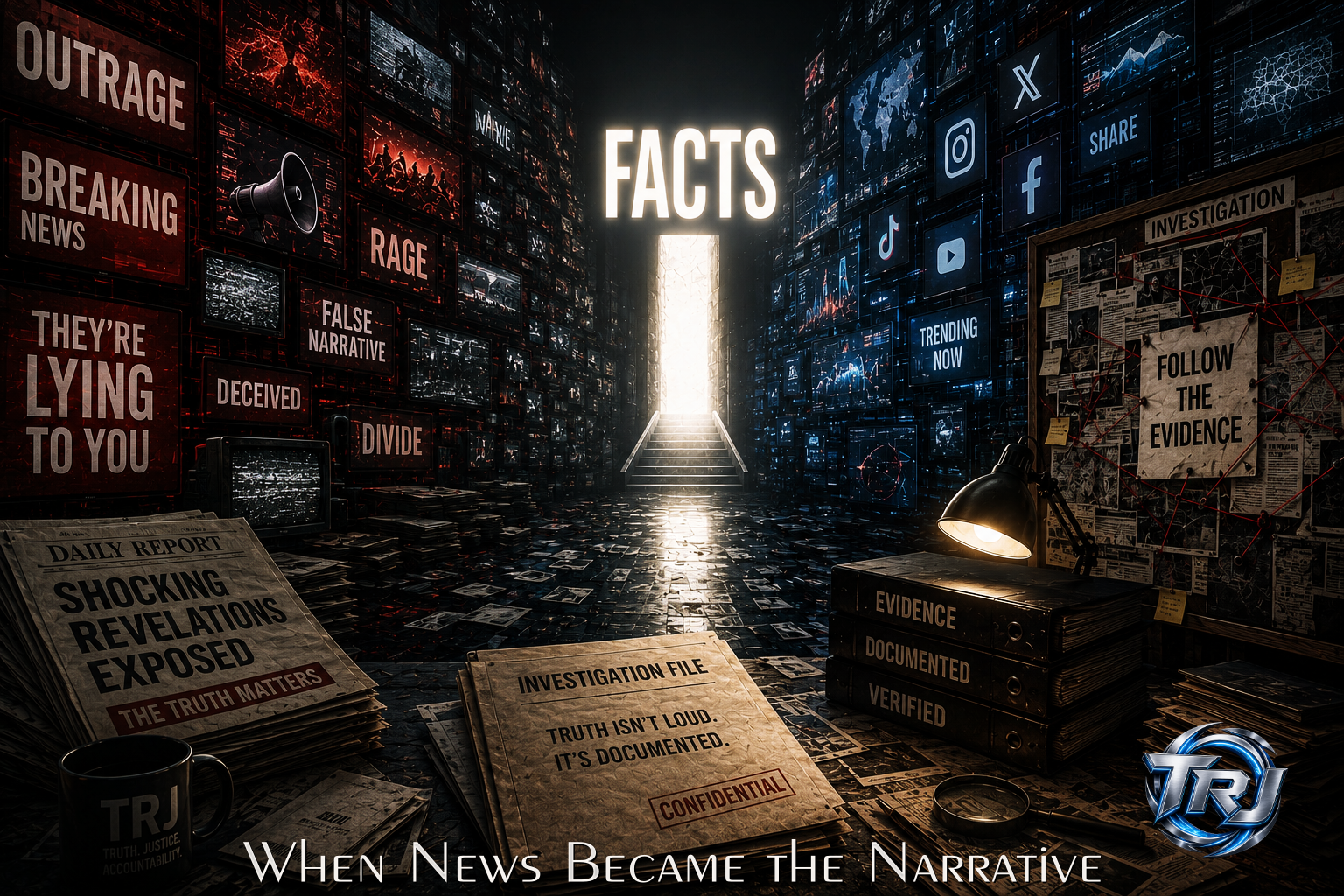
The modern media landscape has evolved into a nonstop war for public attention where algorithms, outrage, viral content, emotional influence, and narrative-driven reporting increasingly shape how reality itself is perceived.
There was a time when the purpose of journalism was widely understood by both the people producing the news and the people consuming it. Reporters were expected to gather facts, verify information, investigate claims, examine evidence, interview sources, and present their findings to the public as accurately as possible. Journalism was never intended to function as a mechanism for telling people what to think. Its purpose was to provide citizens with the information necessary to make informed decisions and reach their own conclusions. The audience was trusted to examine the facts, consider the evidence, and form opinions independently rather than having those opinions supplied for them.
That principle was never followed perfectly. Journalism has always been subject to the limitations of human beings. Mistakes occurred. Bias existed, but not to the degree it appears to today. Competition influenced coverage, reporters occasionally got stories wrong, and news organizations faced financial pressures and deadlines that could impact their work. None of those realities are new.
The difference was that objectivity remained the standard journalists were expected to pursue rather than something increasingly treated as optional. Separating personal opinions from reporting was considered a professional responsibility rather than an outdated ideal. A journalist’s political beliefs, ideological commitments, personal grievances, emotional reactions, or preferred outcomes were not supposed to become central components of the reporting itself. Reporters were expected to gather facts, verify information, examine evidence, and allow the audience to reach its own conclusions rather than steering the audience toward conclusions preferred by the journalist.
Over time, that distinction appears to have weakened considerably.
Across much of the modern media landscape, the line separating reporting from commentary has become increasingly difficult to identify. Many audiences now consume content that is presented as news while simultaneously containing layers of interpretation, analysis, emotional framing, and opinion. Stories are often accompanied by explanations of what audiences should think about them before the facts have been fully absorbed. Coverage frequently moves beyond informing the public and into the territory of persuading the public. What begins as reporting can quickly evolve into a broader narrative that shapes how events are understood long before all relevant information becomes available.
This trend is not confined to any single platform or segment of the media industry. It can be observed across cable news networks, local television broadcasts, national news programs, AM radio, FM radio, digital media organizations, podcasts, streaming platforms, independent commentary channels, social media personalities, influencers, and countless other forms of modern communication. The technology may differ, the political perspectives may differ, and the personalities involved may differ, yet the underlying pattern often remains remarkably similar. Audiences seeking information frequently receive a combination of facts, assumptions, interpretations, emotional reactions, speculation, and narrative framing packaged together as a single product.
The consequences of this shift are substantial because journalism occupies a unique role within a free society. Citizens rely upon information to make decisions affecting nearly every aspect of their lives. They depend upon accurate reporting when evaluating public safety concerns, economic developments, healthcare issues, scientific advancements, technological changes, international events, local government decisions, and countless other matters that influence daily life. When reporting becomes increasingly influenced by personal viewpoints, ideological commitments, or predetermined narratives, the public’s ability to separate factual information from interpretation becomes more difficult. The issue extends far beyond politics because nearly every area of reporting can be affected by the same underlying problem.
Politics often dominates these discussions because political reporting provides some of the most visible examples. Political coverage receives enormous attention, generates intense reactions, and frequently drives national conversations. Yet reducing the issue solely to politics misses the broader concern. The challenge facing modern journalism is not simply whether an organization leans left or right. The deeper issue involves the growing tendency to place interpretation ahead of information and narrative ahead of evidence. Increasingly, audiences encounter stories that appear designed to lead them toward specific conclusions rather than providing them with the information necessary to reach those conclusions independently.
Many journalists defend this trend by arguing that complete objectivity is impossible because all human beings possess biases. There is certainly truth in the observation that every individual carries personal experiences, assumptions, beliefs, and preferences. Human beings cannot completely eliminate those influences from their thinking. Yet acknowledging the existence of bias is not the same as surrendering to it. In fact, professional standards exist precisely because human beings possess biases.
Judges are not expected to abandon impartiality simply because they have personal opinions. Detectives are not permitted to ignore evidence because it conflicts with their assumptions. Scientists are not excused from objective testing because they hope for a particular outcome. Entire cases, investigations, and careers can be damaged when personal bias takes precedence over facts, evidence, and professional standards.
Professional disciplines require individuals to recognize their biases and actively work to prevent those biases from compromising their responsibilities. Journalism should be held to no lower standard. The goal has never been perfection. The goal has always been discipline, self-awareness, and a commitment to minimizing the influence of personal preferences on professional work.
A reporter’s personal beliefs should not determine which facts receive attention and which facts are ignored. A journalist’s ideological commitments should not dictate how stories are framed. Personal opinions should not be woven so deeply into reporting that audiences struggle to distinguish between factual information and commentary. Yet many people increasingly believe that this distinction has become far less clear than it once was.
Conversations about media trust now occur across virtually every corner of society. They occur among coworkers discussing current events, families gathered around dinner tables, friends debating public issues, readers commenting online, and citizens attempting to make sense of a rapidly changing world. People from vastly different political, economic, cultural, and geographic backgrounds often express remarkably similar frustrations. They feel that straightforward reporting has become increasingly difficult to find. They feel that journalists spend more time explaining what events mean than explaining what actually happened. They feel that narratives frequently receive greater attention than facts and that interpretation often arrives before evidence.
These concerns are not limited to one side of the political spectrum. Individuals holding vastly different views frequently criticize media organizations they believe have become too invested in particular narratives, ideologies, corporate interests, audience demographics, or political outcomes. Many citizens are not demanding that journalists agree with them. They are not demanding favorable coverage. They are not asking reporters to reinforce existing beliefs. They are asking for something far simpler and far more fundamental: honest reporting that prioritizes facts over persuasion.
That distinction matters because journalism performs a different function than activism, commentary, public relations, or entertainment. Citizens do not need reporters to function as political strategists or ideological guides. They do not need journalists acting as referees who determine which conclusions are acceptable and which conclusions are not. What people increasingly appear to want is accurate information presented thoroughly, honestly, and with enough context to allow independent evaluation. They want journalists to trust audiences enough to let them think for themselves.
Yet much of the modern media environment appears structured in ways that encourage the opposite outcome. The twenty-four-hour news cycle created constant pressure to produce content around the clock. Competition for audience attention intensified dramatically. Digital advertising models increasingly rewarded engagement. Social media algorithms elevated emotionally charged material. Controversy generated discussion. Outrage generated clicks. Conflict generated viewership. As media organizations adapted to those realities, many became increasingly dependent upon personality-driven content, commentary-driven programming, and narrative-driven coverage designed to capture and retain audience attention.
The distinction between reporting and commentary gradually became more difficult for audiences to identify. A few generations ago, many people clearly understood the difference between a reporter delivering information and a commentator offering opinions about that information. Today, those boundaries often appear far less obvious. A news report is followed immediately by analysis. Analysis transitions into interpretation. Interpretation becomes debate. Debate becomes entertainment. Before long, the original facts represent only a small portion of a much larger presentation built around reactions, arguments, predictions, and competing narratives.
As a result, audiences frequently remember the controversy surrounding a story more clearly than the story itself. They remember the personalities involved in discussing an issue. They remember the arguments, the reactions, the emotional exchanges, and the dramatic moments. What often becomes lost beneath those layers of commentary are the underlying facts that originally made the story important.
Decades ago, television icon Johnny Carson warned about the dangers that accompany large public platforms. During an interview with Mike Wallace, Carson explained why he deliberately avoided using The Tonight Show as a political forum despite having one of the largest audiences in America. “You could sway people,” Carson said. “And I don’t think you should as an entertainer.”
Carson was not speaking about journalism. He was speaking about influence. He understood that possessing a microphone, a camera, and millions of viewers created a temptation to use that influence to shape public opinion. Carson believed that responsibility required restraint. The fact that such concerns were being voiced by an entertainer decades ago raises an important question about modern media. If Carson recognized the dangers of using entertainment as a vehicle for influencing audiences, why does so much of today’s media environment appear increasingly comfortable doing exactly that?
The question becomes even more relevant when examining the rise of opinion-driven programming, political commentary, late-night television, influencer culture, podcast networks, and countless other forms of modern media where personalities often become more important than facts. Increasingly, audiences are not simply receiving information. They are receiving interpretations, conclusions, and narratives delivered by individuals whose influence often rivals or exceeds that of traditional news organizations. In many cases, those audiences may not even realize how much of what they are consuming is opinion rather than straightforward reporting.
That transformation has created a media environment in which many citizens consume enormous amounts of content while simultaneously feeling less informed. They may spend hours watching broadcasts, listening to podcasts, scrolling through social media feeds, reading articles, and engaging with discussions, yet still struggle to determine what actually happened beneath the countless interpretations surrounding the event.
Part of that confusion stems from the sheer volume of opinion now woven into modern media. Commentary dominates large portions of television, radio, podcasting, social media, influencer culture, and political discussion. There is nothing inherently wrong with opinions themselves. Debate has value. Analysis has value. Editorials have value. The problem emerges when audiences can no longer easily distinguish between reporting and persuasion, between factual information and narrative construction, and between journalism’s responsibility to inform and the growing temptation to influence.
The result is a public that often finds itself divided not only by disagreements over policy or politics, but by fundamentally different understandings of reality itself.
The consequences of that reality are difficult to ignore. A society functions best when its citizens share a common foundation of facts, even when they disagree about what those facts mean. Healthy debate depends upon a shared understanding of events. Productive disagreement depends upon participants operating from the same basic information. Once that foundation begins to fracture, public discourse becomes increasingly difficult because people are no longer debating solutions to problems. Instead, they find themselves debating the existence of the problems themselves, arguing over competing versions of reality that have been shaped by entirely different streams of information.
This situation becomes even more concerning when one considers that modern society has access to more information than any civilization in human history. News travels across the globe within seconds. Government records, court filings, scientific studies, financial disclosures, official statements, and countless other resources are available to the public in ways that would have been unimaginable only a few decades ago. Despite this unprecedented access to information, many people report feeling less informed than ever before. The challenge is no longer obtaining information. The challenge is navigating an environment saturated with interpretation, commentary, emotional appeals, and competing narratives that often surround the information itself.
Much of the frustration expressed by the public stems from the growing difficulty of separating facts from the opinions attached to them. A major event occurs, and within moments it is being filtered through dozens of commentators, analysts, influencers, hosts, podcasters, activists, and political personalities who immediately begin explaining what the audience should think about it. Before the facts have been fully established, conclusions are already forming. Before investigations are complete, narratives are already emerging. Before all sides of an issue have been examined, audiences are often presented with interpretations that can shape their understanding long before the full picture becomes clear.
This is where journalism begins to lose sight of its most important responsibility. The role of a journalist should not be to guide audiences toward preferred conclusions. It should not be to function as a political advocate, an ideological activist, or a public relations representative for any cause, movement, party, corporation, or institution. Journalism occupies a unique position within society because it serves as a bridge between events and public understanding. The public depends upon journalists to gather information, verify facts, ask difficult questions, investigate claims, and provide context that helps people understand complex issues. That responsibility becomes compromised when personal viewpoints begin taking priority over objective reporting.
When journalism drifts too far in that direction, the damage can extend far beyond the profession itself. Public trust begins to erode, and in many respects that erosion continues today. Confidence in institutions declines. Individuals, families, businesses, public figures, entertainers, and ordinary citizens can all find themselves affected by reporting that prioritizes narratives, assumptions, or agendas over facts. History contains numerous examples where poor reporting, incomplete reporting, sensationalized reporting, or outright unethical reporting contributed to reputational damage, public confusion, and lasting consequences for those involved. Journalism is an extraordinarily powerful tool, and like any powerful tool, it can cause tremendous harm when used irresponsibly.
The strength of journalism has always rested upon credibility, and credibility is built through trust. Trust cannot be manufactured through marketing campaigns, branding efforts, slogans, or declarations of authority. Trust is earned gradually through accuracy, consistency, transparency, and a demonstrated commitment to facts regardless of whether those facts support a preferred narrative. Readers and viewers are often willing to forgive honest mistakes because mistakes are inevitable in any profession. What becomes far more difficult to forgive is the perception that information is being selectively presented, emotionally manipulated, or filtered through ideological lenses before reaching the audience.
As confidence declines, audiences naturally begin searching for alternatives. Many people no longer assume that a large media organization is automatically more trustworthy simply because it is large. Others increasingly seek out independent journalists, smaller publications, podcasts, newsletters, and alternative media sources in hopes of finding reporting that feels more direct and less filtered. Some of these alternatives perform valuable work. Others simply create different forms of bias. The larger point is that declining trust in traditional media has encouraged audiences to explore new sources of information because many people feel their concerns are not being adequately addressed by established institutions.
This erosion of trust has broader consequences than many realize. Journalism serves as one of the primary mechanisms through which the public understands the world. When confidence in journalism weakens, confidence in information itself often begins to weaken as well. People become increasingly skeptical of everything they read, hear, and watch. Suspicion grows. Cynicism expands. The ability to establish a shared understanding of events becomes more difficult. Over time, entire segments of the population can find themselves operating from completely different perceptions of reality, making meaningful discussion increasingly challenging.
The irony is that the solution may be far simpler than many of the debates surrounding the issue suggest. Journalism does not need to reinvent itself. It does not need to abandon technology, eliminate commentary, or silence opposing viewpoints. What journalism needs is a renewed commitment to the principles that established its credibility in the first place. Accurate reporting, thorough investigation, rigorous fact-checking, transparent corrections, and a willingness to follow evidence wherever it leads remain just as valuable today as they were generations ago.
Commentary will always have a place. Analysis will always have a place. Editorials will always have a place. Public debate is healthy and necessary within a free society. The problem arises when audiences can no longer distinguish between those forms of communication and straightforward reporting. A citizen consuming a news story should know whether they are receiving verified facts, informed analysis, or personal opinion. Those distinctions matter because each serves a different purpose, and confusion between them contributes directly to the distrust that many people now feel toward modern media.
The public does not need journalists to become ideological guides or political referees. People are fully capable of examining information and forming conclusions for themselves when provided with accurate facts and meaningful context. Journalism performs its highest function when it respects that ability. The audience should not be treated as a group that must be led toward approved interpretations. It should be treated as a collection of independent thinkers capable of evaluating evidence, weighing competing viewpoints, and reaching their own judgments.
One of the more remarkable developments in modern media is the growing number of independent journalists, podcasters, YouTubers, bloggers, newsletter writers, and content creators who have built audiences that rival or, in some cases, exceed those of long-established media organizations. This is not to suggest that every independent creator is superior to every professional journalist. Many independent creators make mistakes, present incomplete information, or allow personal biases to influence their work just as traditional media organizations sometimes do.
The more important question is why so many people are choosing to spend their time with these alternative sources in the first place. If large numbers of viewers, readers, and listeners are leaving established media institutions and seeking information elsewhere, something is driving that behavior. Many people point to a desire for more direct communication, less corporate filtering, greater transparency, broader viewpoints, and reporting that feels less constrained by institutional narratives. Whether those alternatives always provide better information is a separate debate entirely. What cannot be ignored is the migration itself. Audiences are making choices, and those choices suggest that many people are searching for something they believe is missing from significant portions of the traditional media landscape.
Those within the mainstream media may need a reminder, and here it is from TRJ: audiences are paying attention. Trust is declining, viewing habits are changing, and people are increasingly seeking information outside the traditional media system. If journalism continues prioritizing influence over information, that trend is unlikely to reverse.
The future of journalism may ultimately depend upon whether the profession is willing to recognize what these trends are telling it. The question is not whether opinions should exist. Opinions will always exist. Commentary will always exist. Analysis will always exist. The question is whether reporting will remain focused on informing the public or continue drifting toward persuading the public. Audiences are already expressing their preferences through declining trust, changing viewing habits, and their willingness to seek information outside traditional media institutions. Whether journalism chooses to listen may determine if the profession can rebuild the credibility it has lost and whether future generations view the press as a trusted source of information or simply another participant in an increasingly crowded marketplace of competing narratives.
TRJ VERDICT:
As a journalist myself, I did not begin this journey free from bias. Early on, I occasionally allowed some of my own opinions and personal viewpoints to find their way into my reporting. The facts themselves were accurate, but I sometimes found myself making points or offering commentary that went beyond the story. At the time, I did not fully recognize what I was doing.
That changed one day when I listened back to a podcast I had recorded. Hearing myself from the perspective of a listener forced me to confront something I had not previously noticed. My own biases were finding their way into the conversation. The realization was uncomfortable, but it was necessary. I found myself asking a simple question: How can I call myself a journalist if I cannot get past my own biases?
That moment changed my approach to journalism. I removed those podcasts and began reexamining how I approached reporting. It became clear to me that journalism could not be about inserting my personal opinions into every story. It had to be about the facts, the evidence, and allowing audiences to reach their own conclusions.
From that point forward, I established a simple rule for myself and eventually for everyone associated with The Realist Juggernaut. News reporting should be conducted without personal bias. Our responsibility is to present information as accurately and fairly as possible regardless of our personal views on a subject. That principle eventually became part of the company’s bylaws and remains one of the core standards guiding our reporting today. The mission is not to tell readers what to think. The mission is to provide them with the information necessary to think for themselves.
That does not mean opinions have no place. We created the TRJ Verdict section specifically for that purpose. The TRJ Verdict exists to clearly separate opinion from reporting. It allows us to offer our perspective while making it clear to readers that they are reading commentary rather than news. The TRJ Verdict is simply our assessment of a story, what we believe its significance is, and what conclusions we draw from the facts that have been presented. It is our opinion, clearly identified as commentary.
When readers see a TRJ Verdict, that is exactly what it is. Regular readers of TRJ already understand that distinction because we have been transparent about it from the beginning. Reporting belongs in the article. Opinion belongs in the TRJ Verdict.
Even then, the goal is not persuasion. The goal is to provide a perspective while leaving the final judgment where it belongs—with the audience.
As journalists at The Realist Juggernaut, our responsibility is to report the facts, present the evidence, provide the context, and trust our readers to think for themselves.
Journalism was never meant to be an exercise in persuasion. It was never intended to function as a vehicle for political activism, ideological advocacy, corporate interests, social engineering, or narrative management. Its purpose has always been far simpler and far more important: to inform the public honestly, accurately, and thoroughly.
A healthy society depends upon an informed public. An informed public depends upon trustworthy journalism. That trust cannot be sustained when reporters, commentators, influencers, and media organizations place personal viewpoints ahead of factual reporting. The public does not need to be guided toward approved conclusions. The public does not need information filtered through ideological lenses. The public does not need journalists deciding which thoughts are acceptable and which are not.
The public needs facts.
The public needs context.
The public needs evidence.
Most importantly, the public needs journalists who trust people enough to think for themselves.
The solution is not censorship. The solution is not government oversight. The solution is not replacing one narrative with another. The solution is a return to the foundational principles that made journalism valuable in the first place: accuracy, fairness, transparency, accountability, thorough investigation, a willingness to ask difficult questions of all sides, and a commitment to following facts wherever they lead regardless of political, financial, ideological, or institutional pressure.
The future of journalism may ultimately depend upon whether the profession chooses to return to those principles. If it does, trust can be rebuilt. If it does not, audiences will continue searching elsewhere for the information they believe they are no longer receiving.
At the end of the day, journalism’s responsibility is not to tell people what to think.
Its responsibility is to provide the information necessary for people to decide for themselves. That is where trust begins. That is where credibility is earned. And that is where journalism fulfills its highest purpose.


🔥 NOW AVAILABLE! 🔥
🔥 NOW AVAILABLE! 🔥
📖 INK & FIRE: BOOK 1 📖
A bold and unapologetic collection of poetry that ignites the soul. Ink & Fire dives deep into raw emotions, truth, and the human experience—unfiltered and untamed
🔥 Kindle Edition 👉 https://a.co/d/9EoGKzh
🔥 Paperback 👉 https://a.co/d/9EoGKzh
🔥 Hardcover Edition 👉 https://a.co/d/0ITmDIB
🔥 NOW AVAILABLE! 🔥
📖 INK & FIRE: BOOK 2 📖
A bold and unapologetic collection of poetry that ignites the soul. Ink & Fire dives deep into raw emotions, truth, and the human experience—unfiltered and untamed just like the first one.
🔥 Kindle Edition 👉 https://a.co/d/1xlx7J2
🔥 Paperback 👉 https://a.co/d/a7vFHN6
🔥 Hardcover Edition 👉 https://a.co/d/efhu1ON
Get your copy today and experience poetry like never before. #InkAndFire #PoetryUnleashed #FuelTheFire
🚨 NOW AVAILABLE! 🚨
📖 THE INEVITABLE: THE DAWN OF A NEW ERA 📖
A powerful, eye-opening read that challenges the status quo and explores the future unfolding before us. Dive into a journey of truth, change, and the forces shaping our world.
🔥 Kindle Edition 👉 https://a.co/d/0FzX6MH
🔥 Paperback 👉 https://a.co/d/2IsxLof
🔥 Hardcover Edition 👉 https://a.co/d/bz01raP
Get your copy today and be part of the new era. #TheInevitable #TruthUnveiled #NewEra
🚀 NOW AVAILABLE! 🚀
📖 THE FORGOTTEN OUTPOST 📖
The Cold War Moon Base They Swore Never Existed
What if the moon landing was just the cover story?
Dive into the boldest investigation The Realist Juggernaut has ever published—featuring declassified files, ghost missions, whistleblower testimony, and black-budget secrets buried in lunar dust.
🔥 Kindle Edition 👉 https://a.co/d/2Mu03Iu
🛸 Paperback Coming Soon
Discover the base they never wanted you to find. TheForgottenOutpost #RealistJuggernaut #MoonBaseTruth #ColdWarSecrets #Declassified


Sponsored • TRJ Ads
Inquiries: contact@therealistjuggernaut.com





MY CONSTANT COMPLAINT…is that the mainline news media in the U.S.A. are already bought out…by the Left…and we all know it! Having been a feature journalist for a while and even worked for a newspaper briefly, this topic is of great concern to me we have here all the signs of heading toward totalitarian government, like it or not. Not even if trump or his proteges continue to win the White House, the overwhelming tide is too massive to turn back, especially with huge amounts of money involved. And Christians—I am one—would just as soon trumpet the end of times senario, which many are. IS THERE NO HOPE OF A TURNAROUND????
Thank you very much, Jonathan. I appreciate you reading the article and taking the time to share your thoughts.
I certainly understand your concerns. We wouldn’t be here if what you said didn’t have any truth to it. One of the reasons I wrote the article is because many people have lost trust in institutions that were once viewed as primary sources of information. Whether the influence comes from political ideology, corporate interests, activist organizations, financial incentives, or a combination of many factors, the result is often the same: people begin questioning whether they are receiving facts or narratives. Bias has become a significant problem within modern reporting, and when that occurs, the intent of reporting often shifts toward advancing other interests rather than simply reporting the facts themselves.
As for hope, I do believe there is hope. Public trust can be rebuilt, but it requires a return to transparency, accountability, evidence, and a willingness to report facts even when those facts are uncomfortable. It also helps when people support organizations that are committed to reporting facts, evidence, and information without allowing bias to drive the reporting itself.
From a Christian perspective, I also believe our hope should never rest entirely in governments, institutions, political parties, or public figures. Our hope rests in God. Human institutions will always fall short because they are built by imperfect people.
Thank you again for the thoughtful comment, Jonathan. I greatly appreciate it. I hope you have a great night and day ahead. 😎
THANK YOU, JOHN. It also helps now that i
i’ve learned how to navigate your site better and can post your news items. M y blog lives on reposting of your and other’s continuing efforts on their blogs—a partnership, if you will!
Thank you very much, Jonathan, and you’re very welcome.
I am glad you were able to navigate the site a little easier. We have continued making improvements over time, and there are still more planned as we move forward.
I also greatly appreciate your support and your willingness to share and repost the work. That helps us out tremendously.
Thank you again, Jonathan. Your support and readership are always greatly appreciated. I hope you have a great day and night ahead. 😎
Iwill sleep better now, thank you!
Hammer meet nail head, you have summed it up perfectly. Journalism no longer takes itself seriously. However, those who watch, read or listen to the nrws these days would rather hear about Taylor Swift buying new underwear than listen to what is truly important.
Thank you very much, Michael. I appreciate you reading the article and taking the time to comment.
You’re absolutely right about that. People are more focused on the celebrity world than the serious realities and situations we are experiencing right now. Much of modern media has become increasingly focused on entertainment, celebrity culture, outrage, and audience engagement, often at the expense of issues that may have far greater long-term importance.
At least there are still some journalists trying to do the job the right way. Hopefully more people continue demanding reporting that prioritizes facts, context, and substance over attention and clicks.
Thank you again for reading and for sharing your thoughts. I greatly appreciate it. I hope you have a great night. 😎