
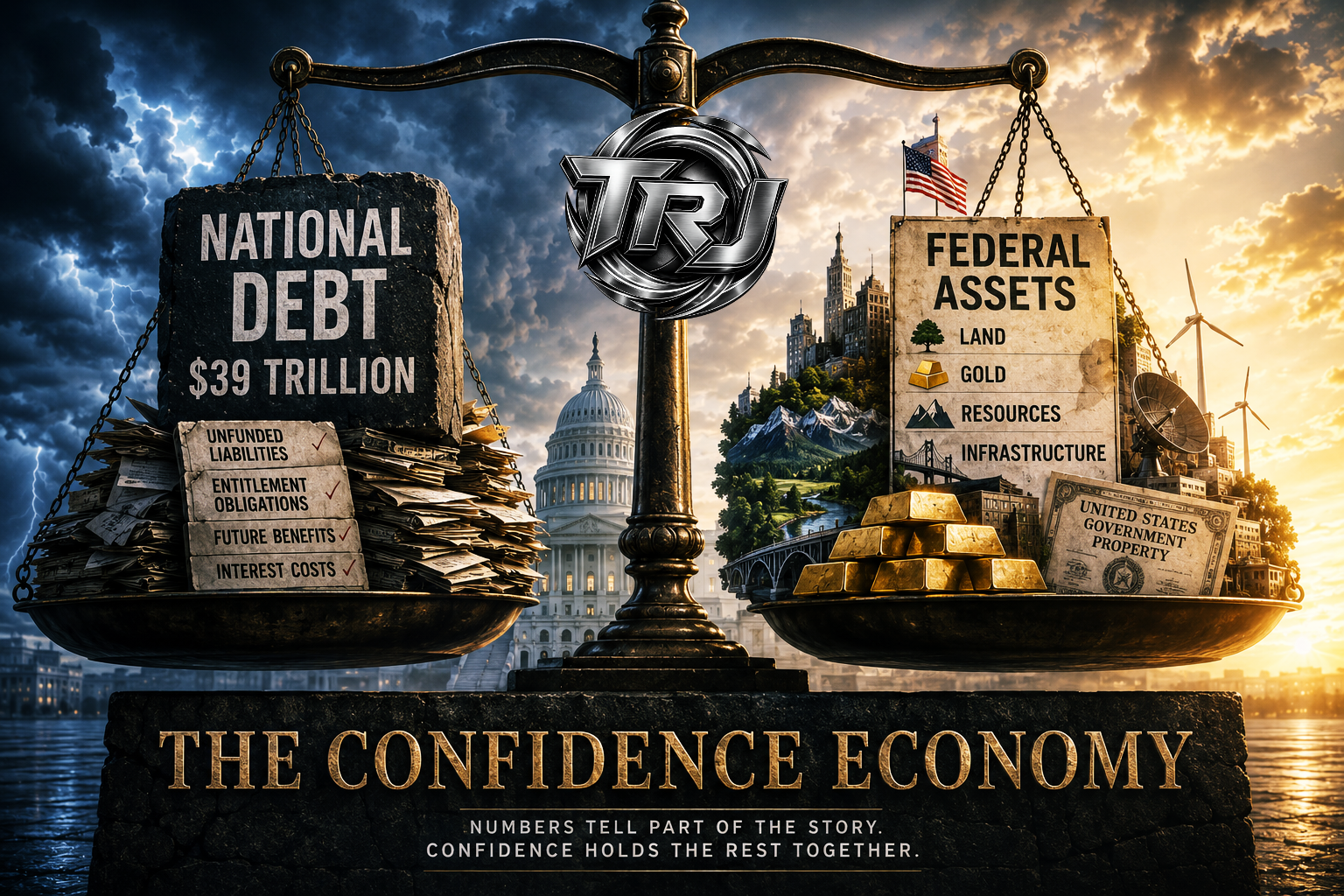
The Debt Everyone Sees. The Assets Few Discuss. The Questions Nobody Wants to Ask
Most Americans know the national debt is high. Many know it has surpassed $39 trillion. The number appears in headlines, political speeches, economic reports, and campaign advertisements so frequently that it has almost become background noise. Trillions of dollars are discussed so casually today that many people have lost any real sense of what those figures actually represent. The debt has become one of those subjects everyone recognizes yet few people fully examine.
The conversation usually follows a predictable pattern. Politicians blame one another. One party points at the other. Economists debate spending, taxes, deficits, and interest rates. News organizations report the latest debt figures before moving on to the next story. What rarely happens is a deeper examination of the nation’s actual balance sheet. Few people stop and ask what should be one of the most obvious questions in the entire discussion.
What does the federal government actually own?
That question may sound simple, but the answer reveals a much larger story about debt, wealth, accountability, and the financial condition of the United States. If an individual owed a substantial amount of money, lenders would examine their assets, liabilities, income, and ability to repay what they owe. Businesses are evaluated the same way. Investors study balance sheets before risking capital. Yet when discussing the federal government, the conversation often begins with the debt and ends with the debt.
The deeper questions are rarely explored. How much does the government actually own? How much wealth exists within the nation itself? How much of that wealth belongs to the government and how much belongs to the American people? Most importantly, how did the wealthiest nation in human history accumulate debt on a scale that would have seemed unimaginable only a few generations ago?
The answers reveal a reality that is far more complicated than the political arguments Americans hear every election cycle. The United States is not a poor country. The American people are not poor. Yet at the same time, the federal government carries debt, liabilities, and obligations that continue growing year after year. Understanding how both of those statements can be true at the same time requires looking beyond the headlines and examining the numbers themselves.
The Debt Everyone Talks About
According to U.S. Treasury data, the national debt stood at approximately $39.2 trillion as of June 2026. That figure alone is difficult to comprehend because it exists on a scale that most people never encounter in everyday life. Millions become billions. Billions become trillions. Eventually the numbers become so large that they lose their meaning. Americans hear the figure repeatedly, yet few stop to consider what $39.2 trillion actually represents or how such a debt burden was accumulated in the first place.
The debt did not appear overnight. It was built gradually through decades of deficit spending, borrowing, interest payments, emergency spending programs, military expenditures, entitlement commitments, infrastructure projects, economic stimulus measures, foreign aid programs, and countless legislative decisions made by successive administrations and Congresses. Each individual decision may have appeared manageable at the time. The cumulative result is what Americans see today.
Supporters of one political party often blame the other for the debt. Democrats point to Republican spending. Republicans point to Democratic spending. Each side presents charts, statistics, and historical comparisons intended to prove its case. Yet when examining a debt burden that has accumulated over multiple generations, the reality becomes harder to reduce to a partisan argument. The debt continued growing under both Democratic and Republican administrations. Congress changed hands repeatedly. Control of Washington shifted back and forth for decades. Through all of those changes, the debt continued moving in one direction.
That reality leads to a conclusion many Americans may find uncomfortable. The current debt burden was not created by one party. It was created over decades by elected officials from both major parties who repeatedly approved spending, borrowing, and obligations that exceeded the government’s revenues. The names changed. The debt remained. At some point the discussion stops being about which party deserves more blame and becomes a broader question of fiscal management and accountability.
The debt itself is only part of the story. Debt means very little without understanding what stands behind it. When an individual takes out a mortgage, there is a house attached to the loan. When a business borrows money, lenders examine assets, revenue streams, and future earning potential. The same basic principle naturally raises questions about the federal government. If Washington owes approximately $39.2 trillion, what assets exist behind those obligations?
That question led to one of the most surprising parts of this investigation. Many Americans assume the federal government possesses vast amounts of wealth capable of offsetting much of the debt. The government does own significant assets. It controls hundreds of millions of acres of land, military installations, federal buildings, infrastructure, mineral rights, energy resources, strategic reserves, equipment, and countless other holdings throughout the country. Yet once the numbers begin coming into focus, another question quickly emerges.
How much are those assets actually worth when compared to a debt burden approaching $40 trillion?
That is where the conversation starts becoming far more interesting than the political debates that dominate television screens every election season.
What Does the Government Actually Own?
The moment the discussion shifts from debt to assets, the national debt conversation begins looking very different. Most Americans know the federal government owns land, buildings, military bases, vehicles, infrastructure, and natural resources. What many people do not realize is how difficult it is to determine the total value of everything the federal government owns. Unlike a publicly traded corporation, the federal government is not attempting to maximize shareholder value, nor are many of its assets regularly bought and sold on open markets. Assigning precise values to military installations, federal infrastructure, strategic assets, and public lands can be extremely complicated.
The federal government’s official financial statements provide an accounting view of federal assets, but they do not represent a comprehensive economic valuation of all federal land, natural resources, stewardship assets, infrastructure, and other government-controlled resources. Many such assets have substantial value even when they are not held for sale or fully recognized on the federal balance sheet.
Even so, certain assets can be identified and examined individually. The federal government controls hundreds of millions of acres of land across the United States, particularly throughout the western states. These lands contain timber resources, grazing areas, energy reserves, mineral deposits, water rights, recreational areas, and other assets that possess measurable economic value. The government also owns thousands of federal buildings, research facilities, military installations, ports, equipment, and transportation infrastructure. Collectively, these assets represent a substantial amount of wealth.
The existence of those assets often creates the impression that the government’s financial position must be stronger than critics claim. On the surface, that assumption seems reasonable. After all, an entity that owns vast amounts of land and resources should possess significant value. The problem emerges when those assets are compared directly against the scale of the debt.
A debt burden approaching $40 trillion is so enormous that even very large asset values begin looking surprisingly small by comparison. Billions quickly become insignificant. Hundreds of billions begin appearing modest. Even figures measured in trillions can lose their impact when placed beside obligations measured in tens of trillions.
This realization became particularly clear when examining one asset that many Americans often assume could significantly reduce the debt burden: gold.
For generations, gold has occupied a unique place in the public imagination. It is tangible. It cannot be printed. It has served as a store of value for thousands of years. Whenever concerns about debt, inflation, or monetary policy arise, discussions about gold are never far behind. Many people assume that the United States possesses such a massive gold reserve that it could dramatically alter the country’s financial position if necessary.
The reality is surprising.
Using current market prices, the entire U.S. gold reserve is worth approximately $1.1 trillion. That figure is certainly impressive. Few individuals or institutions on Earth possess wealth measured in trillions of dollars. Yet when compared against a national debt of approximately $39.2 trillion, the picture changes dramatically. Even if every ounce of government-owned gold were sold tomorrow at current market prices, the overwhelming majority of the national debt would remain.
That realization is important because it demonstrates just how large the debt has become. The issue is no longer whether the government possesses valuable assets. It clearly does. The issue is whether those assets are sufficient to offset obligations that have accumulated over many decades. As the numbers continue coming into focus, the answer becomes increasingly difficult to ignore.
The debt is not large because the government lacks assets.
The debt is large because the obligations have grown far faster than the asset base supporting them.
And that realization led to an even bigger discovery. While examining federal assets, another balance sheet emerged that receives far less attention than the federal government’s books. It was not the balance sheet of Washington. It was the balance sheet of the American people themselves.
The Obligations Beyond the Debt
One of the most challenging aspects of examining the federal government’s financial condition is determining where the discussion should stop. The official national debt is approximately $39.2 trillion, and that figure is documented by the U.S. Treasury. Yet many economists, policy analysts, financial researchers, and our own research at TRJ suggest that the debt alone does not tell the entire story. Beyond the debt already recorded on government balance sheets are long-term commitments tied to pensions, healthcare programs, entitlement obligations, and other future liabilities that will require funding in the decades ahead.
Estimating the value of those future commitments is difficult because different methodologies produce different results. Some estimates remain relatively conservative while others produce significantly larger figures. During the course of this analysis, a high-end obligation scenario approaching $200 trillion was examined to illustrate how dramatically the financial picture changes when future commitments are considered alongside existing debt. The purpose of the exercise was not to claim that the federal government officially reports a $200 trillion debt burden, but rather to explore the scale of obligations that could exist when long-term commitments are included in the calculation.
The results were striking.
Using a generous estimated asset valuation of approximately $45.7 trillion in total federal assets—including land holdings, mineral rights, buildings, infrastructure, strategic assets, gold reserves, and other government-owned resources—a long-term obligation scenario approaching $200 trillion would produce an asset shortfall of roughly $154.3 trillion. It is important to note that the $45.7 trillion figure represents an estimated asset valuation scenario rather than an official federal asset figure, while the $200 trillion obligation figure represents a high-end long-term obligation scenario that includes future commitments beyond the officially reported national debt. Even allowing for significant debate over the exact figures, the exercise illustrates a reality that many Americans never consider. The challenge facing the federal government may extend far beyond the official debt number that dominates headlines.
While the nation’s gold reserves are often cited as a significant federal asset, their estimated market value of approximately $1.1 trillion represents only a very small fraction of the national debt and an even smaller fraction of the broader long-term obligations examined in this analysis. Even if every ounce of government-held gold were liquidated at current market prices, the overwhelming majority of both the national debt and the projected obligations would remain. In that context, debates over whether the gold is physically present at Fort Knox miss the larger point. Even if every ounce is exactly where it is supposed to be, the value of those reserves remains relatively small when compared to the scale of the debt and obligations being discussed.
Naturally, critics will argue that future obligations should not be treated the same way as debt already owed today. Supporters of that view point out that many commitments will be funded over decades through future revenues, taxation, economic growth, policy adjustments, and other mechanisms. That argument has merit. Future obligations are not identical to debt currently due and payable. At the same time, obligations remain obligations. They represent promises, commitments, and financial responsibilities that future federal administrations and Congresses will eventually be expected to address.
Perhaps the most important takeaway from this exercise is not the specific number itself but the scale of the gap it reveals. Even under generous asset assumptions, the federal government’s projected obligations appear to be growing much faster than the assets available to support them. Whether one agrees with the higher-end estimates or not, the direction of the trend raises legitimate questions about long-term sustainability, fiscal management, and the burden that will ultimately be passed to future generations. The larger those future commitments become, the more difficult it becomes to dismiss them as someone else’s problem waiting somewhere beyond the horizon.
Based on current debt levels, spending patterns, and long-term obligations, the financial consequences of today’s decisions may extend across multiple generations if the system continues operating in its present form. If significant fiscal, monetary, or economic disruptions occur beforehand, the outcome could look very different and potentially prove catastrophic for governments, financial institutions, businesses, and individuals alike.
The Balance Sheet of the American People
The deeper this investigation went, the more apparent it became that America’s debt story and America’s wealth story are not the same story. In fact, they may be two of the most misunderstood financial realities in the country today. For years, discussions about the national debt have created the impression that the United States is financially poor or somehow running out of wealth. The numbers tell a very different story.
According to Federal Reserve data, American households and nonprofit organizations collectively possess approximately $204.5 trillion in assets. After accounting for approximately $21.6 trillion in liabilities, total household and nonprofit net worth stands at roughly $183 trillion. Those figures represent one of the largest concentrations of private wealth ever accumulated by a population in human history.
At first glance, that number appears almost impossible to comprehend. A nation whose households collectively possess approximately $183 trillion in net worth does not sound like a nation facing financial problems. Yet the reality is more complicated than a single number can convey.
The existence of $183 trillion in household wealth does not mean every American is wealthy. It does not mean every family owns substantial assets. It does not mean every worker has a comfortable retirement account. It does not mean every community is prospering. A significant portion of that wealth exists in stocks, retirement funds, business ownership, commercial real estate, investment portfolios, intellectual property, and other assets that are not distributed evenly throughout society.
Millions of Americans continue living paycheck to paycheck despite the enormous wealth that exists within the broader economy. Rising housing costs, healthcare expenses, insurance premiums, food prices, energy costs, taxes, and inflation continue placing pressure on families across the country. The existence of national wealth does not automatically translate into individual financial security.
Both realities can be true simultaneously.
America can be extraordinarily wealthy while millions of Americans struggle financially.
America can possess trillions in private wealth while the federal government carries trillions in debt.
America can remain one of the richest nations in history while many citizens feel increasingly squeezed by the cost of living.
Understanding that distinction is critical because it reveals something that is often overlooked in discussions about debt. The wealth reflected in the Federal Reserve’s household net-worth figures does not belong to Washington. It belongs to homeowners, workers, entrepreneurs, investors, retirees, business owners, and families throughout the country. The federal government cannot simply count private wealth as a government asset. A family’s retirement account is not a Treasury asset. A privately owned business is not a federal asset. A home owned by an American family does not appear on the government’s balance sheet.
This is where one of the most striking contrasts in the entire discussion emerges. While American households spent decades building wealth through work, investment, innovation, savings, and entrepreneurship, the federal government spent decades accumulating debt, liabilities, and future obligations. The result is a divide between the financial condition of the American people and the financial condition of the government itself that raises a difficult question.
If the American people collectively built one of the largest pools of wealth in human history, how did Washington accumulate approximately $39.2 trillion in debt during the same period?
That question sits at the heart of this entire discussion, and answering it requires looking beyond the numbers themselves and examining the decisions that produced them.
How Did We Get Here?
This reality often frustrates Americans because political debates frequently focus on assigning blame to one side or the other. Democrats blame Republicans. Republicans blame Democrats. Election cycles come and go with promises to restore fiscal responsibility, reduce spending, eliminate waste, balance budgets, and place the nation on a more sustainable financial path. Yet when the debt is examined across multiple generations of leadership, a different picture begins to emerge. The debt continued growing under both Democratic and Republican administrations. Congress changed hands repeatedly. Control of Washington shifted back and forth for decades. Through all of those changes, the debt continued moving in one direction. At some point, the blame game becomes less important than understanding how we arrived here and what comes next.
Periods of unified government came and went. Periods of divided government came and went. The names changed, the parties changed, and the political arguments changed, but the overall trajectory remained remarkably consistent.
That does not mean every administration made identical decisions or that every policy contributed equally to the problem. It does mean that the current debt burden cannot honestly be assigned to one party while ignoring the role played by the other. The debt accumulated over decades of decisions made by elected officials from both major political parties, making the issue far larger than any single election cycle or administration.
At some point, the argument stops being about which side deserves more blame and becomes a question of accountability across the federal government as a whole.
If elected officials had consistently exercised long-term fiscal discipline over multiple generations, the country would not be approaching $40 trillion in debt today. If spending had been aligned more closely with revenues, if borrowing had been used more selectively, if long-term obligations had been managed more carefully, and if political leaders had focused as aggressively on reducing debt as they often focused on creating new programs and increasing their own compensation, the financial picture might look very different.
Instead, the federal government increasingly relied on borrowing as a normal operating practice. Deficits became routine. Everything else became routine. National debt became a permanent feature of the federal budget rather than a temporary consequence of extraordinary circumstances. New spending initiatives were often layered on top of existing obligations while previous commitments remained in place. Interest payments continued accumulating. Future liabilities continued expanding. The debt continued climbing higher and higher regardless of which party occupied the White House or controlled Capitol Hill.
The result is a financial condition that would concern most Americans if they encountered it anywhere else. Businesses that continuously spend beyond their means eventually face consequences. Households that repeatedly rely on debt eventually face consequences. State and local governments that fail to manage finances eventually face consequences. Yet the federal government operates on a scale so large that many people assume the normal rules no longer apply.
History suggests otherwise.
Throughout history, governments, empires, currencies, and financial systems have all been subject to economic realities. Some adjusted through growth. Some restructured obligations. Some inflated away portions of their debt. Some experienced prolonged periods of stagnation. Others faced far more severe outcomes. The details varied from one society to another, but the underlying principle remained remarkably consistent. Financial obligations cannot grow indefinitely without consequences.
That does not mean the United States is on the verge of collapse tomorrow. It does not mean a crisis is guaranteed to occur next year or even next decade. It does mean that debt matters, and the longer debt continues growing faster than the government’s ability to support it, the more difficult the eventual adjustments become.
The question Americans should be asking is not whether debt matters.
The question is how much debt is too much, how long current trends can continue, and what the eventual cost of those decisions will be for future generations.
The Inflation Question
For many Americans, discussions about debt feel distant and abstract until the conversation turns to inflation. Few people spend their time studying Treasury reports, Federal Reserve balance sheets, or government accounting statements. What people do notice are rising grocery bills, increasing insurance premiums, higher utility costs, more expensive homes, larger rent payments, and a dollar that no longer stretches as far as it once did. That reality is one of the primary reasons so many Americans are concerned about the nation’s long-term fiscal trajectory. A price increase of a few dollars may seem manageable in isolation, but when those increases occur repeatedly over years or decades, the cumulative impact can become significant. Costs that rise from three dollars to six dollars, then to eight dollars, ten dollars, or beyond place increasing pressure on household budgets. The concern for many Americans is not simply today’s prices, but the possibility that the purchasing power of their income and savings may continue eroding over time if inflationary pressures persist.
Purchasing power is one of the most important aspects of this discussion because it directly affects the daily lives of ordinary Americans. As purchasing power declines, the same amount of money buys fewer goods and services than it once did. The effects extend beyond groceries, utilities, and household expenses. Purchasing power also affects borrowing capacity. When prices rise and interest rates increase, homes, vehicles, and other major purchases often become more expensive to finance. In many cases, borrowers can end up repaying significantly more than the amount originally borrowed once interest costs are included. As affordability declines, Americans are often forced to take on larger loans, longer repayment periods, or higher monthly payments simply to maintain the same standard of living that previous generations achieved at a lower cost.
The average American does not need an economist to explain that something has changed. People remember what a gallon of milk cost years ago. I am old enough to remember paying 84 cents per gallon for gasoline on the reservation during the mid-1990s, while many city gas stations were charging between 99 cents and $1.10 per gallon. Many remember what houses sold for and recall filling a shopping cart with far fewer concerns about the total at checkout. They remember when a dollar stretched further than it does today and when everyday necessities consumed a smaller percentage of the household budget. They remember when a single income could support a family in ways that have become increasingly difficult in many parts of the country today. Whether those changes are caused by monetary policy, government spending, supply chain disruptions, energy costs, labor markets, corporate pricing decisions, or some combination of factors, the end result is the same. Americans are paying more for many of the necessities of life.
This is where the debt conversation becomes impossible to separate from the broader economy. Debt does not exist in isolation. Borrowing affects fiscal policy. Fiscal policy affects government spending. Government spending affects the economy. Interest payments affect budgets. Monetary policy affects lending, investment, and purchasing power. Every piece of the system interacts with the others.
Many economists disagree on the precise relationship between debt and inflation. Some argue that government borrowing can be managed effectively under the right conditions. Others warn that excessive debt and expanding obligations eventually place increasing pressure on the financial system. Entire schools of economic thought have been built around these debates. What remains beyond dispute is that debt carries costs. Interest must be paid. Obligations must be funded. Programs must be maintained. Future commitments eventually become present commitments.
As debt grows, those costs grow with it.
The concern for many Americans is not simply the size of today’s debt but the trajectory of the system itself. A government carrying nearly $40 trillion in debt must continue financing that debt. New obligations continue emerging while existing obligations remain in place. Future liabilities continue extending beyond the debt already recorded on official balance sheets. Each year brings new spending priorities, new economic challenges, new emergencies, and new political promises. Very few of those discussions begin with the question of how existing obligations will be reduced.
That reality helps explain why so many Americans feel uneasy despite living in one of the wealthiest nations in history. They see extraordinary wealth throughout the economy. They see technological innovation, massive corporations, financial markets reaching historic valuations, and trillions of dollars moving through the system. At the same time, they see rising costs, growing debt, increasing obligations, and a federal government that appears unable or unwilling to reverse the trajectory.
This is where the discussion moves beyond politics and enters the realm of mathematics. Governments can borrow. Governments can refinance debt. Governments can restructure priorities. Governments can change policies. What no government can do indefinitely is ignore the relationship between assets, liabilities, obligations, revenues, and expenses. Eventually those numbers matter.
The debate is not whether the numbers matter.
The debate is when they matter, how they matter, and who ultimately bears the cost when decades of fiscal decisions finally reach their limits.
The Question Nobody Wants to Ask
After examining the debt, the federal assets, the gold reserves, the household wealth figures, and the broader economic picture, one question continues emerging from the numbers. If the United States remains one of the wealthiest nations in human history, why is the federal government carrying approximately $40 trillion in debt?
The question challenges assumptions across the political spectrum because it forces Americans to confront two realities that exist at the same time. On one hand, the Federal Reserve’s data shows that American households and nonprofit organizations collectively possess approximately $183 trillion in net worth, representing one of the largest concentrations of private wealth ever accumulated by a population. On the other hand, the federal government continues carrying debt, liabilities, and future obligations that have expanded over decades despite operating within one of the most productive economies in the world.
The existence of enormous private wealth does not automatically solve the government’s debt problem. A family’s retirement account cannot be used to pay federal interest expenses. A privately owned business does not appear on the federal balance sheet. A homeowner’s equity does not reduce the national debt. The wealth exists, but much of that wealth belongs to the people who earned it, invested it, built it, and saved it. This distinction is critical because it highlights the difference between the financial condition of the American people and the financial condition of the federal government.
The debate surrounding the debt often becomes trapped between two extremes. One side treats the debt as an immediate catastrophe while the other treats it as little more than a political talking point. The numbers suggest a more complicated reality. The United States continues generating extraordinary amounts of wealth through its workers, businesses, entrepreneurs, investors, industries, and financial markets. At the same time, Washington continues carrying obligations that have grown far faster than many Americans believe is sustainable over the long term. The issue is not whether wealth exists within the country. The Federal Reserve’s own data answers that question. The issue is why a nation capable of generating such extraordinary wealth has allowed its government to accumulate debt on such an enormous scale.
That question becomes even more important when viewed through the lens of future generations. Debt accumulated today does not simply disappear tomorrow. Interest payments continue. Obligations remain. Programs require funding. New spending priorities emerge while existing commitments stay in place. Each generation inherits financial decisions made by the generations before it. The longer those obligations continue expanding, the more difficult the eventual solutions become.
Perhaps the most important realization to emerge from this investigation is that Americans are often looking at the wrong balance sheet. The country’s wealth and the government’s debt are frequently discussed as though they are the same thing. They are not. One reflects the wealth created by millions of individuals, families, workers, investors, and business owners. The other reflects decades of fiscal decisions made by elected officials from both major political parties. Understanding that distinction may be one of the most important steps toward having an honest conversation about where the country stands today and where it may be heading in the future.
The Full Balance Sheet
There is another aspect of this discussion that continues generating debate among economists, investors, monetary historians, and ordinary citizens. Many people view modern fiat currencies differently than previous generations viewed money. A gold coin possesses value as a tangible asset regardless of which government happens to be in power. A fiat currency, by contrast, derives much of its value from confidence in the government, economy, institutions, and financial system supporting it. Critics argue that this distinction matters because confidence itself cannot be measured, stored, or audited in the same way as a tangible asset. To those individuals, a currency increasingly backed by promises, borrowing, and future obligations rather than hard assets raises legitimate concerns about long-term sustainability.
Many Americans assume that money exists primarily as physical currency circulating throughout the economy. The reality is far different. While approximately $2.42 trillion in paper currency remains in circulation, the overwhelming majority of modern money exists not as cash but as digital account balances, bank deposits, credit instruments, loans, and electronic ledger entries spread throughout the global financial system. At the same time, the estimated market value of the nation’s gold reserves is approximately $1.1 trillion.
For critics of modern fiat monetary systems, this distinction is significant. We argue that much of what is commonly referred to as money no longer represents a tangible asset but instead exists as a financial claim, digital record, or promise supported by confidence in the institutions and systems behind it. From that perspective, the modern monetary system is built less upon physical reserves and more upon trust, credit, and the expectation that those promises will continue being honored in the future.
This raises a difficult question. If the overwhelming majority of modern money exists as digital balances, financial claims, and debt-based instruments rather than tangible assets, what ultimately supports the value of those claims if confidence in the system begins to erode? Supporters argue that economic output, taxation, financial markets, and institutional stability provide that support. Critics remain unconvinced, pointing instead to rising debt, expanding obligations, inflationary pressures, and a monetary system that appears increasingly dependent upon continued confidence and perpetual growth.
As a critic of modern fiat monetary systems, I view the issue somewhat differently. If a currency possesses no direct redeemability into a tangible asset and derives its value primarily from confidence, then an obvious question emerges: what ultimately gives that promise value? How does a piece of paper acquire worth on its own? What gives a digital ledger entry value beyond the belief that someone else will accept it tomorrow? These questions sit at the center of the debate between supporters of fiat currencies and those who favor asset-backed monetary systems.
Supporters argue that the value comes from the productive capacity of the economy, the government’s ability to tax, the stability of institutions, and the confidence of individuals, businesses, governments, and financial markets participating in the system both nationally and globally.
In my view, modern fiat currencies possess purchasing power because of the confidence supporting them, but they possess little or no intrinsic value of their own. The paper itself has virtually no independent worth, and the value assigned to it is derived primarily from confidence, legal tender status, institutional support, and the collective belief that others will continue accepting it in exchange for goods and services both nationally and globally. In that sense, I believe the dollar lacks the kind of tangible, inherent value historically associated with asset-backed forms of money such as gold and silver.
From what we can see throughout this investigation, we have reached a conclusion that many economists would dispute but that many critics of modern fiat monetary systems would likely understand. In TRJ’s view, the modern dollar possesses purchasing power because of confidence, legal tender status, institutional support, and widespread acceptance, but no meaningful intrinsic value. The paper itself has virtually no independent worth, and the overwhelming majority of modern money exists not as tangible currency but as digital balances, financial claims, debt instruments, and accounting entries. What gives the dollar value is not the paper itself but confidence, legal tender status, institutional support, and the collective belief that others will continue accepting it in exchange for goods and services both nationally and globally.
To TRJ, and to many critics of modern fiat monetary systems, that distinction matters. Purchasing power and intrinsic value are not the same thing. One is based upon acceptance. The other is based upon what something is worth independent of belief. From that perspective, the modern monetary system rests largely upon confidence, promises, and the expectation that those promises will continue being honored rather than upon tangible value.
Confidence is a powerful thing. It can build economies, sustain currencies, and support entire financial systems. But confidence can also be fragile. If confidence erodes, so does the value assigned to the paper. Trust is much like a marriage. As long as trust remains, the relationship survives. When trust disappears, people walk away. Financial systems are no different, whether operating nationally or globally.
TRJ VERDICT
After examining the national debt, federal assets, long-term obligations, household wealth, gold reserves, inflation, purchasing power, and the structure of the modern monetary system itself—with certain figures necessarily presented as estimates and valuation ranges—one conclusion becomes difficult to ignore.
America appears wealthy on paper. The balance sheets say so. The asset valuations say so. The financial markets say so. Yet many Americans increasingly question how much of that wealth represents tangible value and how much exists as financial claims, debt-supported valuations, and confidence-driven assets within the broader monetary system.
Washington, however, has accumulated debt and obligations on a scale that would have been difficult for previous generations to imagine.
The debt did not appear overnight. It was built over decades through borrowing, spending, expanding obligations, and political decisions made by elected officials from both major parties. Administrations changed. Congress changed. The debt continued growing.
At the same time, this investigation revealed a deeper issue extending beyond the debt itself. Modern money is increasingly detached from tangible assets and increasingly dependent upon confidence, institutional support, legal tender status, and the collective belief that others will continue accepting it in exchange for goods and services.
Supporters argue that economic output, taxation, financial markets, and institutional stability provide that support. Critics remain unconvinced. After reviewing the debt, assets, obligations, purchasing power, monetary structure, and broader financial picture examined throughout this investigation, we remain unconvinced as well.
As critics of modern fiat monetary systems, we believe the modern dollar possesses purchasing power but lacks meaningful intrinsic value. The paper itself has virtually no independent worth. What gives it value is confidence, and confidence is among the most fragile foundations upon which any financial system can rest.
Regardless of which view one accepts, one reality remains clear. The purchasing power of modern money does not originate from the paper itself. It originates from the broader system supporting it. Individuals, businesses, governments, and financial institutions continue accepting the currency because they believe others will continue accepting it tomorrow. If modern currency contained redeemable gold, silver, copper, or other tangible assets within the note itself, the debate surrounding intrinsic value would be fundamentally different. Modern U.S. currency does not. Even the precious metal content historically associated with circulating coinage has largely disappeared from modern currency, leaving most forms of money dependent upon assigned rather than intrinsic value.
Confidence is powerful. It can build economies, sustain currencies, and support entire financial systems.
But confidence is just that—confidence. And whether that confidence is justified or misplaced, confidence itself appears increasingly fragile across many institutions and systems throughout the world. Concerns surrounding financial stability, sovereign debt, inflation, banking risks, and economic uncertainty continue to be discussed by governments, central banks, financial institutions, and market participants alike.
Are we paying attention to the balance sheet?
And perhaps more importantly, are we paying attention to the assumptions holding the balance sheet together?
Federal Reserve Economic Data (FRED), Federal Reserve Bank of St. Louis. Households and Nonprofit Organizations: Net Worth, Level (TNWBSHNO). Data provided by the Board of Governors of the Federal Reserve System.

U.S. Department of the Treasury and Office of Management and Budget, Financial Report of the United States Government, Fiscal Year 2025, March 19, 2026. Federal government’s consolidated financial statements, assets, liabilities, long-term fiscal projections, stewardship assets, natural resources disclosures, and fiscal sustainability analysis. (Free Download)
U.S. Department of the Treasury, Fiscal Data, Status Report of U.S. Government Gold Reserve, Treasury-Owned Gold Holdings, May 31, 2026. Treasury records indicate approximately 261.5 million fine troy ounces of gold with an official book value of approximately $11.04 billion based on the statutory gold price of $42.2222 per ounce.
Important Note: The Treasury’s reported book value does not reflect the current market value of gold. The official figures continue using the statutory valuation of approximately $42.22 per troy ounce established decades ago. At contemporary market prices, the estimated value of the same gold holdings would be substantially higher and could approach or exceed approximately $1.1 trillion depending on prevailing gold prices at the time of calculation. (Free Download)
U.S. Department of the Treasury – Bureau of the Fiscal Service, Debt to the Penny and Who Holds It database and historical debt records. (Free download)
Federal Reserve Board, Financial Accounts of the United States – Balance Sheet of Households and Nonprofit Organizations (1952–2026). Household and nonprofit net worth data. (Free Download)
U.S. Department of the Treasury, Bureau of the Fiscal Service, Daily Treasury Statement: Cash and Debt Operations of the United States Treasury, June 11, 2026. (Free Download)
Board of Governors of the Federal Reserve System, Money and Payments: The U.S. Dollar in the Age of Digital Transformation (January 2022).
The Federal Reserve itself has acknowledged that public confidence is essential to the functioning of modern money and payment systems. According to the Federal Reserve’s 2022 discussion paper Money and Payments: The U.S. Dollar in the Age of Digital Transformation, “For a nation’s economy to function effectively, its citizens must have confidence in its money and payment services. (Free Download)
U.S. Department of the Treasury, The Future of Money and Payments (September 2022).
Board of Governors of the Federal Reserve System, Money and Payments: The U.S. Dollar in the Age of Digital Transformation (January 2022). (Free Download)
Federal Reserve Bank of Dallas, Money (Everyday Economics Series). (Free Download)
| Category | Amount | Type |
|---|---|---|
| Gold Reserves (Market Value @ $4,209.03/oz) | $1.1T | Estimated Market Value |
| Federal Land | $3.2T – $9.6T | Estimated Range |
| Mineral Rights & Resources | $3T – $10T | Estimated Range |
| Oil & Gas Resources | $2T – $8T | Estimated Range |
| Timber Resources | $0.5T – $2T | Estimated Range |
| Federal Buildings & Facilities | $1T – $3T | Estimated Range |
| Military Bases & Infrastructure | $2T – $5T | Estimated Range |
| Military Equipment & Assets | $2T – $5T | Estimated Range |
| Federal Loans & Financial Assets | $2T | Estimated Value |
| Total Federal Assets (Low) | $16.8T | Scenario |
| Total Federal Assets (Mid) | $27.6T | Scenario |
| Total Federal Assets (High) | $45.7T | Scenario |
| National Debt | ~$39T | Official |
| Other Federal Liabilities | ~$9T | Official |
| Total Official Federal Liabilities | ~$48T | Official |
| Foreign-Held Debt | ~$9.5T | Included in National Debt |
| Domestic-Held Debt | ~$29.5T | Included in National Debt |
| Long-Term Obligations (Low Estimate) | ~$100T | Estimate |
| Long-Term Obligations (High Estimate) | ~$200T+ | Estimate |
| Asset Shortfall vs Official Liabilities (Low Asset Scenario) | -$31.2T | Calculated |
| Asset Shortfall vs Official Liabilities (Mid Asset Scenario) | -$20.4T | Calculated |
| Asset Shortfall vs Official Liabilities (High Asset Scenario) | -$2.3T | Calculated |
| Asset Shortfall vs $200T Long-Term Obligation Scenario | -$154.3T | Calculated |
| Component | Amount |
|---|---|
| Household Real Estate | $53.0T |
| Household Nonfinancial Assets | $62.9T |
| Corporate Equity & Business Ownership | Included within Net Worth |
| Retirement Accounts, Stocks, Bonds, Mutual Funds, Cash & Deposits | Included within Net Worth |
| Other Household Assets | Included within Net Worth |
| Household & Nonprofit Liabilities (Mortgages, Loans, etc.) | Already Netted Out |
| Total Household & Nonprofit Net Worth | $183.0T |
| Item | Amount |
|---|---|
| Household & Nonprofit Net Worth | $183T |
| National Debt | $39T |
TRJ BLACK FILE — THE CONFIDENCE ECONOMY
These are documented financial realities.
FILE #001 — The Debt
The United States currently carries approximately $39.2 trillion in national debt. The debt accumulated over decades through borrowing, spending, deficits, wars, entitlement programs, economic interventions, and routine government operations.
FILE #002 — The Assets
The federal government controls vast land holdings, infrastructure, military installations, natural resources, strategic reserves, buildings, and other assets throughout the United States. Determining their total value is difficult because many are not regularly bought and sold on open markets and are not fully reflected as economic valuations within official financial statements.
FILE #003 — The Gold
Treasury records show the United States maintains approximately 261.5 million fine troy ounces of gold. While substantial, the estimated market value of those reserves remains only a fraction of the debt and broader obligations examined throughout this investigation.
FILE #004 — The Obligations
Beyond the officially reported national debt, long-term obligations tied to pensions, healthcare programs, entitlement commitments, and other future responsibilities represent additional financial burdens that future governments will be required to address.
FILE #005 — The Wealth
American households and nonprofit organizations collectively possess approximately $183 trillion in net worth. The wealth of the American people and the financial condition of the federal government are not the same thing.
FILE #006 — The Paper
Approximately $2.4 trillion exists as physical paper currency. Physical currency represents only a small portion of the modern monetary system.
FILE #007 — The Digital Majority
The overwhelming majority of modern money exists not as cash but as digital balances, deposits, loans, credit instruments, and electronic ledger entries.
FILE #008 — The Fiat System
The dollar is no longer redeemable for gold or silver. Modern currency derives its value through legal tender status, institutional support, economic activity, taxation, financial markets, and public acceptance.
FILE #009 — The Value Question
Supporters argue that productive capacity, economic output, taxation, institutional stability, and financial markets provide sufficient support. Critics remain unconvinced.
FILE #010 — The Realization
Much of the modern financial system operates through records, claims, obligations, digital entries, and confidence in the institutions supporting them. The system functions because people continue believing those claims will be honored tomorrow.
The story was never simply about debt. The story was never simply about gold. The story was never simply about paper currency.
The story is that much of the modern financial system ultimately rests upon confidence. Confidence is powerful. It can build economies, sustain currencies, and support entire financial systems. But confidence is just that—confidence.


🔥 NOW AVAILABLE! 🔥
🔥 NOW AVAILABLE! 🔥
📖 INK & FIRE: BOOK 1 📖
A bold and unapologetic collection of poetry that ignites the soul. Ink & Fire dives deep into raw emotions, truth, and the human experience—unfiltered and untamed
🔥 Kindle Edition 👉 https://a.co/d/9EoGKzh
🔥 Paperback 👉 https://a.co/d/9EoGKzh
🔥 Hardcover Edition 👉 https://a.co/d/0ITmDIB
🔥 NOW AVAILABLE! 🔥
📖 INK & FIRE: BOOK 2 📖
A bold and unapologetic collection of poetry that ignites the soul. Ink & Fire dives deep into raw emotions, truth, and the human experience—unfiltered and untamed just like the first one.
🔥 Kindle Edition 👉 https://a.co/d/1xlx7J2
🔥 Paperback 👉 https://a.co/d/a7vFHN6
🔥 Hardcover Edition 👉 https://a.co/d/efhu1ON
Get your copy today and experience poetry like never before. #InkAndFire #PoetryUnleashed #FuelTheFire
🚨 NOW AVAILABLE! 🚨
📖 THE INEVITABLE: THE DAWN OF A NEW ERA 📖
A powerful, eye-opening read that challenges the status quo and explores the future unfolding before us. Dive into a journey of truth, change, and the forces shaping our world.
🔥 Kindle Edition 👉 https://a.co/d/0FzX6MH
🔥 Paperback 👉 https://a.co/d/2IsxLof
🔥 Hardcover Edition 👉 https://a.co/d/bz01raP
Get your copy today and be part of the new era. #TheInevitable #TruthUnveiled #NewEra
🚀 NOW AVAILABLE! 🚀
📖 THE FORGOTTEN OUTPOST 📖
The Cold War Moon Base They Swore Never Existed
What if the moon landing was just the cover story?
Dive into the boldest investigation The Realist Juggernaut has ever published—featuring declassified files, ghost missions, whistleblower testimony, and black-budget secrets buried in lunar dust.
🔥 Kindle Edition 👉 https://a.co/d/2Mu03Iu
🛸 Paperback Coming Soon
Discover the base they never wanted you to find. TheForgottenOutpost #RealistJuggernaut #MoonBaseTruth #ColdWarSecrets #Declassified


Sponsored • TRJ Ads
Inquiries: contact@therealistjuggernaut.com







Thank you for this excellent article, John. This is a subject I have been concerned about for quite some time and the information in the article gives us a good look at real numbers. People don’t realize how large 1 Trillion is and that’s part of the problem. If the debt was under 10 Trillion I would still be concerned but not as concerned as I am that it is now at 40 T. One thing in this entire discussion that is a certainty is that there will be interest on the debt. The rate will change but In fiscal year 2025, the U.S. federal government spent $970 billion on net interest payments for the national debt. I understand that the government and individuals also earn money on investments but I don’t see interest income as much of a sure thing as interest spending once someone has built up a sizable debt. This is why I’ve been saying for years that we need a balanced budget and that we even need to start paying down the debt if at all possible. The different opinions about Long-Term Obligations is also an important factor. It looks to be a hard number to pinpoint.
You mentioned the folks that are living paycheck to paycheck. Many of those people are now having to take on debt just to keep up with expenses. The pressures that financial situations can create can have a huge effect on people. These are the people I’m concerned with. Adding a couple of trillion to the debt along with another 3/4 Trillion in interest each year impacts everyone but those in what used to be called the middle class seem to get hit the hardest. If we are seriously concerned about the future of all Americans, we need to balance the budget and start making moves to lower the debt. This should have been done long ago, but better late than never. I do think we will eventually get to a place that we can’t rebound. I have no idea where that is but some think we are already past it.
I wish the best for America but I think we have been too materialistic for too long. Many times we have bought things that we cannot afford both publicly and privately. We have trusted in our money more than we have trusted in God. That has been a big mistake and only God knows the future. I hope our debt numbers start to go down. If the numbers keep increasing, there will eventually be a day of reckoning and the higher the number is the more pain it will cause.
Thank you for this outstanding article.
You’re very welcome, Chris. I appreciate you reading the article and taking the time to leave such a thoughtful comment.
One thing I’ve learned while we were researching this subject is that most people simply cannot visualize numbers this large. Once you start talking about tens of trillions of dollars, the scale becomes difficult to comprehend.
I also share your concern for the people who are struggling financially. Behind all of these numbers are real people trying to pay bills, support families, and keep up with rising costs. I think those in Washington ought to be ashamed of how far they’ve allowed this situation to progress and for how long it has been ignored.
I also think your point about faith is very important.
We can analyze the numbers and discuss possible outcomes, but ultimately only God knows what the future holds.
Thank you again for the excellent comment and for your continued support, Chris. I greatly appreciate it. I hope you have a great day and week ahead. 😎
You’re welcome, John, and thank you again for doing research on this topic. I have put up posts about it off and on for years and I’m very surprised the subject doesn’t get more attention.
Thank you for your kind words. I hope you have a great day and week ahead as well!😊