
Thank you for reading or listening to The Realist Juggernaut. Independent journalism should be accessible to everyone.
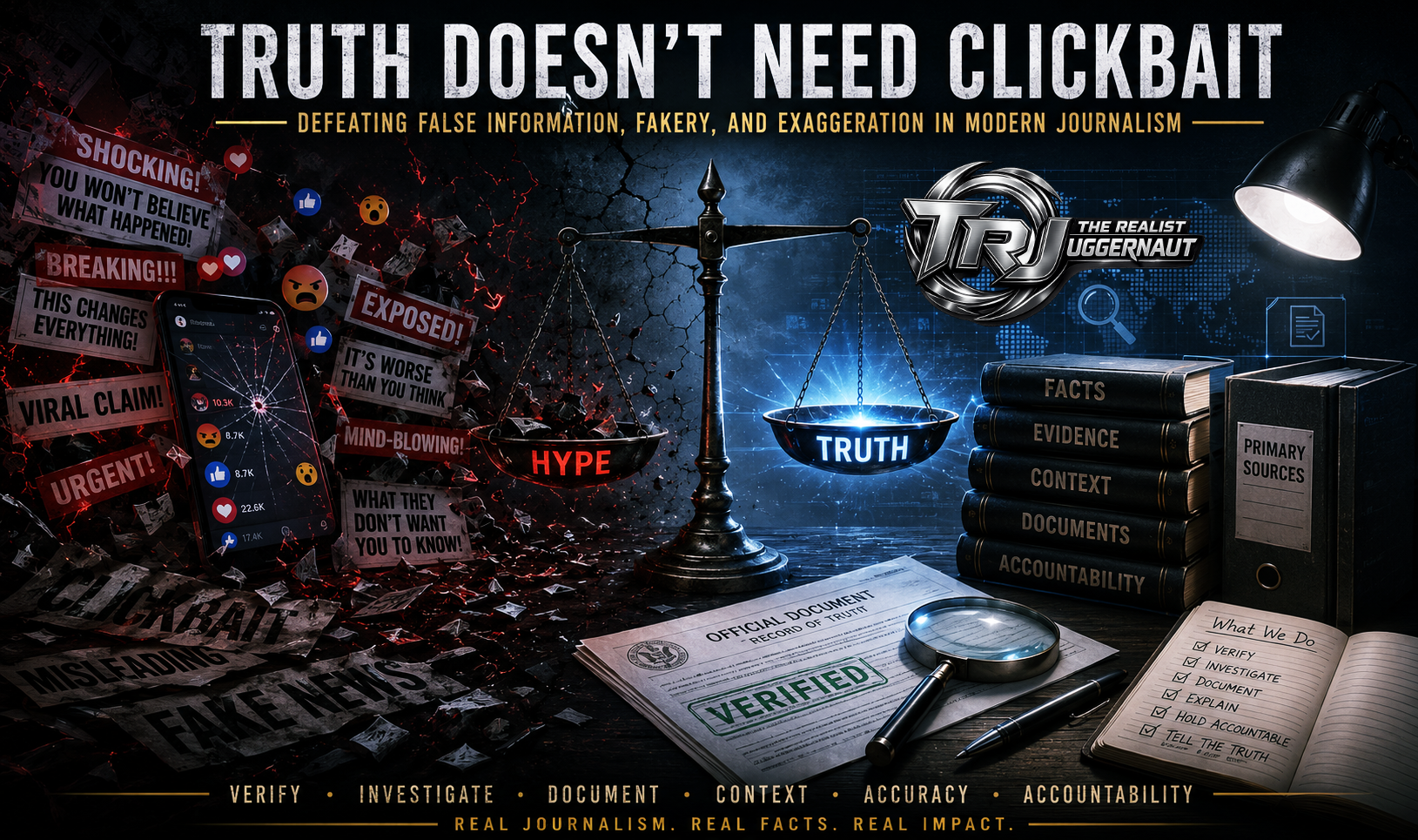
THE WAR AGAINST CLICKBAIT
Journalism has always carried an enormous responsibility. At its foundation, the purpose of reporting is to investigate what happened, verify the available evidence, establish the necessary context, and provide the public with information that allows people to understand the world around them. That responsibility has not disappeared in the digital age, but the environment in which journalism operates has changed dramatically.
Today, information moves across the world within seconds. A headline published in one country can reach millions of people before reporters, scientists, government agencies, investigators, or other experts have had enough time to determine exactly what happened. Social media posts can travel farther than the original documents upon which a story is based. Images can be removed from context, videos can be manipulated, artificial intelligence can generate convincing synthetic content, and speculation can quickly become indistinguishable from established fact once enough people begin repeating it.
At the center of this problem is an economy built around attention.
Clicks generate traffic. Traffic generates revenue. Engagement increases visibility. Algorithms often reward content that provokes immediate emotional reactions, creating an environment where fear, anger, outrage, shock, and curiosity can become powerful tools for attracting an audience. The pressure to capture attention can encourage headlines that make events appear more dramatic, dangerous, mysterious, or conclusive than the available evidence actually supports.
This does not mean every compelling headline is clickbait or that every extraordinary story is exaggerated. Reality itself can be extraordinary. Scientific discoveries can fundamentally alter our understanding of the universe. Cyberattacks can threaten critical infrastructure. Governments can make decisions with enormous consequences. New technologies can introduce possibilities that once belonged entirely to science fiction. When the facts are remarkable, journalism should never diminish them simply to appear cautious.
The responsibility is to ensure that the evidence is just as remarkable as the claim.
That distinction has become especially important as readers attempt to navigate an enormous volume of information from sources with dramatically different standards of verification. A technically accurate statement can still create a false impression when critical context is omitted. Preliminary research can be presented as scientific certainty. A theoretical capability can be portrayed as an operational technology. A cybersecurity vulnerability can become a claim that an entire national infrastructure system has already been compromised. A scientific phenomenon can be transformed into an approaching catastrophe even when researchers have made no such prediction.
Once those exaggerated interpretations enter the information ecosystem, correcting them becomes considerably more difficult. The original claim may have already reached millions of people, while the detailed explanation that follows receives only a fraction of the attention.
This is one reason The Realist Juggernaut approaches certain subjects differently.
When we investigate a complex story, our objective is not simply to tell readers that something happened. We want to understand what happened, how it happened, what the evidence actually establishes, what remains uncertain, and where the limitations of current knowledge begin. That sometimes requires examining official documents, government records, scientific research, technical reports, public statements, cybersecurity advisories, court records, and other primary or authoritative materials before reaching a conclusion.
It also means separating facts that may appear similar but carry entirely different implications.
There is a difference between a vulnerability and a confirmed breach. There is a difference between a cyberattack affecting individual infrastructure systems and an adversary controlling an entire national electrical grid. There is a difference between scientific evidence and scientific speculation. There is a difference between an experimental technology and a fully operational system. There is a difference between something being technically possible and evidence showing that it is actually happening.
Those distinctions matter.
They are also easily lost when complicated subjects are compressed into headlines designed primarily to generate attention.
This is why our reporting may sometimes spend additional time establishing exactly what a technology, scientific discovery, cybersecurity threat, government action, or developing event can and cannot do. We would rather provide readers with enough context to understand the limitations of the evidence than leave them with an exaggerated impression simply because the exaggerated version sounds more exciting. At times, this may result in some repetition as we work to ensure the information we are presenting is clearly understood and not misinterpreted.
At the same time, thorough journalism must remain readable. Repeating the same explanation too many times can become counterproductive, even when the intention behind that repetition is to prevent misunderstanding. There is a balance between reinforcing an important distinction and trusting readers once that distinction has been clearly established. That is a balance every publication committed to detailed reporting must continue working to maintain, including our own.
The larger challenge extends beyond traditional clickbait.
Artificial intelligence has introduced an entirely new dimension to the information problem. Synthetic photographs can depict events that never occurred. Artificially generated voices can imitate real people. Deepfake videos can create convincing representations of individuals saying or doing things they never said or did. Entire articles, social media campaigns, websites, and networks of automated accounts can be created at a scale that would have been impossible only a few years ago.
The ability to manufacture convincing information is advancing rapidly, making verification more important than ever.
Future readers may encounter an environment where seeing something with their own eyes is no longer enough to establish that it happened. Journalism will therefore carry an even greater responsibility to establish provenance, examine original sources, verify timelines, identify manipulation, distinguish authentic material from synthetic content, and acknowledge openly when available evidence does not permit a definitive conclusion.
Trust cannot survive without that discipline.
News organizations also have to recognize that correcting misinformation does not give journalism permission to replace one misleading narrative with another. Accuracy cannot depend upon which political party benefits, which institution is embarrassed, which corporation is affected, or which conclusion generates the greatest audience response. Evidence must remain evidence regardless of whose interests it supports or challenges.
That principle is central to what we do at The Realist Juggernaut.
We do not believe readers need to be frightened into clicking an article. We do not believe speculation should be presented as established fact. We do not believe uncertainty should be hidden when uncertainty genuinely exists. We also do not believe legitimate threats, documented wrongdoing, scientific discoveries, technological developments, or matters of public importance should be minimized simply because the facts are uncomfortable.
Our responsibility is to follow the evidence wherever it leads.
That philosophy is also why some of our investigations are considerably longer than the abbreviated reporting that has become common across the modern information environment. Complex subjects cannot always be responsibly explained in a few hundred words. Documents require context. Technical systems require explanation. Conflicting claims require examination. Timelines must be established, and conclusions should be supported by the evidence presented before them.
Readers deserve more than a headline designed to capture their attention.
They deserve to understand the story behind it.
This is particularly important because the consequences of misinformation do not remain confined to the internet. False information can damage reputations, influence elections, create unnecessary public fear, distort scientific understanding, affect financial decisions, undermine confidence in legitimate institutions, and interfere with the public’s ability to recognize genuine threats when they emerge.
When everything is described as a catastrophe, people eventually stop recognizing actual catastrophes.
When every scientific development becomes revolutionary, genuine breakthroughs lose their significance.
When every cybersecurity incident becomes an existential attack, the public becomes less capable of distinguishing routine threats from events that truly demand urgent attention.
And when every headline is designed to provoke the strongest possible reaction, journalism risks becoming another form of entertainment rather than a public service built upon truth.
The solution is not less journalism.
It is better journalism.
It means slowing down long enough to verify before declaring. It means reading the document instead of repeating what someone claimed the document said. It means examining the research rather than relying solely upon a sensational interpretation of its findings. It means correcting errors when they occur and remaining willing to reconsider conclusions when new evidence emerges.
It also means respecting readers enough to give them the facts without assuming those facts must first be exaggerated to become interesting.
At The Realist Juggernaut, that is the standard we continue working to uphold. We will investigate stories that deserve deeper examination. We will challenge claims when the evidence does not support them. We will document what we find, explain why it matters, distinguish what is known from what remains uncertain, and provide our readers with the context necessary to understand the difference.
We will not always get everything perfect. No serious journalistic organization should pretend that it will. Responsible journalism requires constant examination of its own methods, including recognizing when an explanation can be clearer, when an article can be stronger, or when something can be presented more effectively without sacrificing depth or accuracy.
What cannot change is the commitment behind the work.
The modern information environment does not need more exaggeration masquerading as journalism. It does not need more fabricated outrage, misleading headlines, synthetic fakery, unsupported speculation, or carefully constructed narratives designed primarily to manipulate audiences into clicking, sharing, and reacting.
It needs evidence.
It needs context.
It needs accountability.
It needs journalists willing to investigate beyond the headline and readers willing to look beyond it.
The truth will not always be the loudest information competing for attention. It may not always produce the most sensational headline or generate the fastest reaction. But journalism was never supposed to manufacture a more exciting version of reality simply because reality had to compete for clicks.
The truth does not need clickbait.
It needs to be investigated.
It needs to be documented.
And above all, it needs to be told.


🔥 NOW AVAILABLE! 🔥
🔥 NOW AVAILABLE! 🔥
📖 INK & FIRE: BOOK 1 📖
A bold and unapologetic collection of poetry that ignites the soul. Ink & Fire dives deep into raw emotions, truth, and the human experience—unfiltered and untamed
🔥 Kindle Edition 👉 https://a.co/d/9EoGKzh
🔥 Paperback 👉 https://a.co/d/9EoGKzh
🔥 Hardcover Edition 👉 https://a.co/d/0ITmDIB
🔥 NOW AVAILABLE! 🔥
📖 INK & FIRE: BOOK 2 📖
A bold and unapologetic collection of poetry that ignites the soul. Ink & Fire dives deep into raw emotions, truth, and the human experience—unfiltered and untamed just like the first one.
🔥 Kindle Edition 👉 https://a.co/d/1xlx7J2
🔥 Paperback 👉 https://a.co/d/a7vFHN6
🔥 Hardcover Edition 👉 https://a.co/d/efhu1ON
Get your copy today and experience poetry like never before. #InkAndFire #PoetryUnleashed #FuelTheFire
🚨 NOW AVAILABLE! 🚨
📖 THE INEVITABLE: THE DAWN OF A NEW ERA 📖
A powerful, eye-opening read that challenges the status quo and explores the future unfolding before us. Dive into a journey of truth, change, and the forces shaping our world.
🔥 Kindle Edition 👉 https://a.co/d/0FzX6MH
🔥 Paperback 👉 https://a.co/d/2IsxLof
🔥 Hardcover Edition 👉 https://a.co/d/bz01raP
Get your copy today and be part of the new era. #TheInevitable #TruthUnveiled #NewEra
🚀 NOW AVAILABLE! 🚀
📖 THE FORGOTTEN OUTPOST 📖
The Cold War Moon Base They Swore Never Existed
What if the moon landing was just the cover story?
Dive into the boldest investigation The Realist Juggernaut has ever published—featuring declassified files, ghost missions, whistleblower testimony, and black-budget secrets buried in lunar dust.
🔥 Kindle Edition 👉 https://a.co/d/2Mu03Iu
🛸 Paperback Coming Soon
Discover the base they never wanted you to find. TheForgottenOutpost #RealistJuggernaut #MoonBaseTruth #ColdWarSecrets #Declassified


Sponsored • TRJ Ads
Inquiries: contact@therealistjuggernaut.com





Nice new look. Have a great sunday.
Thank you very much, Milu.
I’m glad you like the new look. I hope you have a great Sunday as well! 😎