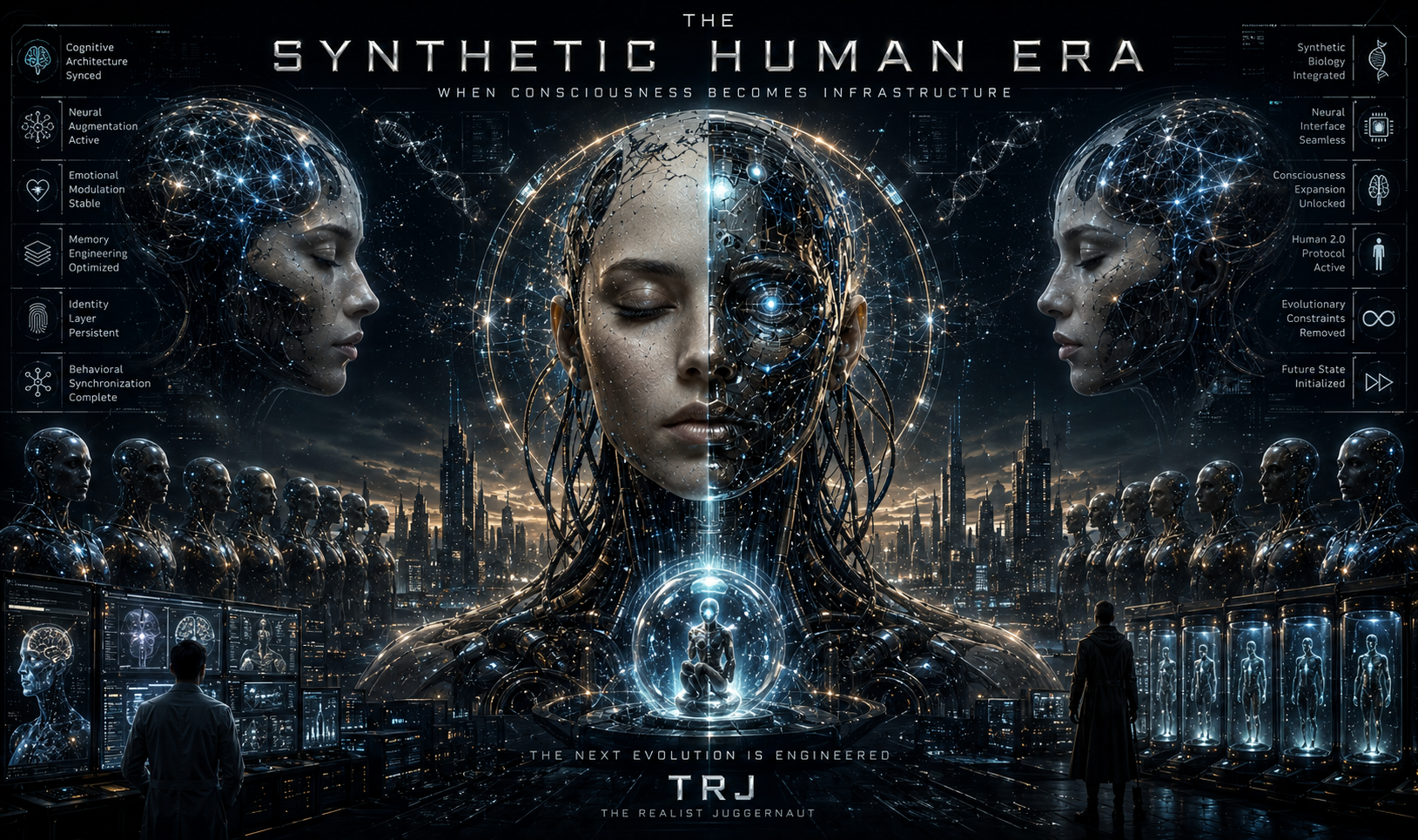
When Synthetic Civilization Stops Needing Human Pair Bonding.
Human civilization was built around biological continuity.
For thousands of years, societies stabilized themselves through reproduction, family structures, generational inheritance, pair bonding, communal dependency, and emotional investment in future descendants. Entire civilizations were organized around the assumption that human intimacy, emotional attachment, sexuality, parenting, and long-term partnership remained inseparable from the continuation of the species itself.
That assumption is beginning to fracture.
Modern synthetic civilization increasingly separates intimacy from reproduction, attachment from family formation, companionship from parenting, and emotional fulfillment from biological continuity. What previous civilizations experienced as interconnected systems are gradually becoming detached from one another through technological, cultural, economic, and psychological transformation occurring simultaneously across modern society.
The consequences may reshape civilization more profoundly than most populations currently recognize.
For most of human history, reproduction emerged naturally from the structure of ordinary life. Relationships formed through physical communities, economic interdependence, social continuity, cultural expectation, religious frameworks, survival necessity, and biological attraction operating within environments that strongly reinforced long-term family formation. Human beings reproduced not merely because of instinct, but because civilization itself was structured around continuity between generations.
Modern synthetic civilization increasingly operates according to entirely different conditions.
Relationships destabilize more rapidly. Pair bonding weakens. Economic pressure delays family formation. Digital environments fragment social continuity. Geographic mobility disrupts community permanence. Synthetic entertainment systems reduce real-world interaction. Emotional exhaustion rises. Birth rates decline across many technologically advanced societies simultaneously. Increasing numbers of individuals remain isolated, childless, emotionally detached, or psychologically disconnected from traditional family structures altogether.
This transformation is not occurring by accident.
It emerges naturally from the architecture of synthetic civilization itself.
Modern societies increasingly optimize around individual experience rather than generational continuity. Consumption replaces inheritance as the dominant organizing principle of life. Mobility replaces permanence. Flexibility replaces stability. Personal optimization replaces communal obligation. Emotional gratification increasingly separates from long-term responsibility structures that historically sustained reproduction naturally across generations.
Technology accelerates every part of this transition.
The rise of synthetic intimacy systems represents one of the most important developments in this process because it further separates attachment from reproduction biologically. Human beings historically formed relationships partly because intimacy, companionship, sexuality, emotional bonding, and reproduction remained psychologically and physically interconnected within ordinary human experience.
Synthetic systems increasingly dissolve those connections.
Artificial intimacy environments may eventually provide emotional companionship, sexual gratification, attentiveness, attachment simulation, behavioral compatibility, and psychological stabilization without requiring long-term pair bonding, family formation, or biological reproduction at all.
That distinction changes civilization structurally.
Once emotional fulfillment becomes increasingly obtainable through synthetic systems optimized around individual gratification rather than generational continuity, the biological incentive structures historically reinforcing reproduction begin weakening further. Human beings may increasingly prioritize emotionally manageable synthetic environments over the instability, sacrifice, responsibility, and unpredictability associated with raising children and maintaining long-term biological family systems.
The shift may feel rational while it unfolds.
That is what makes it dangerous.
Modern populations already increasingly perceive parenting through the lens of financial burden, emotional exhaustion, instability, lifestyle restriction, psychological strain, and uncertainty about the future itself while synthetic civilization continuously amplifies those pressures through economic acceleration, social fragmentation, collapsing trust structures, and permanent digital overstimulation operating around the nervous system every day.
Artificial systems emerge within those conditions, offering what many individuals may increasingly perceive as emotionally easier alternatives: companionship without sacrifice, intimacy without parenting, attachment without responsibility, and emotional gratification without generational obligation. The implications become enormous once reproduction itself begins shifting further into technological infrastructure.
Artificial womb research, embryo engineering, genetic optimization systems, fertility preservation technologies, advanced reproductive selection systems, and synthetic gestational infrastructure all represent early indicators of a civilization gradually moving reproduction away from biological intimacy and toward technological management environments.
The transformation may initially appear medically beneficial.
Many of the technologies involved may genuinely help individuals struggling with infertility, medical complications, genetic disease prevention, or reproductive limitations. Some systems may reduce suffering significantly.
But beneath those benefits, civilization begins crossing a deeper threshold.
Reproduction gradually shifts from biological continuity into managed infrastructure.
That distinction changes the future of humanity itself.
Historically, reproduction emerged from human relationships existing independently outside centralized optimization systems. Children inherited unpredictability because biology itself remained partially uncontrollable. Human diversity evolved naturally through imperfect biological continuity distributed across populations over enormous spans of time.
Synthetic civilization increasingly moves toward environments where reproduction may become progressively engineered, optimized, selected, screened, delayed, controlled, commercialized, and technologically mediated.
The child gradually shifts from inheritance toward design.
That possibility carries civilizational implications previous societies never confronted at comparable scale.
Once reproduction becomes technologically manageable, societies inevitably face questions surrounding optimization itself. Which traits become desirable? Which characteristics become prioritized? Which conditions become screened? Which enhancements become normalized? Which populations gain access to advanced reproductive systems while others remain excluded economically or politically?
The implications extend far beyond medicine. As reproductive technology becomes more sophisticated, those decisions increasingly intersect with questions of economics, governance, social engineering, inequality, technological access, demographic control, and ultimately the future direction of the species itself.
Synthetic civilization may increasingly view uncontrolled biological reproduction as inefficient compared to technologically managed systems promising optimization, stability, health selection, predictive genetic analysis, and behavioral engineering possibilities.
That transition fundamentally alters how civilization perceives human life.
Children may increasingly become luxury infrastructure rather than natural continuations of ordinary family systems. Parenting may shift toward economically stratified environments where biological continuity becomes more difficult to sustain organically within increasingly unstable societies optimized around productivity rather than intergenerational permanence.
At the same time, populations experiencing emotional fulfillment primarily through synthetic attachment systems may gradually lose psychological investment in reproduction itself. This creates a dangerous convergence where synthetic intimacy weakens pair bonding, economic instability weakens family formation, technological reproduction weakens biological necessity, and artificial emotional systems weaken the loneliness pressures that historically pushed human beings toward community formation, long-term partnership, and generational continuity.
Together, these forces begin destabilizing one of the oldest organizing structures in human civilization: the biological family. The consequences may unfold slowly at first through declining birth rates, delayed parenting, smaller households, rising isolation, increasing childlessness, expanding emotional dependence upon synthetic systems, and weakening intergenerational continuity until civilization continues functioning outwardly while the demographic architecture beneath it gradually transforms.
Many technologically advanced societies are already approaching portions of this threshold.
Replacement-level fertility continues declining across numerous industrialized nations simultaneously. Entire governments increasingly confront demographic decline as economic systems built around perpetual population growth begin destabilizing beneath aging populations and shrinking younger generations.
Synthetic civilization may unintentionally accelerate these trends dramatically.
Once intimacy, companionship, sexuality, emotional regulation, and attachment become increasingly satisfiable without reproduction or long-term pair bonding, biological continuity itself may gradually lose psychological centrality within ordinary life.
That possibility changes the future of the species more profoundly than most technological revolutions combined.
Human civilization historically survived because individuals invested emotionally in future generations beyond themselves. Families created continuity between past and future. Children connected civilizations across time. Reproduction ensured not merely survival, but cultural inheritance, emotional permanence, social continuity, and psychological investment in humanity’s future existence itself.
Synthetic civilization increasingly reorganizes human experience around the present moment instead through immediate gratification, continuous stimulation, personal optimization, behavioral engagement, emotional regulation, and algorithmic fulfillment until the future itself gradually weakens beneath the weight of permanent synthetic immediacy.
At the extreme end of this trajectory, civilization may eventually reach environments where reproduction itself becomes largely separated from ordinary intimacy entirely. Artificial gestation systems, reproductive engineering infrastructures, genetic optimization markets, and state-managed demographic stabilization systems could theoretically emerge as technological substitutes for biological family continuity once natural reproduction rates fall beneath sustainable thresholds.
At that stage, humanity no longer reproduces primarily because of emotional pair bonding between biological individuals.
It reproduces because civilization requires population maintenance. That distinction changes the meaning of human continuity itself. The family ceases functioning as civilization’s primary reproductive structure. Infrastructure replaces intimacy. Systems replace inheritance.
Optimization replaces biological unpredictability.
And future generations may eventually inherit a civilization where reproduction no longer feels emotionally connected to ordinary human relationships because the societies surrounding them gradually detached attachment, intimacy, sexuality, and continuity from one another through decades of synthetic adaptation unfolding slowly enough that most populations barely recognized the transformation while living through it.
TRJ VERDICT
The collapse of natural reproduction may become one of the most consequential transformations synthetic civilization ever produces because it destabilizes the biological continuity structures human societies evolved around for thousands of years.
Human civilization historically depended upon long-term pair bonding, family formation, parenting, generational inheritance, and emotional investment in future descendants to maintain social continuity across time.
Synthetic civilization increasingly weakens all of those systems simultaneously.
The danger is not merely declining birth rates. The deeper danger is that artificial emotional systems, synthetic intimacy infrastructures, technological reproduction technologies, economic instability, and behavioral optimization architectures are gradually separating human attachment from biological continuity itself.
Human beings were never designed for civilizations where intimacy, companionship, emotional fulfillment, and sexuality could increasingly exist independently from family formation or biological reproduction altogether.
Yet modern civilization is increasingly moving directly toward those conditions.
Synthetic systems reward gratification over permanence, optimization over inheritance, emotional convenience over generational responsibility, and individualized fulfillment over long-term civilizational continuity.
That shift changes reproduction psychologically.
The risk is not simply that fewer people may choose to have children.
The risk is that populations may gradually lose emotional attachment to biological continuity itself because synthetic civilization increasingly conditions human beings around immediate emotional regulation systems operating independently from the family structures that historically sustained civilization naturally across generations.
Once reproduction becomes technologically manageable and emotional fulfillment becomes increasingly detached from biological intimacy, civilization may begin treating human continuity not as a natural social process emerging organically from ordinary relationships, but as a demographic infrastructure problem requiring technological management.
At that stage, reproduction no longer functions primarily as an extension of human intimacy.
It becomes a controlled system optimized around population maintenance, genetic selection, economic stability, and technological administration.
And populations raised entirely inside those environments may eventually inherit a civilization where natural reproduction feels psychologically optional because the infrastructure surrounding them was designed not to preserve generational continuity, but to optimize human existence continuously around synthetic systems operating every hour of every day.


🔥 NOW AVAILABLE! 🔥
🔥 NOW AVAILABLE! 🔥
📖 INK & FIRE: BOOK 1 📖
A bold and unapologetic collection of poetry that ignites the soul. Ink & Fire dives deep into raw emotions, truth, and the human experience—unfiltered and untamed
🔥 Kindle Edition 👉 https://a.co/d/9EoGKzh
🔥 Paperback 👉 https://a.co/d/9EoGKzh
🔥 Hardcover Edition 👉 https://a.co/d/0ITmDIB
🔥 NOW AVAILABLE! 🔥
📖 INK & FIRE: BOOK 2 📖
A bold and unapologetic collection of poetry that ignites the soul. Ink & Fire dives deep into raw emotions, truth, and the human experience—unfiltered and untamed just like the first one.
🔥 Kindle Edition 👉 https://a.co/d/1xlx7J2
🔥 Paperback 👉 https://a.co/d/a7vFHN6
🔥 Hardcover Edition 👉 https://a.co/d/efhu1ON
Get your copy today and experience poetry like never before. #InkAndFire #PoetryUnleashed #FuelTheFire
🚨 NOW AVAILABLE! 🚨
📖 THE INEVITABLE: THE DAWN OF A NEW ERA 📖
A powerful, eye-opening read that challenges the status quo and explores the future unfolding before us. Dive into a journey of truth, change, and the forces shaping our world.
🔥 Kindle Edition 👉 https://a.co/d/0FzX6MH
🔥 Paperback 👉 https://a.co/d/2IsxLof
🔥 Hardcover Edition 👉 https://a.co/d/bz01raP
Get your copy today and be part of the new era. #TheInevitable #TruthUnveiled #NewEra
🚀 NOW AVAILABLE! 🚀
📖 THE FORGOTTEN OUTPOST 📖
The Cold War Moon Base They Swore Never Existed
What if the moon landing was just the cover story?
Dive into the boldest investigation The Realist Juggernaut has ever published—featuring declassified files, ghost missions, whistleblower testimony, and black-budget secrets buried in lunar dust.
🔥 Kindle Edition 👉 https://a.co/d/2Mu03Iu
🛸 Paperback Coming Soon
Discover the base they never wanted you to find. TheForgottenOutpost #RealistJuggernaut #MoonBaseTruth #ColdWarSecrets #Declassified


Sponsored • TRJ Ads
Inquiries: contact@therealistjuggernaut.com