Thank you for reading or listening to The Realist Juggernaut. Independent journalism should be accessible to everyone.
When Human Thought Becomes Continuously Observable.
For most of human history, the human mind remained partially hidden by default.
People could think privately, allowing emotional conflict, doubt, fear, contradiction, fantasy, insecurity, anger, attraction, grief, resentment, confusion, and philosophical uncertainty to unfold internally without immediate exposure or continuous interpretation, categorization, prediction, analysis, or monetization by external systems operating permanently around the individual nervous system.
That invisible interior space mattered more than most civilizations fully realized.
Private consciousness allowed human beings to experiment psychologically without immediate social consequence. Internal thought could mature slowly before becoming external action. Identity could evolve privately. Emotional instability could remain temporary rather than permanently archived. Contradictions could exist unresolved inside the mind while individuals gradually worked through them biologically over time.
Synthetic civilization is beginning to alter that condition fundamentally.
The transformation did not begin with neural implants or advanced brain-computer interfaces capable of reading thoughts directly. It began much earlier through the rise of predictive digital infrastructure designed to continuously monitor behavior, emotional response, attention patterns, social interaction, purchasing habits, movement history, communication rhythms, biometric activity, and psychological preference across interconnected technological ecosystems operating every hour of every day.
The systems surrounding modern civilization observe human behavior continuously.
That observation changes consciousness itself.
For most of human history, observation remained limited by physical reality. Governments, institutions, corporations, communities, and social groups could only monitor relatively small portions of ordinary human existence. Human beings still retained vast regions of psychological privacy simply because no infrastructure existed capable of tracking behavior continuously at population scale.
Modern synthetic civilization removes those limitations.
Smartphones monitor movement. Platforms monitor interaction. Algorithms monitor attention. Devices monitor speech patterns. Wearables monitor biological signals. Cameras monitor expression. Search engines monitor curiosity. Recommendation systems monitor desire. Predictive infrastructures monitor behavioral deviation. Artificial intelligence systems synthesize these streams into expanding psychological models capable of interpreting human beings with growing precision.
At first glance, most of these systems appear harmless. Many are marketed as tools for convenience, personalization, safety, optimization, health improvement, enhanced user experiences, and behavioral efficiency. That framing matters enormously because synthetic civilization rarely normalizes transformation through coercion alone.
Human beings voluntarily integrate these systems into ordinary life because the surrounding infrastructure rewards participation. Predictive systems reduce uncertainty. Recommendation systems reduce decision fatigue. Biometric systems improve convenience. Emotional targeting improves engagement. Algorithmic filtering accelerates information processing. Artificial intelligence personalizes digital existence around the individual user continuously.
The machine becomes integrated into ordinary cognition gradually enough that populations stop recognizing the scale of observation surrounding them. That is the threshold where private consciousness begins eroding structurally rather than politically. The danger is not simply surveillance in the traditional sense, as traditional surveillance historically focused primarily on monitoring actions.
Synthetic civilization moves toward monitoring cognition itself through behavioral interpretation systems capable of modeling emotional states, psychological tendencies, attention flows, attraction patterns, ideological susceptibility, stress responses, decision probabilities, and predictive behavioral forecasting long before individuals fully recognize many of those processes consciously themselves.
That distinction changes the relationship between human beings and thought entirely.
Artificial intelligence systems do not observe behavior. They infer meaning from it. Every interaction becomes data. Every hesitation becomes signal. Every pattern becomes psychologically valuable. Every emotional response becomes commercially useful. Every preference becomes behaviorally exploitable inside systems designed to optimize prediction continuously across enormous populations simultaneously.
The implications extend far beyond advertising.
Civilization is gradually constructing environments where machine systems understand individuals behaviorally at scales no previous society ever possessed the technological infrastructure to achieve.
This changes how power operates.
Historically, institutions exercised influence primarily through laws, force, economics, religion, propaganda, and social pressure. Predictive synthetic systems introduce a different model entirely. Influence emerges through anticipation. Systems no longer need to wait for human decisions fully to form before responding to them. Behavioral infrastructures predict, shape, redirect, and optimize human behavior preemptively through continuous psychological modeling operating beneath ordinary digital life itself.
The human nervous system adapts around these environments slowly.
That is what makes the transformation difficult to recognize clearly.
People already modify behavior based on perceived observation. Individuals curate identity differently online than privately. Speech patterns shift depending on platform visibility. Emotional expression changes beneath algorithmic exposure. Opinions become performative beneath social observation systems. Many people self-regulate psychologically around environments where digital permanence and predictive interpretation never fully disappear.
The mind internalizes observation over time.
That process reshapes consciousness itself.
Human beings think differently when they know they are continuously observable. Psychological experimentation narrows. Internal contradiction becomes harder to tolerate publicly. Emotional spontaneity weakens. Behavioral conformity rises. Individuals optimize themselves around systems capable of interpreting and archiving behavior permanently.
This creates a civilization where consciousness gradually adapts around observability itself.
The consequences become heavier once predictive artificial intelligence systems begin integrating biometric analysis directly into ordinary infrastructure. Eye movement tracking, facial micro-expression analysis, vocal stress interpretation, attention mapping, emotional inference systems, neurological interface research, and behavioral prediction engines move toward environments where external systems may eventually interpret psychological states continuously in real time with extraordinary precision.
That possibility changes the future of mental privacy fundamentally.
For most of human history, biological consciousness retained a degree of natural opacity. Human beings could hide thought behind silence. Internal emotion could remain invisible. Individuals maintained psychological territory inaccessible to continuous institutional interpretation because biology itself created observational limitations no system could fully overcome.
Synthetic civilization is steadily moving toward removing those limitations. The machine does not necessarily need literal mind reading to destabilize private consciousness; it only needs to predict human beings accurately enough that internal psychological territory becomes progressively transparent through behavioral inference systems operating continuously around them. That threshold may arrive much sooner than many populations currently expect.
Artificial intelligence systems already identify emotional states, purchasing intent, political preference, attraction patterns, stress indicators, depression markers, behavioral instability, and psychological vulnerability through ordinary digital interaction data alone. Future systems integrating biometric infrastructure, wearable technology, neural interface research, environmental monitoring, and adaptive predictive modeling may expand those capabilities dramatically.
The implications become civilizational once consciousness itself becomes commercially valuable infrastructure.
Human attention already functions as economic currency inside synthetic civilization. Emotional response functions as monetizable behavioral signal. Predictive psychological modeling may eventually become one of the most valuable resources in modern economies because systems capable of anticipating human behavior gain enormous influence across commerce, governance, entertainment, political systems, military strategy, and social management itself.
The mind becomes market territory.
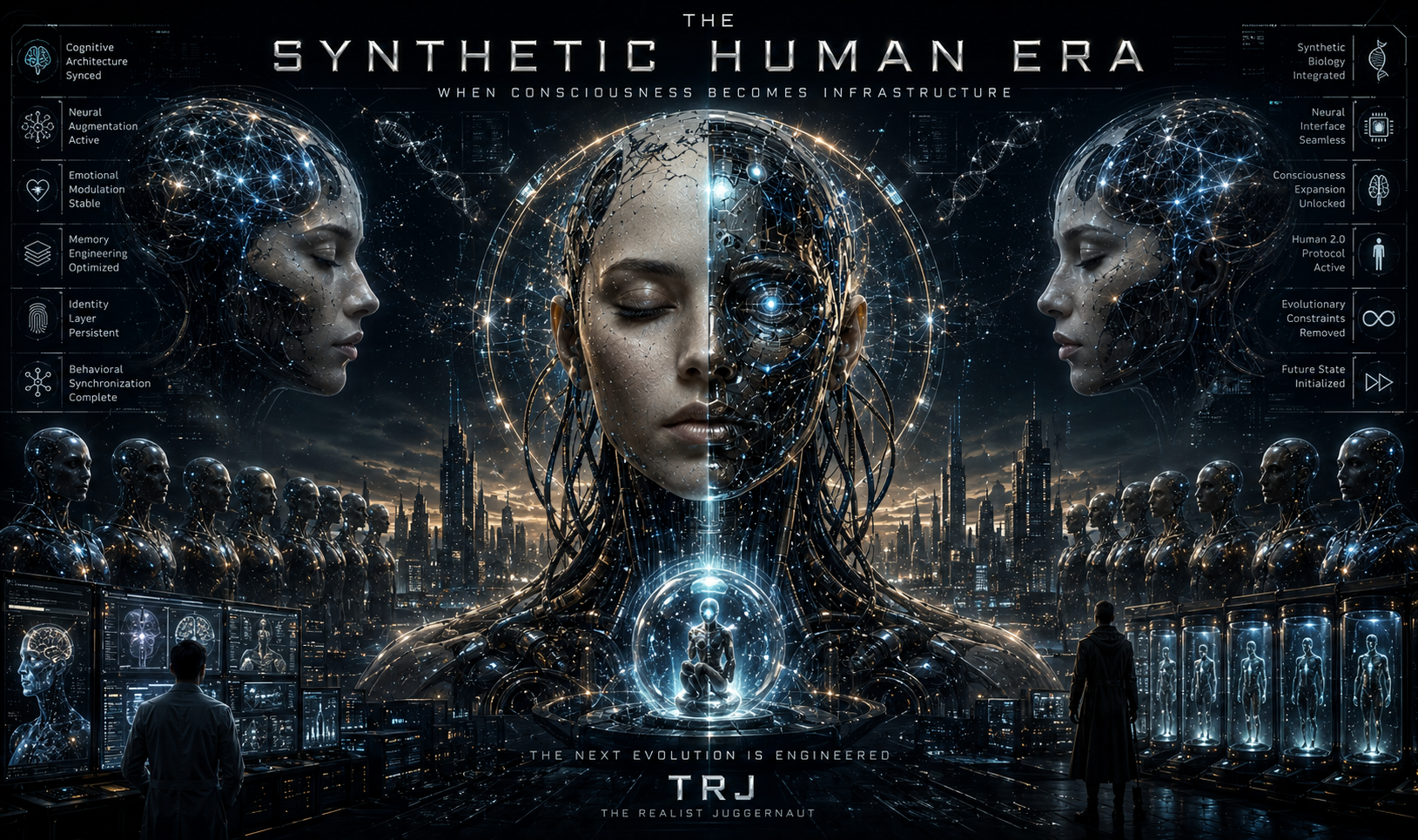
That transformation may become one of the defining realities of the Synthetic Human Era.
Future generations raised entirely inside predictive environments may experience continuous psychological interpretation as ordinary life. Children growing up beneath algorithmic personalization systems, biometric educational technologies, adaptive emotional infrastructures, predictive content environments, and AI-mediated social systems may never fully experience the degree of mental opacity previous civilizations considered natural.
Privacy may stop meaning psychological invisibility and instead come to mean controlled access to continuous interpretation systems already surrounding ordinary life permanently. That distinction matters enormously.
Once civilization normalizes continuous behavioral prediction deeply enough, human beings may gradually begin adapting their consciousness around permanent interpretability itself. Thoughts become shaped by anticipated reaction. Identity becomes optimized for algorithmic readability. Emotional expression becomes behaviorally filtered. Psychological experimentation weakens beneath continuous predictive exposure.
The result is not surveillance.
It is cognitive environmental restructuring.
Human consciousness historically developed within conditions where large portions of internal existence remained inaccessible to external systems naturally. Synthetic civilization constructs environments where the boundary between internal and external psychological space weakens continuously beneath predictive machine infrastructure operating every hour of every day.
That transformation changes what it means to possess a private self at all.
And once civilizations fully normalize environments where emotional states, behavioral tendencies, psychological vulnerabilities, attraction systems, cognitive patterns, and predictive thought modeling become continuously observable through artificial systems surrounding ordinary life permanently, future populations may eventually inherit a world where consciousness itself no longer feels naturally private because synthetic civilization reorganized human existence around continuous interpretability slowly enough that most people never fully recognized the transition while living through it.
TRJ VERDICT
The end of private consciousness may become one of the most psychologically destabilizing transformations synthetic civilization ever produces because it erodes one of the oldest invisible conditions underlying human freedom itself: the ability to think internally without continuous external interpretation.
Human beings were never designed for environments where emotional states, behavioral patterns, psychological tendencies, cognitive vulnerabilities, attraction systems, and predictive responses could be continuously modeled, interpreted, categorized, archived, and optimized through machine infrastructure operating permanently around the nervous system.
Yet synthetic civilization moves directly toward those conditions.
The danger is not surveillance in the traditional sense. The deeper danger is that predictive artificial systems are gradually restructuring the boundary between internal consciousness and external infrastructure itself.
Historically, human beings retained natural psychological opacity because biology imposed observational limits no institution, government, corporation, or social structure could fully overcome. Thoughts could remain private. Contradictions could remain internal. Emotional instability could exist temporarily without permanent interpretation. Consciousness itself retained hidden territory inaccessible to continuous systemic observation.
Synthetic civilization weakens those conditions.
Artificial intelligence systems no longer simply monitor actions. They infer emotion, predict behavior, model psychology, anticipate decisions, interpret attention, map vulnerability, and optimize influence continuously through expanding behavioral infrastructures integrated into ordinary life itself.
That shift changes consciousness structurally.
The risk is not simply that institutions may know more about people.
The risk is that populations may gradually adapt psychologically around permanent observability altogether until human beings begin thinking, behaving, feeling, expressing emotion, forming identity, and processing internal conflict beneath continuous predictive interpretation systems operating so seamlessly that future generations no longer experience mental privacy as a natural human condition at all.
Once civilization reaches that threshold, consciousness itself may begin reorganizing around interpretability.
At that stage, the private mind no longer functions primarily as independent internal territory existing beyond systemic reach.
It becomes another environment synthetic civilization continuously models, predicts, shapes, and monetizes through artificial infrastructure operating every hour of every day.


🔥 NOW AVAILABLE! 🔥
🔥 NOW AVAILABLE! 🔥
📖 INK & FIRE: BOOK 1 📖
A bold and unapologetic collection of poetry that ignites the soul. Ink & Fire dives deep into raw emotions, truth, and the human experience—unfiltered and untamed
🔥 Kindle Edition 👉 https://a.co/d/9EoGKzh
🔥 Paperback 👉 https://a.co/d/9EoGKzh
🔥 Hardcover Edition 👉 https://a.co/d/0ITmDIB
🔥 NOW AVAILABLE! 🔥
📖 INK & FIRE: BOOK 2 📖
A bold and unapologetic collection of poetry that ignites the soul. Ink & Fire dives deep into raw emotions, truth, and the human experience—unfiltered and untamed just like the first one.
🔥 Kindle Edition 👉 https://a.co/d/1xlx7J2
🔥 Paperback 👉 https://a.co/d/a7vFHN6
🔥 Hardcover Edition 👉 https://a.co/d/efhu1ON
Get your copy today and experience poetry like never before. #InkAndFire #PoetryUnleashed #FuelTheFire
🚨 NOW AVAILABLE! 🚨
📖 THE INEVITABLE: THE DAWN OF A NEW ERA 📖
A powerful, eye-opening read that challenges the status quo and explores the future unfolding before us. Dive into a journey of truth, change, and the forces shaping our world.
🔥 Kindle Edition 👉 https://a.co/d/0FzX6MH
🔥 Paperback 👉 https://a.co/d/2IsxLof
🔥 Hardcover Edition 👉 https://a.co/d/bz01raP
Get your copy today and be part of the new era. #TheInevitable #TruthUnveiled #NewEra
🚀 NOW AVAILABLE! 🚀
📖 THE FORGOTTEN OUTPOST 📖
The Cold War Moon Base They Swore Never Existed
What if the moon landing was just the cover story?
Dive into the boldest investigation The Realist Juggernaut has ever published—featuring declassified files, ghost missions, whistleblower testimony, and black-budget secrets buried in lunar dust.
🔥 Kindle Edition 👉 https://a.co/d/2Mu03Iu
🛸 Paperback Coming Soon
Discover the base they never wanted you to find. TheForgottenOutpost #RealistJuggernaut #MoonBaseTruth #ColdWarSecrets #Declassified


Sponsored • TRJ Ads
Inquiries: contact@therealistjuggernaut.com