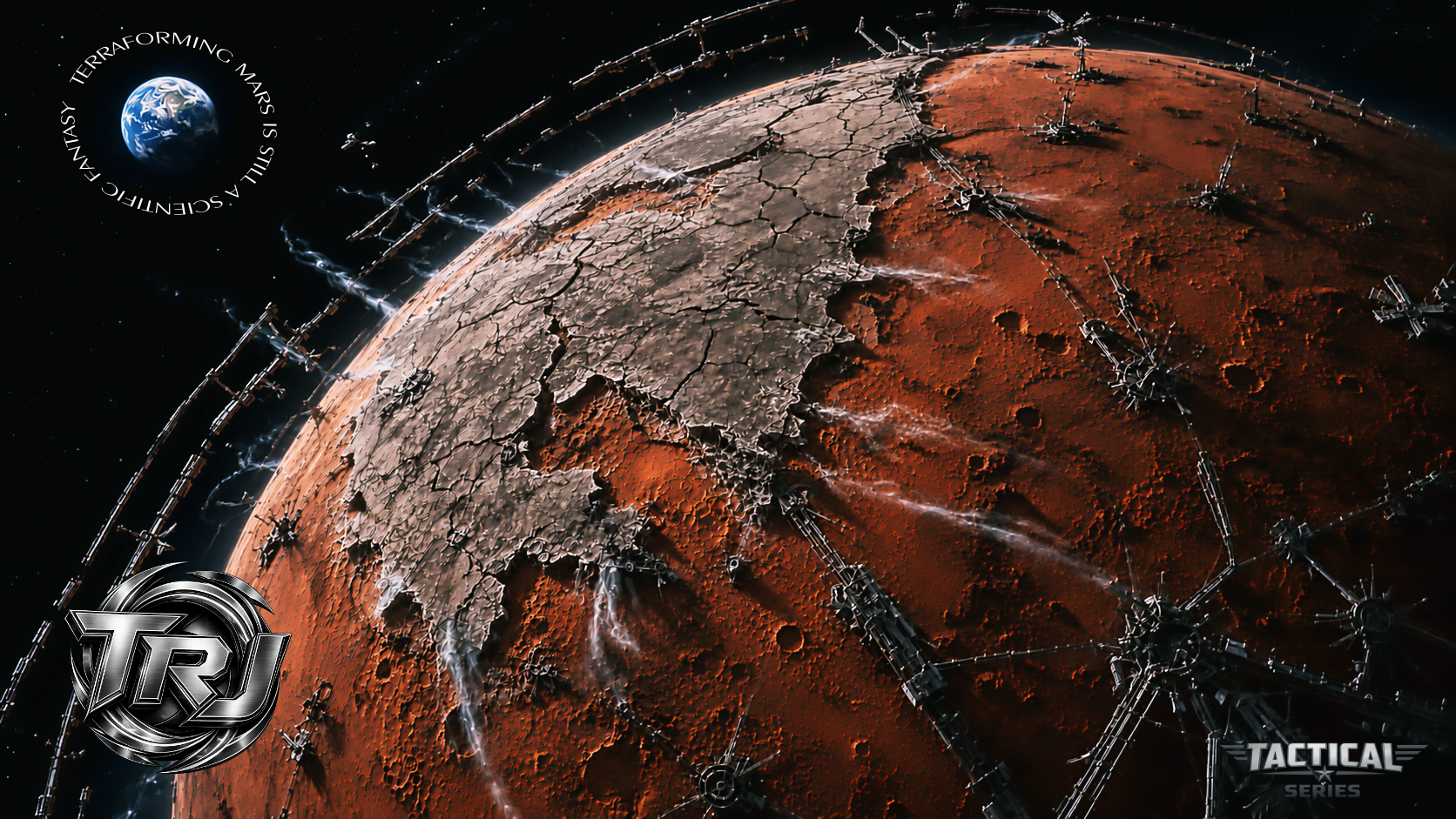
A new scientific roadmap may advance research into warming Mars, but it does not overcome the planet’s atmosphere, radiation, gravity, chemistry, biological uncertainty, or the industrial scale required to create a self-sustaining human world.
Scientists have developed a new research roadmap examining whether Mars could be deliberately warmed through technologies ranging from engineered atmospheric particles and orbital reflectors to localized solid-state greenhouse systems. The work is legitimate planetary science. It could improve understanding of Martian climate, atmospheric physics, resource extraction, artificial greenhouse effects, water behavior, autonomous engineering, and the limits of planetary modification. What it does not demonstrate is that humanity has discovered how to transform Mars into a self-sustaining second Earth capable of supporting human life without continuous artificial protection.
That distinction is critical because the scientific paper itself is considerably more cautious than some of the broader discussion surrounding terraforming. Released in April 2026, A Research Roadmap for Assessing the Feasibility of Warming Mars outlines research pathways for determining whether non-biological methods could substantially increase Martian temperatures. The authors explicitly state that their roadmap does not assume warming Mars is desirable. Their objective is to determine what would have to be true for warming to work, what it could cost, what could go wrong, and which experiments would be necessary to answer those questions. The roadmap identifies three major research tracks: solid-state greenhouse materials for localized warming, orbital reflectors capable of concentrating sunlight on strategically important regions, and methods of producing broader atmospheric warming.
That is serious science. It is also a long distance from proving that Mars can be terraformed into another Earth.
Warming Mars is not terraforming Mars. Producing oxygen on Mars is not terraforming Mars. Melting additional ice is not terraforming Mars. Redirecting sunlight is not terraforming Mars. Manipulating atmospheric chemistry is not terraforming Mars. Each accomplishment could demonstrate an impressive engineering capability without creating the integrated planetary environment necessary for humans to walk outside, breathe naturally, drink naturally occurring water, grow food throughout an open biosphere, reproduce safely across generations, and exist without an enormous technological system continuously separating their bodies from the Martian environment.
TRJ examined this fundamental problem in 2025, and the central conclusion has not changed. New technologies can change individual variables. They do not automatically change the planetary equation.
Mars remains Mars.
THE NEW ROADMAP IS ABOUT WARMING MARS
The new roadmap is important because it attempts to move the discussion away from vague speculation and toward experimentally testable questions. Solid-state greenhouse materials could potentially create localized environments warm enough to assist water extraction, food production, or other controlled operations. Orbital reflectors could concentrate solar energy on selected locations, including carbon-dioxide ice reservoirs. Engineered atmospheric materials could potentially increase global temperatures by changing how incoming and outgoing radiation moves through the Martian atmosphere. The researchers are asking whether these processes work, how efficiently they work, what resources they require, and what secondary effects they might produce.
Those are legitimate questions because manipulating one aspect of Mars could have consequences extending far beyond temperature. Artificial warming changes the water cycle, atmospheric circulation, ice stability, cloud formation, surface chemistry, and the distribution of volatile materials. A 2026 Mars climate-modeling preprint examining artificial warming found that every 20 Kelvin of global warming in its model produced roughly a tenfold increase in atmospheric water vapor through sublimation from the northern polar cap. The same simulations produced complicated regional responses, including nighttime warming at low latitudes, substantial daytime cooling in some winter midlatitude regions, and redistribution of water between ice reservoirs. The researchers explicitly identified major uncertainties involving present-day Martian weather, climate, particle microphysics, and the radiative properties of proposed warming agents.
That result illustrates exactly why warming cannot be treated as a thermostat. Changing the temperature changes other parts of the system, and those changes produce additional effects that must then be understood. The science becomes more complicated as the intervention becomes larger.
Terraforming would require manipulating nearly everything.
ENGINEERED PARTICLES DO NOT CREATE A PLANET
One of the most discussed proposals involves engineered microscopic particles capable of strengthening the Martian greenhouse effect. Earlier modeling found that specially designed particles suspended in the atmosphere could potentially produce substantial warming far more efficiently than some previous approaches. The idea is scientifically interesting because Mars contains materials that could theoretically be used in manufacturing such particles, reducing the requirement to transport every kilogram from Earth.
A computer model demonstrating atmospheric warming is still the beginning of the problem rather than the end.
Particles can collide and aggregate. They can settle. They can interact with Martian dust. Atmospheric circulation can transport them away from intended regions. Their physical properties can change. Their effectiveness can vary as concentrations change, and their behavior must remain predictable across an atmosphere whose climate and microphysics scientists are still working to characterize.
Producing planetary quantities of engineered material introduces another problem. Raw resources must be extracted. Mining requires machinery. Machinery requires power. Materials must be processed. Manufacturing systems must produce particles with controlled dimensions and physical properties. Distribution systems must place them into the atmosphere. Monitoring systems must determine whether they are producing the intended climatic response. The entire operation would require maintenance, replacement components, communications, energy, and some method of responding if the intervention produced an unexpected effect.
Before anyone could industrialize the Martian climate, an enormous industrial system would already need to exist. That contradiction follows the terraforming concept everywhere.
THE FRANKENSTEIN PROBLEM
Terraforming Mars resembles a planetary Frankenstein experiment: take one technology to warm the atmosphere, another to manufacture oxygen, another to redirect sunlight, another to extract water, another to process chemically difficult surface material, another to protect biological organisms from radiation, another to manufacture atmospheric gases, and another to maintain controlled ecosystems. Assemble enough individual technologies and eventually declare that the collection has become a habitable planet. That is where the argument begins to break down.
A planet is not simply a collection of independent environmental variables. Earth does not function because someone assembled the correct percentages of oxygen and nitrogen, added water, adjusted the temperature, scattered plants across the surface, and switched everything on. Earth’s atmosphere, oceans, geology, climate, hydrological systems, microorganisms, biological ecosystems, chemistry, gravity, and magnetic environment interact continuously. Those relationships developed across billions of years of planetary evolution. Mars experienced billions of years of its own evolution. The two planets reached radically different environmental states.
Reproducing an individual characteristic of Earth does not reproduce Earth. Reproducing ten characteristics does not establish that those characteristics will interact with one another in the same way they do here. Every artificial intervention changes other variables, and those changes can create new feedbacks, resource requirements, maintenance burdens, chemical reactions, or unintended consequences.
This is the central problem hidden beneath the excitement surrounding individual technological breakthroughs. A brilliant technology can work exactly as designed and still fail to make Mars substantially more Earth-like. The pieces can work. That does not mean the assembled planetary organism lives.
WARMING MARS IS NOT TERRAFORMING MARS
Temperature is only one requirement for human habitability. A naturally habitable human environment requires adequate atmospheric pressure, appropriate atmospheric composition, accessible water, manageable radiation exposure, usable chemistry, stable climatic conditions, sustainable nutrient cycles, and a biological environment capable of maintaining itself without civilization-scale machinery operating continuously simply to prevent environmental collapse.
A warmer Mars with inadequate atmospheric pressure remains lethal to an unprotected human being. A Mars with greater atmospheric pressure but no breathable oxygen remains lethal. An atmosphere containing oxygen without sufficient buffer gases introduces another set of physiological and combustion problems. A Mars with breathable air but dangerous long-term radiation exposure remains hazardous. A planet containing air and water but lacking a functioning biosphere still does not become Earth.
The scale becomes apparent when atmospheric requirements are quantified. A 2026 system-level analysis estimated that human-relevant atmospheric pressures on Mars imply atmospheric inventories on the order of 10^17 to 10^18 kilograms. The same analysis found that breathable endpoints become dominated by oxygen and buffer-gas requirements and estimated minimum oxygenation work exceeding approximately 10^25 joules. Depending upon the proposed completion time, the industrial system could require material throughput of around 10^7 to 10^8 kilograms per second and average power ranging from hundreds of terawatts into the petawatt class.
Those numbers reveal the real problem: terraforming is not a machine, factory, greenhouse, or climate experiment; it is an attempt to alter an entire planetary system.
THE ATMOSPHERIC PROBLEM
Mars currently possesses an average surface pressure of only about 6 millibars, or approximately 0.6 percent of Earth’s atmospheric pressure at sea level. That pressure varies with elevation and season, but the entire Martian atmosphere remains far too thin to support an unprotected human being. Liquid water exposed at the surface would generally freeze, evaporate, or boil away rather than remain stable across open landscapes.
The scale of the pressure deficit is difficult to overstate. The Armstrong limit—the pressure below which water boils at normal human body temperature—is approximately 62.7 millibars. Present-day Mars provides less than one-tenth of that pressure. Reaching the Armstrong limit would not produce breathable air or make the environment safe; it would only cross one basic pressure threshold associated with human exposure. A person would still require oxygen, thermal protection, radiation protection, and protection from the atmospheric composition.
An Earth-like atmosphere presents a much larger requirement. Earth’s average sea-level pressure is approximately 1,013 millibars. Mars would therefore need an enormous increase in atmospheric mass before it approached terrestrial pressure, and that mass would have to contain gases compatible with human respiration rather than simply any material capable of increasing the pressure.
Earlier terraforming proposals often suggested releasing carbon dioxide trapped in Martian polar deposits, soil, and minerals. The expectation was that additional carbon dioxide would thicken the atmosphere, strengthen greenhouse warming, release more volatile material, and create a self-reinforcing cycle that gradually transformed the planet.
NASA’s assessment of the available carbon dioxide revealed a fundamental problem with that scenario. Vaporizing the carbon dioxide in the polar deposits would only double the present atmospheric pressure from approximately 0.6 percent to 1.2 percent of Earth’s. Heating the Martian soil could release additional carbon dioxide, but obtaining the full estimated amount would require strip-mining the planet to a depth of approximately 100 yards. Carbon locked inside mineral deposits would require extensive excavation and high-temperature processing, while deeply buried deposits remain uncertain and inaccessible using present technology. Even the broadest estimates involving known Martian sources remain far below the pressure required to create Earth-like conditions.
A 2026 system-level analysis reached the same obstacle through atmospheric mass accounting. It treated accessible Martian carbon dioxide as an inventory measured in tens of millibars rather than the multiple bars required for a warm, open atmosphere. A representative 20-millibar carbon-dioxide atmosphere would remain below the Armstrong limit and was estimated to produce less than 10 Kelvin of warming under current Martian sunlight. The analysis found that approaching globally stable surface liquid-water temperatures could require carbon-dioxide pressure near one bar—roughly comparable to Earth’s total atmospheric pressure and far beyond currently identified accessible Martian inventories.
Carbon dioxide also does not become breathable simply because enough of it is accumulated. An atmosphere dominated by carbon dioxide would remain lethal to humans even if its total pressure increased substantially. Creating a human-compatible atmosphere would require enormous quantities of oxygen and a suitable buffer gas such as nitrogen or argon, along with control over pressure, temperature, combustion risk, toxicity, and long-term atmospheric stability.
The mass requirement follows directly from planetary physics. The 2026 analysis calculated that every millibar of global Martian atmospheric pressure requires approximately 3.89 quadrillion kilograms of gas. Reaching even the Armstrong limit would require an atmospheric inventory of approximately 2.4 × 10^17 kilograms. Breathable open-surface conditions would require still greater inventories, including approximately 8.2 × 10^17 kilograms of oxygen for an Earth-like oxygen partial pressure and about 1.9 × 10^18 kilograms of nitrogen for a substantial buffer atmosphere.
Water vapor cannot close the gap by itself because Mars is too cold for enough water to remain in the atmosphere without substantial prior warming. Synthetic greenhouse gases and engineered particles may trap heat efficiently at lower concentrations, but trapping heat does not create the atmospheric mass required for human pressure or supply breathable oxygen and buffer gases. A planet can become warmer while remaining physically impossible for an unprotected person to inhabit.
If the necessary atmospheric material is not available locally in accessible form, it must come from somewhere else. Humanity would have to process enormous quantities of Martian rock, manufacture suitable gases from available elements, or import volatile-rich material from elsewhere in the Solar System. NASA’s assessment found that redirecting comets and asteroids would require many thousands of objects. Such a proposal would replace the atmospheric shortage with an interplanetary extraction, transportation, navigation, and impact-management project of extraordinary scale.
Every proposed solution encounters the same conservation law: matter does not appear because engineers need it. Technology can extract matter, transform it, transport it, and rearrange it, but it cannot manufacture planetary mass from nothing. Mars does not merely need warmer air. It needs an atmosphere that exists in sufficient quantity, contains the correct gases, remains stable, and can support human biology without permanent mechanical intervention.
That is the atmospheric problem. Before humanity could breathe on Mars, it would first have to find, process, transport, and retain an atmosphere that the planet does not currently possess.
THE NITROGEN PROBLEM
Oxygen receives most of the attention in popular terraforming discussions because humans require it for respiration, but oxygen alone does not create an Earth-like atmosphere. Approximately 78 percent of Earth’s atmosphere is nitrogen. That nitrogen supplies most of the pressure surrounding the human body, dilutes the oxygen to reduce combustion hazards, participates in biological nutrient cycles, and contributes to the environmental stability upon which terrestrial life depends.
Present-day Mars contains nitrogen, but only in a trace inventory within an atmosphere that is already extremely thin. Nitrogen makes up roughly 1.9 percent of the Martian atmosphere, placing its partial pressure near 0.1 millibar. Earth’s nitrogen partial pressure is close to 790 millibars. The comparison reveals a difference of several thousand times between the nitrogen pressure surrounding life on Earth and the nitrogen currently available in the Martian atmosphere.
Mars appears to have possessed a substantially larger nitrogen inventory early in its history. Measurements and modeling of nitrogen isotopes indicate that lighter nitrogen escaped more readily than heavier nitrogen as the atmosphere evolved, leaving the modern atmosphere enriched in the heavier isotope. That record supports the conclusion that significant nitrogen was lost to space across billions of years.
The ancient nitrogen is not sitting conveniently above present-day Mars waiting to be recovered. Some nitrogen may remain chemically bound inside the crust, regolith, minerals, or buried deposits, but the existence of nitrogen-bearing material does not establish an accessible planetary inventory capable of supplying a thick atmosphere.
NASA’s Curiosity rover detected fixed nitrogen in the form of nitrates inside Martian rock samples, demonstrating that biologically and chemically usable nitrogen existed on Mars approximately 3.5 billion years ago. That discovery is important for understanding ancient habitability, but nitrate detected in individual rocks is not evidence of a recoverable global supply large enough to construct an atmosphere.
The distinction between atmospheric nitrogen and fixed nitrogen also matters. Molecular nitrogen gas can serve as an atmospheric buffer, but most plants and animals cannot use it directly. Terrestrial ecosystems depend upon microorganisms and other processes that convert atmospheric nitrogen into biologically available compounds. Reconstructing an Earth-style nitrogen system on Mars would therefore require more than releasing nitrogen gas. It would require establishing and maintaining an entire nitrogen cycle involving fixation, biological uptake, decomposition, recycling, and protection against long-term loss.
A 2026 system-level analysis estimated that creating a substantial nitrogen buffer with a partial pressure of 50 kilopascals would require approximately 1.9 × 10^18 kilograms of nitrogen. That is 1.9 quintillion kilograms of a gas whose accessible Martian inventory has not been demonstrated. The requirement exists before accounting for extraction losses, processing inefficiencies, leakage, atmospheric escape, chemical reactions with the surface, or the energy needed to recover nitrogen from minerals.
Extracting dispersed nitrogen from Martian material would require mining, crushing, heating, chemically processing, and transporting enormous quantities of rock and regolith. Every kilogram of recovered nitrogen would depend upon industrial equipment, energy, maintenance, replacement components, and waste management. If the nitrogen concentration in the processed material were low, the amount of material moved through the industrial system would be vastly greater than the mass of nitrogen ultimately released.
Importing nitrogen or another suitable buffer gas from elsewhere in the Solar System would not eliminate the problem. It would convert the atmospheric shortage into an interplanetary mining and transportation operation involving extraordinary masses. Humanity would have to identify a source, extract the material, move it across space, deliver it safely to Mars, and retain it after release.
An atmosphere rich in manufactured oxygen but lacking sufficient buffer gas would not become another Earth. It would present different pressure, combustion, physiological, agricultural, and ecological problems that would require continued artificial management. Oxygen production can support machinery, breathing systems, and sealed habitats, but it does not answer the planetary question of where the remaining atmospheric mass comes from.
The chemistry may be understood, but the accounting still has to balance. Mars does not need an abstract percentage of nitrogen written into a theoretical atmospheric recipe. It needs the actual matter in quantities measured on a planetary scale.
That is the nitrogen problem: technology can process nitrogen only if a sufficient inventory exists and can be reached. It cannot extract an Earth-sized atmosphere from a supply that has never been shown to exist.
THE OXYGEN PROBLEM
Producing oxygen on Mars has already been demonstrated. NASA’s Mars Oxygen In-Situ Resource Utilization Experiment, known as MOXIE, successfully extracted oxygen from carbon dioxide in the Martian atmosphere aboard the Perseverance rover. The experiment proved that local atmospheric material could be collected, compressed, heated, and electrochemically separated to produce oxygen suitable for future life-support or propellant systems.
MOXIE was an extraordinary engineering success. It was not planetary oxygenation.
Across 16 operational runs, MOXIE produced a total of 122 grams of oxygen. At its highest demonstrated rate, it generated 12 grams per hour at a purity of at least 98 percent. NASA compared its total production to the amount of oxygen a small dog breathes in approximately ten hours. That output was appropriate for a compact technology demonstration designed to prove the process under Martian conditions.
The scale changes completely when the objective moves from supporting a crew or producing rocket oxidizer to constructing a planetary atmosphere. A 2026 system-level analysis estimated that an Earth-like oxygen partial pressure on Mars would require approximately 8.2 × 10^17 kilograms of oxygen. That is about 6.7 quintillion times the total amount produced during MOXIE’s mission.
Even if one MOXIE unit operated continuously at its peak demonstrated rate of 12 grams per hour, producing that atmospheric oxygen inventory would take approximately 7.8 quadrillion years. Completing the same task within 1,000 years would theoretically require the uninterrupted equivalent output of roughly 7.8 trillion MOXIE units operating at peak performance. Those comparisons are not criticisms of MOXIE, which was never designed for planetary production. They reveal the difference between demonstrating a chemical process and transforming an atmosphere.
Scaling the machine would not be a matter of building a slightly larger version. Planetary oxygen production would require an industrial network capable of collecting atmospheric carbon dioxide or oxygen-bearing material, processing it continuously, rejecting heat, handling byproducts, maintaining equipment, replacing damaged components, and distributing oxygen across the entire planet. Every production facility would require power, compressors, filters, high-temperature electrolysis systems, control electronics, transportation infrastructure, and protection from Martian dust, radiation, and thermal cycling.
The energy requirement is equally severe. The 2026 analysis estimated a reversible minimum oxygenation requirement of approximately 1.2 × 10^25 joules. Spreading that idealized minimum across 1,000 years would still demand average power near 0.38 petawatts. Compressing the project into 100 years would increase the average requirement to approximately 3.8 petawatts. Those figures represent theoretical lower bounds before accounting for real-world inefficiencies, mining, construction, transportation, maintenance, atmospheric loss, and the energy required to fill chemical sinks.
Oxygen is also highly reactive. Mars contains iron-bearing minerals and other reduced materials capable of consuming oxygen through chemical reactions. Before a large oxygen atmosphere could accumulate, some of the manufactured oxygen would react with the surface and subsurface rather than remain available in the air. The industrial system would have to produce enough oxygen to satisfy those geochemical sinks, replace continuing losses, and still build the atmospheric inventory required for respiration.
MOXIE’s process does not create atmospheric mass from nothing. It separates carbon dioxide into oxygen and carbon monoxide, changing the chemical form of material already present in the thin Martian atmosphere. Converting atmospheric carbon dioxide into oxygen on a planetary scale would therefore reduce a gas being considered for greenhouse warming while producing a carbon-monoxide byproduct that would also require management. The process can alter atmospheric composition, but it cannot solve the shortage of total atmospheric mass identified in the atmospheric and nitrogen equations.
Oxygen production for sealed habitats remains far more achievable because the gas can be manufactured for a limited number of people, contained, recycled, and conserved within a controlled environment. Oxygen needed for rocket propellant could also be accumulated before a crew arrives. Those applications could transform Mars exploration by reducing the amount of material transported from Earth.
A habitat-scale oxygen system and a planetary oxygen system are not successive versions of the same project. One supports a controlled enclosure. The other attempts to manufacture a major component of an entire world.
MOXIE proved that humanity can produce oxygen on Mars. It did not prove that humanity can oxygenate Mars. A process can be technologically successful, scientifically important, and operationally useful while remaining completely inadequate for planetary transformation.
That is not a contradiction. It is scale.
ORBITAL MIRRORS AND ARTIFICIAL SUNLIGHT
Orbital reflectors represent another scientifically credible area of investigation. Large reflective structures positioned in space could redirect sunlight toward selected regions of Mars, increasing the available solar energy and potentially warming locations containing water ice, carbon-dioxide deposits, human habitats, or other valuable resources. The 2026 research roadmap identifies orbital reflectors as one of the major approaches deserving further study while acknowledging that a substantial combined reflective area would be required.
Such a system could become a valuable energy-management technology capable of supporting localized warming, resource extraction, or controlled operations. Its usefulness would not make it a complete terraforming system.
An orbital reflector would not create atmospheric mass, manufacture the required nitrogen and oxygen, change Martian gravity, restore a global magnetic dynamo, remove hazardous compounds from the regolith, establish sustainable ecological cycles, or create a functioning terrestrial biosphere. It would perform one specific function by redirecting solar energy toward a designated location.
That capability could represent an extraordinary engineering achievement, but it would leave the central barriers to planetary habitability unresolved. Presenting redirected sunlight as a pathway toward another Earth requires demonstrating how every atmospheric, biological, chemical, geological, and industrial problem remaining after the reflectors have performed their function would also be solved.
MARS LOST THE PLANETARY ENVIRONMENT TERRAFORMING IS TRYING TO RECONSTRUCT
Mars was not always the cold, dry world observed today. Geological evidence preserves ancient river valleys, lake basins, deltas, and minerals formed through prolonged interaction with liquid water. Those features indicate that early Mars experienced periods when its surface environment was radically different, supported by a thicker atmosphere capable of producing pressures and temperatures more favorable to flowing water.
The planet did not remain in that state. Mars is smaller than Earth, possesses weaker gravity, and no longer generates a global magnetic field through an active internal dynamo. Its atmosphere became exposed to a combination of solar wind, ultraviolet radiation, atmospheric chemistry, impacts, and long-term escape processes that gradually removed gases or locked them into the surface. The disappearance of Mars’s early environment was not caused by one isolated event, but by planetary processes operating across billions of years.
NASA’s MAVEN mission has spent years investigating that transformation by measuring the interaction among the solar wind, the Martian upper atmosphere, the ionosphere, and the planet’s remaining localized magnetic fields. Its observations have shown several processes through which atmospheric particles escape into space, including ion escape and sputtering. During sputtering, ions accelerated by the solar wind collide with particles in the upper atmosphere and transfer enough energy to eject some of them into space.
MAVEN measurements of argon isotopes indicated that approximately 65 percent of the planet’s argon was lost through sputtering. Because argon is chemically unreactive and cannot be removed easily through reactions with the surface, its isotopic record provides scientists with an important measure of atmospheric loss. Those findings support the conclusion that solar wind and radiation removed most of the Martian atmosphere, contributing to the transformation of a world that once supported rivers and lakes into the cold, dry planet observed today. In 2025, MAVEN also made the first direct observation of atmospheric sputtering at Mars, confirming a process scientists had long identified as an important source of atmospheric loss.
Atmospheric escape is not constant. Solar storms and periods of elevated solar activity can increase the rate at which material is removed, and the young Sun was more active than it is today. Mars also retains localized crustal magnetic fields and an induced magnetosphere created through interaction between the solar wind and its upper atmosphere, but neither functions as the global magnetic system surrounding Earth.
The absence of an Earth-style global magnetic field is not the only reason Mars lost much of its atmosphere, and its importance should not be separated from the planet’s lower gravity, atmospheric composition, solar history, and geological evolution. The combined evidence demonstrates that Mars did not merely become cold. It underwent a long planetary transformation involving the loss of atmospheric mass, surface water, internal magnetic activity, and environmental conditions that had once allowed liquid water to persist.
This history matters because terraforming proposes more than warming a frozen landscape. It asks humanity to reconstruct portions of an environment that Mars lost across billions of years and then maintain those conditions against the physical processes that helped remove them. A newly manufactured atmosphere would not necessarily disappear immediately, but its long-term stability would have to be calculated against continuing atmospheric escape, chemical reactions with the surface, and other sinks. If losses continued, the engineered system could require permanent monitoring and replenishment.
Warming Mars does not reverse billions of years of atmospheric evolution. Producing oxygen does not restart its internal dynamo. Melting ice does not restore the atmospheric pressure, water cycle, geological activity, and planetary protections that once existed together. Terraforming therefore involves more than rebuilding something Mars lost. It requires creating an artificial planetary state and proving that it can remain stable under the same Martian conditions that helped dismantle the natural one.
RADIATION DOES NOT DISAPPEAR WHEN MARS GETS WARMER
Increasing Martian temperatures does not eliminate the planet’s radiation environment. Mars lacks Earth’s global magnetic protection and possesses only a thin atmosphere, leaving its surface exposed to energetic particles under conditions radically different from those in which human biology evolved. Warming the surface would not provide meaningful protection unless the intervention also created an atmospheric column thick enough to absorb or deflect a substantial portion of the incoming radiation.
The Martian surface is exposed primarily to two major forms of space radiation: galactic cosmic rays originating beyond the Solar System and solar energetic particles accelerated during solar eruptions. Galactic cosmic rays include extremely energetic protons and heavier atomic nuclei capable of penetrating spacecraft, habitats, and human tissue. Solar particle events can deliver intense bursts of radiation over shorter periods, creating a different threat that would require reliable monitoring, forecasting, and access to heavily shielded emergency areas.
NASA’s Curiosity rover has measured this environment directly through its Radiation Assessment Detector. During the rover’s first ten months on Mars, galactic cosmic rays produced a slowly varying absorbed dose of approximately 210 micrograys per day at the surface. The measurements also showed that the thin Martian atmosphere provides some protection and that the planet itself blocks radiation arriving from below, but neither eliminates the continuing exposure from above.
This is where comparisons between Mars and human experience aboard the International Space Station become dangerously simplistic. The ISS demonstrates that humans can survive for extended periods inside a sophisticated artificial environment in low-Earth orbit. It does not establish that people can live indefinitely on the Martian surface. The station operates within Earth’s broader magnetic environment and remains supported by terrestrial mission control, launch infrastructure, replacement components, resupply missions, medical expertise, and the possibility of returning crews to Earth. Mars presents a different environment, a much longer emergency-response timeline, and a fundamentally different biological proposition.
Radiation risk is not determined simply by placing a wall between a person and the source. Particle type, energy, penetration, dose rate, exposure duration, affected tissue, and cumulative exposure all matter. Highly energetic particles can collide with atoms inside shielding materials, spacecraft structures, the atmosphere, or Martian regolith and produce showers of secondary particles. Poorly selected shielding can therefore create additional radiation inside the protected area rather than simply stopping what arrives from outside.
Water, hydrogen-rich materials, specialized shielding, thick layers of Martian regolith, and subsurface construction could reduce exposure. Habitats could be buried, built inside lava tubes, or surrounded by locally sourced material to limit the mass transported from Earth. Solar-storm shelters could provide additional protection during periods of elevated activity. Those approaches may make temporary habitation safer, but every one depends upon construction, monitoring, maintenance, and continued technological support.
None of those measures terraform Mars. If human survival requires people to remain beneath substantial shielding because the external environment remains biologically hazardous, the planet has not become naturally habitable. Humanity may have constructed a protected outpost, but it has not created an open world in which human life can exist without permanent separation from the surrounding environment.
A bunker is not a biosphere.
THE HUMAN BODY IS NOT A ROVER
Robotic exploration has demonstrated that machines can perform extraordinary work on Mars. Rovers and landers have operated far beyond some of their original mission expectations, returning enormous quantities of scientific information from an environment no human being has ever entered. Their success is undeniable, but machines possess a critical advantage: they are not biological organisms.
A rover does not breathe, require food, experience psychological strain, or depend upon functioning lungs, kidneys, bones, cardiovascular and immune systems, or reproductive organs. It does not require atmospheric pressure to protect a living body, face cancer as a biological consequence of radiation exposure, become pregnant, raise children, or experience the lifelong effects of aging under Martian conditions. Machines can be engineered to operate within environmental extremes that the human body cannot simply adapt itself to withstand.
A machine that fails can be abandoned or replaced. Human beings cannot be treated as disposable components in a planetary engineering experiment. The successful operation of technology on Mars therefore proves that machines can function there; it does not establish that Mars can become a sustainable human world. Machines and human beings do not encounter the planet under the same biological terms.
MARTIAN GRAVITY CANNOT BE ENGINEERED AWAY
Mars possesses approximately 38 percent of Earth’s surface gravity. Terraforming does not change that fundamental planetary condition. Warming the atmosphere, manufacturing oxygen, releasing water, redirecting sunlight, introducing plants, or constructing an artificial magnetic shield would leave Mars as a 0.38g world because its gravity is determined principally by its mass and radius.
Humanity has extensive experience living at one Earth gravity and decades of evidence documenting what happens to adults in microgravity. Long-duration spaceflight can contribute to bone-density loss, muscle atrophy, cardiovascular deconditioning, changes in fluid distribution, altered balance and coordination, vision-related problems, and other physiological effects. Exercise, nutrition, medication, and specialized equipment can reduce some of those effects, but they do not reproduce every function that continuous Earth gravity provides.
Mars does not present a microgravity environment, and 38 percent of Earth’s gravity could reduce some of the physiological damage associated with weightlessness. The unanswered question is whether that level is sufficient to protect the human body across years or an entire lifetime. Scientists do not yet know whether biological responses improve in direct proportion to gravity, whether different organs require different minimum levels, or whether critical protective effects appear only after gravity crosses specific thresholds. NASA has acknowledged that the ability of Martian gravity to prevent bone loss or support recovery remains unknown.
The evidence gap becomes much larger when the question moves beyond healthy adult astronauts and short-term missions. Humanity has no multigenerational human data demonstrating how conception, pregnancy, placental function, fetal development, birth, childhood growth, skeletal formation, cardiovascular development, neurological development, immune function, reproduction, and aging would proceed when an entire life occurs at 0.38g. Research involving model organisms and simulated gravity can identify possible biological responses, but it cannot establish that human development and reproduction would remain normal across generations.
Artificial gravity could be created inside rotating spacecraft or specially designed habitats, and centrifugation may become an important countermeasure for crews traveling to Mars or occupying temporary outposts. Such systems would introduce their own engineering requirements involving rotation rates, habitat size, mechanical reliability, human adaptation, maintenance, and continuous power. They would also provide artificial gravity only within the rotating structure.
A centrifuge does not increase the gravity of Mars. It creates a controlled environment that protects humans from a planetary condition technology cannot remove. If residents must spend substantial portions of their lives inside rotating habitats to maintain their health, Mars itself has not become naturally compatible with human biology.
This is not a minor unanswered question that can be postponed until after the atmosphere is warmed or temporary outposts are constructed. It goes directly to whether human beings could remain healthy, reproduce successfully, and develop normally across generations under Martian gravity. Climate engineering can alter temperature, atmospheric composition, and access to surface resources. No climate-engineering roadmap changes the mass of the planet beneath those systems.
THE PERCHLORATE PROBLEM
Martian regolith presents another challenge that warming the planet would not automatically resolve. Multiple Mars missions have detected perchlorate salts in Martian surface materials, adding a chemical problem to an environment already defined by extreme cold, low atmospheric pressure, radiation exposure, and limited readily accessible liquid water. Perchlorates are highly soluble salts containing chlorine and oxygen, and significant human exposure can interfere with the thyroid’s ability to use iodide, making their presence relevant to both long-term human health and any attempt to use Martian material for agriculture or water production.
Their presence does not mean controlled agriculture is chemically impossible. Regolith can theoretically be processed, perchlorates can be removed or reduced through treatment, and growing systems can avoid direct reliance on untreated Martian material. Those solutions require energy, equipment, water, processing facilities, monitoring, replacement components, and continued management.
Water makes the issue particularly important because soluble compounds do not simply vanish when ice melts. Artificially warming Mars enough to mobilize larger quantities of water would cause that water to interact with minerals and salts accumulated within the regolith under billions of years of Martian environmental conditions. Scientists would need to understand what becomes dissolved, transported, concentrated, chemically transformed, or deposited elsewhere before assuming that a warmer and wetter Mars becomes biologically equivalent to a terrestrial landscape.
The larger problem is that Martian regolith is not terrestrial soil in the biological sense. Earth’s productive soils contain organic matter, microorganisms, fungi, nutrients, gases, water, and enormously complicated ecological communities continuously processing material. Martian regolith is fragmented planetary material. Adding water does not automatically turn it into Iowa farmland.
SYNTHETIC BIOLOGY CREATES ANOTHER PLANETARY PROBLEM
Synthetic biology is frequently discussed as a possible component of planetary engineering because microorganisms could theoretically be designed or selected to process minerals, break down hazardous compounds, contribute to oxygen production, assist resource extraction, participate in nutrient cycles, or survive conditions lethal to more complex organisms. Controlled biological systems could become useful inside sealed habitats, laboratories, water-processing facilities, and agricultural environments.
Releasing self-replicating organisms into the open Martian environment would create an entirely different level of risk.
Humanity does not know whether Mars is completely lifeless. No living Martian organism has been confirmed, but the absence of confirmed life does not prove that every potentially habitable environment is sterile. Protected locations beneath the surface, within ice deposits, near transient water activity, or inside geologically isolated environments could preserve biological material or evidence of ancient life that surface missions have not yet reached.
Introducing terrestrial organisms into those environments would create forward contamination—the transfer of Earth-based biological material to another world. NASA identifies controlling forward contamination as a central objective of planetary protection because terrestrial organisms and organic material could interfere with the search for extraterrestrial life. International planetary-protection policy also directs robotic and human missions to avoid contaminating Martian “Special Regions,” where environmental conditions may allow terrestrial organisms to survive or where Martian life could potentially exist.
The scientific consequences could be permanent. If a future mission detected cells, organic compounds, metabolic activity, or other possible biosignatures, researchers would first have to determine whether the evidence originated on Mars or arrived aboard an earlier spacecraft, human habitat, waste system, biological experiment, or engineered-organism release. Contamination could produce a false indication of Martian life, conceal genuine Martian biology beneath terrestrial material, or chemically alter the environment containing the evidence.
Synthetic biology makes that problem more serious because organisms designed to tolerate Martian conditions would be intentionally equipped to survive environments that ordinarily limit contamination. Genetic safeguards or biological containment systems could reduce the risk of uncontrolled growth, but no safeguard can guarantee permanent containment across planetary distances, changing environmental conditions, mutation, equipment failure, and timescales extending far beyond the original experiment. Once a self-replicating organism escaped into an accessible Martian environment, retrieving every descendant could become impossible.
The ethical problem extends beyond preserving a scientific site. If Mars contains an independent form of life, even at the microbial level, it would represent a second biological origin separate from Earth and one of the most consequential discoveries in human history. Releasing terrestrial organisms before resolving that question could replace, disrupt, outcompete, or genetically contaminate a biological system humanity had not yet discovered or understood.
Synthetic biology may still have an important role in Mars exploration, especially inside contained systems where microorganisms could recycle waste, produce food or oxygen, process water, and reduce dependence upon supplies from Earth. Controlled use within a habitat is not equivalent to releasing engineered life across the planet.
Terraforming therefore collides not only with engineering feasibility. It collides with planetary protection, scientific integrity, biological containment, and the responsibility to investigate Mars before deliberately rewriting it. Humanity should not contaminate the answer before it has finished asking whether Mars ever lived.
THE INDUSTRIAL CIVILIZATION PROBLEM
Nearly every proposed terraforming solution eventually encounters the same obstacle: industrial scale. Engineered atmospheric particles would require manufacturing facilities supplied by extensive mining and material-processing operations. Those operations would depend upon excavation equipment, transportation networks, refineries, power generation, communications systems, autonomous machinery, maintenance programs, and a continuous supply of replacement components. Atmospheric processors would require sustained energy, orbital systems would require monitoring and control, and every component would need to operate under Martian conditions across extraordinary timescales.
The scale of that industry would extend far beyond constructing several habitats or research stations. Planetary engineering would require humanity to identify usable deposits, extract billions or trillions of tons of material, separate the required elements, manufacture specialized products, transport them across Mars, and distribute them into the atmosphere or orbital environment. Each step would generate waste, consume energy, wear down machinery, and create additional systems requiring inspection, repair, and replacement.
Mars would also impose severe operating conditions on the industrial network. Fine dust could enter mechanical systems, coat solar equipment, reduce visibility, and interfere with seals and moving components. Low temperatures and extreme thermal cycles could stress materials, electronics, batteries, lubricants, and structural connections. Radiation could damage equipment and degrade electronics. Communication delays would prevent Earth-based operators from controlling every machine in real time, requiring extensive autonomy and local decision-making.
Repairing that infrastructure would require more than spare parts delivered from Earth. A durable Martian industrial system would need the capacity to manufacture replacement components locally, including electronics, motors, sensors, seals, pressure vessels, cables, tools, and specialized materials. Producing those components would require additional factories, precision equipment, chemical processing, quality control, software support, and trained personnel. The industry responsible for terraforming Mars would first have to develop the ability to reproduce and sustain much of itself.
Each proposed solution therefore creates further dependencies that must also be constructed, powered, maintained, and protected against failure. Redundancy would be essential because the loss of one power station, communications link, manufacturing facility, transportation route, or atmospheric-processing network could disrupt systems far beyond the original failure. A planetary project would need to survive dust storms, equipment breakdowns, supply interruptions, software failures, economic disruptions, and changes in political support without allowing critical operations to collapse.
The concept consequently stops resembling a single technological breakthrough and begins resembling the construction of an entire industrial civilization whose purpose is to operate a planetary machine while keeping every supporting machine functional. That civilization would have to exist before the environment it was intended to create became habitable.
The terraforming system would eventually become part of the environment itself. If the failure or shutdown of its machinery caused the engineered atmosphere, climate, water cycle, or biosphere to deteriorate, the resulting world would never have become naturally self-sustaining. Humanity would not have created another Earth; it would have constructed life support on a planetary scale and inherited the permanent obligation to keep it running.
THE FRANKENSTEIN EQUATION DOES NOT CLOSE
This is the part of the terraforming discussion that deserves far greater scrutiny. Proposals are frequently evaluated one technology at a time: Can Mars be warmed? Can oxygen be manufactured? Can water be extracted? Can atmospheric particles be engineered? Can sunlight be redirected? Can microorganisms survive? Can Martian resources be mined?
The answer to several of those individual questions may be yes, but proving that separate technologies can perform isolated functions does not establish that they can collectively produce a stable and habitable planet.
The system-level equation is far more demanding. Sufficient atmospheric mass must be obtained, the necessary gases must be produced in the required quantities, immense energy and material-throughput demands must be sustained, and the resulting atmosphere must remain stable against escape and geochemical loss. Radiation exposure must become compatible with unrestricted biological life, terrestrial organisms must function within the resulting chemistry and gravity, ecological cycles must become self-sustaining, and the entire system must survive equipment failures, climate feedbacks, resource interruptions, and environmental changes extending across centuries. Every requirement must be satisfied simultaneously because the failure of one critical component could compromise the rest of the engineered environment.
Terraforming cannot be established by solving one variable at a time and assuming the separate answers will eventually add up to Earth. The technologies must operate as one stable, interconnected, and self-sustaining planetary system. Until the complete equation closes, assembling individual solutions does not amount to creating another world.
REVERSE THE EXPERIMENT: TRY TURNING EARTH INTO MARS
One of the clearest ways to understand the true scale of terraforming is to reverse the proposition and imagine humanity attempting to transform Earth into the physical equivalent of present-day Mars. This would require far more than damaging the environment, destroying civilization, or triggering a mass extinction. It would mean stripping away nearly the entire atmosphere, eliminating the oceans, collapsing the biosphere, altering the planet’s surface conditions, and somehow reducing its gravity until Earth became a cold, dry, irradiated world resembling Mars.
Earth has survived enormous asteroid impacts, catastrophic volcanic episodes, major climatic transitions, glaciations, atmospheric changes, geological upheaval, magnetic-field reversals, and mass extinctions. Some of those events eliminated vast portions of existing biological diversity, yet the planet continued functioning as an interconnected geological, atmospheric, hydrological, chemical, and biological system.
A massive asteroid could devastate continents, collapse civilization, and drive countless species into extinction without eliminating Earth’s oceans or removing its atmosphere. It could radically alter the global climate without changing Earth’s gravity, mass, or fundamental planetary structure. Humanity could destroy itself while the planet’s natural systems continued operating for millions or billions of years afterward.
Humanity could therefore make Earth uninhabitable for human civilization far more easily than it could physically turn Earth into Mars. That distinction reveals the magnitude of the proposition facing anyone who intends to transform Mars into an Earth-like world.
Terraforming Mars would require humanity to take a planet shaped by billions of years of radically different evolution and manufacture enough Earth-like planetary behavior to overcome its existing atmosphere, climate, chemistry, radiation environment, gravity, geology, and absence of a functioning terrestrial biosphere. Reversing the direction of the experiment does not reduce its scale.
If dismantling Earth’s naturally functioning planetary system would require far more than the destruction of human civilization, constructing an equivalent system on Mars cannot be treated as a matter of assembling enough individual technologies until another Earth emerges. That is the Frankenstein problem in its clearest form: humanity may be able to construct many of the individual pieces, but their successful operation would not guarantee that the assembled planetary system could live, regulate itself, or endure.
TIME DOES NOT SOLVE THE EQUATION
Terraforming discussions frequently relocate their most difficult problems to the distant future. If a process cannot be completed within decades, the projected timeline expands to centuries. If centuries remain insufficient, the proposal is extended across millennia. Time then becomes a substitute for explaining how the physical, industrial, economic, and political requirements could actually be met.
A thousand-year engineering project would require the civilization operating it to maintain the necessary knowledge, resources, infrastructure, institutional commitment, and technological capacity for a thousand years. Governments change, economies collapse, wars occur, resources become scarce, political priorities shift, institutions disappear, and technologies become obsolete. Civilizations themselves are not guaranteed indefinite survival, and humanity has no assurance that its present level of technological capability will continue uninterrupted across centuries or millennia.
Extending the deadline does not eliminate the project’s requirements. Atmospheric mass would still have to be obtained, energy would still have to be generated, machinery would still require maintenance, industrial systems would still need replacement components, and every stage would have to survive failures and interruptions across generations. A proposal cannot escape an industrial requirement that cannot be met today simply by assigning it to people who have not yet been born.
The longer the proposed terraforming timeline becomes, the more assumptions must be made about the stability, resources, priorities, and capabilities of an unknown future civilization. At some point, the proposal stops describing a credible engineering program and begins depending upon future generations to solve every problem the present cannot.
That is not evidence of feasibility. It is speculation projected across time.
THE FUNDING QUESTION CANNOT BE IGNORED
Mars research has genuine scientific value, and technologies developed for planetary exploration can produce substantial benefits far removed from Mars. That reality also creates an economic incentive structure that deserves scrutiny whenever enormous promises about humanity’s Martian future accompany requests for investment, contracts, government funding, technological development, or public support.
A Mars program can generate value even if its grandest objective never succeeds. Advanced robotics, autonomous systems, propulsion technology, artificial intelligence, materials research, communications equipment, energy systems, resource-processing technology, and launch infrastructure can all produce valuable applications. Intellectual property can remain profitable, companies can grow, contractors can be paid, investors can obtain returns, and institutions can expand without Mars ever becoming a naturally habitable human world.
This does not establish that the people or organizations supporting Mars research are acting dishonestly, and the existence of financial incentives does not invalidate legitimate scientific work. It does require a clear distinction between the value created by pursuing the project and the feasibility of achieving its most ambitious objective. A program can succeed economically, generate major technological advances, and produce important scientific discoveries while failing to transform Mars into anything resembling Earth.
The organizations financing, designing, manufacturing, and deploying the technology can benefit from the attempt itself. The human beings expected to live within the resulting environment would carry a fundamentally different form of risk. Financial losses can be absorbed, equipment can be replaced, companies can restructure, and programs can be redirected. Human biology does not receive those protections when a habitat, shielding system, oxygen supply, or other critical component fails.
Public enthusiasm and financial investment must therefore remain connected to what the science has actually demonstrated. Funding a compelling vision can advance technology and expand humanity’s reach into space, but the economic success of a Mars industry cannot be treated as evidence that Mars can be transformed into a self-sustaining human world. Funding the dream and proving that the dream is physically achievable are two entirely different accomplishments.
EARTH REMAINS THE REALITY CHECK
There is an uncomfortable contradiction in discussing the engineering of another planet while humanity continues struggling to maintain critical infrastructure on the only planet already naturally capable of supporting human life. Electrical grids age, water systems deteriorate, bridges require repair, transportation networks demand continual maintenance, major projects experience cost overruns, supply chains fail, governments change priorities, and necessary work is deferred as economic and political interests compete for limited resources.
All of those problems occur on Earth, where workers can breathe outside, water exists naturally, agriculture already operates, and established networks of hospitals, factories, roads, ports, power systems, communications infrastructure, and emergency services support nearly every major undertaking. Replacement components can be manufactured and transported through existing supply chains, while millions of trained people remain available to operate equipment, repair failures, and respond when systems break down.
Mars provides none of that civilizational foundation. Every habitat, power source, transportation system, processing facility, communication network, replacement component, and emergency capability would have to be constructed, delivered, or manufactured within an environment that remains inherently hostile to human survival. A failure that creates delays or financial losses on Earth could become fatal on Mars.
The claim that humanity could maintain an artificial planetary environment across centuries or millennia therefore requires far more than advanced technology. It assumes that the same political instability, economic competition, institutional weakness, deferred maintenance, resource disputes, and failures of long-term planning that affect infrastructure on Earth would somehow cease to follow humanity beyond this planet.
Greed will not disappear because the machinery is sent to Mars. Politics, economic competition, conflicting priorities, and institutional failure will travel with the people and organizations responsible for the project. Human nature does not become futuristic simply because the equipment does.
MARS EXPLORATION AND TERRAFORMING ARE NOT THE SAME QUESTION
None of these obstacles diminish the scientific importance of Mars or the value of continuing to explore it. Mars is one of the most important planetary laboratories humanity has ever encountered, preserving evidence of a world that underwent a profound environmental transformation. Its ancient water systems, atmospheric history, minerals, polar deposits, geological formations, and potentially habitable subsurface environments can help scientists understand planetary evolution, atmospheric loss, habitability, and the conditions under which life may emerge, survive, or disappear.
Robotic exploration has already transformed humanity’s understanding of the planet, and more advanced machines can continue investigating its surface and subsurface without requiring Mars to become another Earth. Rovers, landers, orbiters, aerial vehicles, and future autonomous systems can examine regions that remain inaccessible, conduct experiments, retrieve samples, and pursue evidence of past or present life.
Scientific exploration and terraforming therefore represent two fundamentally different ambitions. Exploration seeks to understand Mars as it exists and discover what its history can teach humanity about planets, climate, and life. Terraforming seeks to force Mars into an environmental state it does not naturally possess. The scientific value of the first does not establish the feasibility or necessity of the second.
THE NEW ROADMAP IS VALUABLE—BUT IT DOES NOT DEFEAT MARS
The 2026 roadmap is valuable precisely because serious science does not begin by declaring victory. It identifies unknowns, proposes experiments, examines costs, considers unintended consequences, and asks what would have to be true before warming Mars could be considered feasible. The authors do not present their roadmap as proof that Mars can be transformed into another Earth.
Research into engineered atmospheric particles could improve climate modeling. Orbital reflectors could advance large-scale space engineering. Solid-state greenhouse systems could reveal new methods of controlling localized environments. Studies of artificial warming could improve understanding of the Martian water cycle, while atmospheric research could reveal more about planetary evolution. Each of those scientific achievements could carry substantial value without global terraforming ever succeeding.
The problem begins when research into warming Mars is presented as evidence that the planet can be terraformed, when terraforming studies are treated as a proven pathway toward another Earth, and when theoretical planetary engineering creates a public expectation that humanity will eventually manufacture a replacement home.
The roadmap establishes a framework for investigating what may be possible. It does not eliminate the physical limits imposed by Mars itself, including its atmospheric scarcity, radiation environment, gravity, chemistry, resource constraints, and absence of a functioning terrestrial biosphere. Those planetary conditions—not the ambition surrounding the research—will ultimately determine what can be achieved.
TRJ BLACK FILE
CASE DESIGNATION: THE TERRAFORMING PARADOX
The central contradiction hidden beneath the terraforming concept is that the technology required to transform Mars would itself require an industrial system of extraordinary complexity operating on Mars before the proposed transformation had been completed. Engineered atmospheric particles require manufacturing facilities. Manufacturing requires mining and resource processing. Mining requires machinery and energy. Orbital infrastructure requires construction, deployment, control, and maintenance. Atmospheric engineering requires continuous monitoring. Every system requires redundancy, replacement components, and an industrial chain capable of keeping the larger system operational.
The argument is often presented as though technology gradually solves Mars one problem at a time until the planet eventually becomes habitable. The more closely the complete system is examined, the more the opposite problem appears. Every solution creates another dependency. Warming changes the water cycle. Mobilizing water changes chemistry. Atmospheric engineering requires mass. Mass requires extraction or transportation. Oxygen requires energy. Buffer gases require material inventories. Radiation protection requires shielding. Shielding requires construction. Construction requires industry. Industry requires power. Power systems require maintenance.
The complete equation becomes larger every time another missing planetary function is identified.
This is why the Frankenstein analogy matters. Terraforming assumes that independently engineered systems can eventually be assembled into the equivalent of a naturally functioning planet. Earth demonstrates that habitability is not merely the sum of separate environmental technologies; it is an interconnected planetary state sustained by atmospheric, geological, hydrological, chemical, and biological processes that developed across billions of years.
Mars is not a damaged version of Earth awaiting repair. It is a fundamentally different planet shaped by its own gravity, atmospheric history, geology, radiation environment, chemistry, climate, and planetary evolution. Technologies capable of altering individual conditions on Mars do not establish that humanity can reproduce the interactions necessary to transform those separate changes into a stable, self-regulating, and biologically sustainable world.
That is the terraforming paradox: the more clearly humanity defines what would be required to manufacture another Earth, the more apparent it becomes that Earth’s habitability cannot be recreated simply by assembling technological substitutes for its individual parts. The investigation may reveal new ways to modify Mars, but it also reveals how extraordinarily difficult it would be to reproduce the planetary system that already sustains us.
TRJ VERDICT
The new scientific roadmap for warming Mars represents legitimate research into planetary climate modification, atmospheric physics, engineered materials, orbital infrastructure, water behavior, resource utilization, and the limits of human engineering. Its researchers deserve to have their work represented accurately. The roadmap identifies what would have to be true for Mars to be warmed, what such an undertaking could cost, what could go wrong, and which experiments would be required to evaluate the proposed methods. It does not establish that Mars can be transformed into a self-sustaining second Earth.
The technologies under investigation may still produce extraordinary scientific and engineering advances. Engineered particles may alter Martian temperatures, orbital reflectors may redirect solar energy, machines can manufacture oxygen, robotic systems can process local resources, and controlled environments may support temporary human activity. Those capabilities could help humanity explore Mars, study its history, extract resources, and survive for limited periods within protected habitats.
None of those achievements would reproduce the interconnected atmospheric, geological, hydrological, chemical, magnetic, and biological systems that make Earth naturally habitable. Warming portions of Mars, manufacturing air, extracting water, shielding habitats, and sustaining isolated outposts through continuous technological support would create controlled survival zones—not a living planet capable of sustaining humanity on its own.
TRJ’s conclusion is unequivocal: Mars will never become another Mother Earth. Humanity may eventually visit the planet and survive there temporarily, but no collection of machines will transform Mars into a naturally self-sustaining world equivalent to the planet that gave us life. Technology may help human beings endure Mars for a time. It will never manufacture another Earth.


🔥 NOW AVAILABLE! 🔥
🔥 NOW AVAILABLE! 🔥
📖 INK & FIRE: BOOK 1 📖
A bold and unapologetic collection of poetry that ignites the soul. Ink & Fire dives deep into raw emotions, truth, and the human experience—unfiltered and untamed
🔥 Kindle Edition 👉 https://a.co/d/9EoGKzh
🔥 Paperback 👉 https://a.co/d/9EoGKzh
🔥 Hardcover Edition 👉 https://a.co/d/0ITmDIB
🔥 NOW AVAILABLE! 🔥
📖 INK & FIRE: BOOK 2 📖
A bold and unapologetic collection of poetry that ignites the soul. Ink & Fire dives deep into raw emotions, truth, and the human experience—unfiltered and untamed just like the first one.
🔥 Kindle Edition 👉 https://a.co/d/1xlx7J2
🔥 Paperback 👉 https://a.co/d/a7vFHN6
🔥 Hardcover Edition 👉 https://a.co/d/efhu1ON
Get your copy today and experience poetry like never before. #InkAndFire #PoetryUnleashed #FuelTheFire
🚨 NOW AVAILABLE! 🚨
📖 THE INEVITABLE: THE DAWN OF A NEW ERA 📖
A powerful, eye-opening read that challenges the status quo and explores the future unfolding before us. Dive into a journey of truth, change, and the forces shaping our world.
🔥 Kindle Edition 👉 https://a.co/d/0FzX6MH
🔥 Paperback 👉 https://a.co/d/2IsxLof
🔥 Hardcover Edition 👉 https://a.co/d/bz01raP
Get your copy today and be part of the new era. #TheInevitable #TruthUnveiled #NewEra
🚀 NOW AVAILABLE! 🚀
📖 THE FORGOTTEN OUTPOST 📖
The Cold War Moon Base They Swore Never Existed
What if the moon landing was just the cover story?
Dive into the boldest investigation The Realist Juggernaut has ever published—featuring declassified files, ghost missions, whistleblower testimony, and black-budget secrets buried in lunar dust.
🔥 Kindle Edition 👉 https://a.co/d/2Mu03Iu
🛸 Paperback Coming Soon
Discover the base they never wanted you to find. TheForgottenOutpost #RealistJuggernaut #MoonBaseTruth #ColdWarSecrets #Declassified


Sponsored • TRJ Ads
Inquiries: contact@therealistjuggernaut.com