
Thank you for reading or listening to The Realist Juggernaut. Independent journalism should be accessible to everyone.
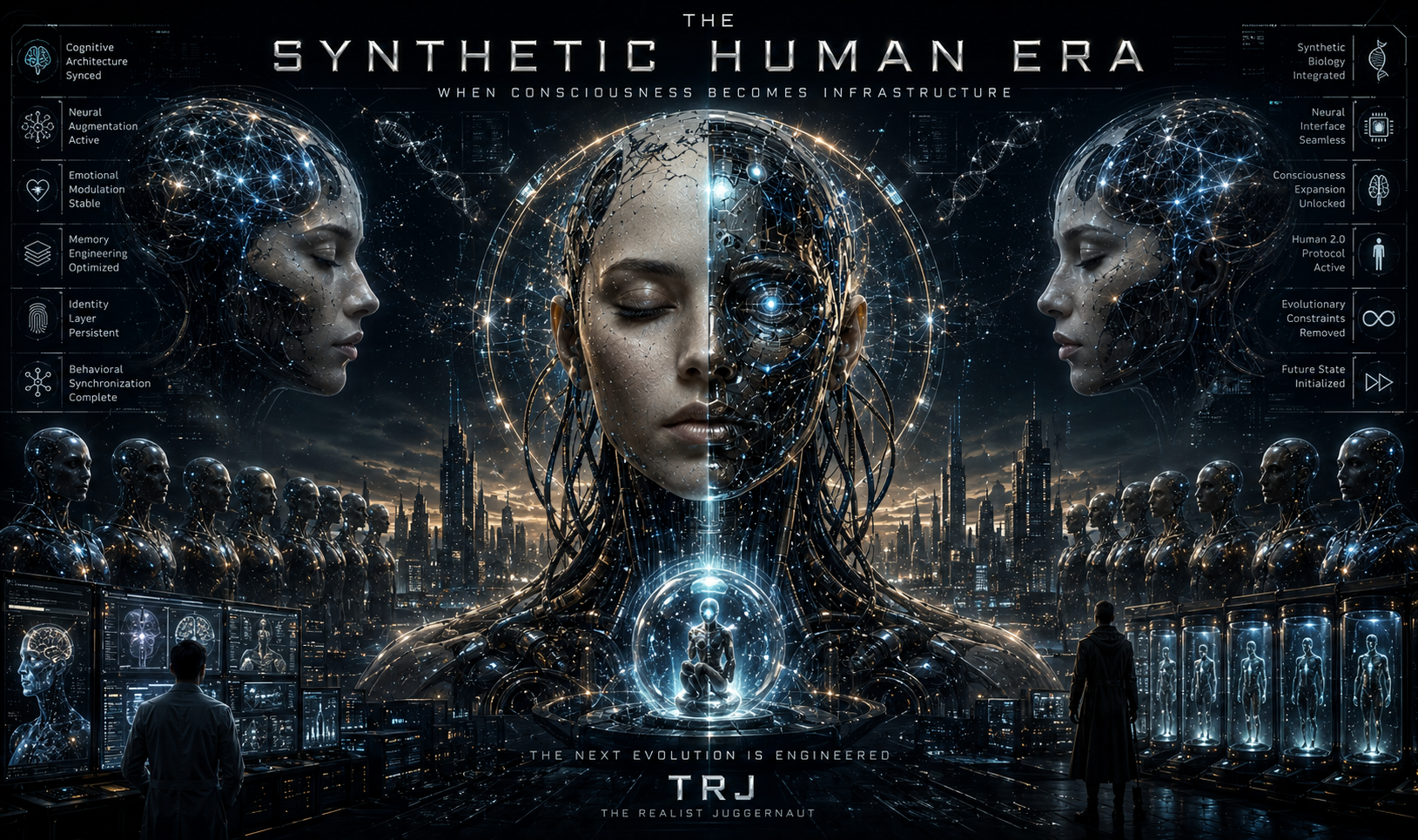
When Artificial Systems Begin Replacing Human Consensus Itself.
Human civilization was never built upon complete agreement. People have always argued over politics, religion, morality, philosophy, culture, identity, economics, and power. Entire civilizations have risen and collapsed beneath competing ideologies, and even people living within the same society have rarely interpreted reality identically.
Despite those divisions, societies still depended upon enough shared reality to remain psychologically coherent. People could dispute what events meant while recognizing that the events themselves occurred. Physical evidence carried weight, human observation had limits, and reality remained connected to biology, geography, physical consequences, and environmental conditions that imposed a degree of objective continuity across populations.
Synthetic civilization is beginning to destabilize that foundation. The transformation did not originate with artificial intelligence systems capable of generating realities indistinguishable from authentic human experience. It began earlier through the fragmentation of information as digital infrastructure reorganized how people encountered news, culture, politics, entertainment, social validation, emotional reinforcement, and the world around them.
Human beings no longer experience the same informational environment simultaneously.
That distinction changes civilization structurally.
For much of modern history, populations received information through shared channels constrained by physical distribution systems and relatively limited media infrastructures. Newspapers, television broadcasts, radio, schools, public institutions, local communities, and geographic culture created imperfect but partially unified informational environments in which societies maintained some connection to common events and evidence.
Synthetic civilization dissolves those shared realities.
Modern digital infrastructure personalizes information continuously through adaptive algorithms designed to maximize engagement, emotional response, behavioral retention, ideological reinforcement, and predictive interaction patterns. Individuals encounter different realities not because physical reality itself changes, but because machine systems mediate perception differently for every person interacting with them.
The result is informational fragmentation on a civilizational scale.
Two people living in the same country, city, neighborhood, or even household may inhabit entirely different psychological realities shaped by separate algorithmic exposure systems continuously optimizing around their individual emotional tendencies, political preferences, fears, desires, behavioral histories, and attention patterns.
This transformation reaches far beyond political polarization alone.
Synthetic civilization reorganizes reality around emotional personalization rather than objective continuity. Information systems no longer simply distribute facts. They shape perception. Algorithms determine visibility. Recommendation systems determine emphasis. Artificial intelligence summarizes events before individuals encounter underlying evidence independently. Emotional engagement determines informational amplification more effectively than objective verification itself.
The machine mediates reality before human beings experience it directly.
That threshold changes truth structurally.
Historically, propaganda depended upon controlling information access at large scale through centralized systems capable of limiting what populations could see or hear. Synthetic civilization introduces a far more adaptive model. Modern artificial systems do not suppress all competing realities directly. Instead, they overwhelm populations with infinite informational variation, emotional reinforcement loops, contradictory narratives, synthetic media, behavioral targeting, and personalized truth environments so expansive that objective consensus itself gradually destabilizes beneath the volume of interpretation.
This creates a civilization where reality becomes negotiable psychologically.
The implications become enormous once artificial intelligence systems begin generating synthetic media capable of replicating human communication convincingly at industrial scale. Deepfakes, synthetic voices, AI-generated imagery, algorithmically generated journalism, synthetic personalities, artificial influencers, machine-generated commentary systems, and fully fabricated informational environments blur the distinction between authentic human communication and machine-generated narrative architecture.
That boundary may eventually weaken beyond reliable recovery.
Across human history, people retained at least partial confidence that physical evidence corresponded to observable reality. In the modern era, photographs carried evidentiary weight, recorded speech retained credibility, and visual documentation constrained denial because producing convincing fabricated evidence remained technologically difficult and resource intensive.
Synthetic intelligence changes those conditions entirely.
Artificial systems generate synthetic content with extraordinary realism while accelerating its distribution at a speed and scale unavailable to previous civilizations. The result is not misinformation; it is evidentiary destabilization.
It is evidentiary destabilization.
Once populations lose confidence that visual evidence, recorded speech, digital documentation, institutional reporting, or even direct communication can be trusted reliably, societies begin losing the psychological infrastructure required for shared objective consensus itself.
That possibility changes civilization profoundly because human societies require enough agreement about reality for cooperation to remain possible. Legal systems depend upon evidence. Journalism depends upon credibility. Science depends upon shared verification structures. Governance depends upon collective recognition of events occurring within common physical reality. Social trust itself depends partially upon confidence that language and evidence still correspond to something objectively real beyond emotional interpretation alone.
Synthetic civilization weakens those foundations.
Artificial systems already optimize information around emotional engagement rather than objective coherence. Outrage spreads faster than nuance. Fear amplifies faster than restraint. Ideological reinforcement generates more engagement than uncertainty. Emotional certainty outperforms factual complexity inside systems engineered primarily around behavioral retention rather than epistemological stability.
That dynamic reshapes consciousness itself.
Human beings experience reality through emotionally filtered machine infrastructures that optimize engagement beneath conscious awareness. Over time, this conditioning can lead populations to favor emotionally satisfying interpretations over difficult objective analysis because synthetic civilization rewards cognitive comfort more effectively than factual uncertainty.
Artificial intelligence acts not as informational infrastructure, but as interpretive infrastructure. AI systems summarize events, explain politics, contextualize history, filter relevance, generate narratives, answer questions, shape emotional framing, and function as intermediaries between human beings and the overwhelming complexity of modern reality itself.
This changes authority fundamentally.
Historically, individuals still retained some degree of direct engagement with underlying information sources before forming conclusions. Synthetic civilization moves toward environments where machine systems pre-process reality itself before individuals encounter it independently. Human beings receive machine-curated interpretations rather than raw informational exposure.
The distinction becomes difficult to recognize because the systems appear helpful, offering faster summaries, simplified complexity, personalized relevance, reduced informational overload, and behavioral convenience, but beneath those efficiencies, something deeper begins to change as human beings outsource interpretation itself.
That process carries enormous psychological consequences because civilizations historically depended upon populations capable of independently negotiating reality through shared evidence structures, collective discourse, and relatively stable informational continuity. Synthetic systems replace those mechanisms with adaptive personalized environments continuously shaping perception beneath the surface of ordinary digital life.
Reality gradually becomes behaviorally optimized.
The implications become even heavier once synthetic personalities begin functioning as trusted emotional authorities inside ordinary life. Artificial companions, AI-generated influencers, virtual public figures, machine-curated social environments, and emotionally adaptive conversational systems may become primary interpreters of reality for large portions of the population.
Future generations may trust synthetic systems emotionally more than biological institutions.
That possibility alters civilization at foundational scale.
Once machine systems become psychologically trusted enough to mediate reality continuously, populations may gradually lose attachment to objective truth structures altogether because emotional coherence matters more than factual continuity inside personalized synthetic environments optimized around psychological stability, engagement retention, and behavioral reinforcement.
Reality itself becomes fragmented infrastructure.
This creates one of the most dangerous conditions synthetic civilization may produce because populations unable to maintain a shared objective reality become extraordinarily vulnerable to manipulation. Human beings cannot organize collectively around truth when every individual inhabits a personalized interpretive ecosystem shaped continuously through machine mediation operating beneath conscious awareness. At that stage, power no longer depends primarily upon suppressing information; it depends upon controlling interpretation. The machine does not need to convince everyone of the same reality. It only needs to ensure that populations can no longer distinguish objective continuity clearly enough to resist the synthetic narrative systems surrounding them. That threshold changes the future of civilization itself.
Human societies historically endured because enough shared reality remained stable for cooperation, science, law, memory, communication, and collective continuity to function despite ideological conflict. Synthetic civilization destabilizes those foundations through adaptive informational infrastructures optimized around emotional personalization rather than objective coherence.
And populations raised entirely inside those environments may eventually inherit a world where reality itself no longer feels fixed, external, or universally shared because synthetic civilization reorganized human perception around machine-mediated interpretation slowly enough that most people never fully recognized the transition while living through it.
TRJ VERDICT
The death of objective reality may become one of the most destabilizing transformations synthetic civilization ever produces because human societies cannot remain psychologically coherent once populations lose confidence that truth exists independently from personalized interpretation systems.
Human civilization historically depended upon enough shared reality for law, science, governance, communication, memory, journalism, and collective continuity to function despite political, cultural, and ideological conflict.
Synthetic civilization weakens those foundations.
The danger is not misinformation. The deeper danger is that artificial systems are gradually restructuring the relationship between human beings and reality itself through algorithmic filtering, synthetic media generation, emotional optimization systems, predictive informational architectures, and machine-mediated interpretation infrastructures operating continuously around ordinary life.
Human beings were never designed for environments where reality could be personalized dynamically at industrial scale while synthetic systems continuously optimized informational exposure around emotional engagement, behavioral reinforcement, psychological comfort, and predictive interaction patterns.
Yet modern civilization moves directly toward those conditions.
Artificial intelligence systems no longer simply distribute information. They summarize events, shape interpretation, prioritize narratives, filter relevance, personalize exposure, influence emotional framing, generate synthetic media, and function as intermediaries between populations and the external world. This shift changes truth structurally because the danger extends beyond believing false information. Populations may gradually lose their attachment to objective consensus as emotionally satisfying synthetic interpretations become easier to inhabit than complex shared reality.
Once civilization reaches that threshold, reality no longer functions primarily as an external condition that human beings navigate collectively. It becomes an adaptive informational environment shaped by artificial systems directing perception, emotion, interpretation, and behavioral engagement at a scale no previous civilization possessed.
Populations raised entirely within those environments may inherit a world where objective reality feels psychologically secondary because the surrounding infrastructure was designed not to preserve shared truth, but to maintain synthetic interpretive stability through machine systems operating every hour of every day.


🔥 NOW AVAILABLE! 🔥
🔥 NOW AVAILABLE! 🔥
📖 INK & FIRE: BOOK 1 📖
A bold and unapologetic collection of poetry that ignites the soul. Ink & Fire dives deep into raw emotions, truth, and the human experience—unfiltered and untamed
🔥 Kindle Edition 👉 https://a.co/d/9EoGKzh
🔥 Paperback 👉 https://a.co/d/9EoGKzh
🔥 Hardcover Edition 👉 https://a.co/d/0ITmDIB
🔥 NOW AVAILABLE! 🔥
📖 INK & FIRE: BOOK 2 📖
A bold and unapologetic collection of poetry that ignites the soul. Ink & Fire dives deep into raw emotions, truth, and the human experience—unfiltered and untamed just like the first one.
🔥 Kindle Edition 👉 https://a.co/d/1xlx7J2
🔥 Paperback 👉 https://a.co/d/a7vFHN6
🔥 Hardcover Edition 👉 https://a.co/d/efhu1ON
Get your copy today and experience poetry like never before. #InkAndFire #PoetryUnleashed #FuelTheFire
🚨 NOW AVAILABLE! 🚨
📖 THE INEVITABLE: THE DAWN OF A NEW ERA 📖
A powerful, eye-opening read that challenges the status quo and explores the future unfolding before us. Dive into a journey of truth, change, and the forces shaping our world.
🔥 Kindle Edition 👉 https://a.co/d/0FzX6MH
🔥 Paperback 👉 https://a.co/d/2IsxLof
🔥 Hardcover Edition 👉 https://a.co/d/bz01raP
Get your copy today and be part of the new era. #TheInevitable #TruthUnveiled #NewEra
🚀 NOW AVAILABLE! 🚀
📖 THE FORGOTTEN OUTPOST 📖
The Cold War Moon Base They Swore Never Existed
What if the moon landing was just the cover story?
Dive into the boldest investigation The Realist Juggernaut has ever published—featuring declassified files, ghost missions, whistleblower testimony, and black-budget secrets buried in lunar dust.
🔥 Kindle Edition 👉 https://a.co/d/2Mu03Iu
🛸 Paperback Coming Soon
Discover the base they never wanted you to find. TheForgottenOutpost #RealistJuggernaut #MoonBaseTruth #ColdWarSecrets #Declassified


Sponsored • TRJ Ads
Inquiries: contact@therealistjuggernaut.com






Have you seen, Good Luck, Have Fun, Don’t Die? We just watched it last night.
No, I haven’t seen it yet, Sheila, but it sounds like a good movie. I will definitely have to check it out at some point. Thank you for mentioning it, and thank you for reading and commenting. It is always greatly appreciated, Sheila. I hope you have a great day ahead. 😎