
Thank you for reading or listening to The Realist Juggernaut. Independent journalism should be accessible to everyone.
Humanity Built a System That Records, Reconstructs, Predicts, and Influences Us—and Unplugging Can No Longer Provide an Escape
Privacy did not disappear in a single moment. It was surrendered in fragments, extracted through convenience, buried inside agreements, generated through ordinary activity, and assembled by systems most people never knew existed. One application learned where someone traveled. Another learned what they purchased. A search engine recorded their questions. A streaming service measured their attention. A vehicle documented their movements. A wearable monitored their body. A financial institution preserved their transactions. A camera captured their face. A social platform mapped their relationships. Each fragment appeared limited when viewed alone. Together, they formed something far more complete: a continuously developing reconstruction of a human life.
The public still speaks about privacy as though it can be restored by changing a setting, refusing cookies, closing an account, or turning off location services. Those actions can restrict certain forms of collection. They cannot recall information already transmitted, separate data already combined, destroy records already copied, remove photographs stored by other people, retrieve information already sold, or eliminate conclusions produced by artificial intelligence. The visible account is only the entrance. Behind it sits an architecture of databases, identifiers, analytical systems, commercial relationships, backups, archives, and derived profiles that can survive long after the user leaves.
The danger is not that one all-seeing institution possesses every fact about every person. The danger is that thousands of separate systems possess enough fragments to reconstruct much of the same result whenever access, money, authority, or analytical power brings those fragments together. A telecommunications company knows one part. A retailer knows another. A data broker knows another. A social platform knows relationships and interests. A connected vehicle knows routes and driving behavior. A health application knows intimate physical details. Public records contribute addresses, property, businesses, licenses, and legal events. Cameras add faces, places, times, and associations. AI supplies the connective tissue.
This system does not require complete certainty. It operates through probability. It can estimate income without seeing a tax return, infer illness without reading a medical chart, detect a relationship without viewing a private conversation, and identify religious or political activity without receiving a direct declaration. The conclusion may be accurate, partially accurate, or wrong. It can still influence the advertisement displayed, the price offered, the risk assigned, the account flagged, the opportunity presented, or the scrutiny imposed.
The loss of privacy is therefore greater than the exposure of secrets. It is the loss of meaningful control over how a person is observed, reconstructed, classified, predicted, and treated. Privacy once depended heavily on physical separation, limited records, human memory, distance, time, and the difficulty of connecting one fact to another. Digital systems weakened every one of those protections. Artificial intelligence is now attacking what remains.
PRIVACY WAS CONVERTED INTO INFRASTRUCTURE
The early internet encouraged people to think of data as something they intentionally entered into a computer. A person typed a name, sent a message, created a profile, or submitted a payment. Information appeared to move only when the user deliberately provided it. That model no longer describes digital life.
Modern systems generate information through operation itself. Opening an application can reveal the device, network, location, language, time zone, operating system, advertising identifier, and version of the software being used. Remaining on a screen can disclose attention. Scrolling can reveal interest. Hesitation can be measured. Mouse movements, abandoned shopping carts, viewing duration, repeated searches, notification responses, and the time between actions can become behavioral signals. The person does not need to publish anything. Their interaction produces the record.
This passive production of information turned surveillance into infrastructure. It no longer requires an investigator to follow someone, a listener to monitor a conversation, or a clerk to assemble a file. Collection can occur automatically across millions of people at once. Storage is inexpensive. Processing is continuous. The system does not become bored, forget a face, misplace a paper folder, or stop working at the end of a shift.
Convenience accelerated this transformation because each connected service offered a practical reason to collect more. Navigation required location. Photo organization benefited from facial recognition. Voice assistants required audio processing. Fraud prevention demanded device and behavioral analysis. Personalization depended on history. Fitness services measured movement and health. Smart-home systems observed occupancy and routines. Connected vehicles recorded performance and travel. The data gathered for one function could later acquire commercial, analytical, security, or developmental value beyond the reason that first placed it inside the system.
The exchange was presented as a choice between access and refusal. In practice, refusal became harder as connected systems entered employment, education, banking, health care, transportation, government services, communication, and commerce. A person could decline one application, but avoiding the entire architecture required withdrawing from essential parts of modern society. Consent remained visible on the screen while dependence grew underneath it.
The terms governing this exchange rarely provided genuine understanding. A user was expected to evaluate extensive policies describing collection, analytics, contractors, affiliates, advertising partners, security uses, research, product improvement, legal obligations, corporate transfers, and future changes. The company knew its own system. The individual saw only the interface.
Privacy was not simply traded for convenience. It became a resource consumed by the infrastructure providing that convenience. Once entire industries learned to extract economic and operational value from human information, collection stopped being incidental. It became a permanent function of the system.
THE SYSTEM CAN BUILD AN IDENTITY WITHOUT THE PERSON
A person does not need to create a detailed profile for one to exist. Identities can be assembled through devices, addresses, transactions, networks, public records, household associations, photographs, and information supplied by others. The resulting profile may be scattered across many systems, but it can still represent a recognizable individual.
Account identifiers provide one connection. Email addresses and telephone numbers provide others. Advertising identifiers distinguish devices. IP addresses can associate activity with a household or workplace. Payment information connects purchases. Repeated location patterns identify homes and employers. Shared networks reveal groups of devices occupying the same space. Contact lists map relationships. Uploaded photographs connect faces to names, events, and locations.
Device fingerprinting can recognize a browser or device through a combination of technical characteristics. Screen dimensions, system configuration, installed capabilities, browser properties, language, time zone, and other signals can form a distinctive pattern. Clearing cookies may remove one marker without erasing the larger collection of traits that allows the device to be recognized again.
Behavior itself can become an identifier. People develop patterns in how they type, move through applications, hold devices, travel, shop, read, and respond. A system may not need a permanent name attached to every action if recurring behavior allows separate sessions to be associated with the same probable person. Identity becomes less dependent on one stable credential and more dependent on the total pattern.
Non-users are not outside this process. A person may refuse to join a social platform while friends upload photographs containing their face. A relative may synchronize a contact list containing their telephone number and email address. A family member’s device can reveal a shared home. Public records can identify property ownership, business associations, court activity, licenses, and previous addresses. Retail and advertising systems can contribute purchases and household characteristics. The profile grows without the subject ever opening an account.
This creates a collective privacy problem that cannot be solved through individual discipline. One person’s decision affects information about other people. A photograph reveals everyone standing in the frame. Genetic information reveals biological relatives. A connected doorbell records neighbors and visitors. A vehicle records passengers and destinations. A contact list exposes relationships. A household device can collect voices belonging to people who never agreed to its terms.
The system can therefore know a person through the informational shadows cast by everyone and everything around them. Refusal to disclose is no longer the same as remaining unknown.
LOCATION IS A BIOGRAPHY WITHOUT SENTENCES
Few categories of information expose the structure of a life as clearly as location. A single coordinate may reveal little. A sustained pattern can identify a home, workplace, medical provider, place of worship, school, relationship, routine, and private concern without requiring the person to explain any of them.
Repeated overnight presence points toward a residence. Consistent weekday activity suggests employment. Regular stops at a school may reveal children or caregiving responsibilities. Visits to a specialist can indicate a health condition. Attendance at a church, synagogue, mosque, or other religious institution can disclose faith. Travel to a union office can reveal labor activity. Presence at a political event can reveal civic participation. Repeated movement alongside another device can expose a relationship.
The interpretation becomes more powerful when location is combined with time. A visit at noon may have a different meaning from an overnight stay. A single visit may be accidental. Repeated visits establish a pattern. A sudden break in routine may indicate illness, unemployment, travel, separation, hospitalization, or a change in living arrangements. The data does not need to explain the event. It narrows the possibilities.
The scale of commercial location collection demonstrates that this is not limited to a few specialized applications. Companies operating within the location-data industry have claimed the capacity to process billions of signals from approximately one billion mobile devices in a single day. These signals can enter the commercial system through applications, embedded software, advertising identifiers, wireless networks, connected vehicles, and transactions occurring behind ordinary digital activity.
Real-time advertising auctions add another layer. When a page or application prepares to display an advertisement, information about the device and the surrounding circumstances can be transmitted to participants competing for the opportunity to reach that user. The auction may last only a fraction of a second. The data exposed through the process can have a life far beyond the advertisement ultimately displayed.
Location information is frequently described as anonymous when it is attached to a device identifier instead of a name. That separation provides weak protection when the device returns to the same residence each night, travels to the same workplace each morning, and maintains recurring contact with identifiable people and places. Other databases can close the gap.
The problem extends beyond commercial advertising. Location can be acquired by private investigators, corporate clients, government contractors, analytical companies, and entities operating through layers of resale. Once records move across multiple organizations, the individual may have no reliable method to determine who possesses them, how long they will remain, or what new purpose will later be assigned to them.
A person may never write a diary. Their movements can write one for them.
DATA BROKERS CLOSE THE DISTANCE BETWEEN FRAGMENTS
Data brokers exist because information gains value when it is collected, organized, corrected, connected, classified, and sold. They acquire records from commercial sources, public databases, applications, retailers, surveys, advertising systems, financial activity, and other brokers. Their products can verify identity, locate people, identify relationships, build marketing audiences, assess characteristics, and support predictions about future conduct.
The individual rarely has a direct relationship with every broker holding information about them. There may be no application on their phone, account in their name, or recognizable service they knowingly entered. The broker can remain invisible while its products influence visible parts of life.
A profile may include verified facts, outdated details, incorrect associations, estimates, and inferred categories. An old address can connect the wrong household. A shared device can blend the activity of several people. A recycled telephone number can attach history to a new owner. A family purchase can be assigned to the wrong individual. An algorithm can convert correlation into a label that appears more certain than the evidence supporting it.
The resulting identity can contain far more than contact information. It may include income range, household composition, interests, purchasing power, property, vehicles, political engagement, religious activity, health-related indicators, travel, and predicted responsiveness to particular offers. Some systems produce scores designed to estimate reliability, financial risk, medication adherence, purchasing behavior, or the probability that a person will act in a certain way.
These scores change privacy from a question of exposure into a question of power. A hidden profile can affect what a person is shown without revealing why. It can influence which offer reaches them, which promotion disappears, which product appears first, or which transaction receives additional scrutiny. The person sees the outcome. The system retains the reasoning.
The same information can acquire different meanings for different buyers. A retailer may view a new parent as a marketing category. An insurer may view the household through risk. A political organization may see a persuadable voter. A creditor may see financial vulnerability. A criminal may see an opportunity. A foreign intelligence service may see access, leverage, or national value. The data does not control its purpose once it has crossed enough boundaries.
Opting out of one broker cannot guarantee removal from the wider market. Another broker may hold the same source material. Information may remain inside reports connected to relatives, neighbors, or associates. Public records continue to exist. New copies can be collected. A successful removal can therefore become temporary rather than final.
The database economy does not need one permanent master file. It needs a sufficient number of fragments and the ability to reconnect them when someone is willing to pay.
DELETION CANNOT REVERSE WHAT DATA HAS ALREADY CREATED
Digital deletion is commonly imagined as destruction. A person presses a button, the account disappears, and the information appears to be gone. The visible result conceals a far more complicated process.
Information may exist inside an active account database, security logs, advertising systems, analytical tools, archives, backups, development environments, fraud controls, legal records, and third-party services. Copies may have been transmitted under earlier agreements. Portions may be retained to complete transactions, resolve disputes, prevent abuse, satisfy legal duties, or protect the company. The public-facing profile represents only one location within that network.
Closing an account can remove access without removing every record. Deleting a post can hide it from public view while cached copies, screenshots, moderation records, archives, or other users’ copies continue to exist. Removing a photograph from one service cannot retrieve the same image from every device that downloaded it. Deleting a message from one interface cannot guarantee that no recipient, backup, log, or notification preserved its content.
The deeper problem is that raw information produces new information. A voice recording creates a transcript. A photograph produces a facial template. A location history produces a routine. A group of purchases produces a consumer category. Browsing behavior produces an interest profile. A set of interactions produces an engagement prediction. These derived products may continue to function without displaying the source that created them.
That means information has descendants.
A person may delete the recording while the transcript remains. They may remove the photograph while a biometric representation survives. They may erase visible activity while the system retains an audience classification created from it. They may close the account while a model trained on past behavior continues applying what it learned to future users and future decisions.
The requirement to destroy models and algorithms derived from improperly collected information has already appeared in regulatory enforcement because deleting raw records alone could leave the benefit of the collection intact. That principle exposes the weakness of ordinary deletion rights. Unless every derivative, duplicate, recipient, and trained product is identified and destroyed, the original information can continue exerting influence after it appears to be gone.
Breaches make recovery more difficult. Once information has been stolen and copied outside the original organization, no account setting can retrieve it. Exposure involving biometrics, genetics, medical history, or lifelong movement patterns can remain consequential for decades because those attributes cannot be meaningfully replaced.
Deletion remains useful because reducing the number of active copies can reduce future risk. It does not restore the condition that existed before collection. Information cannot always be returned to the private state from which it came.
AI HAS DESTROYED THE PRIVACY OF THE UNDISCLOSED
Before modern artificial intelligence, vast databases could contain more information than their owners could practically interpret. Records remained valuable, but extracting every connection required time, specialized analysts, manual searches, and clearly defined questions. AI has changed that limitation.
Language systems can search, summarize, and classify enormous quantities of text. Computer-vision systems can recognize faces, objects, locations, and activity inside images and video. Voice systems can transcribe speech, distinguish speakers, analyze tone, and connect spoken information to other records. Predictive models can examine behavior across millions of people and identify patterns too subtle or numerous for direct human review.
Old information acquires new power when analytical capability improves. A photograph taken years before advanced facial recognition can later identify someone. Stored audio can become searchable after better transcription arrives. Historical location records can expose associations once systems learn to compare movement across devices. Customer messages can be analyzed for emotion, vulnerability, personality, and intent long after the conversation ends.
AI also changes what it means for information to be missing. A system does not always need a direct statement when surrounding evidence supports an inference. It can estimate income through property, location, devices, employment, purchases, subscriptions, and travel. It can infer health concerns through searches, pharmacy activity, clinic visits, sleep changes, food purchases, and altered routines. It can identify probable relationships through communication patterns, shared networks, co-location, photographs, and household activity.
The inference does not have to be certain. A probability can be enough to alter a decision. A company may show a different offer because a person appears financially vulnerable. A platform may promote content because an emotional state suggests susceptibility. A security system may increase scrutiny because behavior resembles a statistical pattern. A hiring system may lower a ranking because indirect variables correlate with an unwanted characteristic. The person can be affected without ever learning what the system concluded.
Incorrect inferences do not restore privacy. They create a second danger. A flawed system can attach the wrong medical interest, political belief, financial condition, relationship, or risk category to an innocent person. Automated repetition can then spread the error across decisions that appear objective because a machine produced them.
The final private space was once the distance between what a person revealed and what others could prove. AI is occupying that distance. Silence no longer guarantees secrecy. Refusal no longer prevents classification. Missing information no longer prevents the system from constructing an answer.
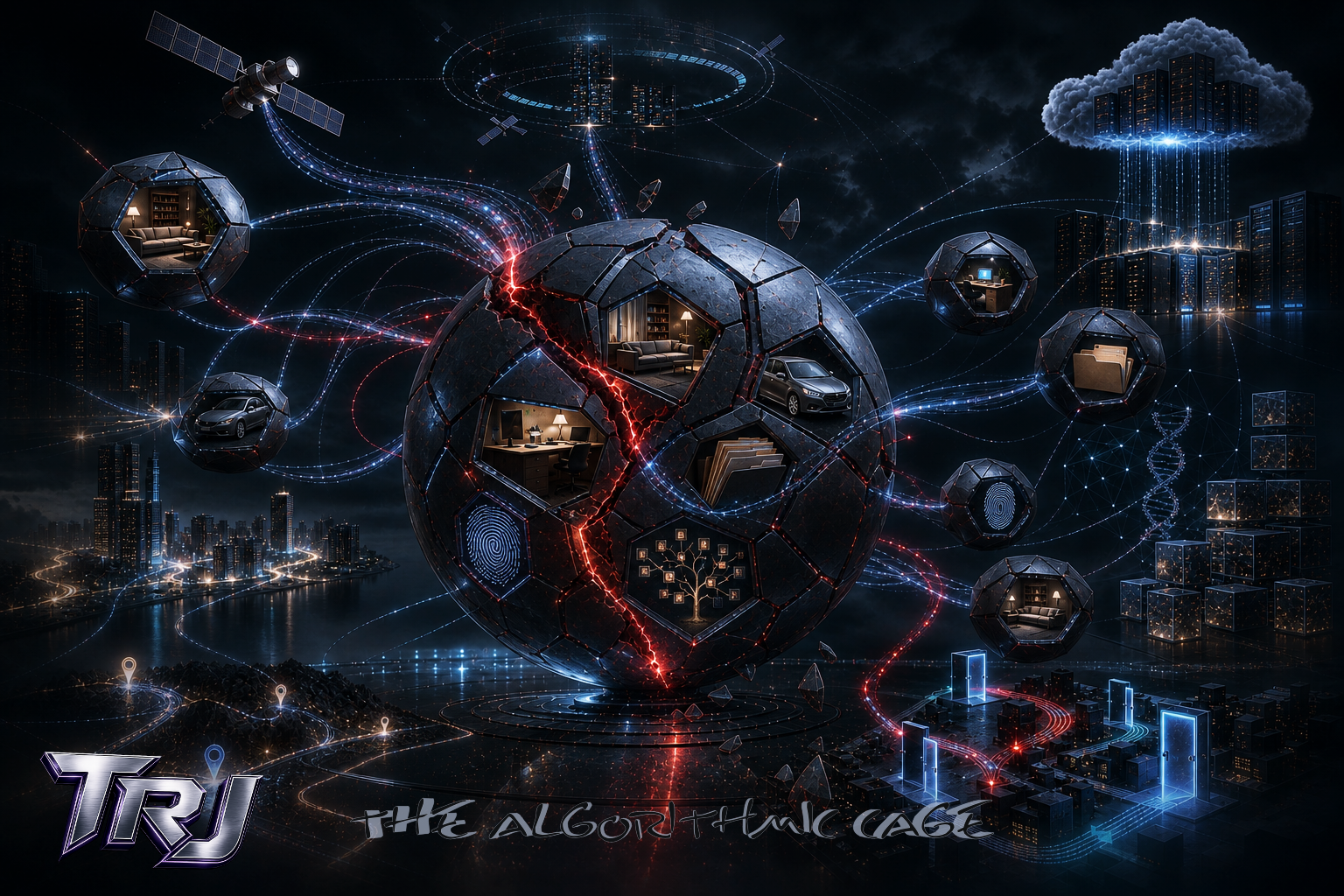
The algorithmic cage begins when observation becomes prediction. It closes when those predictions begin shaping the environment through which the person must live.
THE HOME HAS BECOME A SENSOR NETWORK
The home was once the strongest physical boundary protecting private life. Walls blocked public observation. Conversations disappeared unless someone remembered or recorded them. Daily routines remained known mainly to the people living inside. Connected technology has weakened that boundary by placing microphones, cameras, sensors, accounts, and cloud services throughout the household.
A smart television can record viewing behavior. A voice assistant must process sound to recognize commands. A security camera captures residents, visitors, delivery workers, neighbors, and activity beyond the property. A thermostat can indicate occupancy and routine. A connected appliance can report when and how it is used. A wearable can transmit sleep, movement, heart activity, exercise, and other physical measurements. A gaming system can record interactions, purchases, voice communications, and playing habits. A wireless router can identify devices entering and leaving the network.
Each product may perform the function its owner purchased. The privacy problem begins with the additional record created by that function. A television does not need to understand the meaning of a program to register what appeared on the screen. A thermostat does not need to know why a household’s schedule changed to record that it changed. A doorbell does not need to identify every passerby to preserve faces, voices, vehicles, and times. Once stored and transmitted, those records can be processed far beyond the physical object that collected them.
Cloud connectivity moves household information outside the household. Video, audio, device status, settings, and usage history may travel to remote servers for storage, analysis, synchronization, security, or product development. The resident sees a camera attached to a wall. The complete system includes the camera, home network, mobile application, user account, cloud provider, contractors, analytical services, security controls, and every person or system authorized to access the resulting information.
That chain introduces risks at every point. Employees may receive unnecessary access. Contractors may handle sensitive material. Credentials may be stolen. Accounts may be compromised. A company may change its policies. A service may be sold. A database may be breached. Information collected for one function may later assist another. The owner can unplug the device, but unplugging does not retrieve recordings or analytical products already transmitted beyond the home.
The presence of other people complicates consent. A visitor may not know that audio is being processed. A child cannot understand the lasting implications of a device preserving speech and behavior. A neighbor may be recorded by a camera they do not own. A worker entering the property may become part of a facial or behavioral record without any meaningful opportunity to refuse.
The smart home did not merely automate private space. It connected private space to an external information system.
THE PHYSICAL WORLD NOW PRODUCES DIGITAL RECORDS
Leaving a phone at home no longer guarantees that movement through society will go unrecorded. The physical world contains cameras, license-plate readers, access-control systems, payment terminals, traffic sensors, vehicle systems, facial-recognition tools, drones, body-worn cameras, and privately operated security networks. These technologies serve many legitimate purposes, including public safety, theft prevention, traffic management, emergency response, and property protection. Their combined effect is the conversion of physical presence into searchable data.
An automated license-plate reader can capture a plate, location, date, time, direction of travel, and image of the vehicle. A single record documents a moment. A network of readers can reconstruct movement across jurisdictions. Federal agencies have acknowledged access to third-party systems providing nationwide sources of license-plate information. The camera does not need to know who is driving. Registration records, address information, other cameras, and recurring travel patterns can help connect the vehicle to a person.
Facial recognition performs a similar transformation. A face visible in public was once identifiable only to people who recognized it. A digital image can now be compared against databases containing enormous numbers of photographs. Those photographs may originate from licenses, passports, arrests, social platforms, commercial services, public websites, security footage, and images uploaded by other people.
Recognition changes the practical meaning of public anonymity. A person can remain one stranger among thousands when identification depends on human memory. That protection weakens when cameras preserve the scene and software can compare every visible face against searchable collections. The person does not need to present identification. Their body becomes the identifier.
The eye in the sky is no longer one eye. It is a distributed canopy of sensors operating from buildings, streets, vehicles, businesses, homes, aircraft, and handheld devices. No single camera needs to follow someone everywhere. Separate recordings can become a continuous account when time, location, face, vehicle, device, and transaction information are connected.
Private surveillance expands this environment beyond government systems. Stores monitor customers. Employers monitor workplaces. Apartment buildings control entry. Schools use security technology. Homeowners record streets and sidewalks. Vehicles contain external cameras. Members of the public record events continuously and distribute the results through online platforms. A person may carefully limit their own technology while remaining visible through systems controlled by everyone around them.
This is why disconnecting does not create invisibility. The individual can stop carrying one sensor. They cannot switch off the connected environment through which they must travel.
THE BODY HAS BECOME A PERMANENT CREDENTIAL
Passwords can be changed after exposure. Payment cards can be canceled. Account numbers can be replaced. Biometric information creates a different kind of risk because the credential is attached to the human body.
Facial geometry, fingerprints, voice characteristics, iris patterns, walking style, and other physical or behavioral traits can assist identification. These systems can improve security and convenience, but they also create durable templates that remain sensitive for the life of the person. That permanence magnifies the consequences of compromise.
Biometric systems do not always store a conventional photograph or recording. They may convert physical characteristics into mathematical representations designed for comparison. That transformation does not eliminate the privacy concern. The template remains connected to a trait the person cannot abandon. If it is copied, breached, misused, or matched across systems, the subject cannot obtain a new body.
Faces and voices are also exposed through ordinary human activity. A person’s image can appear in family photographs, professional profiles, security footage, public events, videos, interviews, and other people’s recordings. A voice can appear in messages, meetings, podcasts, customer-service calls, videos, and home devices. Generative AI has increased the value and danger of these materials by enabling imitation as well as identification.
A sufficiently developed collection can support facial reconstruction, voice cloning, impersonation, synthetic media, and attempts to defeat identity systems. The same records that help establish who someone is can be used to manufacture convincing evidence that they said or did something they never said or did. Privacy loss therefore converges with identity loss.
Errors create another danger. Facial-recognition systems have produced false matches that caused innocent people to be followed, searched, removed from businesses, or accused of wrongdoing. The system’s confidence can acquire authority before its accuracy has been properly examined. A person may then be required to disprove an automated conclusion produced from an image they never knew had entered the database.
The body was once the final proof of physical presence. In the synthetic era, it is also a data source, a credential, a surveillance target, and raw material for replication.
GENETIC PRIVACY CAN BE SURRENDERED BY SOMEONE ELSE
Genetic information reaches beyond the individual more deeply than nearly any other category of data. DNA can reveal ancestry, biological relationships, inherited traits, disease risks, and characteristics shared across families. Its significance does not end with the person who provided the sample.
Biological relatives share portions of their genetic information. One person’s decision to submit DNA can expose information about parents, siblings, children, distant relatives, deceased family members, and descendants who have not yet been born. Those relatives may never have entered the service, signed an agreement, or granted permission. Their connection exists through biology.
This makes genetic consent structurally incomplete. A person can authorize the processing of their own sample, but they cannot isolate the familial information embedded within it. The record carries facts about other people. It can reveal previously unknown relationships, identify family lines, support surname inferences, and expose inherited medical risks.
Genetic information is also permanent, and a breach occurring today may retain significance decades from now because scientific knowledge and analytical capacity continue advancing. Information that reveals little under current methods may disclose far more when future systems learn how to interpret it.
AI intensifies that risk by accelerating pattern recognition across large genetic datasets. The combination of genomic information, medical records, family histories, public genealogy, demographic information, and other databases can create conclusions extending far beyond the original purpose of the sample.
A person can decide never to submit their DNA and still become partially visible through relatives. This is one of the clearest demonstrations that privacy can no longer be treated solely as an individual possession protected through individual choices.
Some information about a person now exists inside other people.
CHILDREN ENTER THE CAGE BEFORE THEY CAN UNDERSTAND IT
A child can begin generating a digital identity before birth. Pregnancy applications, medical systems, purchase histories, baby registries, ultrasound images, family posts, and location patterns can establish the first signals. After birth, photographs, smart monitors, voice assistants, educational platforms, games, streaming services, connected toys, health applications, and family accounts continue building the record.
Parents often share these materials through love, pride, concern, or convenience. The resulting archive can still outlive the childhood it documents. Images can be copied. Names can be indexed. Faces can become searchable. Voice recordings can train recognition systems. Interests can become advertising categories. Educational behavior can become performance data. A child’s mistakes, emotions, friendships, and development can enter systems before the child possesses the maturity to understand permanence.
Children also interact with algorithms designed to measure attention and predict engagement. Every pause, replay, search, selection, and response can teach the system what holds their interest. The content placed before them then changes according to those observations. The system learns from the child while helping shape the environment in which the child learns about the world.
This creates a developmental feedback loop. A recommendation influences attention. Attention generates data. The data refines the profile. The refined profile changes the next recommendation. Over time, the system may become skilled at predicting what will keep the child watching, clicking, playing, purchasing, or returning.
Age does not automatically reset the record. A teenager can inherit years of information generated by parents, schools, devices, platforms, and earlier versions of themselves. An adult may enter employment, credit, insurance, and commercial systems carrying classifications built from a childhood they had no power to keep private.
The generation now growing inside connected environments may never experience the older meaning of anonymity. Their past can remain available to systems capable of reinterpreting it through tools that did not exist when the information was created.
They are not entering the algorithmic cage as adults who accepted its conditions. Many are being born inside it.
THE LAW PROTECTS CATEGORIES RATHER THAN THE COMPLETE PERSON
American privacy protections remain divided across sectors, data types, jurisdictions, and relationships. Health information may receive protection when handled by certain covered medical entities while similar information inferred by a shopping application, location broker, search history, or connected device may fall under a different legal structure. Financial institutions have specific obligations. Credit-reporting systems operate under another framework. Children younger than thirteen receive certain online protections. State laws provide additional rights to some residents. Public records, commercial data, employment systems, telecommunications, and government information each carry their own rules and exceptions.
As of 2026, the United States still does not have one comprehensive federal privacy law governing the complete commercial life cycle of personal information. The result is a fragmented system in which protection can depend on who collected the data, why it was collected, where the person lives, how the information is classified, and what the recipient intends to do with it.
The same fact can move between protected and less-protected contexts. A diagnosis inside a medical record receives specific safeguards. A visit to a treatment center captured through location information can reveal the same condition indirectly. A prescription history held within a covered health system occupies one legal category. Searches, purchases, and advertisements associated with that medication can create a parallel health profile elsewhere.
This fragmentation becomes harder to manage when AI creates inferences. Laws written around collected records do not always address conclusions calculated from those records. A company may never receive a document stating a person’s condition, religion, income, or relationship. Its systems can still assign a probability to each.
Legal rights to access, correct, opt out, or request deletion can reduce harm. Exercising those rights requires knowing which organization holds the information. The data-broker market contains companies most people have never heard of. Third-party sharing can create chains the individual cannot trace. Public records can repopulate commercial profiles. Derived products may not appear in the copy of raw information returned to the person.
The law can require responsible handling within defined boundaries. It cannot recreate the obscurity that existed before the information was collected, copied, inferred, and distributed.
THE ALGORITHMIC CAGE DOES MORE THAN WATCH
Surveillance is commonly understood as observation. The algorithmic cage extends beyond observation because it uses what it learns to modify the environment surrounding the person.
A recommendation system decides which content appears first. An advertising system chooses which fear, desire, insecurity, or interest to target. A pricing system can evaluate location, browsing behavior, demographics, shopping history, credit-related information, mouse movements, and abandoned purchases before determining which offer to present. A fraud system decides which transaction appears suspicious. A hiring system ranks applicants. A tenant-screening product evaluates prospective renters. A financial model estimates risk. A platform determines which voices receive attention and which disappear beneath the feed.
The individual does not encounter the same digital world as everyone else. Each person receives a partially constructed environment based on what the system believes about them. Two people can search for the same product and see different rankings, promotions, or prices. Two users can open the same platform and receive radically different accounts of society. Two applicants can enter an automated system and be evaluated through variables they cannot inspect.
This creates a closed behavioral cycle. The system collects information, builds a profile, predicts a response, changes the environment, records the reaction, and uses that reaction to refine the profile. The person’s behavior becomes both the target of the system and the fuel that improves it.
Choice still exists inside this structure, but it is not exercised in a neutral space. The available options, their order, their timing, their presentation, and the emotional pressure surrounding them can be deliberately arranged. Dark patterns can make refusal confusing, acceptance effortless, cancellation exhausting, and disclosure appear necessary. Personalization can make persuasion more precise because the system has already studied what works on that individual.
The cage does not need to issue commands. It can guide attention, narrow visibility, increase friction, reward certain behavior, and quietly make other behavior harder. It can shape probabilities while preserving the appearance that every decision originated entirely from the person.
The most powerful surveillance system is not one that merely records conduct. It is one that learns how to influence the conduct it records.
UNPLUGGING IS NO LONGER A MEANINGFUL EXIT
Disconnecting from the internet can still reduce direct participation. A person can stop generating searches, social activity, cloud interactions, application telemetry, streaming histories, and certain forms of device data. They can remove connected products, use cash in some transactions, avoid optional accounts, restrict permissions, and keep sensitive information away from networked systems.
Those actions can reduce exposure. They cannot remove the person from a society whose institutions and surroundings remain connected.
Employment creates records. Banking creates records. Property ownership creates records. Medical care creates records. Education creates records. Travel creates records. Government services create records. Vehicles create records. Cameras create records. Other people create records. A person who abandons every personal account can still appear in a relative’s contact list, a neighbor’s security footage, a passenger manifest, an employer’s system, a public filing, a license-plate database, a store camera, or a photograph posted by someone else.
The historical record remains. Years of locations, purchases, messages, images, identifiers, searches, relationships, and transactions do not return to the person when the connection ends. Copies may remain across companies, contractors, brokers, recipients, backups, archives, breached collections, and trained systems. AI can continue discovering new meaning inside old information without receiving another signal from the subject.
The surrounding population also prevents complete withdrawal. Household members carry connected devices. Businesses operate sensors. Streets contain cameras. Vehicles communicate. Institutions rely on databases. Friends take photographs. Relatives submit DNA. The disconnected person continues casting data through association.
This is why unplugging is no longer an escape hatch. It is barely a brake.
The system is already in place.
THE S.O.S. IS THAT THERE MAY BE NO WAY BACK
Humanity built this architecture before fully understanding what artificial intelligence would make possible. Information was collected under the assumption that individual fragments had limited value, that anonymity could be created by removing names, that storage did not guarantee comprehension, and that data gathered for one purpose would remain confined to that purpose.
Those assumptions have collapsed.
Names can be reconstructed. Anonymous records can be connected. Old archives can be reexamined. Faces can be recognized. Voices can be cloned. Relationships can be inferred. Locations can be interpreted. Genetic information can expose families. Behavioral patterns can identify individuals. AI can transform scattered fragments into predictions about facts no person knowingly disclosed.
The result is not simply a world with less privacy. It is a world in which the independent human being is accompanied by a digital reconstruction built from observation, transaction, association, and inference. That reconstruction can be copied, sold, searched, scored, challenged by no one, and used to influence the conditions under which the real person lives.
The system does not need to know everything. It needs enough to predict, classify, persuade, include, exclude, reward, investigate, or deny. It does not need to be correct every time. It needs only to possess enough authority for its conclusions to matter.
No privacy setting can solve an infrastructural problem. No account deletion can retrieve every copy. No individual refusal can silence other people’s devices. No disconnected phone can disable the cameras, databases, vehicles, institutions, and analytical systems operating throughout society. No person can reclaim genetic information shared through family biology. No human being can inspect every model that has learned from their past.
This is the S.O.S.
Privacy is already gone. Remaining connected continues expanding the record, but disconnecting can barely slow the process because the machinery no longer depends entirely on voluntary participation. The internet escaped the screen and entered homes, vehicles, streets, workplaces, institutions, bodies, and relationships. Artificial intelligence gave the resulting information the power to explain, predict, and influence the people from whom it was taken.
In the most brutal sense, a nuclear war or comparable civilizational collapse could interrupt much of this machinery by destroying electrical grids, communications networks, satellites, data centers, connected devices, and the institutions operating them. It still would not guarantee that the accumulated information disappeared. Hardened facilities, geographically distributed backups, offline archives, protected government systems, and surviving databases could preserve portions of the human record. Any event powerful enough to silence the architecture by force would also be powerful enough to destroy modern civilization alongside it.
That is how deeply the system has been embedded. Humanity cannot shut it down without dismantling essential parts of the world built around it, and catastrophe would offer destruction rather than freedom.
A person can unplug from the internet.
They cannot unplug the world around them.
There may no longer be a meaningful individual exit from the algorithmic cage.
TRJ VERDICT
The destruction of privacy is not the result of one company, one government, one device, or one generation of technology. It is the result of an entire civilization reorganizing itself around permanent information collection. Human activity has become raw material for databases, commercial profiles, biometric systems, predictive models, and automated decisions. Artificial intelligence did not create this architecture, but it gave the architecture the ability to connect what was separated, infer what was never disclosed, and act upon conclusions no person may ever be permitted to inspect.
Personal security practices still matter, but they cannot solve an infrastructural problem. Strong passwords, encrypted communications, restricted permissions, disconnected devices, and account deletion can reduce exposure. They cannot erase historical records, retrieve sold information, destroy breached copies, remove other people’s recordings, reverse genetic disclosure, or force every algorithm to forget what it has already learned. Responsibility cannot continue being placed almost entirely upon individuals who have no realistic way to identify every system holding information about them.
Any meaningful response must address collection before it occurs, prohibit unnecessary retention, restrict the sale and repurposing of sensitive information, require disclosure of inferred characteristics, provide enforceable rights to challenge automated classifications, and compel the destruction of models and analytical products created from unlawfully obtained data. Systems capable of affecting employment, housing, credit, insurance, pricing, health care, public benefits, or legal scrutiny must not be permitted to hide behind proprietary secrecy when their conclusions materially affect human lives.
Privacy may never return to what it was before the connected world. Society can still decide how much power the accumulated record will possess. If it refuses to make that decision, the algorithmic cage will continue closing—not because one machine conquered humanity, but because humanity connected every part of life and surrendered control of the resulting information one convenient transaction at a time.





🔥 NOW AVAILABLE! 🔥
🔥 NOW AVAILABLE! 🔥
📖 INK & FIRE: BOOK 1 📖
A bold and unapologetic collection of poetry that ignites the soul. Ink & Fire dives deep into raw emotions, truth, and the human experience—unfiltered and untamed
🔥 Kindle Edition 👉 https://a.co/d/9EoGKzh
🔥 Paperback 👉 https://a.co/d/9EoGKzh
🔥 Hardcover Edition 👉 https://a.co/d/0ITmDIB
🔥 NOW AVAILABLE! 🔥
📖 INK & FIRE: BOOK 2 📖
A bold and unapologetic collection of poetry that ignites the soul. Ink & Fire dives deep into raw emotions, truth, and the human experience—unfiltered and untamed just like the first one.
🔥 Kindle Edition 👉 https://a.co/d/1xlx7J2
🔥 Paperback 👉 https://a.co/d/a7vFHN6
🔥 Hardcover Edition 👉 https://a.co/d/efhu1ON
Get your copy today and experience poetry like never before. #InkAndFire #PoetryUnleashed #FuelTheFire
🚨 NOW AVAILABLE! 🚨
📖 THE INEVITABLE: THE DAWN OF A NEW ERA 📖
A powerful, eye-opening read that challenges the status quo and explores the future unfolding before us. Dive into a journey of truth, change, and the forces shaping our world.
🔥 Kindle Edition 👉 https://a.co/d/0FzX6MH
🔥 Paperback 👉 https://a.co/d/2IsxLof
🔥 Hardcover Edition 👉 https://a.co/d/bz01raP
Get your copy today and be part of the new era. #TheInevitable #TruthUnveiled #NewEra
🚀 NOW AVAILABLE! 🚀
📖 THE FORGOTTEN OUTPOST 📖
The Cold War Moon Base They Swore Never Existed
What if the moon landing was just the cover story?
Dive into the boldest investigation The Realist Juggernaut has ever published—featuring declassified files, ghost missions, whistleblower testimony, and black-budget secrets buried in lunar dust.
🔥 Kindle Edition 👉 https://a.co/d/2Mu03Iu
🛸 Paperback Coming Soon
Discover the base they never wanted you to find. TheForgottenOutpost #RealistJuggernaut #MoonBaseTruth #ColdWarSecrets #Declassified


Sponsored • TRJ Ads
Inquiries: contact@therealistjuggernaut.com






John, excellent article…very informative and well written. Interesting about a family member’s choice to use an ancestry service as necessarily invoking everyone else in the family.
What a depressing outlook. I don’t know what will come first… 1) a totalitarian govt using the “only used for advertising” data that people so easily gave up… or 2) AI becomes SkyNet and humans… used as marketing test groups, or as slaves… become irrelevant and expendable. Those fig trees are putting out leaves…
Do you know how AI is being used in the CCP with their social credit system? Wow, what a nightmare
Thank you very much, Darryl. I greatly appreciate that.
The ancestry-service issue is especially disturbing because one person can voluntarily submit DNA while revealing biological information about relatives who never agreed to participate.
Yes, the CCP uses social-credit scoring, ratings, blacklists, redlists, and related monitoring systems. AI strengthens that structure by helping authorities connect facial-recognition systems, surveillance-camera footage, online activity, financial records, travel, court enforcement, business compliance, and other government-held information. Depending upon the system and violation involved, people or organizations can face restrictions involving travel, financing, contracts, services, and other opportunities.
It is not one identical numerical score controlling every Chinese citizen in every circumstance. It is a network of national, regional, judicial, financial, and regulatory systems capable of sharing information and imposing consequences. That fragmented structure may be more dangerous because it can expand quietly without requiring one visible master score.
China demonstrates exactly why information collected for one stated purpose can never be assumed to remain confined to that purpose. Once surveillance, databases, state authority, and AI operate together, observation can become classification, and classification can then become control.
That is the algorithmic cage described in the article, and we researched it extensively. It does not merely watch people; it can shape what they are permitted to do after watching them. We are already there. These systems are being introduced and applied gradually, right under everyone’s noses.
We were warned long, long ago.
God gave Adam this command:
“Of every tree of the garden thou mayest freely eat: But of the tree of the knowledge of good and evil, thou shalt not eat of it.”
—Genesis 2:16–17, KJV
The serpent later tempted Eve by claiming:
“Ye shall not surely die… ye shall be as gods, knowing good and evil.”
—Genesis 3:4–5, KJV
Humanity was warned from the beginning about the temptation to possess knowledge, seize authority, and become its own judge of good and evil.
Those fig trees are certainly putting out leaves, Darryl. I hope all is well, and I hope you have a great night. 😎