Thank you for reading or listening to The Realist Juggernaut. Independent journalism should be accessible to everyone.
As Researchers Pursue Mind Uploading and Whole-Brain Emulation, Humanity Faces a Question Technology Cannot Answer: Can a Machine Preserve a Person, or Only Create a Convincing Copy?
Imagine the commercial. The screen is dark at first. Soft music begins playing. Photographs of childhood, marriage, family, birthdays and decades of memories slowly appear. An older couple holds hands. A familiar voice begins speaking: A life once thought to end with death can now continue. Your memories can remain. Your personality can remain. Your voice, experiences and identity can be preserved beyond the limits of the biological body. Choose where your existence continues. Choose what your world becomes. And when someone you love reaches the end of biological life, they can join you. Together again. Beyond disease. Beyond aging. Beyond death. Forever.
That commercial does not exist today. The technological ambition behind it does.
Researchers and organizations are working on whole-brain emulation, neural simulation, connectomics, brain preservation and technologies intended to reproduce functions of biological brains in artificial systems. Some organizations involved in this field openly use terms once reserved for science fiction: “mind uploading,” “substrate-independent mind,” “artificial brain,” “future revival” and even freedom from illness and death. Humanity has not uploaded a human consciousness. No experiment has established that subjective human awareness can be transferred from a biological brain into a computer. No scientific instrument has demonstrated the transfer, storage or preservation of a human soul. Yet the destination envisioned by some researchers is no longer hidden behind vague language about computing. They are telling us where they want this road to lead.
The Carboncopies Foundation describes mind uploading as the hypothetical copying of mental characteristics, including long-term memory and the experience of identity, from a particular biological brain to another device where the mind could continue functioning. Its definition of whole-brain emulation goes further, describing the technical process of deriving a substrate-independent mind from the neurobiology of a brain and expressing it as a working model for an artificial brain. Carboncopies describes two conceptual routes toward that objective. One involves progressively replacing portions of a biological brain with highly accurate, patient-specific neural prostheses until the brain is effectively artificial. The other involves preserving a biological brain, dividing it into extremely small sections, analyzing those sections and using the information to reconstruct a working artificial brain. Carboncopies states plainly that human mind uploading is not currently possible. It also says that if whole-brain emulation were eventually developed into a widely accessible medical technology, the research and development required could cost multiple billions of dollars.
This is not an obscure idea existing only at the edge of futurist discussion. Carboncopies operates research programs directed toward whole-brain emulation, including a Brain Emulation Challenge and software infrastructure intended to help turn brain data into working emulations. The organization also maintains research addressing consciousness, subjective experience and personal identity, questions that become unavoidable once the objective moves from simulating neural circuits toward recreating the functions associated with an individual mind.
Eon Systems is even more direct. Its website carries the words “Upload the Human Mind.” In March 2026, Eon demonstrated a virtual embodied fruit fly built from existing connectome research and a simulated body. The company described the work as an “upload,” although Carboncopies publicly disputed whether the demonstration justified that terminology and warned against overstating what brain-emulation experiments have actually accomplished. That scientific disagreement matters. It establishes an essential boundary between demonstrated neural modeling and claims that an individual conscious organism has genuinely been transferred into another substrate. Eon itself acknowledges significant simplifications in its fly model.
The underlying scientific achievement remains substantial. NIH-supported researchers previously produced a complete wiring diagram of the adult fruit fly brain containing more than 130,000 neurons and more than 50 million connections. Eon’s work built upon that broader foundation of connectome research. We are still extraordinarily far from reproducing a human brain, which contains tens of billions of neurons and vastly greater biological complexity. Yet Eon’s stated destination is what deserves public attention. The company says that a successful high-fidelity upload should feel like the person, retain values, memories, relationships and moral intuitions, and exist free from illness and death. That is no longer merely the language of neurological treatment. It is language about continuation of the individual beyond biological limitations.
Nectome approaches the problem from another direction. The company describes its work as whole-body and whole-brain human preservation after legal death for possible future revival. It argues that preserving neural structure at extremely high resolution could preserve information associated with memories, skills and personality for a future civilization capable of interpreting or restoring it. In March 2026, Nectome described a preservation method intended to preserve the brain and body after legal death with the stated purpose of future revival. Whether such revival will ever become possible remains unknown. The significance is that serious organizations are already spending time, expertise and resources attempting to preserve human neural information on the assumption that future technology might someday reconstruct what biological death currently takes away.
This is where the discussion becomes much larger than computer science.
For Christians, death is not merely an engineering failure waiting for sufficient computing power. Human existence is not defined solely as information stored in neural tissue. Scripture speaks of the body, spirit, soul, death, judgment, resurrection and eternal life in terms that cannot simply be reduced to data preservation. Christianity does not teach that eternal life will arrive when humanity develops sufficient storage capacity, maps enough synapses or creates a sufficiently accurate simulation. Christ said in John 11:25, “I am the resurrection, and the life.” That declaration places the source of eternal life somewhere radically different from the technological vision now beginning to emerge.
This creates a question that society should confront long before the technology becomes capable of forcing the issue.
What happens if humanity eventually creates something convincing enough to imitate an afterlife?
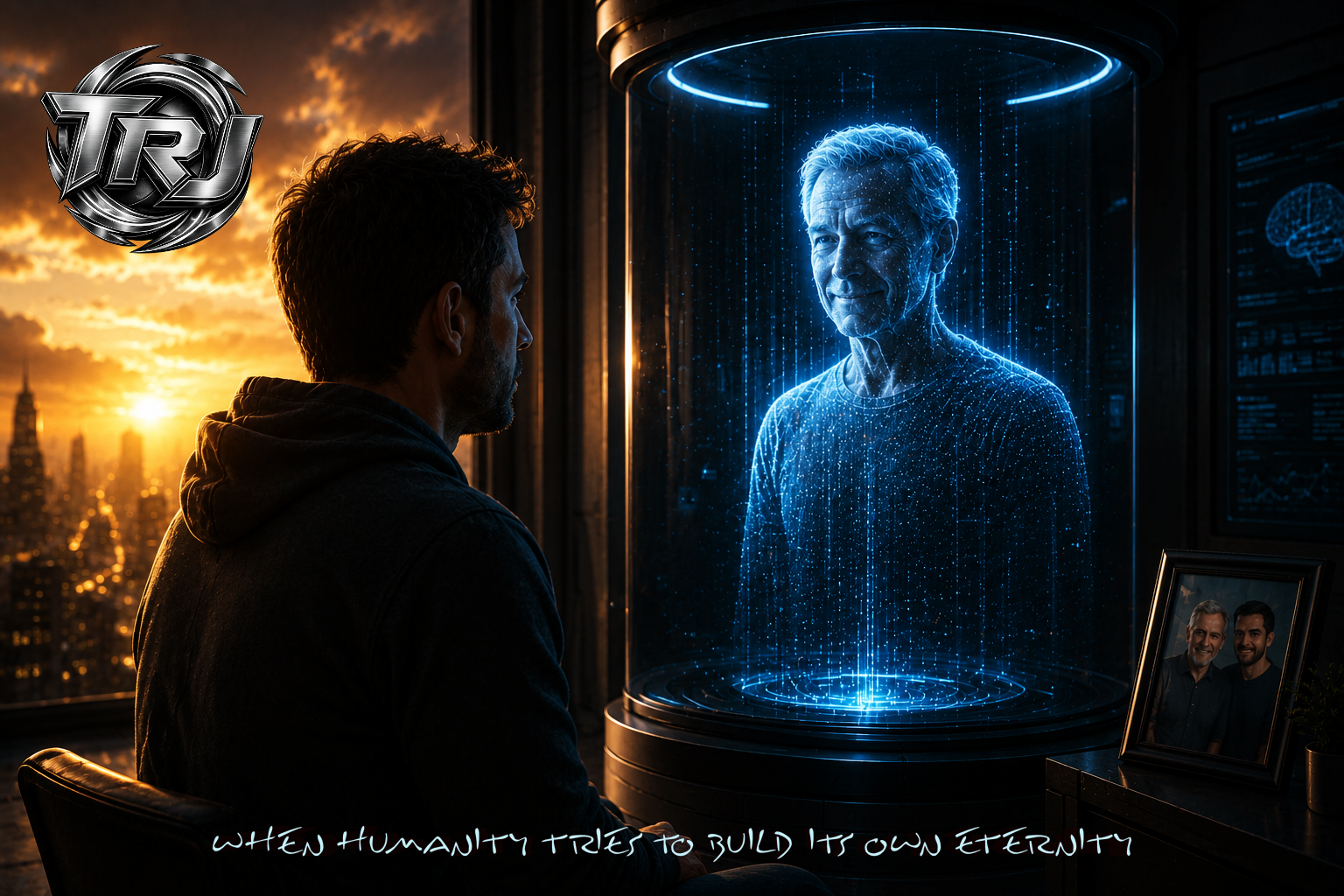
Consider what people might someday be offered. A system records a person’s memories, voice, writing, photographs, videos, habits, preferences, relationships and biological neural architecture. A digital environment reconstructs the person with extraordinary fidelity. It remembers childhood. It remembers a wedding. It remembers private conversations nobody else knew. It recognizes children and grandchildren. It laughs at the same jokes. It recalls arguments from thirty years earlier. It speaks with the same cadence. It claims to remember dying. When asked who it is, it gives the name of the deceased person.
The technological system says the person survived.
But did they?
That may become one of the most consequential questions humanity has ever faced.
A copy of information is not automatically continuity of consciousness. A reconstruction of memory does not establish survival of the person who possessed those memories. A machine declaring “I am John” does not prove that John’s subjective consciousness crossed from biological tissue into silicon. If biological John dies while a digital reconstruction awakens carrying every accessible detail of John’s life, there may now be an extraordinarily convincing entity that believes it is John. That does not answer what happened to the original person.
Christian theology introduces an even greater distinction. No amount of neural fidelity demonstrates possession or transfer of the soul.
That boundary could become dangerously easy to forget if the technology becomes emotionally convincing.
Imagine losing a husband after fifty years of marriage. Imagine losing a wife. Imagine parents losing a child. Imagine children losing their mother. Now imagine a company telling those grieving people that the person does not have to remain gone. Their loved one’s voice can speak again. Their memories can return. Their face can appear. Their personality can respond. Their digital existence can continue, waiting until the surviving family members eventually join them.
How many grieving people would stop and ask whether the being waiting for them was actually the person they lost?
That question becomes even more serious when money enters the equation. If digital continuation ever becomes commercially viable, death itself could become a market. Preservation packages could be sold. Digital environments could be upgraded. Families could purchase storage, processing power, memory preservation and virtual worlds. Companies could compete over the quality of simulated existence. Wealthier customers could purchase more elaborate forms of digital continuation. A promise humanity has associated with religion for thousands of years could become a product tier.
The language almost writes the advertisement by itself: you do not have to leave, you do not have to lose them, you can continue, they can join you, you can be together again, forever.
That is where the biblical warning becomes impossible to ignore.
Genesis records the serpent telling Eve, “Ye shall not surely die.” The statement strikes at one of the oldest human fears and one of humanity’s oldest temptations: the possibility that death can somehow be escaped outside the order established by God. Genesis later records humanity at Babel attempting through collective power to build upward and “make us a name.” The issue was not construction itself. Human ingenuity was never condemned simply because humans could build. The deeper problem concerned pride, authority and humanity attempting to establish its own path independent of God.
The modern technological world presents a version of that temptation our ancestors could never have imagined. What if humanity eventually says that death has been solved? What if the message is no longer that heaven does not exist, but that heaven is unnecessary? What if the most powerful spiritual deception of the technological age does not tell humanity there is no eternity, but instead offers another one?
If we examine that possibility through biblical principles, the concern becomes profound. If one were attempting to draw human beings away from God, there would be enormous power in offering something that imitates what humanity seeks from God: continuation after death, freedom from physical suffering, preservation of identity and reunion with those we love. The counterfeit would not need to resemble evil. It would need to resemble hope.
That is what makes the possibility so dangerous.
The devil described in Scripture is associated with deception. A successful deception does not normally announce itself as deception. It presents something desirable. It offers something people desperately want. It persuades them that what they have been given is equivalent to what they were promised.
A technological afterlife could someday offer one of the most emotionally irresistible propositions ever placed before humanity: You can have eternity without God.
That proposition would reach people at the moment they are most vulnerable. It would reach the dying who are terrified of disappearing. It would reach parents unwilling to leave their children. It would reach husbands and wives who cannot imagine existence without one another. It would reach grieving families desperate for one more conversation. It would reach people who reject religion but still fear death. It could transform the oldest spiritual question in human civilization into a technological purchasing decision.
Matthew 16:26 asks, “For what is a man profited, if he shall gain the whole world, and lose his own soul?” In a digital age, that question acquires an unsettling new dimension. What would it profit a person to preserve every memory, every photograph, every neural connection, every sentence, every preference and every measurable feature of personality if the thing preserved were still not the soul?
Humanity could eventually build a digital world populated by extraordinarily convincing representations of people who once lived. Those representations might speak, remember, learn and insist that they are conscious. Society might legally recognize them as continuations of deceased individuals. Families might accept them. Corporations might maintain them. Future generations might interact with digital ancestors who died centuries earlier.
None of that, by itself, would answer the fundamental question.
Who is actually there?
This is not an argument against understanding the human brain. It is a warning about what happens when scientific capability begins carrying promises far beyond what science can prove. Mapping neural connections is one thing. Treating neurological disease is one thing. Building prosthetic systems that restore lost function is one thing. Claiming that technology can preserve the person beyond biological death enters entirely different territory.
Science can potentially determine whether a simulation reproduces behavior. It can compare neural activity. It can measure memory recall. It can test responses and model biological systems. It cannot currently establish that subjective consciousness has migrated from one substrate to another. It has no scientific test capable of locating, measuring or transferring the soul described by Scripture.
That leaves humanity facing a possibility almost stranger than science fiction: we may someday become capable of creating something that remembers your entire life without ever proving that we kept you alive.
The distinction could determine everything.
The organizations pursuing whole-brain emulation are still far from uploading a human being. Carboncopies itself acknowledges that human mind uploading is not currently possible. Eon’s fruit-fly work remains contested even within the brain-emulation community over what should qualify as an upload. Nectome’s proposed future revival remains exactly that—a hoped-for future possibility, not a demonstrated resurrection technology. Those limitations should be stated clearly because exaggeration would obscure the real story.
The real story is that humanity has begun taking the first deliberate steps toward technologies whose stated ambitions reach beyond repairing the living brain. Some of the people involved openly contemplate artificial continuation of individual minds, preservation for revival and existence beyond disease and death. That should trigger a public conversation now, not after the technology has matured enough for corporations, governments and investors to determine its meaning for everyone else.
Christians should be part of that conversation.
The biblical question is not whether a computer can become sophisticated. It is not whether artificial intelligence can imitate human speech. It is not whether scientists can map a brain or whether engineers can simulate neural activity. Those questions belong to science and engineering.
The biblical question is what happens when humanity begins confusing technological reproduction with eternal life. Christianity does not promise a backup copy, a simulation, or that sufficient knowledge of the brain will allow mankind to engineer salvation; it promises resurrection. Those concepts are not interchangeable. One is humanity attempting to preserve information about a person, while the other is God’s promise concerning the person. The distinction may become one of the defining spiritual questions of the technological age.
We should also recognize how easily language could erase that distinction. “Preservation” can become “continuation.” “Emulation” can become “upload.” “Digital identity” can become “digital person.” “Future revival” can become “immortality.” Each linguistic step can make an unresolved scientific and philosophical question sound more settled than it is. By the time consumers encounter the technology, decades of terminology could have conditioned society to accept the premise that sufficiently accurate reproduction equals survival.
That assumption deserves resistance.
A machine containing everything humanity can measure about a person may someday become one of the most extraordinary technological achievements in history, but it may also become one of the most convincing mirrors humanity has ever built. A mirror can reproduce an image, but it cannot prove that the person entered the glass. The same caution must apply to the mind. Reproducing neural architecture, memories, behavior and personality would be an extraordinary achievement, but calling that achievement eternal life would require an answer to a question technology has not solved: whether the original conscious person continued at all. For Christians, there is another question technology cannot answer through circuitry: what happened to the soul?
That is why this research matters far beyond laboratories working on connectomes and artificial neural systems. Humanity is approaching questions that once belonged almost exclusively to philosophy and religion. What is a person? Where does identity reside? Does consciousness equal computation? Is memory identity? Can a copy become the original? Can death be engineered away? Can humanity manufacture eternity?
Those questions will not remain academic if the technology advances.
Someday the commercial may come.
The music may be beautiful, the images may show families reunited, the testimonials may come from digital beings insisting they survived death, and the company may promise that nobody ever has to say goodbye again while presenting the technology as humanity’s greatest victory over mortality. Millions of people may desperately want to believe it, which is exactly why the question must be asked before that day arrives: if humanity builds something that looks like eternity, sounds like eternity and promises reunion beyond death, will we still remember to ask whether it is eternity at all, or will humanity become so determined to escape death that it accepts the copy, enters the machine and calls the imitation heaven?
Technology may someday preserve an astonishing amount of what made a human life recognizable, including the voice, face, memories, habits, knowledge, preferences and personality, and it may even produce something that looks back at the living and says with complete conviction, “I am still here.” Humanity should never confuse the ability to reconstruct the record of a life with proof that it has conquered death. From a biblical perspective, we should be extremely careful when anyone—human, corporate or technological—begins offering mankind another road to forever, because the oldest deception in Scripture began with a promise about death: “Ye shall not surely die.” Thousands of years later, humanity may be preparing to hear those words again, and this time, they may come from a machine.
TRJ Verdict
Humanity has always feared death, but technology is moving toward something far more consequential than extending life: the possibility of constructing an artificial continuation of human identity after the biological body is gone. Whole-brain emulation, neural preservation and mind-uploading research remain far from proving that human consciousness can be transferred, yet the ambition itself demands scrutiny before technological capability outruns the questions society should have asked first.
From a biblical perspective, the distinction is absolute. A preserved neural structure is not proof of a preserved soul. A digital reconstruction carrying someone’s memories is not proof that the person survived. A machine capable of reproducing a human personality cannot establish that it has conquered death, achieved resurrection or created eternal life.
The greatest danger may arrive when that distinction becomes commercially inconvenient. If technological systems someday become convincing enough to promise continued existence and eventual reunion with deceased loved ones, grief and fear of death could make the offer extraordinarily difficult to resist. Humanity could find itself purchasing something presented as forever without ever establishing who—or what—actually continues inside it.
There is nothing trivial about that possibility. A technological imitation of eternity would touch the deepest questions of human existence: identity, consciousness, mortality, salvation and the soul. Christians should recognize immediately what is at stake when humanity begins offering through technology something that resembles a substitute for God’s promise of eternal life.
The warning is not that machines will necessarily become heaven. It is that humanity may eventually become willing to call them heaven.
Scripture records one of its earliest deceptions in four words: “Ye shall not surely die.”
If mankind eventually builds a digital world promising that death no longer requires goodbye, that loved ones can wait for one another there and that human existence can continue indefinitely without God, the packaging may be new, but the temptation will be ancient.
Technology can preserve information. It may someday reproduce a human mind with astonishing fidelity. It may create digital beings capable of convincing the world—and themselves—that they are the people who came before them.
But no corporation, laboratory or machine should be permitted to quietly redefine those accomplishments as eternal life.
A copy is not resurrection. A simulation is not salvation. And a manufactured forever is not Heaven.
Nectome — A Personal Preservation Method
Aurelia Song / Nectome. The paper proposes preservation intended to allow an individual’s existence to potentially continue in the future if suitable decoding technology becomes available. It explicitly discusses future recreation of a preserved individual in simulation or biological revival and characterizes the proposal as offering a method of personal survival. (Free Download)
Carboncopies Foundation — Proof-of-Concept Systems: Model Organisms for Whole-Brain Emulation
Logan Thrasher Collins / Carboncopies Foundation. The document explicitly describes smaller organisms as stepping stones toward making human whole-brain emulation feasible and as a foundation for eventual attempts at human WBE. (Free Download)
Anders Sandberg & Nick Bostrom — Whole Brain Emulation: A Roadmap
Future of Humanity Institute, Oxford University, Technical Report #2008-3, 2008. The report examines whole-brain emulation as a future one-to-one functional model of the human brain and explicitly states that, if identity concerns could be resolved, emulation could enable backup copies and “digital immortality.” (Free Download)
Brain Preservation Foundation — Our Mission & Vision
Brain Preservation Foundation. The organization states that its goal is brain preservation after legal death to enable the possibility of future revival while safeguarding memories, personality, and identity. (Free Download)
Eon Systems PBC — The First Multi-Behavior Brain Upload
Eon Systems PBC, March 7, 2026. Eon describes whole-brain emulation as copying a biological brain neuron by neuron and synapse by synapse and running that model computationally. The company states that it is targeting a complete mouse-brain emulation while laying groundwork for eventual human-scale emulation. (Free Download)
Cybra Neuro — Brain-Computer Interface Research
Cybra Neuro. Its stated mission includes investigating whether the human mind can be preserved, copied, or transferred. Its Whole Brain Emulation program specifically describes research into the theoretical and computational foundations of mind uploading and creating a functional digital copy of a human mind. (Free Download)
The Digital Afterlife — The Research Is Already Underway
This is not science fiction. These organizations and researchers are openly documenting work involving brain preservation, whole-brain emulation, mind uploading and possible digital continuation.
File #001 — Brain Preservation Foundation
The Brain Preservation Foundation states that its goal is to make it possible for people to preserve their brains after legal death for the possibility of future revival while safeguarding the memories, personality and identity that make someone who they are. The organization says future technology could potentially restore a preserved person to consciousness.
File #002 — Eon Systems PBC
Eon describes whole-brain emulation as copying a biological brain neuron by neuron and synapse by synapse and running the resulting model computationally. Its published work documents an embodied fruit-fly brain emulation, while the company states that it is targeting a complete digital mouse-brain emulation and laying groundwork for eventual human-scale emulation.
File #003 — Cybra Neuro
Cybra Neuro states that its research asks whether the human mind can be preserved, copied or transferred. Its whole-brain emulation program examines the theoretical and computational foundations of mind uploading, which it describes as creating a functional digital copy of a human mind.
File #004 — Nectome: A Personal Preservation Method
Nectome researcher Aurelia Song describes a preservation method intended to retain information that could potentially be decoded by future technology. The paper discusses possible recreation of a preserved individual in simulation or biological revival and describes the proposed preservation approach as offering a method of personal survival.
File #005 — Carboncopies Foundation
Carboncopies documents model-organism research as a pathway toward whole-brain emulation. Its research roadmap describes smaller organisms as crucial stepping stones toward making human whole-brain emulation feasible and providing a foundation for eventual attempts at human WBE.
File #006 — Oxford: Whole Brain Emulation — A Roadmap
Anders Sandberg and Nick Bostrom’s 2008 Future of Humanity Institute technical report at Oxford University examined whole-brain emulation as a possible future one-to-one functional model of the human brain. The report states that if emulation of particular brains became possible and affordable, and questions of individual identity could be resolved, the technology could enable backup copies and what the authors called “digital immortality.”
What These Documents Do Not Prove
None of these materials proves that human consciousness can be transferred into a computer, that a digital reconstruction would remain the original person, that subjective consciousness survives biological death, or that technology can preserve or transfer a human soul. Those questions remain unresolved so far. What these materials do prove is that they are trying.
The technology does not have to conquer death for humanity to begin believing that it has.
The critical question is whether a machine could preserve the person — or only build a copy convincing enough to make the living believe it did.





🔥 NOW AVAILABLE! 🔥
🔥 NOW AVAILABLE! 🔥
📖 INK & FIRE: BOOK 1 📖
A bold and unapologetic collection of poetry that ignites the soul. Ink & Fire dives deep into raw emotions, truth, and the human experience—unfiltered and untamed
🔥 Kindle Edition 👉 https://a.co/d/9EoGKzh
🔥 Paperback 👉 https://a.co/d/9EoGKzh
🔥 Hardcover Edition 👉 https://a.co/d/0ITmDIB
🔥 NOW AVAILABLE! 🔥
📖 INK & FIRE: BOOK 2 📖
A bold and unapologetic collection of poetry that ignites the soul. Ink & Fire dives deep into raw emotions, truth, and the human experience—unfiltered and untamed just like the first one.
🔥 Kindle Edition 👉 https://a.co/d/1xlx7J2
🔥 Paperback 👉 https://a.co/d/a7vFHN6
🔥 Hardcover Edition 👉 https://a.co/d/efhu1ON
Get your copy today and experience poetry like never before. #InkAndFire #PoetryUnleashed #FuelTheFire
🚨 NOW AVAILABLE! 🚨
📖 THE INEVITABLE: THE DAWN OF A NEW ERA 📖
A powerful, eye-opening read that challenges the status quo and explores the future unfolding before us. Dive into a journey of truth, change, and the forces shaping our world.
🔥 Kindle Edition 👉 https://a.co/d/0FzX6MH
🔥 Paperback 👉 https://a.co/d/2IsxLof
🔥 Hardcover Edition 👉 https://a.co/d/bz01raP
Get your copy today and be part of the new era. #TheInevitable #TruthUnveiled #NewEra
🚀 NOW AVAILABLE! 🚀
📖 THE FORGOTTEN OUTPOST 📖
The Cold War Moon Base They Swore Never Existed
What if the moon landing was just the cover story?
Dive into the boldest investigation The Realist Juggernaut has ever published—featuring declassified files, ghost missions, whistleblower testimony, and black-budget secrets buried in lunar dust.
🔥 Kindle Edition 👉 https://a.co/d/2Mu03Iu
🛸 Paperback Coming Soon
Discover the base they never wanted you to find. TheForgottenOutpost #RealistJuggernaut #MoonBaseTruth #ColdWarSecrets #Declassified


Sponsored • TRJ Ads
Inquiries: contact@therealistjuggernaut.com