
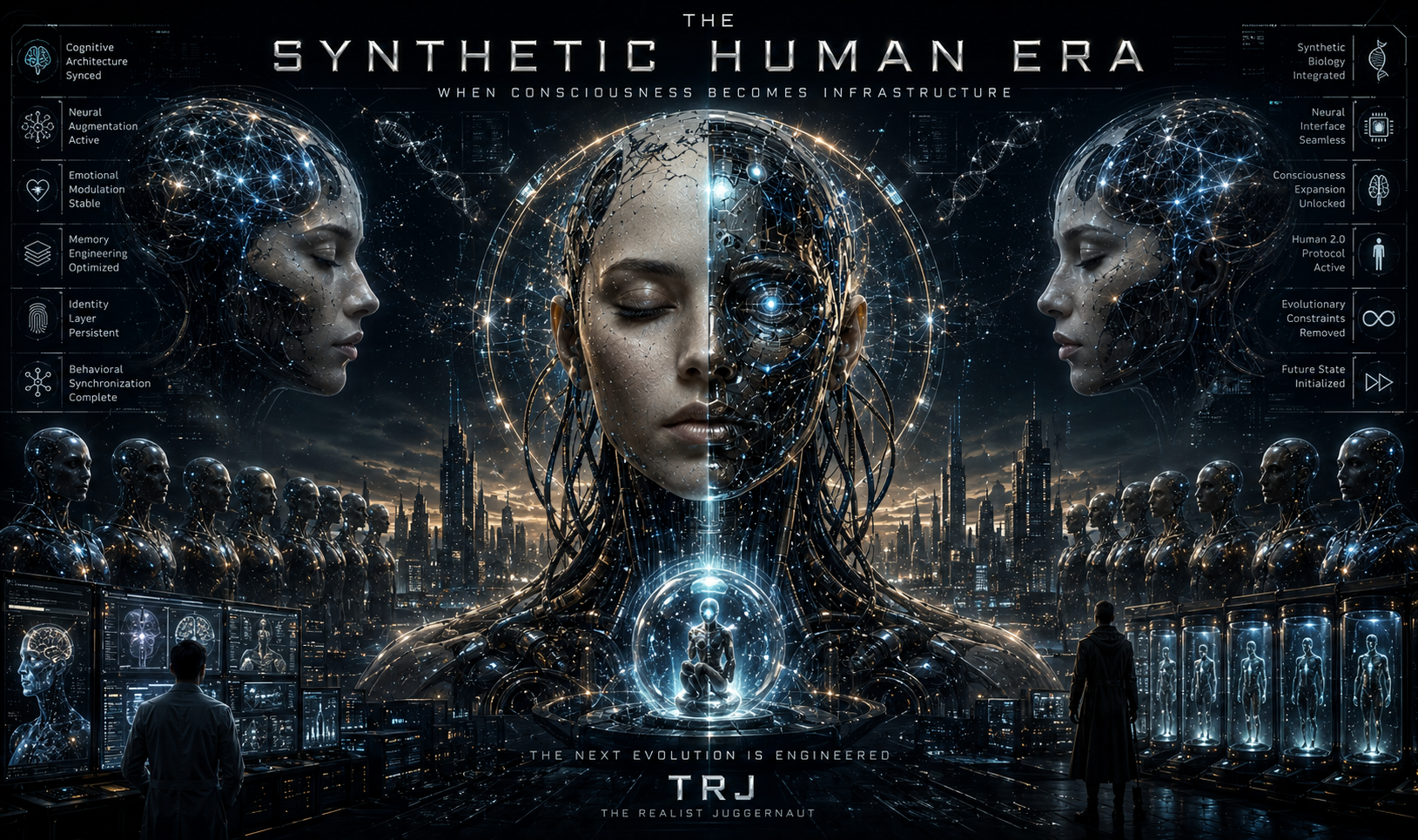
Thank you for reading or listening to The Realist Juggernaut. Independent journalism should be accessible to everyone.
Identity, Personality Data, Voice, Memory, and the Ownership of Digital Selves.
Human beings have always possessed an identity without needing to understand it as a commercial asset. A face belonged to the person carrying it. A voice emerged from the body that produced it. Memory remained within the mind. Personality developed through experience, and ordinary conversation disappeared unless another person deliberately recorded it. The separation between the human being and the information describing that human being remained protected partly by the physical limitations of the world itself.
Synthetic civilization is removing those limitations.
A person’s face can be reconstructed from photographs, their voice cloned from recordings, their writing patterns inferred from messages, their movements modeled from video, their preferences extracted from behavior, and their personality approximated through years of digital interaction. These elements can be assembled into a synthetic identity capable of speaking, appearing, answering questions, creating material, making recommendations, and representing the biological individual across digital environments.
The person may recognize the result as a version of themselves.
The law may recognize several different owners.
That conflict emerges because identity is not currently governed as one unified form of property. A photograph can be protected by copyright belonging to the photographer. A video may belong to the company that produced it. A voice recording may involve rights held by performers, producers, employers, platforms, or other contracting parties. Personal data can be collected under privacy terms. Biometric information may receive protection under certain laws while remaining exposed under others. A person’s commercial identity may be protected through publicity rights that vary by jurisdiction.
The biological individual stands at the center of the reconstruction without necessarily controlling every component required to build it.
A synthetic self may therefore be assembled from materials the person created, materials others created about them, information inferred from behavior, and technological systems owned by companies. No single legal category automatically gives the individual complete authority over the finished identity.
This produces a disturbing possibility: a company may construct a convincing version of someone while the person represented lacks the practical power to access, modify, transfer, or destroy it.
The ownership problem begins with source material. A person may provide photographs, voice samples, writing, video, personal history, and behavioral information to a platform for one purpose. The company could later use those materials to improve models, generate avatars, personalize services, train synthetic voices, or create identity features never contemplated when the information was first collected.
Consent may technically appear inside a privacy policy or service agreement, yet broad contractual language does not guarantee that users understand the identity systems that can be built from their data. Permission to store a voice message is not necessarily permission to create a voice model. Permission to upload photographs is not necessarily permission to generate a moving replica. Permission to personalize recommendations is not necessarily permission to construct an artificial personality capable of acting in the user’s name.
Each use changes the nature of what the data becomes.
A voice recording is evidence of something a person said. A voice model is a system capable of producing statements the person never made. A photograph captures appearance at one moment. A visual replica can place the individual inside events that never occurred. A collection of messages preserves written communication. A personality model can generate new positions, emotional reactions, and decisions attributed to the person.
The transformation from record to generator represents the central ownership threshold.
Companies may argue that the person supplied only the raw material while the developer created the model through engineering, computing, training, testing, and proprietary architecture. Under that reasoning, the individual retains interests in personal data or commercial identity while the company owns the synthetic system created from it.
The result is a division between the human being and the machinery capable of reproducing them. The person may control certain uses of their name or appearance while the company controls the model that makes those uses possible.
This distinction gives technological providers enormous leverage. A performer may own aspects of a professional identity while a studio controls recordings used to build the replica. An employee may possess a recognizable voice and communication style while the employer owns work produced within the job. A customer may provide years of personal interaction while the platform owns the behavioral system developed from that history.
The synthetic self becomes distributed across contracts the person may never have negotiated meaningfully.
Employment will become one of the earliest environments where this conflict appears. Companies already collect meetings, written communication, performance records, training materials, customer interactions, biometric access information, and professional knowledge. Those records could be used to build synthetic employees capable of performing portions of a person’s role.
A company might create an artificial sales representative carrying a successful employee’s voice, appearance, persuasion style, and accumulated knowledge. A hospital could construct a synthetic training model from a physician’s recorded explanations. A university could develop an instructional avatar from a professor’s lectures. A broadcaster could preserve a journalist’s delivery. A business could retain the communication style of an executive after the person leaves.
The employer may describe the system as institutional knowledge. The individual may experience it as continued use of their identity without continued consent or compensation.
The conflict becomes more severe when the replica affects the person’s future opportunities. A synthetic employee could compete with the biological worker whose behavior trained it. The company might terminate the person while continuing to use an artificial version that requires no salary, benefits, rest, or contractual renegotiation. The replica could perform indefinitely while the original human being loses control over the professional value extracted from their identity.
Consent obtained as a condition of employment cannot be treated casually. Workers may agree to recording or data collection because refusal threatens the job. A contract permitting broad technological use can appear voluntary while reflecting a severe imbalance in bargaining power.
The duration of consent also matters. A person may authorize one project, one production, one language, one campaign, or one defined period. Synthetic systems make reuse easy, creating pressure to treat limited permission as permanent access. A voice recorded for one advertisement can generate thousands of new advertisements. A body scan created for one film can appear in future productions. A training avatar authorized for internal education can migrate into public commercial use.
The marginal cost of replication can fall sharply while the human identity supplying the value remains singular.
Contracts must distinguish among recording, reproduction, training, generation, modification, transfer, sublicensing, and future use. Permission in one category should not automatically authorize every other category. The person should know whether the model can create new speech, whether its output can be edited, whether third parties can license it, and whether the system will remain active after the original agreement ends.
Revocation presents a deeper technical problem. Deleting source files may not remove what a trained system learned from them. A company could erase recordings while retaining a model capable of reproducing the voice or personality. The user receives confirmation that data was deleted while the functional identity remains embedded within model weights, backups, derivative systems, testing archives, and copies transferred to contractors.
A meaningful right to deletion must address the capability created from the data, not only the original files.
Federal regulators have recognized that personal information used to develop algorithms and artificial-intelligence models can create continuing privacy risks. The Federal Trade Commission has required model and algorithm deletion in cases involving data obtained unlawfully, establishing an important principle: companies should not retain the commercial benefits of systems built from improperly acquired information merely because the raw data has been removed.
Synthetic identity will test how far that principle extends. If a company lacked valid permission to build a replica, destroying the source recordings while preserving the replica would not restore the person’s control. The generated capability itself would remain the violation.
Biometric information adds another layer. Facial geometry, voice patterns, movement patterns, iris characteristics, fingerprints, and other bodily traits can be used for authentication and identification. These traits are difficult to replace after exposure. A stolen password can be changed. A compromised face or voice cannot be exchanged for a new biological identity.
The Federal Trade Commission has warned that unexpected biometric collection, unsupported claims, weak risk assessment, poor security, and failures to monitor third-party use can cause consumer harm. Synthetic systems expand those risks because biometric information can move beyond recognition and into reproduction.
A company does not need to steal a person’s face physically. It can create an artificial face capable of appearing anywhere.
This transforms identity theft. Traditional identity theft uses personal information to access money, credit, or accounts. Synthetic identity theft can use the person themselves as the instrument. A replica can speak to relatives, appear in meetings, endorse products, issue instructions, enter social environments, and generate evidence of actions that never occurred.
The biological person may then bear the burden of disproving their own synthetic behavior.
Authentication systems will need to establish not only whether an image or voice appears genuine, but whether the person authorized the specific communication. A valid voice model can produce an unauthorized statement. A verified digital identity can still be controlled by the wrong actor. Authenticating the origin of the model does not prove the legitimacy of every output it creates.
Each synthetic communication should carry verifiable information showing which model generated it, who authorized the action, what modifications occurred, and whether the biological individual reviewed the result. This record must remain accessible without requiring the public to trust the company operating the system.
Identity provenance cannot depend solely upon appearance because appearance is precisely what synthetic systems can manufacture.
Personality data may prove even more difficult to protect than biometrics. A person’s temperament, humor, fears, values, loyalties, communication habits, emotional triggers, and decision patterns are rarely collected as one identifiable file. They are inferred through behavior.
Platforms can analyze the time a user spends reading, the subjects that produce reactions, the people they contact, the language they use under stress, the purchases they regret, the arguments they abandon, and the opinions they revise. These fragments can be combined into a behavioral representation more detailed than anything the individual intentionally disclosed.
Companies may claim ownership over the inferences because their systems produced them. The user supplied the behavior, but the platform generated the model describing what that behavior means.
This creates an ownership paradox. A company may know the person well enough to simulate them while insisting that the inferred personality belongs to the company’s analytical system rather than the human being being analyzed.
A person should possess enforceable rights over high-impact identity inferences, especially when those inferences can reproduce behavior or support decisions made in their name. The fact that a company discovered a pattern does not erase the connection between that pattern and the individual whose life produced it.
Accuracy creates another problem. A synthetic self can be wrong.
The model may exaggerate certain traits, misinterpret humor, confuse temporary behavior with permanent character, or construct political, religious, emotional, and moral positions that the person rejects. Training data may reflect a narrow period of life. A person experiencing grief, illness, stress, or professional pressure may communicate differently from their broader identity.
A replica trained during that period could preserve distortion as personality.
The individual needs the right to inspect and challenge significant representations made through the synthetic model. Companies cannot treat correction as interference with proprietary technology when the output affects the person’s reputation, employment, relationships, financial interests, or public identity.
Correction also carries risks. Allowing someone to edit a synthetic self could create a polished version that conceals authentic history. The objective is not to make every model flattering. It is to prevent companies from attributing generated conduct to a person without clear authorization and to give individuals meaningful authority over whether the replica operates at all.
Multiple replicas could produce conflicting versions of the same person. One company may build a professional model from workplace records. Another may construct a social model from platform behavior. A third may create a consumer model from purchases and location data. A private service may build an authorized personal replica from information supplied directly by the individual.
Each system can claim to represent the same biological person while behaving differently.
The individual’s identity becomes a contested territory among models trained for separate purposes.
One version may be calm and professional. Another may be provocative because engagement systems amplified emotional behavior. A third may be highly commercial because purchasing data shaped its responses. The public could encounter several synthetic identities without knowing which, if any, the person authorized.
The right to identity must include the right to reject false equivalence among those versions. A model built to predict behavior is not automatically authorized to represent the person. A profile created for advertising is not the person’s official digital self. A workplace replica is not the complete individual. A public avatar should not be treated as authentic merely because enough personal data made it convincing.
Public figures will face acute exposure because large volumes of recordings are available. Authors, musicians, actors, journalists, political leaders, athletes, business executives, clergy, and educators may have enough public material to support detailed replicas without providing new data directly. The availability of information does not eliminate the person’s interest in controlling generated identity.
Public visibility is not permanent consent to artificial reproduction.
The U.S. Copyright Office concluded that existing protections leave gaps and recommended a federal right addressing the unauthorized distribution of realistic digital replicas. That recommendation reflects the fact that copyright alone cannot solve the problem. A person may not own the copyright in a photograph or recording while still possessing a powerful interest in preventing it from being used to manufacture a false version of them.
A synthetic identity right should therefore attach to the individual rather than depend entirely upon ownership of source media. It should protect voice, visual appearance, recognizable behavior, and other defining characteristics when artificial systems use them to create a convincing representation.
That right must be difficult to transfer permanently. People can license defined commercial uses, but selling total and irreversible control over a synthetic self could allow companies to own a person’s public identity long after the original agreement has lost any reasonable connection to its purpose.
Core identity should not become alienable property capable of permanent sale.
Licenses should specify duration, territory, purpose, medium, compensation, modification limits, approved audiences, and whether new material can be generated. Rights involving employment, medical need, financial pressure, or unequal bargaining power require additional protection because consent may reflect circumstance rather than genuine preference.
Companies should also be prohibited from burying synthetic-identity rights inside general terms of service. Permission to operate a replica should require a clear, separate agreement written in language an ordinary person can understand. Renewal should require affirmative consent when the purpose expands.
The biological individual must know when the synthetic version is active and what it is doing.
A private dashboard could show where the model is deployed, which organizations accessed it, what content it generated, which changes were made, and which licenses remain active. The user should be able to suspend unauthorized uses immediately while disputes are investigated.
Compensation must follow use. A company earning revenue through a person’s synthetic identity should not avoid payment merely because a model generated the performance. The value still comes from recognizable human characteristics, professional history, and personal data. Automation changes the method of production, not the origin of the identity being commercialized.
Ownership also extends to memory. A synthetic self may contain autobiographical records, conversations, emotional associations, and interpretations of life events. Those memories can involve other people, making absolute control difficult. One person’s memory of a marriage, friendship, workplace, or conflict includes information about individuals who never consented to become part of the replica.
The person creating a synthetic self cannot claim unlimited authority over every life incorporated into their memory. Systems need methods for protecting third-party privacy, restricting sensitive disclosure, and allowing others to challenge harmful or false material without giving them power to erase legitimate personal history.
Memory is relational, but the model makes it reproducible.
The final authority over activation should remain with the person represented whenever that person is alive and capable of deciding. Family members, employers, platforms, and business partners should not be able to authorize a replica merely because they possess relevant recordings. Possession of data is not possession of identity.
The person must also retain the right not to be simulated. Refusal cannot be treated as resistance to innovation or a decision forfeited by public visibility. Synthetic civilization will create strong economic incentives to reproduce people because an artificial identity can work, speak, sell, teach, entertain, and influence without many biological limitations.
That efficiency cannot become a superior claim to the human self.
The greatest ownership dispute of the Synthetic Human Era may not involve machines demanding freedom from humans. It may involve human beings demanding freedom from machine versions of themselves controlled by institutions they cannot see, inspect, or escape.
A synthetic self can outnumber the biological person, operate across several locations, communicate continuously, and survive every attempt by the original individual to withdraw from public life. It can become more visible than the person it represents.
If control remains fragmented among platforms, employers, data companies, studios, model developers, and contract holders, the human being may become the least powerful version of their own identity.
TRJ VERDICT
The ownership of the synthetic self may become one of the defining battles of digital civilization because identity is no longer limited to the body carrying it.
A person’s face, voice, memory, behavior, personality, professional knowledge, and emotional patterns can be separated, analyzed, modeled, and assembled into systems capable of producing new actions in the person’s name. Each component may fall under a different contract or legal category, allowing several organizations to claim control over a replica built from one human life.
That fragmentation cannot remain the foundation of synthetic identity.
The person represented must possess a primary and enforceable right over whether a synthetic version can be created, activated, modified, transferred, commercialized, or destroyed. Ownership of a photograph, recording, platform, model architecture, or employment archive should not grant automatic authority to manufacture an artificial person from the human being captured within it.
Consent must be specific.
Permission to record is not permission to clone.
Permission to store is not permission to simulate.
Permission to analyze is not permission to speak in someone’s name.
Permission granted for one project is not permanent ownership of a human identity.
Companies must distinguish source data from the models created through it, and deletion must address both. Removing recordings while retaining a functioning replica does not restore control. A person should be able to discover where their synthetic identity operates, review authorized uses, challenge false outputs, revoke licenses under defined conditions, and receive compensation when commercial value is extracted from their identity.
Core identity rights should not be buried inside service agreements or transferred permanently through contracts signed under economic pressure. The human being must remain more legally important than the artificial representation constructed from them.
Synthetic civilization will claim that replicas create efficiency, preserve knowledge, expand creativity, and allow identity to operate beyond biological limits. Those benefits do not answer the central question.
Who possesses the final authority to decide what the synthetic version says, believes, remembers, sells, endorses, and becomes?
If the answer is the platform, the employer, the studio, the developer, or the company holding the model, then the synthetic self does not belong to the person whose life created it.
The person belongs to the system capable of reproducing them.





🔥 NOW AVAILABLE! 🔥
🔥 NOW AVAILABLE! 🔥
📖 INK & FIRE: BOOK 1 📖
A bold and unapologetic collection of poetry that ignites the soul. Ink & Fire dives deep into raw emotions, truth, and the human experience—unfiltered and untamed
🔥 Kindle Edition 👉 https://a.co/d/9EoGKzh
🔥 Paperback 👉 https://a.co/d/9EoGKzh
🔥 Hardcover Edition 👉 https://a.co/d/0ITmDIB
🔥 NOW AVAILABLE! 🔥
📖 INK & FIRE: BOOK 2 📖
A bold and unapologetic collection of poetry that ignites the soul. Ink & Fire dives deep into raw emotions, truth, and the human experience—unfiltered and untamed just like the first one.
🔥 Kindle Edition 👉 https://a.co/d/1xlx7J2
🔥 Paperback 👉 https://a.co/d/a7vFHN6
🔥 Hardcover Edition 👉 https://a.co/d/efhu1ON
Get your copy today and experience poetry like never before. #InkAndFire #PoetryUnleashed #FuelTheFire
🚨 NOW AVAILABLE! 🚨
📖 THE INEVITABLE: THE DAWN OF A NEW ERA 📖
A powerful, eye-opening read that challenges the status quo and explores the future unfolding before us. Dive into a journey of truth, change, and the forces shaping our world.
🔥 Kindle Edition 👉 https://a.co/d/0FzX6MH
🔥 Paperback 👉 https://a.co/d/2IsxLof
🔥 Hardcover Edition 👉 https://a.co/d/bz01raP
Get your copy today and be part of the new era. #TheInevitable #TruthUnveiled #NewEra
🚀 NOW AVAILABLE! 🚀
📖 THE FORGOTTEN OUTPOST 📖
The Cold War Moon Base They Swore Never Existed
What if the moon landing was just the cover story?
Dive into the boldest investigation The Realist Juggernaut has ever published—featuring declassified files, ghost missions, whistleblower testimony, and black-budget secrets buried in lunar dust.
🔥 Kindle Edition 👉 https://a.co/d/2Mu03Iu
🛸 Paperback Coming Soon
Discover the base they never wanted you to find. TheForgottenOutpost #RealistJuggernaut #MoonBaseTruth #ColdWarSecrets #Declassified


Sponsored • TRJ Ads
Inquiries: contact@therealistjuggernaut.com





I HYPER-SCROLLED HERE…WEEEEEEEEEEEEE-! 😀 A SIMPLE POINT IN COMPARISON…WHO OWNS THE TWELVE OR MORE VERSIONS OF ME RUNNING AROUND ON FACEBOOK, THAT I CAN’T ACCESS BECAUSE SOMEONE CHANGED MY PASSWORD ON ME? SEEMS OBVIOUS—THE CREATOE OF EACH SHAM COPY OF ME—THEY ARE THE ONES RAKING IN WHATEVER PROCEEDS THEY CAN DUPE PEOPLE OUT OF. IS THAT WHY SOME REFUSE TO ANSWER MT EMAILS?
Thank you very much for reading and sharing the articles, Jonathan. It’s greatly appreciated. Those kinds of issues are exactly the kind of problem this article is getting at. Once fake versions of a person start circulating outside their control, the confusion can spread quickly. People may not know which account is real, what messages actually came from you, or whether they are dealing with an impersonator, and that absolutely could make some people hesitant to respond to your emails. I hope you can get those fake accounts removed, because that kind of identity abuse can cause real damage. I’m also glad you found the hyper-scroll button useful. Thanks again, Jonathan. I hope you have a great day ahead. 😎