
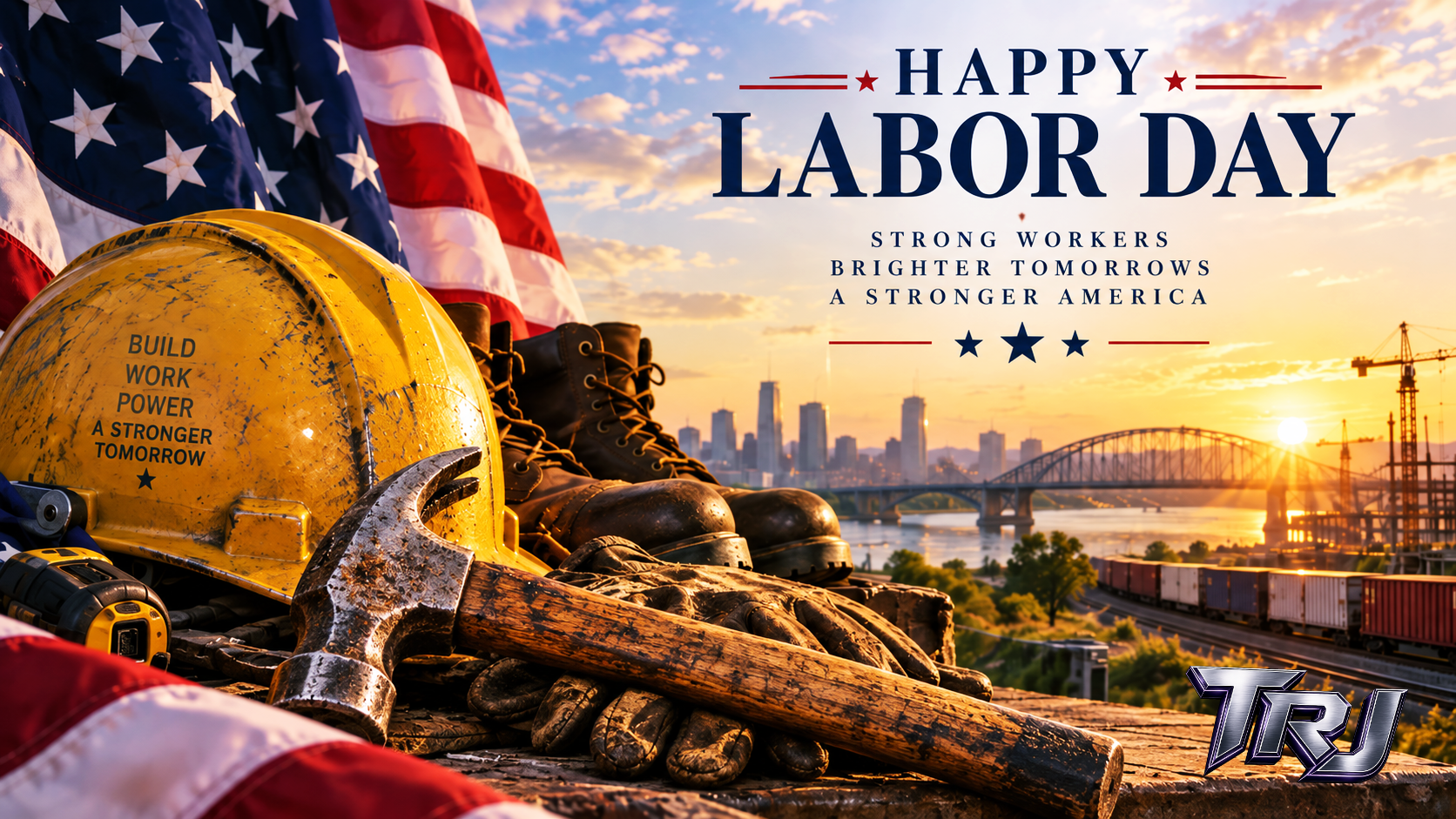
Thank you for reading or listening to The Realist Juggernaut. Independent journalism should be accessible to everyone.
Work, Dignity, Sacrifice, and the Americans Whose Labor Keeps the Country Moving
Labor Day is often treated as the final long weekend of summer, a day associated with travel, cookouts, retail sales, and a brief pause before the pace of autumn returns. Beneath that familiar rhythm is a national recognition of something far more important: the work people perform every day to keep homes, businesses, institutions, communities, and essential systems operating.
Modern life depends upon labor so completely that much of it disappears from view when everything works correctly. Electricity reaches homes because people maintain generating systems, transmission infrastructure, substations, controls, and equipment. Food reaches store shelves because farmers, processors, inspectors, warehouse workers, drivers, distributors, and retailers move it through a chain that stretches across farms, factories, highways, and cities. Water arrives through systems maintained by engineers, utility crews, treatment workers, technicians, and municipal employees. Roads remain open because people design, inspect, repair, clear, pave, and maintain them.
The success of those systems can make the work behind them easy to overlook. A delivery that arrives on time rarely causes anyone to wonder how many people were involved in getting it there. A hospital operating normally does not draw attention to the thousands of tasks being performed behind the scenes. A clean building, a functioning network, an open road, a repaired vehicle, a stocked store, and a working furnace all appear ordinary because someone did the work required to make them ordinary.
Labor Day offers a reason to look beyond the finished result.
There are people beginning their workday while much of the country is still asleep. Truck drivers are moving freight before sunrise. Bakers are preparing food before customers arrive. Utility crews may be responding to storm damage or equipment failures before most homes turn on their first light. Nurses are finishing overnight shifts while another group prepares to take over. Police officers, firefighters, emergency medical personnel, dispatchers, corrections officers, and other public-safety workers remain on duty regardless of whether the calendar marks a holiday.
The country does not stop functioning because many people have the day off.
Hospitals remain open. Power systems remain active. Emergency calls continue. Transportation networks continue operating. Hotels remain staffed. Restaurants continue serving customers. Public infrastructure still requires attention. Somewhere, someone is working because the system around them depends upon it.
Much of that work is physically demanding. Construction workers spend years lifting, cutting, welding, climbing, digging, framing, pouring, repairing, and operating equipment in conditions that can be hot, cold, loud, wet, dangerous, or exhausting. Mechanics spend long hours solving problems hidden inside engines, transmissions, electrical systems, and machinery. Electricians work around systems where precision matters because the consequences of error can be severe. Plumbers, roofers, lineworkers, machinists, heavy-equipment operators, maintenance technicians, and other skilled tradespeople perform work that requires judgment developed through experience.
Advanced technology has not erased the importance of those skills.
A highly automated building still needs someone who understands the electrical system when it fails. A modern vehicle still needs a technician capable of diagnosing problems software cannot solve on its own. A factory filled with robotics still depends upon workers who can maintain, calibrate, repair, and manage the equipment. A digital economy still depends upon physical infrastructure, and physical infrastructure still depends upon human hands and human judgment.
That connection matters as artificial intelligence, robotics, and automation continue changing the workplace.
Technology has always altered labor. Machines reduced certain forms of physical effort. Computers transformed administration and communication. Robotics changed manufacturing. Software replaced large portions of manual recordkeeping. Artificial intelligence is now affecting writing, programming, analysis, customer service, logistics, design, research, and administrative work.
The challenge is not stopping technological advancement. The challenge is understanding what that advancement means for the people whose work is being changed by it.
A company can reduce costs through automation, but that decision may also affect a worker who spent decades building expertise in a particular role. A business can streamline a process while a family loses the income that paid for housing, transportation, food, medical care, and education. An industry can become more efficient while a community built around that industry begins struggling with job losses and declining economic activity.
Those consequences are not arguments against innovation. They are reminders that economic change has human effects.
Workers are not abstract measurements of productivity. They are members of families and communities. They pay mortgages and rent, buy groceries, repair cars, support local businesses, raise children, care for relatives, pay taxes, and participate in the economic life of the places where they live. Income earned through labor moves outward into thousands of other transactions that sustain businesses and employment elsewhere.
That relationship is especially visible in small communities.
A local restaurant depends upon cooks, servers, dishwashers, suppliers, delivery drivers, repair technicians, accountants, cleaners, farmers, manufacturers, and customers who earn money through work of their own. A construction company depends upon material suppliers, equipment dealers, fuel distributors, insurers, engineers, inspectors, lenders, and skilled workers. A neighborhood store depends upon the purchasing power of the people who live nearby.
Labor connects the economy in ways that rarely fit neatly into one job title.
Some occupations receive prestige and public recognition. Others operate quietly and receive very little attention. That difference does not determine whether the work matters.
A sanitation worker contributes directly to public health. A school custodian helps maintain the environment where children spend much of their day. A warehouse employee helps keep stores supplied. A home health aide may make it possible for an elderly or disabled person to remain safely at home. An agricultural worker helps move food into the supply chain. A communications technician keeps homes and businesses connected. A hospital environmental-services worker plays a role in infection control and patient safety.
The work may be unseen, but the consequences of its absence would be immediate.
There is dignity in work because work creates, repairs, maintains, protects, teaches, serves, transports, builds, and provides. That dignity does not depend upon salary, social status, educational level, or whether a person works behind a desk, inside a truck, on a construction site, in a hospital, at a computer, in a factory, or outdoors.
Labor also involves sacrifice.
Many people accept overtime because ordinary expenses have become harder to manage. Some work nights because the pay is better or because family responsibilities make other schedules impossible. Some miss birthdays, holidays, school events, and family dinners because their jobs require someone to be present. Some work through physical discomfort because missing a shift would mean losing income they cannot afford to lose. Others save vacation time for emergencies rather than rest.
For business owners, responsibility can carry a different form of pressure. A small-business owner may spend sleepless nights calculating payroll, rent, insurance, taxes, inventory, repairs, and cash flow. During difficult months, some pay employees before paying themselves because keeping the business alive means protecting the livelihoods attached to it.
Work is not always a story about ambition.
Often, it is a story about responsibility.
A person may not love every hour of a job and can still take pride in doing it well. Someone may finish a shift exhausted and still know that the work mattered. A worker may spend thirty years performing a job that never attracts public attention while building a stable home, supporting a family, helping coworkers, and becoming the person others trust when something goes wrong.
That kind of consistency deserves recognition.
The same is true of work performed outside traditional payroll systems. Parents raising children, relatives caring for aging family members, spouses managing households, and people providing unpaid care perform labor with real social value even when no wage measures it. The time spent preparing meals, coordinating appointments, caring for someone who cannot care for themselves, managing a household, or helping a family member through illness does not become less important because it does not appear on a paycheck.
Care is work.
Responsibility is work.
The country depends upon both.
Labor Day also raises a larger question about the future of work.
Workers need opportunities to learn new skills when industries change. They need safe workplaces. They need compensation that reflects the realities of ordinary life. They need employers who understand that productivity has limits and that exhaustion eventually produces consequences of its own. They need educational systems willing to treat skilled trades as serious career paths rather than secondary options.
Businesses need the ability to compete, invest, innovate, hire, expand, and remain profitable. Workers need a realistic opportunity to build stable lives through the value their labor creates.
Those interests do not have to exist in permanent conflict.
Healthy businesses create jobs, products, services, investment, and economic activity. Skilled and dependable workers make those businesses possible. One side cannot function indefinitely without the other.
A serious Labor Day discussion should recognize that relationship instead of reducing work to political slogans every time.
The country depends upon people who know how to do things.
It depends upon people who can repair a power line, replace a transmission, diagnose an illness, maintain a server, operate heavy equipment, manage a classroom, build a home, harvest a crop, fly an aircraft, inspect a bridge, install a furnace, run a business, protect a community, or solve a problem under pressure.
It also depends upon people willing to learn and people willing to work.
Skills pass from one generation to the next through apprenticeships, classrooms, job sites, training programs, workshops, offices, hospitals, garages, kitchens, factories, farms, and countless other places where experience becomes knowledge.
That transfer matters because every generation eventually relies upon the next one to understand the systems it inherited.
The future will bring different tools, different industries, and different forms of work. Artificial intelligence will alter some occupations. Automation will change others. New technologies will create jobs that barely exist today, while some existing roles will shrink or disappear.
The human need for purpose, stability, competence, responsibility, and contribution will remain.
People want to know that what they do matters.
They want to know that years spent learning a skill have value. They want to know that effort can produce a stable life. They want to know that work performed well is recognized, even if that recognition comes quietly.
Labor Day gives the country an opportunity to acknowledge that truth without turning it into spectacle.
The worker repairing a road may never know the names of the people who drive safely over it afterward. The nurse finishing a long shift may never see the future years of the patient they helped stabilize. The teacher may never know which lesson changed a student’s direction. The mechanic may never know how important it was for a family to have their vehicle working again. The lineman restoring power after a storm may never meet the people waiting inside dark homes.
The value of work often extends far beyond the moment in which it is performed.
That is why Labor Day should mean more than a day away from work.
It should remind us that modern life is supported by people whose effort is built into nearly everything we use, depend upon, purchase, drive, eat, repair, build, teach, maintain, or trust.
The country keeps moving because people keep working.
Not every worker will be noticed publicly.
Not every job will be noticed.
Not every sacrifice will be understood.
The work still matters.
And so do the people doing it.
Have a good and safe Labor Day.
— The Realist Juggernaut





🔥 NOW AVAILABLE! 🔥
🔥 NOW AVAILABLE! 🔥
📖 INK & FIRE: BOOK 1 📖
A bold and unapologetic collection of poetry that ignites the soul. Ink & Fire dives deep into raw emotions, truth, and the human experience—unfiltered and untamed
🔥 Kindle Edition 👉 https://a.co/d/9EoGKzh
🔥 Paperback 👉 https://a.co/d/9EoGKzh
🔥 Hardcover Edition 👉 https://a.co/d/0ITmDIB
🔥 NOW AVAILABLE! 🔥
📖 INK & FIRE: BOOK 2 📖
A bold and unapologetic collection of poetry that ignites the soul. Ink & Fire dives deep into raw emotions, truth, and the human experience—unfiltered and untamed just like the first one.
🔥 Kindle Edition 👉 https://a.co/d/1xlx7J2
🔥 Paperback 👉 https://a.co/d/a7vFHN6
🔥 Hardcover Edition 👉 https://a.co/d/efhu1ON
Get your copy today and experience poetry like never before. #InkAndFire #PoetryUnleashed #FuelTheFire
🚨 NOW AVAILABLE! 🚨
📖 THE INEVITABLE: THE DAWN OF A NEW ERA 📖
A powerful, eye-opening read that challenges the status quo and explores the future unfolding before us. Dive into a journey of truth, change, and the forces shaping our world.
🔥 Kindle Edition 👉 https://a.co/d/0FzX6MH
🔥 Paperback 👉 https://a.co/d/2IsxLof
🔥 Hardcover Edition 👉 https://a.co/d/bz01raP
Get your copy today and be part of the new era. #TheInevitable #TruthUnveiled #NewEra
🚀 NOW AVAILABLE! 🚀
📖 THE FORGOTTEN OUTPOST 📖
The Cold War Moon Base They Swore Never Existed
What if the moon landing was just the cover story?
Dive into the boldest investigation The Realist Juggernaut has ever published—featuring declassified files, ghost missions, whistleblower testimony, and black-budget secrets buried in lunar dust.
🔥 Kindle Edition 👉 https://a.co/d/2Mu03Iu
🛸 Paperback Coming Soon
Discover the base they never wanted you to find. TheForgottenOutpost #RealistJuggernaut #MoonBaseTruth #ColdWarSecrets #Declassified


Sponsored • TRJ Ads
Inquiries: contact@therealistjuggernaut.com







Very nice.
Thank you very much, and thank you for reading. 😎
You make a very sound argument here, happy Labor Day John.
Thank you very much, Michael. Happy Labor Day to you as well. 😎