
Thank you for reading or listening to The Realist Juggernaut. Independent journalism should be accessible to everyone.
When Employers Can Measure, Predict, and Modify the Worker.
Employment has always involved an exchange between human labor and institutional power. Workers provide time, knowledge, skill, effort, judgment, and physical capability in return for compensation. Employers establish schedules, performance expectations, safety requirements, professional standards, and the conditions under which work must be completed. The relationship has never been equal because the organization controls access to income while the individual depends upon that income for survival.
Synthetic civilization is expanding that authority beyond the work people perform and into the biological, emotional, and cognitive systems producing it.
The modern worker can be observed through login records, location tracking, application use, typing activity, communication patterns, productivity software, cameras, microphones, wearable devices, vehicle sensors, access badges, customer ratings, biometric systems, and artificial-intelligence tools capable of combining those signals into behavioral profiles. Each measurement may appear limited when viewed alone. Together, they can create a detailed model of how the employee moves, communicates, concentrates, reacts to pressure, uses time, interacts with colleagues, and deviates from expected performance.
The employer no longer sees only the finished work.
It begins seeing the human system behind it.
Electronic monitoring already allows organizations to record conversations, track movement through GPS or workplace badges, capture screenshots, measure keyboard activity, photograph workers through webcams, and issue automated instructions throughout the day. Federal labor law can prohibit employer surveillance that interferes with employees’ protected concerted activity. In 2022, the NLRB’s then-General Counsel proposed applying that principle specifically to intrusive electronic surveillance and algorithmic management, but that memorandum was rescinded in 2025.
This form of visibility changes the workplace before any disciplinary action occurs. People behave differently when they know they are continuously monitored. They avoid unapproved conversations, shorten breaks, reduce informal interaction, suppress disagreement, and organize their conduct around what the system can measure. The worker begins managing the appearance of productivity alongside the work itself.
Performance becomes a permanent display.
Traditional supervision contained natural limits. A manager could observe a worker during part of the day, review completed tasks, speak with colleagues, and evaluate outcomes. Continuous digital monitoring removes many of those limits by allowing every measurable action to become part of the employment record. The organization gains a memory more complete than any individual supervisor could maintain.
A delayed response, extended pause, unusual route, missed target, change in vocal tone, or decline in typing speed can become a signal. Artificial intelligence can compare those signals with past behavior, team averages, performance expectations, and data collected from other workers. The employee may not know which actions influence the model or how much weight each signal carries.
Measurement then moves into prediction.
An employer may attempt to forecast who will resign, who may become injured, who is likely to miss work, who appears disengaged, who may fail to meet quotas, who should receive promotion, or who represents a potential security risk. Predictive tools can promise earlier intervention and more consistent management, but their conclusions depend upon data selected by humans, historical patterns, system design, and assumptions about which behavior should be considered normal.
A prediction can affect someone before the predicted event occurs.
A worker classified as a likely resignation risk may be denied training because the employer expects them to leave. An employee scored as unreliable may receive fewer opportunities, producing the weak record the system anticipated. Someone identified as a potential safety concern may be removed from demanding assignments without understanding why. The model’s forecast begins shaping the environment through which the employee’s future is judged.
Prediction becomes self-confirming.
Hiring systems already rank résumés, analyze assessments, conduct automated interviews, score candidates, and filter applicant pools. These tools can process large numbers of applications consistently and reduce some forms of individual favoritism. They can also reproduce barriers hidden inside training data, evaluation criteria, language patterns, access requirements, or assumptions about successful employees.
The Equal Employment Opportunity Commission has warned that artificial intelligence and algorithmic tools do not receive an exemption from federal civil-rights law. Automated systems can screen out qualified people with disabilities, create discriminatory effects, or hide bias behind technical complexity. Employers remain responsible for ensuring that selection tools comply with the law and that applicants receive reasonable accommodations where required.
The difficulty lies in proving what occurred. A rejected applicant may receive no explanation beyond a standardized notice. The employer may rely upon a vendor. The vendor may protect its model as proprietary. The system may use hundreds of variables whose interactions cannot be described easily. The individual experiences a life-changing decision without knowing which part of their identity, behavior, speech, appearance, or history caused the rejection.
Human judgment can be biased, inconsistent, and poorly documented. Automated judgment can distribute the same weakness across thousands of people while presenting the result as objective.
Once employed, the worker may enter an environment governed through algorithmic management. Software can assign tasks, set pace, calculate routes, schedule shifts, evaluate completion time, issue warnings, approve breaks, and compare performance continuously. The human manager may remain present while surrendering daily authority to a system treated as more efficient.
The employee then works for an invisible decision process.
A person may receive instructions without knowing who established them, face discipline without speaking to the decision-maker, and struggle to explain circumstances the model did not recognize. Equipment failure, disability, customer behavior, weather, caregiving responsibilities, unsafe conditions, and ordinary human variation can appear as performance deficiencies when the system evaluates only measurable output.
Efficiency becomes detached from context.
The worker may be told that the algorithm does not punish anyone and only provides recommendations. That distinction carries little meaning when managers follow the recommendation automatically. Human review becomes ceremonial if the reviewer lacks time, authority, or technical understanding to challenge the system.
A meaningful human decision requires more than a person pressing the final button.
Emotional analysis could extend corporate authority further. Systems may claim to infer attention, stress, confidence, enthusiasm, honesty, fatigue, or dissatisfaction through facial movement, speech, posture, interaction patterns, and biometric signals. Employers may view such tools as methods for preventing burnout, improving safety, evaluating customer service, or identifying workers who need support.
Human emotion cannot be reduced safely to one universal set of outward signals. Culture, disability, trauma, personality, medication, neurodivergence, fatigue, and individual communication style affect expression. A person who avoids eye contact may be concentrating rather than disengaged. A flat vocal tone may reflect disability rather than hostility. Nervous movement may indicate anxiety without revealing dishonesty.
A system trained to reward one presentation of enthusiasm may turn personality conformity into an employment requirement.
This changes professional identity. Workers may begin adjusting facial expression, voice, movement, language, and emotional display to satisfy machines evaluating them. The employee no longer performs only for managers, customers, or colleagues. They perform for a behavioral model searching continuously for approved signals.
Authenticity becomes professionally risky.
Biometric monitoring can also enter workplace safety. Wearable devices may detect fatigue, heat stress, dangerous movement, toxic exposure, or physical strain. Sensors can warn workers before injuries occur, identify hazardous equipment behavior, and improve emergency response. These uses can save lives when designed carefully and limited to genuine safety purposes.
The same information can become a tool for discipline, insurance decisions, scheduling, or termination. A device intended to detect strain could identify physical limitations. A fatigue monitor could reveal medical conditions or off-duty behavior. A stress system could expose emotional vulnerability. The employer may claim that the data concerns job performance while the worker experiences surveillance of the body itself.
Safety information cannot become unrestricted employment intelligence.
Purpose limits are essential because data collected under one justification can be repurposed easily. Workers may agree to wear sensors to prevent injury without agreeing that management can use the results to rank physical endurance, select employees for overtime, or identify those likely to require medical leave.
Consent carries limited protection where refusing technology threatens employment. A worker may sign an agreement authorizing monitoring because the alternative is losing access to income. The legal appearance of choice cannot erase the economic pressure beneath it.
The corporate human emerges fully when organizations move from measuring workers to modifying them.
Artificial-intelligence systems can already guide communication, recommend tone, structure schedules, prioritize tasks, generate responses, summarize information, and direct attention. These tools may reduce administrative burden and help employees work more effectively. The deeper transformation begins when their recommendations become continuous behavioral instructions designed to optimize the worker in real time.
A system may tell an employee when to speak, rest, move, respond, change tone, increase pace, reduce emotion, contact a customer, or abandon a task. It could adjust workloads according to biometric state, present motivational prompts during declining attention, and change digital environments to produce specific behavioral responses.
The workplace becomes an adaptive system operating around the nervous system.
The employee may still feel autonomous because each prompt appears small. The cumulative effect can shape concentration, communication, movement, emotional presentation, and decision-making throughout the entire day. The worker’s behavior becomes a product refined through constant feedback.
Corporate authority no longer stops at directing labor.
It begins engineering the person performing it.
Cognitive augmentation will intensify that pressure. Employees using advanced artificial assistants can process information faster, generate more material, communicate across languages, analyze complex data, and manage workloads beyond ordinary biological capacity. Organizations will reward those gains because improved performance creates economic advantage.
The augmented worker may quickly become the expected worker.
A tool introduced as optional can become necessary once productivity standards adjust around those using it. Employees who decline machine assistance may appear slow. Workers who protect privacy may seem uncooperative. Those who require time for independent thought may be judged against colleagues operating through continuous artificial support.
Voluntary augmentation disappears when refusing it makes continued employment unrealistic.
This pattern could expand from software into wearable systems, advanced sensory tools, physical exoskeletons, neural interfaces, attention-monitoring devices, and technologies designed to regulate fatigue or concentration. Each system may offer real benefits, particularly for demanding or dangerous work. The ethical boundary concerns whether the worker remains free to decide what enters the body and how deeply employment can influence cognition.
A company should not gain authority over a person’s nervous system simply because the technology improves output.
Neural and cognitive information requires protection beyond ordinary workplace data. A system capable of measuring attention, stress, mental workload, or emotional reaction reaches into territory once inaccessible to employers. Such information could reveal medical conditions, disability, fear, disagreement, attraction, exhaustion, or resistance before the person chooses to express any of it.
Mental privacy must not become a benefit available only outside working hours.
The division between employment and private life may weaken further through remote work and connected devices. Software operating inside the home can record activity, background sound, location, household routines, and periods of inactivity. A worker may complete tasks from a private space while corporate monitoring follows them into that environment.
Off-duty data creates another risk. Fitness trackers, health applications, personal devices, social platforms, and location services can reveal sleep, movement, medical patterns, relationships, and outside employment. Employers may view such information as relevant to safety, reliability, or security. The worker may have no meaningful way to separate the professional identity from the biological life supporting it.
Employment should purchase labor during defined periods.
It should not purchase permanent access to the person.
Algorithmic systems could also weaken collective action. Workers need private communication to discuss wages, safety, scheduling, management, and working conditions. Continuous surveillance may discourage those conversations even when no explicit prohibition exists. Employees may fear that unusual group movement, shared language, communication patterns, or changes in behavior will identify organizing activity.
The machine does not need to understand labor rights to interfere with them. It only needs to flag deviations that management interprets as risk.
Automated management can divide workers through individualized goals, schedules, incentives, and performance scores. Each employee receives a separate environment calibrated around personal behavior, reducing opportunities to recognize shared conditions. Workers may blame themselves for failing targets that were adjusted invisibly through the system.
Collective problems become personalized performance failures.
This isolation strengthens corporate control because employees cannot challenge standards they cannot see or compare. One worker may receive higher quotas than another based on predictions the company never discloses. Pay, scheduling, and promotion may vary through personalized models while each individual lacks enough information to identify a broader pattern.
Transparency must therefore include more than notice that artificial intelligence is being used. Workers need to understand which decisions the system influences, what data it collects, how long that information remains stored, which third parties receive it, and how they can challenge errors.
Employees should have access to the significant data used to evaluate them. They should be able to correct inaccurate records, obtain explanations for high-impact decisions, request human review, and receive protection against retaliation for challenging automated conclusions.
Vendors cannot become accountability shields. Employers selecting artificial-intelligence tools remain responsible for the consequences of using them. A company should not avoid liability by claiming that a third-party system produced the score or recommendation.
Independent audits are necessary, but an audit cannot be reduced to a technical certificate purchased from another company. Evaluation must examine discrimination, disability access, security, privacy, labor rights, accuracy, worker well-being, and the difference between claimed performance and real conditions.
Workers themselves must participate in system design and deployment. In 2024 guidance, the Department of Labor emphasized transparency, worker engagement, job quality, rights, and well-being in workplace artificial intelligence. Those principles recognize that employees are not passive data sources. They understand how work occurs and can identify dangers that developers, executives, and vendors may miss.
A system designed without worker participation may optimize a version of the job that exists only in management records.
The benefits of workplace artificial intelligence should not be dismissed. Automation can reduce dangerous tasks, identify safety hazards, improve accessibility, support workers with disabilities, remove repetitive administrative labor, and help people make better decisions. Consistent evaluation can expose favoritism where human management previously operated without accountability.
The goal should not be eliminating workplace technology.
The goal should be preventing workplace technology from converting employment into behavioral ownership.
Human performance includes fluctuation. People have strong days and difficult days. They solve problems through methods that do not always appear efficient. Informal conversation creates trust. Rest prevents mistakes. Reflection can look inactive while producing better judgment. Creativity often emerges through detours that productivity systems classify as wasted time.
A workplace optimized only around measurable activity may destroy the conditions that produce insight, loyalty, cooperation, and long-term competence.
The most efficient worker in a narrow model may not be the most valuable human being in a real organization.
Corporate systems must also preserve room for dissent. Employees need the ability to question instructions, report unsafe conditions, challenge unethical behavior, and refuse actions that violate law or conscience. A worker optimized for compliance may become less capable of exercising the judgment organizations claim to value.
Artificial systems trained to reduce friction may treat principled resistance as a performance problem.
The right to remain human at work must include the right to reasonable cognitive independence, emotional privacy, physical autonomy, and periods not subject to continuous measurement. Employees who can perform essential job duties should not be punished solely for refusing unnecessary biometric monitoring or invasive augmentation.
Certain forms of observation may be justified by genuine safety and security needs. Those uses should be narrow, disclosed, time-limited, and subject to oversight. Continuous monitoring cannot become the default simply because technology makes it possible.
The workplace has always shaped people. Labor develops skills, habits, discipline, identity, confidence, stress, and social relationships. Synthetic management changes the scale and precision of that influence by allowing organizations to measure behavior continuously and adjust the environment around each individual.
The Corporate Human is not simply an employee who uses artificial intelligence.
It is a worker whose body, attention, emotion, cognition, and behavior become components inside a corporate optimization system.
TRJ VERDICT
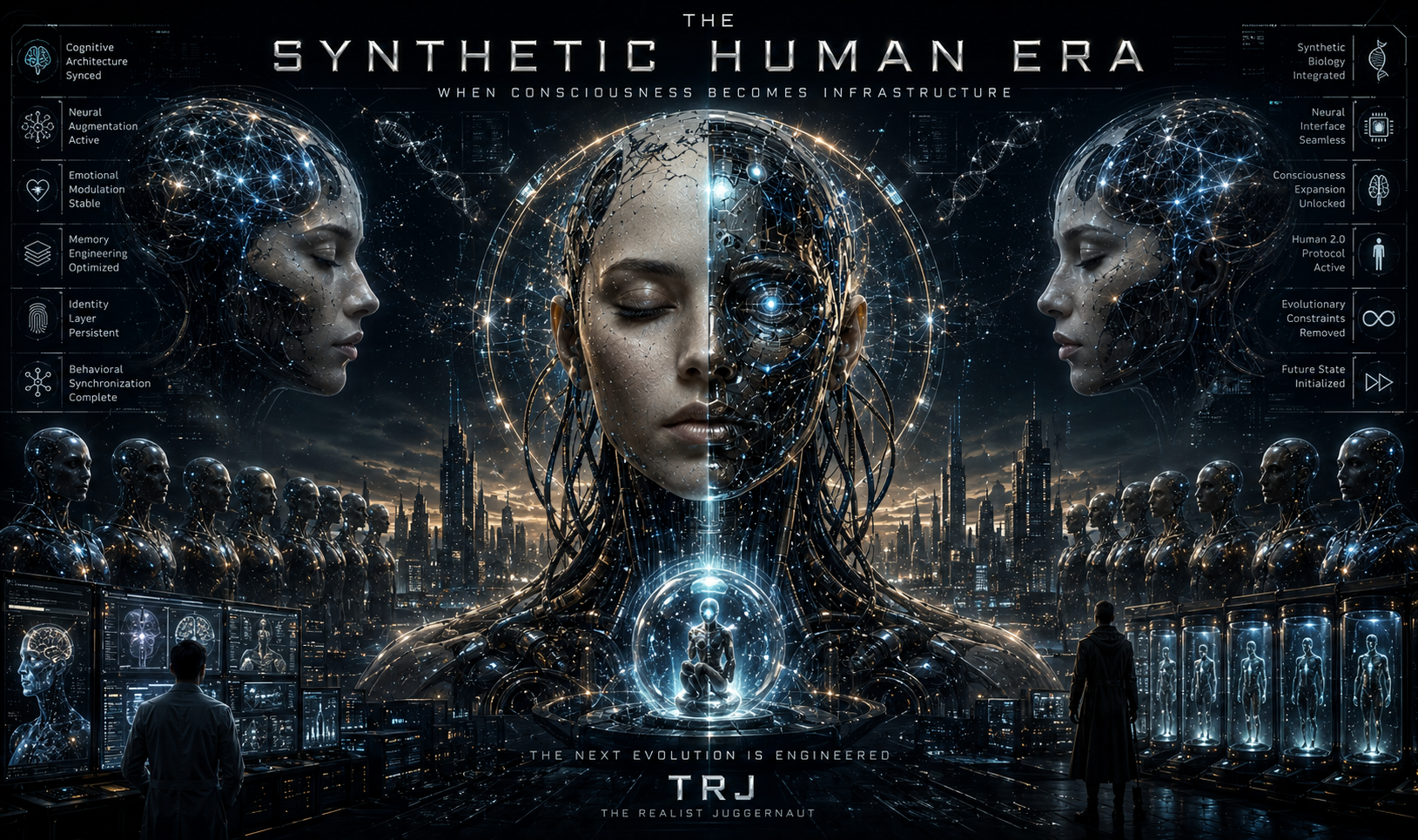
The Corporate Human may become one of the most consequential transformations of the Synthetic Human Era because employment provides institutions with a direct pathway into the daily behavior of billions of people.
Artificial intelligence can improve safety, reduce repetitive work, support accessibility, identify discrimination, and help workers perform complex tasks. Those benefits are substantial and should remain part of the future workplace.
The danger begins when assistance becomes surveillance, surveillance becomes prediction, and prediction becomes behavioral control.
An employer that measures location, communication, productivity, attention, emotion, physical condition, and cognitive state gains access to more than labor. It gains an operational model of the worker.
That model can determine who is hired, promoted, trusted, disciplined, augmented, or removed. It can shape behavior through individualized quotas, prompts, schedules, emotional scoring, and continuous instructions that leave the worker responsible for decisions they did not meaningfully control.
No employee should lose opportunity because an unexplained system predicted future failure. No worker should be forced to surrender unnecessary biometric or cognitive information merely to remain economically viable. No employer should use safety technology as a pathway into unrestricted medical surveillance, and no company should hide responsibility behind a vendor or algorithm.
Workers must receive clear notice, access to relevant records, explanations for high-impact decisions, meaningful human review, protection against retaliation, reasonable accommodations, strict purpose limits, and a voice in the systems governing their work.
The right to work must not become conditional upon surrendering the right to remain internally private.
Synthetic civilization will offer employers tools capable of refining human performance with extraordinary precision. The decisive question is whether those systems serve workers or gradually redesign workers to serve the systems.
A corporation may purchase labor.
It may establish standards.
It may evaluate results.
It must never be permitted to treat the human being performing the work as programmable corporate infrastructure.





🔥 NOW AVAILABLE! 🔥
🔥 NOW AVAILABLE! 🔥
📖 INK & FIRE: BOOK 1 📖
A bold and unapologetic collection of poetry that ignites the soul. Ink & Fire dives deep into raw emotions, truth, and the human experience—unfiltered and untamed
🔥 Kindle Edition 👉 https://a.co/d/9EoGKzh
🔥 Paperback 👉 https://a.co/d/9EoGKzh
🔥 Hardcover Edition 👉 https://a.co/d/0ITmDIB
🔥 NOW AVAILABLE! 🔥
📖 INK & FIRE: BOOK 2 📖
A bold and unapologetic collection of poetry that ignites the soul. Ink & Fire dives deep into raw emotions, truth, and the human experience—unfiltered and untamed just like the first one.
🔥 Kindle Edition 👉 https://a.co/d/1xlx7J2
🔥 Paperback 👉 https://a.co/d/a7vFHN6
🔥 Hardcover Edition 👉 https://a.co/d/efhu1ON
Get your copy today and experience poetry like never before. #InkAndFire #PoetryUnleashed #FuelTheFire
🚨 NOW AVAILABLE! 🚨
📖 THE INEVITABLE: THE DAWN OF A NEW ERA 📖
A powerful, eye-opening read that challenges the status quo and explores the future unfolding before us. Dive into a journey of truth, change, and the forces shaping our world.
🔥 Kindle Edition 👉 https://a.co/d/0FzX6MH
🔥 Paperback 👉 https://a.co/d/2IsxLof
🔥 Hardcover Edition 👉 https://a.co/d/bz01raP
Get your copy today and be part of the new era. #TheInevitable #TruthUnveiled #NewEra
🚀 NOW AVAILABLE! 🚀
📖 THE FORGOTTEN OUTPOST 📖
The Cold War Moon Base They Swore Never Existed
What if the moon landing was just the cover story?
Dive into the boldest investigation The Realist Juggernaut has ever published—featuring declassified files, ghost missions, whistleblower testimony, and black-budget secrets buried in lunar dust.
🔥 Kindle Edition 👉 https://a.co/d/2Mu03Iu
🛸 Paperback Coming Soon
Discover the base they never wanted you to find. TheForgottenOutpost #RealistJuggernaut #MoonBaseTruth #ColdWarSecrets #Declassified


Sponsored • TRJ Ads
Inquiries: contact@therealistjuggernaut.com


