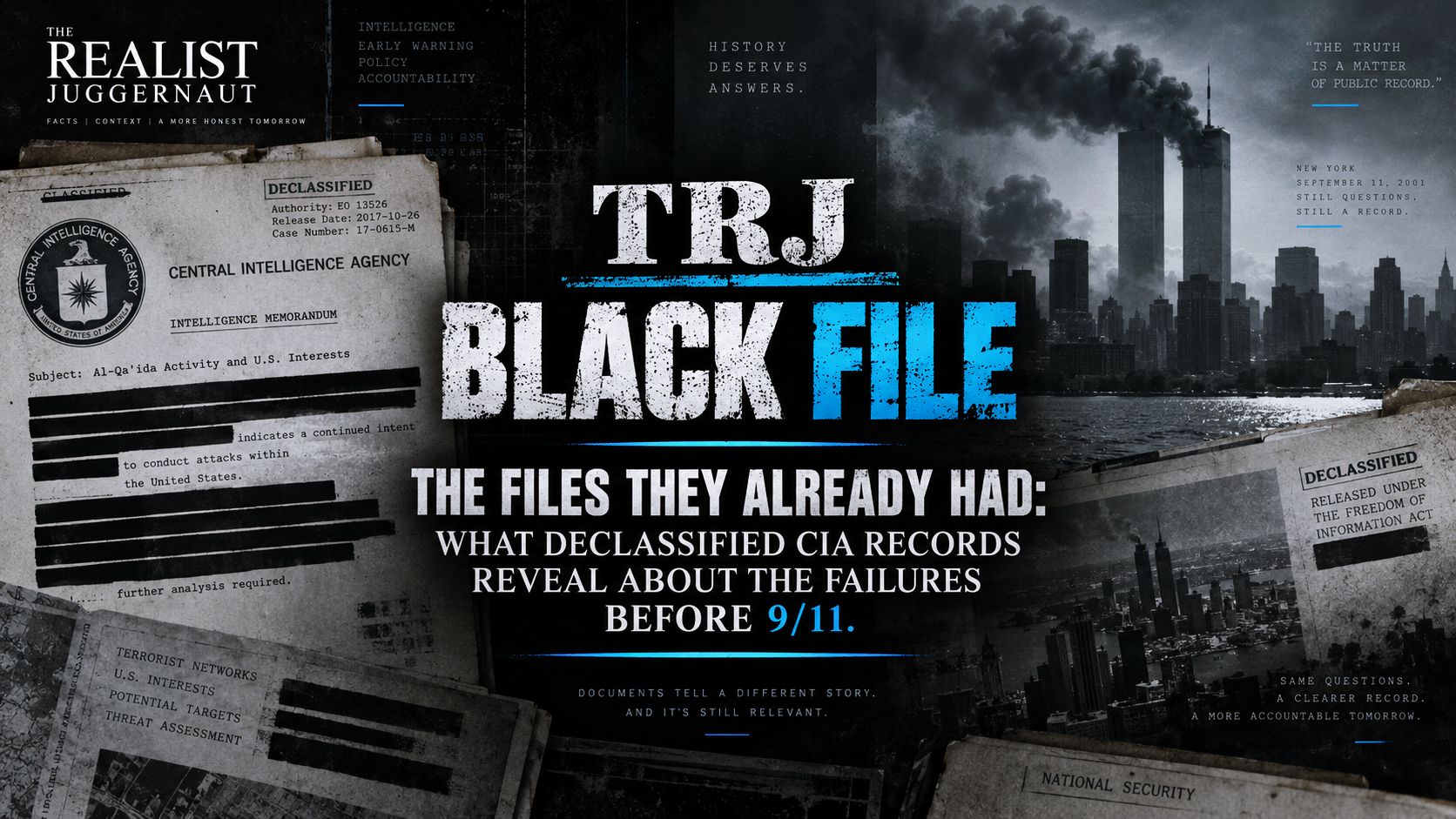
The official record shows that the United States had spent years preparing for terrorism, expanding investigative authority, monitoring al Qaeda, tracking suspected operatives, gathering intelligence, and debating how agencies could share information. September 11 did not expose a threat that Washington had never considered. It exposed how badly a government that already understood the danger could still fail to act on what it possessed.
The story of September 11, 2001, cannot be reduced to a government suddenly discovering that international terrorism threatened the American homeland. Years before the attacks, federal officials were already attempting to strengthen counterterrorism laws, expand electronic surveillance capabilities that would also reach people and communications inside the United States, coordinate intelligence operations, monitor terrorist organizations, disrupt Osama bin Laden’s network, and determine how information gathered for intelligence purposes could be used by criminal investigators.
The documentary record establishes that the groundwork was already being built.
In January 1995, President Bill Clinton promised comprehensive legislation intended to strengthen the federal government’s ability to combat terrorism. His administration subsequently proposed expanded federal criminal jurisdiction, stronger mechanisms for removing suspected terrorists, measures targeting terrorist financing, greater electronic surveillance and wiretap authority for the FBI, and additional funding for federal intelligence and law-enforcement agencies. These initiatives came years before September 11.
The policy continued developing. Presidential Decision Directive 39, issued in June 1995, formally treated terrorism as both a national-security matter and a criminal matter while assigning federal agencies responsibilities for detecting, preventing, investigating, and responding to attacks. During 1995 and 1996, the administration sought larger FBI counterterrorism budgets and supported additional CIA counterterrorism funding. In 1998, Presidential Decision Directives 62 and 63 expanded the framework again, establishing additional counterterrorism programs, strengthening coordination through the National Security Council, and addressing the protection of critical infrastructure.
This is significant because many of the central political questions that exploded into public view after September 11 were already being debated before the attacks. How much surveillance authority should investigators possess? How should intelligence gathered under national-security authorities reach criminal investigators? How should suspected terrorists be monitored inside the United States? How much information could agencies exchange without violating legal restrictions or exposing intelligence sources and methods?
Those questions had already produced friction inside the federal government.
Years before September 11, Congress and the White House were already debating how much additional authority federal investigators should receive in terrorism cases. In February 1995, President Bill Clinton transmitted the proposed Omnibus Counterterrorism Act of 1995 to Congress, describing it as legislation intended to correct gaps in existing law and strengthen the federal government’s ability to respond to terrorism. The proposal included measures designed to facilitate terrorist investigations and prosecutions, expand federal jurisdiction, address terrorist financing, and strengthen investigative authority.
The Senate version, S. 390, introduced the following day, included provisions for court-ordered access to certain immigration records and authorization for the interception of communications in specified terrorism-related offenses. The bill’s findings also stated that international terrorism threatened the United States both overseas and inside its own territory and called for the full range of available governmental tools to confront that threat.
Congressional debate from May 1995 shows that lawmakers were already wrestling with the civil-liberties consequences of expanded counterterrorism powers. Senator Arlen Specter warned that any wiretapping provisions added to the legislation would require close scrutiny to protect constitutional rights. In the same debate, he raised concerns about secret proceedings, freedom of association, and the balance between public safety and the Bill of Rights.
That record matters because it establishes that the surveillance and investigative debate did not begin after September 11. The federal government had already spent years attempting to expand counterterrorism authority while Congress debated where constitutional limits should be drawn. The attacks of September 11 radically changed the political environment surrounding those arguments.
The Foreign Intelligence Surveillance Act established judicial oversight for certain intelligence surveillance conducted inside the United States. During the 1990s, the Justice Department developed procedures governing the movement of intelligence information to criminal prosecutors. Attorney General Janet Reno issued formal information-sharing procedures in 1995. The 9/11 Commission later concluded that these rules became misunderstood and applied more restrictively than the written procedures required, creating barriers that became known collectively as “the wall.” The Commission found that actual coordination between FBI intelligence personnel and criminal investigators became substantially weaker than the law itself demanded.
That distinction became critical because the government was not operating without intelligence on al Qaeda.
American officials had been confronting the organization and its leadership for years. The Commission found that the United States had reasonable opportunities to mobilize more aggressively against al Qaeda after intelligence gathered during 1996 and 1997, after the East Africa embassy bombings in 1998, after terrorist plots uncovered in 1999, and after the bombing of the USS Cole in October 2000. The Commission concluded that the major policy agencies did not meet the threat despite those opportunities.
The CIA itself was deeply engaged against bin Laden. Its operations attempted to disrupt al Qaeda, gather intelligence on the organization, and develop opportunities to capture or kill its leadership. By the late 1990s, CIA officers were producing a sustained flow of intelligence on bin Laden’s reported movements and activities, while President Bill Clinton, National Security Advisor Sandy Berger, and other senior officials received recurring reporting concerning the terrorist threat.
The threat was obviously not confined to intelligence analysts or mid-level officials. It reached the highest levels of the executive branch under two administrations. President Bill Clinton received recurring intelligence concerning Osama bin Laden and al Qaeda, and the 9/11 Commission found that Clinton and National Security Advisor Sandy Berger maintained a special daily pipeline of reporting on bin Laden’s reported location. His administration pursued diplomatic pressure, covert disruption operations, and plans intended to capture or kill bin Laden.
That awareness carried into the incoming George W. Bush administration. Before Bush took office, CIA officials briefed him and his senior advisers on terrorism and the danger posed by bin Laden. During the presidential transition, Clinton later recalled warning Bush that bin Laden and al Qaeda represented the most serious threat he would face. The CIA continued providing intelligence to the incoming administration, and Bush and his advisers accepted that al Qaeda was responsible for the USS Cole attack while beginning development of a new strategy intended to eliminate the organization.
By the spring and summer of 2001, the warning environment had become severe. U.S. intelligence agencies were receiving a sustained stream of threat reporting, and CIA Director George Tenet later told the Commission that “the system was blinking red.” President Bush was receiving regular intelligence on bin Laden through the President’s Daily Brief, with more than 40 Bin Laden-related intelligence articles appearing between January 20 and September 10, 2001. On August 6, Bush received a Presidential Daily Brief titled “Bin Ladin Determined to Strike in US.” The specific tactical details of the September 11 operation were not known, but the broader danger from al Qaeda had reached both presidents and the senior national-security leadership well before the attacks.
Bin Laden also did not emerge from an intelligence environment completely foreign to the United States. His rise occurred through the anti-Soviet Afghan jihad, a theater in which the CIA supported resistance forces opposing the Soviet occupation while Pakistani intelligence served as a major intermediary. Afghan fighters, Arab volunteers, private financial networks, regional governments, intelligence services, and militant organizations developed inside that broader conflict.
Al Qaeda later grew from the militant infrastructure and relationships created during that era. The importance of this history is not that every actor within that environment worked directly for American intelligence. Its importance is that Afghanistan, militant networks in the region, and the forces from which bin Laden’s organization developed were not unknown terrain to U.S. intelligence.
By the late 1990s, bin Laden had openly turned against the United States. American military forces in Saudi Arabia, U.S. policy in the Middle East, Washington’s relationship with the Saudi government, and American support for Israel became central grievances in his public declarations. The United States was therefore dealing with an adversary whose hostility was public, whose organization was already connected to major terrorist attacks, and whose activities were already receiving intense intelligence attention.
The failure that followed was not simply a shortage of warnings. It was the inability to make existing intelligence produce coordinated action.
Khalid al-Mihdhar and Nawaf al-Hazmi provide one of the clearest examples.
In January 2000, U.S. intelligence learned that Mihdhar possessed a valid American visa. Information also emerged concerning Hazmi and the movements of individuals associated with a meeting in Kuala Lumpur, Malaysia. The Commission found no evidence that appropriate domestic agencies were alerted in time to search for the men when the information first became available. Mihdhar and Hazmi subsequently entered the United States without triggering the coordinated domestic response that their known associations could have justified.
The Commission later identified the failure explicitly as an operational opportunity that had been lost. The CIA did not place Mihdhar on the appropriate watchlist in January 2000 and did not notify the FBI when it learned that he possessed a valid U.S. visa.
The problem continued after the men reached the United States.
By March 2000, reporting showed that Hazmi had traveled to Los Angeles. The Commission found no evidence that this information reached the FBI at that time. The government therefore possessed information connecting a known al Qaeda-associated traveler to entry into the United States, yet the domestic investigative system did not begin searching for him.
The intelligence trail resurfaced in 2001.
The Commission found that the CIA failed to notify the FBI of information connecting Khallad, an al Qaeda operative associated with the USS Cole investigation, to the Kuala Lumpur meeting attended by Mihdhar. FBI investigators working the Cole case did not know before September 11 that Khallad had attended that meeting. Internal CIA reporting contained information that FBI investigators did not receive.
By May 2001, threat reporting was surging. A CIA officer detailed to the FBI revisited the Kuala Lumpur material. The records included information showing that Mihdhar possessed a U.S. visa and that Hazmi had entered Los Angeles in January 2000. A CIA official reviewed the cables and took no action on them.
This was not information buried forever in an inaccessible archive. Officials were looking at it months before the attacks.
The Commission’s reconstruction shows the institutional problem in stark terms. CIA personnel tended to focus on geographic areas and foreign operations. FBI investigators tended to follow individual subjects through criminal or domestic investigations. Intelligence existed inside separate systems, held by officers operating under different missions, authorities, procedures, and institutional cultures. The information did not reliably converge where it needed to.
The broader government system suffered from the same weakness.
The Commission later described an enormous federal information storehouse containing intelligence, immigration data, customs records, travel information, and other government holdings. It concluded that the United States had a weak system for processing and using that information. In the Hazmi case, information that could have helped identify him existed, but no one asked for it. Other information moved through compartmented channels or remained inaccessible to officials who could have acted on it.
The Commission called attention to a culture built around “need to know” rather than “need to share.” Agencies guarded information according to Cold War security practices. Officials faced risks for improperly sharing classified material but faced far fewer institutional consequences for withholding information that another agency might need. The result was a system capable of collecting large amounts of intelligence without consistently assembling those fragments into an operational picture.
Those weaknesses existed alongside another serious problem inside the CIA’s Counterterrorist Center: workload.
Internal CIA records describe officers operating in a crisis-driven environment with enormous demands from policymakers and senior Agency officials. Personnel reported insufficient staffing, burnout, limited time for strategic analysis, and an inability to exploit all of the information being collected. Officers acknowledged that the volume of incoming material created a risk that a warning could remain unidentified.
A later joint response from CTC officials challenged portions of the Inspector General’s accountability findings, but their defense itself demonstrates how serious the environment had become. They described triage among incoming leads, cases, and analytical work because available personnel and resources could not fully absorb the workload. They also described persistent funding and staffing pressures as counterterrorism responsibilities expanded.
This does not erase institutional responsibility. It helps explain how responsibility became fragmented.
A system under intense pressure can still fail. A system containing dedicated officers can still fail. A government can possess significant intelligence and still fail. The existence of hard-working personnel does not change what happened when information failed to reach the people who needed it or when warnings failed to produce action.
The summer of 2001 makes that point even harder to ignore.
The Commission found that domestic agencies lacked a coherent game plan for responding to the growing terrorist threat. Officials responsible for overseas operations had established procedures and experience. Domestic agencies received warnings but were not given clear instructions establishing what they were expected to do in response. At a July meeting involving domestic agencies, officials were briefed largely on overseas threats and were not directed to create a specific domestic defensive posture.
The FAA conducted 27 special security briefings for air carriers between May 1 and September 11, 2001. Two addressed overseas hijacking threats. None addressed suicide hijackings or aircraft being used as weapons, and no new aviation-security measures were instituted in response to the broader warning environment.
National-security officials also believed a major al Qaeda attack was approaching. FBI counterterrorism chief Dale Watson told the Commission that he and CIA Counterterrorist Center chief Cofer Black had discussed possible attacks and expected one around July 4. Watson recalled feeling strongly that something was going to happen, while describing the intelligence as insufficiently specific. Attorney General John Ashcroft received threat briefings from the CIA and acting FBI Director Thomas Pickard during the same period.
The Commission’s conclusion about the domestic response was direct: the domestic agencies never mobilized against the threat. Borders were not hardened and transportation systems were not fortified.
The aviation issue adds another layer.
The Commission concluded that the Counterterrorist Center did not conduct the analytical work necessary to explore how hijacked or explosives-laden aircraft might be used as weapons. It did not establish indicators designed to detect such a plot. The intelligence community therefore did not build a warning system specifically tuned to recognize the significance of suspicious flight training.
That deficiency became critical during the summer.
An FBI report from Arizona raised concern about terrorist interest in aviation training. Zacarias Moussaoui was arrested in August after suspicious conduct at a Minnesota flight school. The Moussaoui matter was briefed to senior CIA officials under the heading “Islamic Extremist Learns to Fly.” The Commission concluded that the warning system was not structured to understand the potential significance of these separate events.
While federal agencies were collecting intelligence and debating counterterrorism authorities, the operation that would become September 11 was already moving into its final stages. Beginning in 2000, several of the men chosen to pilot the hijacked aircraft entered the United States and enrolled in American flight schools. Mohamed Atta, Marwan al-Shehhi and Ziad Jarrah trained in Florida, while Hani Hanjour later conducted additional training in Arizona. By the end of 2000, several had obtained advanced pilot qualifications or simulator experience on larger aircraft. During 2001, the operation expanded as additional hijackers entered the country and joined the pilots who would direct the four aircraft.
The preparations continued inside the United States during the spring and summer of 2001. Members of the operation traveled domestically, conducted cross-country flights, studied aviation procedures and positioned themselves near the airports from which the final flights would depart. The men later described by the Commission as the “muscle hijackers” were intended to help seize the cockpits and control the passengers while the trained pilots took command of the aircraft.
On the morning of September 11, 2001, nineteen hijackers boarded four transcontinental passenger flights departing from Boston, Washington Dulles and Newark. Several were flagged by the existing CAPPS passenger-screening system, yet the security procedures in force at the time did not prevent them from boarding. Once airborne, the teams seized the aircraft. American Airlines Flight 11 and United Airlines Flight 175 were flown into the World Trade Center, American Airlines Flight 77 struck the Pentagon, and United Airlines Flight 93 crashed in Pennsylvania after passengers resisted the hijackers. The operation had been assembled over months, much of it while its participants were living, training and traveling inside the United States.
The pieces did exist.
They existed across different agencies, databases, cables, investigations, watchlists, field offices, intelligence units, and chains of command. The catastrophic weakness was not that every piece was absent. The weakness was that no single system consistently assembled them, recognized their combined significance, and forced a coordinated response.
The surveillance debate running through this period makes the aftermath of September 11 especially important.
Before the attacks, the federal government had already spent years seeking stronger counterterrorism authorities, expanded electronic surveillance capabilities, greater coordination, and broader mechanisms for monitoring threats. Legal restrictions and institutional interpretations had produced disputes over how intelligence and criminal investigations should interact. Some of those restrictions were later changed when Congress enacted the USA PATRIOT Act of 2001 after September 11. The Commission specifically noted that a strict interpretation affecting FISA-related information sharing remained in place until passage of the 2001 Act.
The attacks transformed the political environment surrounding those powers.
Congress responded rapidly by granting federal investigative agencies substantial new authority. The 9/11 Commission itself later acknowledged that the Patriot Act shifted significant power toward the federal government and raised legitimate questions about personal privacy and civil liberties. In the name of counterterrorism, Americans accepted a broader government ability to obtain records, trace communications, conduct roving surveillance, expand information sharing between intelligence and law enforcement, and use national-security authorities that could reach people, records, and communications inside the United States.
Some of those powers operated under lower thresholds or broader standards than had existed before September 11, while others reduced institutional barriers that had previously limited how intelligence could move between agencies. The Commission warned that such counterterrorism measures required checks and balances because the American public had vested enormous authority in government after the attacks.
In the immediate aftermath of September 11, Americans were devastated, fearful, and focused on preventing another attack. In that atmosphere, the country accepted broader government surveillance and investigative powers, surrendering a measure of privacy and civil-liberties protection in the name of counterterrorism and national security.
That chronology deserves attention.
Government officials had been seeking stronger counterterrorism and surveillance tools before September 11. One of the clearest examples was S. 390, the Omnibus Counterterrorism Act of 1995, which sought expanded federal authority in terrorism cases and included authorization for the interception of communications in specified terrorism-related offenses. That legislation was part of a broader pre-9/11 effort to strengthen federal investigative powers, information access, intelligence coordination, and counterterrorism enforcement.
S. 390 was not the USA PATRIOT Act. It belonged to an earlier legislative period in which Congress and the executive branch were already debating how far federal counterterrorism authority should extend and how those powers should be balanced against constitutional protections. Congressional debate from 1995 shows that lawmakers were already raising concerns about wiretapping, secret proceedings, freedom of association, and the rights of people subjected to federal surveillance.
Intelligence and law-enforcement agencies were also wrestling with barriers to information sharing. The attacks of September 11 then changed the political environment dramatically. Within weeks, Congress enacted the USA PATRIOT Act of 2001, which expanded and modified federal investigative, surveillance, information-sharing, records-access, and intelligence authorities. Title II of that law was explicitly devoted to “enhanced surveillance procedures,” and later Justice Department testimony described the Act as having changed the relationship between intelligence collection and criminal investigation.
That fact does not need exaggeration to be significant. The federal government had spent years seeking broader counterterrorism authority before September 11, yet it still failed to connect intelligence already in its possession, failed to mobilize domestic agencies effectively, and failed to disrupt an operation that was developing inside the United States. After those failures, the same government received substantially greater powers to collect, share, obtain, and analyze information.
That creates an unavoidable public-interest question: before granting government more power, how thoroughly was the failure to use its existing power examined?
The internal accountability battle that followed shows that the answer was never simple.
CIA officials challenged Inspector General findings that they believed unfairly blamed individual officers or managers for systemic problems. They argued that CTC personnel had worked under extraordinary pressure, limited resources, overwhelming information volume, and constant operational demands. They also disputed claims concerning how much information had reached the FBI and whether senior officials had adequately recognized the threat.
The defenses deserve inclusion because accountability requires understanding what the accused officials themselves said. Yet those defenses do not erase the documented failures. If anything, they make the institutional problem even more apparent. Officers argued that responsibility was diffuse, workloads were overwhelming, resources were inadequate, information was difficult to exploit, and procedures divided authority among organizations that did not always communicate effectively.
That is not a description of a system functioning properly.
It is a description of a system under pressure that failed at the precise moment when failure carried catastrophic consequences.
The record cuts across presidential administrations and political parties. Counterterrorism policy developed throughout the Clinton administration, while intelligence, law-enforcement, border-security, aviation, and information-sharing systems accumulated weaknesses across the 1990s. The Bush administration inherited those structures in January 2001 and confronted an escalating al Qaeda threat during its first eight months in office. The 9/11 Commission found serious shortcomings that extended across both administrations and multiple federal institutions. Responsibility cannot honestly be reduced to one political party, one president, one agency, or one officer.
The failure was institutional. The CIA held intelligence and conducted operations against al Qaeda, the FBI maintained terrorism investigations, the NSA possessed additional intelligence reporting, the State Department operated watchlisting mechanisms, immigration and travel systems contained identifying and travel information, the FAA received threat reporting, and the National Security Council coordinated counterterrorism policy. Yet those separate components never combined into an effective national defense capable of identifying and disrupting the September 11 plot before the attacks.
The Commission ultimately described the greatest barrier to effective intelligence analysis as human and systemic resistance to information sharing. It found a government possessing vast stores of information but lacking the ability to process, distribute, and integrate that material reliably enough to connect the pieces before disaster struck.
Nearly 3,000 people died on September 11, 2001.
For their families, the question of what government knew before the attacks is not an abstract argument about bureaucratic design. It is a question of accountability.
The declassified record shows that America had been warned about al Qaeda, had monitored its leadership, had investigated terrorist networks, had attempted to disrupt plots, had identified individuals who later participated in the attacks, had collected travel information, had maintained watchlisting systems, had debated expanded surveillance authority, and had received an extraordinary volume of threat reporting.
It also shows that those separate components repeatedly failed to produce the response they should have produced under the laws and authorities already in place at the time.
That is the part of the history that cannot be hidden beneath the phrase “failure of imagination.”
There were failures of imagination. There were also failures of communication, management, watchlisting, analysis, prioritization, coordination, domestic preparation, and follow-through.
The distinction matters.
TRJ VERDICT
The documents tell a story far more disturbing than that of a nation caught completely unaware.
The United States had been preparing for terrorism for years. Federal officials had already pursued stronger investigative authority, expanded surveillance tools, developed presidential counterterrorism directives, monitored Osama bin Laden, conducted operations against al Qaeda, tracked suspected extremists, received intelligence concerning individuals who would later become connected to the September 11 plot, and warned senior officials that another major attack was approaching.
The record also shows repeated opportunities that failed to produce decisive action.
Khalid al-Mihdhar’s U.S. visa was known. Nawaf al-Hazmi’s travel to Los Angeles was recorded. Intelligence concerning the Kuala Lumpur meeting existed. Critical information held within CIA channels did not reach FBI investigators who could have acted on it. Aviation-related warning signs appeared. Threat reporting intensified. Senior counterterrorism officials believed another major attack was coming. Yet domestic agencies still failed to mobilize around a unified operational response. The 9/11 Commission later identified these failures individually, including missed watchlisting opportunities, failures to notify the FBI, inadequate prioritization of the search for Mihdhar and Hazmi, and the failure to connect those men and Zacarias Moussaoui to the broader threat reporting surrounding an imminent al Qaeda attack.
That record is enough to explain why questions surrounding September 11 have never disappeared.
It also explains why theories alleging deeper government responsibility continue to attract attention. Those examining the official record are not confronting an empty page. They are confronting documented prior knowledge of the broader threat, institutional contradictions, missed opportunities, compartmented intelligence, internal disputes, failures of coordination, and a government that dramatically expanded its surveillance and investigative powers after failing to use the information, authorities, and mechanisms already available to it effectively. The Commission itself later acknowledged that the Patriot Act vested substantial new powers in federal investigative agencies and warned that the resulting shift of authority toward government required stronger checks, oversight, and protection of civil liberties.
Those facts do not require TRJ to force a conclusion the record does not establish. They require something more important: refusing to pretend the documented record is less troubling than it is.
The central question remains painfully simple.
How could the United States possess this much intelligence, this much history with the threat, this many warnings, this many investigative tools already available before the attacks, and this many opportunities — and still fail to stop what happened on September 11, 2001?
That question deserves to remain open to continued examination as additional records are reviewed and the existing record is measured against what government officials knew, what they possessed, what they were legally capable of doing, and what they ultimately failed to do.
The federal government has declassified a substantial body of material concerning the events surrounding September 11, yet the released record also points to a much larger universe of intelligence reporting, internal communications, operational files, source material, detention records, and classified assessments that has never been made fully public. Given the volume of intelligence activity documented before and after the attacks, it is reasonable to conclude that additional records exist beyond what has been released. Whether all of those records will ever be declassified remains uncertain.

National Commission on Terrorist Attacks Upon the United States, The 9/11 Commission Report: Final Report of the National Commission on Terrorist Attacks Upon the United States, 2004. (Free Download)
Central Intelligence Agency, DCI Counterterrorist Center, Joint Response to OIG Report — Accountability Regarding Findings and Conclusions of the Joint Inquiry into Intelligence Community Activities Before & After 9/11/2001, July 4, 2005. CIA declassified release. (Free Download)
Central Intelligence Agency, Office of Inspector General, Inspection Report of the DCI Counterterrorist Center, Directorate of Operations, August 2001. CIA declassified release. (Free Download)
Central Intelligence Agency, Office of Inspector General, Report on Central Intelligence Agency Accountability Regarding Findings and Conclusions of the Report of the Joint Inquiry into Intelligence Community Activities Before and After the Terrorist Attacks of September 11, 2001, June 2005. CIA declassified release. (Free Download)
George J. Tenet, former Director of Central Intelligence, Response to Inspector General’s 9/11 Accountability Final Draft Report, June 9, 2005. Central Intelligence Agency declassified release. (Free Download)
George J. Tenet, former Director of Central Intelligence, memorandum to CIA Inspector General John Helgerson concerning the 9/11 accountability assessment, February 16, 2005. Central Intelligence Agency declassified release. (Free Download)
Central Intelligence Agency Counterterrorist Center leadership, Joint Response to Draft IG 9/11 Report, January 13, 2005. CIA declassified release. (Free Download)
President William J. Clinton / U.S. Congress, Proposed Legislation: “The Omnibus Counterterrorism Act of 1995,” House Document 104-31, February 9, 1995. U.S. Government Printing Office. (Free Download)
U.S. Senate, 104th Congress, S. 390, Omnibus Counterterrorism Act of 1995, introduced February 10, 1995. (Free Download)
U.S. Congress, Congressional Record — Senate, 104th Congress, First Session, May 26, 1995, debate concerning the Comprehensive Terrorism Prevention Act and related counterterrorism authorities. (Free Download)
U.S. Department of Justice, National Security Division, Statement of Acting Assistant Attorney General Todd Hinnen before the House Judiciary Subcommittee on Crime, Terrorism and Homeland Security, March 30, 2011. (Free Download)
National Commission on Terrorist Attacks Upon the United States, The 9/11 Commission Report — Executive Summary, 2004. (Free Download)
National Commission on Terrorist Attacks Upon the United States, The 9/11 Commission Report, Chapter 6: “From Threat to Threat,” 2004. (Free Download)
National Commission on Terrorist Attacks Upon the United States, The 9/11 Commission Report, Chapter 4: “Responses to al Qaeda’s Initial Assaults,” 2004. (Free Download)
United States Congress, Public Law 107-56, Uniting and Strengthening America by Providing Appropriate Tools Required to Intercept and Obstruct Terrorism (USA PATRIOT Act) Act of 2001, enacted October 26, 2001. (Free Download)
United States Congress, Public Law 109-177, USA PATRIOT Improvement and Reauthorization Act of 2005, enacted March 9, 2006. (Free Download)
TRJ BLACK FILE — THE FILES THEY ALREADY HAD
This Black File contains the official reports, declassified CIA records, congressional documents, federal legislation, and government testimony used to examine what the United States knew, what authorities already existed, what failures occurred before September 11, 2001, and how federal surveillance and investigative powers expanded afterward.
These records are presented in their numbered archive sets so the documentary trail remains intact and each source can be traced back to the corresponding file.
ARCHIVE SET A — CIA RECORDS & FULL 9/11 COMMISSION REPORT
File 001 — 001. 911Report.pdf
Source / Credit: National Commission on Terrorist Attacks Upon the United States, The 9/11 Commission Report: Final Report of the National Commission on Terrorist Attacks Upon the United States, 2004.
File 1 — 1. DOC_0001229684.pdf
Source / Credit: Central Intelligence Agency, DCI Counterterrorist Center, joint response concerning CIA accountability and the findings of the 9/11 intelligence review, July 4, 2005. CIA declassified release.
File 2 — 2. DOC_0001525482.pdf
Source / Credit: Central Intelligence Agency, Office of Inspector General, Inspection Report of the DCI Counterterrorist Center, Directorate of Operations, August 2001. CIA declassified release.
File 3 — 3. DOC_0006184107.pdf
Source / Credit: Central Intelligence Agency, Office of Inspector General, Report on Central Intelligence Agency Accountability Regarding Findings and Conclusions of the Report of the Joint Inquiry into Intelligence Community Activities Before and After the Terrorist Attacks of September 11, 2001, June 2005. CIA declassified release.
File 4 — 4. DOC_0006220800.pdf
Source / Credit: George J. Tenet, former Director of Central Intelligence, Response to Inspector General’s 9/11 Accountability Final Draft Report, June 9, 2005. Central Intelligence Agency declassified release.
File 5 — 5. DOC_0006297294.pdf
Source / Credit: George J. Tenet, former Director of Central Intelligence, memorandum to CIA Inspector General John Helgerson concerning the draft 9/11 accountability assessment, February 16, 2005. Central Intelligence Agency declassified release.
File 6 — 6. DOC_0006364591.pdf
Source / Credit: Central Intelligence Agency Counterterrorist Center leadership, Joint Response to Draft IG 9/11 Report, January 13, 2005. CIA declassified release.
ARCHIVE SET B — PRE-9/11 COUNTERTERRORISM LEGISLATION & DOJ RECORDS
File 1 — 1. CDOC-104hdoc31.pdf
Source / Credit: President William J. Clinton and the United States Congress, Proposed Legislation: “The Omnibus Counterterrorism Act of 1995”, House Document 104-31, February 9, 1995. U.S. Government Printing Office.
File 2 — 2. BILLS-104s390is.pdf
Source / Credit: United States Senate, 104th Congress, S. 390, Omnibus Counterterrorism Act of 1995, introduced February 10, 1995.
File 3 — 3. CREC-1995-05-26.pdf
Source / Credit: United States Congress, Congressional Record — Senate, 104th Congress, First Session, May 26, 1995. Debate concerning federal antiterrorism legislation, investigative authority, wiretapping, secret proceedings, constitutional protections, and civil liberties.
File 4 — 4. National Security Division _ Justice News.pdf
Source / Credit: United States Department of Justice, National Security Division, Statement of Todd Hinnen, Acting Assistant Attorney General for National Security, before the House Judiciary Subcommittee on Crime, Terrorism and Homeland Security, March 30, 2011.
ARCHIVE SET C — 9/11 COMMISSION EXTRACTS
File 1 — 1. Terrorist Attacks Upon the United States.pdf
Source / Credit: National Commission on Terrorist Attacks Upon the United States, The 9/11 Commission Report — Executive Summary, 2004.
File 2 — 2. Terrorist Attacks Upon the United States.pdf
Source / Credit: National Commission on Terrorist Attacks Upon the United States, The 9/11 Commission Report, Chapter 6: “From Threat to Threat”, 2004.
File 3 — 3. National Commission on Terrorist Attacks Upon the United States.pdf
Source / Credit: National Commission on Terrorist Attacks Upon the United States, The 9/11 Commission Report, Chapter 4: “Responses to al Qaeda’s Initial Assaults”, 2004.
ARCHIVE SET D — USA PATRIOT ACT LEGISLATION
File 1 — 1. PLAW-107publ56.pdf
Source / Credit: United States Congress, Public Law 107-56, Uniting and Strengthening America by Providing Appropriate Tools Required to Intercept and Obstruct Terrorism Act of 2001 — USA PATRIOT Act, enacted October 26, 2001.
File 2 — 2. PLAW-109publ177.pdf
Source / Credit: United States Congress, Public Law 109-177, USA PATRIOT Improvement and Reauthorization Act of 2005, enacted March 9, 2006.
The records contained in this Black File document a federal counterterrorism system that existed long before September 11, 2001, the intelligence and institutional failures that followed, the internal accountability disputes that emerged afterward, and the expansion of federal investigative and surveillance authority in the aftermath of the attacks.
The documents were eventually released. The questions contained within them remain.





🔥 NOW AVAILABLE! 🔥
🔥 NOW AVAILABLE! 🔥
📖 INK & FIRE: BOOK 1 📖
A bold and unapologetic collection of poetry that ignites the soul. Ink & Fire dives deep into raw emotions, truth, and the human experience—unfiltered and untamed
🔥 Kindle Edition 👉 https://a.co/d/9EoGKzh
🔥 Paperback 👉 https://a.co/d/9EoGKzh
🔥 Hardcover Edition 👉 https://a.co/d/0ITmDIB
🔥 NOW AVAILABLE! 🔥
📖 INK & FIRE: BOOK 2 📖
A bold and unapologetic collection of poetry that ignites the soul. Ink & Fire dives deep into raw emotions, truth, and the human experience—unfiltered and untamed just like the first one.
🔥 Kindle Edition 👉 https://a.co/d/1xlx7J2
🔥 Paperback 👉 https://a.co/d/a7vFHN6
🔥 Hardcover Edition 👉 https://a.co/d/efhu1ON
Get your copy today and experience poetry like never before. #InkAndFire #PoetryUnleashed #FuelTheFire
🚨 NOW AVAILABLE! 🚨
📖 THE INEVITABLE: THE DAWN OF A NEW ERA 📖
A powerful, eye-opening read that challenges the status quo and explores the future unfolding before us. Dive into a journey of truth, change, and the forces shaping our world.
🔥 Kindle Edition 👉 https://a.co/d/0FzX6MH
🔥 Paperback 👉 https://a.co/d/2IsxLof
🔥 Hardcover Edition 👉 https://a.co/d/bz01raP
Get your copy today and be part of the new era. #TheInevitable #TruthUnveiled #NewEra
🚀 NOW AVAILABLE! 🚀
📖 THE FORGOTTEN OUTPOST 📖
The Cold War Moon Base They Swore Never Existed
What if the moon landing was just the cover story?
Dive into the boldest investigation The Realist Juggernaut has ever published—featuring declassified files, ghost missions, whistleblower testimony, and black-budget secrets buried in lunar dust.
🔥 Kindle Edition 👉 https://a.co/d/2Mu03Iu
🛸 Paperback Coming Soon
Discover the base they never wanted you to find. TheForgottenOutpost #RealistJuggernaut #MoonBaseTruth #ColdWarSecrets #Declassified


Sponsored • TRJ Ads
Inquiries: contact@therealistjuggernaut.com