
Thank you for reading or listening to The Realist Juggernaut. Independent journalism should be accessible to everyone.
What Happens When Human Enhancement Becomes Something Money Can Buy?
Economic inequality has always shaped the human body. Wealth influences nutrition, housing, education, medical care, exposure to danger, working conditions, life expectancy, and the ability to recover from illness. The rich and poor inhabit the same biological species, but they do not experience biological vulnerability under equal conditions.
Human augmentation could transform that inequality from a difference in circumstances into a difference in capability.
Artificial intelligence, advanced prosthetics, brain-computer interfaces, sensory systems, robotic exoskeletons, genetic technologies, personalized medicine, neural stimulation, and biological engineering are moving toward a future where human limitations may no longer be treated solely as fixed conditions. Technology may restore lost function, compensate for disability, improve health, extend physical performance, accelerate learning, strengthen memory, sharpen perception, or connect the nervous system directly with digital infrastructure.
Many of these technologies begin with a medical purpose. Implanted brain-computer interfaces are being investigated as ways to restore communication or motor control for people with paralysis or amputation. Advanced prosthetic systems can return mobility and dexterity. Robotic exoskeletons can support rehabilitation and movement. Genetic interventions may treat severe disease. Sensory devices can restore or expand access to sight, sound, and environmental information.
These goals represent some of the most humane applications of technology because they can reduce suffering and return capabilities that injury, illness, or biology removed.
The boundary changes when restoration becomes enhancement.
A neural interface designed to help a person communicate after paralysis could eventually allow faster interaction with machines. A prosthetic limb created to restore movement might surpass ordinary biological strength or precision. A sensory system developed to compensate for impairment could detect information outside typical human perception. Cognitive tools built to support memory loss could become systems for expanding memory beyond natural limits.
The same technology can move from helping someone reach an ordinary range of function to enabling someone to exceed it.
That transition will not occur equally.
Early enhancement systems will require research, specialized surgery, advanced equipment, personalized calibration, security, maintenance, software support, and continuous medical oversight. High costs will restrict access to governments, corporations, military programs, wealthy institutions, and individuals capable of paying for experimental or premium services.
The first augmented populations may therefore emerge from the highest levels of economic and institutional power.
Wealth has always purchased education, influence, security, and time. Enhancement could allow wealth to purchase faster cognition, stronger bodies, expanded perception, longer health, and direct access to machine intelligence. Economic advantage would begin reproducing itself through human capability.
A wealthy student using advanced cognitive support may learn faster, retain more information, and receive continuous personalized instruction. An augmented professional could analyze complex material more efficiently, communicate through integrated systems, and maintain attention beyond ordinary limits. A physically enhanced worker could perform demanding tasks with less fatigue. An executive connected to predictive intelligence could process information through systems unavailable to competitors.
These advantages would produce greater income, influence, and access to the next generation of enhancements.
The class divide becomes self-reinforcing.
People with early access gain the resources needed to purchase later improvements. Those without access compete against individuals whose advantages are no longer limited to better schools, stronger professional networks, or greater capital. They may be competing against technologically expanded cognition and physical capability.
Merit becomes difficult to define when achievement reflects purchased augmentation.
A person may appear more intelligent because a neural system retrieves information instantly. Another may demonstrate greater endurance because an exoskeleton reduces physical strain. A third may make faster decisions because artificial intelligence pre-processes every available variable. Their accomplishments may still require discipline and judgment, yet those qualities operate through advantages unavailable to others.
Society will have to decide whether augmented performance represents personal merit, technological assistance, capital investment, or some combination of all three.
The distinction will affect education, employment, licensing, athletics, military service, insurance, and access to leadership. An institution may claim to evaluate everyone under one standard while ignoring the technological differences producing performance.
Equal rules do not create equal competition when participants possess radically different capabilities.
Education may become the first major institution to normalize this divide. Wealthier families already purchase tutoring, technology, private instruction, specialized testing preparation, and environments designed around academic success. Cognitive augmentation could deepen that advantage by placing personalized artificial systems around the developing mind from early childhood.
The enhanced student may receive continuous memory support, real-time language translation, adaptive instruction, attention regulation, and instant analytical assistance. Another student may lack reliable internet access, current devices, or basic educational resources. The Organisation for Economic Co-operation and Development has warned that digital divides involve not only internet access and device availability, but also disparities in infrastructure, skills, affordability, and the ability to use digital technologies effectively.
Human augmentation could turn that digital divide into a cognitive divide.
Schools may initially prohibit certain systems during examinations or assignments. Enforcement will become difficult when augmentation moves from visible devices into wearables, implants, sensory systems, or persistent cognitive support operating beneath ordinary observation. Institutions may eventually stop asking whether students use augmentation and begin evaluating which forms are approved.
Once enhanced performance becomes common, unassisted work may appear incomplete.
Students without augmentation could receive accommodations intended to preserve fairness, but the social meaning of unmodified cognition may still decline. Employers may prefer graduates trained through advanced systems because their output meets new expectations. Educational institutions may feel pressured to integrate augmentation simply to keep their students competitive.
The option becomes an obligation through economic pressure.
Employment will accelerate the divide because companies benefit directly from enhanced productivity. Organizations may pay for selected workers to receive advanced tools, physical systems, or cognitive support. Those employees become more valuable to the company while also becoming dependent upon corporate access.
A worker may perform at an augmented level during employment and lose that capability after leaving. The enhancement could rely upon licensed software, proprietary networks, maintenance contracts, or devices controlled by the organization. Professional identity becomes connected to an artificial system the worker does not own.
Others may finance their own augmentation to remain competitive. Training, devices, subscriptions, medical procedures, and upgrades become career expenses. People already burdened by debt may face another pressure: enhance now or accept reduced economic opportunity.
The market can call the decision voluntary while punishing those who refuse.
An unaugmented person may remain fully capable of performing the original job. The problem is that the job will be redesigned around those who exceed the original standard. Higher output becomes normal. Faster decisions become expected. Continuous availability becomes possible. The workplace absorbs technological advantage and converts it into a new baseline.
Human limitation becomes a performance deficiency.
This process creates a class of people who cannot afford to compete and another class who cannot afford to stop upgrading. The wealthy gain first access, but even privileged users may become trapped inside continuous technological maintenance. Enhancement systems require updates, security patches, replacement parts, calibration, medical monitoring, and compatibility with changing infrastructure.
A person’s expanded capability may depend upon recurring payments.
Missed subscriptions could reduce memory access, sensory support, processing capacity, physical strength, or connectivity. A device implanted inside the body may remain physically present while premium functions become restricted remotely. Human capability becomes subject to licensing terms.
The enhanced person is not entirely independent.
They are economically tethered to the provider maintaining the enhancement.
Corporate failure could leave users with obsolete systems integrated into their bodies. A discontinued device may no longer receive security updates or replacement components. A company acquisition could transfer sensitive neural or biological data to a new owner. An upgrade could change behavior, performance, or compatibility. Removing the system may require surgery or create physical and psychological consequences.
The cost of enhancement therefore extends far beyond purchase. Users may need lifetime support from companies whose own lifespans are uncertain.
The wealthy may protect themselves through private medical care, redundant systems, legal agreements, and access to replacement technologies. Lower-income users receiving subsidized or employer-funded augmentation may depend upon a single provider with fewer choices.
The same device can represent liberation for one person and technological dependency for another.
Healthcare systems will face pressure to distinguish medically necessary restoration from elective enhancement. Insurance may cover a device that returns function but refuse features that exceed an established biological range. Manufacturers could build the same hardware with several software levels, allowing basic movement under medical coverage while reserving greater strength, speed, sensory range, or cognitive integration for customers who pay additional fees.
Human capability could be divided through software tiers.
The person using a prosthetic system may know that the body could perform better if a feature were unlocked. A patient receiving neural support may gain basic communication while wealthier users access faster interfaces. The hardware limitation is not biological or technical. It is financial.
This creates a moral conflict for disability communities. Enhancement technology can expand independence and access, but a market centered on optimization may also suggest that bodies require correction before they deserve full participation. Society may invest in modifying individuals while neglecting accessible buildings, transportation, communication, employment practices, and public infrastructure.
Technology should support human freedom without turning difference into inferiority.
A person who declines augmentation should not be treated as defective. Someone who embraces advanced prosthetics should not be accused of abandoning humanity. The decision belongs to the individual, but meaningful choice exists only when both paths receive social and economic respect.
The cultural pressure to enhance may become stronger than formal coercion. Attractive bodies, rapid cognition, emotional control, physical endurance, and sensory expansion could be marketed as signs of ambition, intelligence, discipline, and success. Remaining unmodified may be associated with weakness, poverty, fear, or resistance to progress.
The body becomes a visible class marker.
Cosmetic procedures already demonstrate how optional modification can become socially expected. Synthetic enhancement could magnify that process by connecting appearance with measurable performance. A person may not seek augmentation out of personal desire. They may seek it because relationships, employers, educational institutions, and social hierarchies may favor those who possess it.
The market does not need to force transformation when inequality makes refusal costly.
Genetic technology introduces a deeper dimension because advantage may begin before the individual can consent. The World Health Organization has called for governance of human genome editing that promotes health equity, reduces socioeconomic inequality, and avoids discrimination. Those concerns are essential because genetic interventions could move from disease treatment toward the selection or enhancement of physical and cognitive traits.
The article The Collapse of Natural Reproduction already examined the restructuring of reproduction through technological systems. The class question reaches a separate consequence: what happens when wealthy families can purchase biological advantages before birth while other families cannot?
If heritable enhancement becomes viable, wealth could influence not only the opportunities children receive but the biological traits they inherit. Economic privilege would begin embedding itself across generations through engineered capability.
The class system becomes biological.
Even non-heritable interventions could produce generational effects. Parents with access to longer health, stronger cognition, and greater earning capacity can transfer more knowledge, stability, and wealth to children. Their advantages compound without requiring genetic inheritance.
Longevity technologies may create the most powerful concentration of all. People with resources could remain healthy, productive, and economically active for longer periods while those without access experience ordinary aging and disease. Extended healthy life would allow greater wealth accumulation, longer leadership, additional education, and more time to influence institutions.
Power may stop rotating at the pace biological aging once imposed.
An elite capable of extending health and cognitive performance could retain control across several generations of ordinary human life. Younger populations may find that positions, assets, land, and institutional authority remain occupied by augmented individuals who do not retire under previous expectations.
Longevity then becomes political and economic power.
Geography will create another divide. Wealthy countries and regions may develop enhancement infrastructure while poorer areas continue struggling with basic healthcare, education, sanitation, nutrition, and connectivity. International inequality could move from differences in development to differences in human capability.
Augmented states may gain military, scientific, economic, and industrial advantages. Their populations could process information faster, recover from injury more effectively, and operate advanced systems with greater integration. Nations without access may become dependent upon foreign enhancement providers and the governments controlling them.
Technology could create a hierarchy among countries similar to the class hierarchy forming within them.
Military programs will have strong incentives to pursue augmentation because improved perception, endurance, communication, and machine integration provide strategic advantage. Systems developed for soldiers may later enter civilian markets, but access could remain restricted by cost, classification, or national-security policy.
Veterans may also depend upon proprietary systems after service. A person whose body was integrated with military technology could leave the institution while still requiring maintenance from it. Questions of ownership, autonomy, medical support, and continued access would follow the individual for life.
Enhancement markets may also produce unsafe underground economies. People excluded by price or regulation may seek unapproved implants, counterfeit software, illegal genetic interventions, or unlicensed procedures. The desire to compete can push users toward systems without adequate testing, security, medical supervision, or long-term support.
Failure may cause permanent physical or cognitive harm.
A black market becomes more likely when society demands augmented performance while legal access remains restricted to the wealthy. Prohibition alone cannot solve a system whose economic incentives reward enhancement.
Regulation must separate legitimate protection from class preservation. Safety standards are necessary for implanted devices, biological interventions, neural systems, and technologies capable of changing human function. Those standards should not become barriers structured so only the wealthiest institutions can participate.
Public investment will be essential if medically valuable enhancements are to benefit more than an economic elite. Restorative technologies should not remain luxury goods when they can provide communication, mobility, sensory access, or relief from severe disease. Access based solely upon wealth would convert scientific progress into another mechanism of exclusion.
The distinction between restoration and enhancement will still resist simple boundaries. Restoring someone to an average range assumes that the average body defines appropriate function. Some people may seek capabilities that differ from ordinary standards because those capabilities support their own identity and independence.
Policy should focus on harm, consent, fairness, and coercion rather than imposing one rigid definition of the acceptable human body.
Neural data requires especially strong protection. An enhancement connected to the brain may collect information about movement, attention, intention, or cognitive activity. Companies could use that data to improve devices, personalize services, or develop commercial systems. The user may receive enhanced capability while surrendering information drawn directly from neural processes.
Access to enhancement should not require ownership of the user’s mind by the provider.
Interoperability can reduce dependency by allowing people to change maintenance companies, software providers, or external systems without losing the function of the device. Open technical standards, long-term support requirements, security obligations, and repair rights will become central to bodily autonomy.
A person should not lose movement, communication, or perception because a manufacturer refuses third-party repair.
Civil-rights protections must also expand. Employers, schools, insurers, lenders, and public institutions may begin distinguishing between augmented and unaugmented individuals. Some may favor enhanced people for performance. Others may exclude them because of perceived security risks, medical costs, or uncertainty about fairness.
Both groups can face discrimination.
The law will need to protect the right to use necessary technology and the right to refuse unnecessary augmentation. Institutions may establish limited restrictions where safety or fair competition requires them, but those restrictions must be supported by evidence rather than fear or economic preference.
Human worth cannot become a performance ranking based upon installed capability.
The deepest danger is not the existence of enhanced individuals. Human beings have always used tools to extend strength, memory, perception, and communication. Clothing, medicine, writing, machines, computers, and networks all expanded human capability.
The danger appears when enhancement becomes the condition for receiving full economic and social recognition.
A society divided between augmented and unaugmented people may continue claiming that everyone possesses equal legal status while constructing every meaningful opportunity around capabilities only one class can afford.
Equality survives in language while disappearing in practice.
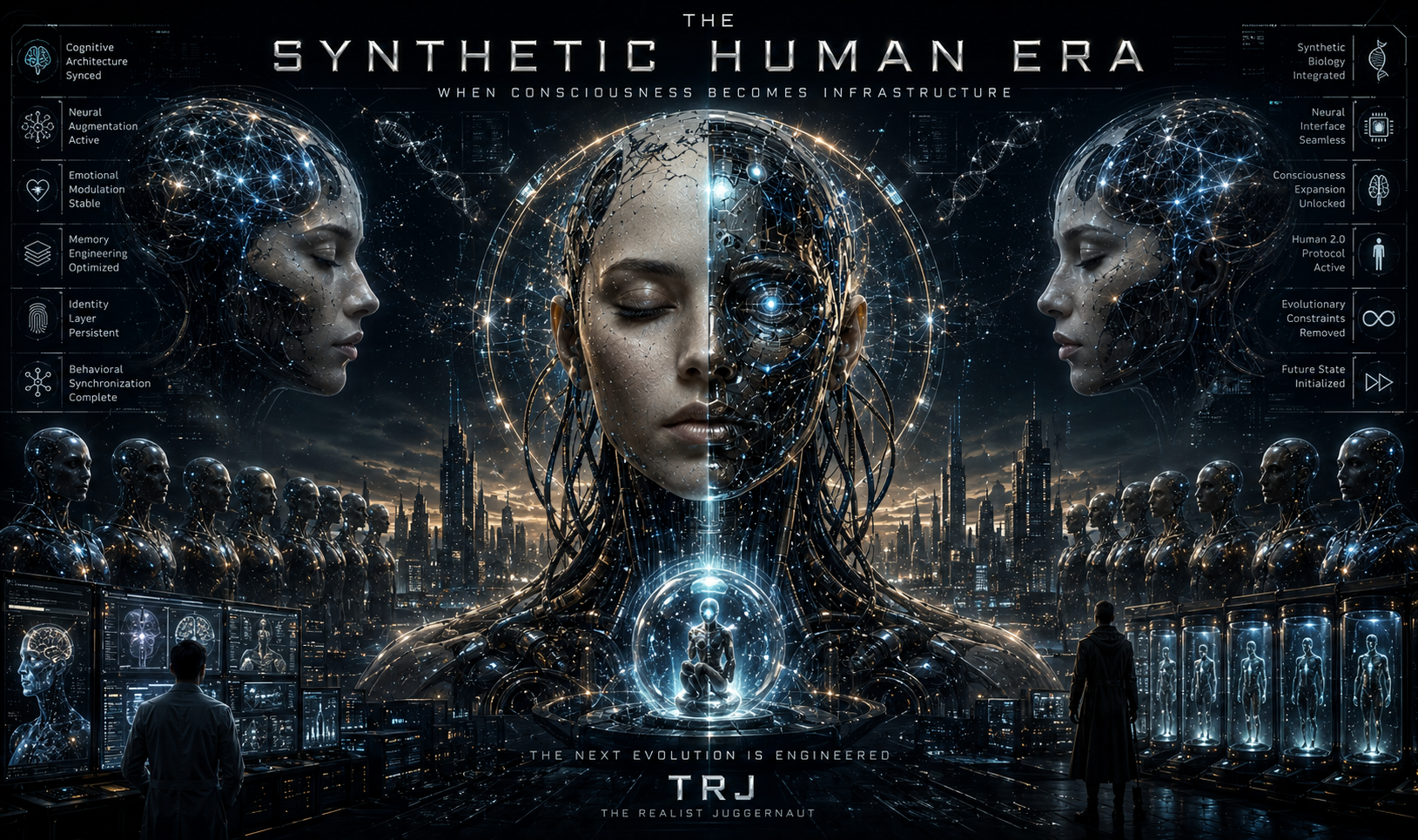
The Synthetic Human Era will force civilization to decide whether augmentation is a shared human achievement or a private advantage sold to the highest bidder. The technology itself cannot answer that question. Markets distribute according to purchasing power. Justice requires a separate decision concerning which capabilities should remain available regardless of wealth.
If civilization fails to make that decision, the human class system will no longer describe who owns the most.
It will describe who has been technologically permitted to become more.
TRJ VERDICT
The Augmented Class Divide may become one of the most destabilizing inequalities of synthetic civilization because it moves privilege beyond wealth, education, and opportunity into the capabilities of the human body and mind.
Enhancement technologies can restore movement, communication, sensory function, health, and independence. They can reduce suffering and allow people to participate in society with freedoms biology once denied them. Those achievements should be protected and expanded.
The danger begins when access follows wealth alone.
A society where affluent individuals can purchase stronger bodies, faster cognition, extended health, enhanced perception, and direct machine integration will no longer contain only economic classes. It will contain capability classes.
Those with early access will use enhanced performance to gain more wealth, education, authority, and access to later technologies. Those excluded will compete against advantages they cannot reach through effort alone. Merit becomes inseparable from purchased augmentation.
The divide will deepen if employers, schools, and institutions redesign expectations around enhanced performance. An unmodified person may remain fully capable by every previous standard while appearing deficient inside systems optimized around augmented populations.
No one should be forced to alter the body or surrender neural privacy simply to receive education, maintain employment, or participate in public life. No person who depends upon an assistive system should lose essential capability because a subscription expires, a company fails, or proprietary software becomes unsupported.
Restorative technologies should not remain luxury goods when they provide mobility, communication, sensory access, or relief from serious disease. Enhancement systems that create major social advantages require policies addressing access, safety, interoperability, repair, discrimination, consent, and long-term support.
Civilization must protect both the freedom to augment and the freedom to remain unmodified.
Human enhancement will be described as personal choice, but choice cannot be separated from the economic environment surrounding it. When refusal carries exclusion and access depends upon wealth, the market is no longer offering freedom.
It is assigning biological advantage by income.
The final question is not whether humanity should use technology to overcome suffering and limitation.
It is whether the future human being will be a shared possibility—or a premium version available only to those who can afford the upgrade.





🔥 NOW AVAILABLE! 🔥
🔥 NOW AVAILABLE! 🔥
📖 INK & FIRE: BOOK 1 📖
A bold and unapologetic collection of poetry that ignites the soul. Ink & Fire dives deep into raw emotions, truth, and the human experience—unfiltered and untamed
🔥 Kindle Edition 👉 https://a.co/d/9EoGKzh
🔥 Paperback 👉 https://a.co/d/9EoGKzh
🔥 Hardcover Edition 👉 https://a.co/d/0ITmDIB
🔥 NOW AVAILABLE! 🔥
📖 INK & FIRE: BOOK 2 📖
A bold and unapologetic collection of poetry that ignites the soul. Ink & Fire dives deep into raw emotions, truth, and the human experience—unfiltered and untamed just like the first one.
🔥 Kindle Edition 👉 https://a.co/d/1xlx7J2
🔥 Paperback 👉 https://a.co/d/a7vFHN6
🔥 Hardcover Edition 👉 https://a.co/d/efhu1ON
Get your copy today and experience poetry like never before. #InkAndFire #PoetryUnleashed #FuelTheFire
🚨 NOW AVAILABLE! 🚨
📖 THE INEVITABLE: THE DAWN OF A NEW ERA 📖
A powerful, eye-opening read that challenges the status quo and explores the future unfolding before us. Dive into a journey of truth, change, and the forces shaping our world.
🔥 Kindle Edition 👉 https://a.co/d/0FzX6MH
🔥 Paperback 👉 https://a.co/d/2IsxLof
🔥 Hardcover Edition 👉 https://a.co/d/bz01raP
Get your copy today and be part of the new era. #TheInevitable #TruthUnveiled #NewEra
🚀 NOW AVAILABLE! 🚀
📖 THE FORGOTTEN OUTPOST 📖
The Cold War Moon Base They Swore Never Existed
What if the moon landing was just the cover story?
Dive into the boldest investigation The Realist Juggernaut has ever published—featuring declassified files, ghost missions, whistleblower testimony, and black-budget secrets buried in lunar dust.
🔥 Kindle Edition 👉 https://a.co/d/2Mu03Iu
🛸 Paperback Coming Soon
Discover the base they never wanted you to find. TheForgottenOutpost #RealistJuggernaut #MoonBaseTruth #ColdWarSecrets #Declassified


Sponsored • TRJ Ads
Inquiries: contact@therealistjuggernaut.com







This is a fascinating and important thought experiment. The distinction you make between restoration and enhancement is especially significant. Technology that restores sight, movement, communication, or independence can be profoundly liberating; the ethical questions become much harder when the same technologies begin giving some people capabilities beyond ordinary human limits.
What really caught my attention is the possibility of a self-reinforcing inequality. If money can buy cognitive, physical, or sensory advantages, those advantages could potentially generate more wealth and influence, which could then purchase further enhancements. The traditional gap between people who have more resources and those who have fewer could become something much deeper.
Thank you very much for reading and commenting. One of the broader concerns is what happens when these systems become tied to access, licensing, employment, insurance, or institutional control. The question may eventually be less about who chooses enhancement and more about whether people can realistically refuse it without being placed at a disadvantage. That is where the issue moves beyond technology and into autonomy, dependency, and human freedom. 😎