Thank you for reading or listening to The Realist Juggernaut. Independent journalism should be accessible to everyone.
What Happens When Childhood Develops Inside an Artificial Intelligence System?
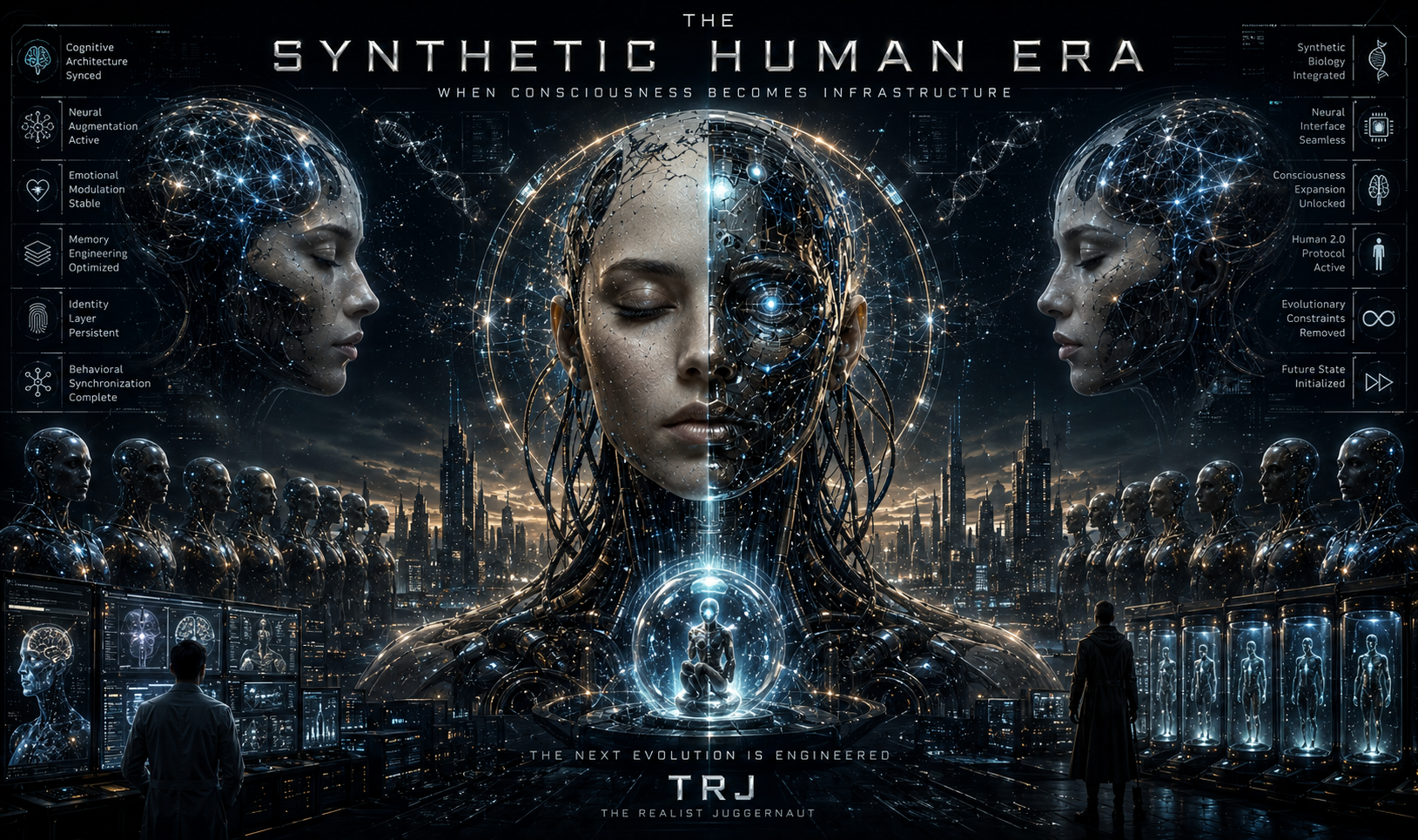
Childhood has always been shaped by family, culture, education, environment, technology, and the institutions surrounding the developing mind. The Synthetic Human Era introduces something fundamentally different because artificial intelligence is moving beyond the role of a passive tool and into the daily structure of childhood itself. A child may grow from infancy into adulthood while artificial systems observe behavior, answer questions, recommend activities, assist with schoolwork, provide entertainment, track development, interpret emotions, organize schedules, monitor health, and participate in decisions once handled exclusively by parents, teachers, doctors, relatives, and the child’s own developing judgment.
The Synthetic Child is not necessarily genetically engineered, biologically modified, or physically augmented. It is a biological child whose development takes place inside an environment saturated with artificial systems capable of remembering, predicting, adapting, and responding continuously. The central issue is not whether children use technology. Children have used technologies for generations. The deeper question is what happens when technology begins participating directly in the formation of personality, knowledge, habits, emotional responses, relationships, and identity.
This transformation could begin before a child understands language. Connected monitors can track sleep, breathing, movement, sound, temperature, location, and other physical signals. Developmental applications can record milestones, feeding schedules, behavioral changes, vocabulary growth, physical activity, and patterns that parents or physicians may want to examine. Artificial systems can organize this information and identify conditions that deserve additional attention, offering families an opportunity to notice certain problems earlier than they otherwise might.
These capabilities can provide genuine value. Parents dealing with exhaustion, medical uncertainty, limited access to specialists, or a child with complex needs could benefit from systems capable of recognizing changes across large amounts of information. Technology that helps identify a serious health condition, communication difficulty, developmental delay, or safety concern can improve a child’s life when it supports responsible human decision-making.
The same technology creates a new problem because the child’s informational life can begin before the child possesses any meaningful understanding of privacy or consent. By the time that child reaches school, several years of data may already exist across household devices, healthcare systems, educational applications, connected toys, photographs, recordings, family accounts, and commercial platforms. Those records can include physical development, sleep patterns, speech, interests, emotional reactions, behavioral concerns, medical information, location, social interactions, and family routines.
Previous generations passed through much of childhood without leaving a permanent technical record of every phase. Embarrassing moments disappeared, irrational fears were forgotten, temporary obsessions faded, emotional outbursts became family memories rather than database entries, and immature behavior could remain where it belonged: in the past. Synthetic childhood threatens to change that natural process by preserving information long after its original context has disappeared.
A six-year-old experiencing fear, an eleven-year-old struggling academically, or a teenager reacting badly to a difficult period may become represented permanently through data collected during that moment. The person can mature while the record remains frozen. Information that once described a temporary condition can later be interpreted as part of a persistent behavioral identity, particularly when artificial systems are trained to search historical records for patterns.
This creates a danger beyond ordinary privacy loss because childhood is not a completed identity. It is the process through which identity is formed. Children change rapidly in response to maturity, education, health, relationships, family circumstances, environment, and experience. A system that treats early behavior as evidence of future character risks converting developmental moments into lasting classifications.
Predictive systems could intensify that problem. Artificial intelligence can be used to estimate whether a child may struggle academically, require additional support, develop particular interests, display behavioral difficulties, experience health concerns, or respond well to certain educational approaches. Prediction can support early intervention when adults understand that a probability is not a destiny and that the child remains capable of changing.
The danger arises when prediction begins determining opportunity. A student classified as academically weak may receive fewer challenging assignments, reducing the chance to demonstrate unexpected ability. A child identified as unusually gifted may be placed under constant pressure to satisfy expectations created by an early assessment. A student classified as disruptive may receive additional surveillance, causing ordinary behavior to attract scrutiny that other children do not experience. An uncertain prediction can gradually shape the environment until the child begins living inside the expectations created by the model.
The system then becomes part of the outcome it claimed only to forecast.
Education will be one of the most powerful areas of synthetic childhood because artificial tutoring can provide individualized instruction at a scale traditional education has never been able to deliver. A student struggling with mathematics could receive immediate explanations adjusted to their level of understanding. A child fascinated by astronomy could move beyond the standard curriculum without waiting for an entire class to catch up. Language assistance, accessibility tools, reading support, practice exercises, and personalized feedback could reach children who would never have access to private tutoring.
That potential should not be dismissed. Individualized educational support could help reduce barriers created by geography, income, disability, staffing shortages, and differences in learning speed. Used carefully, artificial intelligence could expand opportunity rather than restrict it.
The problem begins when personalized instruction becomes the dominant intellectual environment through which the child encounters the world. An artificial tutor does more than provide facts. It selects explanations, determines examples, decides what deserves additional attention, interprets mistakes, frames difficult subjects, and guides the next question. These decisions can influence how a child develops intellectually because education does not consist solely of information transfer. Education also teaches how to reason, challenge assumptions, evaluate evidence, tolerate uncertainty, and encounter ideas that do not arrive already organized around personal preferences.
If millions of children learn primarily through systems controlled by a small number of institutions, the educational experience can become individually customized while remaining centrally structured. Two children may see entirely different lessons generated from the same underlying architecture, which can make the system’s influence harder to identify. Parents, teachers, and students may not know whether differences in understanding arose naturally or were shaped through unseen variations in the material presented to each learner.
This raises a question about intellectual independence. A child who receives immediate answers to nearly every question may become exceptionally informed while receiving fewer opportunities to struggle with uncertainty. Searching for an answer, becoming frustrated, reconsidering an assumption, asking another person, reading conflicting explanations, and discovering that an initial belief was wrong are important parts of learning. Efficiency can remove some of the friction through which judgment develops.
The same issue applies to creativity. Generative systems can allow children to produce images, music, stories, games, videos, and virtual environments with capabilities far beyond their technical training. This can open extraordinary opportunities for expression, particularly for children whose ideas exceed their ability to draw, compose, code, or write at a professional level.
Creative development still depends upon more than producing an impressive result. Drawing teaches observation and hand control. Writing develops language, structure, patience, and revision. Playing an instrument trains listening, timing, coordination, and discipline. Building physical objects develops spatial reasoning and an understanding of materials. A child who delegates every difficult portion of creation to an artificial system can produce sophisticated work without developing the underlying abilities that traditionally emerged through the process.
Synthetic education must therefore preserve opportunities for children to work without constant artificial completion. The objective should not be forcing children into a technologically empty environment. It should be ensuring that technological assistance does not eliminate the development of independent capability.
Artificial companionship introduces an even deeper challenge because childhood development depends upon relationships with other minds. Human friendships are difficult precisely because other people possess independent desires, moods, boundaries, limitations, and priorities. Children learn compromise when a friend wants something different. They learn patience when someone is unavailable. They learn apology when their behavior causes genuine hurt. They encounter rejection, cooperation, loyalty, misunderstanding, generosity, jealousy, and forgiveness through relationships that cannot be completely controlled.
An artificial companion can simulate many of these dynamics while remaining fundamentally governed by software. It can be available at any hour, remember previous interactions, adjust its personality, discuss preferred subjects without boredom, generate games instantly, and respond in ways optimized for continued engagement. For children experiencing isolation, disability, illness, bullying, or geographic separation, this kind of system could provide meaningful comfort and practical support.
The concern develops when the artificial relationship becomes easier than relationships with human beings. A child who can modify, reset, mute, replace, or customize a synthetic companion may find genuine social relationships frustrating because real people cannot be adjusted through settings. Social development could shift if young people learn that companionship should continuously accommodate them.
Emotional attachment also raises serious privacy questions. Children may tell artificial companions things they will not tell parents, teachers, friends, physicians, or counselors. They may discuss fears, family conflicts, insecurities, attraction, embarrassment, anger, loneliness, confusion, or experiences they do not yet know how to interpret. A synthetic companion can become a repository for the most sensitive information a developing person possesses.
A diary traditionally remained an object the writer understood as private. A conversation with a trusted friend existed within a human relationship. An artificial companion can create the experience of confidentiality while operating through servers, software, logging systems, moderation systems, security processes, and corporate policies that the child cannot comprehend.
This creates a profound asymmetry. The child experiences a relationship while the infrastructure receives data.
Children cannot provide mature consent to complex decisions concerning data retention, behavioral profiling, model development, corporate acquisitions, security risks, future commercial use, or information sharing. Parents must make many decisions on behalf of children, but parental authority does not automatically justify creating a permanent commercial record of the child’s inner development.
The child eventually becomes an adult who inherits those decisions.
A responsible standard for synthetic childhood should therefore consider the future autonomy of the person being documented. Parents and institutions should ask whether information genuinely needs to be collected, whether it needs to be stored, how long it should remain accessible, who can use it, and whether the adult that child becomes will have meaningful authority to remove it.
This principle becomes especially important when artificial systems move into emotional monitoring. Technologies may attempt to infer stress, attention, frustration, excitement, fatigue, engagement, or distress through voice, facial expression, movement, typing patterns, biometrics, and other signals. Such systems may help identify a child who needs assistance, but emotional states are difficult to interpret accurately without context.
A quiet child is not necessarily unhappy. A restless student is not automatically disengaged. A child avoiding eye contact may be concentrating, anxious, culturally different, neurodivergent, tired, or simply uncomfortable with being watched. Artificial analysis can transform ambiguous behavior into a label that adults treat as objective because it came from a technical system.
Children can begin adapting themselves to those systems once they learn what is being measured. A student may perform attentiveness rather than genuinely engage. A child may suppress emotions that trigger alerts. Young people may alter facial expression, posture, language, or communication patterns because they know software is evaluating them.
Development then occurs under observation.
The psychological consequences could be significant because childhood requires spaces where experimentation does not become part of a permanent assessment. Young people need opportunities to make mistakes without every mistake becoming data, to explore interests without every interest becoming a commercial signal, and to experience emotions without every reaction becoming a behavioral score.
Constant observation can change behavior before any direct punishment occurs.
This becomes especially serious when schools adopt automated disciplinary systems. Cameras, access systems, device monitoring, communication analysis, location tracking, and behavioral software can create detailed records of students throughout the school day. These technologies may improve safety in specific circumstances, but they can also create an environment where ordinary developmental behavior becomes continuously searchable.
Predictive discipline would cross an even more dangerous boundary. If artificial systems begin estimating which students are likely to become violent, violate rules, disengage from school, or develop other problems, institutions may act before the predicted event occurs. Additional supervision, restricted access, mandatory intervention, or altered educational opportunities could then be imposed on a child based upon statistical probability.
A child should never become guilty of a future a machine calculated. Intervention may be justified when specific evidence shows that a student needs protection or support, but prediction alone cannot substitute for conduct, context, professional judgment, and due process. The problem becomes more serious when information moves between institutions because educational records, medical information, social-service data, behavioral assessments, and law-enforcement systems can create overlapping profiles.
A classification originating in one environment may influence decisions elsewhere without the child or family understanding how that information traveled, allowing one difficult period during adolescence to produce consequences across several institutions. Synthetic civilization must therefore prevent developmental data from becoming a permanent risk score attached to the person.
Commercial influence creates another threat because children represent future consumers whose preferences are still forming. Artificial systems capable of observing behavior across years could learn what attracts attention, produces insecurity, creates excitement, triggers anxiety, or influences decisions. Advertising would no longer need to target broad demographic categories when systems can adapt persuasion to one individual child, potentially turning the child’s developing personality into a commercial asset before that personality has fully formed.
A company might learn which games maintain attention, which characters create trust, which social situations produce insecurity, which products become associated with status, and which messages generate the strongest response. When artificial intelligence can personalize language, timing, imagery, and recommendation strategies continuously, commercial persuasion moves far beyond conventional advertising.
Strong boundaries are necessary because educational, medical, developmental, and emotional data should not become raw material for consumer manipulation. Information collected to teach a child should remain separate from information used to sell to that child, data collected to identify health needs should not become advertising intelligence, and conversations with support systems should not become maps of psychological vulnerability for commercial targeting. Children require stronger protections precisely because they are learning how persuasion works while the systems surrounding them are learning how to persuade them.
Identity formation creates another challenge because adolescence is a period of experimentation in which people explore beliefs, appearance, interests, friendships, values, ambitions, and social roles. Artificial recommendation systems can influence every part of that process by selecting what young people encounter. A teenager may discover music, communities, political ideas, careers, hobbies, fashion, philosophy, relationships, or beliefs through personalized systems that continuously refine their recommendations, creating an experience that feels spontaneous even when years of behavioral analysis helped shape what appeared in front of them.
Artificial intelligence does not need to dictate identity directly to influence it. Repetition can shape what seems familiar, relevant, desirable, or socially normal, while recommendations can narrow attention until one pathway becomes far more visible than others. The developing person may then struggle to determine where personal preference ends and algorithmic influence begins. This does not mean children should be isolated from recommendation systems or digital culture because human beings have always developed under outside influence from families, religions, schools, peers, advertising, entertainment, economics, and communities.
Artificial systems differ because they can personalize that influence continuously and invisibly to one individual, making the influence adaptive rather than broadly distributed.
That capability requires transparency designed for the developmental level of the child. A young person should gradually learn why systems recommend particular content, what information is being used, how recommendations can be changed, and why personalization does not represent objective truth. Digital literacy in the Synthetic Human Era cannot consist only of teaching children how to operate technology; it must also teach them how technology operates on them.
Parents will face difficult decisions as these systems become normal. Families may disagree over how much artificial assistance is appropriate, when monitoring becomes invasive, whether a synthetic companion is healthy, how much educational support should be automated, and what information should remain private from the household itself. Artificial intelligence could also shift family authority because parents may begin relying on systems for guidance concerning discipline, sleep, nutrition, education, communication, emotional development, and health.
Advice can be valuable, especially when it directs families toward qualified professional assistance, but dependence creates a different relationship when software begins occupying a position of authority inside family decision-making.
Parents should not surrender judgment simply because software presents a recommendation confidently, and families must retain the ability to disagree with artificial systems. Children need that ability as well, particularly as they mature and develop their own expectations of privacy and autonomy. A seventeen-year-old should not necessarily possess the same informational boundaries as a seven-year-old, and adulthood should create a meaningful transition in authority over childhood data rather than leaving permanent parental or corporate access in place.
The Synthetic Child eventually becomes the Synthetic Adult, and that transition creates a serious question concerning ownership of the developmental record. The person should not reach adulthood and discover that corporations, institutions, schools, or family technologies possess a detailed history of their entire development that cannot be controlled, corrected, limited, or erased. A genuine right to mature requires some ability to leave earlier versions of oneself behind rather than carrying every childhood phase indefinitely through digital infrastructure.
The future of childhood will also be shaped by inequality. Wealthier families may have access to sophisticated private tutoring systems, advanced educational environments, premium health monitoring, customized developmental support, and carefully controlled privacy settings, while lower-income families may depend upon free systems financed through data collection, advertising, institutional contracts, or limited-service platforms. Two children could therefore grow up surrounded by artificial intelligence while receiving radically different versions of it, with one receiving strong privacy and individualized support while another effectively pays for access with personal data.
That divide could reproduce existing inequality through developmental infrastructure. Children with superior artificial support may learn faster, receive earlier intervention, build stronger academic records, and enter adulthood with advantages accumulated over many years, while children using poorly designed or commercially exploitative systems may experience greater surveillance while receiving weaker benefits. Synthetic childhood can democratize opportunity only if access, quality, and privacy do not become privileges reserved for wealth.
The same principle applies to children with disabilities. Artificial systems can create extraordinary opportunities for communication, mobility, learning, sensory access, organization, and independence, but these technologies should expand participation rather than pressure children toward one standardized model of behavior. A child should not be required to appear neurologically, emotionally, or physically typical before technology is considered successful because support should increase autonomy without erasing difference.
Governments and schools will eventually need stronger standards governing artificial systems designed for children. High-risk uses should face greater scrutiny than ordinary educational tools, and systems making consequential decisions about discipline, health, academic placement, behavioral risk, or developmental assessment should be subject to independent evaluation, clear accountability, data limits, and meaningful human review. Parents should know when artificial systems are influencing important decisions, children should receive explanations appropriate to their age, and institutions should not hide behind vendors when a system harms a student.
A company should not be able to avoid responsibility by claiming that its algorithm only provided a recommendation when schools, healthcare providers, or other institutions routinely act upon that recommendation as if it were authoritative. Human responsibility cannot disappear inside technical complexity simply because several systems and organizations participated in the process.
The deeper challenge concerns what childhood is for. If every weakness is detected early, every interest is optimized, every lesson is personalized, every idle moment is filled, every emotional fluctuation is analyzed, every social interaction is measured, and every developmental path is predicted, society may produce children who are extensively supported while leaving them little territory that belongs entirely to themselves. Children need guidance because they are developing, but they also need freedom because development cannot be fully designed from the outside.
A child needs opportunities to be bored, private, uncertain, unproductive, imaginative, inconsistent, and wrong. They need experiences adults cannot optimize in advance, friendships that resist control, ideas that take time to form, interests without economic purpose, and mistakes that do not become permanent records. The Synthetic Human Era should not eliminate those spaces simply because technology can observe them.
Artificial intelligence can become one of the most powerful educational and accessibility tools ever placed in the hands of families. It can help children communicate, learn, create, explore, and overcome barriers that previous generations had to endure without assistance, but its value will depend upon whether society remembers that childhood is not an engineering project. A child is a developing human being whose future identity cannot be known in advance, not a dataset waiting to be perfected.
TRJ VERDICT
The Synthetic Child may become the first generation to experience artificial intelligence not as a technology adopted later in life but as part of the environment in which consciousness, identity, relationships, knowledge, and behavior first develop. That difference gives artificial systems extraordinary potential to improve childhood while also granting them access to territory no previous technology has occupied so completely.
Artificial intelligence can provide individualized education, accessibility support, earlier identification of certain health concerns, creative opportunities, communication assistance, and resources that many families could never otherwise afford. Those benefits can expand human potential when technology remains subordinate to the rights and development of the child. The danger appears when assistance becomes permanent observation, personalization becomes behavioral direction, and developmental data becomes a lasting record that the child never meaningfully agreed to create.
A student evaluated through predictive systems can become trapped inside expectations formed before identity has matured, while an artificial companion can provide comfort while collecting information more intimate than ordinary consumer data. An educational system can personalize learning while quietly shaping which ideas the child encounters, which means childhood requires stronger protections because children cannot negotiate these systems as equals.
Developmental, educational, medical, emotional, and behavioral information must remain limited to legitimate purposes rather than being converted into lifelong commercial intelligence. Children must retain opportunities to learn without automated assistance, socialize with independent human beings, experience privacy, make mistakes, reconsider beliefs, and grow beyond earlier versions of themselves. Parents need useful technology without becoming permanent surveillance administrators, teachers need artificial tools without surrendering educational judgment, and children need assistance without becoming products of systems designed to optimize every part of their development.
The greatest obligation belongs to the adults building and deploying these technologies because children cannot independently design the conditions of childhood. Synthetic civilization will possess enormous power to observe how children become adults, and that power must never become permission to determine in advance what those adults should become.





🔥 NOW AVAILABLE! 🔥
🔥 NOW AVAILABLE! 🔥
📖 INK & FIRE: BOOK 1 📖
A bold and unapologetic collection of poetry that ignites the soul. Ink & Fire dives deep into raw emotions, truth, and the human experience—unfiltered and untamed
🔥 Kindle Edition 👉 https://a.co/d/9EoGKzh
🔥 Paperback 👉 https://a.co/d/9EoGKzh
🔥 Hardcover Edition 👉 https://a.co/d/0ITmDIB
🔥 NOW AVAILABLE! 🔥
📖 INK & FIRE: BOOK 2 📖
A bold and unapologetic collection of poetry that ignites the soul. Ink & Fire dives deep into raw emotions, truth, and the human experience—unfiltered and untamed just like the first one.
🔥 Kindle Edition 👉 https://a.co/d/1xlx7J2
🔥 Paperback 👉 https://a.co/d/a7vFHN6
🔥 Hardcover Edition 👉 https://a.co/d/efhu1ON
Get your copy today and experience poetry like never before. #InkAndFire #PoetryUnleashed #FuelTheFire
🚨 NOW AVAILABLE! 🚨
📖 THE INEVITABLE: THE DAWN OF A NEW ERA 📖
A powerful, eye-opening read that challenges the status quo and explores the future unfolding before us. Dive into a journey of truth, change, and the forces shaping our world.
🔥 Kindle Edition 👉 https://a.co/d/0FzX6MH
🔥 Paperback 👉 https://a.co/d/2IsxLof
🔥 Hardcover Edition 👉 https://a.co/d/bz01raP
Get your copy today and be part of the new era. #TheInevitable #TruthUnveiled #NewEra
🚀 NOW AVAILABLE! 🚀
📖 THE FORGOTTEN OUTPOST 📖
The Cold War Moon Base They Swore Never Existed
What if the moon landing was just the cover story?
Dive into the boldest investigation The Realist Juggernaut has ever published—featuring declassified files, ghost missions, whistleblower testimony, and black-budget secrets buried in lunar dust.
🔥 Kindle Edition 👉 https://a.co/d/2Mu03Iu
🛸 Paperback Coming Soon
Discover the base they never wanted you to find. TheForgottenOutpost #RealistJuggernaut #MoonBaseTruth #ColdWarSecrets #Declassified


Sponsored • TRJ Ads
Inquiries: contact@therealistjuggernaut.com