Thank you for reading or listening to The Realist Juggernaut. Independent journalism should be accessible to everyone.
Human memory was never designed to function as a perfect archive.
For much of modern history, that statement would have been viewed as an obvious observation rather than a profound concern. People forget names. They forget conversations. They forget dates, locations, and countless details from ordinary life. Entire years often compress into fragments. Significant events remain vivid while less meaningful experiences gradually disappear into obscurity. The process has always been accepted as a natural characteristic of biological cognition.
What many people fail to recognize is that forgetting serves a purpose.
The human brain does not simply store information. It constantly prioritizes, filters, reorganizes, and reinterprets experience. Memory evolved as an adaptive system rather than a recording device. It preserves what appears important while allowing less relevant information to fade. This process reduces cognitive overload, supports emotional adaptation, and enables individuals to construct coherent identities from the immense complexity of lived experience.
In many ways, forgetting is just as important as remembering.
Civilization is now building systems that operate according to an entirely different philosophy.
Digital memory does not forget naturally. It does not prioritize emotional adaptation. It does not soften difficult experiences through the passage of time. Information stored within digital infrastructure remains available indefinitely unless deliberately altered or removed. Every year, the amount of information preserved by modern society expands dramatically. Messages, photographs, videos, transactions, location histories, communications, behavioral patterns, biometric measurements, and countless other forms of data are being accumulated at scales unprecedented in human history.
The significance of this shift extends far beyond storage capacity.
For thousands of years, memory existed primarily within human beings. Records certainly existed, but they were fragmented, incomplete, and often inaccessible. Most personal history remained internal. The individual mind served as the primary repository of experience.
That relationship is changing.
Modern civilization increasingly externalizes memory into technological systems. What began as simple documentation has evolved into an expanding network of digital archives capable of preserving enormous portions of human activity. Smartphones, cloud services, wearable devices, social platforms, intelligent assistants, surveillance systems, and interconnected databases collectively form a growing memory layer surrounding everyday life.
Artificial intelligence introduces a new dimension to this transformation.
Traditional archives store information. Artificial intelligence interprets it.
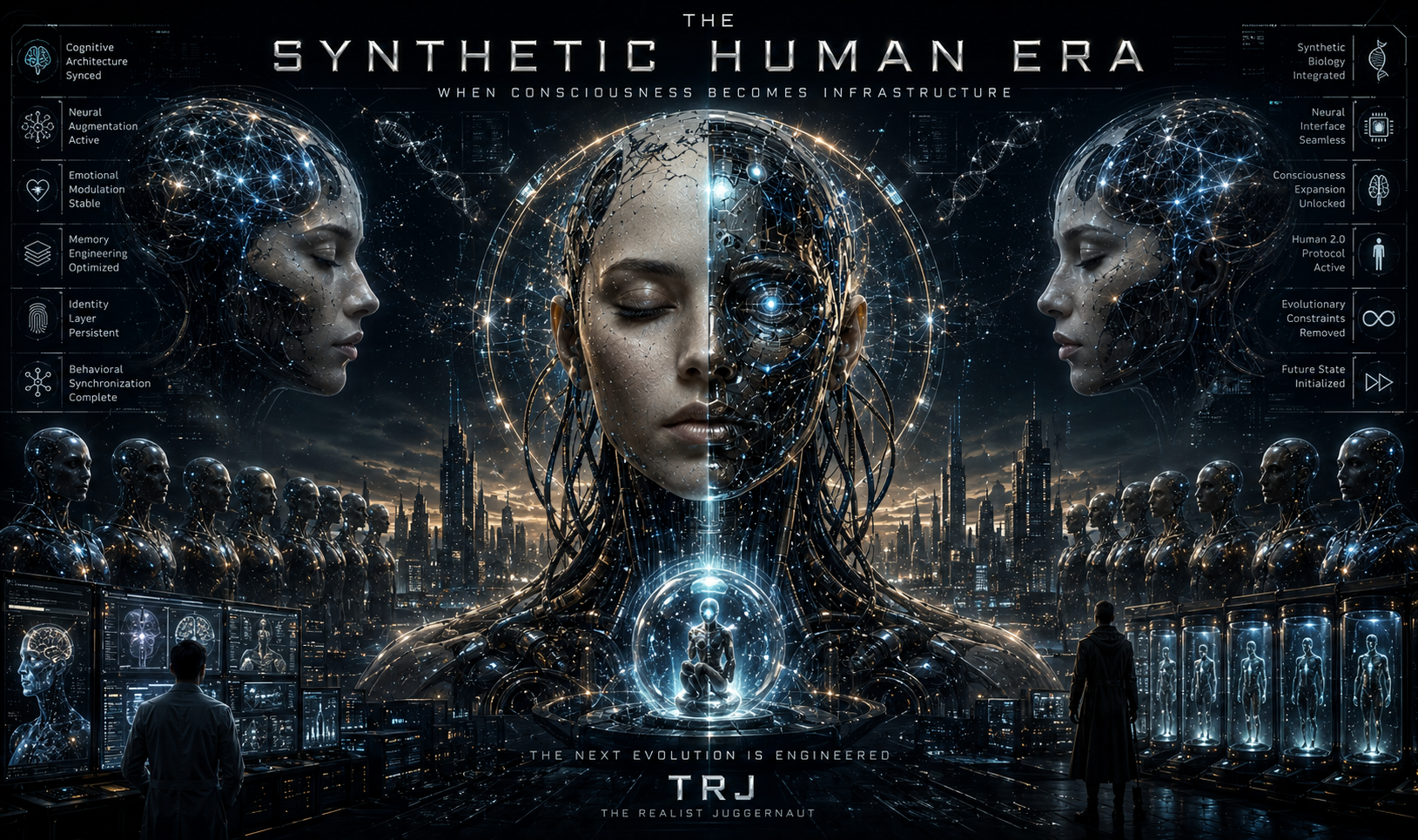
That distinction may become one of the defining characteristics of the Synthetic Human Era.
The emergence of intelligent memory systems represents a departure from every previous model of human record keeping. Historically, archives remained passive. Documents existed until someone retrieved them. Photographs remained dormant until viewed. Records preserved information but did not actively participate in understanding it.
Artificial intelligence changes that dynamic entirely.
Modern systems increasingly organize, categorize, summarize, contextualize, and connect information automatically. As these capabilities continue advancing, memory systems cease functioning solely as repositories and begin functioning as interpretive infrastructures capable of identifying relationships across vast quantities of information.
The implications are profound.
For the first time in human history, individuals may increasingly rely upon systems outside their own minds to retrieve, organize, and explain portions of their personal history. The issue is not whether external systems can store more information than biological memory. That question has already been answered. Digital infrastructure surpassed the storage limitations of individual cognition years ago.
The more significant question concerns dependency.
What happens when people no longer view memory as an internal process?
What happens when external systems become the primary mechanism through which information is recalled, organized, and understood?
Civilizations have always been shaped by the technologies they depend upon. Agricultural societies thought differently than hunter-gatherer societies. Industrial societies thought differently than agricultural societies. Information societies reorganized themselves around digital communication and instantaneous access to knowledge.
Synthetic memory may represent another transformation of similar magnitude.
As external systems assume increasing responsibility for information retention, human cognition begins adapting accordingly. This process is already visible. Many people no longer attempt to remember information they know can be retrieved instantly. Navigation systems reduce reliance on spatial memory. Search engines reduce reliance on factual retention. Cloud archives reduce reliance on personal organization. The brain continuously adapts to the environment surrounding it, allocating resources according to perceived necessity.
When memory becomes infrastructure, cognition changes with it.
The consequences extend beyond convenience.
Human identity is deeply connected to memory. Individuals understand themselves through accumulated experience. Personal histories influence decisions, values, relationships, ambitions, fears, and expectations. The stories people construct about their lives are built from remembered events arranged into meaningful narratives.
Synthetic memory introduces new variables into that process.
As external systems increasingly participate in organizing personal history, questions emerge regarding authority and interpretation. Information rarely exists in isolation. Context determines meaning. Events gain significance through perspective, sequence, and understanding. Artificial intelligence systems capable of analyzing large collections of historical information may eventually provide interpretations that influence how individuals understand their own experiences.
This does not require malicious intent.
It emerges naturally from the architecture itself.
A system designed to organize information inevitably influences how that information is perceived. Recommendations influence attention. Summaries influence understanding. Prioritization influences significance. Contextualization influences interpretation. Even when operating accurately, intelligent systems participate in shaping how information is experienced.
The distinction between preserving memory and influencing memory becomes increasingly difficult to separate.
This challenge extends beyond individuals.
Entire societies rely upon collective memory. Cultures preserve identity through shared histories, traditions, institutions, records, and narratives passed between generations. Collective memory shapes national identity, political systems, social cohesion, and historical understanding.
Synthetic memory infrastructures possess the capacity to preserve information at scales previously unimaginable. Historical records, communications, imagery, scientific research, cultural artifacts, and societal developments can be stored with extraordinary completeness.
That capability creates opportunities.
It also creates vulnerabilities.
When societies depend heavily upon digital memory infrastructures, questions of ownership, control, access, and preservation become increasingly important. Who maintains these systems? Who determines what is preserved? Who controls access? How are interpretations formed? What happens when infrastructure responsible for preserving memory becomes concentrated within a relatively small number of institutions, corporations, or technological platforms?
These questions are not merely technical.
They are civilizational.
Throughout history, societies have often struggled to preserve information. Future societies may face a different challenge entirely. Instead of information scarcity, they may confront information abundance so vast that artificial systems become necessary intermediaries between human beings and their own historical records.
In such an environment, memory ceases to function solely as recollection.
It becomes infrastructure.
Another consequence emerges from permanence itself.
Human experience has historically been shaped by the ability to move beyond previous stages of life. Individuals mature. Opinions evolve. Knowledge expands. Mistakes become lessons. The passage of time creates distance between present identity and past experience.
Digital permanence alters that relationship.
As more aspects of life become recorded and preserved, the distinction between past and present may become increasingly compressed. Historical information remains continuously accessible. Earlier decisions, statements, and behaviors persist within archives capable of retrieving them instantly.
This transformation may influence how future generations perceive growth, change, and personal development.
A society built upon permanent records may develop different assumptions regarding identity than societies shaped primarily by biological memory. Individuals have traditionally been allowed to evolve beyond earlier versions of themselves because memory naturally fades and contexts change. Continuous preservation introduces new questions regarding forgiveness, adaptation, and personal transformation.
The issue is not technological capability.
The issue is how civilization chooses to integrate that capability into human life.
Perhaps the most significant shift occurs when authentic experience itself begins changing.
Historically, experiences occurred first and were remembered later. The event existed independently of the memory. Increasingly, modern life unfolds within environments where documentation accompanies experience in real time. Photographs, recordings, digital interactions, and archived communications become intertwined with the experience itself.
The result is subtle but important.
The relationship between living and recording begins to blur.
As synthetic memory infrastructures expand, future generations may develop fundamentally different relationships with memory, identity, privacy, history, and personal experience than any civilization before them. They may inherit a world where vast portions of human existence are preserved, searchable, interpretable, and continuously accessible through systems operating beyond the limits of biological cognition.
The Synthetic Human Era is not merely changing how humanity thinks.
It is changing where memory lives.
For thousands of years, memory remained inseparable from the human mind. It was imperfect, fragile, emotional, adaptive, and deeply personal. It faded with age, evolved with experience, and reflected the uniquely human process of transforming information into meaning.
Synthetic memory introduces a different model entirely.
One built upon preservation, accessibility, permanence, and increasingly, interpretation.
The greatest question facing future civilization is not whether these systems can remember more than humans. They can.
The question is whether humanity can preserve the human meaning of memory once memory itself becomes infrastructure.
TRJ VERDICT
The defining challenge of synthetic memory is not technological.
It is philosophical.
Human civilization evolved around memory systems that were inseparable from biology. People remembered imperfectly because they were human. Entire cultures developed around storytelling, interpretation, reflection, and the gradual transformation of experience into wisdom. Memory was never simply information storage. It was part of the process through which human beings understood themselves and the world around them.
Synthetic memory changes that relationship fundamentally.
For the first time in history, memory is migrating beyond the limits of individual cognition and becoming part of an external infrastructure capable of preserving, organizing, and increasingly interpreting human experience at enormous scale.
The danger is not that machines will remember more than people.
The danger is that societies may gradually transfer responsibility for remembering to systems that operate according to entirely different principles than the human mind.
Biological memory exists to create meaning. Synthetic memory exists to preserve information.
Those objectives are not always the same.
The future of memory may ultimately determine the future of identity itself. Because once civilization begins relying upon infrastructure to preserve, organize, and explain the past, the question is no longer who remembers.
The question becomes who defines what memory means.


🔥 NOW AVAILABLE! 🔥
🔥 NOW AVAILABLE! 🔥
📖 INK & FIRE: BOOK 1 📖
A bold and unapologetic collection of poetry that ignites the soul. Ink & Fire dives deep into raw emotions, truth, and the human experience—unfiltered and untamed
🔥 Kindle Edition 👉 https://a.co/d/9EoGKzh
🔥 Paperback 👉 https://a.co/d/9EoGKzh
🔥 Hardcover Edition 👉 https://a.co/d/0ITmDIB
🔥 NOW AVAILABLE! 🔥
📖 INK & FIRE: BOOK 2 📖
A bold and unapologetic collection of poetry that ignites the soul. Ink & Fire dives deep into raw emotions, truth, and the human experience—unfiltered and untamed just like the first one.
🔥 Kindle Edition 👉 https://a.co/d/1xlx7J2
🔥 Paperback 👉 https://a.co/d/a7vFHN6
🔥 Hardcover Edition 👉 https://a.co/d/efhu1ON
Get your copy today and experience poetry like never before. #InkAndFire #PoetryUnleashed #FuelTheFire
🚨 NOW AVAILABLE! 🚨
📖 THE INEVITABLE: THE DAWN OF A NEW ERA 📖
A powerful, eye-opening read that challenges the status quo and explores the future unfolding before us. Dive into a journey of truth, change, and the forces shaping our world.
🔥 Kindle Edition 👉 https://a.co/d/0FzX6MH
🔥 Paperback 👉 https://a.co/d/2IsxLof
🔥 Hardcover Edition 👉 https://a.co/d/bz01raP
Get your copy today and be part of the new era. #TheInevitable #TruthUnveiled #NewEra
🚀 NOW AVAILABLE! 🚀
📖 THE FORGOTTEN OUTPOST 📖
The Cold War Moon Base They Swore Never Existed
What if the moon landing was just the cover story?
Dive into the boldest investigation The Realist Juggernaut has ever published—featuring declassified files, ghost missions, whistleblower testimony, and black-budget secrets buried in lunar dust.
🔥 Kindle Edition 👉 https://a.co/d/2Mu03Iu
🛸 Paperback Coming Soon
Discover the base they never wanted you to find. TheForgottenOutpost #RealistJuggernaut #MoonBaseTruth #ColdWarSecrets #Declassified


Sponsored • TRJ Ads
Inquiries: contact@therealistjuggernaut.com