
Thank you for reading or listening to The Realist Juggernaut. Independent journalism should be accessible to everyone.
Only months after promoting New York as a future artificial intelligence powerhouse, Governor Kathy Hochul has halted new hyperscale data center permitting—raising questions about the state’s long-term technology strategy and infrastructure planning.
New York has spent the past several years promoting itself as a destination for artificial intelligence, advanced computing, and next-generation technology investment. Now, in a move that is already drawing national attention, Governor Kathy Hochul has signed an executive order creating the nation’s first statewide moratorium on new hyperscale data centers while state regulators develop a new regulatory framework.
The one-year pause temporarily halts state environmental permitting for new hyperscale data centers, generally defined as facilities requiring 50 megawatts or more of electricity, with the governor’s office citing concerns involving electrical grid capacity, rising utility costs, environmental impacts, water consumption, and community effects. Those are meaningful concerns. If the state intended to become a national leader in artificial intelligence, those infrastructure requirements should have been factored into long-term planning before publicly committing to that vision.
At a time when AI is becoming more and more a part of the working infrastructure, pulling back now could create problems for businesses that will rely on AI to remain competitive in the future.
Governor Hochul said the pause is intended to ensure New Yorkers are not forced to shoulder the costs of major infrastructure upgrades needed to support rapidly expanding artificial intelligence facilities while the state develops what it describes as a nation-leading regulatory framework. Yet the argument is likely to face scrutiny from taxpayers who have already endured some of the highest state and local tax burdens in the country and may question why concerns over infrastructure costs are only now becoming central to the state’s artificial intelligence strategy.
If the concern is the electrical grid, that problem should have been addressed years ago. A one-year moratorium does not erase decades of infrastructure challenges. If the electrical grid truly is the primary obstacle, then there is no guarantee this issue will be resolved within a year. Without meaningful modernization, the state could simply find itself extending the pause again and again. When the moratorium ends, New York will still face the same fundamental challenges unless significant investments are made to modernize the electrical grid.
Businesses have choices. They can invest in New York, or they can invest elsewhere. Every delay creates an opportunity for another state to welcome those projects instead. At a time when states are competing for technology investment, New York appears to be making that decision easier for its competitors.
That contrast is likely to become one of the central policy debates surrounding the executive order.
Data centers are not simply buildings filled with computer servers. They form the digital backbone supporting cloud computing, enterprise software, cybersecurity operations, scientific research, financial systems, healthcare infrastructure, streaming services, government operations, artificial intelligence development, and countless online services relied upon every day by businesses and consumers alike.
As demand for AI computing accelerates worldwide, hyperscale data centers have become some of the most sought-after infrastructure projects in the technology sector. These facilities require substantial electrical capacity, advanced cooling systems, high-speed fiber connectivity, and significant long-term investment.
Supporters of the moratorium argue that states must carefully evaluate whether electrical infrastructure, water resources, environmental protections, and local communities can support rapidly expanding AI infrastructure before approving additional projects. The governor’s office has stated that the temporary pause will allow regulators to establish stronger standards while protecting ratepayers and the state’s electrical grid.
Critics warn that delaying major data center construction could have broader economic consequences. Technology companies often evaluate multiple states before committing billions of dollars to infrastructure investments. Extended permitting delays or regulatory uncertainty may encourage companies to redirect projects to states with fewer restrictions, potentially affecting construction activity, long-term employment opportunities, tax revenue, and future technology investment.
The executive order also places New York at the center of a growing national debate over artificial intelligence infrastructure. Across the United States and internationally, governments are weighing the economic benefits of large-scale data centers against concerns involving electricity demand, water usage, environmental impacts, land use, and community development. Similar proposals and restrictions have emerged in several jurisdictions as policymakers grapple with AI’s rapidly expanding infrastructure requirements.
For businesses operating in New York—or companies considering future expansion into the state—the announcement introduces new questions about long-term infrastructure planning. Organizations that depend on high-capacity computing environments may now watch closely to see how New York’s regulatory framework develops over the next year and whether future permitting requirements remain competitive with neighboring states.
The announcement marks a significant policy development because it comes after New York repeatedly positioned itself as a leader in artificial intelligence. In recent years, the state has promoted AI innovation, signed legislation governing frontier AI systems through the Responsible AI Safety and Education (RAISE) Act, and publicly emphasized New York’s role in shaping the future of artificial intelligence.
TRJ Verdict
Government leaders have every right to reassess policy as technology evolves. They also have a responsibility to explain why they have dramatically changed course in such a short period of time.
Only months after promoting New York as a future leader in artificial intelligence, Governor Kathy Hochul has now signed the nation’s first statewide moratorium on new hyperscale data centers. That is not a minor adjustment. It is a significant reversal of the message New York was sending to the technology industry.
Let’s face it. New York’s electrical grid has struggled for years. Summer outages and aging infrastructure are nothing new. If state leaders believed artificial intelligence and large-scale computing represented the future, strengthening the electrical grid should have been a priority long before this moratorium was announced.
Data centers are not built solely for artificial intelligence. They support journalism, cloud computing, cybersecurity, healthcare, education, manufacturing, financial services, scientific research, and countless other industries that rely on modern computing infrastructure.
What raises concern is not the existence of electrical grid issues. Those issues have been known for years. The concern is the sudden timing of this reversal. After publicly promoting New York’s AI ambitions, the state has now taken the opposite approach by pausing major infrastructure projects needed to support that future.
Could there be more behind this decision than concerns about the electrical grid alone? We believe that is a fair question. Until state leaders fully explain this dramatic reversal, questions surrounding its timing will continue.
New York should have been strengthening its electrical grid and other critical infrastructure long before reaching this point.
For a government that wanted to lead the AI revolution, that raises serious questions about long-term planning. New Yorkers drive over the results of neglected infrastructure every day—bumpy roads, potholes, and sinkholes. Now the same concerns appear to be catching up with the state’s electrical grid. If New York truly intended to lead the AI revolution, the infrastructure to support that future should have been built years ago, not after the demand arrived.
How many businesses does New York intend to drive elsewhere before recognizing that overregulation and uncertainty carry consequences? Technology companies, manufacturers, and employers have options. If New York continues making it more difficult to invest, those investments will simply go elsewhere. States compete every day for jobs, innovation, and economic growth. Policies that discourage investment don’t stop progress—they redirect it. New York should be leading that future, not watching it cross the state line.
The race to dominate artificial intelligence is well underway. Governments across the country are investing billions of dollars and competing to attract the infrastructure needed to support that future. That makes New York’s abrupt reversal all the more striking. If the state intends to lead the AI revolution, its policies should encourage the infrastructure required to support it—not create uncertainty for businesses or another excuse to ask New Yorkers to pay more. New Yorkers already pay enough.
For decades, policymakers, utility operators, and experts have discussed the need to modernize the nation’s electrical grid and improve its resilience against a range of threats, including severe weather, aging infrastructure, cyberattacks, and, in some discussions, electromagnetic pulse (EMP) events. Those conversations have continued for years, yet many infrastructure challenges remain. If New York intended to become a national leader in artificial intelligence, accelerating grid modernization should have been a priority long before data center demand reached today’s levels—not after it.
Document Analysis
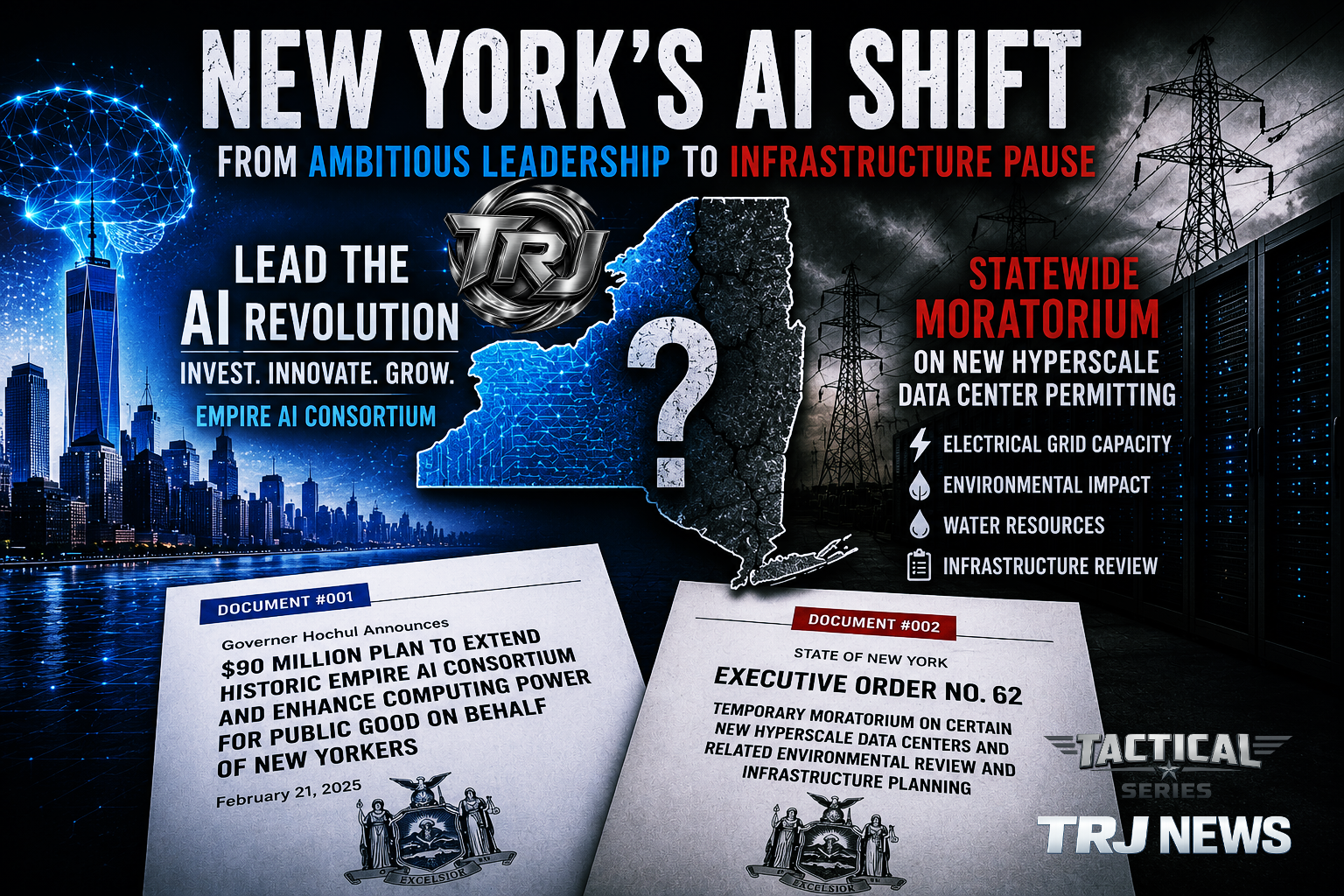
The first document outlines the state’s ambitious vision to establish New York as a national leader in artificial intelligence through the Empire AI Consortium. It details expanded computing capabilities, increased public and private investment, additional research partnerships, workforce development, economic growth, and a long-term commitment to positioning New York at the forefront of AI innovation.
The second document establishes a statewide moratorium on new hyperscale data center permitting while state agencies evaluate electrical grid capacity, environmental impacts, water resources, infrastructure requirements, and long-term regulatory planning before additional large-scale AI infrastructure projects move forward—if they move forward at all.
Together, these documents reveal a significant shift in New York’s approach to artificial intelligence infrastructure. Within months, the state’s public message evolved from aggressively expanding AI research, computing power, and investment to temporarily halting new hyperscale data center permitting while fundamental infrastructure questions are reassessed. That contrast raises an important question: if New York intended to lead the AI revolution, why were the infrastructure requirements needed to support that vision not fully addressed before reaching this point? The documentary record presented in this Black File establishes the timeline behind that policy shift.
Documents Included With This TRJ Black File
- Governor Hochul Announces $90 Million Plan to Extend Historic Empire AI Consortium and Enhance Computing Power for Public Good on Behalf of New Yorkers.
- Executive Order No. 62 – Temporary Moratorium on Certain New Hyperscale Data Centers and Related Environmental Review and Infrastructure Planning.
Greater Rochester Chamber of Commerce. Governor Hochul Announces $90 Million Plan to Extend Historic Empire AI Consortium and Enhance Computing Power for Public Good on Behalf of New Yorkers. February 21, 2025. (Free Download)
State of New York. Executive Order No. 62: Temporary Moratorium on Certain New Hyperscale Data Centers and Related Environmental Review and Infrastructure Planning. (Free Download)
TRJ BLACK FILE — DOCUMENT ANALYSIS
This Black File contains two official documents that reveal a significant shift in New York’s artificial intelligence strategy.
Document #001 — Empire AI Expansion Announcement
New York publicly committed itself to becoming a national leader in artificial intelligence through expanded computing power, public and private investment, research partnerships, workforce development, and long-term economic growth. The announcement repeatedly emphasizes New York’s goal of leading the AI revolution.
Document #002 — Executive Order No. 62
Only months later, New York announced a statewide moratorium on new hyperscale data center permitting while state agencies evaluate electrical grid capacity, environmental impacts, water resources, infrastructure requirements, and long-term regulatory planning before additional large-scale AI infrastructure projects move forward—if they move forward at all.
TRJ Analysis
The documents contained in this Black File establish the timeline. What they do not answer is one of the most important questions of all: If New York intended to lead the AI revolution, why wasn’t the infrastructure prepared before reaching this point?
The documentary record preserved in this Black File establishes the foundation for that question and the policy shift that made it necessary.


🔥 NOW AVAILABLE! 🔥
🔥 NOW AVAILABLE! 🔥
📖 INK & FIRE: BOOK 1 📖
A bold and unapologetic collection of poetry that ignites the soul. Ink & Fire dives deep into raw emotions, truth, and the human experience—unfiltered and untamed
🔥 Kindle Edition 👉 https://a.co/d/9EoGKzh
🔥 Paperback 👉 https://a.co/d/9EoGKzh
🔥 Hardcover Edition 👉 https://a.co/d/0ITmDIB
🔥 NOW AVAILABLE! 🔥
📖 INK & FIRE: BOOK 2 📖
A bold and unapologetic collection of poetry that ignites the soul. Ink & Fire dives deep into raw emotions, truth, and the human experience—unfiltered and untamed just like the first one.
🔥 Kindle Edition 👉 https://a.co/d/1xlx7J2
🔥 Paperback 👉 https://a.co/d/a7vFHN6
🔥 Hardcover Edition 👉 https://a.co/d/efhu1ON
Get your copy today and experience poetry like never before. #InkAndFire #PoetryUnleashed #FuelTheFire
🚨 NOW AVAILABLE! 🚨
📖 THE INEVITABLE: THE DAWN OF A NEW ERA 📖
A powerful, eye-opening read that challenges the status quo and explores the future unfolding before us. Dive into a journey of truth, change, and the forces shaping our world.
🔥 Kindle Edition 👉 https://a.co/d/0FzX6MH
🔥 Paperback 👉 https://a.co/d/2IsxLof
🔥 Hardcover Edition 👉 https://a.co/d/bz01raP
Get your copy today and be part of the new era. #TheInevitable #TruthUnveiled #NewEra
🚀 NOW AVAILABLE! 🚀
📖 THE FORGOTTEN OUTPOST 📖
The Cold War Moon Base They Swore Never Existed
What if the moon landing was just the cover story?
Dive into the boldest investigation The Realist Juggernaut has ever published—featuring declassified files, ghost missions, whistleblower testimony, and black-budget secrets buried in lunar dust.
🔥 Kindle Edition 👉 https://a.co/d/2Mu03Iu
🛸 Paperback Coming Soon
Discover the base they never wanted you to find. TheForgottenOutpost #RealistJuggernaut #MoonBaseTruth #ColdWarSecrets #Declassified


Sponsored • TRJ Ads
Inquiries: contact@therealistjuggernaut.com







According to this source, “The US accounts for approximately 54% of all hyperscale data center capacity worldwide.”
https://theworlddata.com/data-center-statistics-in-us/
I agree with your statement:
“If state leaders believed artificial intelligence and large-scale computing represented the future, strengthening the electrical grid should have been a priority long before this moratorium was announced.”
Why does it seem that we constantly seem to put the cart before the horse. We create systems that will be vulnerable to cyberattack in the future, costing possibly millions of dollars in losses, but we go ahead with the plan anyway.
I can’t really speak to what New York needs to do on this matter because it is probably far more complex than I can speak to at the moment. What is obvious is that so much of our infrastructure is getting old that it needs upgrading no matter what we do about data centers. Once touted American ingenuity can still be seen in many areas but what ever happened to common sense?
Thank you for this article.